

The DOI matches its Crossref record; 28 of the 28 references it cites were found in a registry or an index.
Changes in sleep pattern and sleep quality during COVID-19 lockdown
Open accessAbstract
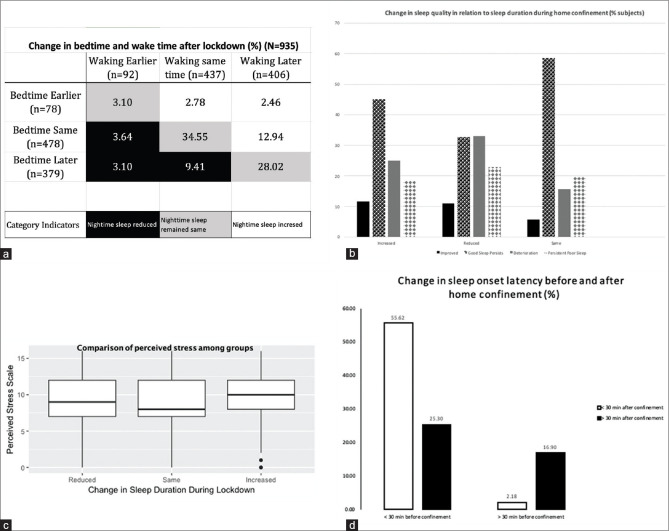
INTRODUCTION: To mitigate the spread of the pandemic coronavirus infection (COVID-19), governments across the world have adopted "lockdowns" which have confined many individuals to their homes. This disrupts normal life routines, elements of which are important circadian cues. The pandemic is also associated with new stressors, altered roles, and uncertainties about health and economic security, which are also likely to affect sleep. The current study is an online survey of sleep experience, routines, physical activity, and symptoms of anxiety and depression, to study the alterations associated with the lockdown. MATERIALS AND METHODS: The survey was conducted in early May 2020 using a questionnaire circulated through social media platforms. Questions related to demographic characteristics, current and previous sleep schedules, routine, and working patterns. Insomnia (Insomnia Severity Index - 4), Stress (Perceived Stress Scale - 4), anxiety and depressive symptoms (Patient Health Questionnaire - 4) and physical activity (International Physical Activities Questionnaire) were assessed using standardized instruments. RESULTS: A total of 958 valid responses were received. Compared to the prelockdown period, there was a shift to a later bedtime and waking time, with a reduction in night-time sleep and an increase in day-time napping. These effects were visible across occupational groups, but mostly affected working individuals except health professionals. Sleep quality deteriorated across groups. Reductions in sleep duration were associated with depressive symptoms. CONCLUSIONS: The COVID-19 lockdown is associated with changes in sleep schedule and in the quantity and quality of night-time sleep. Although these changes are associated with elevated rates of emotional symptoms, it is unclear from these cross-sectional results, whether sleep deterioration produces psychological distress, or vice versa.
Overview
The claims and statistics of this paper haven’t been checked yet.
Run the check — free, no account needed. It reads the open-access text and checks the sources it cites.
Integrity signals
Registry
Cites
Statistics
Figures
Verification
Claims the paper makes
The claims and statistics of this paper haven’t been checked yet.
Run the check — free, no account needed. It reads the open-access text and checks the sources it cites.
Claims other papers make about this one
Each is checked against this paper’s own text: does it say what the citing paper says it does?
The cited source says what the claim attributes to it.
In the citing paper
“Quarantine in the COVID-19 epidemic has caused many changes in the lifestyle of most people [63].”
From Effect of acceptance and commitment therapy on mood, sleep quality and quality of life in menopausal women: a randomized controlled trial (2022) · cites this paper as [66]
Self-check
Percentages, sums and reported differences re-computed from the paper’s own numbers.
The self-check needs the paper’s full text.
Citations
Cites
Morin, C. M., Belleville, G., Bélanger, L., & Ivers, H. (2011) · Sleep · doi:10.1093/sleep/34.5.601 · Cited by 4,620
An Ultra-Brief Screening Scale for Anxiety and Depression: The PHQ–4
Kroenke, K., Spitzer, R. L., Williams, J. B. W., & Löwe, B. (2009) · Psychosomatics · doi:10.1016/s0033-3182(09)70864-3 · Cited by 4,261
Lee, P. H., Macfarlane, D. J., Lam, T., & Stewart, S. M. (2011) · International Journal of Behavioral Nutrition and Physical Activity · doi:10.1186/1479-5868-8-115 · Cited by 3,370
The two‐process model of sleep regulation: a reappraisal
Borbély, A. A., Daan, S., Wirz‐Justice, A., & Deboer, T. (2016) · Journal of Sleep Research · doi:10.1111/jsr.12371 · Cited by 1,577
Self-Reported and Measured Sleep Duration: How Similar Are They?
Lauderdale, D. S., Knutson, K. L., Yan, L. L., Liu, K., & Rathouz, P. J. (2008) · Epidemiology · doi:10.1097/ede.0b013e318187a7b0 · Cited by 1,565
Altena, E., Baglioni, C., Espie, C. A., Ellis, J., Gavriloff, D., Holzinger, B., Schlarb, A., Frase, L., Jernelöv, S., & Riemann, D. (2020) · Journal of Sleep Research · doi:10.1111/jsr.13052 · Cited by 991 · cited 7×
“In addition, they experience a lack of novel stimuli, disruptions of routine activity, increased parenting responsibilities, especially for women, and altered productivity expectations for those engaged in professional duties from home.[3] In addition to the ever‐present fear of contracting COVID‐19 as it spreads acro…”
BackgroundResultInfluentialSnyder, E., Cai, B., DeMuro, C., Morrison, M. F., & Ball, W. (2018) · Journal of Clinical Sleep Medicine · doi:10.5664/jcsm.7478 · Cited by 473
The Prospective Association between Sleep Deprivation and Depression among Adolescents
ROBERTS, R. E., & Duong, H. T. (2014) · SLEEP · doi:10.5665/sleep.3388 · Cited by 459
Insomnia during the COVID-19 pandemic in a Greek population
Voitsidis, P., Gliatas, I., Bairachtari, V., Papadopoulou, K., Papageorgiou, G., Parlapani, E., Syngelakis, M., Holeva, V., & Diakogiannis, I. (2020) · Psychiatry Research · doi:10.1016/j.psychres.2020.113076 · Cited by 411
Goethals, L., Barth, N., Guyot, J., Hupin, D., Celarier, T., & Bongue, B. (2020) · JMIR Aging · doi:10.2196/19007 · Cited by 360
Research works printed but not linked: 1
- Lauderdale, 2008, Sleep duration: How well do self-reports reflect objective measures.The CARDIA sleep study?, Epidemiology, 838
Cited by
Sorted by citations
Items 101–200 of 354
The sequel to COVID-19: the antithesis to life
Bhandari, S., Shaktawat, A. S., Patel, B., Dube, A., Kakkar, S., Tak, A., Gupta, J., & Rankawat, G. (2020) · Journal of Ideas in Health · doi:10.47108/jidhealth.vol3.issspecial1.69 · Cited by 15
Healthcare workers' sleep quality after COVID‐19 infection: A cross‐sectional study
Bozan, Ö., Atış, Ş. E., Çekmen, B., Şentürk, M., & Kalkan, A. (2021) · International Journal of Clinical Practice · doi:10.1111/ijcp.14772 · Cited by 14
Zaman, A., Sloggett, K. J., Caldwell, A. E., Catenacci, V. A., Cornier, M., Grau, L., Vetter, C., Rynders, C. A., & Thomas, E. A. (2022) · Obesity · doi:10.1002/oby.23399 · Cited by 14
Risk of insomnia during COVID-19: effects of depression and brain functional connectivity
Tian, Y., Vitiello, M. V., Wang, H., Wang, Y., Dong, D., Xu, H.-Z., Yu, P., Qiu, J., He, Q., Chen, H., et al. (2023) · Cerebral Cortex · doi:10.1093/cercor/bhad016 · Cited by 13
Gessa, G. D., & Zaninotto, P. (2023) · Journal of Applied Gerontology · doi:10.1177/07334648231159373 · Cited by 13
Unveiling Coronasomnia: Pandemic Stress and Sleep Problems During the COVID-19 Outbreak
Chen, S., & Cheng, C. (2024) · Nature and Science of Sleep · doi:10.2147/nss.s459945 · Cited by 13
Shi, M., Stelick, A. N., Licker, S., & Dando, R. (2021) · Journal of Food Science · doi:10.1111/1750-3841.15905 · Cited by 13
The Impact of COVID-19 on Sleep Quality in People Living With Disabilities
Heinze, N., Hussain, S. F., Castle, C. L., Godier-McBard, L. R., Kempapidis, T., Ftouni, S., Espie, C. A., & Gomes, R. S. M. (2021) · Frontiers in Psychology · doi:10.3389/fpsyg.2021.786904 · Cited by 13
Çiftçi, B., & Demirhan, F. (2022) · International Journal of Occupational Safety and Ergonomics · doi:10.1080/10803548.2022.2090132 · Cited by 13
Kosendiak, A. A., Adamczak, B. B., Kontek, S., Kuźnik, Z., Roman, M., Gostkowski, M., & Niedziółka, A. (2023) · International Journal of Environmental Research and Public Health · doi:10.3390/ijerph20032406 · Cited by 15
Extracting Stress-Related EEG Patterns From Pre-Sleep EEG for Forecasting Slow-Wave Sleep Deficiency
Su, C.-H., Ko, L., Jung, T., Onton, J., Tzou, S.-C., Juang, J.-C., & Hsu, C. (2024) · IEEE Transactions on Neural Systems and Rehabilitation Engineering · doi:10.1109/tnsre.2024.3394471 · Cited by 15
He, L., Zhao, W., Gao, Y., Gao, X., & Lei, X. (2021) · International Journal of Psychophysiology · doi:10.1016/j.ijpsycho.2021.07.001 · Cited by 13
Pilz, L. K., Pereira, N. D. S. C., Francisco, A. P., Carissimi, A., Constantino, D. B., Caus, L. B., de Abreu, A. C. O. V., Amando, G. R., Bonatto, F., de Carvalho, P. V. V., et al. (2022) · Brazilian Journal of Psychiatry · doi:10.1590/1516-4446-2021-2109 · Cited by 12
El‐Monshed, A. H., Khonji, L. M., Altheeb, M. K., Saad, M. T. E., Elsheikh, M. A., Loutfy, A., Ali, A. S., El‐Gazar, H. E., Fayed, S. M., & Zoromba, M. A. (2024) · Worldviews on Evidence-Based Nursing · doi:10.1111/wvn.12707 · Cited by 13
Meitei, S. Y., Pao, P. S. V., Baite, K. D., & Konjengbam, H. (2021) · Sleep and Vigilance · doi:10.1007/s41782-021-00153-5 · Cited by 10
Impacts of COVID-19 Pandemic on Sleep Quality Evaluated by Wrist Actigraphy: A Systematic Review
Ferreira-Souza, L. F., Julianelli-Peçanha, M., Coelho-Oliveira, A. C., Bahia, C. M. C. D. S., Paineiras-Domingos, L. L., Reis-Silva, A., Moura-Fernandes, M. C., Trindade-Gusmão, L. C., Taïar, R., de Sá-Caputo, D. D. C., et al. (2023) · Journal of Clinical Medicine · doi:10.3390/jcm12031182 · Cited by 13
Cobb, R. J., Sheehan, C. M., Nguyen, A. W., & Johnson, D. A. (2022) · Sleep Health · doi:10.1016/j.sleh.2022.01.001 · Cited by 11
Castro, L., Serrão, C., Rodrigues, A. R., Marina, S., dos Santos, J. P. M., Amorim-Lopes, T. S., Miguel, C., Teixeira, A., & Duarte, I. (2023) · Frontiers in Psychology · doi:10.3389/fpsyg.2023.1271004 · Cited by 16
Kim, R. H., Paulino, Y. C., & Kawabata, Y. (2024) · International Journal of Environmental Research and Public Health · doi:10.3390/ijerph21040509 · Cited by 10
SARS-CoV-2 infection is associated with increased odds of insomnia, RLS and dream enactment behavior
Kumar, N., Goyal, A., Hussain, A., Saini, L. K., Chawla, O., Arora, P. K., Daga, R., Tikka, S. K., Goyal, S., Kanchan, S., et al. (2022) · Indian Journal of Psychiatry · doi:10.4103/indianjpsychiatry.indianjpsychiatry_586_21 · Cited by 10
Self-citationDule, A., Abdu, Z., Hajure, M., & Mohammedhussein, M. (2021) · American Journal of Health Research · doi:10.11648/j.ajhr.20210906.14 · Cited by 10
Bibliometric analysis of the top-50 cited articles on COVID-19 and physical activity
Zhang, F., Zhang, Y., Yu, Y., Lu, W., & Zhang, H. (2022) · Frontiers in Public Health · doi:10.3389/fpubh.2022.926244 · Cited by 15
Li, L., Liu, L., Niu, Z., Zhong, H., Mei, S., & Griffiths, M. D. (2023) · Frontiers in Psychiatry · doi:10.3389/fpsyt.2023.1108016 · Cited by 10
Vaishnav, M., Dalal, P., & Javed, A. (2020) · Indian Journal of Psychiatry · doi:10.4103/psychiatry.indianjpsychiatry_1030_20 · Cited by 10
Self-citationRadhakrishnan, A., Govindaraj, R., Sasidharan, A., Ravindra, P. N., Yadav, R., & Kutty, B. M. (2021) · Sleep Medicine · doi:10.1016/j.sleep.2020.12.041 · Cited by 10
COVID-somnia: Sleep disturbance among Indian nurses during COVID-19 pandemic
Kumar, M., Kumari, A., Rohilla, K. K., Dhawan, S., Singh, A., Sharma, N., Kriplani, N., Barari, N., & Soni, R. K. (2022) · Journal of Family Medicine and Primary Care · doi:10.4103/jfmpc.jfmpc_2113_21 · Cited by 10
Veljković, M., Pavlovič, D., Stojanović, N. M., Džopalić, T., & Dragonjić, L. P. (2022) · Medicina · doi:10.3390/medicina58111686 · Cited by 11
The impact of COVID-19 quarantine on lifestyle indicators in the United Arab Emirates
AlBlooshi, S., Al-Falasi, M., Taha, Z., Ktaibi, F. E., & Khalid, A. (2023) · Frontiers in Public Health · doi:10.3389/fpubh.2023.1123894 · Cited by 9
Abdu, Y., Naja, S., Ibrahim, M. I. M., Abdou, M., Ahmed, R., Elhag, S., Saleh, A., Yassin, M. A., & Bougmiza, I. M. (2023) · Diabetes Metabolic Syndrome and Obesity · doi:10.2147/dmso.s421878 · Cited by 9
Lan, A., Kotler, D., Kronfeld‐Schor, N., Stukalin, Y., & Einat, H. (2022) · Sleep and Biological Rhythms · doi:10.1007/s41105-021-00371-4 · Cited by 9
Riva, E., Terraneo, M., Lucchini, M., & Gerosa, T. (2022) · BMC Public Health · doi:10.1186/s12889-022-14048-1 · Cited by 10
Ye, Y., Wang, H., Ye, L., & Gao, H. (2024) · International Journal of Mental Health Promotion · doi:10.32604/ijmhp.2024.049606 · Cited by 10
Sleep duration during the COVID-19 pandemic in Bangladesh: A GIS-based large sample survey study
Al‐Mamun, F., Hussain, N., Sakib, N., Hosen, I., Rayhan, I., Abdullah, A. H., Bhuiyan, A. K. M. I., Sarker, M. A., Hossain, S., Zou, L., et al. (2023) · Scientific Reports · doi:10.1038/s41598-023-30023-1 · Cited by 8
Saoji, A. A., Swathi, P. S., Bhat, R., Bansal, B., Mohanty, S., & Lakshmi, R. K. R. R. (2023) · Journal of Integrative and Complementary Medicine · doi:10.1089/jicm.2023.0175 · Cited by 8
Sardella, A., Varallo, G., Agus, M., Lenzo, V., Zagaria, A., Terrone, G., Musetti, A., Castelnuovo, G., Quattropani, M. C. A., & Franceschini, C. (2023) · PubMed Central · doi:10.36131/cnfioritieditore20230501 · Cited by 8
Patel, V. K., Pandey, S., Jani, A. M., Tiwari, D. S., Patel, F., & Thakrar, R. (2021) · Journal of Mental Health and Human Behaviour · doi:10.4103/jmhhb.jmhhb_179_20 · Cited by 7
Cerasuolo, M., Malloggi, S., Conte, F., Albinni, B., Rosa, O. D., Rescott, M. L., Giganti, F., & Ficca, G. (2021) · Brain Science · doi:10.3390/brainsci11081051 · Cited by 7
Sleep and diet patterns of college students during the COVID-19 pandemic lockdowns
Rotvold, A., Parker, K. R. B., Honrath, K., & Rhee, Y. S. (2022) · Journal of American College Health · doi:10.1080/07448481.2022.2089850 · Cited by 8
Reversing the Deconditioning Effects of the Pandemic in the Elderly via Telerehabilitation
Bağkur, M., Yerlikaya, T., İnanç, G., & Öniz, A. (2021) · Neurological Sciences and Neurophysiology · doi:10.4103/nsn.nsn_107_21 · Cited by 8
Prevalence of Insomnia and Sleep Habits during the First and Second Wave of COVID-19 in Belgium
Roland, A., Colomb, C., Noël, S., Putilov, A. A., Ogińska, H., Delwiche, B., Benkirane, O., Windal, M., Vanlaer, N., Briganti, G., et al. (2023) · Psychologica Belgica · doi:10.5334/pb.1160 · Cited by 9
Wan, J., Liu, L., Chen, Y., Zhang, T., & Huang, J. G. (2023) · Frontiers in Psychiatry · doi:10.3389/fpsyt.2023.1239437 · Cited by 8
Dell’Osso, B. M., Viganò, C. A., Conti, D., Scarpa, C., Casati, L., Albert, U., Carmassi, C., Carrà, G., Cirulli, F., Nanni, M. G., et al. (2022) · Comprehensive Psychiatry · doi:10.1016/j.comppsych.2022.152345 · Cited by 8
The impact of COVID-19 on the everyday life of blind and sighted individuals
Gori, M., Bertonati, G., Mazzoni, E., Elisa, F., & Amadeo, M. B. (2022) · Frontiers in Psychology · doi:10.3389/fpsyg.2022.897098 · Cited by 7
Gupta, C. C., Duncan, M. J., Ferguson, S. A., Rebar, A. L., Vandelanotte, C., Sprajcer, M. A., Khalesi, S., Booker, L. A., Rampling, C. M., Rigney, G., et al. (2023) · Journal of Activity Sedentary and Sleep Behaviors · doi:10.1186/s44167-023-00035-3 · Cited by 7
İDE, D., & GÜNDÜZ, T. (2021) · Ergonomi · doi:10.33439/ergonomi.935728 · Cited by 7
John, B., Marath, U., Valappil, S. P., Mathew, D., & Renjitha, M. (2022) · Sleep and Vigilance · doi:10.1007/s41782-022-00210-7 · Cited by 7
Sugito, S., Allsabah, M. A. H., & Kurniawan, B. T. (2022) · JOURNAL SPORT AREA · doi:10.25299/sportarea.2022.vol7(1).8188 · Cited by 7
Mitchell, J. J., Bu, F., Fancourt, D. E., Steptoe, A., & Bone, J. K. (2022) · Scientific Reports · doi:10.1038/s41598-022-20196-6 · Cited by 8
Lin, S., Lan, Y.-T., Hsia, P.-H., Kao, C.-L. M., Tsou, H., & Lin, Y. (2023) · Journal of Affective Disorders · doi:10.1016/j.jad.2022.12.139 · Cited by 7
Kite, C., Atkinson, L., McGregor, G., Clark, C. C. T., Randeva, H. S., & Kyrou, I. (2023) · International Journal of Environmental Research and Public Health · doi:10.3390/ijerph20032309 · Cited by 9
Adolescents Mental Health During Covid-19 Pandemic
Sitohang, E. D. (2023) · JOURNAL OF BAJA HEALTH SCIENCE · doi:10.47080/joubahs.v3i01.2481 · Cited by 7
Ayalew, M., Deribe, B., Hussen, S., Defar, S., Shimber, E. T., & Gedefaw, A. (2023) · Frontiers in Psychiatry · doi:10.3389/fpsyt.2023.1142926 · Cited by 7
Chaves, E. A., Reddy, S. D., Cadieux, A. M., Tomasula, J., & Reynolds, K. (2022) · International Journal of Environmental Research and Public Health · doi:10.3390/ijerph19095597 · Cited by 11
Platto, S., Serres, A., Normando, S., Wang, Y., & Turner, D. C. (2022) · Animals · doi:10.3390/ani12192596 · Cited by 7
Garcia, M. C., Paravidino, V. B., Lopes, C. D. S., Mediano, M. F. F., Gonçalves, T. R., de Oliveira, A. J., & Sichieri, R. (2024) · American Journal of Human Biology · doi:10.1002/ajhb.24035 · Cited by 10
Impact of the COVID-19 pandemic on daily life and worry among mothers in Bhaktapur, Nepal
Ranjitkar, S., Strand, T. A., Ulak, M., Kvestad, I., Shrestha, M., Schwinger, C., Chandyo, R. K., Shrestha, L., & Hysing, M. (2022) · PLOS Global Public Health · doi:10.1371/journal.pgph.0000278 · Cited by 6
Changes in lifestyle during the COVID-19 lockdown in Brazil: Impact on sleep quality
Minetto, G. V., da Cunha, D. T., & Esteves, A. M. (2022) · Sleep Epidemiology · doi:10.1016/j.sleepe.2022.100033 · Cited by 6
Sleep Disorders in Patients with Parkinson's Disease during COVID-19 Pandemic
Desai, I., Gupta, R. M., Kumar, M., Tiwari, A., & Kumar, N. (2022) · Annals of Indian Academy of Neurology · doi:10.4103/aian.aian_255_22 · Cited by 6
Self-citationShayea, A. M. F., Alotaibi, N. M., Nadar, M. S., Alshemali, K., & Alhadlaq, H. W. (2022) · Vaccines · doi:10.3390/vaccines10122171 · Cited by 6
Kim, S. J. (2023) · Primary care diabetes · doi:10.1016/j.pcd.2023.05.006 · Cited by 6
The Effects of COVID-19 Process on Time Management of Foreign Language Teacher Candidates
Cengizhan, S. (2021) · Educational policy analysis and strategic research · doi:10.29329/epasr.2020.345.13 · Cited by 6
Covid-19 and changes in sleep health in the Blackfeet Community
John‐Henderson, N. A., Oosterhoff, B. J., Hall, B., Johnson, L. R., Lafromboise, M. E., Malatare, M., Salois, E. M., & Carter, J. R. (2021) · Sleep Medicine · doi:10.1016/j.sleep.2021.06.041 · Cited by 6
Vaidya, R., Kaza, S., Gupta, P., Weine, S. M., Nooyi, S. C., & Chaudhury, N. (2021) · Journal of Mental Health and Human Behaviour · doi:10.4103/jmhhb.jmhhb_65_21 · Cited by 6
Zheng, D., Qin, Q., Peng, Y., Zhong, H., Huang, Y., Wang, H., Tan, Q., & Li, Y. (2024) · Frontiers in Public Health · doi:10.3389/fpubh.2024.1406396 · Cited by 7
Al‐Ajlouni, Y. A., Park, S. H., Alawa, J., Dodin, B. E., Shamaileh, G., Makarem, N., Keyes, K. M., & Duncan, D. T. (2022) · International Journal of Environmental Research and Public Health · doi:10.3390/ijerph19020776 · Cited by 8
Koppehele‐Gossel, J., Weinmann, L., Klimke, A., Windmann, S., & Voss, U. (2022) · International Journal of Clinical and Health Psychology · doi:10.1016/j.ijchp.2022.100364 · Cited by 5
Hassinger, A., Monegro, A., & Perez, G. (2023) · BMC Pediatrics · doi:10.1186/s12887-023-03875-9 · Cited by 5
Wiciak, M. T., Shazley, O., & Santhosh, D. (2023) · American Journal of Lifestyle Medicine · doi:10.1177/15598276231182621 · Cited by 6
Calidad de sueño en Uruguay al inicio de la pandemia
Minetti, P. T., Benedetto, L., Copiz, N., & Peyrou, S. (2023) · Anales de la Facultad de Medicina · doi:10.25184/anfamed2023v10n2a1 · Cited by 5
Wu, T.-L., Chu, T. F., & Liu, H.-T. (2024) · Buildings · doi:10.3390/buildings14010265 · Cited by 5
Çınar, N. (2022) · SiSli Etfal Hastanesi Tip Bulteni / The Medical Bulletin of Sisli Hospital · doi:10.14744/semb.2022.40326 · Cited by 5
Uncertainty stress and self-rated health during the early stage of the COVID-19 outbreak
Zhu, Z., Wu, D., Wei, K., Liu, Y., Xu, Z., Jiao, G., Yu, L., Taylor, A., & Zou, L. (2023) · Health Psychology and Behavioral Medicine · doi:10.1080/21642850.2023.2173202 · Cited by 6
Klanidhi, K. B., Ranjan, P., Kaur, T., Khan, M., Ghosh, T., Upadhyay, A. D., Chopra, S., Sarkar, S., Kaloiya, G. S., Barre, V. P., et al. (2021) · Diabetes & Metabolic Syndrome Clinical Research & Reviews · doi:10.1016/j.dsx.2021.05.017 · Cited by 5
Self-citationDil, S., Yıldırım, T., & Öztürk, P. Ç. (2023) · Scientific Reports · doi:10.1038/s41598-023-42825-4 · Cited by 6
Prabhat, A., Kumar, A., & Bhardwaj, S. K. (2022) · Sleep and Vigilance · doi:10.1007/s41782-022-00200-9 · Cited by 5
Cheng, C., Chen, S., & Chen, S. (2024) · Cyberpsychology Behavior and Social Networking · doi:10.1089/cyber.2023.0571 · Cited by 4
Thiab, S. H., Barakat, M. M., Alqudah, R., Basheti, I. A., & Daoud, S. (2022) · Pharmacy Practice · doi:10.18549/pharmpract.2022.2.2670 · Cited by 4
Harbi, M. K. A., Alsabani, M. H., Olayan, L. H., Rifai, D. A., Alobaid, S. A., Althanyyan, A. F., Alsahli, N. M., Alsubaie, W. S., Alotaibi, W. S. M., & Alosaimi, S. D. (2023) · Journal of Multidisciplinary Healthcare · doi:10.2147/jmdh.s399546 · Cited by 4
CLINICAL FEATURES OF ANXIETY DISORDER IN POST-COVID-19 SYNDROME AND FINDING OF ITS PREDICTORS
Boiko, D. I. (2021) · Ukrainian Scientific Medical Youth Journal · doi:10.32345/usmyj.4(127).2021.22-29 · Cited by 4
Azmi, R. N., Hanifa, D. N. C., Fernando, N. S. A., & Putri, M. R. (2021) · Jurnal Ilmu Kesehatan · doi:10.30650/jik.v9i1.1649 · Cited by 4
Law, C., Sokolovsky, A. W., Yap, D. L., Erblich, J., Gunthert, K. C., & Behar, E. (2024) · Behavior Therapy · doi:10.1016/j.beth.2024.09.005 · Cited by 3
Pluim, C. F., Martinez, J. E., Giudicessi, A., Munera, D., Vila‐Castelar, C., Guzmán‐Vélez, E., Ramirez-Gomez, L. A., Duffy, J. F., Cronin‐Golomb, A., & Quiroz, Y. T. (2025) · Healthcare · doi:10.3390/healthcare13060675 · Cited by 3
Dule, A., Abdu, Z., Hajure, M., Mohammedhussein, M., & Tariku, M. (2021) · Science Journal of Public Health · doi:10.11648/j.sjph.20210906.14 · Cited by 3
Habbash, F., Salah, A. B., Almarabheh, A. J., & Jahrami, H. (2022) · Nature and Science of Sleep · doi:10.2147/nss.s380141 · Cited by 3
Colreavy, E., Keenan, L., & Downes, M. (2023) · Journal of Clinical Sleep Medicine · doi:10.5664/jcsm.10628 · Cited by 3
Billings, J. M., Kwesell, A., Cosby, S., & Lin, S. (2024) · Frontiers in Psychology · doi:10.3389/fpsyg.2024.1462297 · Cited by 3
Fritz, R., & Cook, D. J. (2025) · JMIR Nursing · doi:10.2196/69052 · Cited by 3
Chen, S., Rice, S., Storey, K., Keglovits, M., Devine, M., Yan, Y., & Stark, S. L. (2022) · OTJR Occupational Therapy Journal of Research · doi:10.1177/15394492221107557 · Cited by 3
Wu, C., Yan, J., He, C., Wu, J., Zhang, Y.-J., Du, J., Lin, Y., Zhang, Y., Heng, C., & Lang, H. (2022) · Frontiers in Public Health · doi:10.3389/fpubh.2022.993831 · Cited by 3
Kalp Yetersizliği Olan Bireylerde Uyku Kalitesi, Koronavirüs Anksiyetesi ve Stres Arasındaki İlişki
İlaslan, E. (2023) · Journal of Cardiovascular Nursing · doi:10.5543/khd.2023.00377 · Cited by 3
Wiciak, M. T., Shazley, O., & Santhosh, D. (2024) · Journal of Primary Care & Community Health · doi:10.1177/21501319241228117 · Cited by 7
Rana, M., Gupta, P. C., Grover, S., Furr, A., & Bhargava, N. (2023) · Indian Journal of Public Health · doi:10.4103/ijph.ijph_1761_22 · Cited by 3
Self-citationPark, H. R., Lee, S., Moon, H., Kim, J. H., Cho, J. W., Cho, Y. W., Yun, C., Han, S., & Chu, M. K. (2024) · PLoS ONE · doi:10.1371/journal.pone.0311600 · Cited by 3
Mondal, A., Saha, I., Banerjee, N., Saha, P. K., Ghosh, S., & Saha, D. (2021) · Asian Journal of Medical Sciences · doi:10.3126/ajms.v12i10.38024 · Cited by 3
Psychological aspect of common people during lockdown
Chaklader, B., Srivastava, K., Rathod, H. K., & Ak, B. (2021) · Industrial Psychiatry Journal · doi:10.4103/0972-6748.328789 · Cited by 3
Parikh, N. C., Balchandani, A. D., Nakum, D. H., Patel, B. S., Bhowmick, S. S., Shah, N. D., & Darji, V. K. (2021) · Indian Journal of Psychiatry · doi:10.4103/psychiatry.indianjpsychiatry_930_20 · Cited by 3
Tseng, T., Li, M., Kao, Y.-H., Chen, L., & Lin, H. (2021) · Frontiers in Public Health · doi:10.3389/fpubh.2021.745925 · Cited by 3
Fakılı, F., & Bayram, N. G. (2022) · Journal of Turkish Sleep Medicine · doi:10.4274/jtsm.galenos.2021.76476 · Cited by 3
Intra-individual impact of the COVID-19 pandemic on mental health and sleep in young adults
Knickerbocker, K. J., Cox, E. A., Dhawka, L., Woods, K., & Ingram, K. K. (2022) · PLoS ONE · doi:10.1371/journal.pone.0276165 · Cited by 5
Sleep Disturbance and SARS–CoV‐2 Vaccinations in Patients With Chronic Inflammatory Disease
Pawar, N., Taylor, K. E., Yang, M. M., Deepak, P., Kim, W., Paley, M., Matloubian, M., Carvidi, A. B., Ciorba, M. A., Demissie, E., et al. (2022) · Arthritis Care & Research · doi:10.1002/acr.25065 · Cited by 3
Metadata
- Authors
- Krishnan, V., Gupta, R., Grover, S., Basu, A., Tripathi, A., Subramanyam, A., Nischal, A., Hussain, A., Mehra, A., Ambekar, A., Saha, G., Mishra, K., Bathla, M., Jagiwala, M., Manjunatha, N., Nebhinani, N., Gaur, N., Kumar, N., Dalal, P., Kumar, P., Midha, P., Daga, R., Tikka, S., Praharaj, S., Goyal, S., Kanchan, S., Sarkar, S., Das, S., Sarkhel, S., Padhy, S., Sahoo, S., Satyanarayana Rao, T., Dubey, V., Menon, V., Chhabra, V., Lahan, V., & Avasthi, A.
- Affiliations
- All India Institute of Medical Sciences Rishikesh (IN)
- King George's Medical University (IN)
- Government Medical College (IN)
- All India Institute of Medical Sciences Bhopal (IN)
- All India Institute of Medical Sciences Jodhpur (IN)
- National Neurosciences Centre (IN)
- Satguru Partap Singh Hospital (IN)
- Fortis Hospital (IN)
- Corresponding author
- Krishnan, Vijay
- ORCID
- Venue
- Indian Journal of Psychiatry
- Published
- 2020
- Volume
- 62
- Issue
- 4
- Pages
- 370
- ISSN
- 0019-5545 (ISSN-L)
- PMC
- PMC7597722
- OpenAlex
- W3045700366
- Cited by
- 357
- References
- 28
- Citations by year
- 2026: 16 · 2025: 17 · 2024: 40 · 2023: 83 · 2022: 97 · 2021: 90 · 2020: 14
- FWCI
- 68.44
- Type
- journal article
- Language
- en
- Open access
- diamond
- doi.org
- Licence
- cc-by-nc-sa
- Locations
- Indian Journal of Psychiatry (publishedVersion, cc-by-nc-sa)
- PubMed Central (publishedVersion, cc-by-nc-sa)
- PubMed (publishedVersion)
- DOAJ (DOAJ: Directory of Open Access Journals) (submittedVersion)
- Topics
- Social Sciences › Psychology › Experimental and Cognitive Psychology › Sleep and related disorders
- Social Sciences › Psychology › Clinical Psychology › COVID-19 and Mental Health
- Social Sciences › Psychology › Experimental and Cognitive Psychology › Sleep and Work-Related Fatigue
- Keywords
- COVID-19 lockdown, sleep patterns, sleep quality, insomnia, daytime napping, sleep duration, anxiety symptoms, depressive symptoms, perceived stress, physical activity, occupational groups, healthcare workers
About these checks
Registry, retraction, Cites and statistics results are computed, not judged, with one exception: a printed reference that no index lists is read once by a model before it counts as a citation error. Claims are extracted by a model and kept only when their quote appears verbatim in the text; each cited source is then checked, with a model’s help, for whether it says what the claim relies on. Those verdicts can be wrong — read the claim’s quote and the cited source before relying on one.
Statistics and arithmetic are recomputed, not judged.
Confidence bands are shown only for fields calibrated on our annotated test set. None is calibrated yet, so no band is shown.
What counts as a claim ›How we measure confidence ›How we check this ›
Are you an author, or do you see a problem with this page? Request a review
