

The DOI matches its Crossref record; 31 of the 31 references it cites were found in a registry or an index.
Clinical practice guidelines for autism spectrum disorders
Open accessAbstract
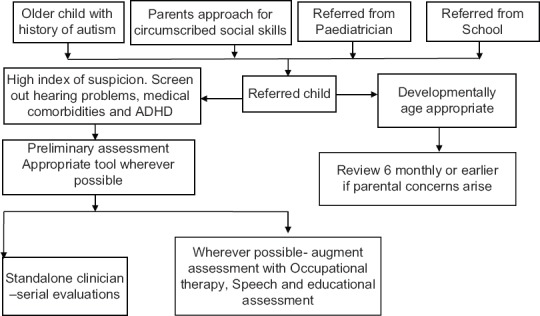
INTRODUCTION These guidelines have been framed after an amalgamation of expert guidelines across the globe, and existing practices in India, as outlined by experts in the field. Due to the lack of systematic research in the field of autism in India, the evidence of the said practices is not documented, which becomes a limitation of these guidelines. The good part is that India has an indigenous tool for assessment, which has been recommended by the Government of India, which we have attached as an Appendix 1. Autism has till date always been viewed as an illness from the medical model, and hunt for a “cure” has been the norm. With the increase in awareness and available therapies, the focus shifted to disability and inclusion. However, as more autistic individuals express themselves and their needs, the focus now has shifted from the medical model to the social model of neurodiversity, thereby implying that autism is actually a variant of normal human development and human diversity. The next decade will probably see how best the two paradigms can be aligned to destigmatize and integrate autistic individuals into society at large. Keeping the above in mind, the 5th edition of the Diagnostic and Statistical Manual of Mental Disorders (DSM 5) shifted from grouping the disorders as separate diagnoses under the umbrella of pervasive developmental disorders (PDDs) to conceptualizing them as all members of the broader category of known as autism spectrum disorder (ASD). The number of core domain deficits was reduced to two (social communication and repetitive behavior). ASD would now be diagnosed when a patient demonstrated at least three symptoms in the domain of social communication and at least two symptoms of restricted interests/repetitive behaviors; including an added behavior of hyper-or hypo-reactivity to sensory input or unusual interests in sensory aspects of the environment [Table 1].Table 1: Diagnostic and statistical manual of mental disorders -IV-TR versus diagnostic and statistical manual of mental disorders - 5MAJOR CHANGES TO THE DIAGNOSTIC AND STATISTICAL MANUAL OF MENTAL DISORDERS-5, AUTISM DIAGNOSTIC CRITERIA Category name changed from PDDs to ASDs The inclusion of sensory differences in criteria Recommendation to identify “specifiers” to better understand the individual needs of each child with ASD (cognitive and language ability, level of supports needed, co-occurring medical and mental health conditions, catatonia) The inclusion of co-occurring mental health disorders (e.g., attention-deficit/hyperactivity disorder). The International Classification of Diseases-10th version (ICD-10), still used the term PDD. What is interesting is that the proposed changes in ICD-11 have not only changed the nosology to ASD but have also included intellectual development and functional language, which is closer to the clinical picture, and also is in keeping with the concept of neurodiversity. At a glance, when we compare these classificatory systems, below are the changes we can see [Table 2].Table 2: Change in the classification of autismThus with the above inclusions, the numbers are bound to increase. The latest statistics state that the prevalence of ASD, is now estimated at 1 in 68, more in males, (Centre for Disease Control National Center on Birth Defects and Developmental Disabilities, USA, 2014), which is alarming rise from 1:500 less than a decade ago. The possible reason for this is increase in the number of copy number variation and gene variations. Multiple genes seem to be involved. These genes are responsible for synaptic plasticity, synaptic scaffolding proteins, receptors, cell adhesion molecules or proteins that are involved in chromatin remodeling, transcription, protein synthesis or degradation, or actin cytoskeleton dynamics. For example, Genes for neuroligins, SHANKs, CNTNAP2, FMR1 to name a few. On analysis of neuronal growth and pathways cortico-striato-thalamo-cortical circuits (for repetitive behaviors), ventral tegmental area connectivity to nucleus accumbens (for social interaction), and amydala to ventral hippocampal connectivity (for social interactions) are areas of active interest and study. The validity of the same, and the translation into structural diagnostic neuro-imaging is yet to be established, and hence limits the use of the same. Similarly, functional neuropathology reveals excessive synapses due to a slow pruning process. However, diagnostic modalities to ascertain the same are yet awaited. PROCESS OF ASSESSMENT Autism being a complex disorder, the assessment should as far as possible be done by multidisciplinary team who besides the psychiatrist should include a psychologist, a special educator, an occupational therapist, and an audiologist and speech therapist [Figure 1]. In the western world, educational psychologists in school settings double up for the assessment of cognition and curricular level too. Furthermore, it is good to keep the child's pediatrician i
Overview
The claims and statistics of this paper haven’t been checked yet.
Run the check — free, no account needed. It reads the open-access text and checks the sources it cites.
Integrity signals
Registry
Cites
Statistics
Figures
Verification
Claims the paper makes
The claims and statistics of this paper haven’t been checked yet.
Run the check — free, no account needed. It reads the open-access text and checks the sources it cites.
Claims other papers make about this one
Each is checked against this paper’s own text: does it say what the citing paper says it does?
The source backs part of the claim, not all of it — or backs it for a different population, condition or comparison.
In the citing paper
“Similar treatment guidelines published to date are either now outdated or offer guidance on one co-occurring condition but may not serve as a reference across multiple symptom domains, present which drugs may be used in ASD without walking through the nuanced decision-making process of choosing and prescribing a drug to match the unique needs of individual patients, or do not specifically discuss”
From Pharmacological treatment in autism: a proposal for guidelines on common co-occurring psychiatric symptoms (2025) · cites this paper as [34]
Experimental — accuracy not yet measured
Self-check
Percentages, sums and reported differences re-computed from the paper’s own numbers.
The self-check needs the paper’s full text.
Citations
Cites
Diagnostic and Statistical Manual of Mental Disorders
American Psychiatric Association (2013) · doi:10.1176/appi.books.9780890425596 · Cited by 116,369
Lai, M.-C., Lombardo, M. V., & Baron-Cohen, S. (2014) · The Lancet · doi:10.1016/s0140-6736(13)61539-1 · Cited by 2,371
Recurrence Risk for Autism Spectrum Disorders: A Baby Siblings Research Consortium Study
Ozonoff, S., Young, G. S., Carter, A., Messinger, D., Yirmiya, N., Zwaigenbaum, L., Bryson, S., Carver, L. J., Constantino, J. N., Dobkins, K., et al. (2011) · Pediatrics · doi:10.1542/peds.2010-2825 · Cited by 1,429
Volkmar, F. R., Siegel, M. S., Woodbury‐Smith, M., King, B. H., McCracken, J. T., & State, M. W. (2014) · Journal of the American Academy of Child & Adolescent Psychiatry · doi:10.1016/j.jaac.2013.10.013 · Cited by 938
Autism Spectrum Disorder: Classification, diagnosis and therapy
Sharma, S., Gonda, X., & Tarazi, F. I. (2018) · Pharmacology & Therapeutics · doi:10.1016/j.pharmthera.2018.05.007 · Cited by 745
The Maudsley Prescribing Guidelines
Taylor, D., Paton, C., & Kerwin, R. (2007) · doi:10.1201/b21605 · Cited by 366
Fung, L. K., Mahajan, R., Nozzolillo, A., Bernal, P., Krasner, A., Jo, B., Coury, D., Whitaker, A., Veenstra-Vanderweele, J., & Hardan, A. Y. (2016) · Pediatrics · doi:10.1542/peds.2015-2851k · Cited by 294
The onset of autism: patterns of symptom emergence in the first years of life
Ozonoff, S., Heung, K., Byrd, R., Hansen, R., & Hertz‐Picciotto, I. (2008) · Autism Research · doi:10.1002/aur.53 · Cited by 293
The Maudsley Prescribing Guidelines in Psychiatry (Full-Text Access)
(2025) · Wiley eBooks · doi:10.1002/9781119870203.mpg016 · Cited by 291
Autism Spectrum Disorder in Anorexia Nervosa: An Updated Literature Review
Westwood, H., & Tchanturia, K. (2017) · Current Psychiatry Reports · doi:10.1007/s11920-017-0791-9 · Cited by 277
Research works printed but not linked: 3
- Lai, 2014, Autism, Lancet, 896
- Stigler, 2014, Psychopharmacologic management of serious behavioral disturbance in ASD, Child Adolesc Psychiatr Clin N Am, 73
- Volkmar, 2014, Practice parameter for the assessment and treatment of children and adolescents with autism spectrum disorder, J Am Acad Child Adolesc Psychiatry, 237
Cited by
Sorted by citations
Fieiras, C., Chen, M. H., Liquitay, C. M. E., Meza, N., Rojas, V., Franco, J. V. A., & Eva Madrid, A. (2022) · BMJ Evidence-Based Medicine · doi:10.1136/bmjebm-2021-111804 · Cited by 64
Autism Spectrum Disorders: Etiology, Epidemiology, and Challenges for Public Health
Ostrowski, J., Religioni, U., Gellert, B. M., Sytnik-Czetwertyński, J., & Pinkas, J. (2024) · Medical Science Monitor · doi:10.12659/msm.944161 · Cited by 52
Manter, M. A., Birtwell, K. B., Bath, J., Friedman, N. D. B., Keary, C. J., Neumeyer, A. M., Palumbo, M. L., Thom, R. P., Stonestreet, E., Brooks, H., et al. (2025) · BMC Medicine · doi:10.1186/s12916-024-03814-0 · Cited by 51
“…symptom domains, present which drugs may be used in ASD without walking through the nuanced decision-making process of choosing and prescribing a drug to match the unique needs of individual patients, or do not specifically discuss the ASD landscape and health-care system in the U.S. [31–34].”
Shoaib, A., Cepeda, M. S., Murray, G., & Ochs-Ross, R. (2021) · Journal of Autism and Developmental Disorders · doi:10.1007/s10803-021-05289-x · Cited by 39
Gerdes, M. E., Aistis, L. A., Sachs, N. A., Williams, M., Roberts, J. D., & Goldstein, R. E. R. (2022) · International Journal of Environmental Research and Public Health · doi:10.3390/ijerph19095121 · Cited by 37
Saudi Expert Consensus-Based Autism Spectrum Disorder Statement: From Screening to Management
Alenezi, S., Alyahya, A., Alkhalifah, S. M., Bakhsh, H. R., Alismail, E., Aldhalaan, H., Alwazna, T., Alzrayer, N. M., AlSuwailem, S. S., Alnemary, F., et al. (2022) · Children · doi:10.3390/children9091269 · Cited by 34
Moreira, M. D. S., & Aragão, G. F. (2022) · Amplla Editora eBooks · doi:10.51859/amplla.tea2232-1 · Cited by 31
Konrad, K., Gerloff, C., Kohl, S. H., Mehler, D. M. A., Mehlem, L., Volbert, E. L., Komorek, M., Henn, A. T., Boecker, M., Weiß, E. O., et al. (2024) · Frontiers in Neuroscience · doi:10.3389/fnins.2024.1286130 · Cited by 33
Awaji, N. N. A., Al-Taleb, S., Albagawi, T., Alshammari, M., Sharar, F., & Mortada, E. M. (2024) · Journal of Multidisciplinary Healthcare · doi:10.2147/jmdh.s447151 · Cited by 24
Manoj, G., Gupta, V., Bhattacharya, A., Aleem, S. G. A., Vedantham, D., Prince, A. A., & Ronickom, J. F. A. (2024) · Multimedia Tools and Applications · doi:10.1007/s11042-024-18817-5 · Cited by 16
Towards a neurodiversity-affirmative conceptualisation of psycho-education in the context of autism
Plas, L. V. D., Vanaken, G., Steyaert, J. G., Hens, K., & Noens, I. L. J. (2024) · Research in Autism · doi:10.1016/j.rasd.2024.102391 · Cited by 16
Biswas, M., Vanwong, N., & Sukasem, C. (2024) · Frontiers in Pharmacology · doi:10.3389/fphar.2023.1285967 · Cited by 13
Levante, A., Martis, C., & Lecciso, F. (2025) · European Journal of Investigation in Health Psychology and Education · doi:10.3390/ejihpe15070142 · Cited by 16
Gupta, N., & Gupta, M. (2023) · CNS Spectrums · doi:10.1017/s1092852923002389 · Cited by 15
Emerging Treatments and Therapies for Autism Spectrum Disorder: A Narrative Review
Kaye, A. D., Allen, K. E., Smith, V. S., Tong, V. T., Mire, V. E., Huy, N. V., Lee, Z., Kouri, M., Baptiste, C. J., Mosieri, C. N., et al. (2024) · Cureus · doi:10.7759/cureus.63671 · Cited by 13
Nursing care of patients with autism spectrum disorder
Owen, A. M., Gary, A., & Schnetter, V. A. (2020) · Nursing Made Incredibly Easy! · doi:10.1097/01.nme.0000653180.86134.05 · Cited by 9
Mukherjee, S. B. (2020) · Indian Pediatrics · doi:10.1007/s13312-020-2003-7 · Cited by 9
Noori, F., Tiwari, S., Padickaparambil, S., & Pothiyil, D. I. (2022) · Indian Journal of Psychological Medicine · doi:10.1177/02537176221096769 · Cited by 9
An investigation of adherence to best practice guidelines for autism diagnosis in New Zealand
Taylor, L. J., Eggleston, M. J. F., Thabrew, H., van der Meer, L. A. J., Waddington, H. L., Whitehouse, A., & Evans, K. L. (2021) · Autism · doi:10.1177/13623613211015757 · Cited by 9
Bishop, C. S., Beale, J. T., & Bruce‐Low, S. (2023) · Physical Activity and Health · doi:10.5334/paah.243 · Cited by 8
Systematic review of the effectiveness of homoeopathy in the treatment of autism spectrum disorder
Saxena, V. S. V., Chacko, G., & Saxena, U. (2021) · Clinical Archives of Communication Disorders · doi:10.21849/cacd.2021.00339 · Cited by 8
Autism Spectrum Disorder Managed with Individualised Homoeopathic Medicine—Analysis of 20 Cases
Gilla, D., Sreeja, K. R., & Resmy, R. (2022) · Homœopathic Links · doi:10.1055/s-0042-1744435 · Cited by 7
Raj, S., Alwinesh, M. T. J., & Mammen, P. M. (2025) · Indian Journal of Psychiatry · doi:10.4103/indianjpsychiatry.indianjpsychiatry_811_24 · Cited by 6
Pharmacological Treatment of Autism Spectrum Disorder: A Systematic Review of Treatment Guidelines
Tomiyama, S., Yoshida, K., Tani, H., & Uchida, H. (2025) · Pharmacopsychiatry · doi:10.1055/a-2514-4452 · Cited by 6
Assessment of Techniques for Teaching School Children with Autism
Adalarasu, K., Jagannath, M., & James, O. (2019) · IRBM · doi:10.1016/j.irbm.2019.10.003 · Cited by 5
How Does Autism Affect the Processing of Child Sexual Abuse Trauma?
Carbajal, J., & Praetorius, R. T. (2020) · Index of Texas Archaeology Open Access Grey Literature from the Lone Star State · Cited by 5
Ţăranu, M., Baykal, G. E., Torgersson, O., & Eriksson, E. W. (2025) · ACM International Conference on Interaction Design and Children (IDC) · doi:10.1145/3713043.3728846 · Cited by 4
Afzal, M. J., Tayyaba, S., Ashraf, M. W., Javaid, F., & Bălaş, V. E. (2019) · Elsevier eBooks · doi:10.1016/b978-0-12-819593-2.00003-0 · Cited by 4
Silva, L. W. D. L., Andreis, L. M., Fernandes, S., & Neto, F. R. (2025) · Revista Educação Especial · doi:10.5902/1984686x91436 · Cited by 3
Abidin, R. Z., Alias, M. N., & Wakhidah, N. (2024) · El-Usrah Jurnal Hukum Keluarga · doi:10.22373/ujhk.v7i2.26607 · Cited by 3
Evangelou, C., Pappa, A., Gkanis, I., Iatraki, G., & Soulis, S. (2025) · European Journal of Special Needs Education · doi:10.1080/08856257.2025.2491193 · Cited by 2
Gogineni, R. R., Joshi, P. R., & Rostain, A. L. (2023) · Oxford University Press eBooks · doi:10.1093/med/9780197521359.003.0023 · Cited by 2
Coffey, S. (2023) · Education Finance and Policy · doi:10.1162/edfp_a_00420 · Cited by 2
Knez, M., Sladojević, B., Oblak, N., Gorenc, A., & Novak, A. (2021) · Slovenska pediatrija revija pediatrov Slovenije in specialistov šolske ter visokošolske medicine Slovenije · doi:10.38031/slovpediatr-2021-4-06 · Cited by 2
Saravanan, V., Castelino, A. M., & Meethan, S. (2023) · Advances in psychology, mental health, and behavioral studies (APMHBS) book series · doi:10.4018/978-1-6684-9983-2.ch027 · Cited by 1
Chen, H., Ge, S., Yao, P., Yang, T., Cao, X., & Sun, D. (2024) · Psychological Reports · doi:10.1177/00332941241269510 · Cited by 1
Exploring the Role of the Rehabilitation Care Team in the Autistic Child
Maini, B. (2025) · Springer eBooks · doi:10.1007/978-981-96-4162-8_3 · Cited by 1
Daly, J., Rushe, D. M., Rabbitte, K., Connon, G., & Healy, O. (2025) · Advances in Autism · doi:10.1108/aia-10-2025-0105 · Cited by 1
Lopes, L. P. N., Moura, M. D. G., Lima, E. D. C., Mazzei, L. G., Bergamaschi, C. D. C., Abe, F. C., de Oliveira, J. C., & Lopes, L. C. (2026) · Pharmacoepidemiology and Drug Safety · doi:10.1002/pds.70365 · Cited by 1
Montalva-Valenzuela, F., Guzmán-Muñoz, E., García-Carrillo, E., Farías‐Valenzuela, C., Aroca, J. G., Concha‐Cisternas, Y., Molina-Márquez, I., Sepulveda, R. A. Y., & Castillo-Paredes, A. (2026) · Journal of Clinical Medicine · doi:10.3390/jcm15145334 · Cited by 1
Updates in Management of Autism Spectrum Disorder: A Review
Fadl, A. A., Nafadi, K. K., & Jastaniah, S. Z. (2022) · Journal of Pharmaceutical Research International · doi:10.9734/jpri/2022/v34i587260 · Cited by 1
Autism Services in Maharashtra
Subramanyam, A. A., & Patkar, P. (2022) · Annals of Indian Psychiatry · doi:10.4103/aip.aip_92_21 · Cited by 1
Self-citationPrecision medicine: recent advances, current challenges and future perspectives
(2024) · Frontiers research topics · doi:10.3389/978-2-8325-5042-7 · Cited by 1
Arun, P., Garg, J., & Sharma, A. (2020) · Journal of Psychosocial Rehabilitation and Mental Health · doi:10.1007/s40737-020-00166-9
Nithya, H. M., Kannan, P. P., Sudhakar, S., & Srinivasan, R. (2019) · INDIAN JOURNAL OF MENTAL HEALTH AND NEUROSCIENCES · doi:10.32746/10.32746/ijmhns.2019.v2.i2.27
de Figueiredo, B. Q., Neto, A. R., Presot, I. Q., Oliveira, I. P., Peres, M. L. A., Medeiros, V. L. O., & Oliveira, R. C. (2021) · Research Society and Development · doi:10.33448/rsd-v10i9.18107
Knez, M., Sladojević, B., Oblak, N., Gorenc, A., & Novak, A. (2021) · Slovenska pediatrija revija pediatrov Slovenije in specialistov šolske ter visokošolske medicine Slovenije · doi:10.38031/slovpediatr-2021-4-06en
ASPECTOS GENÉTICOS DO TRANSTORNO DO ESPECTRO AUTISTA (TEA)
de Andrade, M. D. F. C., Carvalho, E. D. F., & Carvalho, K. D. M. (2022) · Amplla Editora eBooks · doi:10.51859/amplla.tea2232-12
Porcino, J. M. A., & Vasconcelos, G. C. (2022) · Amplla Editora eBooks · doi:10.51859/amplla.tea2232-6
Porcino, J. M. A., Pinheiro, N. M., Souza, T. M. D. S. F., Soares, C. C. A., de Lima, M. A., & Filho, V. D. D. S. (2022) · Amplla Editora eBooks · doi:10.51859/amplla.tea2232-24
TEA LEVE: ANTIGA SINDROME DE ASPERGER
de Carvalho, B. M. M., Ferreira, L. E. A., Simão, S. E., Ribeiro, L. D. S., Sousa, M. C., Los, M. E., Lobato, C. P., & de Carvalho, A. V. A. M. (2022) · Amplla Editora eBooks · doi:10.51859/amplla.tea2232-10
TRANSTORNO DO ESPECTRO AUTISTA E DIAGNÓSTICO POR IMAGEM
Morais, Y. B., Felix, L. D. C., & Oliveira, S. D. R. C. (2022) · Amplla Editora eBooks · doi:10.51859/amplla.tea2232-21
DIETAS ISENTAS DE GLÚTEN E CASEÍNA EM CRIANÇAS E ADOLESCENTES COM TEA
Vasconcelos, Q. D. J. S. (2022) · Amplla Editora eBooks · doi:10.51859/amplla.tea2232-30
METILAÇÃO DO DNA ENVOLVIDA NA EXPRESSÃO DO TRANSTORNO DO ESPECTRO AUTISTA
Maia, D. O., Alves, A. D. S., Guimarães, S. C. M., Rocha, I. G. B., ALBUQUERQUE, G. B. D., & Aragão, G. F. (2022) · Amplla Editora eBooks · doi:10.51859/amplla.tea2232-13
Profile of Children suspected of ASD in a Tertiary Care Centre
Pratyusha, A., & Mandadi, G. D. (2022) · Telangana journal of IMA. · doi:10.52314/tjima.2022.v2i2.80
Doença de Pompe Tardia associada ao Transtorno do Espectro Autista: um relato de caso
Novaes, F. S., Bernardes, D. A. V., Oliveira, G. A., Souza, L. M. A., Costa, D. M., & Ferraz, L. S. (2024) · Brazilian Journal of Health Review · doi:10.34119/bjhrv7n2-041
Complementary Health Approaches Commonly Used for Autism Spectrum Disorder
Handal, L., Barrett, J., Wu, N. W., Berends, M. N., & McPherson, P. (2025) · Autism and child psychopathology series · doi:10.1007/978-3-032-01237-1_17
Management of the Communication Impairments Associated with Autism Spectrum Disorders
Ademokoya, J. A., Balogun, J. A., & Balogun, O. (2026) · Springer eBooks · doi:10.1007/978-3-031-86558-9_12
Niveditha, S., Kulkarni, R., Ramesh, J., & Srilakshmi, S. (2026) · Journal of Research in Ayurvedic Sciences · doi:10.4103/jras.jras_316_24
DESCRIPTIVE STUDY ON EARLY DETECTION OF AUTISM FROM FINGERPRINT
Radhakrishnan, D., & Preetkamal, D. (2026) · Genetics and Molecular Research · doi:10.4238/xasggm67
Metadata
- Authors
- Subramanyam, A., Mukherjee, A., Dave, M., & Chavda, K.
- Affiliations
- Topiwala National Medical College & BYL Nair Charitable Hospital (IN)
- P. D. Hinduja Hospital and Medical Research Centre (IN)
- ORCID
- Dave, Malay
- Venue
- Indian Journal of Psychiatry
- Published
- 2019
- Volume
- 61
- Issue
- 8
- Pages
- 254
- ISSN
- 0019-5545 (ISSN-L)
- PMC
- PMC6345133
- OpenAlex
- W2910508166
- Cited by
- 59
- References
- 31
- Citations by year
- 2026: 4 · 2025: 10 · 2024: 10 · 2023: 6 · 2022: 16 · 2021: 6 · 2020: 4 · 2019: 3
- FWCI
- 4.22
- Type
- journal article
- Language
- en
- Open access
- diamond
- doi.org
- Licence
- cc-by-nc-sa
- Locations
- Indian Journal of Psychiatry (publishedVersion, cc-by-nc-sa)
- Europe PMC (PubMed Central) (publishedVersion, cc-by-nc-sa)
- PubMed Central (publishedVersion, cc-by-nc-sa)
- PubMed (publishedVersion)
- DOAJ (DOAJ: Directory of Open Access Journals) (submittedVersion)
- Topics
- Life Sciences › Neuroscience › Cognitive Neuroscience › Autism Spectrum Disorder Research
- Health Sciences › Medicine › Psychiatry and Mental health › Child Nutrition and Feeding Issues
- Social Sciences › Psychology › Developmental and Educational Psychology › Behavioral and Psychological Studies
- Keywords
- autism spectrum disorder, autism diagnosis, DSM-5 diagnostic criteria, ICD-11, medical model of autism, autism treatment, inclusive education, pervasive developmental disorders, sensory hypersensitivity, restricted and repetitive behaviors, social communication deficits, co-occurring mental health disorders
About these checks
Registry, retraction, Cites and statistics results are computed, not judged, with one exception: a printed reference that no index lists is read once by a model before it counts as a citation error. Claims are extracted by a model and kept only when their quote appears verbatim in the text; each cited source is then checked, with a model’s help, for whether it says what the claim relies on. Those verdicts can be wrong — read the claim’s quote and the cited source before relying on one.
Statistics and arithmetic are recomputed, not judged.
Confidence bands are shown only for fields calibrated on our annotated test set. None is calibrated yet, so no band is shown.
What counts as a claim ›How we measure confidence ›How we check this ›
Are you an author, or do you see a problem with this page? Request a review
