

The DOI matches its Crossref record; 19 of the 20 references it cites were found in a registry or an index.
Evaluation of the food safety training for food handlers in restaurant operations
Open accessAbstract
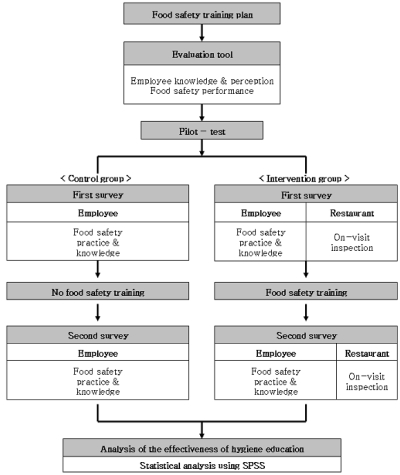
This study examined the extent of improvement of food safety knowledge and practices of employee through food safety training. Employee knowledge and practice for food safety were evaluated before and after the food safety training program. The training program and questionnaires for evaluating employee knowledge and practices concerning food safety, and a checklist for determining food safety performance of restaurants were developed. Data were analyzed using the SPSS program. Twelve restaurants participated in this study. We split them into two groups: the intervention group with training, and the control group without food safety training. Employee knowledge of the intervention group also showed a significant improvement in their score, increasing from 49.3 before the training to 66.6 after training. But in terms of employee practices and the sanitation performance, there were no significant increases after the training. From these results, we recommended that the more job-specific and hand-on training materials for restaurant employees should be developed and more continuous implementation of the food safety training and integration of employee appraisal program with the outcome of safety training were needed.
Overview
The claims and statistics of this paper haven’t been checked yet.
Run the check — free, no account needed. It reads the open-access text and checks the sources it cites.
Integrity signals
Registry
Cites
Statistics
Figures
Verification
Claims the paper makes
The claims and statistics of this paper haven’t been checked yet.
Run the check — free, no account needed. It reads the open-access text and checks the sources it cites.
Claims other papers make about this one
Each is checked against this paper’s own text: does it say what the citing paper says it does?
The source backs part of the claim, not all of it — or backs it for a different population, condition or comparison.
In the citing paper
“However, this is contrary to expected, since self-reported data are usually susceptible to social desirability bias [112], i.e., the tendency of respondents to give socially desirable responses in such a way as to be viewed favorably by others [113]. Thus, respondents tend to overestimate their food safety practices as being higher than their actual practices deserve [38,66,114,115].”
From A Systematic Review and Meta-Analysis of the Effects of Food Safety and Hygiene Training on Food Handlers (2020) · cites this paper as [38]
Experimental — accuracy not yet measuredThe cited source says what the claim attributes to it.
In the citing paper
“For studies assessing practices thorough observations, evaluation was mainly done using a checklist [38,97,98,99,116].”
From A Systematic Review and Meta-Analysis of the Effects of Food Safety and Hygiene Training on Food Handlers (2020) · cites this paper as [38]
The cited source says what the claim attributes to it.
In the citing paper
“despite studies indicating that this is not necessarily true [37,38].”
From A Systematic Review and Meta-Analysis of the Effects of Food Safety and Hygiene Training on Food Handlers (2020) · cites this paper as [38]
Self-check
Percentages, sums and reported differences re-computed from the paper’s own numbers.
The self-check needs the paper’s full text.
Citations
Cites
Foodborne viruses: an emerging problem
Koopmans, M., & Duizer, E. (2003) · International Journal of Food Microbiology · doi:10.1016/s0168-1605(03)00169-7 · Cited by 742
Food handlers’ hygiene knowledge in small food businesses
Walker, E., Pritchard, C., & Forsythe, S. J. (2003) · Food Control · doi:10.1016/s0956-7135(02)00101-9 · Cited by 212
Food Handlers and Foodborne Diseases: Knowledge, Attitudes, and Reported Behavior in Italy
Angelillo, I. F., Viggiani, N. M. A., Rizzo, L., & Bianco, A. (2000) · Journal of Food Protection · doi:10.4315/0362-028x-63.3.381 · Cited by 198
Food handler certification by home study: measuring changes in knowledge and behavior
Howes, M., McEwen, S., Griffiths, M. D., & Harris, L. N. (1996) · Dairy, food and environmental sanitation · Cited by 179
Impact of Changing Consumer Lifestyles on the Emergence/Reemergence of Foodborne Pathogens
Collins, J. E. (1997) · Emerging infectious diseases · doi:10.3201/eid0304.970409 · Cited by 164
Evaluation of a food hygiene training course in Scotland
Ehiri, J. E., Morris, G. P., & McEwen, J. (1997) · Food Control · doi:10.1016/s0956-7135(97)00005-4 · Cited by 125
Tokuç, B., Ekuklu, G., Berberoğlu, U., Bilge, E., & Dedeler, H. (2008) · Food Control · doi:10.1016/j.foodcont.2008.08.013 · Cited by 108
Factors that Contribute to Outbreaks of Foodborne Disease
Bryan, F. L. (1978) · Journal of Food Protection · doi:10.4315/0362-028x-41.10.816 · Cited by 102
Plotkin, B. J., & Kimball, A. M. (1997) · Emerging infectious diseases · doi:10.3201/eid0301.970101 · Cited by 73
School food service research review
(1994) · Journal of the American Dietetic Association · doi:10.1016/0002-8223(94)92581-x · Cited by 58
Research works printed but not linked: 20
- Korea Foodservice Information, 2006, Korea Foodservice Statistical Yearbook, 525
- Institute of Korea Rural Economics, 2005, Current Status and Improvement Plan of Statistics in Foodservice Industry, 91
- Ko, 2005, Korean Journal of Society of Food and Cookery Science, 21, 155
- Yoon, 2003, Korean Journal of Community Nutrition, 8, 610
- The Korea Food Drug and Administration, 2008, Strategic Plans for Preventing Foodborne Illness, 1
- Kim, 2009, Tourism Science Studies, 33, 317
- Kim, 1998, Journal of Korean Society for Health Education and promotion, 15, 79
- Chang, 2003, Nutritional Sci, 6, 118
- Howes, 1996, Dairy, Food and Environment sanitation, 16, 737
- Noh JM. Field assessment of microbiological quality of restaurant operations and development of a sanitation training manual (master's thesis). Seoul: Yonsei University; 2006.
- Kim SJ. Assessment of sanitation management and development of self-managed sanitation module for Korean food restaurants (master's thesis). Seoul: Yonsei University; 2005.
- Choi, JH. An education and training cases study for the implementation of HACCP system for school foodservice operations (master's thesis). Seoul: Yonsei University; 2000.
- Ryu, 1995, Journal of Korean Society Food Science, 11, 274
- Eo, 2001, Journal of the Korean Diet Association, 7, 56
- The Korean Food and Drug Administration, 2005, The Korean Food Code: HACCP, 1
- Kwak, 2005, Korean Journal of food and cookery Science, 21, 290
- Ministry of Education and Human Resources Development, 2004, Guidelines of Sanitation Management for School Foodservice Operations, 1
- Rivas, 1982, School Foodservice Research Review, 6, 113
- Kwak, 1994, Journal of the Korean Society of Food Culture, 9, 251
- Lee, 2003, Journal of the Korean Diet Association, 9, 22
Cited by
Sorted by citations
Knowledge, attitudes and practices of food handlers in food safety: An integrative review
Zanin, L. M., da Cunha, D. T., de Rosso, V. V., Capriles, V. D., & Stedefeldt, E. (2017) · Food Research International · doi:10.1016/j.foodres.2017.07.042 · Cited by 296
Sani, N. A., & Siow, O. N. (2013) · Food Control · doi:10.1016/j.foodcont.2013.09.036 · Cited by 283
da Cunha, D. T., Stedefeldt, E., & de Rosso, V. V. (2014) · Food Control · doi:10.1016/j.foodcont.2014.03.012 · Cited by 233
Al‐Shabib, N. A., Mosilhey, S. H., & Husain, F. M. (2015) · Food Control · doi:10.1016/j.foodcont.2015.05.002 · Cited by 228
The effects of Internet addiction on the lifestyle and dietary behavior of Korean adolescents
Kim, Y., Park, J. Y., Kim, S. B., Jung, I.-K., Lim, Y. S., & Kim, J.-H. (2010) · Nutrition Research and Practice · doi:10.4162/nrp.2010.4.1.51 · Cited by 202
Metadata
- Authors
- Park, S.-H., Kwak, T.-K., & Chang, H.-J.
- Affiliations
- Imported Food Analysis Division Center for Food and Drug Analysis, Gyeongin Regional Food and Drug Administration, Incheon 402-825, Korea.
- Yonsei University (KR)
- Department of Food Science and Nutrition, College of Natural Science, Dankook University, Jukjeon-dong, Suji-gu, Youngin 448-701, Korea.
- Venue
- Nutrition Research and Practice
- Published
- 2010
- Volume
- 4
- Issue
- 1
- Pages
- 58
- ISSN
- 1976-1457 (ISSN-L)
- PMC
- PMC2830416
- OpenAlex
- W2066466043
- Cited by
- 168
- References
- 20
- Citations by year
- 2026: 5 · 2025: 4 · 2024: 12 · 2023: 8 · 2022: 13 · 2021: 13 · 2020: 12 · 2019: 15 · 2018: 16 · 2017: 8 · 2016: 11 · 2015: 12 · 2014: 11 · 2013: 6 · 2012: 8
- FWCI
- 13.25
- Type
- journal article
- Language
- en
- Open access
- hybrid
- doi.org
- Licence
- Locations
- Nutrition Research and Practice (publishedVersion, cc-by-nc)
- Europe PMC (PubMed Central) (publishedVersion, cc-by-nc)
- PubMed Central (publishedVersion, cc-by-nc)
- PubMed (publishedVersion)
- Topics
- Life Sciences › Agricultural and Biological Sciences › Food Science › Food Safety and Hygiene
- Health Sciences › Medicine › Public Health, Environmental and Occupational Health › Occupational Health and Safety in Workplaces
- Social Sciences › Psychology › Applied Psychology › Human Resource Development and Performance Evaluation
- Keywords
- food safety training, food handlers, restaurant employees, food safety knowledge, food safety practices, sanitation, performance evaluation (human resources), food service establishments
About these checks
Registry, retraction, Cites and statistics results are computed, not judged, with one exception: a printed reference that no index lists is read once by a model before it counts as a citation error. Claims are extracted by a model and kept only when their quote appears verbatim in the text; each cited source is then checked, with a model’s help, for whether it says what the claim relies on. Those verdicts can be wrong — read the claim’s quote and the cited source before relying on one.
Statistics and arithmetic are recomputed, not judged.
Confidence bands are shown only for fields calibrated on our annotated test set. None is calibrated yet, so no band is shown.
What counts as a claim ›How we measure confidence ›How we check this ›
Are you an author, or do you see a problem with this page? Request a review
