

Network meta-analysis: application and practice using Stata
Open accessThe DOI matches its Crossref record; 47 of the 47 references it cites were found in a registry or an index.
Abstract
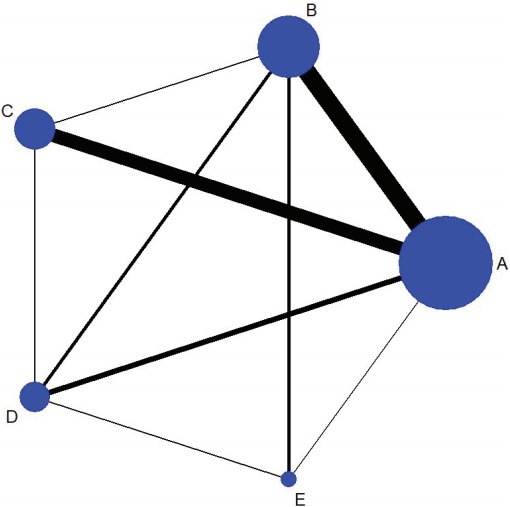
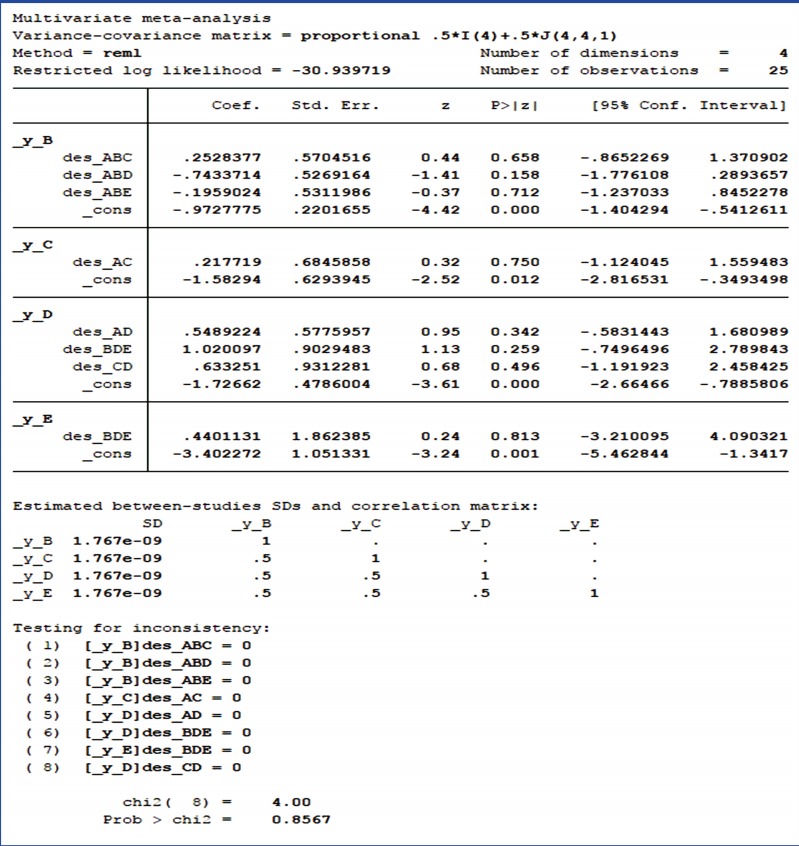
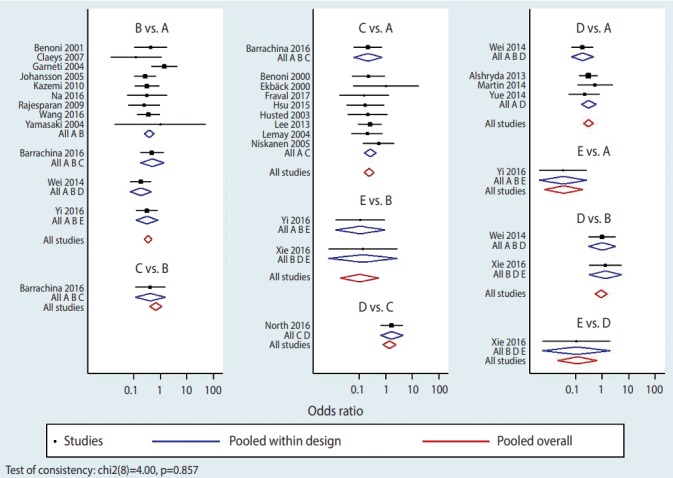
This review aimed to arrange the concepts of a network meta-analysis (NMA) and to demonstrate the analytical process of NMA using Stata software under frequentist framework. The NMA tries to synthesize evidences for a decision making by evaluating the comparative effectiveness of more than two alternative interventions for the same condition. Before conducting a NMA, 3 major assumptions-similarity, transitivity, and consistency-should be checked. The statistical analysis consists of 5 steps. The first step is to draw a network geometry to provide an overview of the network relationship. The second step checks the assumption of consistency. The third step is to make the network forest plot or interval plot in order to illustrate the summary size of comparative effectiveness among various interventions. The fourth step calculates cumulative rankings for identifying superiority among interventions. The last step evaluates publication bias or effect modifiers for a valid inference from results. The synthesized evidences through five steps would be very useful to evidence-based decision-making in healthcare. Thus, NMA should be activated in order to guarantee the quality of healthcare system.
Overview
The claims and statistics of this paper haven’t been checked yet.
Free: it reads the open-access text and checks the first 5 claims that cite a source we can check. Create a free account to check every claim.
Integrity signals
Registry
Cites
Statistics
Figures
Verification
Claims the paper makes
The claims and statistics of this paper haven’t been checked yet.
Free: it reads the open-access text and checks the first 5 claims that cite a source we can check. Create a free account to check every claim.
Claims other papers make about this one
Each is checked against this paper’s own text: does it say what the citing paper says it does?
In the citing paper
“The network meta-analysis was performed following the current Preferred Reporting Items for Systematic Reviews and Meta-Analyses guideline items (26,27): 1) a network geometry was created to explore the comparisons between resistance training loads; 2) transitivity was tested by fitting a network inconsistency assumption along with Q test and side-splitting analyses between indirect and direct”
From Resistance training load effects on muscle hypertrophy and strength gain: systematic review and network meta-analysis. (2021) · cites this paper as [26]
Self-check
Percentages, sums and reported differences re-computed from the paper’s own numbers.
The self-check needs the paper’s full text.
Citations
Cites
Hutton, B., Salanti, G., Caldwell, D. M., Chaimani, A., Schmid, C. H., Cameron, C., Ioannidis, J. P. A., Straus, S., Thorlund, K., Jansen, J. P., et al. (2015) · Annals of Internal Medicine · doi:10.7326/m14-2385 · Cited by 8,269
Salanti, G., Ades, A. E., & Ioannidis, J. P. A. (2011) · Journal of Clinical Epidemiology · doi:10.1016/j.jclinepi.2010.03.016 · Cited by 3,766
Checking consistency in mixed treatment comparison meta-analysis
Dias, S., Welton, N. J., Caldwell, D. M., & Ades, A. E. (2010) · Statistics in Medicine · doi:10.1002/sim.3767 · Cited by 2,521
Combination of direct and indirect evidence in mixed treatment comparisons
Lu, G., & Ades, A. E. (2004) · Statistics in Medicine · doi:10.1002/sim.1875 · Cited by 2,166
Consistency and inconsistency in network meta-analysis: concepts and models for multi-arm studies
Higgins, J. P. T., Jackson, D., Barrett, J. K., Lu, G., Ades, A. E., & White, I. R. (2012) · Research Synthesis Methods · doi:10.1002/jrsm.1044 · Cited by 2,098
Bucher, H. C., Guyatt, G. H., Griffith, L. E., & Walter, S. D. (1997) · Journal of Clinical Epidemiology · doi:10.1016/s0895-4356(97)00049-8 · Cited by 2,052
Salanti, G. (2012) · Research Synthesis Methods · doi:10.1002/jrsm.1037 · Cited by 1,729
Cipriani, A., Furukawa, T. A., Salanti, G., Geddes, J. R., Higgins, J. P., Churchill, R., Watanabe, N., Nakagawa, A., Omori, I. M., McGuire, H., et al. (2009) · The Lancet · doi:10.1016/s0140-6736(09)60046-5 · Cited by 1,654
Network meta‐analysis for indirect treatment comparisons
Lumley, T. (2002) · Statistics in Medicine · doi:10.1002/sim.1201 · Cited by 1,206
White, I. R., Barrett, J. K., Jackson, D., & Higgins, J. P. T. (2012) · Research Synthesis Methods · doi:10.1002/jrsm.1045 · Cited by 1,114
Cited by
Items 601–663 of 663
Wang, S., Bai, L., Zhu, P., Wang, H., Zhou, E., Jing, M., Fu, S., Lyu, Q., & Bai, T. (2026) · Frontiers in Neurology · doi:10.3389/fneur.2025.1726927
Zhao, Y., Tao, Y., Zhu, Y., Li, S., Guo, H., Huang, Y., Huang, Y., & Fang, C. (2026) · Endocrine · doi:10.1007/s12020-026-04560-4
“This NMA adopted a frequentist framework in accordance with established guidelines [ 27 ].”
Liu, C., Jia, S., Wang, M.-Z., Zhang, M.-X., Wang, X.-L., Zhang, H.-J., & Jiang, W. (2026) · npj Cardiovascular Health · doi:10.1038/s44325-026-00106-9
“This statistical analysis comprised the following fi ve steps 33 : visualizing the network relationship, assessing consistency assumptions, illustrating comparative effectiveness with a network forest plot, ranking interventions based on cumulative rankings, and evaluating publication bias.”
de Liyis, B. G., Wiyanjana, K. D. F., Golden, N., Maliawan, S., & Mahadewa, T. G. B. (2026) · The Egyptian Journal of Neurology Psychiatry and Neurosurgery · doi:10.1186/s41983-026-01087-3
“The analysis was conducted using Stata software version 18 (StataCorp, College Station, TX, USA), with statistical significance defined as p < 0.05 [6].”
InfluentialYao, X., Pu, J., Fan, Y., Jiang, X., Zhao, H., Wang, Y., Ye, Y., Wei, Y., & Yang, L. (2026) · BMJ Open · doi:10.1136/bmjopen-2025-110995
“We will first perform conventional pairwise meta-analyses of direct comparisons using Review Manager (V.5.4.1), followed by frequentist network meta-analyses using Stata (V.14.1) 54 and the netmeta package in R. 55 We will use random-effects models to account for heterogeneity in intervention effects.”
InfluentialWhat can we learn from network meta-analyses published in top medical journals
Tian, C., Li, M., Jiang, J., Hou, L., Pan, B., Wang, Y. C., Ge, L., & Yue, X. (2026) · Systematic Reviews · doi:10.1186/s13643-025-03066-w
de Liyis, B. G., Benet, A., Kusdiansah, M., Hafif, M., Ariyaprakai, C., Gómez-Vega, J. C., Farinha, N. C., Sham, J. K., Jayapalan, R. R., Golidtum, J. P., et al. (2026) · Neurosurgical Review · doi:10.1007/s10143-026-04220-1
Liu, Q., Xin, X., Wang, H., Zhai, B., Dong, N., Guo, Y., & Xie, J. (2026) · Pediatric Obesity · doi:10.1111/ijpo.70104
“Inconsistency was tested using both consistency and inconsistency models, where a p value > 0.05 indicated no significant inconsistency [29].”
InfluentialWang, J., Sun, G., Shen, C., Zhu, H., & He, Z. (2026) · Frontiers in Public Health · doi:10.3389/fpubh.2026.1712259 · Cited by 2
Wu, X., Liu, Q., Zhong, W., Zhang, L., Xu, Z., Fan, L., Zhu, J., & Su, L. (2026) · Endocrine · doi:10.1007/s12020-026-04616-5
Gao, Q., Li, P., Han, X., Lv, Y., Wang, J., Tang, H., Zhang, Y., Liu, X., & Wu, W. (2026) · Clinical Rehabilitation · doi:10.1177/02692155261444584
Liu, J., Sui, K., Liu, L., Song, J., Dong, S., Ren, S., Yang, L., & Leng, M. (2026) · Journal of NeuroEngineering and Rehabilitation · doi:10.2196/preprints.99695
Pancholy, S. B., Maqsood, M. H., Saleem, M. S., Zalavadia, D., Khattar, K., Patel, T. M., & Bangalore, S. (2026) · medRxiv · doi:10.64898/2026.05.07.26352700
Flexibility-enhancing Interventions for Ankle Range of Motion: A Network Meta-analysis
Park, J. M., Lee, K. W., Yoon, S. Y., Kim, Y. W., & Lee, S. C. (2026) · International Journal of Sports Medicine · doi:10.1055/a-2876-9237
Researchers' Mental Health and Quality of Life: A Protocol for Systematic Review and Meta‐Analysis
de Azevedo, L. J. Q., Sousa, M. D. M., Costa, M. M., Cordeiro, L. L., Torres, M. M., Nogueira, S. M., Noll, P. R. E. S., & Noll, M. (2026) · Health Science Reports · doi:10.1002/hsr2.72253
“Descriptive and interrater agreement analyses are performed using SPSS version 26 (IBM Corp., Armonk, NY, USA), while meta‐analytical procedures—when applicable—use STATA version 18.5 (StataCorp, College Station, TX, USA) [62].”
InfluentialLópez-González, M. L., Álvarez‐Bueno, C., Molina, M. C., Frontelo-García, M., Rodríguez-Martín, B., & Priego-Jiménez, S. (2026) · Archives of Gerontology and Geriatrics · doi:10.1016/j.archger.2026.106313
Liu, J., Niu, H., Li, J., Chen, Q., & Bi, H. (2026) · BMJ Open · doi:10.1136/bmjopen-2026-116764
“40 Where significant heterogeneity emerges, subgroup analyses based on the average age, gender, illness duration and treatment time of the subjects will be implemented to identify the origins of such heterogeneity.”
Yu, W., Huang, L., Lv, D., Li, M. T., Huang, Y., Li, Y., & Wang, X. (2026) · Frontiers in Medicine · doi:10.3389/fmed.2026.1811907
“Global and local inconsistencies were evaluated using loop-spe-cific and the node-splitting methods (14).”
Duan, L., Zhang, S., Li, L., & Hu, X. (2026) · Journal of Cancer Survivorship · doi:10.1007/s11764-026-02051-z
周晓彬, Yang, N., Xi, C., Ji, J., & Xu, T. (2026) · Frontiers in Endocrinology · doi:10.3389/fendo.2026.1828031
Guo, C., Fang, Z., Han, B., Chen, Y., Han, Q., Tang, W., Zhuang, L., Liu, Y., Qiang, M., Huang, P., et al. (2026) · Frontiers in Rehabilitation Sciences · doi:10.3389/fresc.2026.1780374
“NMA was performed according to the current PRISMA NMA guidelines (43), employing a frequentist framework using STATA 17.0 software.”
InfluentialSotiriadis, A., Tsakiri, I., Papapanou, M., Toulaki, M., Bourou, M. Z., & Siristatidis, C. S. (2026) · Cochrane Database of Systematic Reviews · doi:10.1002/14651858.cd016355
Mei, J., Zhang, W., & Bin, J. (2026) · Frontiers in Psychiatry · doi:10.3389/fpsyt.2026.1747368
(2026) · Frontiers research topics · doi:10.3389/978-2-8325-8154-4
Optimal pharmacological therapy for minor acute ischemic stroke: a network meta-analysis
Feng, S., Liu, S., Zhao, H., Jin, B., & Mei, M. (2026) · Frontiers in Neurology · doi:10.3389/fneur.2026.1834958
Fei, L., Chen, H., Di, J., Zhang, X., Tan, L., & Liu, K. (2026) · Frontiers in Medicine · doi:10.3389/fmed.2026.1743758
“…were evaluated separately using the network node-splitting model to examine the transitivity assumption for this network meta-analysis (36), in this approach, a p > 0.05 indicated consistency between direct and indirect evidence, whereas p ≤ 0.05 suggested potential inconsistency…”
InfluentialKong, C., Zhou, S., Xin, X., & Zhang, Y. (2026) · Frontiers in Physiology · doi:10.3389/fphys.2026.1863589
Wang, K., Wenjun, X., Cao, S., & Liu, Y. C. (2026) · Frontiers in Public Health · doi:10.3389/fpubh.2026.1880248
“The inconsistency model was further used to test inconsistency in the network; when the inconsistency test result was not significant ( p > 0.05), the consistency model was used for analysis (20).”
InfluentialLi, X. J., Gao, W., Li, Z., Zhu, J., Wang, Y., & Li, M. (2026) · Frontiers in Public Health · doi:10.3389/fpubh.2026.1865603
Li, S., Huo, H., Li, D., Li, W., Tan, X., Li, J., Liu, Y., & Wang, D. (2026) · European Journal of Integrative Medicine · doi:10.1016/j.eujim.2026.102720
Liu, L., Xin, X., & Ying, Z. (2026) · Child and Adolescent Psychiatry and Mental Health · doi:10.1186/s13034-026-01132-2
“The inconsistency model was used to test for inconsistency, and when P > 0.05, the consistency model was applied for analysis [21].”
InfluentialYan, X., Li, P., Jia, L., Song, L., Jing, J., Fu, X., & Xu, Z. (2026) · Frontiers in Medicine · doi:10.3389/fmed.2026.1883684
Shen, X., Xue, Y., Dong, Y., Li, H., Wang, Y., Liu, N., Liu, C., & Wang, H. (2026) · iScience · doi:10.1016/j.isci.2026.116801
“103,110 Comparison-adjusted funnel plots and Egger’s test used to assess small-study effects.”
Physical Activity in Urban Areas: Where and When?
(2026) · Frontiers research topics · doi:10.3389/978-2-8325-8381-4
Li, Y., Leng, Q., & Wang, Y. (2026) · Nutritional Neuroscience · doi:10.1080/1028415x.2026.2703619
Li, Y., Deng, Y., Deng, L., Lu, X., HUANG, C., Xing, C. H. E. N., Liu, Y., Chen, P., Tang, M., & Wang, F. (2026) · Frontiers in Neurology · doi:10.3389/fneur.2026.1865968
Liu, J., Sui, K., Liu, L., Song, J., Leng, M., & Yang, L. (2026) · Frontiers in Aging Neuroscience · doi:10.3389/fnagi.2026.1888654
“These pooled estimates were presented as standardized mean differences (SMDs) with corresponding 95% confidence intervals (CIs) and 95% prediction intervals (PIs) (Shim et al., 2017; Borenstein, 2023).”
Publication Bias: Impact on Evidence Synthesis, Detection Methods, and Prevention Strategies
Hussain, R., Ahmad, N. A., Alshorman, K., & Babar, Z.-U.-D. (2026) · Elsevier eBooks · doi:10.1016/b978-0-443-26472-6.00176-5
Zhang, L., Hu, Y., Zhu, X., Shen, Z., & Lang, B. (2026) · International Journal of Nursing Sciences · doi:10.1016/j.ijnss.2026.08.007
Kim, D. H., Jang, D. W., & Hwang, S. H. (2026) · Clinical Otolaryngology · doi:10.1111/coa.70159
“We chose a random-effects NMA with a frequentist framework [60].”
Jin, S., Li, C., Sun, N., & Zheng, X. (2026) · Nutrition Reviews · doi:10.1093/nutrit/nuag117
Ben, Y., Li, H., Chen, R., & Tang, Q. (2026) · Journal of Neurology · doi:10.1007/s00415-026-14061-z
“Funnel plots were used to visually evaluate publication bias based on the symmetry criterion [12].”
Min, J. K., Yoon, S. Y., Kim, Y. W., Park, J. M., & Lee, S. C. (2026) · Journal of Clinical Medicine · doi:10.3390/jcm15176679
“The surface under the cumulative ranking curve (SUCRA) was used to rank the comparative effectiveness of the treatments [19].”
Guo, F., Liu, R., Zou, Y., Li, X., Xie, M., Yao, Y., & Liu, Q. (2026) · Frontiers in Pediatrics · doi:10.3389/fped.2026.1789855
“%) heterogeneity (18).”
Cheng, R., Su, L., Zhang, Y., Zou, J., Zhu, Z., Li, L., & Liu, Z. (2026) · Frontiers in Surgery · doi:10.3389/fsurg.2026.1825289
“Statistical analyses were performed using Stata 17.0 MP (11).”
InfluentialHuang, K.-C., Wang, M. J., Chu, Y.-Y., Huang, R., Lu, Y.-J., Lin, C., Hsu, C., Chen, S.-H., Lin, Y.-T., & Lee, C. (2026) · Journal of Medical Internet Research · doi:10.2196/91174 · Cited by 1
Yang, Z., Sun, J., Huang, P., & Yang, Q. (2026) · BMJ Supportive & Palliative Care · doi:10.1136/spcare-2026-006500
Liu, Y., Wang, X., Zhang, Y., Li, Y., & Huang, Y. (2026) · Frontiers in Neurology · doi:10.3389/fneur.2026.1912776
“…efficacy of TCM therapies in improving sleep quality, with reported potential benefits and generally acceptable short-term tolerability in available studies (14–16); however, the certainty of evidence remains variable because of limitations in trial quality and follow-up duration (14, 15).”
Li, Z., Liu, C., & Liu, Y. (2026) · Endocrine · doi:10.1007/s12020-026-04775-5
“An inconsistency model was initially applied to detect potential discrepancies between direct and indirect evidence; if no statistically significant inconsistency was observed ( p > 0.05), a consistency model was subsequently adopted [28].”
InfluentialZhang, Y., Yu, T., Huang, W., Tian, L., Li, M., Wang, J., & Li, Z. (2026) · Frontiers in Psychiatry · doi:10.3389/fpsyt.2026.1912762
Wei, X., Zhao, H., Yue, S., Ren, T., Yang, Y., Wang, J., Cao, R., Fang, J., Su, F., & Zhong, F. (2026) · Frontiers in Cardiovascular Medicine · doi:10.3389/fcvm.2026.1873140
Sabella‐Jiménez, V., Benjumea‐Bedoya, D., Méndez, Y. C. H., Estupiñán-Bohorquez, A. F., Acosta-Reyes, J., & Flórez, I. D. (2026) · BMJ Paediatrics Open · doi:10.1136/bmjpo-2026-004610
“21 22”
Zhao, J., Hetao, H., Liu, M., Yang, W., Liu, J., & Luo, M. (2026) · EFORT Open Reviews · doi:10.1530/eor-2025-0125
“The ranking of the impacts of the different intervention measures on outcome indicators was evaluated using the surface under the cumulative ranking curve (SUCRA), where larger values indicate greater effectiveness of the intervention measure in improving the outcome (26).”
Cai, L., Lyu, Y., Li, P., & Li, M. (2026) · Frontiers in Medicine · doi:10.3389/fmed.2026.1944318
Hu, S., Liu, J., Wang, F., Wang, G., Zhi, Y., Gao, X., & Kim, D. (2026) · Journal of Clinical Neuroscience · doi:10.1016/j.jocn.2026.112347
Wang, F., Lu, X., Deng, Y., Li, Y., Li, X., HUANG, C., Ma, M., He, B., Yu, L., & Deng, L. (2026) · Frontiers in Neuroscience · doi:10.3389/fnins.2026.1925602
“Network consistency was assessed using the loop-spe-cific approach, node-splitting approach, and global inconsistency test (Dias et al., 2013; Shim et al., 2017).”
Shabana, H., Guðnadóttir, U., Hugerth, L. W., Rodriguez‐Wallberg, K. A., & Brusselaers, N. (2026) · Human Reproduction Update · doi:10.1093/humupd/dmag033
Lai, R., Jin, L., Chen, S., Li, R., Wang, M., & Zhang, L. (2026) · Japan Journal of Nursing Science · doi:10.1111/jjns.70084
Shi, B., Zhou, G., & Xu, N. (2026) · Clinical Rehabilitation · doi:10.1177/02692155261501002
Chang, W., 许红力, Chen, Q., Zhang, H., Du, B., Ma, X., & Huang, Y. (2026) · doi:10.2196/preprints.115270
Wang, L., Zhu, Z., Liu, Y., Qu, J., Li, N., 刘海涛, Cao, L., Ma, Z., Wu, H., & 王金武 (2026) · Archives of Physical Medicine and Rehabilitation · doi:10.1016/j.apmr.2026.10.014
Bo, W., Han, X., Li, T., & Wang, J. (2026) · Clinical Medicine Insights Oncology · doi:10.1177/11795549261504880
叶健, Zhang, L., Xue, C., Liao, M., Chen, X., Lu, C., & Wang, L. (2026) · Frontiers in Cellular and Infection Microbiology · doi:10.3389/fcimb.2026.1916158
Metadata
- Authors
- Shim, S., Yoon, B.-H., Shin, I.-S., & Bae, J.-M.
- Affiliations
- Inje University (KR)
- Jeonju University (KR)
- Jeju National University (KR)
- Corresponding author
- Bae, Jong-Myon
- Venue
- Epidemiology and Health
- Publisher
- Korean Society of Epidemiology
- Published
- 2017-10-27
- Volume
- 39
- Pages
- e2017047
- ISSN
- 1225-3596 (ISSN-L)
- 2092-7193
- PMC
- PMC5733388
- OpenAlex
- W2766765254
- Cited by
- 656
- References
- 46
- Citations by year
- 2026: 111 · 2025: 130 · 2024: 124 · 2023: 80 · 2022: 78 · 2021: 59 · 2020: 52 · 2019: 18 · 2018: 4
- FWCI
- 4.99
- Type
- journal article
- Language
- en
- Open access
- diamond
- doi.org
- Licence
- cc-by
- Locations
- Epidemiology and Health (publishedVersion, cc-by)
- PubMed Central (publishedVersion, cc-by)
- PubMed (publishedVersion)
- DOAJ (DOAJ: Directory of Open Access Journals) (submittedVersion, cc-by-sa)
- Topics
- Social Sciences › Decision Sciences › Statistics, Probability and Uncertainty › Meta-analysis and systematic reviews
- Social Sciences › Sociology and Political Science › Delphi Technique in Research
- Physical Sciences › Mathematics › Statistics and Probability › Statistical Methods in Clinical Trials
- Keywords
- network meta-analysis, Stata, comparative effectiveness, network geometry, consistency assumption, transitivity, publication bias, effect modifiers, evidence synthesis, healthcare decision-making
- MeSH terms
- Network Meta-Analysis as Topic, Humans, Software, Treatment Outcome, Biostatistics
About these checks
Registry, retraction, Cites and statistics results are computed, not judged, with one exception: a printed reference that no index lists is read once by a model before it counts as a citation error. Claims are extracted by a model and kept only when their quote appears verbatim in the text; each cited source is then checked, with a model’s help, for whether it says what the claim relies on. Those verdicts can be wrong — read the claim’s quote and the cited source before relying on one.
Statistics and arithmetic are recomputed, not judged.
Confidence bands are shown only for fields calibrated on our annotated test set. None is calibrated yet, so no band is shown.
What counts as a claim ›How we measure confidence ›How we check this ›
Are you an author, or do you see a problem with this page? Request a review
Data sources
Bibliographic data: Semantic Scholar, OpenAlex, Crossref.
Contains information from the Semantic Scholar Academic Graph Datasets, made available under the ODC Attribution License (ODC-BY 1.0).
Semantic Scholar’s data is described in: Kinney, R., et al. (2023). The Semantic Scholar Open Data Platform. arXiv:2301.10140.
