

A Study on The Impact of Green Cosmetic, Personal Care Products, And Their Packaging on Consumer’s Purchasing Behavior in Luzon, Philippines
Open accessThe DOI matches its Crossref record; 20 of the 23 references it cites were found in a registry or an index; 6 of the 21 sources its claims cite were checked for support.
Abstract
The study investigated the relationship between green products and packaging and consumers' purchasing behavior in Luzon, Philippines, finding price and product quality significantly affect purchase decisions.
Overview
CoChat Summary
TL;DR
This study surveyed consumers in Luzon, Philippines, to examine how green cosmetics, personal care products, and packaging relate to purchasing behavior. Using structural equation modeling, it found pricing and product quality/benefits were significant predictors, while four of six initial independent variables were non-significant.
Key findings
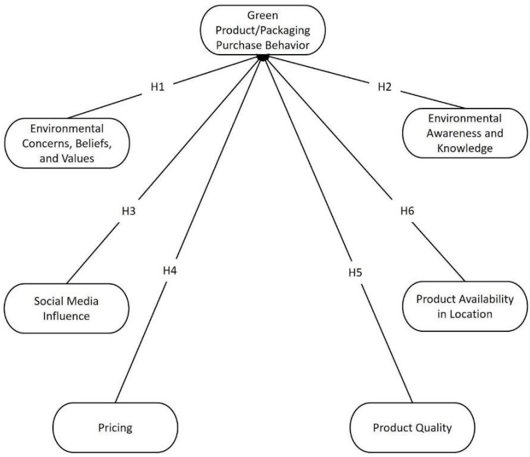
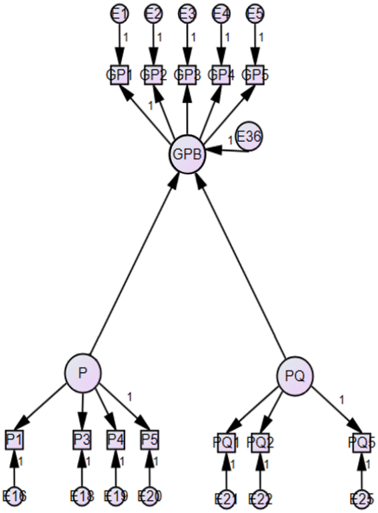
- The modified SEM retained Pricing and Product Quality and Its Benefits as significant factors affecting green product/packaging purchase behavior; four of six initial independent variables were non-significant.
- Model fit values were IFI = 0.922, TLI = 0.899, CFI = 0.921, AGFI = 0.843, and RMSEA = 0.094, all above the paper’s stated minimum cut-offs.
- Construct validity/reliability: Pricing α = 0.767, AVE = 0.470, CR = 0.774; Product Quality α = 0.677, AVE = 0.425, CR = 0.687; Green Purchase Behavior α = 0.921, AVE = 0.675, CR = 0.912.
- Survey results: 58.8% of respondents mostly use green or eco-friendly cosmetics/personal care products; 47.1% reported having more green products at home than conventional products; 51.2% said they spend more on green cosmetics/personal care products than traditional products.
Methods
- Correlational design using online survey questionnaires distributed through Facebook and Messenger; target respondents were ages 18 and above residing in Luzon, Philippines. The computed sample size from the A-priori Sample Size Calculator for SEM was 170; 170 respondents were gathered, and 7 were excluded as outliers after Mahalanobis distance analysis.
- Measures used a 4-point Likert scale (4 = Strongly Agree, 3 = Agree, 2 = Disagree, 1 = Strongly Disagree) across variables including environmental concerns/beliefs/values, environmental awareness/knowledge, social media influence, product availability, pricing, product quality/benefits, and green purchase behavior.
- Analysis used SPSS 25 for multivariate normality and outlier detection, and AMOS 24 for SEM; the initial SEM was modified by removing non-significant variables from regression weights and standardized regression weights.
Limitations
- The authors state that COVID-19 pandemic restrictions limited the target respondents; future research could conduct paper surveys in specific locations for higher response rates and reduced biased data.
- The authors state that four of six independent variables were non-significant in the initial SEM and suggest future research investigate other variables, different locations, and comparative analyses.
- Evident from the text: AVE for Pricing (0.470) and Product Quality (0.425) fall below the conventional 0.5 threshold, though the authors accept them because CR exceeds 0.6; RMSEA = 0.094 is acceptable under the paper’s 0.08–0.10 criterion but above the close-fit 0.05 threshold.
Model-written summary. Check it against the paper before relying on it.
Integrity signals
Registry
Cites
Statistics
Figures
Verification
Claims the paper makes
6 Valid · 0 Not valid · 13 Not checked · 15 Own results and interpretations
Every source the paper cites for this claim was checked and supports it.
In the paper
“According to (Drobac et al. 2020), plastic material is standard packaging for beauty products.”
What the sources say
- Supportedcites Drobac et al. 2020 matched to “Green Face of Packaging – Sustainability Issues of the Cosmetic Industry Packaging” (2020) source
The Abstract states that more than half of the materials used for cosmetic-industry packaging are plastics. That supports the paraphrase that plastic is a standard packaging material for beauty products. (LLM, conf=0.93)
plain- Asserted: passes — The authors put it forward as true.
- Checkable: passes — It can be checked against evidence.
- Load-bearing: passes — The paper’s conclusions depend on it.
- Based: passes — The paper gives a reason why it holds.
- Supported
The cited sources support only part of this claim — read each source’s verdict below.
In the paper
“Many consumers nowadays are willing to spend an extra price if the product carries an additional value and helps take environmental protection (Yue et al. 2020).”
What the sources say
- Partly supportedcites Yue et al. 2020 matched to “Impact of Consumer Environmental Responsibility on Green Consumption Behavior in China: The Role of Environmental Concern and Price Sensitivity” (2020) sourceExperimental — accuracy not yet measured
Section 2.4 reports that up to 78% of respondents in a cited study would buy organic products under a price condition, supporting some willingness to buy green products despite price. Section 5.2 recommends highlighting added attributes such as low-carbon and eco-friendly qualities, but it does not establish that many consumers are willing to pay extra specifically because a product offers those values and helps protect the environment. Page numbers are unavailable in our copy. (LLM, conf=0.82)
plainstates an association- Asserted: passes — The authors put it forward as true.
- Checkable: passes — It can be checked against evidence.
- Load-bearing: unclear — It is unclear whether the paper’s conclusions depend on it.
- Based: passes — The paper gives a reason why it holds.
- Partly supported
Every source the paper cites for this claim was checked and supports it.
In the paper
“Moreover, a recent study (Zhang et al. 2020) stated that the price of green products in the market is relatively higher than that of traditional products.”
What the sources say
- Supportedcites Zhang et al. 2020 matched to “Why Do Consumers Make Green Purchase Decisions? Insights from a Systematic Review” (2020) source
Section 4.2, “Determinants of Green Purchase,” states the claimed price comparison directly: green products in the market are relatively more expensive than traditional products. (LLM, conf=0.95)
plain- Asserted: passes — The authors put it forward as true.
- Checkable: passes — It can be checked against evidence.
- Load-bearing: unclear — It is unclear whether the paper’s conclusions depend on it.
- Based: passes — The paper gives a reason why it holds.
- Supported
Every source the paper cites for this claim was checked and supports it.
In the paper
“According to (Juliano et al. 2017), sewage treatment is not effective enough to remove the danger of the toxic material caused by some cosmetics ingredients.”
What the sources say
- Supportedcites Juliano et al. 2017 matched to “Cosmetic Ingredients as Emerging Pollutants of Environmental and Health Concern. A Mini-Review” (2017) source
The Introduction (p. 1) states that 'sewage treatment plants are not always effective in removing chemicals used as cosmetic ingredients,' listing synthetic musks, perfluoroalkyl compounds, some organic UV-filters and microplastics; the Conclusions (p. 15) repeat that these compounds 'can escape conventional treatment processes, persist in the environment at unexpected levels, undergo bioaccumulation.' Section 5 (Plastic Microbeads) adds that microplastics from cosmetics are 'too small to be trapped in sewage treatment plants' and reach waterways. The citing sentence's 'danger of the toxic material' corresponds to the review's framing of these ingredients as bioactive, persistent emerging pollutants with ecological and health risk; the only softening in the source is 'not always effective'/'some cases,' which the paraphrase preserves via 'some cosmetics ingredients.' (LLM, conf=0.88)
plain- Asserted: passes — The authors put it forward as true.
- Checkable: passes — It can be checked against evidence.
- Load-bearing: unclear — It is unclear whether the paper’s conclusions depend on it.
- Based: passes — The paper gives a reason why it holds.
- Supported
Every source the paper cites for this claim was checked and supports it.
In the paper
“All measures for the goodness of fit have a value greater than the minimum cut-off. Thus, the model represents a good fit.”
What the sources say
- Supportedcites Gefen et al. 2000 matched to “Structural Equation Modeling and Regression: Guidelines for Research Practice” (2000) source
Gefen, Straub and Boudreau (2000) set out exactly this heuristic logic: the fit-index section (Guidelines, NFI/modification-index passage) lists cut-offs (GFI > .90, AGFI > .80, NFI > .90, RMR < .05, chi-square/df < 3:1, insignificant chi-square) and then states that because 'the LISREL statistics in the TAM running example exceed all of the thresholds just cited... The fit indices are good'. Table 12 (Heuristics for Statistical Conclusion Validity, p. of comparative tables) codifies the same thresholds. The 'modified SEM' is the citing authors' own model, so only the cut-off/good-fit rule is attributed here, and our copy supports it; worth noting the same paper adds the caveat that 'Good fit indices show that the data support the proposed model, but they do not indicate that the selected model is necessarily parsimonious or the best' and warns against retrofitting via modification indices (Table 9/Section on fit statistics). (LLM, conf=0.85)
plain- Asserted: passes — The authors put it forward as true.
- Checkable: passes — It can be checked against evidence.
- Load-bearing: passes — The paper’s conclusions depend on it.
- Based: passes — The paper gives a reason why it holds.
- Rests on an assumption not shown here.
- Supported
11 more claims
Create a free account to see all 34 claims and to verify the 3 references still open.
- Probably not a substantial claim. 14
- The quote only partly states this claim. 2
- It may state two separate claims as one. 7
Citations
Cites
Evaluating Structural Equation Models with Unobservable Variables and Measurement Error
Fornell, C., & Larcker, D. F. (1981) · Journal of Marketing Research · doi:10.2307/3151312 · Cited by 109,314
Evaluating structural equation models with unobservable variables and measurement error
Fornell, C., & Larcker, D. F. (1981) · Journal of Marketing Research · doi:10.1177/002224378101800104 · Cited by 109,190
A primer on partial least squares structural equation modeling (PLS-SEM)
Leguina, A. (2015) · International Journal of Research & Method in Education · doi:10.1080/1743727x.2015.1005806 · Cited by 18,921
(2014) · DigitalCommons - Kennesaw State University (Kennesaw State University) · Cited by 12,785
Power analysis and determination of sample size for covariance structure modeling.
MacCallum, R. C., Browne, M. W., & Sugawara, H. M. (1996) · Psychological Methods · doi:10.1037/1082-989x.1.2.130 · Cited by 10,418
Structural Equation Modeling and Regression: Guidelines for Research Practice
Gefen, D., Straub, D., & Boudreau, M.-C. (2000) · Communications of the Association for Information Systems · doi:10.17705/1cais.00407 · Cited by 6,416
Hahladakis, J. N., Velis, C. A., Weber, R., Iacovidou, E., & Purnell, P. (2018) · Journal of Hazardous Materials · doi:10.1016/j.jhazmat.2017.10.014 · Cited by 3,873
Overview of known plastic packaging-associated chemicals and their hazards
Groh, K. J., Backhaus, T., Carney-Almroth, B., Geueke, B., Inostroza, P. A., Lennquist, A., Leslie, H. A., Maffini, M., Slunge, D., Trasande, L., et al. (2019) · Science of The Total Environment · doi:10.1016/j.scitotenv.2018.10.015 · Cited by 913
Impact of competitiveness on salespeople's commitment and performance
Lam, L. W. (2012) · Journal of Business Research · doi:10.1016/j.jbusres.2011.10.026 · Cited by 757
An Overview of Plastic Waste Generation and Management in Food Packaging Industries
Ncube, L. K., Ude, A. U., Ogunmuyiwa, E. N., Zulkifli, R., & Beas, I. N. (2021) · Recycling · doi:10.3390/recycling6010012 · Cited by 647
Research works printed but not linked: 3
- Allied Market Research, Available: https://www.alliedmarketresearch.com/press-release/philippines-beauty-andpersonal-care-market.html, Accessed on March 9, 2021.
- Amberg, N., and Frograssy, C., 'Resources Communication Green Consumer Behavior in the Cosmetics Market' Available: https://www.researchgate.net/publication/334762459\_resources\_Communication\_Green\_Consumer\_Behavior\_i n\_the\_Cosmetics\_Market Accesed on: March 9, 2021.
- Hulin, C., Netemeyer, R., and Cudeck, R., Can a Reliability Coefficient Be Too High? Journal of Consumer Psychology, Vol. 10, Nr. 1, 55-58, 2001. Greenamerica.org, Available: https://www.greenamerica.org/greenliving/ugly-side-cosmetics, Accessed on: March 9, 2021.
Cited by
Towards Sustainable Color Cosmetics Packaging
Dube, M., & Dube, S. (2023) · Cosmetics · doi:10.3390/cosmetics10050139 · Cited by 65
An assessment of Online Buying Behavior among Employees of Sulu State College
Roger, A., & Asiri, M. S. (2024) · SOCIAL PSYCHOLOGY AND HUMAN EXPERIENCE · doi:10.62596/yw2z1p33
Ramírez, S. K. W. (2024) · Universidad Peruana de Ciencias Aplicadas (UPC) · doi:10.19083/tesis/675977
Effect of Heavy Metals on the Environment in Reference to the Cosmetic Industry
Aiswarya, K. P. (2025) · Springer proceedings in earth and environmental sciences · doi:10.1007/978-3-031-93444-5_66
Relova, K. M., & Santos, G. V. (2026) · Psychology and Education A Multidisciplinary Journal · doi:10.70838/pemj.540905
Metadata
- Authors
- Montes, R. M., Pascasio, H. K., Oliquino, J. I., Delapaz, G., & Lugay, C. I.
- Affiliations
- University of Santo Tomas (PH)
- Venue
- Proceedings of the International Conference on Industrial Engineering and Operations Management
- Publisher
- IEOM Society International
- Published
- 2023-05-24
- Pages
- 119-128
- OpenAlex
- W4377967355
- Semantic Scholar
- 959362d5d63069f6baa01a135267bf97d7d00158
- Cited by
- 5
- References
- 23
- Citations by year
- 2026: 1 · 2025: 1 · 2024: 2 · 2023: 1
- FWCI
- 4.47
- Type
- conference paper
- Language
- en
- Open access
- bronze
- doi.org
- Locations
- International Conference on Industrial Engineering and Operations Management (IEOM) (publishedVersion)
- Topics
- Social Sciences › Business, Management and Accounting › Marketing › Environmental Sustainability in Business
- Social Sciences › Business, Management and Accounting › Marketing › Consumer Perception and Purchasing Behavior
- Social Sciences › Business, Management and Accounting › Marketing › Consumer Packaging Perceptions and Trends
- Keywords
- green cosmetics, personal care products, sustainable packaging, consumer purchasing behavior, environmental concern, environmental awareness, social media influence, product availability, pricing, product quality, sustainable marketing, Filipino consumers, Luzon
About these checks
Registry, retraction, Cites and statistics results are computed, not judged, with one exception: a printed reference that no index lists is read once by a model before it counts as a citation error. Claims are extracted by a model and kept only when their quote appears verbatim in the text; each cited source is then checked, with a model’s help, for whether it says what the claim relies on. Those verdicts can be wrong — read the claim’s quote and the cited source before relying on one.
The claim verdicts this report counts are experimental: their accuracy is not yet measured.
A language model drew the claims from the paper on 2026-10-10, under version 3 of the claim definition (model deepseek-v4.1-flash, prompt extract-v3).
A second model labelled each claim on 2026-10-10 (model jev-1.13-20260917, definition revision gold-guideline-v0.2).
Cited sources are checked with a language model’s help (gpt-6-sol and qwen3.8-omni-flash).
Statistics and arithmetic are recomputed, not judged.
Confidence bands are shown only for fields calibrated on our annotated test set. None is calibrated yet, so no band is shown.
What counts as a claim ›How we measure confidence ›How we check this ›
Are you an author, or do you see a problem with this page? Request a review
How to cite
Cite CoChat for the checks on this page, and the paper for its own findings.
- This page
- CoChat. (2026). Citation check: A Study on The Impact of Green Cosmetic, Personal Care Products, And Their Packaging on Consumer’s Purchasing Behavior in Luzon, Philippines. https://app.cochat.ai/papers/10.46254/na07.20220027
- The paper
- Montes, R. M., Pascasio, H. K., Oliquino, J. I., Delapaz, G., & Lugay, C. I. (2023). A Study on The Impact of Green Cosmetic, Personal Care Products, And Their Packaging on Consumer’s Purchasing Behavior in Luzon, Philippines. Proceedings of the International Conference on Industrial Engineering and Operations Management. https://doi.org/10.46254/na07.20220027
Data sources
Bibliographic data: Semantic Scholar, OpenAlex, Crossref.
Contains information from the Semantic Scholar Academic Graph Datasets, made available under the ODC Attribution License (ODC-BY 1.0).
Semantic Scholar’s data is described in: Kinney, R., et al. (2023). The Semantic Scholar Open Data Platform. arXiv:2301.10140.
