

The DOI matches its Crossref record; 1 of the 1 references it cites were found in a registry or an index.
The Fertility Problem Inventory and Infertility-Related Stress: A Case Study
Open accessAbstract
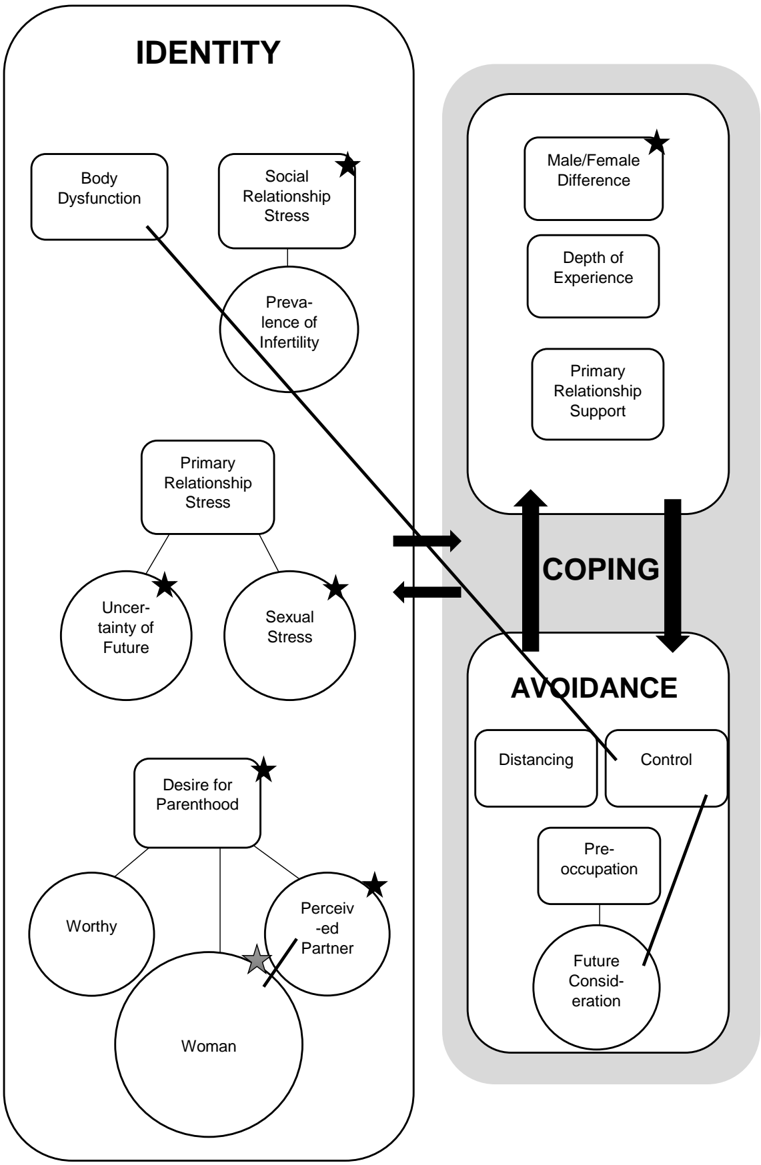
More than seven million people of childbearing age in the United States experience infertility. Oftentimes, for women, the experience of infertility is stressful. The Fertility Problem Inventory (FPI) has been used to quantitatively measure women’s experience of infertility-related stress. However, the construct of infertility-related stress is poorly described in existing literature. The purpose of this case study was to understand how women experience the FPI as a measure of infertility-related stress. To address this issue, women who were undergoing infertility treatment completed the FPI and participated in unstructured interviews. Archival documents were also retrieved to corroborate findings and satisfy saturation. Results indicated that the FPI is lacking in structure and organization to describe women’s experiences of infertility-related stress. Specifically, women described feeling infertility having an influence upon their identity and their coping.
Overview
The claims and statistics of this paper haven’t been checked yet.
Run the check — free, no account needed. It reads the open-access text and checks the sources it cites.
Integrity signals
Registry
Cites
Statistics
Figures


Verification
Claims the paper makes
The claims and statistics of this paper haven’t been checked yet.
Run the check — free, no account needed. It reads the open-access text and checks the sources it cites.
Claims other papers make about this one
Each is checked against this paper’s own text: does it say what the citing paper says it does?
The source backs part of the claim, not all of it — or backs it for a different population, condition or comparison.
In the citing paper
“Anxiety emerged as one of the most prominent features of infertility-related distress, consistent with previous findings from other studies in which anxious rumination was reported to be a common feature of infertility.22 23”
From Infertility-related distress and clinical targets for psychotherapy: A qualitative study (2021) · cites this paper as [22]
Experimental — accuracy not yet measuredThe cited source says what the claim attributes to it.
In the citing paper
“Finally, the broad themes of deterioration of the couple,22 23 28 and of weakened social support systems27 28 have been previously identified.”
From Infertility-related distress and clinical targets for psychotherapy: A qualitative study (2021) · cites this paper as [22]
The cited source says what the claim attributes to it.
In the citing paper
“With regard to the second theme, mood disturbance, other researchers have also reported on the ‘emotional rollercoaster’ of infertility, as well as the loss of control that women frequently experience.6 22 27 28”
From Infertility-related distress and clinical targets for psychotherapy: A qualitative study (2021) · cites this paper as [22]
Self-check
Percentages, sums and reported differences re-computed from the paper’s own numbers.
The self-check needs the paper’s full text.
Citations
Cites
Psychological evaluation and support in a program of in vitro fertilization and embryo transfer
Freeman, E. W., Boxer, A. S., Rickels, K., Tureck, R., & Mastroianni, L. (1985) · Fertility and Sterility · doi:10.1016/s0015-0282(16)48316-0 · Cited by 319
Research works printed but not linked: 26
- Baxter, P., & Jack, S. (2008). Qualitative case study methodology: Study design and implementation for novice researchers. The Qualitative Report, 13(4), 544-559. Retrieved from http://nsuworks.nova.edu/tqr/vol13/iss4/2/
- Creswell, J. W. (2003). Research design: Qualitative, quantitative, and mixed methods approaches (2 nd ed.). Thousand Oaks, CA: Sage.
- Domar, A. D., Zuttermeister, P. C., & Friedman, R. (1993). The psychological impact of infertility: A comparison with patients with other medical conditions. Journal of Psychosomatic Obstetrics and Gynecology, 14, 45-52.
- Edelmann, R. J., & Connolly, K. J. (1998). Psychological state and psychological strain in relation to infertility. Journal of Community and Applied Social Psychology, 8, 303- 311.
- Galhardo, A., Cunha, M., Pinto-Gouveia, J., & Matos, M. (2013). The mediator role of emotion regulation processes and infertility-related stress. Journal of Clinical Psychology in Medical Settings, 20, 497-507. doi:10.1007/s10880-013-9370-3 · DOI
- Gerrity, D. A. (2001). Five medical treatment stages of infertility: Implications for counselors. The Family Journal: Counseling and Therapy for Couples and Families, 9(2), 140-150.
- Gibson, D. M., & Myers, J. E. (2000). Gender and infertility: A relational approach to counseling women. Journal of Counseling & Development, 78(4), 400-410.
- Gourounti, K., Anagnostopoulos, F., Potamianos, G., Lykeridou, K., Schmidt, L., & Vaslamatzis, G. (2012). Perception of control, coping, and psychological stress of infertile women undergoing IVF. Reproductive BioMedicine Online, 24, 670-679. doi:10.1016/j.rbmo.2012.03.002 · DOI
- Gourounti, K., Anagnostopoulos, F., & Vaslamatzis, G. (2010). Psychometric properties and factor structure of the fertility problem inventory in a sample of infertile women undergoing fertility treatment. Midwifery, 27, 660-667. doi:10.1016/j.midw.2010.02.007 · DOI
- Greil, A. L., McQuillan, J., Lowry, M., & Shreffler, K. M. (2011). Infertility treatment and fertility specific distress: A longitudinal analysis of a population-based sample of U.S. women. Social Science & Medicine, 73(1), 87-94. doi: 10.1016/j.socscimed.2011.04.023 · DOI
- Lather, P. (1986). Issues of validity in openly ideological research: Between a rock and a soft place. Interchange, 17(4), 63-84.
- Lawson, A. K., Klock, S. C., Pavone, M. E., Hirshfeld-Cytron, J., Smith, K. N., & Kazer, R. R. (2014). Prospective study of depression and anxiety in female fertility preservation and infertility patients. Fertility and Sterility, 102(5), 1377-1384. doi:10.1016/j.fertnstert. 2014.07.765 · DOI
- Lazarus, R. S., & Folkman, S. (1984). Stress, appraisal, and coping. New York, NY: Springer Publishing.
- Lincoln, Y. S., & Guba, E. C. (2000). Paradigmatic controversies, contradictions, and emerging confluences. In N. K. Denzin & Y. S. Lincoln (Eds.), The handbook of qualitative research (2 nd ed., pp. 163-188).
- Maxwell, J. A. (2013). Conceptual framework: What do you think is going on? In Qualitative research design: An interactive approach (3 rd ed.). Thousand Oaks, CA: Sage.
- Moura-Ramos, M., Gamerio, S., Canavarro, M. C., & Soares, I. (2012). Assessing infertility stress: Re-examining the factor structure of the fertility problem inventory. Human Reproduction, 27(2), 496-505. doi:10.1093/humrep/der388 · DOI · Paper page
- Newton, C. R., Sherrard, W., & Glavac, I. (1999). The fertility problem inventory: Measuring perceived infertility-related stress. Fertility and Sterility, 72(1), 54-62.
- Reason, P., & Rowan, J. (1981). Issues of validity in new paradigm research. In P. Reason & J. Rowan (Eds.) Human inquiry: A sourcebook of new paradigm research (pp. 239- 262). New York, NY: John Wiley.
- Schneider, M. G., & Forthofer M. S. (2005) Associations of psychosocial factors with the stress of infertility treatment. Health & Social Work, 30(3), 183-191.
- Sexton, M. B., Byrd, M. R., & von Kluge, S. (2009). Measuring resilience in women experiencing infertility using the CD-RISC: Examining infertility-related stress, general distress and coping styles. Journal of Psychiatric Research, 44, 236-241.
- Sexton, M. B., Byrd, M. R., O'Donohue, W. T., & Jacobs, N. N. (2010). Web-based treatment for infertility-related psychological distress. Archives of Women's Mental Health, 13, 347-358. doi:10.1007/s00737-009-0142-x · DOI
- Slade, P., O'Neill, C., Simpson, A. J., & Lahen, H. (2007). The relationships between perceived stigma, disclosure patterns, support and distress in new attendees at an infertility clinic. Human Reproduction, 22, 2309-2317. doi:10.1093/humrep/dem115 · DOI
- Stake, R. E. (2006). Multiple case study analysis. New York, NY: Guildford Press.
- Tufford, L. (2011). Helping couples through the crisis of infertility. Psychologica, 33(1), 24- 30.
- Watkins, K. J., & Baldo, T. D. (2004). The infertility experience: Biopsychosocial effects and suggestions for counselors. Journal of Counseling and Development, 82(4), 394-402.
- Yin, R. K. (2013). Case study research: Design and method (4 th ed.). Thousand Oaks, CA: Sage.
Metadata
- Authors
- Born, S., & Preston, J.
- Affiliations
- Johnson State College
- Saybrook University (US)
- ORCID
- Born, Staci
- Venue
- The Qualitative Report
- Publisher
- Nova Southeastern University
- Published
- 2016-03-14
- ISSN
- 1052-0147 (ISSN-L)
- 2160-3715
- OpenAlex
- W1015353322
- Cited by
- 8
- References
- 1
- Citations by year
- 2022: 2 · 2021: 3 · 2019: 1 · 2018: 1 · 2017: 1
- FWCI
- 1.32
- Type
- journal article
- Language
- en
- Open access
- gold
- doi.org
- Licence
- cc-by-nc-sa
- Locations
- The Qualitative Report (publishedVersion, cc-by-nc-sa)
- Cornerstone (Minnesota State University, Mankato) (submittedVersion, cc-by-nc)
- NSUWorks (Nova Southeastern University) (submittedVersion, cc-by-nc-sa)
- Open PRAIRIE (South Dakota State University) (submittedVersion, cc-by-nc-sa)
- Topics
- Health Sciences › Medicine › Reproductive Medicine › Reproductive Health and Technologies
- Social Sciences › Psychology › Social Psychology › Attachment and Relationship Dynamics
- Health Sciences › Medicine › Public Health, Environmental and Occupational Health › Maternal Mental Health During Pregnancy and Postpartum
- Keywords
- infertility, infertility-related stress, Fertility Problem Inventory, women's experiences, infertility treatment, identity, coping
About these checks
Registry, retraction, Cites and statistics results are computed, not judged, with one exception: a printed reference that no index lists is read once by a model before it counts as a citation error. Claims are extracted by a model and kept only when their quote appears verbatim in the text; each cited source is then checked, with a model’s help, for whether it says what the claim relies on. Those verdicts can be wrong — read the claim’s quote and the cited source before relying on one.
Statistics and arithmetic are recomputed, not judged.
Confidence bands are shown only for fields calibrated on our annotated test set. None is calibrated yet, so no band is shown.
What counts as a claim ›How we measure confidence ›How we check this ›
Are you an author, or do you see a problem with this page? Request a review
