

The DOI matches its DataCite record; 37 of the 37 references it cites were found in a registry or an index; 15 of the 29 sources its claims cite were checked for support.
Hyperbolic Entailment Cones for Learning Hierarchical Embeddings
Open accessAbstract
Learning graph representations via low-dimensional embeddings that preserve relevant network properties is an important class of problems in machine learning. We here present a novel method to embed directed acyclic graphs. Following prior work, we first advocate for using hyperbolic spaces which provably model tree-like structures better than Euclidean geometry. Second, we view hierarchical relations as partial orders defined using a family of nested geodesically convex cones. We prove that these entailment cones admit an optimal shape with a closed form expression both in the Euclidean and hyperbolic spaces, and they canonically define the embedding learning process. Experiments show significant improvements of our method over strong recent baselines both in terms of representational capacity and generalization.
Overview
AI snapshot
Written from the paper’s full text.
TL;DR
The paper introduces geodesically convex entailment cones for embedding directed acyclic graphs and hierarchical relations, with closed-form optimal cone shapes in Euclidean and hyperbolic space. On WordNet hypernym link prediction, hyperbolic entailment cones outperform strong baselines, especially as more transitive-closure edges are available during training.
Key findings
- The optimal entailment cones satisfying axial symmetry, rotation invariance, continuity, and transitivity admit closed-form expressions in both Euclidean and hyperbolic geometry; the authors also derive a closed-form exponential map in the Poincaré ball.
- On WordNet link prediction, hyperbolic cones achieve test F1 of 80.1%, 86.0%, and 92.8% at embedding dimension 5 for 10%, 25%, and 50% of non-basic transitive-closure edges in training, and 85.9%, 91.0%, and 94.4% at dimension 10 for the same settings.
- Hyperbolic cones are better than all baselines in all settings except 0% training edges, where order embeddings are better; once a small percentage of transitive-closure edges is available, improvements are sometimes more than 8% F1.
- Hyperbolic cones show the largest growth when transitive-closure edges are added at train time.
Methods
- The model represents an entailment relation \((u,v)\) as \(v\) belonging to the entailment cone \(S_{\psi(u)}^u\), trained with a max-margin loss on angles using margin \(\gamma=0.01\), 10 negative edges per positive edge, batch size 10, learning rate 1e-4, and projection outside an \(\epsilon=0.1\) ball.
- Data: the full transitive closure of the WordNet noun hierarchy with the root removed, containing 82,114 nodes and 661,127 edges; basic transitive-reduction edges are always in training, while non-basic edges are split into validation (5%), test (5%), and training fractions of 0%, 10%, 25%, or 50%.
- Baselines are Simple Euclidean embeddings, Poincaré embeddings, and Order embeddings; evaluation uses precision, recall, and F1, with thresholds tuned on validation, and negative validation/test pairs generated by corrupting each positive edge with five \(u'\) and five \(v'\) non-edges.
Limitations
- The paper states that future work should test whether entailment cones can embed more complex data such as sentences or images; the current experiments are limited to WordNet noun hierarchy link prediction.
- The paper reports that order embeddings are better in the 0% training-edge setting, and that initialization is very important because the loss is highly non-convex; hyperbolic cones are initialized from Poincaré embeddings pretrained for 100 epochs and rescaled by 0.7.
- The paper states that full Riemannian optimization did not give significant empirical improvements over the retraction approximation, so the faster retraction was used; evident from the text, evaluation is restricted to low-dimensional settings (5 and 10 dimensions) and one WordNet-based DAG task.
Model-written summary. Check it against the paper before relying on it.
Integrity signals
Registry
Cites
Statistics
Figures
Verification
Claims the paper makes
15 No basis given · 11 Own interpretation · 8 Supported · 7 Own result · 3 Couldn’t confirm · 3 No full text of the sources · 2 Partly supported · 2 Sources not found · 2 Not checked yet · accuracy not yet measured
The cited sources that could be checked couldn’t confirm or dispute this claim.
In the paper
“Following prior work, we first advocate for using hyperbolic spaces which provably model tree-like structures better than Euclidean geometry.”
What the sources say
- Not checked — no full text of the sourcecites Gromov, 1987 source
- Not checked — no full text of the sourcecites Bowditch, 2006 source
- Could not verifycites Sarkar, 2011 sourceExperimental — accuracy not yet measured
Searches for Euclidean geometry, trees, and distortion found no substantive passage from the paper’s body. The indexed result contains an abstract describing low-distortion embeddings in the hyperbolic plane, but no body-text passage establishing the claimed comparison with Euclidean geometry; the abstract cannot decide the verdict under the evidence rule. (LLM, conf=0.70)
boosteddirect- Asserted: passes — The authors put it forward as true.
- Checkable: passes — It can be checked against evidence.
- Load-bearing: passes — The paper’s conclusions depend on it.
- Based: passes — The paper gives a reason why it holds.
The cited sources support only part of this claim — read each source’s verdict below.
In the paper
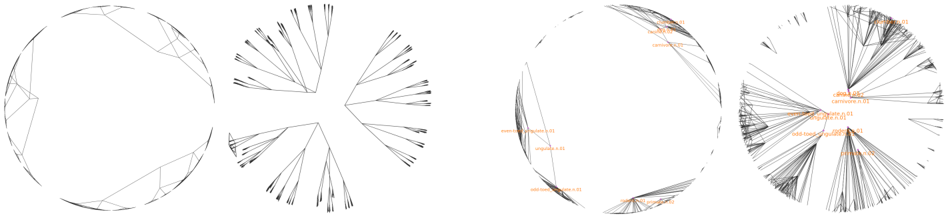
“However, the approach of (Nickel & Kiela, 2017) suffers from a few drawbacks: first, their loss function causes most points to collapse on the border of the Poincar´ e ball, as exemplified in Figure 3.”
What the sources say
- Partly supportedcites Nickel & Kiela, 2017 sourceExperimental — accuracy not yet measured
Section 3 (p. 4) says leaf nodes can be placed close to the Poincaré ball’s boundary to represent hierarchy. It does not say that most points collapse there, or that the loss function causes such a collapse. Section 3.2 (p. 5) instead describes a training step intended to avoid moving too far toward the boundary. (LLM, conf=0.83)
plaindirect- Asserted: passes — The authors put it forward as true.
- Checkable: passes — It can be checked against evidence.
- Load-bearing: passes — The paper’s conclusions depend on it.
- Based: passes — The paper gives a reason why it holds.
- Partly supported
Every source the paper cites for this claim was checked and supports it.
In the paper
“From a machine learning perspective, recently, hyperbolic spaces have been observed to provide powerful representations of entailment relations (Nickel & Kiela, 2017).”
What the sources say
- Supportedcites Nickel & Kiela, 2017 source
The Introduction (p. 2) reports that embeddings in hyperbolic space achieved state-of-the-art performance for lexical entailment. The Discussion (p. 8) likewise describes state-of-the-art lexical-entailment results, supporting the claim that hyperbolic spaces provide powerful representations of entailment relations. (LLM, conf=0.92)
plaincorrelational- Asserted: passes — The authors put it forward as true.
- Checkable: passes — It can be checked against evidence.
- Load-bearing: passes — The paper’s conclusions depend on it.
- Based: passes — The paper gives a reason why it holds.
- Supported
The cited sources that could be checked couldn’t confirm or dispute this claim.
In the paper
“This exponential growth property enables hyperbolic spaces to embed any weighted tree while almost preserving their metric 3 (Gromov, 1987; Bowditch, 2006; Sarkar, 2011).”
What the sources say
- Not checked — no full text of the sourcecites Gromov, 1987 source
- Not checked — no full text of the sourcecites Bowditch, 2006 source
- Could not verifycites Sarkar, 2011 sourceExperimental — accuracy not yet measured
The indexed matches contain only an Abstract and bibliographic metadata, not a passage from the paper’s full text that can serve as evidence under the stated rule. Searches for “exponential,” “growth,” and weighted-tree embedding found no qualifying full-text passage establishing the attributed explanation. (LLM, conf=0.72)
plaindirect- Asserted: passes — The authors put it forward as true.
- Checkable: passes — It can be checked against evidence.
- Load-bearing: passes — The paper’s conclusions depend on it.
- Based: passes — The paper gives a reason why it holds.
Every source the paper cites for this claim was checked and supports it.
In the paper
“For the hyperbolic models, we do not find significant empirical improvements when using full Riemannian optimization instead of approximating it with a retraction map as done in (Nickel & Kiela, 2017).”
What the sources say
- Supportedcites Nickel & Kiela, 2017 source
The citation identifies Nickel and Kiela’s use of a retraction map, not the citing authors’ empirical comparison. Section 3.1 (p. 5) explicitly gives the retraction operation and says it is used with the Riemannian gradient. (LLM, conf=0.93)
plain- Asserted: passes — The authors put it forward as true.
- Checkable: passes — It can be checked against evidence.
- Load-bearing: unclear — It is unclear whether the paper’s conclusions depend on it.
- Based: passes — The paper gives a reason why it holds.
- Supported
Every source the paper cites for this claim was checked and supports it.
In the paper
“We note that Poincar´ e and Simple Euclidean embeddings were trained using a symmetric distance function, and thus cannot be directly used to evaluate asymmetric entailment relations.”
What the sources say
- Supportedcites Nickel & Kiela, 2017 source
The Evaluation section (p. 5) says Poincaré and Euclidean distances give identical embeddings if the order of a pair is reversed, unlike an asymmetric translational score. In Lexical Entailment (p. 8), the authors add a norm-based penalty to score the direction of an is-a relation, consistent with the claim that the symmetric distances alone cannot directly evaluate it. (LLM, conf=0.90)
plaindirect- Asserted: passes — The authors put it forward as true.
- Checkable: passes — It can be checked against evidence.
- Load-bearing: passes — The paper’s conclusions depend on it.
- Based: passes — The paper gives a reason why it holds.
- Supported
Every source the paper cites for this claim was checked and supports it.
In the paper
“For the Simple Euclidean embeddings and Poincar´ e embeddings, we find the burn-in strategy of (Nickel & Kiela, 2017) to be essential for a good initial disentanglement.”
What the sources say
- Supportedcites Nickel & Kiela, 2017 source
Section 3.2 (p. 5) describes Nickel and Kiela’s initial burn-in phase with a reduced learning rate, so the citation correctly identifies the strategy. The statement that it is essential for initial disentanglement in Simple Euclidean and Poincaré embeddings is the citing authors’ own finding, not a result attributed to this source. (LLM, conf=0.90)
plaindirect- Asserted: passes — The authors put it forward as true.
- Checkable: passes — It can be checked against evidence.
- Load-bearing: unclear — It is unclear whether the paper’s conclusions depend on it.
- Based: passes — The paper gives a reason why it holds.
- Supported
The paper states this without a source or data behind it here, so there is nothing to check it against. The quote shows it is in the paper.
In the paper
“We prove that these entailment cones admit an optimal shape with a closed form expression both in the Euclidean and hyperbolic spaces, and they canonically define the embedding learning process.”
- Also stated in: § 1. Introduction · p. 2 · boosted
“The optimal entailment cones satisfying four natural properties surprisingly exhibit canonical closed-form expressions in both Euclidean and hyperbolic geometry that we rigorously derive.”
boosted- Asserted: passes — The authors put it forward as true.
- Checkable: passes — It can be checked against evidence.
- Load-bearing: passes — The paper’s conclusions depend on it.
- Based: passes — The paper gives a reason why it holds.
- The authors state this as an assumption: The optimal entailment cones should satisfy axial symmetry, rotation invariance, continuous aperture, and transitivity.
- Also stated in: § 1. Introduction · p. 2 · boosted
The paper states this without a source or data behind it here, so there is nothing to check it against. The quote shows it is in the paper.
In the paper
“which is also a sufficient condition for transitivity to hold:”
plaindirect- Asserted: passes — The authors put it forward as true.
- Checkable: passes — It can be checked against evidence.
- Load-bearing: passes — The paper’s conclusions depend on it.
- Based: passes — The paper gives a reason why it holds.
The paper states this without a source or data behind it here, so there is nothing to check it against. The quote shows it is in the paper.
In the paper
“Theorem 4. If ψ is defined as in Eqs.25-26, then transitivity holds.”
plaindirect- Asserted: passes — The authors put it forward as true.
- Checkable: passes — It can be checked against evidence.
- Load-bearing: passes — The paper’s conclusions depend on it.
- Based: passes — The paper gives a reason why it holds.
- The authors state this as an assumption: The optimal entailment cones should satisfy axial symmetry, rotation invariance, continuous aperture, and transitivity.
- It may state two separate claims as one. 15
- Probably not a substantial claim. 16
- The quote only partly states this claim. 3
Every source the paper cites for this claim was checked and supports it.
In the paper
“Second, the hyperbolic distance alone (being symmetric) is not capable of encoding asymmetric relations needed for entailment detection, thus a heuristic score is chosen to account for concept generality or specificity encoded in the embedding norm.”
What the sources say
- Supportedcites Nickel & Kiela, 2017 source
Section 4 (p. 5) says Poincaré distance is symmetric and that a symmetric distance does not retain the order of an is-a pair. Section 4.3 (pp. 7–8) uses a score for lexical entailment with a norm-based penalty when the proposed general concept lies lower in the embedding hierarchy. (LLM, conf=0.91)
plaindirect- Asserted: passes — The authors put it forward as true.
- Checkable: passes — It can be checked against evidence.
- Load-bearing: passes — The paper’s conclusions depend on it.
- Based: passes — The paper gives a reason why it holds.
It may state two separate claims as one.
- Supported
Every source the paper cites for this claim was checked and supports it.
In the paper
“The latent hierarchical structure surprisingly emerges as a simple reflection of the space's negative curvature.”
What the sources say
- Supportedcites Nickel & Kiela, 2017 source
Section 2 (p. 2) explains that hyperbolic space has negative curvature and can naturally model tree-like hierarchies. Section 3 (p. 4) says hierarchical organization arises from points’ distances to the origin and can be learned without specifying their order in advance, supporting the paraphrase. (LLM, conf=0.88)
plaindirect- Asserted: passes — The authors put it forward as true.
- Checkable: passes — It can be checked against evidence.
- Load-bearing: passes — The paper’s conclusions depend on it.
- Based: passes — The paper gives a reason why it holds.
Probably not a substantial claim.
- Supported
Every source the paper cites for this claim was checked and supports it.
In the paper
“Experiments show significant improvements of our method over strong recent baselines both in terms of representational capacity and generalization.”
- Also stated in: § 1. Introduction · p. 2 · plain
“Experimentally, we learn high quality embeddings and improve over experimental results in (Nickel & Kiela, 2017) and (Vendrov et al., 2015) on hypernymy link prediction for word embeddings, both in terms of capacity of the model and generalization performance.”
What the sources say
- Supportedcites Nickel & Kiela, 2017 source
Split into 2 atoms — 2 confirmed, 0 partially supported, 0 disputed, 0 misattributed, 0 unverifiable. Expand the claim to see per-atom verdicts.
- Supportedcites Vendrov et al., 2015 source
Vendrov et al. is an identifiable baseline for hypernymy prediction: Section 3 (p. 3) describes predicting withheld WordNet hypernym pairs, and Section 3.4 (p. 4) reports results for its order-embeddings model. The citing authors’ claim that their own method improves on this baseline is their experimental conclusion, not a result attributed to Vendrov et al. (LLM, conf=0.87)
boosteddirect- Asserted: passes — The authors put it forward as true.
- Checkable: passes — It can be checked against evidence.
- Load-bearing: passes — The paper’s conclusions depend on it.
- Based: passes — The paper gives a reason why it holds.
It may state two separate claims as one.
- Also stated in: § 1. Introduction · p. 2 · plain
The cited sources that could be checked couldn’t confirm or dispute this claim.
In the paper
“Conversely, any tree can be embedded with arbitrary low distortion into the Poincar´ e disk (with only 2 dimensions), whereas this is not true for Euclidean spaces even when an unbounded number of dimensions is allowed (Sarkar, 2011; De Sa et al., 2018).”
What the sources say
- Could not verifycites Sarkar, 2011 sourceExperimental — accuracy not yet measured
The indexed results for distortion, embedding, and hyperbolic space returned only abstract and bibliographic text, not a passage from the paper’s full text that can serve as evidence under this rubric. No eligible passage establishes the claim about arbitrarily low distortion in the Poincaré disk or the comparison with Euclidean spaces. (LLM, conf=0.62)
- Not matchedcites De Sa et al., 2018
Couldn’t be matched to a paper in Crossref, so it can’t be checked.
plain- Asserted: passes — The authors put it forward as true.
- Checkable: passes — It can be checked against evidence.
- Load-bearing: passes — The paper’s conclusions depend on it.
- Based: passes — The paper gives a reason why it holds.
It may state two separate claims as one.
- Could not verify
Every source the paper cites for this claim was checked and supports it.
In the paper
“We also compute an analytic closed-form expression for the exponential map in the n -dimensional Poincar´ e ball, allowing us to perform full Riemannian optimization (Bonnabel, 2013) in the Poincar´ e ball, as opposed to the approximate optimization method used by (Nickel & Kiela, 2017).”
What the sources say
- Supportedcites Bonnabel, 2013 source
Split into 2 atoms — 2 confirmed, 0 partially supported, 0 disputed, 0 misattributed, 0 unverifiable. Expand the claim to see per-atom verdicts.
- Supportedcites Nickel & Kiela, 2017 source
Split into 2 atoms — 2 confirmed, 0 partially supported, 0 disputed, 0 misattributed, 0 unverifiable. Expand the claim to see per-atom verdicts.
plaindirect- Asserted: passes — The authors put it forward as true.
- Checkable: passes — It can be checked against evidence.
- Load-bearing: passes — The paper’s conclusions depend on it.
- Based: passes — The paper gives a reason why it holds.
It may state two separate claims as one.
- Supported
The cited sources support only part of this claim — read each source’s verdict below.
In the paper
“Previous work (Nickel & Kiela, 2017) optimizing word embeddings in the Poincar´ e ball used the retraction map R x ( v ) := x + v as a first order approximation of exp x ( v ) .”
What the sources say
- Partly supportedcites Nickel & Kiela, 2017 sourceExperimental — accuracy not yet measured
Section 3.1 (p. 5) explicitly says the authors use the retraction Rθ(v) = θ + v for optimization in the Poincaré ball. The paper does not describe it in terms of an exponential-map approximation, and its Discussion (p. 8) treats models tailored to word embeddings as future work rather than the application optimized here. (LLM, conf=0.87)
plain- Asserted: passes — The authors put it forward as true.
- Checkable: passes — It can be checked against evidence.
- Load-bearing: fails — The paper’s conclusions may not depend on it.
- Based: passes — The paper gives a reason why it holds.
Probably not a substantial claim. The paper’s conclusions may not depend on it.
- Partly supported
The paper states this without a source or data behind it here, so there is nothing to check it against. The quote shows it is in the paper.
In the paper
“Theorem 1. (Unit-speed geodesics) Let x ∈ D n and v ∈ T x D n (= R n ) such that g D x ( v, v ) = 1 . The unitspeed geodesic γ x,v : R + → D n with γ x,v (0) = x and ˙ γ x,v (0) = v is given by”
plain- Asserted: passes — The authors put it forward as true.
- Checkable: passes — It can be checked against evidence.
- Load-bearing: fails — The paper’s conclusions may not depend on it.
- Based: passes — The paper gives a reason why it holds.
Probably not a substantial claim. The paper’s conclusions may not depend on it.
The paper states this without a source or data behind it here, so there is nothing to check it against. The quote shows it is in the paper.
In the paper
“Corollary 1.2. Given any arbitrary geodesic in D n , all its points are coplanar with the origin O .”
plain- Asserted: passes — The authors put it forward as true.
- Checkable: passes — It can be checked against evidence.
- Load-bearing: fails — The paper’s conclusions may not depend on it.
- Based: passes — The paper gives a reason why it holds.
Probably not a substantial claim. The paper’s conclusions may not depend on it.
The paper states this without a source or data behind it here, so there is nothing to check it against. The quote shows it is in the paper.
In the paper
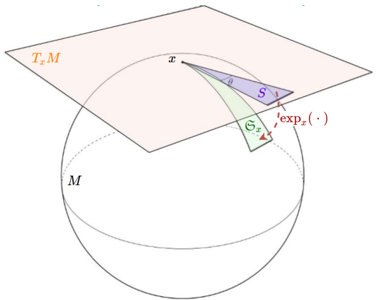
“We propose to replace the entailment regions O x of order-embeddings by a more efficient and generic class of objects, namely geodesically convex entailment cones . These cones are defined on a large class of Riemannian manifolds and induce a partial ordering relation in the embedding space.”
plaindirect- Asserted: passes — The authors put it forward as true.
- Checkable: passes — It can be checked against evidence.
- Load-bearing: passes — The paper’s conclusions depend on it.
- Based: passes — The paper gives a reason why it holds.
Probably not a substantial claim. It may state two separate claims as one.
- The authors state this as an assumption: Hierarchical relations can be modeled as partial orders defined using a family of nested geodesically convex cones.
- The authors state this as an assumption: The optimal entailment cones should satisfy axial symmetry, rotation invariance, continuous aperture, and transitivity.
The paper states this without a source or data behind it here, so there is nothing to check it against. The quote shows it is in the paper.
In the paper
“Corollary 1.1. (Exponential map) The exponential map at a point x ∈ D n , namely exp x : T x D n → D n , is given by”
plain- Asserted: passes — The authors put it forward as true.
- Checkable: passes — It can be checked against evidence.
- Load-bearing: fails — The paper’s conclusions may not depend on it.
- Based: passes — The paper gives a reason why it holds.
Probably not a substantial claim. The paper’s conclusions may not depend on it.
A result the paper reports from its own data — it cites no other source for it, so there is none to check. The quote shows it is in the paper.
In the paper
“It can be seen that our hyperbolic cones are better than all the baselines in all settings, except in the 0% setting for which order embeddings are better.”
plaincorrelational- Asserted: passes — The authors put it forward as true.
- Checkable: passes — It can be checked against evidence.
- Load-bearing: passes — The paper’s conclusions depend on it.
- Based: passes — The paper gives a reason why it holds.
It may state two separate claims as one.
- Rests on an assumption: The basic edges (transitive reduction) are hard to predict.
- Rests on an assumption: The tree root carries little information and only has trivial edges to predict.
- Rests on an assumption: The WordNet noun hierarchy exhibits a latent hierarchical structure.
The paper states this without a source or data behind it here, so there is nothing to check it against. The quote shows it is in the paper.
In the paper
“which gives both a restriction on ϵ (in terms of K ):”
- Also stated in: § 3. Entailment Cones in the Poincar´ e Ball · p. 6 · plain
“as well as a closed form expression for ψ”
plaindirect- Asserted: passes — The authors put it forward as true.
- Checkable: passes — It can be checked against evidence.
- Load-bearing: passes — The paper’s conclusions depend on it.
- Based: passes — The paper gives a reason why it holds.
It may state two separate claims as one.
- Also stated in: § 3. Entailment Cones in the Poincar´ e Ball · p. 6 · plain
The paper states this without a source or data behind it here, so there is nothing to check it against. The quote shows it is in the paper.
In the paper
“Moreover, we have the following equivalent expression of the Poincar´ e entailment cones satisfying Eq. 26:”
plaincorrelational- Asserted: passes — The authors put it forward as true.
- Checkable: passes — It can be checked against evidence.
- Load-bearing: passes — The paper’s conclusions depend on it.
- Based: passes — The paper gives a reason why it holds.
It may state two separate claims as one. The quote only partly states this claim.
- The authors state this as an assumption: The optimal entailment cones should satisfy axial symmetry, rotation invariance, continuous aperture, and transitivity.
A result the paper reports from its own data — it cites no other source for it, so there is none to check. The quote shows it is in the paper.
In the paper
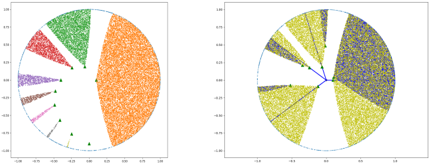
“This figure also shows that transitivity is satisfied for some points on the border of the hypercones.”
plain- Asserted: passes — The authors put it forward as true.
- Checkable: passes — It can be checked against evidence.
- Load-bearing: fails — The paper’s conclusions may not depend on it.
- Based: passes — The paper gives a reason why it holds.
Probably not a substantial claim. The paper’s conclusions may not depend on it.
The paper states this without a source or data behind it here, so there is nothing to check it against. The quote shows it is in the paper.
In the paper
“Theorem 3. If transitivity holds, then the function”
plaindirect- Asserted: passes — The authors put it forward as true.
- Checkable: passes — It can be checked against evidence.
- Load-bearing: passes — The paper’s conclusions depend on it.
- Based: passes — The paper gives a reason why it holds.
The quote only partly states this claim.
- The authors state this as an assumption: The optimal entailment cones should satisfy axial symmetry, rotation invariance, continuous aperture, and transitivity.
The paper states this without a source or data behind it here, so there is nothing to check it against. The quote shows it is in the paper.
In the paper
“One can easily adapt the above proofs to derive entailment cones in the Euclidean space ( R n , g E ) . The only adaptations are: i) replace the hyperbolic cosine law by usual Euclidean cosine law, ii) geodesics are straight lines, and iii) the exponential map is given by exp x ( v ) = x + v . Thus, one similarly obtains that h ( r ) = r sin( ψ ( r )) is non-decreasing, the optimal values of ψ are”
plaindirect- Asserted: passes — The authors put it forward as true.
- Checkable: passes — It can be checked against evidence.
- Load-bearing: fails — The paper’s conclusions may not depend on it.
- Based: passes — The paper gives a reason why it holds.
Probably not a substantial claim. The paper’s conclusions may not depend on it. It may state two separate claims as one. The quote only partly states this claim.
- The authors state this as an assumption: The optimal entailment cones should satisfy axial symmetry, rotation invariance, continuous aperture, and transitivity.
In the paper
“Then, the hyperbolic laws of cosines and sines hold respectively”
What the sources say
- Not matchedcites Parkkonen, 2013
Couldn’t be matched to a paper in Crossref, so it can’t be checked.
plain- Asserted: passes — The authors put it forward as true.
- Checkable: passes — It can be checked against evidence.
- Load-bearing: fails — The paper’s conclusions may not depend on it.
- Based: passes — The paper gives a reason why it holds.
Probably not a substantial claim. The paper’s conclusions may not depend on it.
- Not matched
A claim is checked only against the cited paper’s full text, never its abstract, and none is available for its sources.
In the paper
“For instance, the Euclidean space R n for n ≥ 2 is not δ -hyperbolic for any δ ≥ 0 , while the Poincar´ e ball D n is log(1+ √ 2) -hyperbolic.”
What the sources say
plain- Asserted: passes — The authors put it forward as true.
- Checkable: passes — It can be checked against evidence.
- Load-bearing: passes — The paper’s conclusions depend on it.
- Based: passes — The paper gives a reason why it holds.
It may state two separate claims as one.
In the paper
“We know from the Hopf-Rinow theorem that the hyperbolic space is complete as a metric space. This guarantees that D n is geodesically complete.”
What the sources say
- Not matchedcites Hopf-Rinow theorem
Couldn’t be matched to a paper in Crossref, so it can’t be checked.
boosteddirect- Asserted: passes — The authors put it forward as true.
- Checkable: passes — It can be checked against evidence.
- Load-bearing: fails — The paper’s conclusions may not depend on it.
- Based: passes — The paper gives a reason why it holds.
Probably not a substantial claim. The paper’s conclusions may not depend on it. It may state two separate claims as one.
- Not matched
None of the sources cited for this claim have been checked yet.
In the paper
“Moreover, the regions O x suffer from heavy intersections, implying that their disjoint volumes rapidly become bounded 2 .”
plaindirect- Asserted: passes — The authors put it forward as true.
- Checkable: passes — It can be checked against evidence.
- Load-bearing: passes — The paper’s conclusions depend on it.
- Based: passes — The paper gives a reason why it holds.
It may state two separate claims as one.
The paper states this without a source or data behind it here, so there is nothing to check it against. The quote shows it is in the paper.
In the paper
“Note that for hyperbolic space models the injectivity radius of the tangent space at any point is infinite, thus no restriction is needed.”
plaindirect- Asserted: passes — The authors put it forward as true.
- Checkable: passes — It can be checked against evidence.
- Load-bearing: passes — The paper’s conclusions depend on it.
- Based: fails — The paper may give no reason why it holds.
Probably not a substantial claim. The paper may give no reason why it holds. It may state two separate claims as one.
- The authors state this as an assumption: The exponential map should be injective.
None of the sources cited for this claim have been checked yet.
In the paper
“The hyperbolic space has five models which are often insightful to work in. They are isometric to each other and conformal to the Euclidean space (Cannon et al., 1997; Parkkonen, 2013) 4 .”
What the sources say
- Not checked — no full text of the sourcecites Cannon et al., 1997 source
- Not matchedcites Parkkonen, 2013
Couldn’t be matched to a paper in Crossref, so it can’t be checked.
plain- Asserted: passes — The authors put it forward as true.
- Checkable: passes — It can be checked against evidence.
- Load-bearing: fails — The paper’s conclusions may not depend on it.
- Based: passes — The paper gives a reason why it holds.
Probably not a substantial claim. The paper’s conclusions may not depend on it. It may state two separate claims as one.
A conclusion the paper draws from its own results — it cites no other source for it, so there is none to check. The quote shows it is in the paper.
In the paper
“As a consequence, representing wide (with high branching factor) and deep hierarchical structures in a bounded region of the Euclidean space would cause many points to end up undesirably close to each other. This also implies that Euclidean distances would no longer be capable of reflecting the original tree metric.”
hedgeddirect- Asserted: passes — The authors put it forward as true.
- Checkable: passes — It can be checked against evidence.
- Load-bearing: passes — The paper’s conclusions depend on it.
- Based: passes — The paper gives a reason why it holds.
It may state two separate claims as one.
The paper states this without a source or data behind it here, so there is nothing to check it against. The quote shows it is in the paper.
In the paper
“Geodesics in D n are all intersections of the Euclidean unit ball D n with (degenerated) Euclidean circles orthogonal to the unit sphere ∂ D n (equations are derived below).”
plain- Asserted: passes — The authors put it forward as true.
- Checkable: passes — It can be checked against evidence.
- Load-bearing: fails — The paper’s conclusions may not depend on it.
- Based: passes — The paper gives a reason why it holds.
Probably not a substantial claim. The paper’s conclusions may not depend on it.
In the paper
“It is (up to isometry) uniquely characterized as a complete, simply connected Riemannian manifold with constant negative curvature (Cannon et al., 1997).”
What the sources say
- Not checked — no full text of the sourcecites Cannon et al., 1997 source
plain- Asserted: passes — The authors put it forward as true.
- Checkable: passes — It can be checked against evidence.
- Load-bearing: fails — The paper’s conclusions may not depend on it.
- Based: passes — The paper gives a reason why it holds.
Probably not a substantial claim. The paper’s conclusions may not depend on it.
A conclusion the paper draws from its own results — it cites no other source for it, so there is none to check. The quote shows it is in the paper.
In the paper
“From a learning perspective, there is no need to be concerned about the Riemannian optimization described in Section 4.2, as the usual Euclidean gradient-step is used in this case.”
plain- Asserted: passes — The authors put it forward as true.
- Checkable: passes — It can be checked against evidence.
- Load-bearing: fails — The paper’s conclusions may not depend on it.
- Based: passes — The paper gives a reason why it holds.
Probably not a substantial claim. The paper’s conclusions may not depend on it.
A conclusion the paper draws from its own results — it cites no other source for it, so there is none to check. The quote shows it is in the paper.
In the paper
“Since we are interested in cones with an aperture as large as possible (to maximize model capacity), it is natural to set all terms h ( r ) equal to K := h ( ϵ ) , i.e. to make h constant:”
plaindirect- Asserted: passes — The authors put it forward as true.
- Checkable: passes — It can be checked against evidence.
- Load-bearing: passes — The paper’s conclusions depend on it.
- Based: passes — The paper gives a reason why it holds.
Probably not a substantial claim.
- The authors state this as an assumption: Cones should have an aperture as large as possible to maximize model capacity.
The authors state this as an assumption.
The origin should entail the entire space D^n, i.e. S_0 = D^n.
“we first note that the origin should 'entail' the entire space D n , i.e. S 0 = D n .”
The authors state this as an assumption.
Cones should have an aperture as large as possible to maximize model capacity.
“Since we are interested in cones with an aperture as large as possible (to maximize model capacity)”
The authors state this as an assumption.
The exponential map should be injective.
“Note that, in the above definition, we desire that the exponential map be injective.”
The authors state this as an assumption.
Hierarchical relations can be modeled as partial orders defined using a family of nested geodesically convex cones.
“we view hierarchical relations as partial orders defined using a family of nested geodesically convex cones.”
The authors state this as an assumption.
The optimal entailment cones should satisfy axial symmetry, rotation invariance, continuous aperture, and transitivity.
“we want the definition of cones to exhibit the following four intuitive properties detailed below.”
The paper relies on this without support.
The basic edges (transitive reduction) are hard to predict.
“These edges are hard to predict, so we will always include them in the training set.”
The paper relies on this without support.
The tree root carries little information and only has trivial edges to predict.
“We remove the tree root since it carries little information and only has trivial edges to predict.”
The paper relies on this without support.
Hyperbolic geometry is powerful for embedding hierarchical structures.
“Hyperbolic geometry has proven to be powerful for embedding hierarchical structures.”
The paper relies on this without support.
The WordNet noun hierarchy exhibits a latent hierarchical structure.
“We evaluate the representational and generalization power of hyperbolic entailment cones and of other baselines using data that exhibits a latent hierarchical structure.”
Claims other papers make about this one
Each is checked against this paper’s own text: does it say what the citing paper says it does?
The cited source says what the claim attributes to it.
In the citing paper
“The goal is to model partial order by containment relationship between cones, in particular, the entailment cones satisfy transitivity:”
From Modeling Heterogeneous Hierarchies with Relation-specific Hyperbolic Cones (2021) · cites this paper as [12]
The cited source says what the claim attributes to it.
In the citing paper
“As suggested in [12], hyperbolic cone is hard to optimize with randomized initialization”
From Modeling Heterogeneous Hierarchies with Relation-specific Hyperbolic Cones (2021) · cites this paper as [12]
The cited source says what the claim attributes to it.
In the citing paper
“Hyperbolic entailment cones (Ganea et al., 2018) combine order embeddings with hyperbolic geometry.”
From Probabilistic Box Embeddings for Uncertain Knowledge Graph Reasoning (2021) · cites this paper as Ganea et al., 2018
Citations
Cites
Glove: Global Vectors for Word Representation
Pennington, J., Socher, R., & Manning, C. (2014) · Proceedings of the 2014 Conference on Empirical Methods in Natural Language Processing (EMNLP) · doi:10.3115/v1/d14-1162 · Cited by 34,071 · cited 3×
“A large line of research focuses on embedding discrete data such as graphs (Grover & Leskovec, 2016; Goyal & Ferrara, 2017) or linguistic instances (Mikolov et al., 2013; Pennington et al., 2014; Kiros et al., 2015) into continuous spaces that exhibit certain desirable geometric properties.”
BackgroundDistributed Representations of Words and Phrases and their Compositionality
Mikolov, T., Sutskever, I., Chen, K., Corrado, G., & Dean, J. (2013) · arXiv · doi:10.48550/arxiv.1310.4546 · Cited by 24,533 · cited 3×
“A large line of research focuses on embedding discrete data such as graphs (Grover & Leskovec, 2016; Goyal & Ferrara, 2017) or linguistic instances (Mikolov et al., 2013; Pennington et al., 2014; Kiros et al., 2015) into continuous spaces that exhibit certain desirable geometric properties.”
Backgroundnode2vec: Scalable Feature Learning for Networks
Grover, A., & Leskovec, J. (2016) · Proceedings of the 22nd ACM SIGKDD International Conference on Knowledge Discovery and Data Mining · doi:10.1145/2939672.2939754 · Cited by 10,926 · cited 1×
“A large line of research focuses on embedding discrete data such as graphs (Grover & Leskovec, 2016; Goyal & Ferrara, 2017) or linguistic instances (Mikolov et al., 2013; Pennington et al., 2014; Kiros et al., 2015) into continuous spaces that exhibit certain desirable geometric properties.”
Background(2013) · Cited by 5,726
Introduction to WordNet: An On-line Lexical Database *
Miller, G. A., Beckwith, R., Fellbaum, C., Gross, D., & Miller, K. J. (1990) · International Journal of Lexicography · doi:10.1093/ijl/3.4.235 · Cited by 4,197 · cited 2×
“, 2015) and use the full transitive closure of the WordNet noun hierarchy (Miller et al., 1990).”
BackgroundMethodGeometric Deep Learning: Going beyond Euclidean data
Bronstein, M. M., Bruna, J., LeCun, Y., Szlam, A., & Vandergheynst, P. (2017) · IEEE Signal Processing Magazine · doi:10.1109/msp.2017.2693418 · Cited by 3,661 · cited 2×
“, 2001), Social Networks), one has to deal with data whose latent anatomy is best defined by nonEuclidean spaces such as Riemannian manifolds (Bronstein et al., 2017).”
BackgroundA Comprehensive Introduction to Differential Geometry.
Kramer, A. D., & Spivak, M. (1973) · American Mathematical Monthly · doi:10.2307/2319112 · Cited by 3,525 · cited 1×
“For an in-depth introduction, we refer the reader to (Spivak, 1979) and (Hopper & Andrews, 2010).”
MethodLatent Space Approaches to Social Network Analysis
Hoff, P. D., Raftery, A. E., & Handcock, M. S. (2002) · Journal of the American Statistical Association · doi:10.1198/016214502388618906 · Cited by 1,917 · cited 2×
“…for various tasks and applications, such as link prediction in knowledge bases (Nickel et al., 2011; Bor-des et al., 2013) or in social networks (Hoff et al., 2002), text disambiguation (Ganea & Hofmann, 2017), word hyper-nymy (Shwartz et al., 2016), textual entailment (Rockt¨aschel et al.,…”
BackgroundGromov, M. (1987) · Mathematical Sciences Research Institute Publications · doi:10.1007/978-1-4613-9586-7_3 · Cited by 1,817
A Three-Way Model for Collective Learning on Multi-Relational Data
Nickel, M., Tresp, V., & Kriegel, H. (2011) · Cited by 1,806
Research works printed but not linked: 1
- Bl¨ asius, T., Friedrich, T., Krohmer, A., and Laue, S. Efficient embedding of scale-free graphs in the hyperbolic plane. In LIPIcs-Leibniz International Proceedings in Informatics , volume 57. Schloss Dagstuhl-Leibniz-Zentrum fuer Informatik, 2016.
Cited by
Sorted by citations
Hyperbolic Neural NetworksPreprint
Ganea, O.-E., Bécigneul, G., & Hofmann, T. (2018) · arXiv (Cornell University) · doi:10.48550/arxiv.1805.09112 · Cited by 347
Self-citationHyperbolic Deep Neural Networks: A Survey
Peng, W., Varanka, T., Mostafa, A., Shi, H., & Zhao, G. (2021) · IEEE Transactions on Pattern Analysis and Machine Intelligence · doi:10.1109/tpami.2021.3136921 · Cited by 252
“TextHyper [66] 2018 AE(GRUs) Text Embedding B Google NAACL W h-MDS [68] 2018 Embedding Tree and tree-like data modeling B Stanford PMLR HyperQA [139] 2018 Encoder-Decoder Neural Question Answering B NTU WSDM HyperCone [140] 2018 Embedding NLP and Graph B ETH Zürich ICML HNN [23] 2018 RNN NLP(textual entailment and noi…”
MethodDeep Hierarchical Semantic Segmentation
Li, L., Zhou, T., Wang, W., Li, J., & Yang, Y. (2022) · IEEE Computer Society Conference on Computer Vision and Pattern Recognition/Proceedings - IEEE Computer Society Conference on Computer Vision and Pattern Recognition/Proceedings · doi:10.1109/cvpr52688.2022.00131 · Cited by 212
“Table 9 shows that Cosine distance performs much better than Euclidean distance, corroborating relevant observations in [26,59,65].”
BackgroundA comprehensive overview of knowledge graph completion
Shen, T., Zhang, F., & Cheng, J. (2022) · Knowledge-Based Systems · doi:10.1016/j.knosys.2022.109597 · Cited by 171
Hyperbolic Visual Embedding Learning for Zero-Shot Recognition
Liu, S., Chen, J., Pan, L., Ngo, C., Chua, T., & Jiang, Y. (2020) · IEEE Computer Society Conference on Computer Vision and Pattern Recognition/Proceedings - IEEE Computer Society Conference on Computer Vision and Pattern Recognition/Proceedings · doi:10.1109/cvpr42600.2020.00929 · Cited by 143
“It has been shown that Hyperbolic space is particularly suitable for modeling hierarchical data [26, 13].”
BackgroundMethod
Metadata
- Authors
- Ganea, O.-E., Bécigneul, G., & Hofmann, T.
- Affiliations
- ETH Zurich (CH)
- ORCID
- Hofmann, Thomas
- Venue
- arXiv
- Publisher
- arXiv
- Published
- 2018
- Volume
- 4
- Pages
- 1646-1655
- ISSN
- 2331-8422 (ISSN-L)
- arXiv
- 1804.01882
- OpenAlex
- W2796314760
- Cited by
- 115
- References
- 31
- Citations by year
- 2025: 7 · 2024: 18 · 2023: 15 · 2022: 15 · 2021: 22 · 2020: 19 · 2019: 16 · 2018: 3
- Type
- posted content
- Language
- en
- Open access
- green
- arxiv.org
- Locations
- arXiv (Cornell University) (submittedVersion)
- arXiv (Cornell University)
- International Conference on Machine Learning
- Funders
- National Science Foundation
- Schweizerischer Nationalfonds zur Förderung der Wissenschaftlichen Forschung (167176)
- Topics
- Physical Sciences › Computer Science › Artificial Intelligence › Advanced Graph Neural Networks
- Physical Sciences › Computer Science › Computational Theory and Mathematics › Topological and Geometric Data Analysis
- Physical Sciences › Computer Science › Artificial Intelligence › Neural Networks and Applications
- Keywords
- hyperbolic embeddings, directed acyclic graphs, hierarchical embedding, partially ordered sets, graph representation learning, tree-like structures, hyperbolic geometry
About these checks
Registry, retraction, Cites and statistics results are computed, not judged, with one exception: a printed reference that no index lists is read once by a model before it counts as a citation error. Claims are extracted by a model and kept only when their quote appears verbatim in the text; each cited source is then checked, with a model’s help, for whether it says what the claim relies on. Those verdicts can be wrong — read the claim’s quote and the cited source before relying on one.
A language model drew the claims from the paper on 2026-10-23, under version 3 of the claim definition (model deepseek-v4.1-flash, prompt extract-v3).
A second model labelled each claim on 2026-10-23 (model jev-1.13-20260917, definition revision gold-guideline-v0.2).
Cited sources are checked with a language model’s help (gpt-6-sol).
Statistics and arithmetic are recomputed, not judged.
Confidence bands are shown only for fields calibrated on our annotated test set. None is calibrated yet, so no band is shown.
What counts as a claim ›How we measure confidence ›How we check this ›
Are you an author, or do you see a problem with this page? Request a review
