

Shepherding in a Self-Gravitating Disk of Trans-Neptunian Objects
Open accessThe DOI matches its DataCite record; 58 of the 59 references it cites were found in a registry or an index.
Abstract
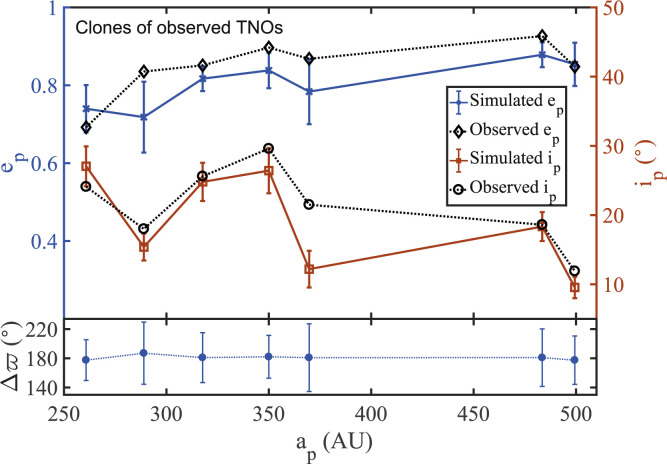
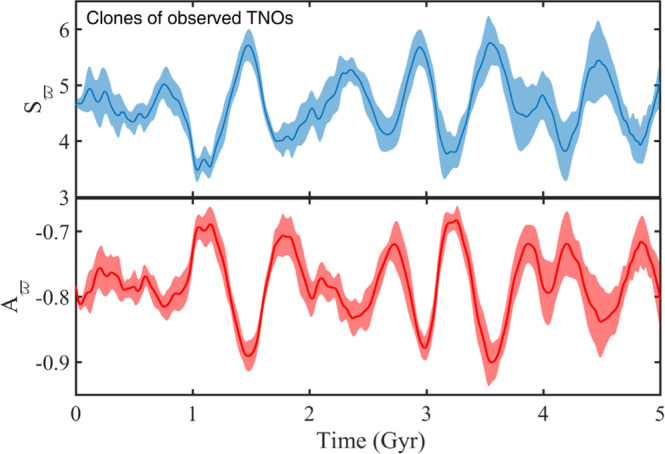
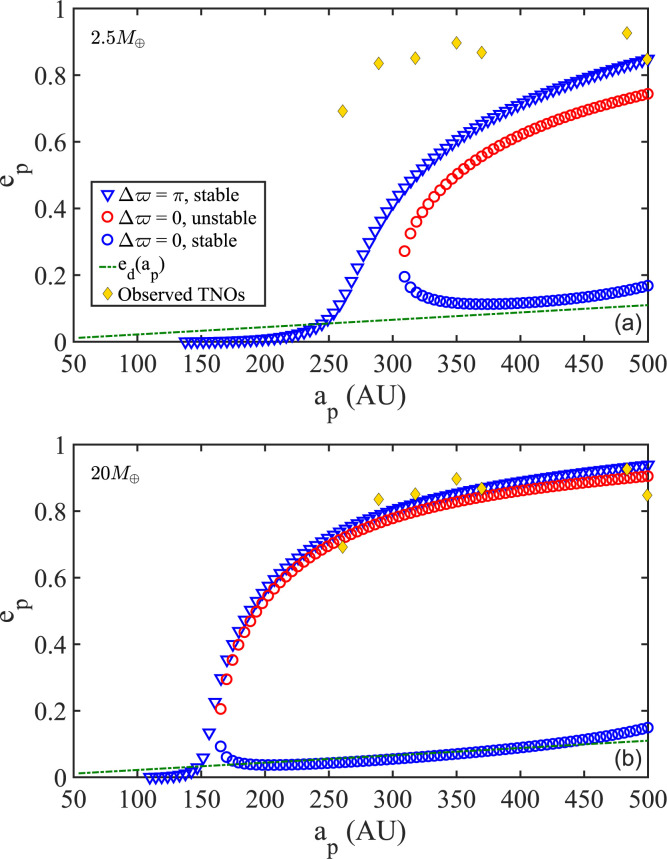
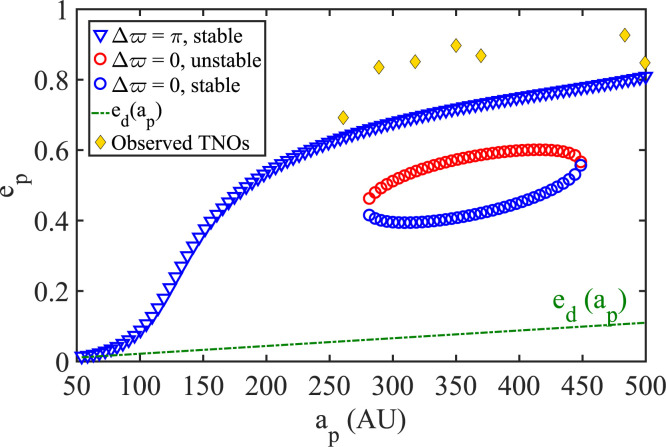
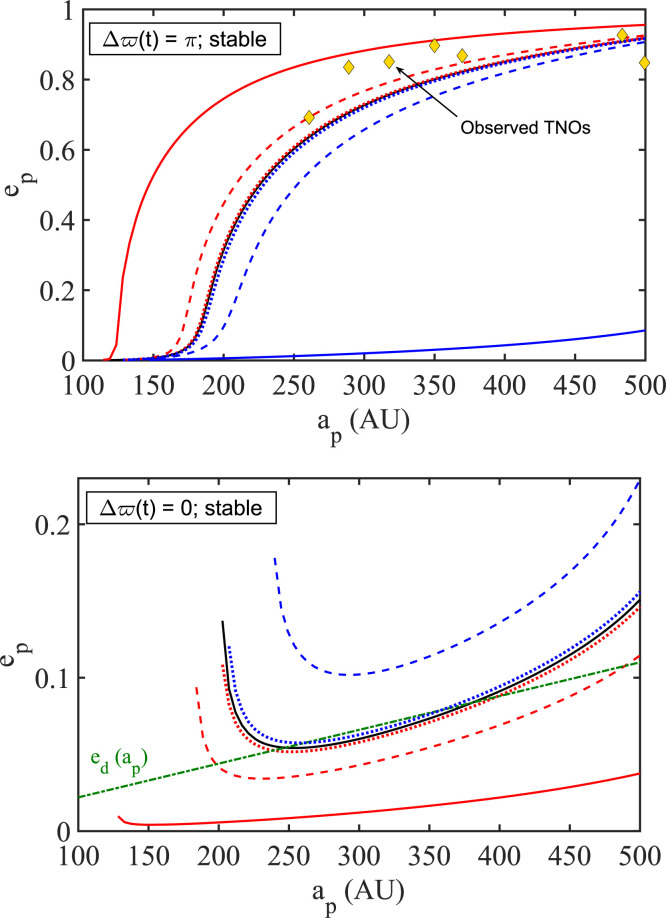
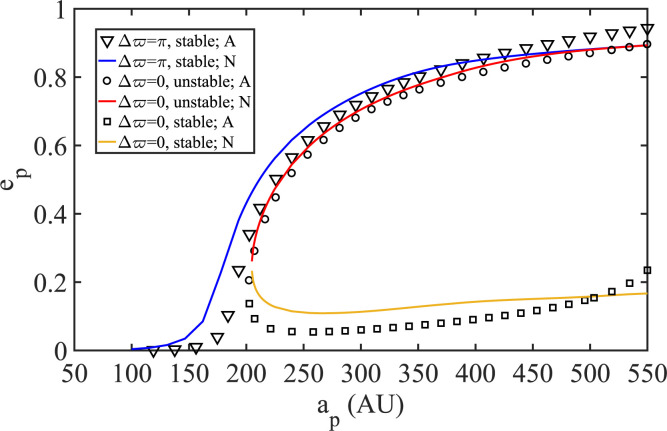
A relatively massive and moderately eccentric disk of trans-Neptunian objects (TNOs) can effectively counteract apse precession induced by the outer planets, and in the process shepherd highly eccentric members of its population into nearly-stationary configurations which are anti-aligned with the disk itself. We were sufficiently intrigued by this remarkable feature to embark on an extensive exploration of the full spatial dynamics sustained by the combined action of giant planets and a massive trans-Neptunian debris disk. In the process, we identified ranges of disk mass, eccentricity and precession rate which allow apse-clustered populations that faithfully reproduce key orbital properties of the much discussed TNO population. The shepherding disk hypothesis is to be sure complementary to any potential ninth member of the Solar System pantheon, and could obviate the need for it altogether. We discuss its essential ingredients in the context of Solar System formation and evolution, and argue for their naturalness in view of the growing body of observational and theoretical knowledge about self-gravitating disks around massive bodies, extra-solar debris disks included.
Overview
The claims and statistics of this paper haven’t been checked yet.
Free: it reads the open-access text and checks the first 5 claims that cite a source we can check. Create a free account to check every claim.
Integrity signals
Registry
Cites
Statistics
Figures
Verification
Claims the paper makes
The claims and statistics of this paper haven’t been checked yet.
Free: it reads the open-access text and checks the first 5 claims that cite a source we can check. Create a free account to check every claim.
Claims other papers make about this one
Each is checked against this paper’s own text: does it say what the citing paper says it does?
The source backs part of the claim, not all of it — or backs it for a different population, condition or comparison.
In the citing paper
“Nevertheless, from the point of view of planet formation, the prolonged existence of the envisioned shepherding disk su ers from many of the same drawbacks outlined in section 7.1 (e.g., radiative stripping of r ≳ 50 AU protoplanetary disk material, disruptive perturbations due to passing stars in the birth cluster, etc.) as well as the apparent incompatibility with the striking decrease in ob”
From The planet nine hypothesis (2019) · cites this paper as Sefilian & Touma (2018)
Experimental — accuracy not yet measured
Self-check
Percentages, sums and reported differences re-computed from the paper’s own numbers.
The self-check needs the paper’s full text.
Citations
Cites
Table of Integrals, Series, and Products
(1980) · Elsevier eBooks · doi:10.1016/c2013-0-10754-4 · Cited by 18,782
Evidence for a Distant Giant Planet in the Solar System
Batygin, K., & Brown, M. E. (2016) · The Astronomical Journal · doi:10.3847/0004-6256/151/2/22 · Cited by 432
Comet showers and the steady-state infall of comets from the Oort cloud
Hills, J. G. (1981) · The Astronomical Journal · doi:10.1086/113058 · Cited by 366
A Sedna-like body with a perihelion of 80 astronomical units
Trujillo, C. A., & Sheppard, S. S. (2014) · Nature · doi:10.1038/nature13156 · Cited by 303
The Structure of the Kuiper Belt: Size Distribution and Radial Extent
Gladman, B., Kavelaars, J. J., Petit, J.-M., Morbidelli, A., Holman, M. J., & Loredo, T. (2001) · The Astronomical Journal · doi:10.1086/322080 · Cited by 241
Hahn, J. M., & Malhotra, R. (2005) · The Astronomical Journal · doi:10.1086/452638 · Cited by 198
An Eccentric-Disk Model for the Nucleus of M31
Tremaine, S. (1995) · The Astronomical Journal · doi:10.1086/117548 · Cited by 187
Collisional Cascades in Planetesimal Disks. II. Embedded Planets
Kenyon, S. J., & Bromley, B. C. (2004) · The Astronomical Journal · doi:10.1086/379854 · Cited by 184
Planetesimal Formation by the Streaming Instability in a Photoevaporating Disk
Carrera, D., Gorti, U., Johansen, A., & Davies, M. B. (2017) · The Astrophysical Journal · doi:10.3847/1538-4357/aa6932 · Cited by 162
Non-linear fluid dynamics of eccentric discs
Ogilvie, G. I. (2001) · Monthly Notices of the Royal Astronomical Society · doi:10.1046/j.1365-8711.2001.04416.x · Cited by 157
Research works printed but not linked: 1
- Sefilian, A. A. 2017, MSc Thesis, American Univ. of Beirut
Cited by
Batygin, K., Adams, F. C., Brown, M. E., & Becker, J. C. (2019) · Physics Reports · doi:10.1016/j.physrep.2019.01.009 · Cited by 181
What if Planet 9 is a Primordial Black Hole?
Scholtz, J., & Unwin, J. (2020) · Physical Review Letters · doi:10.1103/physrevlett.125.051103 · Cited by 95
A New High Perihelion Trans-Plutonian Inner Oort Cloud Object: 2015 TG387
Sheppard, S. S., Trujillo, C. A., Tholen, D. J., & Kaib, N. (2019) · The Astronomical Journal · doi:10.3847/1538-3881/ab0895 · Cited by 62
Sefilian, A. A., Rafikov, R. R., & Wyatt, M. C. (2021) · The Astrophysical Journal · doi:10.3847/1538-4357/abda46 · Cited by 59
Self-citationPerspectives on the distribution of orbits of distant Trans-Neptunian objects
Kavelaars, J. J., Lawler, S. M., Bannister, M. T., & Shankman, C. (2019) · Elsevier eBooks · doi:10.1016/b978-0-12-816490-7.00003-5 · Cited by 38
Sefilian, A. A., Rafikov, R. R., & Wyatt, M. C. (2023) · The Astrophysical Journal · doi:10.3847/1538-4357/ace68e · Cited by 28
Self-citationOSSOS. XV. Probing the Distant Solar System with Observed Scattering TNOs
Kaib, N. A., Pike, R., Lawler, S., Kovalik, M., Brown, C., Alexandersen, M., Bannister, M. T., Gladman, B. J., & Petit, J.-M. (2019) · The Astronomical Journal · doi:10.3847/1538-3881/ab2383 · Cited by 27
The case of HD 106906 debris disc: a binary’s revenge
Farhat, M. A., Sefilian, A. A., & Touma, J. (2023) · Monthly Notices of the Royal Astronomical Society · doi:10.1093/mnras/stad316 · Cited by 26
Self-citationSecular Transport during Disk Dispersal: The Case of Kepler-419
Petrovich, C., Wu, Y., & Ali-Dib, M. (2018) · The Astronomical Journal · doi:10.3847/1538-3881/aaeed9 · Cited by 25
Injection of Inner Oort Cloud Objects into the Distant Kuiper Belt by Planet Nine
Batygin, K., & Brown, M. E. (2021) · The Astrophysical Journal Letters · doi:10.3847/2041-8213/abee1f · Cited by 23
A Pan-STARRS1 Search for Planet Nine
Brown, M. E., Holman, M. J., & Batygin, K. (2024) · The Astronomical Journal · doi:10.3847/1538-3881/ad24e9 · Cited by 23
Sefilian, A. A., Kratter, K. M., Wyatt, M. C., Petrovich, C., Thébault, P., Malhotra, R., & Faramaz, V. (2025) · Monthly Notices of the Royal Astronomical Society · doi:10.1093/mnras/staf1555 · Cited by 22
Self-citationSefilian, A. A. (2024) · The Astrophysical Journal · doi:10.3847/1538-4357/ad32d1 · Cited by 22
Self-citationOn the Dust Signatures Induced by Eccentric Super-Earths in Protoplanetary Disks
李, Y.-P. 亚.-平. L., 李, H. 晖. L., Li, S., & 林, D. N. C. 潮. L. (2019) · The Astrophysical Journal · doi:10.3847/1538-4357/ab4bc8 · Cited by 21
On the Dynamics of the Inclination Instability
Madigan, A.-M., Zderic, A., McCourt, M., & Fleisig, J. (2018) · The Astronomical Journal · doi:10.3847/1538-3881/aad95c · Cited by 19
Limits on the Detection of Planet Nine in the Dark Energy Survey
Belyakov, M., Bernardinelli, P. H., & Brown, M. E. (2022) · The Astronomical Journal · doi:10.3847/1538-3881/ac5c56 · Cited by 18
Potential softening and eccentricity dynamics in razor-thin, nearly Keplerian discs
Sefilian, A. A., & Rafikov, R. R. (2019) · Monthly Notices of the Royal Astronomical Society · doi:10.1093/mnras/stz2412 · Cited by 16
Self-citationGiant-planet Influence on the Collective Gravity of a Primordial Scattered Disk
Zderic, A., & Madigan, A.-M. (2020) · The Astronomical Journal · doi:10.3847/1538-3881/ab962f · Cited by 14
Generation of Low-inclination, Neptune-crossing Trans-Neptunian Objects by Planet Nine
Batygin, K., Morbidelli, A., Brown, M. E., & Nesvorný, D. (2024) · The Astrophysical Journal Letters · doi:10.3847/2041-8213/ad3cd2 · Cited by 11
Apsidal Clustering following the Inclination Instability
Zderic, A., Collier, A., Tiongco, M. A., & Madigan, A.-M. (2020) · The Astrophysical Journal Letters · doi:10.3847/2041-8213/ab91a0 · Cited by 11
Secular Evolution Driven by Massive Eccentric Disks/Rings: An Apsidally Aligned Case
Davydenkova, I., & Rafikov, R. R. (2018) · The Astrophysical Journal · doi:10.3847/1538-4357/aad3ba · Cited by 11
Observational constraints on an undiscovered giant planet in our solar system
Trujillo, C. A. (2019) · Elsevier eBooks · doi:10.1016/b978-0-12-816490-7.00004-7 · Cited by 10
The Resonance Hopping Effect in the Neptune-planet Nine System
Khain, T., Becker, J. C., & Adams, F. C. (2020) · Publications of the Astronomical Society of the Pacific · doi:10.1088/1538-3873/abbd8a · Cited by 9
On the origin of extreme trans-Neptunian objects within Modified Newtonian Dynamics
Migaszewski, C. (2023) · Monthly Notices of the Royal Astronomical Society · doi:10.1093/mnras/stad2250 · Cited by 8
Farhat, M. A., & Touma, J. (2021) · Monthly Notices of the Royal Astronomical Society · doi:10.1093/mnras/stab2490 · Cited by 8
Self-citationDynamical evolution of a self-gravitating planetesimal disk in the distant trans-Neptunian region
Emel’yanenko, V. V. (2022) · Astronomy and Astrophysics · doi:10.1051/0004-6361/202243324 · Cited by 7
Millimeter Dust Emission and Planetary Dynamics in the HD 106906 System
Fehr, A. J., Hughes, A. M., Dawson, R. I., Marino, R. E., Ackelsberg, M., Kittling, J., Flaherty, K., Nesvold, E., Carpenter, J. M., Andrews, S. M., et al. (2022) · The Astrophysical Journal · doi:10.3847/1538-4357/ac9235 · Cited by 7
Orbital Dynamics with the Gravitational Perturbation due to a Disk
Liu, T., Xu, X.-Q., & Liao, X.-H. (2020) · The Astrophysical Journal · doi:10.3847/1538-4357/abb135 · Cited by 5
Suppression of the inclination instability in the trans-Neptunian Solar system
Das, A., & Batygin, K. (2023) · Monthly Notices of the Royal Astronomical Society · doi:10.1093/mnras/stad1687 · Cited by 4
Self-gravitational dynamics within the inner Oort cloud
Batygin, K., & Nesvorný, D. (2024) · Celestial Mechanics and Dynamical Astronomy · doi:10.1007/s10569-024-10195-2 · Cited by 4
Marshall, J. P., Muñoz-Gutiérrez, M. A., Sefilian, A. A., & Peimbert, A. (2025) · Monthly Notices of the Royal Astronomical Society · doi:10.1093/mnras/staf1990 · Cited by 3
Self-citationEmel’yanenko, V. V. (2025) · Celestial Mechanics and Dynamical Astronomy · doi:10.1007/s10569-025-10238-2 · Cited by 2
Orbital features of distant trans-Neptunian objects induced by giant gaseous clumps
Emel’yanenko, V. V. (2020) · Astronomy and Astrophysics · doi:10.1051/0004-6361/202038999 · Cited by 2
Orbital features of distant trans-Neptunian objects induced by giant gaseous clumps
Emel’yanenko, V. V. (2020) · Springer Link (Chiba Institute of Technology) · doi:10.1051/0004-6361/202038999/pdf · Cited by 2
Features of the Dynamical Evolution of a Massive Disk of Trans-Neptunian Objects
Emel’yanenko, V. V. (2021) · Solar System Research · doi:10.1134/s0038094621040055 · Cited by 1
Physical and dynamic characteristics of high-inclination small bodies
Ning, L., JianChun, S., Xian, S., Man-To, H., & Sheng, J. (2025) · Earth and Planetary Physics · doi:10.26464/epp2026024
Interior and Orbital Dynamics at the Innermost and Outermost Reaches of Planetary Systems
Bailey, E. (2020) · CaltechTHESIS (California Institute of Technology) · doi:10.7907/7nh2-g954
Metadata
- Authors
- Sefilian, A. A., & Touma, J. R.
- Affiliations
- University of Cambridge (GB)
- American University of Beirut (LB)
- Venue
- arXiv
- Publisher
- arXiv
- Published
- 2018
- Volume
- 157
- Issue
- 2
- Pages
- 59-59
- ISSN
- 0004-6256 (ISSN-L)
- arXiv
- 1804.06859
- PMC
- PMC7822068
- OpenAlex
- W2797283385
- Cited by
- 33
- References
- 59
- Citations by year
- 2025: 3 · 2024: 4 · 2023: 4 · 2022: 3 · 2021: 4 · 2020: 8 · 2019: 7
- FWCI
- 2.88
- Type
- journal article
- Language
- en
- Open access
- hybrid
- doi.org
- Licence
- Locations
- The Astronomical Journal (publishedVersion, cc-by)
- Europe PMC (PubMed Central) (publishedVersion, cc-by)
- PubMed Central (publishedVersion, cc-by)
- PubMed (publishedVersion)
- arXiv (Cornell University) (submittedVersion)
- arXiv (Cornell University)
- Topics
- Physical Sciences › Earth and Planetary Sciences › Space and Planetary Science › Astro and Planetary Science
- Physical Sciences › Physics and Astronomy › Astronomy and Astrophysics › Stellar, planetary, and galactic studies
- Physical Sciences › Engineering › Aerospace Engineering › Space Satellite Systems and Control
- Keywords
- trans-Neptunian objects, self-gravitating disks, orbital resonance, ninth planet, disk mass, orbital eccentricity, solar system formation and evolution
About these checks
Registry, retraction, Cites and statistics results are computed, not judged, with one exception: a printed reference that no index lists is read once by a model before it counts as a citation error. Claims are extracted by a model and kept only when their quote appears verbatim in the text; each cited source is then checked, with a model’s help, for whether it says what the claim relies on. Those verdicts can be wrong — read the claim’s quote and the cited source before relying on one.
Statistics and arithmetic are recomputed, not judged.
Confidence bands are shown only for fields calibrated on our annotated test set. None is calibrated yet, so no band is shown.
What counts as a claim ›How we measure confidence ›How we check this ›
Are you an author, or do you see a problem with this page? Request a review
Data sources
Bibliographic data: Semantic Scholar, OpenAlex, Crossref.
Contains information from the Semantic Scholar Academic Graph Datasets, made available under the ODC Attribution License (ODC-BY 1.0).
Semantic Scholar’s data is described in: Kinney, R., et al. (2023). The Semantic Scholar Open Data Platform. arXiv:2301.10140.
