

Shepherding in a Self-Gravitating Disk of Trans-Neptunian Objects
Open accessThe DOI matches its DataCite record; 58 of the 59 references it cites were found in a registry or an index.
Abstract
A relatively massive and moderately eccentric disk of trans-Neptunian objects (TNOs) can effectively counteract apse precession induced by the outer planets, and in the process shepherd highly eccentric members of its population into nearly-stationary configurations which are anti-aligned with the disk itself. We were sufficiently intrigued by this remarkable feature to embark on an extensive exploration of the full spatial dynamics sustained by the combined action of giant planets and a massive trans-Neptunian debris disk. In the process, we identified ranges of disk mass, eccentricity and precession rate which allow apse-clustered populations that faithfully reproduce key orbital properties of the much discussed TNO population. The shepherding disk hypothesis is to be sure complementary to any potential ninth member of the Solar System pantheon, and could obviate the need for it altogether. We discuss its essential ingredients in the context of Solar System formation and evolution, and argue for their naturalness in view of the growing body of observational and theoretical knowledge about self-gravitating disks around massive bodies, extra-solar debris disks included.
Overview
The claims and statistics of this paper haven’t been checked yet.
Free: it reads the open-access text and checks the first 5 claims that cite a source we can check. Create a free account to check every claim.
Integrity signals
Registry
Cites
Statistics
Figures
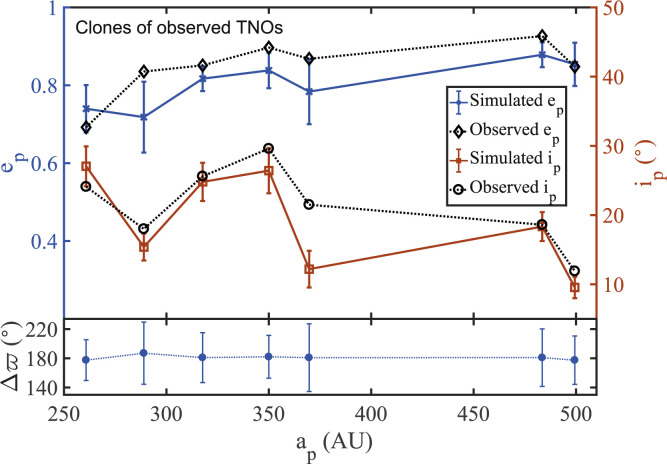
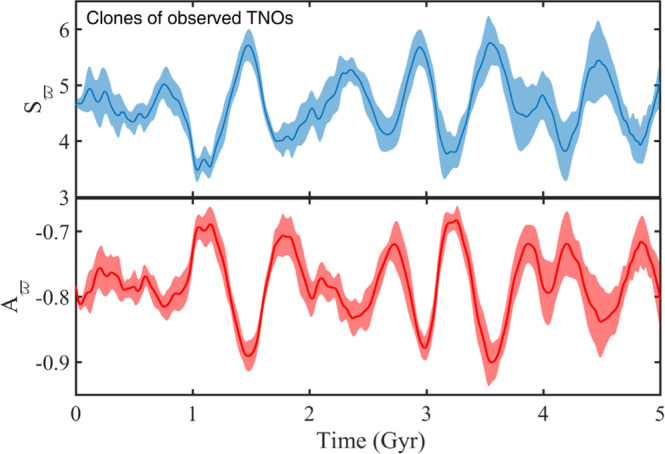
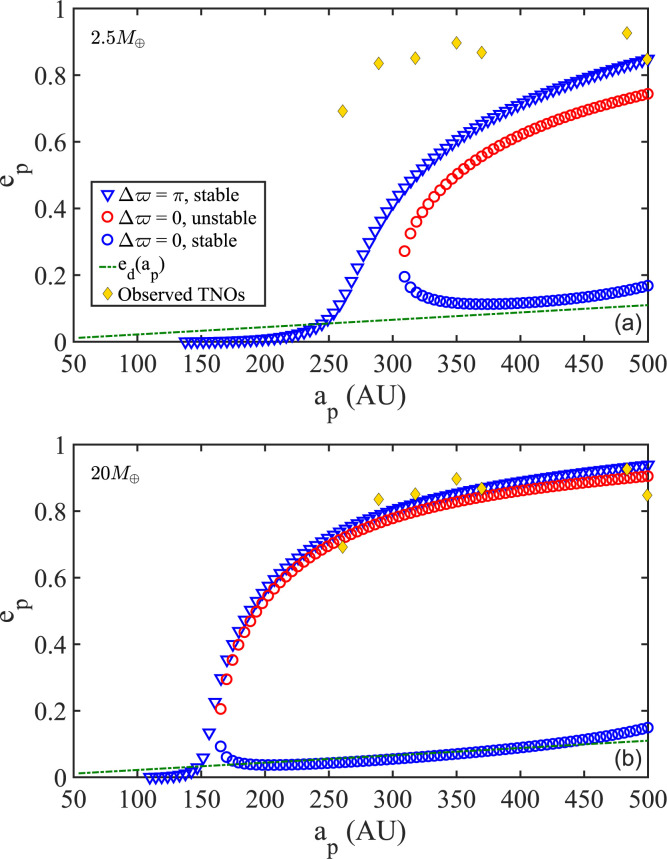
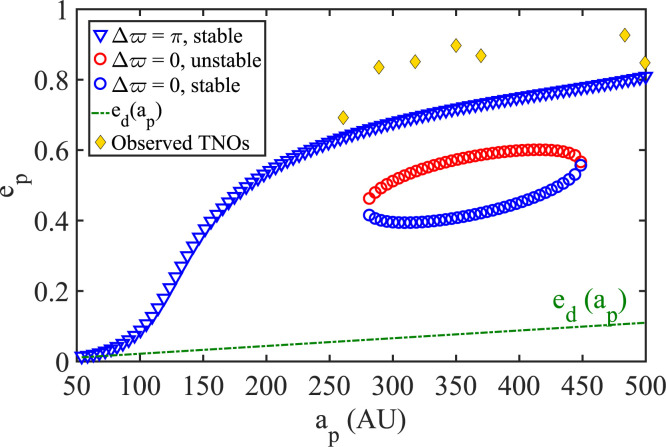
Verification
Claims the paper makes
The claims and statistics of this paper haven’t been checked yet.
Free: it reads the open-access text and checks the first 5 claims that cite a source we can check. Create a free account to check every claim.
Claims other papers make about this one
Each is checked against this paper’s own text: does it say what the citing paper says it does?
The source backs part of the claim, not all of it — or backs it for a different population, condition or comparison.
In the citing paper
“Nevertheless, from the point of view of planet formation, the prolonged existence of the envisioned shepherding disk su ers from many of the same drawbacks outlined in section 7.1 (e.g., radiative stripping of r ≳ 50 AU protoplanetary disk material, disruptive perturbations due to passing stars in the birth cluster, etc.) as well as the apparent incompatibility with the striking decrease in ob”
From The planet nine hypothesis (2019) · cites this paper as Sefilian & Touma (2018)
Experimental — accuracy not yet measured
Self-check
Percentages, sums and reported differences re-computed from the paper’s own numbers.
The self-check needs the paper’s full text.
Citations
Cites
Table of Integrals, Series, and Products
(1980) · Elsevier eBooks · doi:10.1016/c2013-0-10754-4 · Cited by 18,782
Evidence for a Distant Giant Planet in the Solar System
Batygin, K., & Brown, M. E. (2016) · The Astronomical Journal · doi:10.3847/0004-6256/151/2/22 · Cited by 432
Comet showers and the steady-state infall of comets from the Oort cloud
Hills, J. G. (1981) · The Astronomical Journal · doi:10.1086/113058 · Cited by 366
A Sedna-like body with a perihelion of 80 astronomical units
Trujillo, C. A., & Sheppard, S. S. (2014) · Nature · doi:10.1038/nature13156 · Cited by 303
The Structure of the Kuiper Belt: Size Distribution and Radial Extent
Gladman, B., Kavelaars, J. J., Petit, J.-M., Morbidelli, A., Holman, M. J., & Loredo, T. (2001) · The Astronomical Journal · doi:10.1086/322080 · Cited by 241
Hahn, J. M., & Malhotra, R. (2005) · The Astronomical Journal · doi:10.1086/452638 · Cited by 198
An Eccentric-Disk Model for the Nucleus of M31
Tremaine, S. (1995) · The Astronomical Journal · doi:10.1086/117548 · Cited by 187
Collisional Cascades in Planetesimal Disks. II. Embedded Planets
Kenyon, S. J., & Bromley, B. C. (2004) · The Astronomical Journal · doi:10.1086/379854 · Cited by 184
Planetesimal Formation by the Streaming Instability in a Photoevaporating Disk
Carrera, D., Gorti, U., Johansen, A., & Davies, M. B. (2017) · The Astrophysical Journal · doi:10.3847/1538-4357/aa6932 · Cited by 162
Non-linear fluid dynamics of eccentric discs
Ogilvie, G. I. (2001) · Monthly Notices of the Royal Astronomical Society · doi:10.1046/j.1365-8711.2001.04416.x · Cited by 157
Collisional Cascades in Planetesimal Disks II. Embedded Planets
Kenyon, S. J., & Bromley, B. C. (2003) · CERN Document Server (European Organization for Nuclear Research) · Cited by 138
Hahn, J. M., & Malhotra, R. (2005) · CERN Document Server (European Organization for Nuclear Research) · Cited by 134
Color Difference Makes a Difference: Four Planet Candidates around τ Ceti
Feng, F., Tuomi, M., Jones, H. R. A., Barnes, J., Anglada-Escudé, G., Vogt, S. S., & Butler, R. P. (2017) · The Astronomical Journal · doi:10.3847/1538-3881/aa83b4 · Cited by 132
Ward, W. (1981) · Icarus · doi:10.1016/0019-1035(81)90169-x · Cited by 130
Simulations of eccentric disks in close binary systems
Kley, W., Papaloizou, J. C. B., & Ogilvie, G. I. (2008) · Astronomy and Astrophysics · doi:10.1051/0004-6361:200809953 · Cited by 125
The debris disc around τ Ceti: a massive analogue to the Kuiper Belt
Greaves, J. S., Wyatt, M. C., Holland, W. S., & Dent, W. R. F. (2004) · Monthly Notices of the Royal Astronomical Society · doi:10.1111/j.1365-2966.2004.07957.x · Cited by 117
Secular resonances and the origin of eccentricities of Mars and the asteroids
Heppenheimer, T. A. (1980) · Icarus · doi:10.1016/0019-1035(80)90160-8 · Cited by 116
Planetesimal and gas dynamics in binaries
Paardekooper, S.-J., Thébault, P., & Mellema, G. (2008) · Monthly Notices of the Royal Astronomical Society · doi:10.1111/j.1365-2966.2008.13080.x · Cited by 103
Precession of the epsilon ring of Uranus
Goldreich, P., & Tremaine, S. D. (1979) · The Astronomical Journal · doi:10.1086/112587 · Cited by 94
New Extreme Trans-Neptunian Objects: Toward a Super-Earth in the Outer Solar System
Sheppard, S. S., & Trujillo, C. (2016) · The Astronomical Journal · doi:10.3847/1538-3881/152/6/221 · Cited by 92
OSSOS. VI. Striking Biases in the Detection of Large Semimajor Axis Trans-Neptunian Objects
Shankman, C., Kavelaars, J. J., Bannister, M. T., Gladman, B. J., Lawler, S. M., Chen 陳英, Y.-T. 同., Jakubik, M., Kaib, N., Alexandersen, M., Gwyn, S. D. J., et al. (2017) · The Astronomical Journal · doi:10.3847/1538-3881/aa7aed · Cited by 87
Non-linear fluid dynamics of eccentric discs
Ogilvie, G. I. (2001) · CERN Document Server (European Organization for Nuclear Research) · Cited by 85
Constraints on the location of a possible 9th planet derived from the Cassini data
Fienga, A., Laskar, J., Manche, H., & Gastineau, M. (2016) · Astronomy & Astrophysics · doi:10.1051/0004-6361/201628227 · Cited by 76
The formation of planets in circumbinary discs
Pelupessy, I., & Zwart, S. P. (2012) · Monthly Notices of the Royal Astronomical Society · doi:10.1093/mnras/sts461 · Cited by 74
PLANET FORMATION IN CIRCUMBINARY CONFIGURATIONS: TURBULENCE INHIBITS PLANETESIMAL ACCRETION
Meschiari, S. (2012) · The Astrophysical Journal Letters · doi:10.1088/2041-8205/761/1/l7 · Cited by 72
PLANET FORMATION IN STELLAR BINARIES. I. PLANETESIMAL DYNAMICS IN MASSIVE PROTOPLANETARY DISKS
Rafikov, R. R., & Silsbee, K. (2014) · The Astrophysical Journal · doi:10.1088/0004-637x/798/2/69 · Cited by 71
Eccentric‐Disk Models for the Nucleus of M31
Peiris, H. V., & Tremaine, S. D. (2003) · The Astrophysical Journal · doi:10.1086/378638 · Cited by 70
PLANET FORMATION IN SMALL SEPARATION BINARIES: NOT SO SECULARLY EXCITED BY THE COMPANION
Rafikov, R. R. (2013) · The Astrophysical Journal Letters · doi:10.1088/2041-8205/765/1/l8 · Cited by 70
Planetesimal and Gas Dynamics in BinariesPreprint
Paardekooper, S.-J., Thébault, P., & Mellema, G. (2008) · Cited by 69
Secular Stability and Instability in Stellar Systems Surrounding Massive Objects
Tremaine, S. D. (2005) · The Astrophysical Journal · doi:10.1086/429713 · Cited by 67
On the eccentricity of self-gravitating circumstellar disks in eccentric binary systems
Marzari, F., Schöll, H., Thébault, P., & Baruteau, C. (2009) · Astronomy and Astrophysics · doi:10.1051/0004-6361/200912251 · Cited by 66
Simulations of eccentric disks in close binary systems
Kley, W., Papaloizou, J. C. B., & Ogilvie, G. I. (2008) · Springer Link (Chiba Institute of Technology) · doi:10.1051/0004-6361:200809953/pdf · Cited by 64
Solar obliquity induced by planet nine
Bailey, E., Batygin, K., & Brown, M. E. (2016) · The Astronomical Journal · doi:10.3847/0004-6256/152/5/126 · Cited by 62
The Curiously Warped Mean Plane of the Kuiper Belt
Volk, K., & Malhotra, R. (2017) · The Astronomical Journal · doi:10.3847/1538-3881/aa79ff · Cited by 60
Dynamical evolution induced by planet nine
Batygin, K., & Morbidelli, A. (2017) · The Astronomical Journal · doi:10.3847/1538-3881/aa937c · Cited by 58
Dynamical limits on dark mass in the outer solar system
Hogg, D. W., Quinlan, G. D., & Tremaine, S. (1991) · The Astronomical Journal · doi:10.1086/115849 · Cited by 57
Madigan, A.-M., & McCourt, M. (2016) · Monthly Notices of the Royal Astronomical Society: Letters · doi:10.1093/mnrasl/slv203 · Cited by 57
The Secular Evolution of the Primordial Kuiper Belt
Hahn, J. M. (2003) · The Astrophysical Journal · doi:10.1086/377195 · Cited by 52
Observational Bias and the Clustering of Distant Eccentric Kuiper Belt Objects
Brown, M. E. (2017) · The Astronomical Journal · doi:10.3847/1538-3881/aa79f4 · Cited by 48
OSSOS. V. Diffusion in the Orbit of a High-perihelion Distant Solar System Object
Bannister, M. T., Shankman, C., Volk, K., Chen 陳, Y.-T. 英., Kaib, N., Gladman, B. J., Jakubik, M., Kavelaars, J. J., Fraser, W. C., Schwamb, M. E., et al. (2017) · The Astronomical Journal · doi:10.3847/1538-3881/aa6db5 · Cited by 47
Planet Formation in Circumbinary Configurations: Turbulence Inhibits Planetesimal Accretion
Meschiari, S. (2016) · Texas ScholarWorks (Texas Digital Library) · doi:10.15781/t2h98zg54 · Cited by 47
Secular stability and instability in stellar systems surrounding massive objects
Tremaine, S. D. (2004) · CERN Document Server (European Organization for Nuclear Research) · Cited by 46
Constraints on planet nine’s orbit and sky position within a framework of mean motion resonances
Millholland, S., & Laughlin, G. (2017) · The Astronomical Journal · doi:10.3847/1538-3881/153/3/91 · Cited by 45 · cited 1×
“In other words, the behavior of both vectors must be known in order to completely characterize the degree of spatial alignment of a population of orbits, with the following metrics being particularly useful in that regard (Millholland & Laughlin 2017): 1.”
BackgroundConsequences of a Distant Massive Planet on the Large Semimajor Axis Trans-Neptunian Objects
Shankman, C., Kavelaars, J. J., Lawler, S. M., Gladman, B. J., & Bannister, M. T. (2017) · The Astronomical Journal · doi:10.3847/1538-3881/153/2/63 · Cited by 42
Orbital clustering of distant Kuiper belt objects by hypothetical Planet 9. Secular or resonant?
Beust, H. (2016) · Astronomy & Astrophysics · doi:10.1051/0004-6361/201628638 · Cited by 41
Producing distant planets by mutual scattering of planetary embryos
Silsbee, K., & Tremaine, S. (2018) · The Astronomical Journal · doi:10.3847/1538-3881/aaa19b · Cited by 40
Silsbee, K., & Rafikov, R. (2013) · The Astrophysical Journal · doi:10.1088/0004-637x/798/2/71 · Cited by 40
OBSERVATIONAL SIGNATURES OF A MASSIVE DISTANT PLANET ON THE SCATTERING DISK
Lawler, S. M., Shankman, C., Kaib, N., Bannister, M. T., Gladman, B., & Kavelaars, J. J. (2017) · The Astronomical Journal · doi:10.3847/1538-3881/153/1/33 · Cited by 39
Was Planet 9 captured in the Sun’s natal star-forming region?
Parker, R. J., Lichtenberg, T., & Quanz, S. P. (2017) · Monthly Notices of the Royal Astronomical Society Letters · doi:10.1093/mnrasl/slx141 · Cited by 38
Long-lived Lopsided Modes of Annular Disks Orbiting a Central Mass
Jacobs, V., & Sellwood, J. A. (2001) · The Astrophysical Journal · doi:10.1086/321728 · Cited by 37
A Simple Family of Models for Eccentric Keplerian Fluid Disks
Statler, T. S. (2001) · The Astronomical Journal · doi:10.1086/323713 · Cited by 36
Making planet nine: Pebble accretion at 250–750 AU in a gravitationally unstable ring
Kenyon, S. J., & Bromley, B. C. (2016) · The Astrophysical Journal · doi:10.3847/0004-637x/825/1/33 · Cited by 33
Orbital clustering of distant Kuiper belt objects by hypothetical Planet 9. Secular or resonant?
Beust, H. (2016) · Springer Link (Chiba Institute of Technology) · doi:10.1051/0004-6361/201628638/pdf · Cited by 32
Solar obliquity induced by planet nine: Simple Calculation
Lai, D. (2016) · The Astronomical Journal · doi:10.3847/0004-6256/152/6/215 · Cited by 30 · cited 2×
“Further indirect evidence for such a planet was sought around apparent deviations in the orbit of the Cassini spacecraft (Fienga et al. 2016), and in the potential to explain the Sun’s obliquity (Bailey et al. 2016; Lai 2016).”
BackgroundUnstable modes of Keplerian discs
Touma, J. (2002) · Monthly Notices of the Royal Astronomical Society · doi:10.1046/j.1365-8711.2002.05437.x · Cited by 28
Self-citationOn the Nuclear Rotation Curve of M31
Statler, T. S. (1999) · The Astrophysical Journal · doi:10.1086/312306 · Cited by 25
Circularizing Planet Nine through dynamical friction with an extended, cold planetesimal belt
Eriksson, L. E. J., Mustill, A. J., & Johansen, A. (2018) · Monthly Notices of the Royal Astronomical Society · doi:10.1093/mnras/sty111 · Cited by 15
Secular instabilities of Keplerian stellar discs
Kaur, K., Kazandjian, M. V., Sridhar, S., & Touma, J. (2018) · Monthly Notices of the Royal Astronomical Society · doi:10.1093/mnras/sty403 · Cited by 4
Self-citation
Research works printed but not linked: 1
- Sefilian, A. A. 2017, MSc Thesis, American Univ. of Beirut
Cited by
Batygin, K., Adams, F. C., Brown, M. E., & Becker, J. C. (2019) · Physics Reports · doi:10.1016/j.physrep.2019.01.009 · Cited by 181
What if Planet 9 is a Primordial Black Hole?
Scholtz, J., & Unwin, J. (2020) · Physical Review Letters · doi:10.1103/physrevlett.125.051103 · Cited by 95
A New High Perihelion Trans-Plutonian Inner Oort Cloud Object: 2015 TG387
Sheppard, S. S., Trujillo, C. A., Tholen, D. J., & Kaib, N. (2019) · The Astronomical Journal · doi:10.3847/1538-3881/ab0895 · Cited by 62
Sefilian, A. A., Rafikov, R. R., & Wyatt, M. C. (2021) · The Astrophysical Journal · doi:10.3847/1538-4357/abda46 · Cited by 59
Self-citationPerspectives on the distribution of orbits of distant Trans-Neptunian objects
Kavelaars, J. J., Lawler, S. M., Bannister, M. T., & Shankman, C. (2019) · Elsevier eBooks · doi:10.1016/b978-0-12-816490-7.00003-5 · Cited by 38
Metadata
- Authors
- Sefilian, A. A., & Touma, J. R.
- Affiliations
- University of Cambridge (GB)
- American University of Beirut (LB)
- Venue
- arXiv
- Publisher
- arXiv
- Published
- 2018
- Volume
- 157
- Issue
- 2
- Pages
- 59-59
- ISSN
- 0004-6256 (ISSN-L)
- arXiv
- 1804.06859
- PMC
- PMC7822068
- OpenAlex
- W2797283385
- Cited by
- 33
- References
- 59
- Citations by year
- 2025: 3 · 2024: 4 · 2023: 4 · 2022: 3 · 2021: 4 · 2020: 8 · 2019: 7
- FWCI
- 2.88
- Type
- journal article
- Language
- en
- Open access
- hybrid
- doi.org
- Licence
- Locations
- The Astronomical Journal (publishedVersion, cc-by)
- Europe PMC (PubMed Central) (publishedVersion, cc-by)
- PubMed Central (publishedVersion, cc-by)
- PubMed (publishedVersion)
- arXiv (Cornell University) (submittedVersion)
- arXiv (Cornell University)
- Topics
- Physical Sciences › Earth and Planetary Sciences › Space and Planetary Science › Astro and Planetary Science
- Physical Sciences › Physics and Astronomy › Astronomy and Astrophysics › Stellar, planetary, and galactic studies
- Physical Sciences › Engineering › Aerospace Engineering › Space Satellite Systems and Control
- Keywords
- trans-Neptunian objects, self-gravitating disks, orbital resonance, ninth planet, disk mass, orbital eccentricity, solar system formation and evolution
About these checks
Registry, retraction, Cites and statistics results are computed, not judged, with one exception: a printed reference that no index lists is read once by a model before it counts as a citation error. Claims are extracted by a model and kept only when their quote appears verbatim in the text; each cited source is then checked, with a model’s help, for whether it says what the claim relies on. Those verdicts can be wrong — read the claim’s quote and the cited source before relying on one.
Statistics and arithmetic are recomputed, not judged.
Confidence bands are shown only for fields calibrated on our annotated test set. None is calibrated yet, so no band is shown.
What counts as a claim ›How we measure confidence ›How we check this ›
Are you an author, or do you see a problem with this page? Request a review
Data sources
Bibliographic data: Semantic Scholar, OpenAlex, Crossref.
Contains information from the Semantic Scholar Academic Graph Datasets, made available under the ODC Attribution License (ODC-BY 1.0).
Semantic Scholar’s data is described in: Kinney, R., et al. (2023). The Semantic Scholar Open Data Platform. arXiv:2301.10140.
