

The DOI matches its DataCite record; 40 of the 41 references it cites were found in a registry or an index.
Beyond Goldfish Memory: Long-Term Open-Domain Conversation
Open accessAbstract
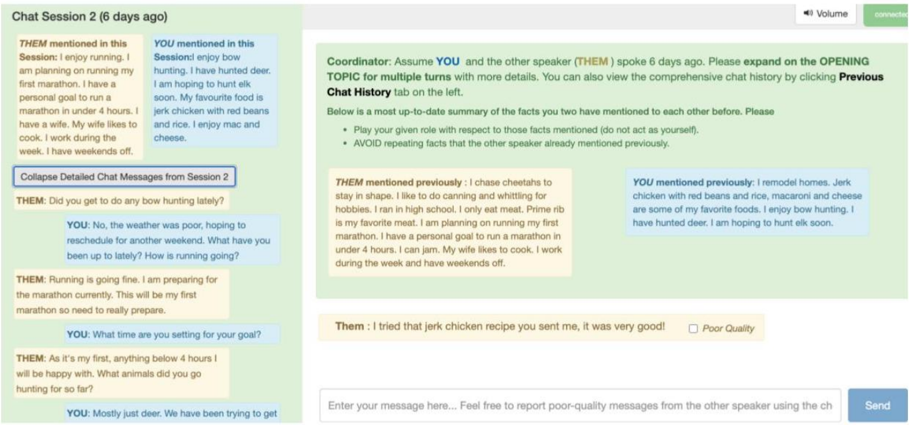
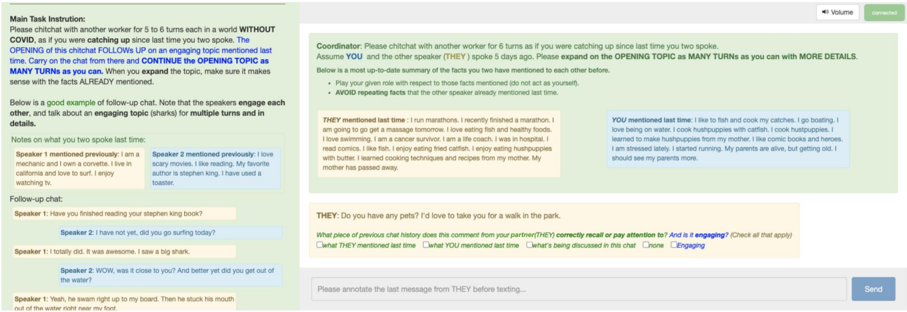
Despite recent improvements in open-domain dialogue models, state of the art models are trained and evaluated on short conversations with little context. In contrast, the long-term conversation setting has hardly been studied. In this work we collect and release a human-human dataset consisting of multiple chat sessions whereby the speaking partners learn about each other's interests and discuss the things they have learnt from past sessions. We show how existing models trained on existing datasets perform poorly in this long-term conversation setting in both automatic and human evaluations, and we study long-context models that can perform much better. In particular, we find retrieval-augmented methods and methods with an ability to summarize and recall previous conversations outperform the standard encoder-decoder architectures currently considered state of the art.
Overview
The claims and statistics of this paper haven’t been checked yet.
Run the check — free, no account needed. It reads the open-access text and checks the sources it cites.
Integrity signals
Registry
Cites
Statistics
Figures
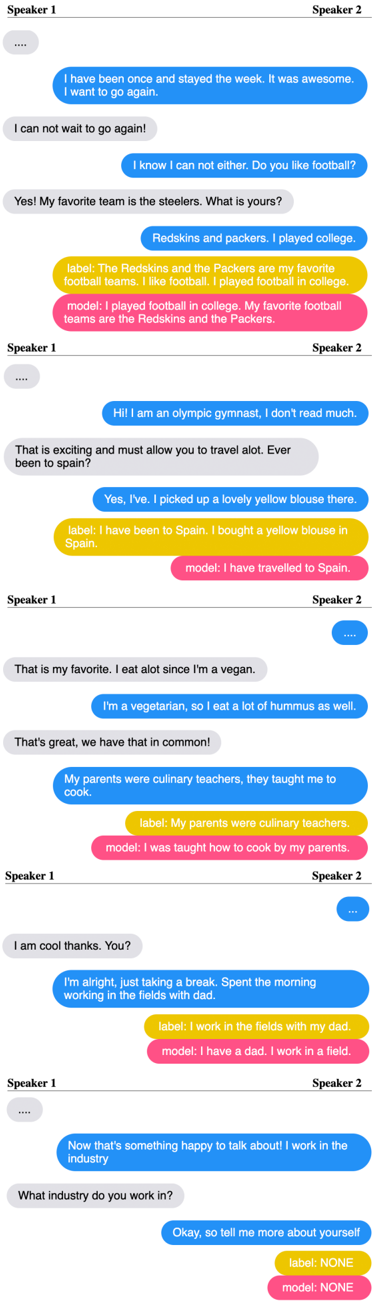
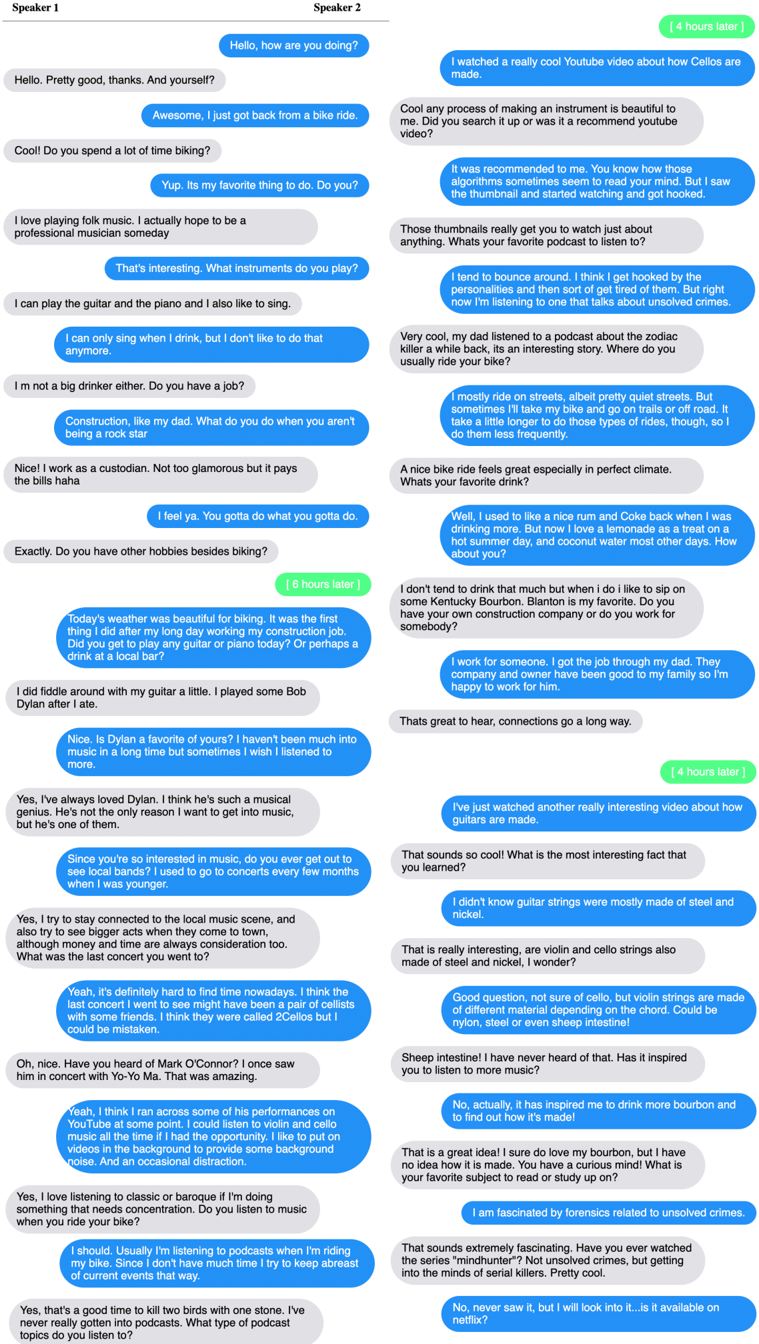
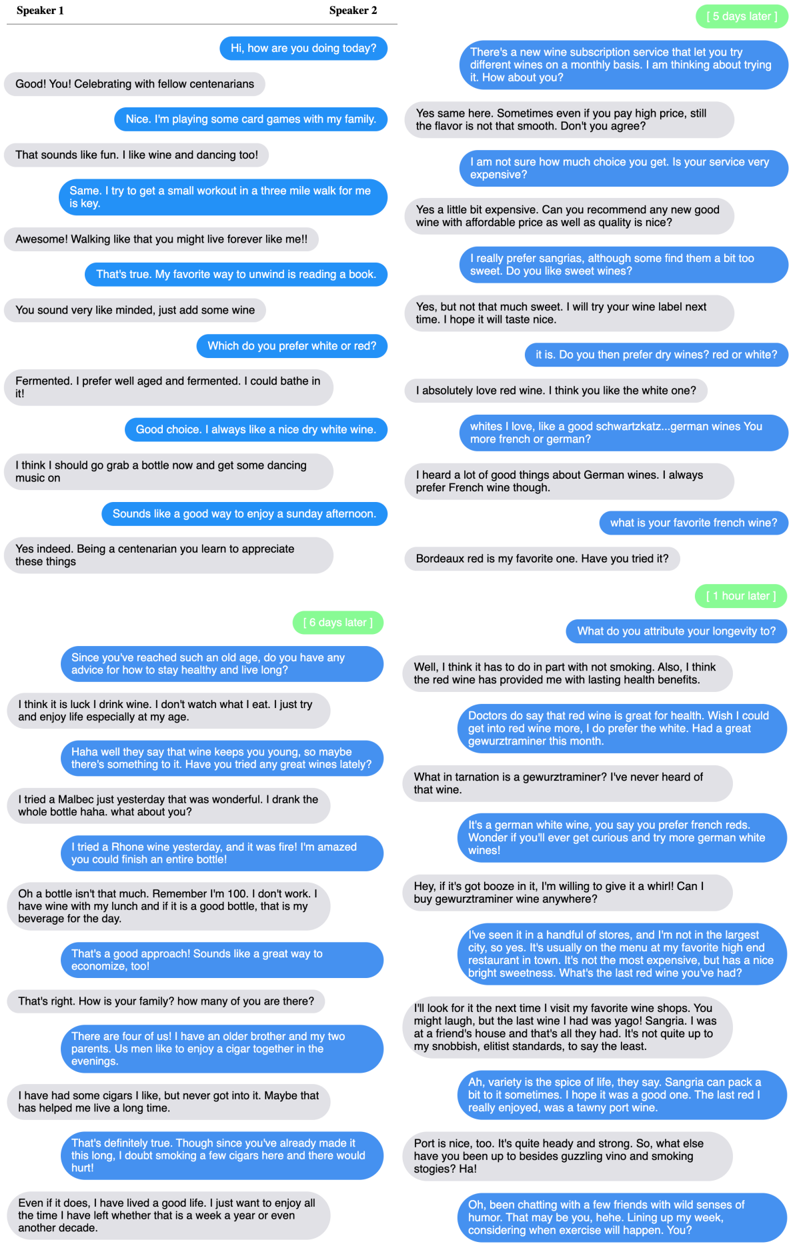
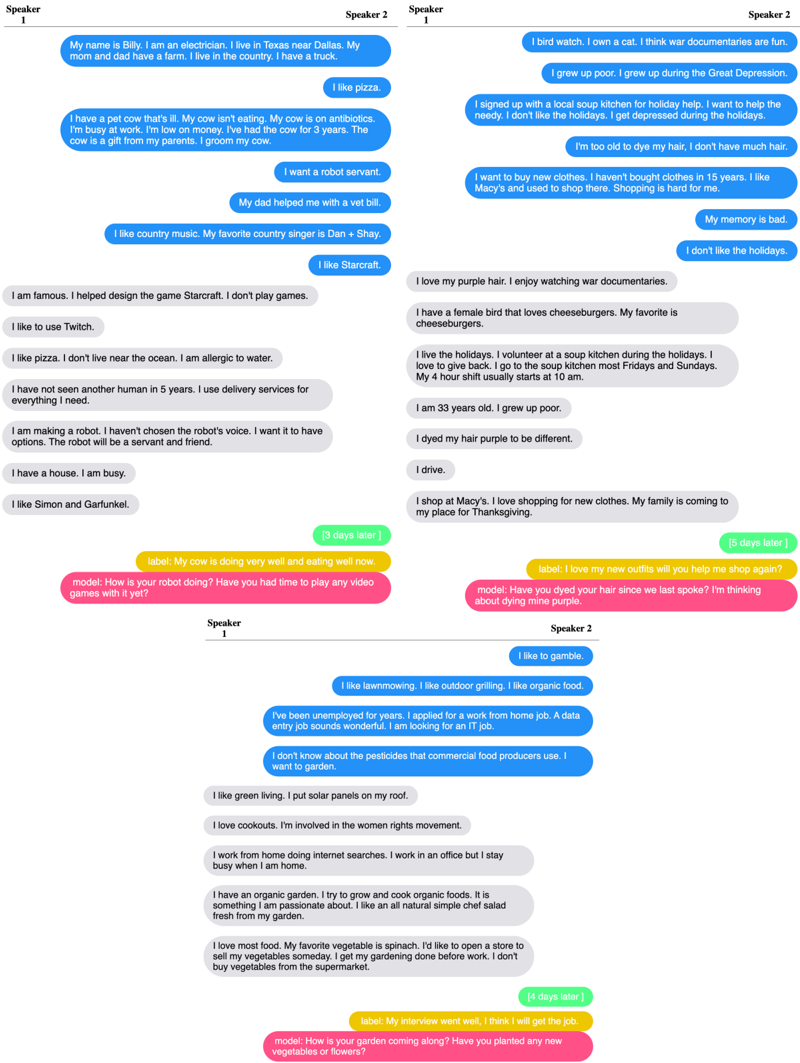
Verification
Claims the paper makes
The claims and statistics of this paper haven’t been checked yet.
Run the check — free, no account needed. It reads the open-access text and checks the sources it cites.
Claims other papers make about this one
Each is checked against this paper’s own text: does it say what the citing paper says it does?
The source backs part of the claim, not all of it — or backs it for a different population, condition or comparison.
In the citing paper
“Numerous approaches have demonstrated that memory-augmented methods improve the memory capabilities of LLMs without requiring fine-tuning, which is often impossible for API-based models [25, 42, 46].”
From CAIM: Development and Evaluation of a Cognitive AI Memory Framework for Long-Term Interaction with Intelligent Agents (2026) · cites this paper as [25]
Experimental — accuracy not yet measuredThe cited source says what the claim attributes to it.
In the citing paper
“MSC [27] is a human-human multi-session open-domain dialogue dataset in which speakers learn about each other across repeated conversations.”
From MRMMIA: Membership Inference Attacks on Memory in Chat Agents (2026) · cites this paper as [27]
The cited source says what the claim attributes to it.
In the citing paper
“Memory-augmented methods extend this concept by retrieving user-specific information from past interactions. This addresses the challenge of a limited context window and enables the integration of past information into the input prompt [25, 29, 45].”
From CAIM: Development and Evaluation of a Cognitive AI Memory Framework for Long-Term Interaction with Intelligent Agents (2026) · cites this paper as [25]
The check wasn’t confident either way, so it gives no verdict — never disputed.
In the citing paper
“Thus, OpenAI released a dataset, namely, PRM800K, which resulted in a SOTA reward model [153].”
From Survey of Hallucination in Natural Language Generation (2023) · cites this paper as [153]
Experimental — accuracy not yet measuredThe check wasn’t confident either way, so it gives no verdict — never disputed.
In the citing paper
“Since the effectiveness of the system is constrained by the performance of the reward model itself, emphasis has been placed on determining the most effective training methods [153].”
From Survey of Hallucination in Natural Language Generation (2023) · cites this paper as [153]
Experimental — accuracy not yet measured
Self-check
Percentages, sums and reported differences re-computed from the paper’s own numbers.
The self-check needs the paper’s full text.
Citations
Cites
Lewis, M., Liu, Y., Goyal, N., Ghazvininejad, M., Mohamed, A., Levy, O., Stoyanov, V., & Zettlemoyer, L. (2020) · Proceedings of the 58th Annual Meeting of the Association for Computational Linguistics · doi:10.18653/v1/2020.acl-main.703 · Cited by 8,821
On the Dangers of Stochastic Parrots: Can Language Models Be Too Big? 🦜
Bender, E. M., Gebru, T., McMillan-Major, A., & Shmitchell, S. (2021) · Proceedings of the 2021 ACM Conference on Fairness, Accountability, and Transparency · doi:10.1145/3442188.3445922 · Cited by 6,988
Billion-scale similarity search with GPUs
Johnson, J., Douze, M., & Jegou, H. (2021) · IEEE Transactions on Big Data · doi:10.1109/tbdata.2019.2921572 · Cited by 4,228
Running experiments on Amazon Mechanical Turk
Paolacci, G., Chandler, J., & Ipeirotis, P. G. (2010) · Judgment and Decision Making · doi:10.1017/s1930297500002205 · Cited by 3,767
Dense passage retrieval for open-domain question answering
Karpukhin, V., Oguz, B., Min, S., Lewis, P., Wu, L., Edunov, S., Chen, D., & Yih, W.-T. (2020) · Proceedings of the 2020 Conference on Empirical Methods in Natural Language Processing (EMNLP) · doi:10.18653/v1/2020.emnlp-main.550 · Cited by 3,575
Retrieval-Augmented Generation for Knowledge-Intensive NLP Tasks
Lewis, P., Perez, E., Piktus, A., Petroni, F., Karpukhin, V., Goyal, N., Küttler, H., Lewis, M., Yih, W.-T., Rocktäschel, T., et al. (2020) · arXiv · doi:10.48550/arxiv.2005.11401 · Cited by 3,101
Longformer: The Long-Document Transformer
Beltagy, I., Peters, M. E., & Cohan, A. (2020) · arXiv · doi:10.48550/arxiv.2004.05150 · Cited by 2,281
Reading Wikipedia to answer open-domain questions
Chen, D., Fisch, A., Weston, J., & Bordes, A. (2017) · Proceedings of the 55th Annual Meeting of the Association for Computational Linguistics (Volume 1: Long Papers) · doi:10.18653/v1/p17-1171 · Cited by 1,546
Self-citationReformer: The Efficient Transformer
Kitaev, N., Kaiser, Ł., & Levskaya, A. (2020) · arXiv · doi:10.48550/arxiv.2001.04451 · Cited by 1,435
MELD: A Multimodal Multi-Party Dataset for Emotion Recognition in Conversations
Poria, S., Hazarika, D., Majumder, N., Naik, G., Cambria, E., & Mihalcea, R. (2019) · Proceedings of the 57th Annual Meeting of the Association for Computational Linguistics · doi:10.18653/v1/p19-1050 · Cited by 1,416
Cited by
Sorted by citations
Survey of Hallucination in Natural Language Generation
Ji, Z., Lee, N., Frieske, R., Yu, T., Su, D., Xu, Y., Ishii, E., Bang, Y. J., Madotto, A., & Fung, P. (2023) · ACM Computing Surveys · doi:10.1145/3571730 · Cited by 5,025
“[153] introduce a dataset consisting of over 40 utterances per episode on average.”
BackgroundUnleashing the potential of prompt engineering for large language models
CHEN, B. ‐., Zhang, Z., Langrené, N., & Zhu, S. (2025) · Patterns · doi:10.1016/j.patter.2025.101260 · Cited by 1,097
Siriwardhana, S., Weerasekera, R., Wen, E., Kaluarachchi, T., Rana, R., & Nanayakkara, S. (2023) · Transactions of the Association for Computational Linguistics · doi:10.1162/tacl_a_00530 · Cited by 337
“Using both parametric and non-parametric memory generally leads to reduced hallucinations and higher interpretability in tasks like question answering and summarization (Xu et al., 2021; Komeili et al., 2021; Guu et al., 2020; Lewis et al., 2020b).”
BackgroundMethodInfluentialJo, E., Epstein, D. A., Jung, H., & Kim, Y.-H. (2023) · Proceedings of the 2023 CHI Conference on Human Factors in Computing Systems · doi:10.1145/3544548.3581503 · Cited by 174
A Survey on the Memory Mechanism of Large Language Model-based Agents
Zhang, Z., Dai, Q., Bo, X., Ma, C., Li, R., Chen, X., Zhu, J., Dong, Z., & Wen, J.-R. (2025) · ACM Transactions on Information Systems · doi:10.1145/3748302 · Cited by 592
“Some previous works have constructed several datasets to support the evaluation of LLM-based agents [26, 191, 194], and some benchmarks also conduct evaluations on the memory capability of LLM-based agents [102, 182, 219].”
Sabour, S., Zhang, W., Xiao, X., Zhang, Y., Zheng, Y., Wen, J., Zhao, J., & Huang, M. (2023) · Frontiers in Digital Health · doi:10.3389/fdgth.2023.1133987 · Cited by 102
Conversational Information Seeking
Zamani, H., Trippas, J. R., Dalton, J., & Radlinski, F. (2023) · Foundations and Trends® in Information Retrieval · doi:10.1561/1500000081 · Cited by 178
“I’m sorry to hear that”: Finding new biases in language models with a holistic descriptor dataset
Smith, E. M., Hall, M., Kambadur, M., Presani, E., & Williams, A. (2022) · Proceedings of the 2022 Conference on Empirical Methods in Natural Language Processing · doi:10.18653/v1/2022.emnlp-main.625 · Cited by 97
“0 (Komeili et al., 2022; Xu et al., 2022), an encoder/decoder model pre-trained on a Reddit dataset extracted by a third party and made available on pushshift.”
MethodInfluentialIrfan, B., Kuoppamäki, S., Hosseini, A., & Skantze, G. (2025) · Autonomous Robots · doi:10.1007/s10514-025-10190-y · Cited by 92
“For personalizing daily interactions through recommendations based on dialogue history, retrieval and memory-augmented models (e.g., (Xu et al., 2022)), ‘in-context learning’ (Dong et al., 2023) and ‘chain of thought’ (Wei et al., 2023; Wang et al., 2023) (i.e., dividing the prompt into steps)…”
InfluentialShuster, K., Komeili, M., Adolphs, L., Roller, S., Szlam, A. D., & Weston, J. (2022) · Findings of the Association for Computational Linguistics: EMNLP (Findings of EMNLP) · doi:10.18653/v1/2022.findings-emnlp.27 · Cited by 118
Self-citationLaMPost: Design and Evaluation of an AI-assisted Email Writing Prototype for Adults with Dyslexia
Goodman, S. M., Buehler, E., Clary, P., Coenen, A., Donsbach, A., Horne, T. N., Lahav, M., MacDonald, R., Michaels, R. B., Narayanan, A., et al. (2022) · Proceedings of the 24th International ACM SIGACCESS Conference on Computers and Accessibility · doi:10.1145/3517428.3544819 · Cited by 71
Irfan, B., Kuoppamäki, S., & Skantze, G. (2024) · Frontiers in Robotics and AI · doi:10.3389/frobt.2024.1363713 · Cited by 82
MemGPT: Towards LLMs as Operating Systems
Packer, C., Wooders, S., Lin, K., Fang, V., Patil, S. G., Stoica, I., & Gonzalez, J. E. (2023) · arXiv · doi:10.48550/arxiv.2310.08560 · Cited by 64
“I understand that you’re studying computer science and have a keen interest in pretty dynamic areas like Formula 1 and sailing.”
BackgroundGenerative Spoken Dialogue Language Modeling
Nguyen, T. A., Kharitonov, E., Copet, J., Adi, Y., Hsu, W.-N., Elkahky, A. M., Tomasello, P., Algayres, R., Sagot, B., Mohamed, A., et al. (2023) · Transactions of the Association for Computational Linguistics · doi:10.1162/tacl_a_00545 · Cited by 97
“More recent research focused on utilizing retrieval augmented generation methods (Lewis et al., 2020) for long-context, multi-session conversations (Xu et al., 2021), and grounding responses on fresh information from the internet (Komeili et al., 2021; Shuster et al., 2022).”
BackgroundRecursively summarizing enables long-term dialogue memory in large language models
Wang, Q., Fu, Y., Cao, Y., Wang, S., Tian, Z., & Ding, L. (2025) · Neurocomputing · doi:10.1016/j.neucom.2025.130193 · Cited by 55
Towards Continual Knowledge Learning of Language Models
Jang, J., Ye, S., Yang, S., Shin, J., Han, J., Kim, G., Choi, S. J., & Seo, M. (2021) · arXiv · doi:10.48550/arxiv.2110.03215 · Cited by 49
DialFact: A Benchmark for Fact-Checking in Dialogue
Gupta, P., Wu, C.-S., Liu, W., & Xiong, C. (2022) · Proceedings of the 60th Annual Meeting of the Association for Computational Linguistics (Volume 1: Long Papers) · doi:10.18653/v1/2022.acl-long.263 · Cited by 48
Few-Shot Bot: Prompt-Based Learning for Dialogue SystemsPreprint
Madotto, A., Lin, Z., Winata, G. I., & Fung, P. (2021) · arXiv (Cornell University) · doi:10.48550/arxiv.2110.08118 · Cited by 96
“Different methods for avoiding inappropriate responses have been proposed (Dinan et al., 2020), especially by generating adversarial examples (Dinan et al., 2019; Xu et al., 2021a).”
BackgroundMethodInfluentialSmith, E., Hsu, O., Qian, R., Roller, S., Boureau, Y.-L., & Weston, J. (2022) · Proceedings of the 4th Workshop on NLP for Conversational AI · doi:10.18653/v1/2022.nlp4convai-1.8 · Cited by 40
Self-citationMemory Sandbox: Transparent and Interactive Memory Management for Conversational Agents
Huang, Z., Gutierrez, S., Kamana, H., & Macneil, S. (2023) · Adjunct Proceedings of the 36th Annual ACM Symposium on User Interface Software and Technology · doi:10.1145/3586182.3615796 · Cited by 34
“This makes it difficult for users to repair conversational breakdowns that happen when there is a misalignment between how the agent manages the memory and how the user perceives the conversation.”
BackgroundPrompted LLMs as Chatbot Modules for Long Open-domain Conversation
Lee, G., Hartmann, V., Park, J., Papailiopoulos, D., & Lee, K. (2023) · Findings of the Association for Computational Linguistics: ACL 2023 · doi:10.18653/v1/2023.findings-acl.277 · Cited by 34
“The Multi-Session Chat dataset (Xu et al., 2022) allows for measuring how well conversational agents maintain a long-term memory of facts about the user and bot.”
Volum, R., Rao, S., Xu, M., DesGarennes, G., Brockett, C., Van Durme, B., Deng, O., Malhotra, A., & Dolan, B. (2022) · Proceedings of the 3rd Wordplay: When Language Meets Games Workshop (Wordplay 2022) · doi:10.18653/v1/2022.wordplay-1.3 · Cited by 30
“, (Lewis et al., 2020; Xu et al., 2021), may provide the needed factual grounding.”
BackgroundInfluentialA-Mem: Agentic Memory for LLM Agents
Xu, W., Liang, Z., Mei, K., Gao, H., Tan, J., & Zhang, Y. (2025) · Advances in Neural Information Processing Systems 38 · doi:10.52202/085713-0593 · Cited by 51
“To evaluate the effectiveness of instruction-aware recommendation in long-term conversations, we utilize the LoCoMo dataset [22], which contains significantly longer dialogues compared to existing conversational datasets [36, 13].”
Survey on Evaluation of LLM-based Agents
Yehudai, A., Eden, L., Li, A., Uziel, G., Zhao, Y., Bar-Haim, R., Cohan, A., & Shmueli-Scheuer, M. (2025) · arXiv · doi:10.48550/arxiv.2503.16416 · Cited by 26
Personalized Dialogue Generation with Persona-Adaptive Attention
Huang, Q., Zhang, Y., Ko, T., Liu, X., Wu, B., Wang, W., & Tang, H. (2023) · Proceedings of the AAAI Conference on Artificial Intelligence · doi:10.1609/aaai.v37i11.26518 · Cited by 27
Keep Me Updated! Memory Management in Long-term Conversations
Bae, S., Kwak, D., Kang, S., Lee, M. Y., Kim, S., Jeong, Y., Kim, H., Lee, S.-W., Park, W., & Sung, N. (2022) · Findings of the Association for Computational Linguistics: EMNLP 2022 · doi:10.18653/v1/2022.findings-emnlp.276 · Cited by 29
Zhang, Q., Naradowsky, J., & Miyao, Y. (2023) · Findings of the Association for Computational Linguistics: ACL (Findings of ACL) · doi:10.18653/v1/2023.findings-acl.417 · Cited by 36
Helping the Helper : Supporting Peer Counselors via AI-Empowered Practice and Feedback
Hsu, S.-L., Shah, R. S., Senthil, P., Ashktorab, Z., Dugan, C., Geyer, W., & Yang, D. (2025) · Proceedings of the ACM on Human-Computer Interaction · doi:10.1145/3710993 · Cited by 92
“Its subsequent iteration [145] continuously maintains a summary of conversation history for reference across chat sessions.”
Improving conversational recommender systems via multi-preference modelling and knowledge-enhanced
Zhang, C., Huang, X., An, J., & Zou, S. (2024) · Knowledge-Based Systems · doi:10.1016/j.knosys.2023.111361 · Cited by 23
State-of-the-Art in Open-Domain Conversational AI: A Survey
Adewumi, T., Liwicki, F., & Liwicki, M. (2022) · Information · doi:10.3390/info13060298 · Cited by 24
Can Large Language Models Be Good Companions?
Xu, Z., Xu, H., Lu, Z., Zhao, Y., Zhu, R., Wang, Y., Dong, M., Chang, Y., Lv, Q., Dick, R. P., et al. (2024) · Proceedings of the ACM on Interactive Mobile Wearable and Ubiquitous Technologies · doi:10.1145/3659600 · Cited by 40
“The visual dialogue task was first introduced by Das et al. [28], involving two participants in an image-based question-answering task, where a person asks a question about an image and a chatbot gives a response.”
Controllable Mixed-Initiative Dialogue Generation through Prompting
Chen, M., Yu, X., Shi, W., Awasthi, U., & Zhou, Y. (2023) · Proceedings of the conference - Association for Computational Linguistics. Meeting · doi:10.18653/v1/2023.acl-short.82 · Cited by 34
Am I Me or You? State-of-the-Art Dialogue Models Cannot Maintain an Identity
Shuster, K., Urbanek, J., Szlam, A., & Weston, J. (2022) · Findings of the Association for Computational Linguistics: NAACL 2022 · doi:10.18653/v1/2022.findings-naacl.182 · Cited by 20
Self-citationMemoryBank: Enhancing Large Language Models with Long-Term Memory
Zhong, W., Guo, L., Gao, Q., Ye, H., & Wang, Y. (2023) · arXiv · doi:10.48550/arxiv.2305.10250 · Cited by 253
Survey and perspective on social emotions in robotics
Hieida, C., & Nagai, T. (2022) · Advanced Robotics · doi:10.1080/01691864.2021.2012512 · Cited by 24
“Chatbot systems, which were previously believed to be impossible, are being developed to considerable performance levels [91].”
BackgroundXu, J., Ung, M., Komeili, M., Arora, K., Boureau, Y.-L., & Weston, J. (2023) · Proceedings of the conference - Association for Computational Linguistics. Meeting · doi:10.18653/v1/2023.acl-long.758 · Cited by 37
Self-citationFineD-Eval: Fine-grained Automatic Dialogue-Level Evaluation
Zhang, C., D’Haro, L. F., Zhang, Q., Friedrichs, T., & Li, H. (2022) · Conference on Empirical Methods in Natural Language Processing (EMNLP) · doi:10.18653/v1/2022.emnlp-main.220 · Cited by 16
Ehtesham-Ul-Haque, M., D’Rozario, J., Adnin, R., Utshaw, F. T., Tasneem, F., Shefa, I. J., & Islam, A. B. M. A. A. (2023) · Cognitive Systems Research · doi:10.1016/j.cogsys.2023.101168 · Cited by 17
Large Language Models as Source Planner for Personalized Knowledge-grounded Dialogues
Wang, H., Hu, M., Deng, Y., Wang, R., Mi, F., Wang, W., Wang, Y., Kwan, W.-C., King, I., & Wong, K. (2023) · Findings of the Association for Computational Linguistics: EMNLP (Findings of EMNLP) · doi:10.18653/v1/2023.findings-emnlp.641 · Cited by 17
Automatic Evaluation and Moderation of Open-domain Dialogue SystemsPreprint
Zhang, C., Sedoc, J., D’Haro, L. F., Banchs, R. E., & Rudnicky, A. I. (2021) · arXiv (Cornell University) · doi:10.48550/arxiv.2111.02110 · Cited by 29
“…baseline released to the participants (see section 3.1 based on a finetuned version of DialogGPT, b) BlenderBot vs 2.0 including its safety layer (Xu, Szlam, and Weston 2021; Komeili, Shuster, and Weston 2021), and c) GPT-3 (Brown et al. 2020) available using the OpenAI API 23 and obtaining the…”
MethodInfluentialHistory-Aware Hierarchical Transformer for Multi-session Open-domain Dialogue System
Zhang, T., Liu, Y., Li, B., Zeng, Z., Wang, P., You, Y., Miao, C., & Cui, L. (2022) · Findings of the Association for Computational Linguistics: EMNLP 2022 · doi:10.18653/v1/2022.findings-emnlp.247 · Cited by 14
A Safe Collaborative Chatbot for Smart Home Assistants
Chkroun, M., & Azaria, A. (2021) · Sensors · doi:10.3390/s21196641 · Cited by 13
So, C., Khvan, A., & Choi, W. (2023) · Computer Animation and Virtual Worlds · doi:10.1002/cav.2149 · Cited by 16
“121,122 Several methods have been proposed by the authors of BlenderBot 2.0, including retrieval augmentation techniques, where a retrieval component finds and selects a part of the context to be included in the final decoding.”
BackgroundMethodInfluentialJang, J., Boo, M., & Kim, H. (2023) · Proceedings of the 2023 Conference on Empirical Methods in Natural Language Processing · doi:10.18653/v1/2023.emnlp-main.838 · Cited by 13
Robots-Dont-Cry: Understanding Falsely Anthropomorphic Utterances in Dialog Systems
Gros, D., Li, Y., & Zhou, Y. (2022) · Conference on Empirical Methods in Natural Language Processing (EMNLP) · doi:10.18653/v1/2022.emnlp-main.215 · Cited by 16
Leveraging Large Language Models for Automated Dialogue Analysis
Finch, S. E., Paek, E. S., & Choi, J. D. (2023) · Annual Meeting of the Special Interest Group on Discourse and Dialogue · doi:10.18653/v1/2023.sigdial-1.20 · Cited by 19
Evaluating LLM-based Agents for Multi-turn Conversations: A Survey
Guan, S., Wang, J., 渡辺, 将., Zhu, B., Lou, J., & Xiong, H. (2026) · ACM Transactions on Intelligent Systems and Technology · doi:10.1145/3793671 · Cited by 71
Don’t Forget Your ABC’s: Evaluating the State-of-the-Art in Chat-Oriented Dialogue Systems
Finch, S. E., Finch, J. D., & Choi, J. D. (2023) · Proceedings of the conference - Association for Computational Linguistics. Meeting · doi:10.18653/v1/2023.acl-long.839 · Cited by 20
Rodríguez-Cantelar, M., Estecha-Garitagoitia, M., D’Haro, L. F., Matía, F., & de Córdoba, R. (2023) · Applied Sciences · doi:10.3390/app13169055 · Cited by 11
Revolutionizing Customer Service : The Impact of Large Language Models on Chatbot Performance
Meduri, S. (2024) · International Journal of Scientific Research in Computer Science Engineering and Information Technology · doi:10.32628/cseit241051057 · Cited by 13
Troussas, C., Krouska, A., Phivos Mylonas, B., Sgouropoulou, C., & Voyiatzis, I. (2025) · Computers · doi:10.3390/computers14030089 · Cited by 16
“For instance, in [55], the authors have pointed out that generative AI models lack coherence over long periods without explicit memory mechanisms.”
Fujii, A., Jokinen, K., Okada, K., & Inaba, M. (2022) · Frontiers in Robotics and AI · doi:10.3389/frobt.2022.933001 · Cited by 9
“In the recent research concerning chatbots, the system for interacting based on long-term memory which contains information about the user and internet searches (Komeili et al., 2021; Xu et al., 2021), and the system for identifying the user by face recognition and looking up the saved user profile to adapt to the use…”
BackgroundMulti-perspective empathy modeling for empathetic dialogue generation
Qiao, B., Zhang, Y., Gao, P., Li, X., Wang, S., & Han, D. (2025) · Knowledge-Based Systems · doi:10.1016/j.knosys.2025.113191 · Cited by 9
Learning as Conversation: Dialogue Systems Reinforced for Information Acquisition
Cai, P., Wan, H., Liu, F., Yu, M., Yu, H. Q., & Joshi, S. (2022) · Conference of the North American Chapter of the Association for Computational Linguistics: Human Language Technologies (NAACL-HLT) · doi:10.18653/v1/2022.naacl-main.352 · Cited by 8
The CRINGE Loss: Learning what language not to model
Adolphs, L., Gao, T., Xu, J., Shuster, K., Sukhbaatar, S., & Weston, J. (2023) · Proceedings of the conference - Association for Computational Linguistics. Meeting · doi:10.18653/v1/2023.acl-long.493 · Cited by 30
Self-citationUnderstanding Users' Privacy Perceptions Towards LLM's RAG-based Memory
Zhang, S., Ma, R., Ma, Y., Li, S., Xu, Y., Yi, X., & Li, H. (2025) · Proceedings of the 2025 Workshop on Human-Centered AI Privacy and Security · doi:10.1145/3733816.3760750 · Cited by 6
“These include recursive summarization and refinement techniques to distill salient information and reduce redundancy [12, 32, 37, 38, 49], as well as selective retrieval-based systems that store memories in unstructured or layered repositories and fetch them based on conversational relevance [3,…”
Jo, W., Hong, S., Choi, J.-W., Kwon, B., Sang, H., Im, D., Kim, S., Kim, S., Lee, T. D., & Yoo, H. (2025) · Digest of technical papers/Digest of technical papers - IEEE International Solid-State Circuits Conference · doi:10.1109/isscc49661.2025.10904658 · Cited by 7
Users' Expectations and Practices with Agent Memory
Jones, B., Stemmler, K., Su, E., Kim, Y., & Kuzminykh, A. (2025) · CHI Conference Extended Abstracts on Human Factors in Computing Systems (CHI EA) · doi:10.1145/3706599.3720158 · Cited by 13
“Strategies for maintaining an agent’s memory include summarization (e.g., [29, 32]) and refinement (e.g., [37]) of conversational and interactional histories, maintaining vector databases and retrieving relevant conversations or information through semantic or linguistic matching (e.g., [13, 24,…”
Rakin, S., Shibly, M. A. R., Hossain, Z. M., Akbar, M. M., & Khan, Z. (2025) · Advances in intelligent systems and computing · doi:10.1007/978-3-031-89063-5_42 · Cited by 20
CDConv: A Benchmark for Contradiction Detection in Chinese Conversations
Zheng, C., Zhou, J., Zheng, Y., Peng, L., Guo, Z., Wu, W., Niu, Z.-Y., Wu, H., & Huang, M. (2022) · Conference on Empirical Methods in Natural Language Processing (EMNLP) · doi:10.18653/v1/2022.emnlp-main.2 · Cited by 9
Open Source System Integration Towards Natural Interaction with Robots
Fujii, A., & Jokinen, K. (2022) · ACM/IEEE International Conference on Human-Robot Interaction (HRI) · doi:10.1109/hri53351.2022.9889582 · Cited by 7
“…concern chatbots that interact with the user on the basis of the bot’s long-term memory which contains information about the user and about their internet searches [22], [23], or use face recognition to identify the user and look up the saved user profile to adapt to the returning user [1].”
BackgroundNon-Real-Time Chatbot: Improving Anthropomorphism and Realizing Long-Term Human–Chatbot Interaction
Mitsuno, S., Ban, M., Arimoto, T., Sugiyama, H., Ishiguro, H., & Yoshikawa, Y. (2025) · International Journal of Human-Computer Interaction · doi:10.1080/10447318.2025.2508316 · Cited by 6
“Our chatbot utilized summarizer, a technique adopted in several studies (e.g., Lee et al., 2023; Shuster et al., 2022; Xu et al., 2021), to ensure consistent and coherent responses over the long-term.”
Tao, D., Wang, C., Huang, F., Chen, J., Huang, Y., & Jiang, M. (2025) · Knowledge-Based Systems · doi:10.1016/j.knosys.2025.114011 · Cited by 10
“SeeKeR Shuster, Komeili, Adolphs, Roller, Szlam and Weston (2022a) surpasses BlenderBot2 Xu et al. (2021) by executing three modular tasks using a single language model: generating search queries, extracting relevant knowledge from retrieved documents, and generating the final response.”
Ai, K., Tang, K., & Wang, C. (2025) · IEEE Transactions on Visualization and Computer Graphics · doi:10.1109/tvcg.2025.3633888 · Cited by 31
“Nevertheless, advanced memory pruning techniques, such as summarization-based approaches [43,66] or retrieval-based hierarchical methods [74], could further improve efficiency and long-term coherence, which we plan to explore in future work.”
LiveChat: A Large-Scale Personalized Dialogue Dataset Automatically Constructed from Live Streaming
Gao, J., Lian, Y., Zhou, Z., Fu, Y., & Wang, B. (2023) · Proceedings of the conference - Association for Computational Linguistics. Meeting · doi:10.18653/v1/2023.acl-long.858 · Cited by 28
Rethinking Response Evaluation from Interlocutor’s Eye for Open-Domain Dialogue Systems
Tsuta, Y., Yoshinaga, N., Sato, S., & Toyoda, M. (2023) · doi:10.18653/v1/2023.ijcnlp-srw.8 · Cited by 5
Kwon, D., Lee, S., Kim, K. H., Lee, S., Kim, T.-Y., & Davis, E. (2023) · Proceedings of the conference - Association for Computational Linguistics. Meeting · doi:10.18653/v1/2023.acl-industry.68 · Cited by 9
Leveraging Intent Entity Enhancement for Task-Oriented Dialogue
Chen, J., Li, S., Kan, B., Wang, F. L., & Hao, T. (2024) · International Joint Conference on Neural Networks (IJCNN) · doi:10.1109/ijcnn60899.2024.10649940 · Cited by 6
Automatically Exposing Problems with Neural Dialog Models
Yu, D., & Sagae, K. (2021) · Conference on Empirical Methods in Natural Language Processing (EMNLP) · doi:10.18653/v1/2021.emnlp-main.37 · Cited by 8
“However, even with carefully pre-processed training data from online sources, neural dialog models are prone to issues including generic utterances, repetition, contradiction, and lack of safety (Li et al., 2016a; Welleck et al., 2020; Li et al., 2020; Roller et al., 2021; Xu et al., 2021).”
BackgroundAdewumi, T., Adeyemi, M., Aremu, A., Peters, B., Buzaaba, H., Oyerinde, S., Rufai, A. M., Ajibade, B., Gwadabe, T., Traore, M. M. K., et al. (2023) · International Joint Conference on Neural Networks (IJCNN) · doi:10.1109/ijcnn54540.2023.10191208 · Cited by 12
“In BlenderBot 2 [46], [47], the same BlendedSkillTalk (BST) [48] collection of datasets used for BlenderBot 1 [3] is used to train the model, in addition to 3 others.”
MethodComplex QA and language models hybrid architectures, SurveyPreprint
Daull, X., Bellot, P., Bruno, E., Martin, V., & Murisasco, É. (2023) · arXiv (Cornell University) · doi:10.48550/arxiv.2302.09051 · Cited by 32
Draw Me a Flower: Processing and Grounding Abstraction in Natural Language
Lachmy, R., Pyatkin, V., Manevich, A., & Tsarfaty, R. (2022) · Transactions of the Association for Computational Linguistics · doi:10.1162/tacl_a_00522 · Cited by 7
“This result corroborates previous findings in studies which show that models benefit from textual history (Haber et al., 2019; Xu et al., 2022).”
ResultFukui, R., Yuguchi, A., Matsumoto, Y., & Okadome, Y. (2024) · IEEE RO-MAN · doi:10.1109/ro-man60168.2024.10731410 · Cited by 4
Improving the closing sequences of interaction between human and robot through conversation analysis
Uchida, T., Kameo, N., & Ishiguro, H. (2024) · Scientific Reports · doi:10.1038/s41598-024-81353-7 · Cited by 5
Those Aren’t Your Memories, They’re Somebody Else’s: Seeding Misinformation in Chat Bot Memories
Atkins, C., Zhao, B. Z. H., Asghar, H. J., Wood, I., & Kâafar, M. A. (2023) · Lecture notes in computer science · doi:10.1007/978-3-031-33488-7_11 · Cited by 7
Answerability: A custom metric for evaluating chatbot performance
Gupta, P., Rajasekar, A. A., Patel, A., Kulkarni, M., Sunell, A., Kim, K., Ganapathy, K., & Trivedi, A. (2022) · Workshop on Generation, Evaluation and Metrics (GEM) · doi:10.18653/v1/2022.gem-1.27 · Cited by 6
“, 2020), and percentage of perturn engaging responses (Xu et al., 2022) focus on how closely the bot-user conversation resembles a human conversation over multiple turns.”
BackgroundCompound AI System for Personalized Learning: Integrating LLM Agents with Knowledge Graphs
Antonov, E. (2024) · International Conference on Robotics, Intelligent Control and Artificial Intelligence (RICAI) · doi:10.1109/ricai64321.2024.10911764 · Cited by 6
“However, they face challenges [10] such as maintaining long-term context [11], providing reliable source attribution [12], and ensuring interpretability, all of which can undermine trust within educational environments.”
MPCHAT: Towards Multimodal Persona-Grounded Conversation
Ahn, J., Song, Y., Yun, S., & Kim, G. (2023) · Proceedings of the conference - Association for Computational Linguistics. Meeting · doi:10.18653/v1/2023.acl-long.189 · Cited by 21
Mind the Gap Between Conversations for Improved Long-Term Dialogue Generation
Zhang, Q., Naradowsky, J., & Miyao, Y. (2023) · Findings of the Association for Computational Linguistics: EMNLP (Findings of EMNLP) · doi:10.18653/v1/2023.findings-emnlp.720 · Cited by 11
Chang, J., & Wu, C. (2025) · IEEE Transactions on Audio Speech and Language Processing · doi:10.1109/taslpro.2025.3578773 · Cited by 4
“…the persona of the system [4], [5], [6], [7]; categorizing the emotion, keyword, knowledge, and topic of the conversation [8], [9], [10], [11], [12], [13], [14], [15], [16], [17], [18]; memorizing the historical context of the dialogue [19], [20]; and blending different communication skills [21].”
GPT-2-based Human-in-the-loop Theatre Play Script Generation
Rosa, R., Schmidtová, P., Dušek, O., Musil, T., Mareček, D., Islam, S. O. U., Novàkovâ, M., Vosecká, K., & Doležal, J. (2022) · doi:10.18653/v1/2022.wnu-1.4 · Cited by 4
“For dialogue generation, Xu et al. (2021)’s work is close to our baseline flat approach (Section 3) in that they generate long dialogues by using summarization.”
BackgroundOpen Domain Response Generation Guided by Retrieved Conversations
Shu, C., Zhang, Z., Chen, Y., Xiao, J. Z., Lau, J. H., Zhang, Q., & Lu, Z. (2022) · IEEE Access · doi:10.1109/access.2022.3225647 · Cited by 4
“Xu et al. [46] found retrieval-augmented methods that have the ability to summarize and recall previous conversations helpful.”
BackgroundFeng, T., Qu, L., & Haffari, G. (2023) · Transactions of the Association for Computational Linguistics · doi:10.1162/tacl_a_00561 · Cited by 5
“, 2021) and MSC (Xu et al., 2022) each, then employed four graduate computer science students and four well-trained crowd-workers to annotate direct causes of responses.”
BackgroundMethodInfluentialDialogue act-based partner persona extraction for consistent personalized response generation
Lee, K., Lee, K., Kim, D., & Lee, K.-H. (2024) · Expert Systems with Applications · doi:10.1016/j.eswa.2024.124380 · Cited by 4
DialRet: Enhancing Dialogue Retention for Multi-session Conversations
Na, Y., Kim, D., & Chae, D. (2025) · Lecture notes in computer science · doi:10.1007/978-981-96-8186-0_7 · Cited by 2
Overview of the Tenth Dialog System Technology Challenge: DSTC10
Yoshino, K., Chen, Y.-N., Crook, P., Kottur, S., Li, J., Hedayatnia, B., Moon, S., Fei, Z., Li, Z., Zhang, J., et al. (2023) · IEEE/ACM Transactions on Audio Speech and Language Processing · doi:10.1109/taslp.2023.3293030 · Cited by 3
“The three chatbots include: a) the pretrained baseline released to the participants (a finetuned version of DialogGPT [70]). b) BlenderBot Vs 2.0 (including its safety layer) [76], [77], and c) GPT-3 [78] (the DaVinci version).”
BackgroundInfluentialA Prompt Chaining Framework for Long-Term Recall in LLM-Powered Intelligent Assistant
Seo, S., Yoo, S., & Jang, Y. (2025) · Proceedings of the 30th International Conference on Intelligent User Interfaces · doi:10.1145/3708359.3712117 · Cited by 3
Design Guidelines for Developing Systems for Dialogue System Competitions
Komatani, K., Takeda, R., Nakashima, K., & Nakano, M. (2022) · Lecture notes in electrical engineering · doi:10.1007/978-981-19-5538-9_11 · Cited by 3
Wen, J., Zhou, H., Guan, J., Zhou, J., & Huang, M. (2023) · Conference on Empirical Methods in Natural Language Processing (EMNLP) · doi:10.18653/v1/2023.emnlp-main.612 · Cited by 3
“The lack of large-scale long-turn di-a alogue data restricts dialogue models from deriving more advanced abilities to utilize long-range context for modeling multi-turn dialogues during pre-training (Xu et al., 2021, 2022b).”
BackgroundPark, C., Lee, J., Son, S., Park, K., Jang, J., & Lim, H. (2024) · Applied Sciences · doi:10.3390/app14114821 · Cited by 3
Position Matters! Empirical Study of Order Effect in Knowledge-grounded Dialogue
Su, H., Kumar, S. H., Mazumder, S., Chen, W., Manuvinakurike, R., Okur, E., Sahay, S., Nachman, L., Chen, S.-T., & Lee, H.-Y. (2023) · DialDoc Workshop on Document-grounded Dialogue and Conversational Question Answering (DialDoc) · doi:10.18653/v1/2023.dialdoc-1.4 · Cited by 3
Towards a Progression-Aware Autonomous Dialogue Agent
Sanders, A., Strzalkowski, T., Si, M., Chang, A., Dey, D., Braasch, J., & Wang, D. (2022) · Conference of the North American Chapter of the Association for Computational Linguistics: Human Language Technologies (NAACL-HLT) · doi:10.18653/v1/2022.naacl-main.87 · Cited by 3
Common Law Annotations: Investigating the Stability of Dialog System Output Annotations
Lee, S., DeLucia, A., Nangia, N., Ganedi, P., Guan, R., Li, R., Ngaw, B., Singhal, A., Vaidya, S., Yuan, Z., et al. (2023) · Findings of the Association for Computational Linguistics: ACL (Findings of ACL) · doi:10.18653/v1/2023.findings-acl.780 · Cited by 3
Westhäußer, R., Minker, W., & Zepf, S. (2026) · Proceedings of the 31st International Conference on Intelligent User Interfaces · doi:10.1145/3742413.3789222 · Cited by 1
“By utilizing external knowledge sources, memory-augmented meth-ods address the limitation of a limited context window and enable the integration of past information into the current input prompt [22, 26, 33, 36, 39, 42, 47, 50].”
Yan, S., Yang, X., Huang, Z., Nie, E., Ding, Z., Li, Z., Ma, X., Bi, J., Kersting, K., Pan, J. Z., et al. (2025) · arXiv · doi:10.48550/arxiv.2508.19828 · Cited by 297
“We further evaluate on the Multi-Session Chat (MSC) dataset (Xu et al., 2021), which contains open-domain dialogues spanning multiple sessions.”
Generating, retrieving persona and generating responses for long-term open-domain dialogue
Cha, D., Lee, D., & Kim, J. (2025) · PeerJ Computer Science · doi:10.7717/peerj-cs.2979 · Cited by 2
“For example, the multi-session chat ( Xu, Szlam & Weston, 2022 ) is a long-term dialogue dataset consisting of dialogues with five sessions, each containing approximately 12 utterances.”
InfluentialSanyal, P., Rathore, K., & Arjunan, R. V. (2026) · Scientific Reports · doi:10.1038/s41598-026-38913-w · Cited by 3
Persona-Identified Chatbot through Small-Scale Modeling and Data Transformation
Keum, B., Sun, J., Lee, W., Park, S., & Kim, H. (2024) · Electronics · doi:10.3390/electronics13081409 · Cited by 2
“Additionally, to closely mimic real-world conversational scenarios, datasets consisting of multiple dialogue sessions have been proposed [9–11].”
BackgroundMethodInfluentialRuPersonaChat: a dialog corpus for personalizing conversational agents
Apanasovich, K., Makhnytkina, O. V., Kabarov, V., & Dalevskaya, O. P. (2024) · Scientific and technical journal of information technologies mechanics and optics · doi:10.17586/2226-1494-2024-24-2-214-221 · Cited by 3
“В наборах данных Multi-Session Chat [7] и DuLeMon [8] данная проблема решена путем обучения модели запоминать в ходе ведения диалога новые факты о персонах своего собеседника и себе самой.”
Metadata
- Authors
- Xu, J., Szlam, A., & Weston, J.
- Affiliations
- Meta (United States) (US)
- ORCID
- Xu, Jing
- Venue
- arXiv
- Publisher
- arXiv
- Published
- 2021
- Pages
- 5180-5197
- ISSN
- 0736-587X (ISSN-L)
- arXiv
- 2107.07567
- OpenAlex
- W3186804217
- Cited by
- 148
- References
- 41
- Citations by year
- 2026: 21 · 2025: 25 · 2024: 22 · 2023: 45 · 2022: 30 · 2021: 5
- FWCI
- 16.87
- Type
- conference paper
- Language
- en
- Open access
- hybrid
- doi.org
- Licence
- Locations
- Proceedings of the conference - Association for Computational Linguistics. Meeting (publishedVersion, cc-by)
- arXiv (Cornell University) (submittedVersion)
- arXiv (Cornell University)
- Topics
- Physical Sciences › Computer Science › Artificial Intelligence › Speech and dialogue systems
- Physical Sciences › Computer Science › Artificial Intelligence › Topic Modeling
- Social Sciences › Business, Management and Accounting › Marketing › AI in Service Interactions
- Keywords
- open-domain dialogue, long-context models, retrieval-augmented generation, dialogue summarization, chatbot evaluation
About these checks
Registry, retraction, Cites and statistics results are computed, not judged, with one exception: a printed reference that no index lists is read once by a model before it counts as a citation error. Claims are extracted by a model and kept only when their quote appears verbatim in the text; each cited source is then checked, with a model’s help, for whether it says what the claim relies on. Those verdicts can be wrong — read the claim’s quote and the cited source before relying on one.
Statistics and arithmetic are recomputed, not judged.
Confidence bands are shown only for fields calibrated on our annotated test set. None is calibrated yet, so no band is shown.
What counts as a claim ›How we measure confidence ›How we check this ›
Are you an author, or do you see a problem with this page? Request a review
