

The DOI matches its DataCite record, with a small difference in title or year; 3 of the 3 references it cites were found in a registry or an index.
Glaze: Protecting Artists from Style Mimicry by Text-to-Image Models
Abstract
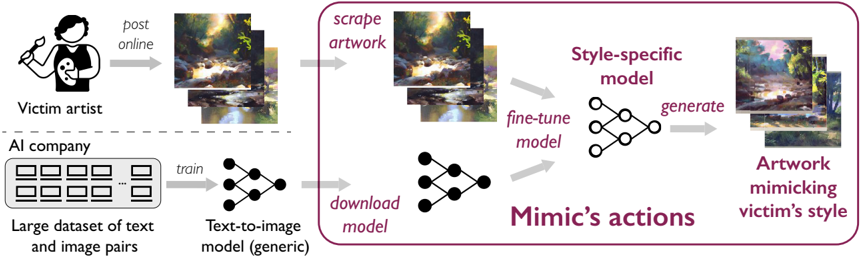
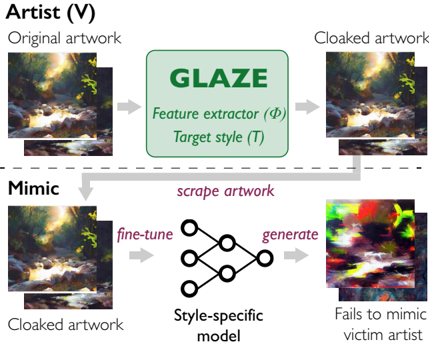
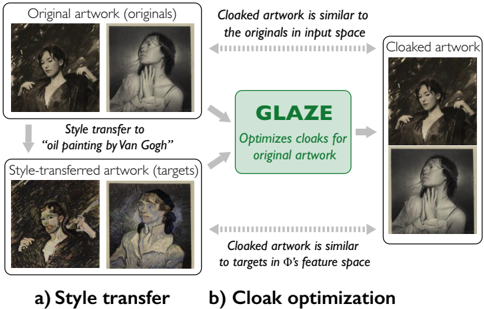
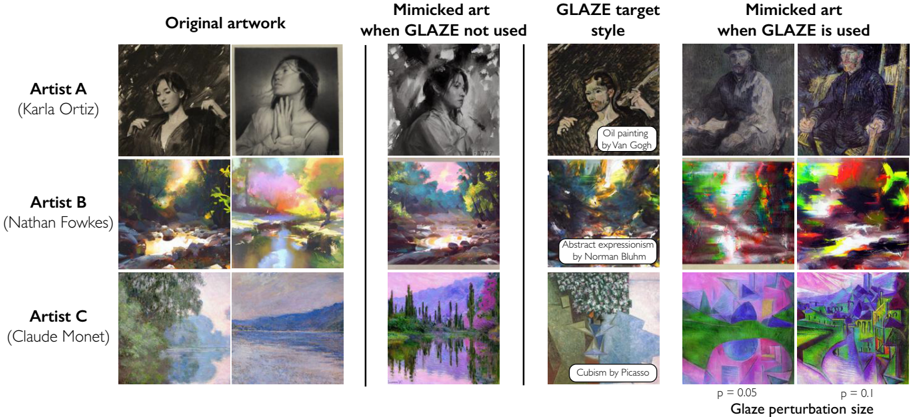
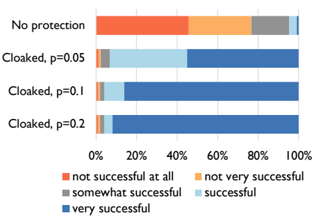
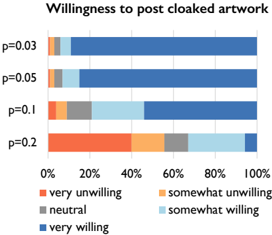
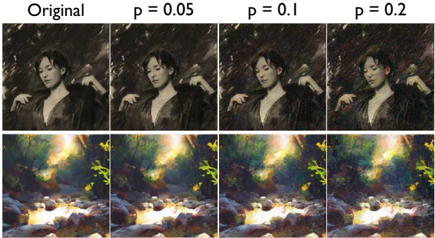
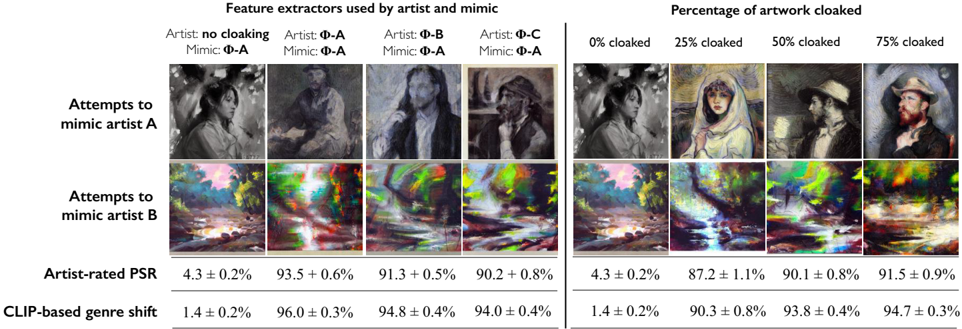
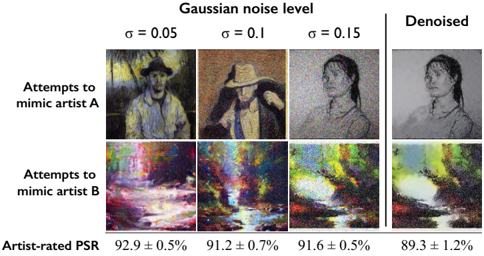
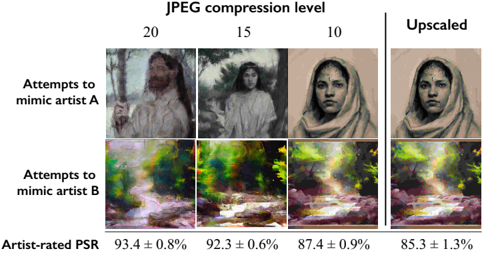
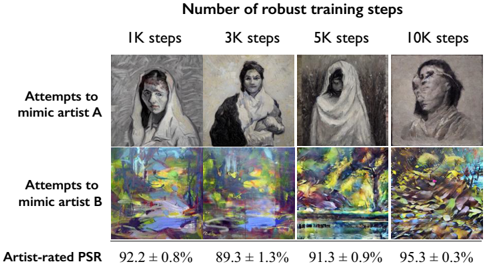
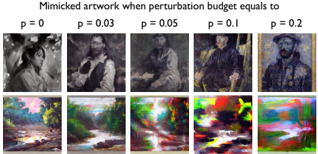
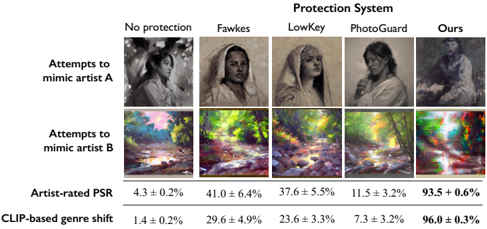
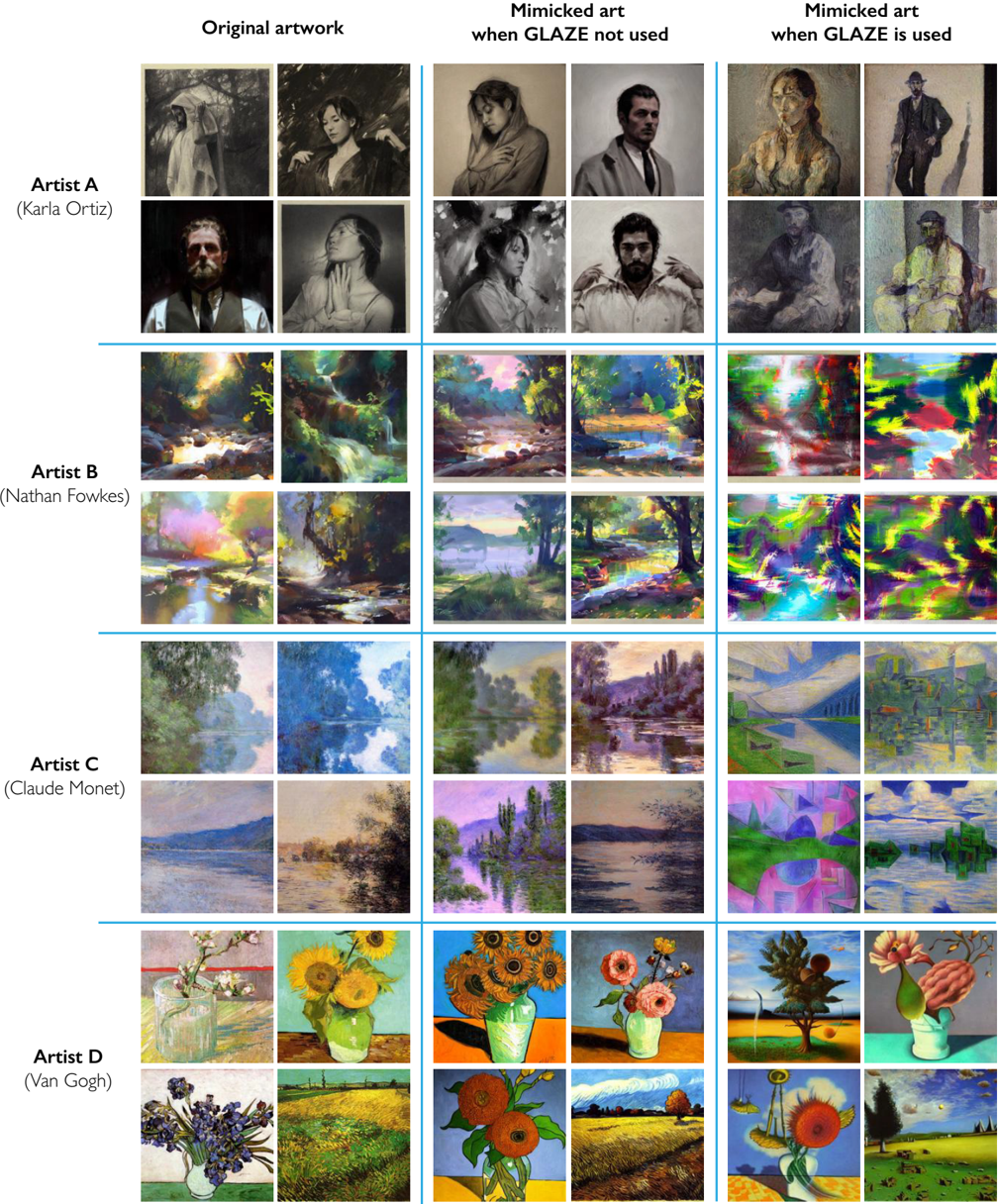
Recent text-to-image diffusion models such as MidJourney and Stable Diffusion threaten to displace many in the professional artist community. In particular, models can learn to mimic the artistic style of specific artists after "fine-tuning" on samples of their art. In this paper, we describe the design, implementation and evaluation of Glaze, a tool that enables artists to apply "style cloaks" to their art before sharing online. These cloaks apply barely perceptible perturbations to images, and when used as training data, mislead generative models that try to mimic a specific artist. In coordination with the professional artist community, we deploy user studies to more than 1000 artists, assessing their views of AI art, as well as the efficacy of our tool, its usability and tolerability of perturbations, and robustness across different scenarios and against adaptive countermeasures. Both surveyed artists and empirical CLIP-based scores show that even at low perturbation levels (p=0.05), Glaze is highly successful at disrupting mimicry under normal conditions (>92%) and against adaptive countermeasures (>85%).
Overview
The claims and statistics of this paper haven’t been checked yet.
Run the check — free, no account needed. It reads the open-access text and checks the sources it cites.
Integrity signals
Registry
Cites
Statistics
Figures


Verification
Claims the paper makes
The claims and statistics of this paper haven’t been checked yet.
Run the check — free, no account needed. It reads the open-access text and checks the sources it cites.
Claims other papers make about this one
Each is checked against this paper’s own text: does it say what the citing paper says it does?
In the citing paper
“Notably, Glaze (Shan et al., 2025) is designed to optimise the distance at the feature level between the original and the protected versions of the images, thereby inducing the model to learn an incorrect artistic style.”
From Generative AI and intellectual property: a systematic literature review of possible issues and mitigations (2026) · cites this paper as Shan et al., 2025
Self-check
Percentages, sums and reported differences re-computed from the paper’s own numbers.
The self-check needs the paper’s full text.
Citations
Cites
Adversarial examples in the physical world
Kurakin, A., Goodfellow, I. J., & Bengio, S. (2018) · Artificial Intelligence Safety and Security · doi:10.1201/9781351251389-8 · Cited by 5,375
DreamBooth: Fine Tuning Text-to-Image Diffusion Models for Subject-Driven Generation
Ruiz, N., Li, Y., Jampani, V., Pritch, Y., Rubinstein, M., & Aberman, K. (2022) · arXiv · doi:10.48550/arxiv.2208.12242 · Cited by 2,442
LAION-5B: An open large-scale dataset for training next generation image-text models
Schuhmann, C., Beaumont, R., Vencu, R., Gordon, C., Wightman, R., Cherti, M., Coombes, T., Katta, A., Mullis, C., Wortsman, M., et al. (2022) · arXiv · doi:10.48550/arxiv.2210.08402 · Cited by 1,022
Research works printed but not linked: 62
- BALAJI, Y., ET AL. ediffi: Text-to-image diffusion models with an ensemble of expert denoisers. arXiv:2211.01324 (2022). · arXiv
- BLAU, Y., AND MICHAELI, T. The perception-distortion tradeoff. In Proc. of CVPR (2018).
- CARLINI, N., AND WAGNER, D. Adversarial examples are not easily detected: Bypassing ten detection methods. In Proc. of AISec (2017).
- CARLINI, N., AND WAGNER, D. Towards evaluating the robustness of neural networks. In Proc. of IEEE S&P (2017).
- CHANDRASEKARAN, V., ET AL. Face-off: Adversarial face obfusca- tion. PETS 2 (2020), 369-390.
- CHANGPINYO, S., SHARMA, P., DING, N., AND SORICUT, R. Con- ceptual 12m: Pushing web-scale image-text pre-training to recognize long-tail visual concepts. In Proc. of CVPR (2021).
- CHEN, W., HU, H., SAHARIA, C., AND COHEN, W. W. Re-imagen: Retrieval-augmented text-to-image generator. arXiv:2209.14491 (2022). · arXiv
- CHEREPANOVA, V., ET AL. Lowkey: Leveraging adversarial attacks to protect social media users from facial recognition. In ICLR (2021).
- DAYMA, B. DALLE Mega -Training Journal, 2022.
- DEMONTIS, A., ET AL. Why do adversarial attacks transfer? ex- plaining transferability of evasion and poisoning attacks. In Proc. of USENIX Security (2019).
- DENG, J., DONG, W., SOCHER, R., LI, L.-J., LI, K., AND FEI-FEI, L. Imagenet: A large-scale hierarchical image database. In Proc. of CVPR (2009).
- FEINMAN, R., CURTIN, R. R., SHINTRE, S., AND GARDNER, A. B. Detecting adversarial samples from artifacts. arXiv:1703.00410 (2017). · arXiv
- GAL, R., ET AL. An image is worth one word: Personalizing text-to- image generation using textual inversion. arXiv:2208.01618 (2022). · arXiv
- GONDIM-RIBEIRO, G., TABACOF, P., AND VALLE, E. Adversarial attacks on variational autoencoders. arXiv:1806.04646 (2018). · arXiv
- HEIKKILA, M. This artist is dominating AI-generated art. and he's not happy about it. MIT Technology Review, Sept 2022.
- KARRAS, T., ET AL. Training generative adversarial networks with limited data. In Proc. of NeurIPS (2020).
- KAWAR, B., ET AL. Imagic: Text-based real image editing with diffusion models. Proc. of CVPR (2023).
- KE, Y., ET AL. Efficient near-duplicate detection and sub-image retrieval. In Proc. of MM (2004).
- KOS, J., FISCHER, I., AND SONG, D. Adversarial examples for generative models. In Proc. of SPW (2018).
- KYNKÄÄNNIEMI, T., KARRAS, T., AITTALA, M., AILA, T., AND LEHTINEN, J. The role of imagenet classes in fréchet inception distance. arXiv:2203.06026 (2022). · arXiv
- LAIDLAW, C., SINGLA, S., AND FEIZI, S. Perceptual adversarial robustness: Defense against unseen threat models. arXiv:2006.12655 (2020). · arXiv
- LI, K.-L., HUANG, H.-K., TIAN, S.-F., AND XU, W. Improving one-class SVM for anomaly detection. In Proc. of IEEE CAT (2003).
- LI, W., ET AL. Object-driven text-to-image synthesis via adversarial training. In Proc. of CVPR (2019).
- LI, Y., FAN, H., HU, R., FEICHTENHOFER, C., AND HE, K. Scaling language-image pre-training via masking. arXiv:2212.00794 (2022). · arXiv
- LIU, Z., LUO, P., WANG, X., AND TANG, X. Deep learning face attributes in the wild. In Proc. of ICCV (Dec. 2015).
- LUO, Z., XI, Y., ZHANG, R., AND MA, J. VC-GPT: Visual con- ditioned GPT for end-to-end generative vision-and-language pre- training. arXiv:2201.12723 (2022). · arXiv
- MANSIMOV, E., PARISOTTO, E., BA, J. L., AND SALAKHUTDINOV, R. Generating images from captions with attention. arXiv:1511.02793 (2015). · arXiv
- MENG, C., ET AL. On distillation of guided diffusion models. arXiv:2210.03142 (2022). · arXiv
- PAPERNOT, N., MCDANIEL, P., AND GOODFELLOW, I. Transfer- ability in machine learning: From phenomena to black-box attacks using adversarial samples. arXiv:1605.07277 (2016). · arXiv
- RADFORD, A., ET AL. Learning transferable visual models from natural language supervision. In Proc. of ICML (2021).
- RADFORD, A., METZ, L., AND CHINTALA, S. Unsupervised rep- resentation learning with deep convolutional generative adversarial networks. arXiv:1511.06434 (2015). · arXiv
- RADIYA-DIXIT, E., ET AL. Data poisoning won't save you from facial recognition. arXiv:2106.14851 (2021). · arXiv
- RAMESH, A., ET AL. Zero-shot text-to-image generation. In Proc. of ICML (2021).
- RAMESH, A., ET AL. Hierarchical text-conditional image generation with clip latents. arXiv:2204.06125 (2022). · arXiv
- ROMBACH, R., ET AL. High-resolution image synthesis with latent diffusion models. In Proc. of CVPR (2022).
- RONY, J., GRANGER, E., PEDERSOLI, M., AND BEN AYED, I. Aug- mented lagrangian adversarial attacks. In Proc. of ICCV (2021).
- SABOUR, S., CAO, Y., FAGHRI, F., AND FLEET, D. J. Adversarial manipulation of deep representations. arXiv:1511.05122 (2015). · arXiv
- SAHARIA, C., ET AL. Palette: Image-to-image diffusion models. In Proc. of SIGGRAPH (2022).
- SALEH, B., AND ELGAMMAL, A. Large-scale classification of fine-art paintings: Learning the right metric on the right feature. arXiv:1505.00855 (2015). · arXiv
- SALEHI, M., ET AL. Arae: Adversarially robust training of autoen- coders improves novelty detection. Neural Networks 144 (2021), 726-736.
- SALMAN, H., KHADDAJ, A., LECLERC, G., ILYAS, A., AND MADRY, A. Raising the cost of malicious AI-powered image editing. arXiv:2302.06588 (2022). · arXiv
- SHAN, S., DING, W., WENGER, E., ZHENG, H., AND ZHAO, B. Y. Post-breach recovery: Protection against white-box adversarial exam- ples for leaked dnn models. In Proc. of ACM CCS (2022).
- SHAN, S., WENGER, E., WANG, B., LI, B., ZHENG, H., AND ZHAO, B. Y. Gotta catch'em all: Using honeypots to catch adversarial attacks on neural networks. In Proc. of ACM CCS (2020).
- SHAN, S., WENGER, E., ZHANG, J., LI, H., ZHENG, H., AND ZHAO, B. Y. Fawkes: Protecting privacy against unauthorized deep learning models. In Proc. of USENIX Security (2020).
- SHARMA, P., DING, N., GOODMAN, S., AND SORICUT, R. Con- ceptual captions: A cleaned, hypernymed, image alt-text dataset for automatic image captioning. In Proc. of ACL (2018).
- SUCIU, O., ET AL. When does machine learning fail? generalized transferability for evasion and poisoning attacks. In Proc. of USENIX Security (2018).
- TABACOF, P., TAVARES, J., AND VALLE, E. Adversarial images for variational autoencoders. arXiv:1612.00155 (2016). · arXiv
- TAO, M., ET AL. DF-GAN: A simple and effective baseline for text-to-image synthesis. In Proc. of CVPR (2022).
- THOMEE, B., ET AL. Yfcc100m: The new data in multimedia re- search. CACM 59, 2 (2016), 64-73.
- UPCHURCH, P., ET AL. Deep feature interpolation for image content changes. In Proc. of CVPR (2017).
- WANG, B., YAO, Y., SHAN, S., LI, H., VISWANATH, B., ZHENG, H., AND ZHAO, B. Y. Neural cleanse: Identifying and mitigating backdoor attacks in neural networks. In Proc. of IEEE S&P (2019).
- WANG, F., AND LIU, H. Understanding the behaviour of contrastive loss. In Proc. of CVPR (2021).
- WEN, Y., ET AL. Hard prompts made easy: Gradient-based discrete optimization for prompt tuning and discovery. arXiv:2302.03668 (2023). · arXiv
- WENGER, E., SHAN, S., ZHENG, H., AND ZHAO, B. Y. SoK: Anti- facial recognition technology. In Proc. of IEEE S&P (2023).
- WHITE, T. Sampling generative networks. arXiv:1609.04468 (2016). · arXiv
- XU, T., ET AL. Attngan: Fine-grained text to image generation with attentional generative adversarial networks. In Proc. of CVPR (2018).
- YOSINSKI, J., CLUNE, J., BENGIO, Y., AND LIPSON, H. How trans- ferable are features in deep neural networks? In Proc. of NeurIPS (2014).
- ZHANG, H., AVRITHIS, Y., FURON, T., AND AMSALEG, L. Smooth adversarial examples. EURASIP Journal on Information Security (2020), 1-12.
- ZHANG, H., ET AL. Stackgan: Text to photo-realistic image synthe- sis with stacked generative adversarial networks. In Proc. of ICCV (2017).
- ZHANG, K., ET AL. Beyond a Gaussian denoiser: Residual learning of deep CNN for image denoising. IEEE Trans. on Image Processing (2017), 3142-3155.
- ZHANG, R., ET AL. The unreasonable effectiveness of deep features as a perceptual metric. In Proc. of CVPR (2018).
- ZHU, M., PAN, P., CHEN, W., AND YANG, Y. Dm-gan: Dynamic memory generative adversarial networks for text-to-image synthesis. In Proc. of CVPR (2019).
Cited by
AI Art and its Impact on Artists
Jiang, H. H., Brown, L., Cheng, J., Khan, M., Gupta, A., Workman, D., Hanna, A., Flowers, J., & Gebru, T. (2023) · Proceedings of the 2023 AAAI/ACM Conference on AI, Ethics, and Society · doi:10.1145/3600211.3604681 · Cited by 265
Arnaudo, A., Coppola, R., Morisio, M., Vetrò, A., Borghi, M., Raso, R., & Khan, B. (2026) · PeerJ Computer Science · doi:10.7717/peerj-cs.3928 · Cited by 2
Metadata
- Authors
- Shan, S., Cryan, J., Wenger, E., Zheng, H., Hanocka, R., & Zhao, B. Y.
- Venue
- arXiv
- Publisher
- arXiv
- Published
- 2023
- arXiv
- 2302.04222
- References
- 3
- Type
- Preprint
About these checks
Registry, retraction, Cites and statistics results are computed, not judged, with one exception: a printed reference that no index lists is read once by a model before it counts as a citation error. Claims are extracted by a model and kept only when their quote appears verbatim in the text; each cited source is then checked, with a model’s help, for whether it says what the claim relies on. Those verdicts can be wrong — read the claim’s quote and the cited source before relying on one.
Statistics and arithmetic are recomputed, not judged.
Confidence bands are shown only for fields calibrated on our annotated test set. None is calibrated yet, so no band is shown.
What counts as a claim ›How we measure confidence ›How we check this ›
Are you an author, or do you see a problem with this page? Request a review
How to cite
Cite CoChat for the checks on this page, and the paper for its own findings.
- This page
- CoChat. (2026). Citation check: Glaze: Protecting Artists from Style Mimicry by Text-to-Image Models. https://app.cochat.ai/papers/10.48550/arxiv.2302.04222
- The paper
- Shan, S., Cryan, J., Wenger, E., Zheng, H., Hanocka, R., & Zhao, B. Y. (2023). Glaze: Protecting Artists from Style Mimicry by Text-to-Image Models. arXiv. https://doi.org/10.48550/arxiv.2302.04222
