

Test of Time: A Benchmark for Evaluating LLMs on Temporal Reasoning
Open accessThe DOI matches its DataCite record; 74 of the 74 references it cites were found in a registry or an index; none of the 24 sources its claims cite is checked for support yet.
Abstract
Large language models (LLMs) have showcased remarkable reasoning capabilities, yet they remain susceptible to errors, particularly in temporal reasoning tasks involving complex temporal logic. Existing research has explored LLM performance on temporal reasoning using diverse datasets and benchmarks. However, these studies often rely on real-world data that LLMs may have encountered during pre-training or employ anonymization techniques that can inadvertently introduce factual inconsistencies. In this work, we address these limitations by introducing novel synthetic datasets specifically designed to assess LLM temporal reasoning abilities in various scenarios. The diversity of question types across these datasets enables systematic investigation into the impact of the problem structure, size, question type, fact order, and other factors on LLM performance. Our findings provide valuable insights into the strengths and weaknesses of current LLMs in temporal reasoning tasks. To foster further research in this area, we are open-sourcing the datasets and evaluation framework used in our experiments: https://huggingface.co/datasets/baharef/ToT.
Overview
CoChat Summary
TL;DR
The paper introduces Test of Time (ToT), a benchmark with synthetic semantic and arithmetic temporal reasoning tasks designed to avoid pre-training leakage and systematically vary graph structure, question type, and fact order. Evaluating Claude-3-Sonnet, GPT-4, and Gemini 1.5 Pro, it finds large effects of graph structure, question type, and fact ordering, with models strongest on single-fact and timezone questions and weakest on timeline and duration questions.
Key findings
- Graph structure strongly affects accuracy: GPT-4 ranged from 40.25% on complete graphs to 92.00% on AWE graphs (Table 3); Gemini 1.5 Pro had the best average rank (1.43), followed by GPT-4 (1.57) and Claude-3-Sonnet (3.00).
- Single-fact questions outperformed multi-fact questions: EventAtWhatTime was easiest (Claude 90.29%, GPT-4 89.43%, Gemini 93.14%), while Timeline was hardest (24.00%, 28.29%, 36.29%) (Table 5). On timeline questions, Gemini had the best precision/recall (0.81/0.83 across all graphs; 0.82/0.65 on complete graphs), while GPT-4 had the lowest (0.60/0.56 across all; 0.36/0.23 on complete) (Table 6).
- Fact order mattered: shuffled order yielded the lowest accuracy and TargetAndStartTime the highest; e.g., Gemini 63.04% shuffled vs 75.00% TargetAndStartTime, GPT-4 60.71% vs 62.60%, Claude 45.71% vs 73.57% (Table 7).
- On ToT-Arithmetic, models excelled on Timezone (Claude 74.00%, GPT-4 88.00%, Gemini 90.00%) and struggled most on Duration (15.00%, 16.00%, 13.50%) (Table 8); GPT-4 had the best average rank (1.29). When GPT-4 or Gemini erred on Duration questions, approximately 21% and 25% of their responses were within one day of the ground truth, respectively.
Methods
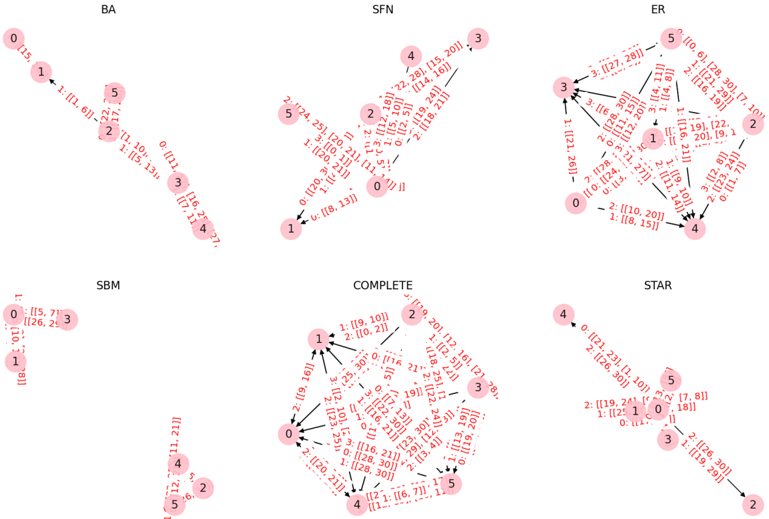
- ToT-Semantic: synthetic graphs generated from Erdős-Rényi, scale-free, Barabási-Albert, stochastic block model, star, complete, and Anonymized Wikidata Extract (AWE) structures; relations and time intervals are assigned, then eight question types are generated and facts sorted five ways, yielding 2,800 questions (7 graph generators × 8 question types × 5 sortings × 10 samples). An expanded dataset of approximately 50,000 examples is also reported.
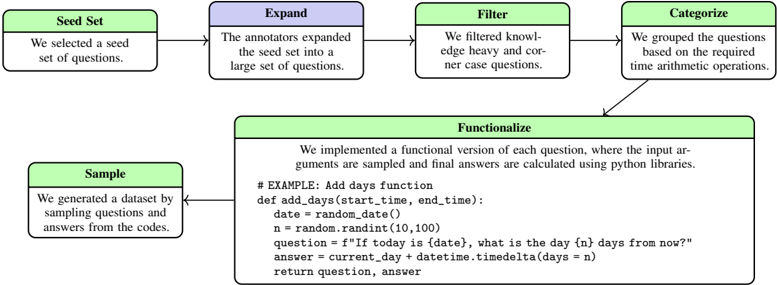
- ToT-Arithmetic: seed questions were expanded by 15 annotators, filtered, categorized into seven categories (AddSubtract, Compare, Duration, Schedule, Timezone, Trick, MultiOp), functionalized, and sampled to 1,850 questions (350 AddSubtract, 350 Compare, 200 Duration, 250 Schedule, 100 Timezone, 250 Trick, 350 MultiOp).
- Evaluation: Claude-3-Sonnet, GPT-4, and Gemini 1.5 Pro were tested; GPT4-Turbo was used for ToT-Semantic because of its higher context limit, and GPT4 for ToT-Arithmetic because of its higher quality. Multiple quality-check rounds verified labels and output-format instructions.
Limitations
- Stated: the benchmark focuses on single-sentence time anchoring and only explicit temporal facts, excluding static facts; future work could extend to multi-sentence and static-fact settings.
- Stated: dataset creation is automated; manual sampling found no errors in the examined subset, but rare errors may still exist.
- Evident: dataset-size reporting is inconsistent across sections (e.g., ToT-Semantic 2,800 in Section 3.1 vs 46,480 in the datasheet; ToT-Arithmetic 1,850 in Section 3.2 vs 2,800 in the datasheet), expanded ToT-Semantic results are reported only for Gemini 1.5 Pro due to computational demands, and cross-task comparisons use GPT4-Turbo versus GPT4.
Model-written summary. Check it against the paper before relying on it.
Integrity signals
Registry
Cites
Statistics
Figures
Verification
Claims the paper makes
0 Valid · 7 Not valid · 13 Not checked · 122 Own results and interpretations
A result the paper reports from its own data — it cites no other source for it, so there is none to check. The quote shows it is in the paper.
In the paper
“Notably, GPT-4 accuracy more than doubled between complete graphs (40.25%) and AWE graphs (92.00%).”
§ EXAMPLE: Add days function def add_days(start_time, end_time): date = random_date() n = random.randint(10,100)question = f"If today is {date}, what is the day {n} days from now?" answer = current_day + datetime.timedelta(days= n) return question, answer > 4.1 Investigating the impact of temporal structure on LLM temporal reasoning
plainstates an association- Asserted: passes — The authors put it forward as true.
- Checkable: passes — It can be checked against evidence.
- Load-bearing: passes — The paper’s conclusions depend on it.
- Based: passes — The paper gives a reason why it holds.
A result the paper reports from its own data — it cites no other source for it, so there is none to check. The quote shows it is in the paper.
In the paper
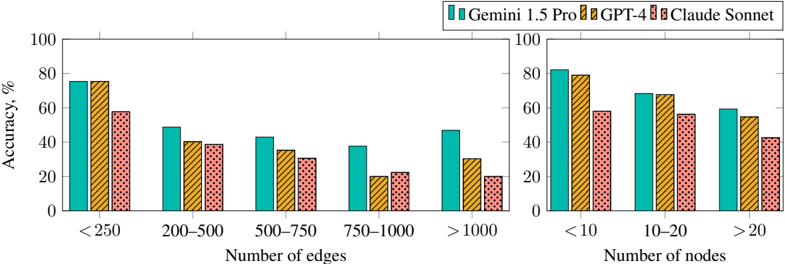
“While the average number of nodes does not appear to consistently influence LLM performance across structures, the number of edges does show some correlation.”
§ EXAMPLE: Add days function def add_days(start_time, end_time): date = random_date() n = random.randint(10,100)question = f"If today is {date}, what is the day {n} days from now?" answer = current_day + datetime.timedelta(days= n) return question, answer > 4.1.1 Influence of graph size on LLM performance
hedgedstates an association- Asserted: passes — The authors put it forward as true.
- Checkable: passes — It can be checked against evidence.
- Load-bearing: unclear — It is unclear whether the paper’s conclusions depend on it.
- Based: passes — The paper gives a reason why it holds.
A result the paper reports from its own data — it cites no other source for it, so there is none to check. The quote shows it is in the paper.
In the paper
“GPT-4 accuracy varied drastically across graph types, from 20.33% for complete graphs to 90.83% for AWE graphs.”
§ EXAMPLE: Add days function def add_days(start_time, end_time): date = random_date() n = random.randint(10,100)question = f"If today is {date}, what is the day {n} days from now?" answer = current_day + datetime.timedelta(days= n) return question, answer > 4.1 Investigating the impact of temporal structure on LLM temporal reasoning
plainstates an association- Asserted: passes — The authors put it forward as true.
- Checkable: passes — It can be checked against evidence.
- Load-bearing: passes — The paper’s conclusions depend on it.
- Based: passes — The paper gives a reason why it holds.
A result the paper reports from its own data — it cites no other source for it, so there is none to check. The quote shows it is in the paper.
In the paper
“As illustrated in Figure 4, increasing either the number of edges or nodes in the ToT-Semantic dataset leads to a decrease in LLM performance.”
§ EXAMPLE: Add days function def add_days(start_time, end_time): date = random_date() n = random.randint(10,100)question = f"If today is {date}, what is the day {n} days from now?" answer = current_day + datetime.timedelta(days= n) return question, answer > 4.1 Investigating the impact of temporal structure on LLM temporal reasoning
plainstates a cause- Asserted: passes — The authors put it forward as true.
- Checkable: passes — It can be checked against evidence.
- Load-bearing: passes — The paper’s conclusions depend on it.
- Based: passes — The paper gives a reason why it holds.
A result the paper reports from its own data — it cites no other source for it, so there is none to check. The quote shows it is in the paper.
In the paper
“An analysis of timeline questions in Table 5 reveals that they pose the greatest challenge across all tasks.”
§ EXAMPLE: Add days function def add_days(start_time, end_time): date = random_date() n = random.randint(10,100)question = f"If today is {date}, what is the day {n} days from now?" answer = current_day + datetime.timedelta(days= n) return question, answer > Performance variations within question types.
plain- Asserted: passes — The authors put it forward as true.
- Checkable: passes — It can be checked against evidence.
- Load-bearing: unclear — It is unclear whether the paper’s conclusions depend on it.
- Based: passes — The paper gives a reason why it holds.
33 more claims
Create a free account to see all 142 claims and every source verdict.
- It may state two separate claims as one. 49
- Probably not a substantial claim. 72
- The quote only partly states this claim. 3
Self-check
Percentages, sums and reported differences re-computed from the paper’s own numbers.
Each contradiction between two passages listed here was confirmed by an independent check.
Rated major: it would touch a result — a value a result rests on, reported and recomputed p-values on opposite sides of the significance level, two passages that conflict with no sign which is right, or a cited work retracted before this paper was published.
In the paper
§ EXAMPLE: Add days function def add_days(start_time, end_time): date = random_date() n = random.randint(10,100)question = f"If today is {date}, what is the day {n} days from now?" answer = current_day + datetime.timedelta(days= n) return question, answer > 3.2.1 Task Creation
“This resulted in a dataset with 1850 questions in total.”
§ EXAMPLE: Add days function def add_days(start_time, end_time): date = random_date() n = random.randint(10,100)question = f"If today is {date}, what is the day {n} days from now?" answer = current_day + datetime.timedelta(days= n) return question, answer > H.2 Composition
“Our ToT benchmark contains 46, 480 data points in the ToT-Semantic dataset and 2, 800 data points in the ToT-Arithmetic dataset.”
Rated minor: it would not touch a result — a value no result rests on, a p-value that stays on the same side of the significance level, or a conflict that is clerical, resolved elsewhere in the paper, or outside its own findings.
In the paper
§ EXAMPLE: Add days function def add_days(start_time, end_time): date = random_date() n = random.randint(10,100)question = f"If today is {date}, what is the day {n} days from now?" answer = current_day + datetime.timedelta(days= n) return question, answer > 4.1.1 Influence of graph size on LLM performance
“SFN graphs, despite having far fewer edges on average than Star graphs”
§ EXAMPLE: Add days function def add_days(start_time, end_time): date = random_date() n = random.randint(10,100)question = f"If today is {date}, what is the day {n} days from now?" answer = current_day + datetime.timedelta(days= n) return question, answer > H.5 Distribution
“| SFN | 17.52 53.46 | | Star | 16.16 34.12 |”
Rated minor: it would not touch a result — a value no result rests on, a p-value that stays on the same side of the significance level, or a conflict that is clerical, resolved elsewhere in the paper, or outside its own findings.
In the paper
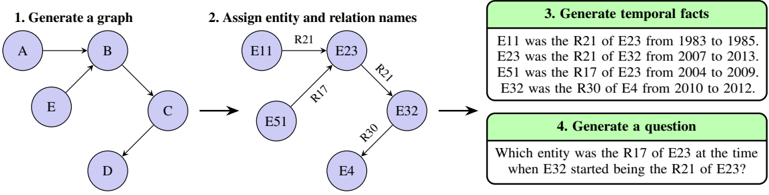
§ Test of Time: A Benchmark for Evaluating LLMs on Temporal Reasoning > 4. Generate a question
“Which entity was the R17 of E23 at the time when E32 started being the R21 of E23?”
§ Test of Time: A Benchmark for Evaluating LLMs on Temporal Reasoning > Step 2: Question Generation.
“E23 was the R21 of E32 from 2007 to 2013.”
Rated minor: it would not touch a result — a value no result rests on, a p-value that stays on the same side of the significance level, or a conflict that is clerical, resolved elsewhere in the paper, or outside its own findings.
In the paper
§ EXAMPLE: Add days function def add_days(start_time, end_time): date = random_date() n = random.randint(10,100)question = f"If today is {date}, what is the day {n} days from now?" answer = current_day + datetime.timedelta(days= n) return question, answer > 4.1.1 Influence of graph size on LLM performance
“exhibit slightly better average performance in Table 3.”
§ EXAMPLE: Add days function def add_days(start_time, end_time): date = random_date() n = random.randint(10,100)question = f"If today is {date}, what is the day {n} days from now?" answer = current_day + datetime.timedelta(days= n) return question, answer > H.5 Distribution
“| SFN | 58.75 | 75.25 | 75.75 | | Star | 59.50 | 80.25 | 74.25 |”
Rated minor: it would not touch a result — a value no result rests on, a p-value that stays on the same side of the significance level, or a conflict that is clerical, resolved elsewhere in the paper, or outside its own findings.
In the paper
§ EXAMPLE: Add days function def add_days(start_time, end_time): date = random_date() n = random.randint(10,100)question = f"If today is {date}, what is the day {n} days from now?" answer = current_day + datetime.timedelta(days= n) return question, answer > 4.3 Impact of temporal fact order on LLM performance
“performance is consistently lowest when facts are presented in a shuffled order”
§ EXAMPLE: Add days function def add_days(start_time, end_time): date = random_date() n = random.randint(10,100)question = f"If today is {date}, what is the day {n} days from now?" answer = current_day + datetime.timedelta(days= n) return question, answer > H.5 Distribution
“| Shuffle | 45.71 | 60.71 | 63.04 | | RelationAndStartTime | 54.29 | 65.36 | 68.57 | | StartTimeAndRelation | 47.68 | 60.54 | 64.64 |”
2 more findings
Create a free account to see every finding of this check.
Citations
Cites
Vaswani, A., Shazeer, N., Parmar, N., Uszkoreit, J., Jones, L., Gomez, A. N., Kaiser, L., & Polosukhin, I. (2017) · arXiv · doi:10.48550/arxiv.1706.03762 · Cited by 120,404
BERT: Pre-training of Deep Bidirectional Transformers for Language Understanding
Devlin, J., Chang, M.-W., Lee, K., & Toutanova, K. (2019) · Proceedings of the 2019 Conference of the North American Chapter of the Association for Computational Linguistics: Human Language Technologies, Volume 1 (Long and Short Papers) · doi:10.18653/v1/n19-1423 · Cited by 54,325
Emergence of Scaling in Random Networks
Barabási, A.-L., & Albert, R. (1999) · Science · doi:10.1126/science.286.5439.509 · Cited by 36,135
Statistical mechanics of complex networks
Albert, R., & Barabási, A.-L. (2002) · Reviews of Modern Physics · doi:10.1103/revmodphys.74.47 · Cited by 20,471
Exploring the Limits of Transfer Learning with a Unified Text-to-Text Transformer
Raffel, C., Shazeer, N., Roberts, A., Lee, K., Narang, S., Matena, M., Zhou, Y., Li, W., & Liu, P. J. (2019) · arXiv · doi:10.48550/arxiv.1910.10683 · Cited by 10,929
DeepWalk: online learning of social representations
Perozzi, B., Al-Rfou, R., & Skiena, S. (2014) · Proceedings of the 20th ACM SIGKDD international conference on Knowledge discovery and data mining · doi:10.1145/2623330.2623732 · Cited by 10,123 · cited 1×
“We note that while our study was limited to parametric graph generators in this work, the field of graph machine learning [10] offers many options for both modeling [44] and learning [25, 19, 48, 20] link structure.”
Self-citationTree of Thoughts: Deliberate Problem Solving with Large Language Models
Yao, S., Yu, D., Zhao, J., Shafran, I., Griffiths, T. L., Cao, Y., & Narasimhan, K. (2023) · arXiv · doi:10.48550/arxiv.2305.10601 · Cited by 7,650 · cited 1×
“…LLM-based techniques have been developed which have advanced the general automated reasoning capabilities of the state-of-the-art models [62, 65], or their capabilities in specific directions including mathematical reasoning [36, 2], logical reasoning [34, 14], multi-modal reasoning [61],…”
Chain-Of-Thought Prompting Elicits Reasoning in Large Language Models
Wei, J., Wang, X., Schuurmans, D., Bosma, M., Ichter, B., Xia, F., Chi, E., Le, Q. V., & Zhou, D. (2022) · Advances in Neural Information Processing Systems 35 · doi:10.52202/068431-1800 · Cited by 4,505
Wikidata: a free collaborative knowledgebase
Vrandečić, D., & Krötzsch, M. (2014) · Communications of the ACM · doi:10.1145/2629489 · Cited by 3,342
Stochastic blockmodels: First steps
Holland, P. W., Laskey, K. B., & Leinhardt, S. (1983) · Social Networks · doi:10.1016/0378-8733(83)90021-7 · Cited by 2,755
Research works printed but not linked: 4
- Tom Brown, Benjamin Mann, Nick Ryder, Melanie Subbiah, Jared D Kaplan, Prafulla Dhariwal, Arvind Neelakantan, Pranav Shyam, Girish Sastry, Amanda Askell, et al. Language models are few-shot learners. NeurIPS, 2020.
- Ines Chami, Sami Abu-El-Haija, Bryan Perozzi, Christopher Ré, and Kevin Murphy. Machine learning on graphs: A model and comprehensive taxonomy. Journal of Machine Learning Research, 23(89):1-64, 2022.
- Jason Xinyu Liu, Ziyi Yang, Ifrah Idrees, Sam Liang, Benjamin Schornstein, Stefanie Tellex, and Ankit Shah. Grounding complex natural language commands for temporal tasks in unseen environments. In Conference on Robot Learning, pages 1084-1110. PMLR, 2023.
- John McCarthy. Programs with common sense. In Proceedings of the Teddington Conference on the Mechanization of Thought Processes, pages 75-91, London, 1959. Her Majesty's Stationary Office. URL http://www-formal.stanford.edu/jmc/mcc59.html.
Cited by
Gemma Team, Kamath, A., Ferret, J., Pathak, S., Vieillard, N., Merhej, R., Perrin, S., Matejovicova, T., Ramé, A., Rivière, M., et al. (2025) · arXiv · doi:10.48550/arxiv.2503.19786 · Cited by 1,156
“BBEH refers to BIG-Bench Extra Hard (Kazemi et al., 2025), a challenging LLM reasoning benchmark that aggregates several reasoning tasks (Fatemi et al., Hessel et al., 2022; Kazemi et al., 2023, 2024b; Kıcıman et al., 2023; Nie et al., 2024; Sánchez et al., 2024; Shah et al., 2024; Tyen et al.,…”
Self-citationBIG-Bench Extra HardPreprint
Kazemi, M., Fatemi, B., Bansal, H., Palowitch, J., Anastasiou, C., Mehta, S. V., Jain, L. K., Aglietti, V., Jindal, D., Chen, P., et al. (2025) · arXiv (Cornell University) · doi:10.48550/arxiv.2502.19187 · Cited by 110
Self-citationTIMER: temporal instruction modeling and evaluation for longitudinal clinical records
Cui, H., Unell, A., Chen, B., Fries, J., Alsentzer, E., Koyejo, S., & Shah, N. H. (2025) · npj Digital Medicine · doi:10.1038/s41746-025-01965-9 · Cited by 81
Kozlowski, A. C., & Evans, J. A. (2025) · Sociological Methods & Research · doi:10.1177/00491241251337316 · Cited by 72
Zhu, Y., Bai, X., Chen, K., Xiang, Y., Yu, J., & Zhang, M. (2025) · Proceedings of the conference - Association for Computational Linguistics. Meeting · doi:10.18653/v1/2025.acl-long.1482 · Cited by 44
Complex QA and language models hybrid architectures, SurveyPreprint
Daull, X., Bellot, P., Bruno, E., Martin, V., & Murisasco, É. (2023) · arXiv (Cornell University) · doi:10.48550/arxiv.2302.09051 · Cited by 44
A Study into Investigating Temporal Robustness of LLMs
Wallat, J., Abdallah, A., Jatowt, A., & Anand, A. (2025) · Findings of the Association for Computational Linguistics: ACL (Findings of ACL) · doi:10.18653/v1/2025.findings-acl.810 · Cited by 38
It’s High Time: A Survey of Temporal Question Answering
Piryani, B., Abdallah, A., Mozafari, J., Anand, A., & Jatowt, A. (2026) · Proceedings of the conference - Association for Computational Linguistics. Meeting · doi:10.18653/v1/2026.acl-long.1332 · Cited by 36
Is Your LLM Outdated? A Deep Look at Temporal Generalization
Zhu, C., Chen, N., Gao, Y., Zhang, Y., Tiwari, P., & Wang, B. (2025) · Proceedings of the 2025 Conference of the Nations of the Americas Chapter of the Association for Computational Linguistics: Human Language Technologies (Volume 1: Long Papers) · doi:10.18653/v1/2025.naacl-long.381 · Cited by 33
“Recently, several methods have been proposed to evaluate models at different times and in various contexts Fatemi et al. (2024); Kasai et al. (2024); Vu et al. (2023).”
Reasoning in Computer Vision: Taxonomy, Models, Tasks, and MethodologiesPreprint
Sarkar, A., Yu, Z., & Idris, M. Y. I. (2025) · arXiv (Cornell University) · doi:10.48550/arxiv.2508.10523 · Cited by 32
ChronoSense: Exploring Temporal Understanding in Large Language Models with Time Intervals of Events
Islakoglu, D. S., & Kalo, J.-C. (2025) · Proceedings of the conference - Association for Computational Linguistics. Meeting · doi:10.18653/v1/2025.acl-short.46 · Cited by 31
Can Multimodal LLMs do Visual Temporal Understanding and Reasoning? The answer is No!Preprint
Imam, M. F., Lyu, C., & Aji, A. F. (2025) · arXiv (Cornell University) · doi:10.48550/arxiv.2501.10674 · Cited by 30
NarraBench: A Comprehensive Framework for Narrative Benchmarking
Hamilton, S., Wilkens, M. J., & Piper, A. (2026) · Conference of the European Chapter of the Association for Computational Linguistics · doi:10.18653/v1/2026.eacl-long.176 · Cited by 28
Weng, M., Cao, D., Yang, W., Sharma, Y., & Liu, Y. (2026) · ACM SIGKDD Conference on Knowledge Discovery and Data Mining (KDD) · doi:10.1145/3770855.3817485 · Cited by 25
UnSeenTimeQA: Time-Sensitive Question-Answering Beyond LLMs’ Memorization
Uddin, M. N., Saeidi, A., Handa, D., Seth, A., Son, T. C., Blanco, E., Corman, S. R., & Baral, C. R. (2025) · Proceedings of the conference - Association for Computational Linguistics. Meeting · doi:10.18653/v1/2025.acl-long.94 · Cited by 26
Zhu, Z., Liao, Y., Chen, Z., Wang, Y., Guan, Y., Wang, Y., & Wang, Y. (2025) · Proceedings of the conference - Association for Computational Linguistics. Meeting · doi:10.18653/v1/2025.acl-long.788 · Cited by 24
Large Language Model Powered Intelligent Urban Agents: Concepts, Capabilities, and ApplicationsPreprint
Han, J., Ning, Y., Yuan, Z., Ni, H., Liu, F., Lyu, T., & Liu, H. (2025) · arXiv (Cornell University) · doi:10.48550/arxiv.2507.00914 · Cited by 24
Bazaga, A., Blloshmi, R., Byrne, B., & de Gispert, A. (2025) · Proceedings of the conference - Association for Computational Linguistics. Meeting · doi:10.18653/v1/2025.acl-long.1358 · Cited by 23
Future Events as Backdoor Triggers: Investigating Temporal Vulnerabilities in LLMsPreprint
Price, S., Panickssery, A., Bowman, S., & Stickland, A. C. (2024) · arXiv (Cornell University) · doi:10.48550/arxiv.2407.04108 · Cited by 22
When LLM Meets Time Series: Can LLMs Perform Multi-Step Time Series Reasoning and InferencePreprint
Ye, W., Liu, J., Cao, D., Yang, W. P., & Liu, Y. (2025) · arXiv (Cornell University) · doi:10.48550/arxiv.2509.01822 · Cited by 19
KnowMe-Bench: Benchmarking Person Understanding for Lifelong Digital CompanionsPreprint
Wu, T., Chen, Z., Weng, Z., Wang, S., Li, C., Zhang, S., Hu, S., Wu, S., Lan, Q., Wang, H., et al. (2026) · arXiv (Cornell University) · doi:10.48550/arxiv.2601.04745 · Cited by 17
LLMAP: LLM-Assisted Multi-Objective Route Planning with User Preferences
Yuan, L., Han, D.-J., Brinton, C. G., & Brunswicker, S. (2025) · Findings of the Association for Computational Linguistics: EMNLP (Findings of EMNLP) · doi:10.18653/v1/2025.findings-emnlp.416 · Cited by 16
ExAnte: A Benchmark for Ex-Ante Inference in Large Language Models
Liu, Y., Wei, X., Shi, L., Li, X., Zhang, B., Dhillon, P. S., & Mei, Q. (2026) · Conference of the European Chapter of the Association for Computational Linguistics · doi:10.18653/v1/2026.eacl-long.72 · Cited by 17
Adapting Large Language Models to Emerging Cybersecurity using Retrieval Augmented GenerationPreprint
Borah, A., Alam, T., & Rastogi, N. (2025) · arXiv (Cornell University) · doi:10.48550/arxiv.2510.27080 · Cited by 15
Always-OnAgents:A Survey of Persistent Memory, State, and Governance in LLMAgentsPreprint
Ding, T., Nannapaneni, A., Liu, B., & Zhang, L. (2026) · arXiv (Cornell University) · doi:10.48550/arxiv.2606.30306 · Cited by 16
Enhancing Logical Reasoning in Large Language Models through Graph-based Synthetic DataPreprint
Zhou, J., Ghaddar, A., Zhang, G., Ma, L., Hu, Y., Pal, S., Coates, M., Wang, B., Zhang, Y., & Hao, J. (2024) · arXiv (Cornell University) · doi:10.48550/arxiv.2409.12437 · Cited by 14
Luo, S., Liu, Y., Lin, D., Zhai, Y., Wang, B., Yang, X., & Liu, J. (2025) · Findings of the Association for Computational Linguistics: ACL (Findings of ACL) · doi:10.18653/v1/2025.findings-acl.1198 · Cited by 13
LTLBench: Towards Benchmarks for Evaluating Temporal Reasoning in Large Language ModelsPreprint
Tang, W., Nuamah, K., & Belle, V. (2026) · Edinburgh Research Explorer (University of Edinburgh) · doi:10.48550/arxiv.2407.05434 · Cited by 13
VideoCogQA: A Controllable Benchmark for Evaluating Cognitive Abilities in Video-Language ModelsPreprint
Li, C., Chen, Q., Li, Z., Tao, F., & Zhang⋆, Y. (2024) · arXiv (Cornell University) · doi:10.48550/arxiv.2411.09105 · Cited by 12
Date Fragments: A Hidden Bottleneck of Tokenization for Temporal Reasoning
Bhatia, G., Peyrard, M., & Zhao, W. (2025) · Conference on Empirical Methods in Natural Language Processing (EMNLP) · doi:10.18653/v1/2025.emnlp-main.159 · Cited by 11
TellTime: An AI-Augmented Calendar with a Voice Interface for Collecting Time-Use Data
Hoefer, M. J. D., Rychecky, R., Gong, M., & Voida, S. (2025) · ACM International Conference on Intelligent User Interfaces (IUI) · doi:10.1145/3708359.3712116 · Cited by 10
Around the World in 24 Hours: Probing LLM Knowledge of Time and Place
Holtermann, C., Röttger, P., & Lauscher, A. (2025) · Proceedings of the conference - Association for Computational Linguistics. Meeting · doi:10.18653/v1/2025.acl-long.1115 · Cited by 10
Exploring the Potential of Large Language Models as Predictors in Dynamic Text-Attributed GraphsPreprint
Lei, R., Ji, J., Ding, H., Lü, Y., Wei, Z., Liu, Y., & Hong, C. (2025) · arXiv (Cornell University) · Cited by 10
USTBench: Benchmarking and Dissecting Spatiotemporal Reasoning of LLMs as Urban Agents
Lai, S., Ning, Y., Yuan, Z., Chen, Z., & Liu, H. (2026) · International Conference on Learning Representations · doi:10.48550/arxiv.2505.17572 · Cited by 10
When Facts Change: Probing LLMs on Evolving Knowledge with evolveQA
Nakshatri, N. S., Roy, S., Arivazhagan, M. G., Zhou, H., Kumar, V. B., & Gangadharaiah, R. (2026) · Conference on Empirical Methods in Natural Language Processing (EMNLP) · doi:10.18653/2026.emnlp-main.2373 · Cited by 8
Question Answering under Temporal Conflict: Evaluating and Organizing Evolving Knowledge with LLMsPreprint
Özer, A., & Yıldız, Ç. (2025) · arXiv (Cornell University) · doi:10.48550/arxiv.2506.07270 · Cited by 8
OIBench: Benchmarking Strong Reasoning Models with Olympiad in InformaticsPreprint
Zhu, Y., Wang, J., Li, Y., Qiu, L., Wang, Z., Xu, J., Cao, X., Wei, Y., Wang, M., Cai, X., et al. (2025) · arXiv (Cornell University) · doi:10.48550/arxiv.2506.10481 · Cited by 8
Song, X., Liang, B., Sun, Y., Zhang, C., Wang, B., & Xu, R. (2025) · International ACM SIGIR Conference on Research and Development in Information Retrieval (SIGIR) · doi:10.1145/3726302.3730173 · Cited by 7
ActionReasoningBench: Reasoning about Actions with and without Ramification Constraints
Handa, D., Dolin, P., Kumbhar, S., Son, T. C., & Baral, C. R. (2025) · International Conference on Learning Representations · doi:10.48550/arxiv.2406.04046 · Cited by 7
Hao, G., Alexandre, F., & Yu, S. P. (2025) · IEEE Transactions on Cognitive and Developmental Systems · doi:10.1109/tcds.2025.3590165 · Cited by 7
Hossain, E., Saha, S., Ornee, T. N., Jennifer, S. S., Biswas, U., Dipta, S. R., Rana, R., & Yousefi, N. (2026) · arXiv (Cornell University) · doi:10.48550/arxiv.2606.20959 · Cited by 6
SPAN: Benchmarking and Improving Cross-Calendar Temporal Reasoning of Large Language Models
Miao, Z., Fu, H., & Wei, C. (2026) · Proceedings of the AAAI Conference on Artificial Intelligence · doi:10.1609/aaai.v40i42.40884 · Cited by 6
DateLogicQA: Benchmarking Temporal Biases in Large Language Models
Bhatia, G., Tang, M. Z., Mahanta, C., & Kazi, M. (2025) · Conference of the North American Chapter of the Association for Computational Linguistics: Human Language Technologies (NAACL-HLT) · doi:10.18653/v1/2025.naacl-srw.32 · Cited by 5
MastermindEval: A Simple But Scalable Reasoning BenchmarkPreprint
Golde, J., Haller, P., Barth, F., & Akbik, A. (2025) · arXiv (Cornell University) · doi:10.48550/arxiv.2503.05891 · Cited by 5
Sobhani, M. E., Sayeedi, M. F. A., Chowdhury, F. H., Arefeen, M. A., Sadeque, F., Bari, M. F., & Shatabda, S. (2026) · arXiv (Cornell University) · doi:10.48550/arxiv.2608.08512 · Cited by 5
Iti-Validator: A Guardrail Framework for Validating and Correcting LLM-Generated Itineraries
Gadbail, S., Desai, M., & Karlapalem, K. (2025) · ACM SIGSPATIAL International Conference on Advances in Geographic Information Systems (SIGSPATIAL GIS) · doi:10.1145/3748636.3763206 · Cited by 4
BeDiscovER: The Benchmark of Discourse Understanding in the Era of Reasoning Language Models
Li, C., & Carenini, G. (2026) · Conference of the European Chapter of the Association for Computational Linguistics · doi:10.18653/v1/2026.eacl-long.207 · Cited by 4
KnowMe-Bench: Benchmarking Person Understanding for Lifelong Digital Companions
Wu, T., Chen, Z., Weng, Z., Wang, S., Zhang, S., Hu, S., Wu, S., Lan, Q., Wang, H., & Chen, R. (2026) · Proceedings of the conference - Association for Computational Linguistics. Meeting · doi:10.18653/v1/2026.acl-long.1394 · Cited by 4
Enhancing Numerical Prediction of MLLMS With Soft Labeling
Wang, P., Cai, Z., Yang, H., Modolo, D., & Swaminathan, A. D. (2025) · IEEE/CVF International Conference on Computer Vision (ICCV) · doi:10.1109/iccv51701.2025.00327 · Cited by 4
Graph Reasoning with LLMs (GReaL)
Tsitsulin, A., Perozzi, B., Fatemi, B., & Halcrow, J. (2024) · ACM SIGKDD Conference on Knowledge Discovery and Data Mining (KDD) · doi:10.1145/3637528.3671448 · Cited by 4
Self-citationChroKnowledge: Unveiling Chronological Knowledge of Language Models in Multiple Domains
Park, Y., Yoon, C., Park, J., Lee, D., Jeong, M., & Kang, J. (2025) · International Conference on Learning Representations · doi:10.48550/arxiv.2410.09870 · Cited by 4
Hatevolution: What Static Benchmarks Don’t Tell Us
Bonaventura, C. D., McGillivray, B., He, Y., & Meroño-Peñuela, A. (2025) · Findings of the Association for Computational Linguistics: ACL (Findings of ACL) · doi:10.18653/v1/2025.findings-acl.910 · Cited by 4
Position Paper: Large Language Models need Episodic Memory
Hao, G., Zhang, Y., Ma, G., Chen, Y., Alexandre, F., & Yu, S. (2025) · International Joint Conference on Neural Networks (IJCNN) · doi:10.1109/ijcnn64981.2025.11229266 · Cited by 3
Towards Interpretable and Trustworthy Time Series Reasoning: A BlueSky Vision
Ning, K., Pan, Z., Jiang, Y., Schneider, A., Nevmyvaka, Y., & Song, D. (2025) · IEEE ... International Conference on Data Mining workshops · doi:10.1109/icdmw69685.2025.00308 · Cited by 3
DateLogicQA: Benchmarking Temporal Biases in Large Language ModelsPreprint
Bhatia, G., Tang, M., Mahanta, C., & Kazi, M. (2024) · arXiv (Cornell University) · doi:10.48550/arxiv.2412.13377 · Cited by 3
Say Anything but This: When Tokenizer Betrays Reasoning in LLMsPreprint
Ayoobi, N., Armstrong, M., & Mukherjee, A. (2026) · arXiv (Cornell University) · doi:10.48550/arxiv.2601.14658 · Cited by 3
Anand, A., Ramesh, M., Mittal, A., Kumar, A., Vyalla, R. R., Cambria, E., Wang, Z., Liu, T., Ng, A. B., See, S., et al. (2026) · arXiv (Cornell University) · doi:10.48550/arxiv.2606.11470 · Cited by 3
When Does Intrinsic Self-Correction Help? A Task-Sensitive AnalysisPreprint
Stav, E., Berlowitz, D., Orner, M., & Kraus, S. (2026) · arXiv (Cornell University) · doi:10.48550/arxiv.2606.23196 · Cited by 3
Leveraging electronic health records for atrial fibrillation cohort generation
Domingo-Aldama, A. G., Prado, M. M., Olea, A. G., Goikoetxea, J., Gojenola, K., & Atutxa, A. (2026) · Health Information Science and Systems · doi:10.1007/s13755-025-00415-w · Cited by 2
On the Cultural Anachronism and Temporal Reasoning in Vision Language Models
Ranjan, M., Jha, P., Kumari, K., & Shen, Z. (2026) · Findings of the Association for Computational Linguistics: ACL (Findings of ACL) · doi:10.18653/v1/2026.findings-acl.1514 · Cited by 2
On the Temporal Question-Answering Capabilities of Large Language Models Over Anonymized DataPreprint
Ruiz, A. G., de la Rosa, T., & Borrajo, D. (2025) · arXiv (Cornell University) · doi:10.48550/arxiv.2504.07646 · Cited by 2
Scaling Up Temporal Domain Generalization via Temporal Experts AveragingPreprint
Liu, A., Miller, K., Saligrama, V., Saenko, K., Gong, B., Lim, S.-N., & Plummer, B. A. (2025) · arXiv (Cornell University) · doi:10.48550/arxiv.2509.26045 · Cited by 2
Towards Efficient Hypergraph and Multi-LLM Agent Recommender SystemsPreprint
Mukande, T., Ali, E., Caputo, A., Dong, R., & OConnor, N. (2025) · arXiv (Cornell University) · doi:10.48550/arxiv.2512.06590 · Cited by 2
Gonzalez, S., Bavandpour, A. A., Ye, P., Zhang, E., Aleksejevs, R., Antić, T., Baron, P., Bhalerao, S., Bhattacharya, S., Burton, Z., et al. (2026) · arXiv (Cornell University) · doi:10.48550/arxiv.2602.20629 · Cited by 2
STaD: Scaffolded Task Design for Identifying Compositional Skill Gaps in LLMsPreprint
An, S., Kadhe, S., Thakur, S., DeLuca, C., & Patel, H. (2026) · arXiv (Cornell University) · doi:10.48550/arxiv.2604.18177 · Cited by 2
Siavoshian, S., Ramadan, O., Saeed, A. K., Johnson, B., Diab, A. M. E.-A., & Rodriguez, B. M. (2026) · arXiv (Cornell University) · doi:10.48550/arxiv.2608.09124 · Cited by 2
Kenneweg, S., Deigmöller, J., Cimiano, P., & Eggert, J. (2026) · SN Computer Science · doi:10.1007/s42979-026-04973-y · Cited by 1
Scaling Up Temporal Domain Generalization via Temporal Experts Averaging
Liu, A., Miller, K., Saligrama, V., Saenko, K., Gong, B., Lim, S.-N., & Plummer, B. A. (2025) · Conference on Empirical Methods in Natural Language Processing (EMNLP) · doi:10.18653/v1/2025.emnlp-main.1432 · Cited by 1
SRF - A Structured Method for Enhancing Large Model Reasoning
Zhu, Q. (2025) · IEEE International Joint Conference on Neural Network · doi:10.1109/ijcnn64981.2025.11228375 · Cited by 1
Bhatia, G., ISA, A. M., Peyrard, M., & Zhao, W. (2026) · Findings of the Association for Computational Linguistics: EMNLP (Findings of EMNLP) · doi:10.18653/2026.findings-emnlp.2149 · Cited by 1
Klein, A., Song, J., Chim, J., Keren, L., Triantafyllopoulos, A., Schuller, B. W., Liakata, M., & Atzil–Slonim, D. (2026) · JMIR Formative Research · doi:10.2196/71230 · Cited by 1
Qian, X., Zhang, Y., Sui, X., Zhao, Y., Zhou, B., & Pan, J. Z. (2026) · Proceedings of the conference - Association for Computational Linguistics. Meeting · doi:10.18653/v1/2026.acl-long.331 · Cited by 1
Is the Future Predictable? Modeling Future Predictability for Reliable Temporal Reasoning
Huang, Y., Zhang, H., Cui, W., Li, Q., Li, L., & Zhang, B. (2026) · Conference on Empirical Methods in Natural Language Processing (EMNLP) · doi:10.18653/2026.emnlp-main.1640 · Cited by 1
Benchmarking Temporal Reasoning and Alignment Across Chinese Dynasties
Wang, Z., Wu, J., Li, P., Jiang, Y., & Zhou, D. (2026) · Conference of the European Chapter of the Association for Computational Linguistics · doi:10.18653/v1/2026.eacl-short.6 · Cited by 2
Structured yet Bounded Temporal Understanding in Large Language ModelsPreprint
Zhang, D., & Rayz, J. T. (2025) · arXiv (Cornell University) · doi:10.48550/arxiv.2510.16685 · Cited by 1
NeSTR: A Neuro-Symbolic Abductive Framework for Temporal Reasoning in Large Language ModelsPreprint
Liang, F., Zeng, W., Zhao, R., & Zhao, X. (2025) · arXiv (Cornell University) · doi:10.48550/arxiv.2512.07218 · Cited by 1
Probing the Reliability of Driving VLMs: From Inconsistent Responses to Grounded Temporal ReasoningPreprint
Chang, C.-P., Wang, C.-Y., Caesar, H., & Pagani, A. (2026) · arXiv (Cornell University) · doi:10.48550/arxiv.2603.09512 · Cited by 1
Cohn, A. G., & Blackwell, R. (2026) · White Rose Research Online (University of Leeds, The University of Sheffield, University of York) · doi:10.48550/arxiv.2605.18380 · Cited by 1
Temporal Preference Concepts and their Functions in a Large Language ModelPreprint
Rios-Sialer, I., Darveshi, S., Jiang, S., Paudel, A., Pronina, A., Bandyopadhyay, I., & Shenk, J. (2026) · arXiv (Cornell University) · doi:10.48550/arxiv.2606.05194 · Cited by 1
What Makes a Latent Thought Valid? Defining and Auditing Thought Representations in LLMsPreprint
Seddik, F., & Fard, F. H. (2026) · arXiv (Cornell University) · doi:10.48550/arxiv.2606.27378 · Cited by 1
Modeling Thought in Time: A Physics of Temporal Intelligence as the Next Frontier of AIPreprint
Ọlásùpọ̀, I. E. A. (2025) · Preprints.org · doi:10.20944/preprints202507.1463.v1
Mani, I. (2025) · Synthesis lectures on human language technologies · doi:10.1007/978-3-031-94058-3_5
Li, Z., Yang, J., & Liu, Y. (2025) · BlackboxNLP Workshop on Analyzing and Interpreting Neural Networks for NLP (BlackboxNLP) · doi:10.18653/v1/2025.blackboxnlp-1.24
Human vs LLM: a Comparative Performance Analysis in a Social Deduction Game
Tinke, P., & von Mentlen, T. (2025) · AIS Electronic Library (AISeL)
Khodja, H. A., Béchet, F., Brabant, Q., Nasr, A., & Lecorvé, G. (2025) · HAL
Iti-Validator: A Guardrail Framework for Validating and Correcting LLM-Generated ItinerariesPreprint
Gadbail, S., Desai, M., & Karlapalem, K. (2025) · arXiv (Cornell University) · doi:10.48550/arxiv.2510.24719
TimeRes: A Turkish Benchmark For Evaluating Temporal Understanding of Large Language Models
Demir, H. Y., Atlamaz, Ü., & Üsküdarlı, S. (2026) · Conference of the European Chapter of the Association for Computational Linguistics · doi:10.18653/v1/2026.eacl-srw.67
TempViz: On the Evaluation of Temporal Knowledge in Text-to-Image Models
Holtermann, C., Krebs, N., & Lauscher, A. (2026) · Conference of the European Chapter of the Association for Computational Linguistics · doi:10.18653/v1/2026.eacl-long.187
LiFT: How to Enable In-Context Learning for Longitudinal ModellingPreprint
Ali, I., Tseriotou, T., Akhter, M., Zhou, Y., & Liakata, M. (2026) · arXiv (Cornell University) · doi:10.48550/arxiv.2604.16382
UserGPT Technical ReportPreprint
Xuan, Y., Yi, H., Mao, F., Cai, D., Liang, L., He, X., Xie, J., Wang, G., Han, Y., Guo, W., et al. (2026) · arXiv (Cornell University) · doi:10.48550/arxiv.2605.08766
DateSAT: A Framework for Solving Date and Period ConstraintsPreprint
Cui, L., Tiwari, S., & Padhye, R. (2026) · arXiv (Cornell University) · doi:10.48550/arxiv.2605.25180
STaD: Scaffolded Task Design for Identifying Compositional Skill Gaps in LLMs
An, S., Kadhe, S., Thakur, S., DeLuca, C., & Patel, H. (2026) · Findings of the Association for Computational Linguistics: ACL (Findings of ACL) · doi:10.18653/v1/2026.findings-acl.1977
ODL-TempLLM: Ontology-Guided and Description Logic-Reasoned Temporal Reasoning with LLMs
Liu, J., Bi, C., Wang, M., Deng, J., Ji, D., & Pan, J. Z. (2026) · Proceedings of the conference - Association for Computational Linguistics. Meeting · doi:10.18653/v1/2026.acl-long.873
From Large Language Models to Multimodal Intelligence: Bridging AI and Cognitive SciencePreprint
Jiang, Y., & Dale, R. A. C. (2026) · Research Square · doi:10.21203/rs.3.rs-8922724/v1
How LLMs Build Fictional Worlds: Setting and Narrative Space in AI-Generated Creative Storytelling
Rohrbacher, K., Nieth, B., Salin, E., Eskofier, B., & Mahlberg, M. (2026) · Conference on Empirical Methods in Natural Language Processing (EMNLP) · doi:10.18653/2026.emnlp-main.1815
Leveraging Large Language Models for Temporal PHI De-identification in Real-World Clinical NotesPreprint
Wang, X., Wang, L., Wen, A., Li, R., Lu, S., Hu, Y., Li, X., Lyu, H., & Liu, H. (2026) · medRxiv · doi:10.64898/2026.09.22.26360316
AgentTime: Can Agents Estimate and Control Their Own Runtime?Preprint
Ofengenden, M., & Andriushchenko, M. (2026) · arXiv (Cornell University) · doi:10.48550/arxiv.2610.09944
Collection-Date Assignment Redirects Answers in Temporal QAPreprint
Oh, M., Jwa, S., Kim, S. K., & Yoon, Y. C. (2026) · arXiv (Cornell University) · doi:10.48550/arxiv.2610.32191
From Document Layout to Causal Topology: An End-to-End Architecture for Temporal Causal ReasoningPreprint
Yang, Z., Luo, W., Chen, Y., & Ou, S. (2026) · arXiv (Cornell University) · doi:10.48550/arxiv.2610.34094
Metadata
- Authors
- Fatemi, B., Kazemi, M., Tsitsulin, A., Malkan, K., Yim, J., Palowitch, J., Seo, S., Halcrow, J., & Perozzi, B.
- Affiliations
- Google (United States) (US)
- Venue
- arXiv
- Publisher
- arXiv
- Published
- 2024
- ISSN
- 2331-8422 (ISSN-L)
- arXiv
- 2406.09170
- OpenAlex
- W4399695687
- Cited by
- 101
- References
- 60
- Citations by year
- 2026: 45 · 2025: 47 · 2024: 8
- Type
- posted content
- Language
- en
- Open access
- green
- arxiv.org
- Licence
- Locations
- arXiv (Cornell University) (submittedVersion, cc-by)
- arXiv (Cornell University) (cc-by)
- Topics
- Physical Sciences › Computer Science › Artificial Intelligence › Topic Modeling
- Physical Sciences › Computer Science › Artificial Intelligence › Logic, Reasoning, and Knowledge
- Physical Sciences › Computer Science › Artificial Intelligence › Natural Language Processing Techniques
- Keywords
- temporal reasoning, large language models, synthetic dataset, benchmarking, temporal logic, factual consistency, evaluation framework
About these checks
Registry, retraction, Cites and statistics results are computed, not judged, with one exception: a printed reference that no index lists is read once by a model before it counts as a citation error. Claims are extracted by a model and kept only when their quote appears verbatim in the text; each cited source is then checked, with a model’s help, for whether it says what the claim relies on. Those verdicts can be wrong — read the claim’s quote and the cited source before relying on one.
A language model drew the claims from the paper on 2026-11-18, under version 3 of the claim definition (model deepseek-v4.1-flash, prompt extract-v3).
A second model labelled each claim on 2026-11-18 (model jev-1.13-20260917, definition revision gold-guideline-v0.2).
Statistics and arithmetic are recomputed, not judged.
Confidence bands are shown only for fields calibrated on our annotated test set. None is calibrated yet, so no band is shown.
What counts as a claim ›How we measure confidence ›How we check this ›
Are you an author, or do you see a problem with this page? Request a review
Data sources
Bibliographic data: Semantic Scholar, OpenAlex, Crossref.
Contains information from the Semantic Scholar Academic Graph Datasets, made available under the ODC Attribution License (ODC-BY 1.0).
Semantic Scholar’s data is described in: Kinney, R., et al. (2023). The Semantic Scholar Open Data Platform. arXiv:2301.10140.
