

SciEvo: A 2 Million, 30-Year Cross-disciplinary Dataset for Temporal Scientometric Analysis
Open accessThe DOI matches its DataCite record; 52 of the 52 references it cites were found in a registry or an index; none of the 34 sources its claims cite is checked for support yet.
Abstract
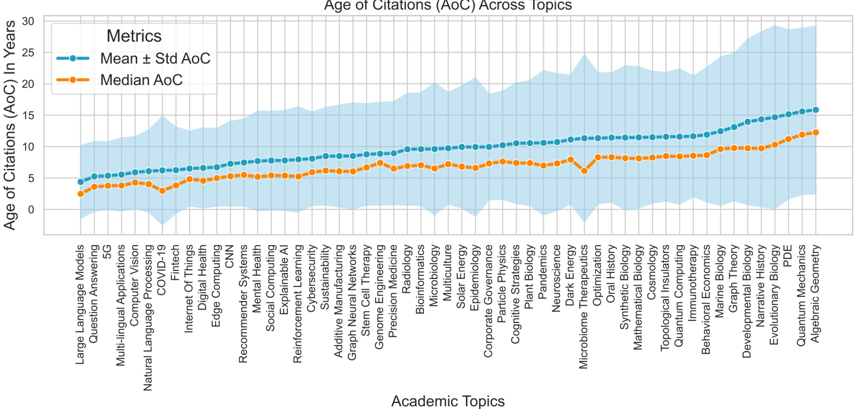
Understanding the creation, evolution, and dissemination of scientific knowledge is crucial for bridging diverse subject areas and addressing complex global challenges such as pandemics, climate change, and ethical AI. Scientometrics, the quantitative and qualitative study of scientific literature, provides valuable insights into these processes. We introduce SciEvo, a longitudinal scientometric dataset with over two million academic publications, providing comprehensive contents information and citation graphs to support cross-disciplinary analyses. SciEvo is easy to use and available across platforms, including GitHub, Kaggle, and HuggingFace. Using SciEvo, we conduct a temporal study spanning over 30 years to explore key questions in scientometrics: the evolution of academic terminology, citation patterns, and interdisciplinary knowledge exchange. Our findings reveal critical insights, such as disparities in epistemic cultures, knowledge production modes, and citation practices. For example, rapidly developing, application-driven fields like LLMs exhibit significantly shorter citation age (2.48 years) compared to traditional theoretical disciplines like oral history (9.71 years). Our data and analytic tools can be accessed at https://github.com/Ahren09/SciEvo.
Overview
CoChat Summary
TL;DR
SciEvo is a longitudinal scientometric dataset of over 2 million arXiv papers spanning 1991–2024, with metadata, full text, keywords, subject categories, citation graphs, and analytic tools. Using it, the authors analyze 30+ years of terminology and citation dynamics, finding shifts toward applied/AI research, strong disciplinary homophily, and citation recency/amnesia.
Key findings
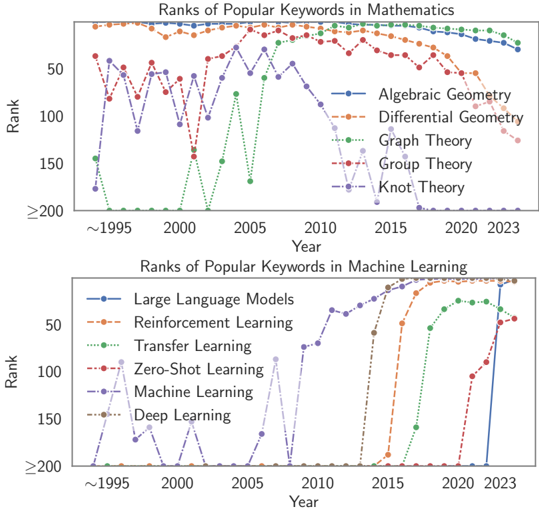
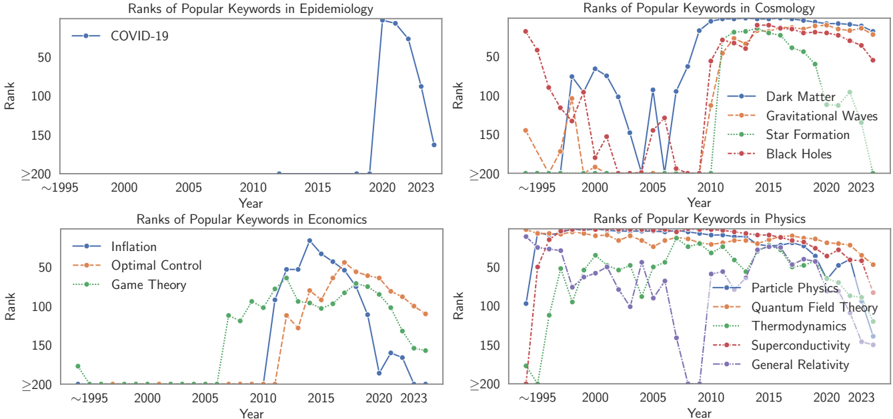
- Machine-learning-related terms rose from an average of only 0.31 of the top-20 annual keywords before 2010 to 9.5 from 2015 onward; top keywords shifted from fields like Algebraic Geometry and Quantum Field Theory toward Deep Learning, Transformers, and Large Language Models.
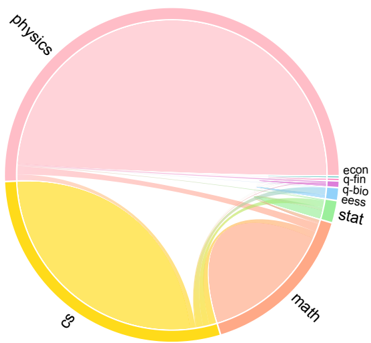
- Citation networks show disciplinary homophily: intra-disciplinary citations account for over 91.0% of all citations.
- Applied/emerging fields show recency bias and citation amnesia: median Age of Citation for LLM research is 2.48 years versus 9.71 years for Oral History; NLP and Machine Learning have median AoCs of 4.02 and 5.06 years, while Narrative History and Oral History have 8.31 and 9.71 years.
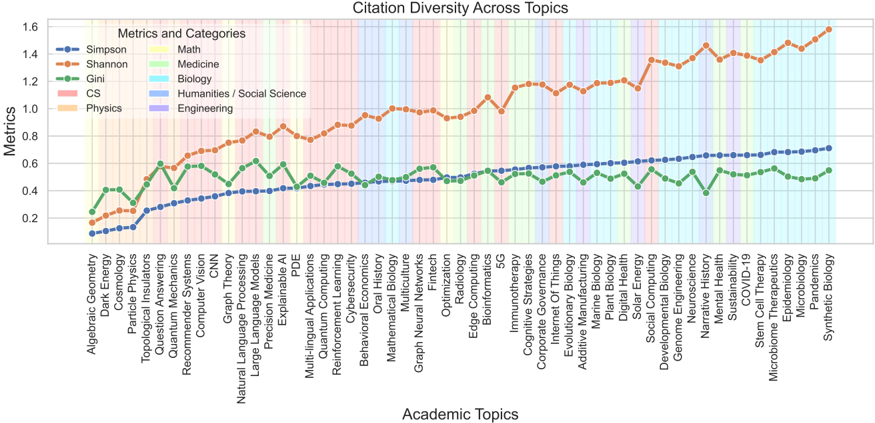
- Topical diversity differs by knowledge-production mode: applied topics such as Graph Neural Networks and Quantum Computing have higher Simpson(i) values (0.479/0.445) than theory-centric topics like Graph Theory and Quantum Mechanism (0.383/0.308).
Methods
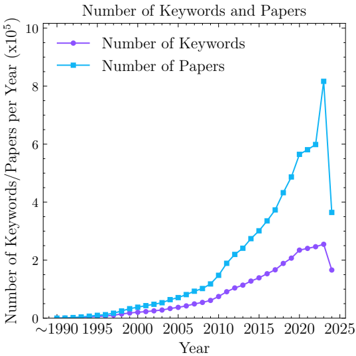
- Dataset: SciEvo contains 2,118,385 arXiv papers from 1991–2024, covering 8 groups and 156 categories; average title length is 10.58 ± 4.07 words, abstract length 146.04 ± 53.70 words, title keywords 3.06 ± 0.30, and abstract keywords 14.62 ± 1.41. It includes metadata, full text, keywords, subject categories, and citation graphs, with citation retrieval relying on Semantic Scholar.
- Diachronic terminology analysis: papers are divided into temporal snapshots; keyword frequencies are ranked over time; keyword co-occurrence graphs are built per snapshot (average 9,028 keywords), a two-layer Graph Convolutional Network is trained with a link-prediction objective, phrases appearing ≥3 times are kept, embeddings are aligned with orthogonal Procrustes, and trajectories are visualized with t-SNE.
- Citation analysis: topical diversity is measured with Simpson’s Diversity Index, Shannon’s Diversity Index, and Gini Index over references’ Fields of Study; temporal diversity is measured with Age of Citation (AoC); citation graphs are analyzed with Louvain community detection.
Limitations
- The paper states that arXiv may not fully reflect research published in local venues or non-English conferences, potentially causing coverage gaps; citation retrieval relies on Semantic Scholar, which may lack metadata for very recent or specialized papers; and the arXiv taxonomy can group diverse subfields, complicating distinctions among closely related areas.
- The paper also states that the dataset is mainly English-centric and suggests future work could integrate CrossRef and Google Scholar, expand humanities coverage, and include real-time updates.
- Evident from the text: the findings are bounded by arXiv and Semantic Scholar coverage, so the reported temporal and citation patterns may not generalize to all scholarly literature or non-English/non-arXiv publication cultures.
Model-written summary. Check it against the paper before relying on it.
Integrity signals
Registry
Cites
Statistics
Figures
Verification
Claims the paper makes
0 Valid · 2 Not valid · 22 Not checked · 76 Own results and interpretations
In the paper
“Citation networks display a strong tendency towards homophily, with intra-disciplinary citation accounting for over 91% of all citations.”
- Also stated in: § 4.1 Topical Diversity · plain
“The intra-and cross-disciplinary citation in Figure 4 show that over 91.0%citations occur within the same discipline.”
§ SciEvo: A 2 Million, 30-Year Cross-disciplinary Dataset for Temporal Scientometric Analysis > 1 Introduction
What the sources say
- Not matchedcites [14]
The reference list we hold has no entry [14].
boostedstates an association- Asserted: passes — The authors put it forward as true.
- Checkable: passes — It can be checked against evidence.
- Load-bearing: unclear — It is unclear whether the paper’s conclusions depend on it.
- Based: passes — The paper gives a reason why it holds.
- Rests on an assumption not shown here.
- Also stated in: § 4.1 Topical Diversity · plain
A result the paper reports from its own data — it cites no other source for it, so there is none to check. The quote shows it is in the paper.
In the paper
“Machine learning-related terms have seen a marked rise in prominence, accounting for an average of only 0.31 words of the top 20 annual terms prior to 2010, but surging to 9.5 words from 2015 onward.”
- Also stated in: § 3.1 Macro-level Changes in Research Priority · plain
“Among the top 20 annual keywords, ML related keywords, accounting for an average of only 0.31 of the top 20 annual keywords prior to 10, but surging to an average of 9.5 from 2015 onward.”
§ SciEvo: A 2 Million, 30-Year Cross-disciplinary Dataset for Temporal Scientometric Analysis > 1 Introduction
plainstates an association- Asserted: passes — The authors put it forward as true.
- Checkable: passes — It can be checked against evidence.
- Load-bearing: passes — The paper’s conclusions depend on it.
- Based: passes — The paper gives a reason why it holds.
- Also stated in: § 3.1 Macro-level Changes in Research Priority · plain
A result the paper reports from its own data — it cites no other source for it, so there is none to check. The quote shows it is in the paper.
In the paper
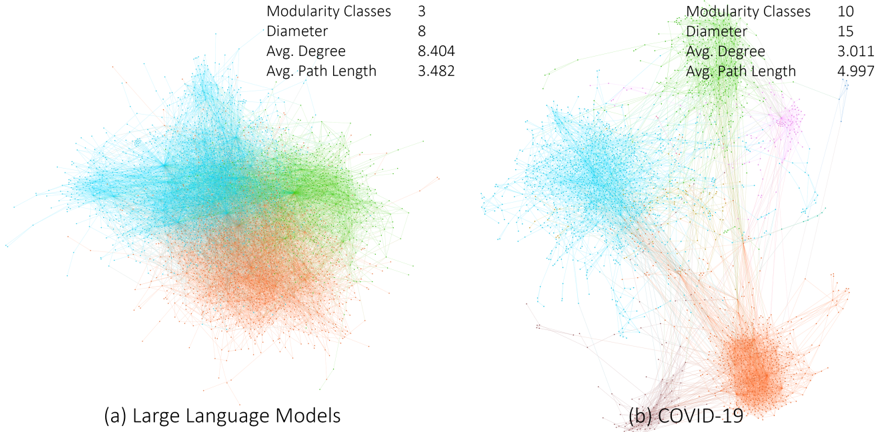
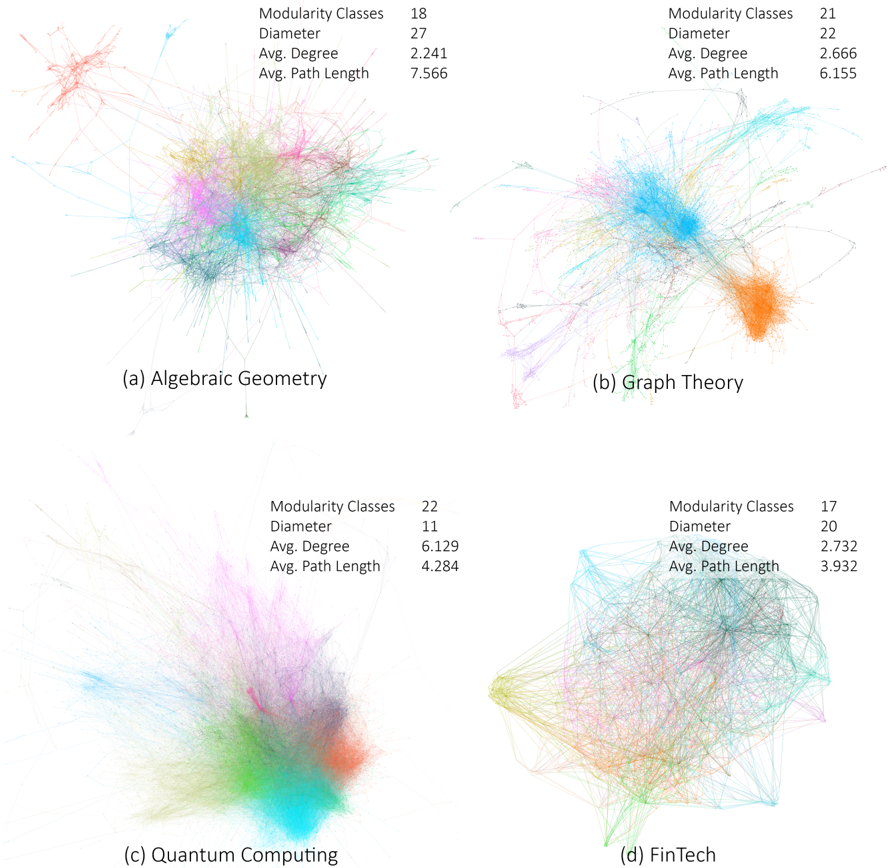
“Graph Theory shows two relatively dominant, independent areas of focus, while Quantum Computing exhibits strong interconnections with diverse research communities.”
§ SciEvo: A 2 Million, 30-Year Cross-disciplinary Dataset for Temporal Scientometric Analysis > Automatic Survey Generation and Literature Retrieval.
boostedstates an association- Asserted: passes — The authors put it forward as true.
- Checkable: passes — It can be checked against evidence.
- Load-bearing: unclear — It is unclear whether the paper’s conclusions depend on it.
- Based: passes — The paper gives a reason why it holds.
A result the paper reports from its own data — it cites no other source for it, so there is none to check. The quote shows it is in the paper.
In the paper
“#Papers | 2,118,385”
§ SciEvo: A 2 Million, 30-Year Cross-disciplinary Dataset for Temporal Scientometric Analysis > Automatic Survey Generation and Literature Retrieval.
plain- Asserted: passes — The authors put it forward as true.
- Checkable: passes — It can be checked against evidence.
- Load-bearing: passes — The paper’s conclusions depend on it.
- Based: passes — The paper gives a reason why it holds.
A result the paper reports from its own data — it cites no other source for it, so there is none to check. The quote shows it is in the paper.
In the paper
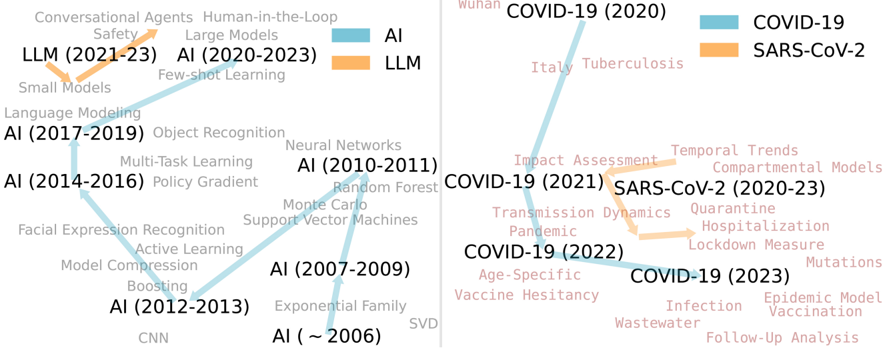
“The keyword follows a constrained trajectory, primarily associated with scientific discussions in epidemiology, virology, and healthcare as it intersect with keywords such as Compartmental Models, Temporal Trends, and Hospitalization.”
§ SciEvo: A 2 Million, 30-Year Cross-disciplinary Dataset for Temporal Scientometric Analysis > Temporal Embedding Alignment
plainstates an association- Asserted: passes — The authors put it forward as true.
- Checkable: passes — It can be checked against evidence.
- Load-bearing: unclear — It is unclear whether the paper’s conclusions depend on it.
- Based: passes — The paper gives a reason why it holds.
31 more claims
Create a free account to see all 100 claims and every source verdict.
- It may state two separate claims as one. 27
- Probably not a substantial claim. 49
- The quote only partly states this claim. 1
Self-check
Percentages, sums and reported differences re-computed from the paper’s own numbers.
Each contradiction between two passages listed here was confirmed by an independent check.
Rated minor: it would not touch a result — a value no result rests on, a p-value that stays on the same side of the significance level, or a conflict that is clerical, resolved elsewhere in the paper, or outside its own findings.
In the paper
§ SciEvo: A 2 Million, 30-Year Cross-disciplinary Dataset for Temporal Scientometric Analysis > C.3 Usage of AI Assistants
“As shown in the arXiv Taxonomy in Figure 7, arXiv supports a wide array of fields, making it an ideal platform for cross-domain studies and the exploration of interdisciplinary trends.”
§ SciEvo: A 2 Million, 30-Year Cross-disciplinary Dataset for Temporal Scientometric Analysis > 4.1 Topical Diversity
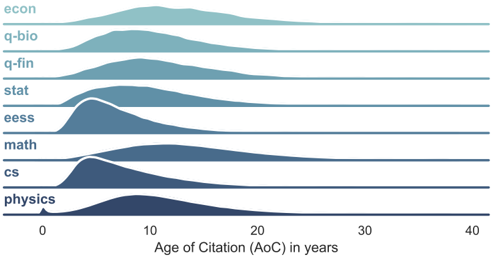
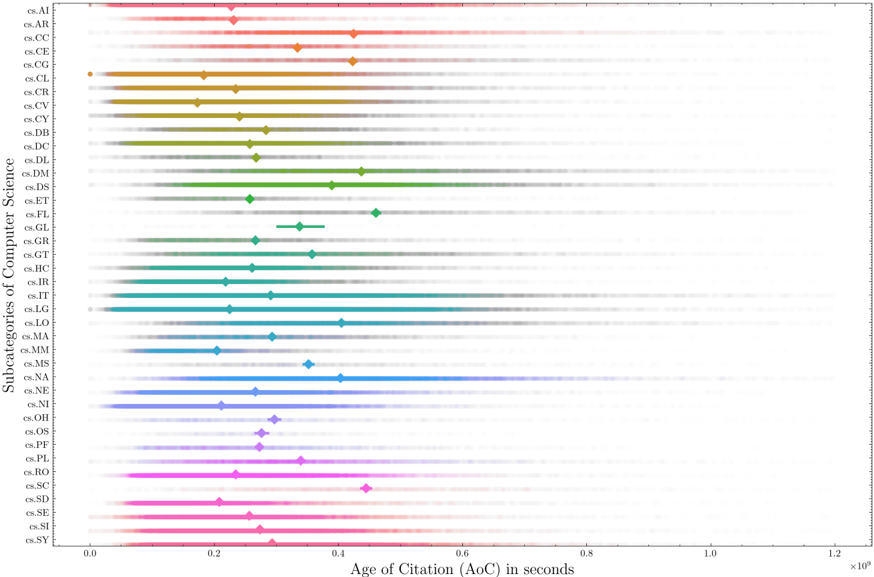
“Figure 7: Age of Citation (AoC) across various arXiv subjects shows distinct trends.”
Rated minor: it would not touch a result — a value no result rests on, a p-value that stays on the same side of the significance level, or a conflict that is clerical, resolved elsewhere in the paper, or outside its own findings.
In the paper
§ SciEvo: A 2 Million, 30-Year Cross-disciplinary Dataset for Temporal Scientometric Analysis > 3.4 Micro-level Shifts in Term Usage
“We train a two-layer Graph Convolutional Network (GCN) [25] model with a link prediction objective on each snapshot to extract the high-order co-occurrence relations among keywords.”
§ SciEvo: A 2 Million, 30-Year Cross-disciplinary Dataset for Temporal Scientometric Analysis > References
“25. William L Hamilton, Jure Leskovec, and Dan Jurafsky. Diachronic word embeddings reveal statistical laws of semantic change. In ACL, pages 1489-1501, 2016.”
Rated minor: it would not touch a result — a value no result rests on, a p-value that stays on the same side of the significance level, or a conflict that is clerical, resolved elsewhere in the paper, or outside its own findings.
In the paper
§ SciEvo: A 2 Million, 30-Year Cross-disciplinary Dataset for Temporal Scientometric Analysis > 4.1 Topical Diversity
“eess and cs exhibit leftskewed distributions, indicating a preference towards recent citation.”
§ SciEvo: A 2 Million, 30-Year Cross-disciplinary Dataset for Temporal Scientometric Analysis > 4.2 Temporal Diversity
“eess (Electrical Engineering and Systems Science) and cs (Computer Science) exhibit right-skewed AoC distributions (Figure 7), indicating a rapid pace of development driven by recent research.”
Citations
Cites
(2008) · Journal of Machine Learning Research · Cited by 33,051
Fast unfolding of communities in large networks
Blondel, V. D., Guillaume, J.-L., Lambiotte, R., & Lefebvre, E. (2008) · Journal of Statistical Mechanics: Theory and Experiment · doi:10.1088/1742-5468/2008/10/p10008 · Cited by 21,424
How to conduct a bibliometric analysis: An overview and guidelines
Donthu, N., Kumar, S., Mukherjee, D., Pandey, N., & Lim, W. M. (2021) · Journal of Business Research · doi:10.1016/j.jbusres.2021.04.070 · Cited by 14,329
Ease of retrieval as information: another look at the availability heuristic
Schwarz, N., Bless, H., Strack, F., Klumpp, G., Rittenauer-Schatka, H., & Simons, A. (1991) · Journal of Personality and Social Psychology · doi:10.1037/0022-3514.61.2.195 · Cited by 1,412
The field of cultural production, or: The economic world reversed
Bourdieu, P. (1983) · Poetics · doi:10.1016/0304-422x(83)90012-8 · Cited by 1,359
Diachronic Word Embeddings Reveal Statistical Laws of Semantic Change
Hamilton, W. L., Leskovec, J., & Jurafsky, D. (2016) · Proceedings of the 54th Annual Meeting of the Association for Computational Linguistics (Volume 1: Long Papers) · doi:10.18653/v1/p16-1141 · Cited by 943
Mapping the backbone of science
Boyack, K. W., Klavans, R., & Börner, K. (2005) · Scientometrics · doi:10.1007/s11192-005-0255-6 · Cited by 937
Liang, W., Zhang, Y., Cao, H., Wang, B., Ding, D., Yang, X., Vodrahalli, K., He, S., Smith, D., Yin, Y., et al. (2023) · arXiv · doi:10.48550/arxiv.2310.01783 · Cited by 633
Page, S. E. (2006) · Quarterly Journal of Political Science · doi:10.1561/100.00000006 · Cited by 591
S2ORC: The Semantic Scholar Open Research Corpus
Lo, K., Wang, L. L., Neumann, M., Kinney, R., & Weld, D. (2020) · Proceedings of the 58th Annual Meeting of the Association for Computational Linguistics · doi:10.18653/v1/2020.acl-main.447 · Cited by 457
Research works printed but not linked: 6
- Deyan Ginev. arxmliv:2020 dataset, an html5 conversion of arxiv.org. https://sigmathling. kwarc.info/resources/arxmliv-dataset-2020/, 2020. SIGMathLing -Special In- terest Group on Math Linguistics.
- Thomas N Kipf and Max Welling. Semi-supervised classification with graph convolutional networks. In ICLR, 2022.
- Everett M Rogers, Arvind Singhal, and Margaret M Quinlan. Diffusion of innovations. In An integrated approach to communication theory and research, pages 432-448. Routledge, 2014.
- Yanchuan Sim, Noah A Smith, and David A Smith. Discovering factions in the computational linguistics community. In Proceedings of the ACL-2012 Special Workshop on Rediscovering 50 Years of Discoveries, pages 22-32, 2012.
- Steven Bird, Robert Dale, Bonnie J Dorr, Bryan R Gibson, Mark Thomas Joseph, Min-Yen Kan, Dongwon Lee, Brett Powley, Dragomir R Radev, Yee Fan Tan, et al. The acl anthology reference corpus: A reference dataset for bibliographic research in computational linguistics. In LREC, 2008.
- Year Closest Keywords to Machine Learning ∼ 1995 Information Retrieval, Classification, Neural Networks, POS Tagging 2000 Ensembles, Logic, Optimization, Machine Translation 2005 Regularization, Support Vector Machines, Data Mining, Reinforcement Learning 2010 Image Classification, Kernel Methods, Reinforcement Learning, Transfer Learning 2015 Object Recognition, Question Answering, Image Generation 2020 Ethics, Scalability, Model Explanation, Post-hoc 2022 Data-driven Analysis, Performance Improvement, Medical Imaging, Cross-lingual 2024 General AI, Large Language Models, Conversational Agents, Retrieval-augmented Generation Table 3: Closest keywords to Machine Learning in the embedding space, reflecting the shifting focus of academic discourse. Time Period Top 5 Most Mentioned Keywords across All Subjects ∼ 1994 Algebraic Geometry, Quantum Field Theory, Quantum Groups, Quantum Gravity, Lattice QCD 1995 -2004 Superconductivity, Algebraic Geometry, Lattice QCD, Particle Physics, Quantum Mechanics 2005 -2014 Algebraic Geometry, Superconductivity, Quantum Mechanics, Dark Matter, Cosmology 2015 -2017 Deep Learning, Dark Matter, Graph Theory, Cosmology, Optimization 2018 -2019 Deep Learning, Machine Learning, Neural Networks, Dark Matter, Reinforcement Learning 2020 -2021 Deep Learning, Machine Learning, Transformers, Reinforcement Learning, COVID-19 2022 -2023 Deep Learning, Machine Learning, Transformers, Reinforcement Learning, Quantum Comput- ing 2024 ∼ Machine Learning, Language Models, Large Language Models, Deep Learning, Reinforcement Learning Table 4: Most frequently mentioned keywords in paper titles across different time periods. arXiv shows a noticeable shift in epistemic priority from mathematics and physics to computer science topics. Time Period Top 5 Most Mentioned Keywords in Computer Science ∼ 1995 Parsing, Machine Translation, Linguistics, Syntax, Semantics 1996 -2000 Parsing, HPSG, ATM Networks, TCP, Linguistics 2001 -2005 Optimization, Logic Programming, Computational Complexity, Quantum Computing 2006 -2010 Information Theory, Graph Theory, Optimization, MIMO, Wireless Networks 2011 -2015 Optimization, Graph Theory, Machine Learning, Complexity, Information Theory 2016 -2020 Deep learning, Machine Learning, Self-supervised Learning, Reinforcement Learning, Opti- mization 2021 -2022 Deep Learning, Machine Learning, Transformers, Reinforcement Learning, COVID-19 2023 -2024 Large Language Models, Deep Learning, Machine Learning, Reinforcement Learning, Fairness Table 5: Most frequently mentioned keywords in the field of Computer Science. Time Period Top 5 Most Mentioned Keywords in Economics Literature 2005 -2009 Quantile Regression, Cornish-Fisher Expansion, Instrumental Variables, Panel Data, Econo- metrics 2010 -2014 Machine Learning, Causal Inference, Game Theory, Nonparametric Methods, Forecasting 2015 -2019 Machine Learning, Causal Inference, Game Theory, Decision Making, Economics 2020 -2022 COVID-19, Machine Learning, Economic Growth, Inequality, Forecasting 2023 -2024 Artificial Intelligence, Reinforcement Learning, Economics, Mechanism Design, Inequality Table 6: Top 5 most mentioned keywords in economics research over time.
Cited by
Science Utopia? Closed-Loop LLM Simulation of Academic Research EcosystemsPreprint
Jin, Y., Wang, Y., Fu, L., He, B., Xiong, S., Xiao, Y., Prakash, B. A., Hester, J., Kumar, S., Evans, J. A., et al. (2026) · arXiv (Cornell University) · doi:10.48550/arxiv.2610.01257 · Cited by 1
Self-citationLLM4Impact: Integrating Heterogeneous Information for Scientific Impact PredictionPreprint
Cao, Y., Flicke, M., He, H., Renz, K., & Geiger, A. (2026) · arXiv (Cornell University) · doi:10.48550/arxiv.2610.10138
LLM-Augmented Innovation Regime Classification: A Hybrid Framework for Patentometric ForesightPreprint
Burmaoğlu, S., Sarıtas, O., & Kara, K. (2026) · Research Square · doi:10.21203/rs.3.rs-9166858/v1
Ignacio, C. J. C., Gómez, G. M., Rodríguez, C. A. C., Lozano, J. L. R., & Miranda, C. A. R. (2026) · Revista de Gestão Social e Ambiental · doi:10.24857/rgsa.v20n9-001
Metadata
- Authors
- Jin, Y., Xiao, Y., Wang, Y., & Wang, J.
- Affiliations
- Georgia Institute of Technology (US)
- University of California, Los Angeles (US)
- Venue
- arXiv
- Publisher
- arXiv
- Published
- 2024
- ISSN
- 2331-8422 (ISSN-L)
- arXiv
- 2410.09510
- OpenAlex
- W4403565989
- Cited by
- 4
- References
- 50
- Citations by year
- 2026: 4
- Type
- posted content
- Language
- en
- Open access
- green
- arxiv.org
- Licence
- Locations
- arXiv (Cornell University) (submittedVersion, cc-by)
- arXiv (Cornell University) (cc-by)
- Topics
- Social Sciences › Library and Information Sciences › scientometrics and bibliometrics research
- Physical Sciences › Computer Science › Information Systems › Web visibility and informetrics
- Social Sciences › Psychology › Experimental and Cognitive Psychology › Psychology Research and Bibliometrics
- Keywords
- citation networks, citation age, interdisciplinary knowledge exchange, citation practices, epistemic cultures, large language models, oral history, cross-disciplinary analysis
About these checks
Registry, retraction, Cites and statistics results are computed, not judged, with one exception: a printed reference that no index lists is read once by a model before it counts as a citation error. Claims are extracted by a model and kept only when their quote appears verbatim in the text; each cited source is then checked, with a model’s help, for whether it says what the claim relies on. Those verdicts can be wrong — read the claim’s quote and the cited source before relying on one.
A language model drew the claims from the paper on 2026-11-23, under version 3 of the claim definition (model deepseek-v4.1-flash, prompt extract-v3).
A second model labelled each claim on 2026-11-23 (model jev-1.13-20260917, definition revision gold-guideline-v0.2).
Statistics and arithmetic are recomputed, not judged.
Confidence bands are shown only for fields calibrated on our annotated test set. None is calibrated yet, so no band is shown.
What counts as a claim ›How we measure confidence ›How we check this ›
Are you an author, or do you see a problem with this page? Request a review
Data sources
Bibliographic data: Semantic Scholar, OpenAlex, Crossref.
Contains information from the Semantic Scholar Academic Graph Datasets, made available under the ODC Attribution License (ODC-BY 1.0).
Semantic Scholar’s data is described in: Kinney, R., et al. (2023). The Semantic Scholar Open Data Platform. arXiv:2301.10140.
