

InternVL3: Exploring Advanced Training and Test-Time Recipes for Open-Source Multimodal Models
Open accessThe DOI matches its DataCite record; 145 of the 145 references it cites were found in a registry or an index; none of the 38 sources its claims cite is checked for support yet.
Abstract
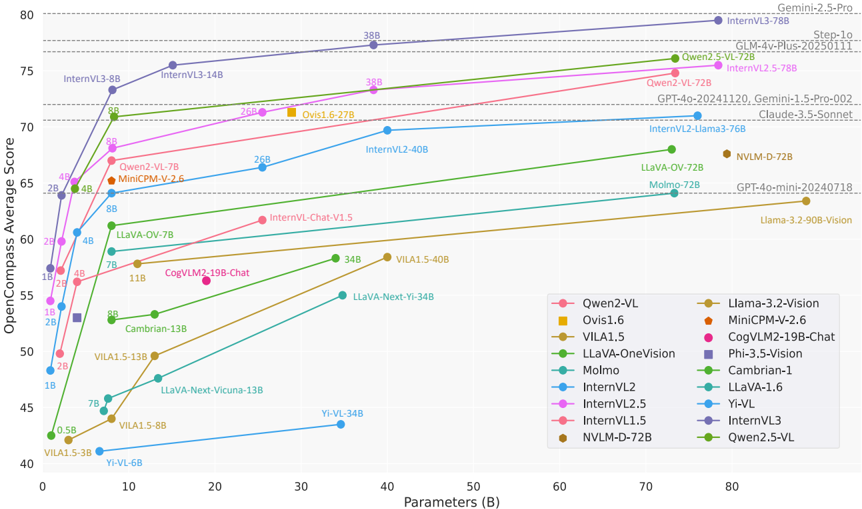
We introduce InternVL3, a significant advancement in the InternVL series featuring a native multimodal pre-training paradigm. Rather than adapting a text-only large language model (LLM) into a multimodal large language model (MLLM) that supports visual inputs, InternVL3 jointly acquires multimodal and linguistic capabilities from both diverse multimodal data and pure-text corpora during a single pre-training stage. This unified training paradigm effectively addresses the complexities and alignment challenges commonly encountered in conventional post-hoc training pipelines for MLLMs. To further improve performance and scalability, InternVL3 incorporates variable visual position encoding (V2PE) to support extended multimodal contexts, employs advanced post-training techniques such as supervised fine-tuning (SFT) and mixed preference optimization (MPO), and adopts test-time scaling strategies alongside an optimized training infrastructure. Extensive empirical evaluations demonstrate that InternVL3 delivers superior performance across a wide range of multi-modal tasks. In particular, InternVL3-78B achieves a score of 72.2 on the MMMU benchmark, setting a new state-of-the-art among open-source MLLMs. Its capabilities remain highly competitive with leading proprietary models, including ChatGPT-4o, Claude 3.5 Sonnet, and Gemini 2.5 Pro, while also maintaining strong pure-language proficiency. In pursuit of open-science principles, we will publicly release both the training data and model weights to foster further research and development in next-generation MLLMs.
Overview
CoChat Summary
TL;DR
InternVL3 introduces a native multimodal pre-training paradigm that jointly learns language and multimodal capabilities in one stage, plus V2PE, SFT/MPO post-training, test-time scaling, and infrastructure optimizations. InternVL3-78B reaches 72.2 on MMMU, setting a new state of the art among open-source MLLMs while remaining competitive with proprietary models.
Key findings
- InternVL3-78B achieves 72.2 on MMMU, 906 on OCRBench, 96.0/98.6 on VCR-EN-Easy (EM/Jaccard), and 89.0/88.7 on MMBench English/Chinese; the paper reports it as a new open-source MLLM state of the art and competitive with ChatGPT-4o, Claude 3.5 Sonnet, and Gemini 2.5 Pro.
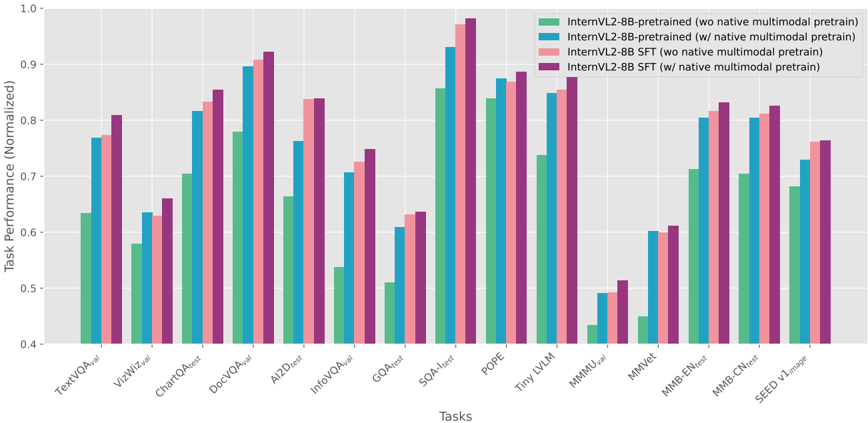
- Native multimodal pre-training is effective: replacing InternVL2-8B’s MLP warmup with native multimodal pre-training yields performance on most benchmarks comparable to the fully multi-stage-trained InternVL2-8B baseline, with further gains after instruction tuning on higher-quality data.
- MPO improves multimodal reasoning across seven benchmarks: InternVL3-78B and InternVL3-38B outperform their non-MPO counterparts by 4.1 and 4.5 points overall, respectively, even though MPO training data is a subset of SFT data.
- Test-time scaling with Best-of-8 and VisualPRM improves reasoning: on the Vision-Only split of MathVerse, best-of-8 gives increases of approximately 6.0 and 3.2 percentage points for InternVL3-38B and InternVL3-78B, respectively.
Methods
- Architecture follows “ViT-MLP-LLM”: vision encoder options are InternViT-300M and InternViT-6B; language models are pre-trained Qwen2.5 series and InternLM3-8B base models; the MLP is a two-layer randomly initialized network; pixel unshuffle reduces each 448×448 image tile to 256 visual tokens.
- Native multimodal pre-training jointly optimizes all parameters on multimodal and pure-language corpora, computes loss only on text tokens, and uses square averaging for token weights. Data combines InternVL2.5 pre-training corpus with GUI, tool usage, 3D scene, and video data, plus InternLM2.5 and open-source text data; the chosen language:multimodal ratio is 1:3, totaling about 200B tokens (50B language, 150B multimodal).
- Post-training uses SFT followed by MPO. SFT grows from 16.3M samples in InternVL2.5 to 21.7M in InternVL3; MPO uses about 300K preference samples and combines DPO preference loss, BCO quality loss, and LM generation loss. Test-time scaling uses Best-of-N with VisualPRM-8B as critic; infrastructure extends InternEVO, yielding a 50% to 200% training speedup for comparable-size models under the same compute budget.
Limitations
- The paper states a noticeable performance gap remains between InternVL3 and models like Qwen2.5-VL on certain benchmarks, such as MuirBench, implying future work may need better training data curation and model refinements.
- The paper reports minor declines on some benchmarks, such as MMHal, and states that optimizing data and training strategies for more consistent improvements remains an important future direction.
- The paper states visual grounding gains plateau at larger scales: InternVL2.5-78B reaches an average score of 92.3 while InternVL3-78B shows 91.4; it speculates this is because InternVL3’s training data expansion did not include additional grounding-specific data and the relative reduction in grounding-targeted data may have restricted localization capabilities.
Model-written summary. Check it against the paper before relying on it.
Integrity signals
Registry
Cites
Statistics
Figures
Verification
Claims the paper makes
0 Valid · 1 Not valid · 14 Not checked · 83 Own results and interpretations
A result the paper reports from its own data — it cites no other source for it, so there is none to check. The quote shows it is in the paper.
In the paper
“When compared with other competitive models, such as Qwen2-VL-72B and Qwen2.5-VL-72B, the InternVL3 series-especially the 78B variant-offers a consistent performance advantage on the multimodal understanding benchmarks.”
§ InternVL3: Exploring Advanced Training and Test-Time Recipes for Open-Source Multimodal Models > 3.6 Comprehensive Multimodal Evaluation
plainstates an association- Asserted: passes — The authors put it forward as true.
- Checkable: passes — It can be checked against evidence.
- Load-bearing: passes — The paper’s conclusions depend on it.
- Based: unclear — It is unclear why the paper says it holds.
A result the paper states — it cites no source for it, so there is none to check. The quote shows it is in the paper.
In the paper
“As a result, the number of training samples grows from 16.3M in InternVL2.5 to 21.7M in InternVL3.”
§ InternVL3: Exploring Advanced Training and Test-Time Recipes for Open-Source Multimodal Models > Data.
plainstates a cause- Asserted: passes — The authors put it forward as true.
- Checkable: passes — It can be checked against evidence.
- Load-bearing: unclear — It is unclear whether the paper’s conclusions depend on it.
- Based: passes — The paper gives a reason why it holds.
A result the paper states — it cites no source for it, so there is none to check. The quote shows it is in the paper.
In the paper
“while also maintaining strong pure-language proficiency.”
§ InternVL3: Exploring Advanced Training and Test-Time Recipes for Open-Source Multimodal Models > Abstract
boosted- Asserted: passes — The authors put it forward as true.
- Checkable: passes — It can be checked against evidence.
- Load-bearing: unclear — It is unclear whether the paper’s conclusions depend on it.
- Based: passes — The paper gives a reason why it holds.
A result the paper reports from its own data — it cites no other source for it, so there is none to check. The quote shows it is in the paper.
In the paper
“Compared with previous models, InternVL3 demonstrates substantial improvements across a wide range of task categories.”
§ InternVL3: Exploring Advanced Training and Test-Time Recipes for Open-Source Multimodal Models > 3.1 Overall Comparison to Other Advanced MLLMs
boosted- Asserted: passes — The authors put it forward as true.
- Checkable: passes — It can be checked against evidence.
- Load-bearing: passes — The paper’s conclusions depend on it.
- Based: passes — The paper gives a reason why it holds.
A result the paper reports from its own data — it cites no other source for it, so there is none to check. The quote shows it is in the paper.
In the paper
“Its capabilities remain highly competitive with leading proprietary models, including ChatGPT-4o, Claude 3.5 Sonnet, and Gemini 2.5 Pro, while also maintaining strong pure-language proficiency.”
§ InternVL3: Exploring Advanced Training and Test-Time Recipes for Open-Source Multimodal Models > Abstract
plain- Asserted: passes — The authors put it forward as true.
- Checkable: passes — It can be checked against evidence.
- Load-bearing: passes — The paper’s conclusions depend on it.
- Based: passes — The paper gives a reason why it holds.
45 more claims
Create a free account to see all 98 claims and every source verdict.
- It may state two separate claims as one. 42
- Probably not a substantial claim. 6
- The quote only partly states this claim. 1
Self-check
Percentages, sums and reported differences re-computed from the paper’s own numbers.
Each contradiction between two passages listed here was confirmed by an independent check.
Rated minor: it would not touch a result — a value no result rests on, a p-value that stays on the same side of the significance level, or a conflict that is clerical, resolved elsewhere in the paper, or outside its own findings.
In the paper
§ InternVL3: Exploring Advanced Training and Test-Time Recipes for Open-Source Multimodal Models > 3.8 Visual Grounding
“InternVL3-8B, InternVL3-9B, and InternVL3-14B yield average scores around 88.2-89.6,reflecting a consistent trend of performance gains as the model size increases.”
§ InternVL3: Exploring Advanced Training and Test-Time Recipes for Open-Source Multimodal Models > 3.6 Comprehensive Multimodal Evaluation
“InternVL3-8B 92.5 94.6 88.0 88.2 92.5 81.8 89.6 90.0 89.6 InternVL3-9B 91.8 93.2 86.6 86.4 91.0 79.9 88.0 88.5 88.2”
Rated minor: it would not touch a result — a value no result rests on, a p-value that stays on the same side of the significance level, or a conflict that is clerical, resolved elsewhere in the paper, or outside its own findings.
In the paper
§ InternVL3: Exploring Advanced Training and Test-Time Recipes for Open-Source Multimodal Models > GPT-4o Gemini 2.0 Claude Aguvis-72B Qwen2.5-VL-72B UI-TARS-72B InternVL3-8B -38B -72B
“The 8B variant (81.4%) already surpasses UI-TARS-72B”
§ InternVL3: Exploring Advanced Training and Test-Time Recipes for Open-Source Multimodal Models > GPT-4o Gemini 2.0 Claude Aguvis-72B Qwen2.5-VL-72B UI-TARS-72B InternVL3-8B -38B -72B
“InternVL3-72B achieves 90.9%, outperforming UI-TARS-72B (90.3%).”
Citations
Cites
Fei-Fei, L., Fergus, R., & Perona, P. (2005) · 2004 Conference on Computer Vision and Pattern Recognition Workshop · doi:10.1109/cvpr.2004.383 · Cited by 2,502
Liu, H., Li, C., Wu, Q., & Lee, Y. J. (2023) · Advances in Neural Information Processing Systems 36 · doi:10.52202/075280-1516 · Cited by 2,428
Making the V in VQA Matter: Elevating the Role of Image Understanding in Visual Question Answering
Goyal, Y., Khot, T., Summers-Stay, D., Batra, D., & Parikh, D. (2017) · 2017 IEEE Conference on Computer Vision and Pattern Recognition (CVPR) · doi:10.1109/cvpr.2017.670 · Cited by 2,287
Chen, Z., Wang, W., Cao, Y., Liu, Y., Gao, Z., Cui, E., Zhu, J., Ye, S., Tian, H., Liu, Z., et al. (2024) · arXiv · doi:10.48550/arxiv.2412.05271 · Cited by 2,204
Self-citationGrounding DINO: Marrying DINO with Grounded Pre-training for Open-Set Object Detection
Liu, S., Zeng, Z., Ren, T., Li, F., Zhang, H., Yang, J., Jiang, Q., Li, C., Yang, J., Su, H., et al. (2025) · Lecture Notes in Computer Science · doi:10.1007/978-3-031-72970-6_3 · Cited by 2,074
Self-citationNatural Questions: A benchmark for question answering research
Kwiatkowski, T., Palomaki, J., Redfield, O., Collins, M., Parikh, A., Alberti, C., Epstein, D., Polosukhin, I., Devlin, J., Lee, K., et al. (2019) · Transactions of the Association for Computational Linguistics · doi:10.1162/tacl_a_00276 · Cited by 2,069
MiniCPM-V: A GPT-4V Level MLLM on Your PhonePreprint
Yao, Y., Yu, T., Zhang, A., Wang, C., Cui, J., Zhu, H., Cai, T., Li, H., Zhao, W., He, Z., et al. (2024) · arXiv · doi:10.48550/arxiv.2408.01800 · Cited by 1,695
Self-citationTriviaQA: A Large Scale Distantly Supervised Challenge Dataset for Reading Comprehension
Joshi, M., Choi, E., Weld, D., & Zettlemoyer, L. (2017) · Proceedings of the 55th Annual Meeting of the Association for Computational Linguistics (Volume 1: Long Papers) · doi:10.18653/v1/p17-1147 · Cited by 1,690
Math-Shepherd: Verify and Reinforce LLMs Step-by-step without Human Annotations
Wang, P., Li, L., Shao, Z., Xu, R., Dai, D., Li, Y., Chen, D., Wu, Y., & Sui, Z. (2024) · Proceedings of the conference - Association for Computational Linguistics. Meeting · doi:10.18653/v1/2024.acl-long.510 · Cited by 1,665
TriviaQA: A Large Scale Distantly Supervised Challenge Dataset for Reading Comprehension
Joshi, M., Choi, E., Weld, D. S., & Zettlemoyer, L. (2017) · arXiv · doi:10.48550/arxiv.1705.03551 · Cited by 1,650
Research works printed but not linked: 6
- Anonymous. CG-bench: Clue-grounded question answering benchmark for long video understanding. In Submitted to The Thirteenth International Conference on Learning Representations, 2024. under review. 14, 15
- Shuai Bai, Keqin Chen, Xuejing Liu, Jialin Wang, Wenbin Ge, Sibo Song, Kai Dang, Peng Wang, Shijie Wang, Jun Tang, et al. Qwen2.5-vl technical report. arXiv preprint arXiv:2502.13923, 2025. 1, 2, 9, 10, 15 · arXiv
- Jie Cao and Jing Xiao. An augmented benchmark dataset for geometric question answering through dual parallel text encoding. In Proceedings of the 29th International Conference on Computational Linguistics, pages 1511-1520, 2022. 6
- Zhe Chen, Weiyun Wang, Hao Tian, Shenglong Ye, Zhangwei Gao, Erfei Cui, Wenwen Tong, Kongzhi Hu, Jiapeng Luo, Zheng Ma, et al. How far are we to gpt-4v? closing the gap to commercial multimodal models with open-source suites. arXiv preprint arXiv:2404.16821, 2024. 2, 3 · arXiv
- Hunter Lightman, Vineet Kosaraju, Yuri Burda, Harrison Edwards, Bowen Baker, Teddy Lee, Jan Leike, John Schulman, Ilya Sutskever, and Karl Cobbe. Let's verify step by step. In The Twelfth International Conference on Learning Representations, 2023. 7
- Minesh Mathew, Viraj Bagal, Rubèn Tito, Dimosthenis Karatzas, Ernest Valveny, and CV Jawahar. Infographicvqa. In Proceedings of the IEEE/CVF Winter Conference on Applications of Computer Vision, pages 1697-1706, 2022. 6, 7, 8, 10
Cited by
InternVL3.5: Advancing Open-Source Multimodal Models in Versatility, Reasoning, and EfficiencyPreprint
Wang, W.-Y., Gao, Z.-W., Gu, L.-X., Pu, H.-J., Cui, L., Wei, X.-G., Liu, Z., Jing, L.-L., Ye, S.-L., Shao, J., et al. (2025) · arXiv.org · doi:10.48550/arxiv.2508.18265 · Cited by 1,872
“…corpora can be classified into two categories: (1) Multimodal data: this subset of data is mainly sourced from the training corpora of InternVL3 [187], covering a diverse range of domains such as image captioning, general question answering, mathematics, scientific disciplines, charts, optical…”
InfluentialSelf-citationGLM-4.1V-Thinking: Towards Versatile Multimodal Reasoning with Scalable Reinforcement LearningPreprint
Hong, W.-Y., Yu, W.-M., Gu, X., Wang, G., Gan, G., Tang, H.-M., Cheng, J.-L., Qi, J., Ji, J.-H., Pan, L.-H., et al. (2025) · arXiv.org · doi:10.48550/arxiv.2507.01006 · Cited by 253
Self-citationPerception Encoder: The best visual embeddings are not at the output of the network
Bolya, D., Huang, P.-Y., Sun, P., Cho, J. H., Madotto, A., Wei, C., Ma, T., Zhi, J., Rajasegaran, J., Rasheed, H., et al. (2025) · neural information processing systems · doi:10.52202/085713-2036 · Cited by 477
Self-citationDeepSeek-OCR: Contexts Optical CompressionPreprint
Wei, H., Sun, Y., & Li, Y. (2025) · arXiv · doi:10.48550/arxiv.2510.18234 · Cited by 433
LLaVA-OneVision-1.5: Fully Open Framework for Democratized Multimodal TrainingPreprint
An, X., Xie, Y., Yang, K., Zhang, W., Zhao, X., Cheng, Z., Wang, Y., Xu, S., Chen, C., Zhu, D., et al. (2025) · arXiv · doi:10.48550/arxiv.2509.23661 · Cited by 399
Self-citationLingshu: Generalist Foundation Model for Unified Multimodal Medical Understanding and Reasoning
Xu, W., Chan, H. P., Li, L., Aljunied, M., Yuan, R., Wang, J., Xiao, C., 陈贵珍, Liu, C., Li, Z., et al. (2026) · IEEE Transactions on Pattern Analysis and Machine Intelligence · doi:10.1109/tpami.2026.3730310 · Cited by 371
Self-citationMiniCPM-V 4.5: Cooking Efficient MLLMs via Architecture, Data, and Training RecipePreprint
Yu, T., Wang, Z., Wang, C., Huang, F., Ma, W., He, Z., Cai, T., Chen, W., Huang, Y., Zhao, Y. X. H. Z. L. M., et al. (2025) · arXiv · doi:10.48550/arxiv.2509.18154 · Cited by 284
“Addressing this efficiency challenge is now a central focus of both research and industry [6, 8, 9, 10, 11], essential for making capable MLLMs more accessible and scalable.”
InfluentialSelf-citationA Survey of Context Engineering for Large Language Models
Mei, L., Yao, J., Ge, Y., Wang, Y., Bi, B., Cai, Y., Liu, J., Li, M., Li, Z.-Z., Zhang, D., et al. (2025) · arXiv · doi:10.48550/arxiv.2507.13334 · Cited by 281
Self-citationTextMonkey: An OCR-Free Large Multimodal Model for Understanding Document
Liu, Y., Yang, B., Liu, Q., Li, Z., Ma, Z., Zhang, S., & Bai, X. (2026) · IEEE Transactions on Pattern Analysis and Machine Intelligence · doi:10.1109/tpami.2026.3653415 · Cited by 279
Self-citationMMSI-Bench: A Benchmark for Multi-Image Spatial Intelligence
Yang, S., Xu, R., Xie, Y., Yang, S., Li, M., Lin, J., Zhu, C., Chen, X., Duan, H., Yue, X., et al. (2026) · International Conference on Learning Representations · doi:10.48550/arxiv.2505.23764 · Cited by 277
“Table 1: Taxonomy of Multi-Image Spatial Reasoning.”
Self-citationMobile-Agent-v3: Fundamental Agents for GUI AutomationPreprint
Ye, J., Zhang, X., Xu, H., Liu, H., Wang, J., Zhu, Z., Zheng, Z., Gao, F., Cao, J., Lu, Z., et al. (2025) · arXiv · doi:10.48550/arxiv.2508.15144 · Cited by 275
Self-citationReCogDrive: A Reinforced Cognitive Framework for End-to-End Autonomous Driving
Li, Y.-K., Xiong, K.-X., Guo, X.-Y., Li, F., Yan, S.-X., Xu, G.-W., Zhou, L.-J., Chen, L., Sun, H.-Y., Wang, B., et al. (2025) · International Conference on Learning Representations · doi:10.48550/arxiv.2506.08052 · Cited by 267
“We adopt InternVL3-8B [30, 33] as our base model, which employs a native multi-modal pre-training paradigm and has demonstrated impressive performance across various benchmarks.”
Self-citationSa2VA: Marrying SAM2 With MLLM for Dense Grounded Understanding of Images and Videos
Yuan, H., Li, X., Zhang, T., Sun, Y., Huang, Z., Xu, S., Ji, S., Tong, Y., Qi, L., Feng, J., et al. (2026) · IEEE Transactions on Pattern Analysis and Machine Intelligence · doi:10.1109/tpami.2026.3720379 · Cited by 221
Cambrian-S: Towards Spatial Supersensing in Video
Yang, S., Yang, J., Huang, P., Brown, E., Yang, Z., Yu, Y., Tong, S., Zheng, Z., Xu, Y., Wang, M., et al. (2026) · International Conference on Learning Representations · doi:10.48550/arxiv.2511.04670 · Cited by 220
RoboRefer: Towards Spatial Referring with Reasoning in Vision-Language Models for Robotics
Zhou, E., An, J., Chi, C., Han, Y., Rong, S., Zhang, C., Wang, P., Wang, Z., Huang, T., Sheng, L., et al. (2025) · neural information processing systems · doi:10.52202/085713-0957 · Cited by 211
ThinkAct: Vision-Language-Action Reasoning via Reinforced Visual Latent Planning
Huang, C.-P., Wu, Y.-H., Chen, M.-H., Wang, Y.-C. F., & Yang, F.-E. (2025) · neural information processing systems · doi:10.52202/085713-2773 · Cited by 208
Self-citationZhang, Y.-F., Lu, X., Yin, S., Fu, C., Chen, W., Hu, X., Wen, B., Jiang, K., Liu, C., Zhang, T., et al. (2026) · International Conference on Learning Representations · doi:10.48550/arxiv.2508.11630 · Cited by 208
“Additionally, we compare the performance of Thyme-7B with other MLLMs such as InternVL3-8B (Zhu et al., 2025), as well as larger-scale models including Qwen-2.”
Self-citationMinerU2.5: A Decoupled Vision-Language Model for Efficient High-Resolution Document Parsing
Niu, J., Liu, Z., Gu, Z., Bin, W., Ouyang, L., Zhao, Z., Chu, T., He, T., Wu, F., Zhang, Q., et al. (2026) · Proceedings of the conference - Association for Computational Linguistics. Meeting · doi:10.18653/v1/2026.acl-industry.3 · Cited by 205
Self-citationDeepEyesV2: Toward Agentic Multimodal Model
Hong, J., Zhao, C.-X., Zhu, C.-L., Lu, W., Xu, G.-H., & Yu, X. (2025) · International Conference on Learning Representations · doi:10.48550/arxiv.2511.05271 · Cited by 145
“5-VL [4], LLaVA-OneVision [24], and InternVL3 [64], expand the training scale and integrated more diverse visual data, significantly improving performance on benchmarks of visual question answering, captioning, and general perception tasks.”
OmniSpatial: Towards Comprehensive Spatial Reasoning Benchmark for Vision Language Models
Jia, M., Qi, Z., Zhang, S., Zhang, W., Yu, X., He, J., Wang, H., & Yi, L. (2026) · International Conference on Learning Representations · doi:10.48550/arxiv.2506.03135 · Cited by 190
“• Open Source Models: Our open-source set comprises Qwen-VL series [6], InternVL series [130], Gemma series [47] and LLaVA-Onevision series [63].”
Self-citationHulu-Med: A Transparent Generalist Model towards Holistic Medical Vision-Language UnderstandingPreprint
Jiang, S., Wang, Y., Song, S., Hu, T., Zhou, C., Pu, B., Zhang, Y., Yang, Z., Yang, F., Zhou, J. T., et al. (2025) · arXiv · doi:10.48550/arxiv.2510.08668 · Cited by 176
Self-citationOvis2.5 Technical ReportPreprint
Lu, S., Li, Y., Yu, X., Hu, Y., Zhao, S., Ma, Y., Wei, Z., Li, Y., Duan, L., Zhao, J., et al. (2025) · arXiv · doi:10.48550/arxiv.2508.11737 · Cited by 170
“The field of multimodal large language models (MLLMs) has seen rapid advancements, with a surge of powerful open-source models demonstrating remarkable capabilities (Liu et al., 2024a; Bai et al., 2025; Zhu et al., 2025; Hong et al., 2025; Yang et al., 2025b; Yue et al., 2025).”
Self-citationIntern-S1: A Scientific Multimodal Foundation ModelPreprint
Bai, L., Cai, Z.-R., Cao, Y.-H., Cao, M., Cao, W., Chen, C., Chen, H.-J., Chen, K., Chen, P.-C., Chen, Y., et al. (2025) · arXiv.org · doi:10.48550/arxiv.2508.15763 · Cited by 25
Self-citationGRIT: Teaching MLLMs to Think with Images
Fan, Y., He, X., Yang, D., Zheng, K., Kuo, C.-C., Zheng, Y., Guan, X., & Wang, X. (2025) · neural information processing systems · doi:10.52202/085713-3884 · Cited by 166
Self-citationBeing-H0: Vision-Language-Action Pretraining from Large-Scale Human Videos
Luo, H., Feng, Y., Zhang, W., Zheng, S., Wang, Y., Yuan, H., Liu, J., Xu, C., Jin, Q., & Lu, Z. (2026) · International Conference on Machine Learning · doi:10.48550/arxiv.2507.15597 · Cited by 166
“While top-performing LMMs [52–54] remain closed source, recent works have show increasing openness through released model weights [55, 56], training details [57], and even data recipes [58].”
InfluentialSelf-citationVisuLogic: A Benchmark for Evaluating Visual Reasoning in Multi-modal Large Language Models
Xu, W., Wang, J., Wang, W., Chen, Z., Zhou, W., Yang, A., Lu, L., Li, H., Wang, X., Zhu, X., et al. (2026) · International Conference on Learning Representations · doi:10.48550/arxiv.2504.15279 · Cited by 163
Self-citationRoboBrain 2.0 Technical ReportPreprint
BAAI RoboBrain Team, Cao, M., Tan, H., Ji, Y., Chen, X., Lin, M., Li, Z., Cao, Z., Wang, P., Zhou, E., et al. (2025) · arXiv · doi:10.48550/arxiv.2507.02029 · Cited by 162
Self-citationViewSpatial-Bench: Evaluating Multi-perspective Spatial Localization in Vision-Language Models
Li, D., Li, H.-X., Wang, Z., Yan, Y., Zhang, H., Chen, S., Hou, G., Jiang, S., Zhang, W., Shen, Y., et al. (2026) · Lecture notes in computer science · doi:10.1007/978-3-032-37098-3_6 · Cited by 160
Self-citationMindCube: Spatial Mental Modeling from Limited Views
Wang, Q., Yin, B., Zhang, P., Zhang, J., Wang, K., Wang, Z., Zhang, J., Chandrasegaran, K., Liu, H., Krishna, R., et al. (2026) · International Conference on Learning Representations · doi:10.48550/arxiv.2506.21458 · Cited by 156
Video-Holmes: Can MLLM Think Like Holmes for Complex Video Reasoning?
Cheng, J., Ge, Y., Wang, T., Ge, Y., Liao, J., & Shan, Y. (2026) · Lecture notes in computer science · doi:10.1007/978-3-032-37531-5_30 · Cited by 144
Lumina-DiMOO: An Omni Diffusion Large Language Model for Multi-Modal Generation and UnderstandingPreprint
Xin, Y., Qin, Q., Luo, S., Zhu, K., Yan, J., Tai, Y., Lei, J., Cao, Y., Wang, K., Wang, Y., et al. (2025) · arXiv · doi:10.48550/arxiv.2510.06308 · Cited by 138
“Efforts such as the LLaVA series (Liu et al., 2023, 2024c,d), QwenVL series (Bai et al., 2023; Wang et al., 2024b; Bai et al., 2025), and InternVL series (Chen et al., 2024c,b; Zhu et al., 2025b; Wang et al., 2025a) demonstrated remarkable exceptional visual comprehension performance.”
Self-citationInternVLA-M1: A Spatially Guided Vision-Language-Action Framework for Generalist Robot PolicyPreprint
Chen, X., Chen, Y., Fu, Y., Gao, N., Jia, J., Jin, W., Li, H., Mu, Y., Pang, J., Qiao, Y., et al. (2025) · arXiv · doi:10.48550/arxiv.2510.13778 · Cited by 135
Self-citationYang, Z., Tang, J., Li, Z., Wang, P., Wan, J., Zhong, H., Liu, X., Yang, M., Wang, P., Bai, S., et al. (2025) · IEEE/CVF International Conference on Computer Vision (ICCV) · doi:10.1109/iccv51701.2025.02019 · Cited by 135
Perception-Aware Policy Optimization for Multimodal Reasoning
Wang, Z., Guo, X.-H., Stoica, S., Xu, H.-Y., Wang, H., Ha, H., Chen, X., Chen, Y., Yan, M.-S., Huang, F., et al. (2025) · International Conference on Learning Representations · doi:10.48550/arxiv.2507.06448 · Cited by 137
“Future work includes scaling to larger model sizes and exploring compatibility with different model families, such as the InternVL (Zhu et al. 2025a) series.”
Self-citationScaling Spatial Intelligence with Multimodal Foundation ModelsPreprint
Cai, Z., Wang, R., Gu, C., Pu, F., Xu, J., Wang, Y., Yin, W., Yang, Z., Chen, W., Sun, Q., et al. (2025) · arXiv · doi:10.48550/arxiv.2511.13719 · Cited by 130
“In recent years, multimodal foundation models [13, 15, 65] have achieved groundbreaking progress across a wide spectrum of tasks.”
InfluentialSelf-citationMonkeyOCR: document parsing with a structure-recognition-relation triplet paradigm
Li, Z., Liu, Y., Liu, Q., Ma, Z., Zhang, Z., Zhang, S., Yang, B., Guo, Z., Zhang, J., Wang, X., et al. (2026) · Science China Information Sciences · doi:10.1007/s11432-026-5121-6 · Cited by 129
Self-citationLaViDa: A Large Diffusion Language Model for Multimodal Understanding
Li, S., Kallidromitis, K., Bansal, H., Gokul, A., Kato, Y., Kozuka, K., Kuen, J., Lin, Z., Chang, K.-W., & Grover, A. (2025) · neural information processing systems · doi:10.52202/085713-3511 · Cited by 126
Self-citationVideoMind: A Chain-of-LoRA Agent for Temporal-Grounded Video Reasoning
Liu, Y., Lin, K. Q., Chen, C. W., & Shou, M. Z. (2026) · International Conference on Learning Representations · doi:10.48550/arxiv.2503.13444 · Cited by 125
Self-citationChen, Y., Huang, W., Shi, B., Hu, Q., Ye, H., Zhu, L., Liu, Z., Molchanov, P. A., Kautz, J., Qi, X., et al. (2025) · neural information processing systems · doi:10.52202/085713-5753 · Cited by 124
Self-citationDeepSeek-OCR 2: Visual Causal FlowPreprint
Wei, H., Sun, Y., & Li, Y. (2026) · arXiv · doi:10.48550/arxiv.2601.20552 · Cited by 122
UI-Venus Technical Report: Building High-performance UI Agents with RFTPreprint
Gu, Z., Zeng, Z., Xu, Z., Zhou, X., Shen, S., Liu, Y., Zhou, B., Meng, C., Xia, T., Chen, W., et al. (2025) · arXiv · doi:10.48550/arxiv.2508.10833 · Cited by 121
Self-citationYang, R., Zhu, Z., Li, Y., Huang, J., Yan, S., Zhou, S., Liu, Z., Li, X., Li, S., Wang, W., et al. (2026) · Lecture notes in computer science · doi:10.1007/978-3-032-36969-7_11 · Cited by 121
Self-citationYume-1.5: A Text-Controlled Interactive World Generation ModelPreprint
Mao, X., Li, Z., Li, C., Xu, X., Ying, K., He, T., Pang, J., Qiao, Y., & Zhang, K. (2025) · arXiv · doi:10.48550/arxiv.2512.22096 · Cited by 120
Self-citationMobile-Agent-v3.5: Multi-platform Fundamental GUI AgentsPreprint
Xu, H., Zhang, X., Liu, H., Wang, J., Zhu, Z., Zhou, S., Hu, X., Gao, F., Cao, J., Wang, Z., et al. (2026) · arXiv · doi:10.48550/arxiv.2602.16855 · Cited by 112
Self-citationKwai Keye-VL 1.5 Technical ReportPreprint
Yang, B., Wen, B., Ding, B., Liu, C., Chu, C., Song, C., Rao, C., Yi, C., Li, D., Zang, D., et al. (2025) · arXiv · doi:10.48550/arxiv.2509.01563 · Cited by 111
Self-citationOvis-U1 Technical ReportPreprint
Wang, G.-H., Zhao, S., Zhang, X., Cao, L., Zhan, P., Duan, L., Lu, S., Fu, M., Chen, X., Zhao, J., et al. (2025) · arXiv · doi:10.48550/arxiv.2506.23044 · Cited by 106
Self-citationKwai Keye-VL Technical ReportPreprint
Kwai Keye Team, Yang, B., Wen, B., Liu, C., Chu, C., Song, C., Rao, C., Yi, C., Li, D., Zang, D., et al. (2025) · arXiv · doi:10.48550/arxiv.2507.01949 · Cited by 104
Self-citationSeeing from Another Perspective: Evaluating Multi-View Understanding in MLLMs
Yeh, C.-H., Wang, C., Tong, S., Cheng, T.-Y., Wang, R., Chu, T., Zhai, Y., Chen, Y., Gao, S., & Ma, Y. (2026) · Proceedings of the AAAI Conference on Artificial Intelligence · doi:10.1609/aaai.v40i14.38188 · Cited by 104
VGR: Visual Grounded Reasoning
Wang, J., Kang, Z., Wang, H., Jiang, H., Li, J., Wu, B., Wang, Y., Ran, J., Liang, X. Q., Feng, C. Q., et al. (2026) · International Conference on Learning Representations · doi:10.48550/arxiv.2506.11991 · Cited by 103
“Building on this idea, recent advancements [25, 48, 3, 44, 45, 28, 51, 56, 19, 47, 10, 11] push the boundaries of efficiency, scalability, and task complexity.”
Self-citationOmniVinci: Enhancing Architecture and Data for Omni-Modal Understanding LLM
Ye, H., Yang, C.-H. H., Goel, A., Huang, W., Zhu, L., Su, Y., Lin, S., Cheng, A.-C., Wan, Z., Tian, J., et al. (2026) · International Conference on Learning Representations · doi:10.48550/arxiv.2510.15870 · Cited by 98
“We start with synthetic audio and video captions using pretrained vision captioning model [118] and audio captioning model [106].”
Self-citationChain-of-Visual-Thought: Teaching VLMs to See and Think Better with Continuous Visual Tokens
Qin, Y., Wei, B., Ge, J., Kallidromitis, K., Fu, S., Darrell, T., & Wang, X. (2026) · Lecture notes in computer science · doi:10.1007/978-3-032-37359-5_25 · Cited by 92
Self-citationTraceable Evidence Enhanced Visual Grounded Reasoning: Evaluation and Methodology
Wang, H.-C., Li, X.-T., Huang, Z.-L., Wang, A.-R., Wang, J.-C., Zhang, T., Zheng, J.-N., Bai, S.-L., Kang, Z.-J., Feng, J.-S., et al. (2025) · arXiv.org · doi:10.48550/arxiv.2507.07999 · Cited by 82
“5-VL series [2], and InternVL3 series [77].”
InfluentialSelf-citationMiMo-Embodied: X-Embodied Foundation Model Technical ReportPreprint
Hao, X., Zhou, L., Huang, Z., Hou, Z., Tang, Y., Zhang, L., Li, G., Lu, Z., Ren, S., Meng, X., et al. (2025) · arXiv · doi:10.48550/arxiv.2511.16518 · Cited by 90
Self-citationLLaVA-OneVision-2: Towards Next-Generation Perceptual IntelligencePreprint
An, X., Xie, Y., Tang, F., Yan, Y., Tan, H., Zhu, D., Chen, C., Zhao, X., Qin, B., Yang, K., et al. (2026) · arXiv · doi:10.48550/arxiv.2605.25979 · Cited by 88
Self-citationAceReason-Nemotron 1.1: Advancing Math and Code Reasoning through SFT and RL Synergy
Liu, Z.-H., Yang, Z.-L., Chen, Y., Lee, C., Shoeybi, M., Catanzaro, B., & Ping, W. (2025) · International Conference on Learning Representations · doi:10.48550/arxiv.2506.13284 · Cited by 82
Self-citationEndoChat: Grounded multimodal large language model for endoscopic surgery
Wang, G., Bai, L., Wang, J., Yuan, K., Li, Z., Jiang, T., He, X., Wu, J., Chen, Z., Lei, Z., et al. (2025) · Medical Image Analysis · doi:10.1016/j.media.2025.103789 · Cited by 87
Self-citationWoW: Towards a World omniscient World model Through Embodied InteractionPreprint
Chi, X., Jia, P., Fan, C.-K., Ju, X., Mi, W., Zhang, K., Qin, Z., Tian, W., Ge, K., Li, H., et al. (2025) · arXiv · doi:10.48550/arxiv.2509.22642 · Cited by 87
Self-citationR1-Reward: Training Multimodal Reward Model Through Stable Reinforcement Learning
Zhang, Y.-F., Lu, X.-Y., Hu, X., Fu, C.-Y., Wen, B., Zhang, T.-K., Liu, C.-Y., Jiang, K.-Y., Chen, K.-B., Tang, K.-Y., et al. (2025) · International Conference on Learning Representations · doi:10.48550/arxiv.2505.02835 · Cited by 68
Self-citationMMBench-GUI: Hierarchical Multi-Platform Evaluation Framework for GUI AgentsPreprint
Wang, X., Wu, Z., Xie, J., Ding, Z., Yang, B., Li, Z., Liu, Z., Li, Q., Dong, X., Chen, Z., et al. (2025) · arXiv · doi:10.48550/arxiv.2507.19478 · Cited by 84
“5 series (Bai et al., 2025), UI-TARS series (Qin et al., 2025), InternVL series (Zhu et al., 2025), Aguvis (Xu et al., 2024b), ShowUI (Lin et al., 2024), UGround (Gou et al., 2024), OS-Atlas (Wu et al., 2024b).”
Self-citationThink with 3D: Geometric Imagination Grounded Spatial Reasoning from Limited ViewsPreprint
Chen, Z., Zhang, M., Yu, X., Luo, X., Sun, M., Pan, Z., An, X., Yan, F., Pei, P., Cai, X., et al. (2025) · arXiv · doi:10.48550/arxiv.2510.18632 · Cited by 84
Self-citationPaddleOCR-VL-1.5: Towards a Multi-Task 0.9B VLM for Robust In-the-Wild Document ParsingPreprint
Cui, C., Sun, T., Liang, S., Gao, T., Zhang, Z., Liu, J., Wang, X., Zhou, C., Liu, H., Lin, M., et al. (2026) · arXiv · doi:10.48550/arxiv.2601.21957 · Cited by 84
Self-citationAdaThinkDrive: Adaptive Thinking via Reinforcement Learning for Autonomous Driving
Luo, Y., Li, F., Xu, S., Lai, Z., Yang, L., Chen, Q., Luo, Z., Xie, Z., Jiang, S., Liu, J., et al. (2026) · Proceedings - IEEE International Conference on Robotics and Automation/Proceedings · doi:10.1109/icra57385.2026.11696257 · Cited by 83
“We observe that for both InternVL3 8B and 2B models[16], the Non-Think model achieves better performance in simple scenarios (Level 1), whereas the Think model consistently outperforms as scene complexity increases (Levels 2 and 3).”
Igniting VLMs toward the Embodied SpacePreprint
Zhai, A., Liu, B., Fang, B., Cai, C., Ma, E., Yin, E., Wang, H., Zhou, H., Wang, J., Shi, L., et al. (2025) · arXiv · doi:10.48550/arxiv.2509.11766 · Cited by 81
“5-VL (8), and the InternVL series (19, 18, 17, 80, 71)).”
Self-citationWorld-in-World: World Models in a Closed-Loop World
Zhang, J., Jiang, M., Dai, N., Lu, T., Uzunoğlu, A., Zhang, S., Wei, Y., Wang, J., Patel, V. M., Liang, P. P., et al. (2026) · International Conference on Learning Representations · doi:10.48550/arxiv.2510.18135 · Cited by 81
“For PathDreamer, the initial semantic map is obtained by running a pretrained RedNet (Jiang et al., 2018) on the initial RGB-D frame to produce per-pixel labels that match the required input specification.”
Self-citationGLM-OCR Technical ReportPreprint
Duan, S., Xue, Y., Wang, W., Su, Z., Liu, H., Yang, S., Gan, G., Wang, G., Wang, Z., Yan, S., et al. (2026) · arXiv · doi:10.48550/arxiv.2603.10910 · Cited by 81
Self-citationMindJourney: Test-Time Scaling with World Models for Spatial Reasoning
Yang, Y., Liu, J., Zhang, Z., Zhou, S., Tan, R., Yang, J., Du, Y., & Gan, C. (2025) · neural information processing systems · doi:10.52202/085713-3669 · Cited by 81
DisasterM3: A Remote Sensing Vision-Language Dataset for Disaster Damage Assessment and Response
Wang, J., Xuan, W., Qi, H., Liu, Z., Liu, K., Wu, Y., Chen, H., Song, J. H., Xia, J., Zheng, Z., et al. (2025) · neural information processing systems · doi:10.52202/085713-5398 · Cited by 80
Self-citationLook-Back: Implicit Visual Re-focusing in MLLM Reasoning
Yang, S., Niu, Y., Liu, Y., Ye, Y., Lin, B., & Yuan, L. (2026) · Proceedings of the AAAI Conference on Artificial Intelligence · doi:10.1609/aaai.v40i14.38154 · Cited by 77
Self-citationOpen-o3-Video: Grounded Video Reasoning with Explicit Spatio-Temporal Evidence
Meng, J., Li, X., Wang, H., Tan, Y., Zhang, T., Kong, L., Tong, Y., Wang, A., Teng, Z., Wang, Y., et al. (2026) · International Conference on Machine Learning · doi:10.48550/arxiv.2510.20579 · Cited by 76
“While recent progress has improved performance on tasks such as video question answering [3, 27, 59, 65, 68], building models that can perform reliable, fine-grained reasoning over long, cluttered scenes remains challenging.”
Self-citationReinforced MLLM: A Survey on RL-Based Reasoning in Multimodal Large Language ModelsPreprint
Zhou, G.-H., Qiu, P.-J., Chen, C., Wang, J., Yang, Z.-M., Xu, J., & Qiu, M.-H. (2025) · arXiv.org · doi:10.48550/arxiv.2504.21277 · Cited by 42
Self-citationSpatial Reasoning with Vision-Language Models in Ego-Centric Multi-View Scenes
Gholami, M., Rezaei, A., Weimin, Z., Mao, S., Zhou, S., Zhang, Y., & Akbari, M. (2026) · International Conference on Learning Representations · doi:10.48550/arxiv.2509.06266 · Cited by 74
Skywork R1V2: Multimodal Hybrid Reinforcement Learning for ReasoningPreprint
Wang, P., Wei, Y., Peng, Y., Wang, X., Qiu, W., Shen, W., Xie, T., Pei, J., Zhang, J., Hao, Y., et al. (2025) · arXiv · doi:10.48550/arxiv.2504.16656 · Cited by 73
Self-citationSurgVLM: A Large Vision-Language Model and Systematic Evaluation Benchmark for Surgical IntelligencePreprint
Zeng, Z., Zhuo, Z., Jia, X., Zhang, E., Wu, J., Zhang, J., Wang, Y., Low, C. H., Jiang, J., Zheng, Z., et al. (2025) · arXiv · doi:10.48550/arxiv.2506.02555 · Cited by 71
“5-7B [ 67] DFN CLIP [16] MCQ 175.20 Qwen 2.5 Max [7] Alibaba Cloud – – MCQ 174.37 InternVL3-78B [78] Shanghai AI Lab InternViT-6B-448px-V2 5 [12] Qwen2.”
InfluentialSelf-citationDeepVideo-R1: Video Reinforcement Fine-Tuning via Difficulty-aware Regressive GRPO
Park, J., Na, J., Kim, J., & Kim, H. J. (2025) · neural information processing systems · doi:10.52202/085713-4626 · Cited by 71
BitVLA: 1-bit Vision-Language-Action Models for Robotics ManipulationPreprint
Wang, H., Xiong, C., Wang, R., & Chen, X. (2025) · arXiv · doi:10.48550/arxiv.2506.07530 · Cited by 68
“Recent years have seen rapid progress in Vision-Language Models (VLMs) [14, 54, 42, 1], which exhibit strong gen-* Correspondence to: Ruiping Wang, wangruiping@ict.ac.cn. eralization across a wide range of vision-language tasks, including visual question answering [25, 26], mathematical reasoning…”
Self-citationBenchmarking Retrieval-Augmented Multimomal Generation for Document Question Answering
Dong, K., YUJING, C., Huang, S., Wang, Y., Tang, R., & Liu, Y. (2025) · neural information processing systems · doi:10.52202/085713-0619 · Cited by 68
Self-citationMME-Finance: A Multimodal Finance Benchmark for Expert-level Understanding and Reasoning
Gan, Z., Zhang, D., Li, H., Wu, Y., Lin, X., Liu, J., Wu, H., Fu, C., Xu, Z., Zhang, R., et al. (2025) · ACM International Conference on Multimedia (ACM MM) · doi:10.1145/3746027.3758230 · Cited by 67
“2 series [27], LLaVA-Next series [24] , InternVL2 series [9], and InternVL3 series [52]; (2) Proprietary MLLMs including GPT-4o [29], GPT-4o-mini [29], Gemini1.”
Self-citationYu, X., Xu, C., Chen, Z., Zhang, Y., Lu, S., Yang, C., Zhang, J., Yan, S., & Hu, X. (2025) · arXiv · doi:10.48550/arxiv.2508.03404 · Cited by 66
Self-citationGeoLLaVA-8K: Scaling Remote-Sensing Multimodal Large Language Models to 8K Resolution
Wang, F., Chen, M., Li, Y., Wang, D., Wang, H., Guo, Z., Wang, Z., Boqi, S., Lan, L., Wang, Y., et al. (2025) · neural information processing systems · doi:10.52202/085713-5317 · Cited by 64
Self-citationArtiMuse: Fine-Grained Image Aesthetics Assessment with Joint Scoring and Expert-Level UnderstandingPreprint
Cao, S., Ma, N., Li, J., Li, X., Shao, L., Zhu, K., Zhou, Y., Pu, Y., Wu, J., Wang, J., et al. (2025) · arXiv · doi:10.48550/arxiv.2507.14533 · Cited by 64
“In our experiments, we adopt InternVL-3-8B [37] as the base model initialized with its pretrained weights.”
InfluentialSelf-citationVision Transformers Don't Need Trained Registers
Jiang, N., Dravid, A. V., Efros, A. A., & Gandelsman, Y. (2025) · neural information processing systems · doi:10.52202/085713-1891 · Cited by 62
OneCAT: Decoder-Only Auto-Regressive Model for Unified Understanding and GenerationPreprint
Li, H., Peng, X., Wang, Y., Peng, Z., Chen, X., Weng, R., Wang, J., Cai, X., Dai, W., & Xiong, H. (2025) · arXiv · doi:10.48550/arxiv.2509.03498 · Cited by 62
“EvE [18] introduces a novel training objective that guides the model’s visual learning by aligning the last layer of LLM’s hidden states of image patch tokens with semantic features from a pre-trained vision encoder.”
Self-citationMLLMs are Deeply Affected by Modality BiasPreprint
Xu, Z., Liao, C., Fu, Y., Lei, K., Lyu, Y., Jiang, L., Ren, B., Chen, J., Wang, J., Li, C., et al. (2025) · arXiv · doi:10.48550/arxiv.2505.18657 · Cited by 62
Self-citationLEGO-Puzzles: How Good Are MLLMs at Multi-step Spatial Reasoning?
Tang, K., Gao, J., Zeng, Y., Duan, H., Sun, Y., Xing, Z., Liu, W., Chen, K., & Lyu, K. (2026) · Lecture notes in computer science · doi:10.1007/978-3-032-37553-7_1 · Cited by 62
Self-citationGRPO-CARE: Consistency-Aware Reinforcement Learning for Multimodal Reasoning
Chen, Y., Ge, Y., Wang, R., Ge, Y., Cheng, J., Shan, Y., & Liu, X. (2026) · Findings of the Association for Computational Linguistics: ACL (Findings of ACL) · doi:10.18653/v1/2026.findings-acl.210 · Cited by 61
Vision-Language-Action Models for Autonomous Driving: Past, Present, and FuturePreprint
Hu, T., Liu, X., Wang, S., Zhu, Y., Liang, A., Kong, L., Zhao, G., Gong, Z., Cen, J., Huang, Z., et al. (2025) · arXiv · doi:10.48550/arxiv.2512.16760 · Cited by 60
“General-purpose VLMs [6, 35, 343] provide strong priors but are not optimized for driving-specific perception, physics, or multi-sensor fusion.”
InfluentialSelf-citationPhyX: Does Your Model Have the "Wits" for Physical Reasoning?Preprint
Shen, H., Wu, T., Han, Q., Hsieh, Y., Wang, J., Zhang, Y., Cheng, Y., Hao, Z., Ni, Y., Wang, X., et al. (2025) · arXiv · doi:10.48550/arxiv.2505.15929 · Cited by 59
Self-citationUniLiP: Adapting CLIP for Unified Multimodal Understanding, Generation and Editing
Tang, H., Xie, C.-W., Bao, X., Weng, T., Li, P., Zheng, Y., & Wang, L. (2026) · International Conference on Learning Representations · doi:10.48550/arxiv.2507.23278 · Cited by 59
Self-citationZhou, Y., Wang, Y., He, X., Xiao, R., Li, Z., Feng, Q., Guo, Z., Yang, Y., Wu, H., Huang, W., et al. (2025) · neural information processing systems · doi:10.52202/085713-0562 · Cited by 58
Self-citationMMR1: Enhancing Multimodal Reasoning with Variance-Aware Sampling and Open ResourcesPreprint
Leng, S., Wang, J., Li, J., Zhang, H., Hu, Z., Zhang, B., Jiang, Y., Zhang, H., Li, X., Bing, L., et al. (2025) · arXiv · doi:10.48550/arxiv.2509.21268 · Cited by 58
Self-citationUI-Venus-1.5 Technical ReportPreprint
Venus Team, :, Gu, Z., Liu, Y., Qiu, X., Shen, S., Wen, Y., Xia, T., Xu, Z., Zeng, Z., et al. (2026) · arXiv · doi:10.48550/arxiv.2602.09082 · Cited by 57
Self-citationLiu, X., Wang, Z., Chen, J., Han, Y., Wang, Y., Yuan, J., Song, J., Huang, S., & Chen, H. (2026) · Proceedings of the AAAI Conference on Artificial Intelligence · doi:10.1609/aaai.v40i9.37673 · Cited by 57
Self-citationHolistic Evaluation of Multimodal LLMs on Spatial IntelligencePreprint
Cai, Z., Wang, Y., Sun, Q., Wang, R., Gu, C., Yin, W., Lin, Z., Yang, Z., Wei, C., Qian, O., et al. (2025) · arXiv · doi:10.48550/arxiv.2508.13142 · Cited by 57
“Despite the impressive advancements in multimodal large language models (MLLMs) [1, 3, 6, 20, 21, 28, 29, 35, 36, 52, 54, 56, 61, 63, 67, 76, 79], it has become evident that even the most advanced MLLMs often fail at spatial tasks that are trivially easy for humans as shown in Fig.”
Self-citationMulti-Modal Generative AI: Multi-Modal LLMs, Diffusions, and the Unification
Wang, X., Zhou, Y., Huang, B., Chen, H., & Zhu, W. (2025) · IEEE Transactions on Circuits and Systems for Video Technology · doi:10.1109/tcsvt.2025.3635224 · Cited by 56
Self-citationWang, Z., Yoon, J., Yu, S., Islam, M. M., Bertasius, G., & Bansal, M. (2025) · Conference on Empirical Methods in Natural Language Processing (EMNLP) · doi:10.18653/v1/2025.emnlp-main.1428 · Cited by 56
How Far are VLMs from Visual Spatial Intelligence? A Benchmark-Driven PerspectivePreprint
Yu, S., Chen, Y., Ju, H., Jia, L., Zhang, F., Huang, S., Wu, Y., Cui, R., Ran, B., Zhang, Z., et al. (2025) · arXiv · doi:10.48550/arxiv.2509.18905 · Cited by 56
“In recent years, Vision-Language Models (VLMs) [4], [11]–[22] attract significant attention due to the powerful visual understanding and reasoning capabilities, bringing widespread applications in various Visual Question Answering (VQA) tasks [23]–[25].”
Self-citationEvo-1: Lightweight Vision-Language-Action Model with Preserved Semantic AlignmentPreprint
Lin, T., Zhong, Y., Du, Y., Zhang, J., Liu, J., Chen, Y., Gu, E., Liu, Z., Cai, H., Zou, Y., et al. (2025) · arXiv · doi:10.48550/arxiv.2511.04555 · Cited by 56
“Evo-1 employs the InternVL3-1B model [33] as its vision-language backbone, which was pretrained under a native multimodal paradigm.”
InfluentialSelf-citationJia, F., Liu, L., Song, Z., Jia, C., Ye, H., Hao, X., & Chen, L. (2026) · International Conference on Machine Learning · doi:10.48550/arxiv.2602.06521 · Cited by 56
“Historical ego actions are serialized into natural language prompts and concatenated with textual instructions, then encoded using the same text tokenizer as InternVL.”
Beyond Language Modeling: An Exploration of Multimodal Pretraining
Tong, S., Fan, D., Nguyen, J., Brown, E., Zhou, G., Qian, S., Zheng, B., Vallaeys, T., Han, J., Fergus, R., et al. (2026) · International Conference on Machine Learning · doi:10.48550/arxiv.2603.03276 · Cited by 55
Streaming Video Instruction TuningPreprint
Xia, J., Chen, P., Zhang, M., Sun, X., & Zhou, K. (2025) · arXiv · doi:10.48550/arxiv.2512.21334 · Cited by 55
“In Tab.11 and12, we further report results using InternVL3[58] and Qwen3VL[37] as Streamo ’s base models.”
Metadata
- Authors
- Zhu, J., Wang, W., Chen, Z., Liu, Z., Ye, S., Gu, L., Tian, H., Duan, Y., Su, W., Shao, J., Gao, Z., Cui, E., Wang, X., Cao, Y., Liu, Y., Wei, X., Zhang, H., Wang, H., Xu, W., Li, H., Wang, J., Deng, N., Li, S., He, Y., Jiang, T., Luo, J., Wang, Y., He, C., Shi, B., Zhang, X., Shao, W., He, J., Xiong, Y., Qu, W., Sun, P., Jiao, P., Lv, H., Wu, L., Zhang, K., Deng, H., Ge, J., Chen, K., Wang, L., Dou, M., Lu, L., Zhu, X., Lu, T., Lin, D., Qiao, Y., Dai, J., & Wang, W.
- Affiliations
- Shanghai Artificial Intelligence Laboratory (CN)
- Chinese University of Hong Kong (HK)
- Sensetime (China) (CN)
- Shanghai Jiao Tong University (CN)
- ORCID
- Venue
- arXiv
- Publisher
- arXiv
- Published
- 2025
- ISSN
- 2331-8422 (ISSN-L)
- arXiv
- 2504.10479
- OpenAlex
- W4416053382
- Cited by
- 2,644
- References
- 138
- Citations by year
- 2026: 1999 · 2025: 638
- Type
- posted content
- Language
- en
- Open access
- green
- arxiv.org
- Licence
- Locations
- arXiv (submittedVersion, cc-by)
- Topics
- Physical Sciences › Computer Science › Computer Vision and Pattern Recognition › Multimodal Machine Learning Applications
- Physical Sciences › Computer Science › Artificial Intelligence › Domain Adaptation and Few-Shot Learning
- Physical Sciences › Computer Science › Computer Vision and Pattern Recognition › Advanced Neural Network Applications
- Keywords
- multimodal large language models, multimodal pre-training, supervised fine-tuning, test-time scaling
About these checks
Registry, retraction, Cites and statistics results are computed, not judged, with one exception: a printed reference that no index lists is read once by a model before it counts as a citation error. Claims are extracted by a model and kept only when their quote appears verbatim in the text; each cited source is then checked, with a model’s help, for whether it says what the claim relies on. Those verdicts can be wrong — read the claim’s quote and the cited source before relying on one.
A language model drew the claims from the paper on 2026-11-28, under version 3 of the claim definition (model deepseek-v4.1-flash, prompt extract-v3).
A second model labelled each claim on 2026-11-28 (model jev-1.13-20260917, definition revision gold-guideline-v0.2).
Statistics and arithmetic are recomputed, not judged.
Confidence bands are shown only for fields calibrated on our annotated test set. None is calibrated yet, so no band is shown.
What counts as a claim ›How we measure confidence ›How we check this ›
Are you an author, or do you see a problem with this page? Request a review
Data sources
Bibliographic data: Semantic Scholar, OpenAlex, Crossref.
Contains information from the Semantic Scholar Academic Graph Datasets, made available under the ODC Attribution License (ODC-BY 1.0).
Semantic Scholar’s data is described in: Kinney, R., et al. (2023). The Semantic Scholar Open Data Platform. arXiv:2301.10140.
