

InternVL3: Exploring Advanced Training and Test-Time Recipes for Open-Source Multimodal Models
Open accessThe DOI matches its DataCite record; 145 of the 145 references it cites were found in a registry or an index; none of the 38 sources its claims cite is checked for support yet.
Abstract
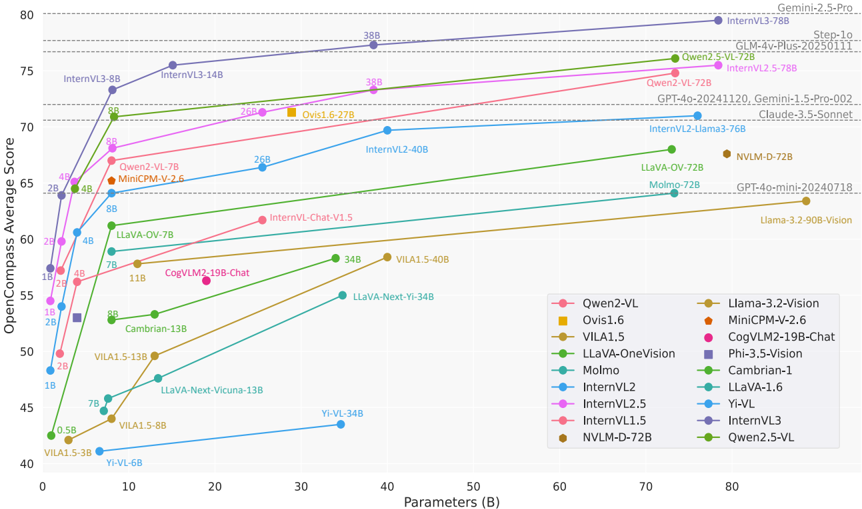
We introduce InternVL3, a significant advancement in the InternVL series featuring a native multimodal pre-training paradigm. Rather than adapting a text-only large language model (LLM) into a multimodal large language model (MLLM) that supports visual inputs, InternVL3 jointly acquires multimodal and linguistic capabilities from both diverse multimodal data and pure-text corpora during a single pre-training stage. This unified training paradigm effectively addresses the complexities and alignment challenges commonly encountered in conventional post-hoc training pipelines for MLLMs. To further improve performance and scalability, InternVL3 incorporates variable visual position encoding (V2PE) to support extended multimodal contexts, employs advanced post-training techniques such as supervised fine-tuning (SFT) and mixed preference optimization (MPO), and adopts test-time scaling strategies alongside an optimized training infrastructure. Extensive empirical evaluations demonstrate that InternVL3 delivers superior performance across a wide range of multi-modal tasks. In particular, InternVL3-78B achieves a score of 72.2 on the MMMU benchmark, setting a new state-of-the-art among open-source MLLMs. Its capabilities remain highly competitive with leading proprietary models, including ChatGPT-4o, Claude 3.5 Sonnet, and Gemini 2.5 Pro, while also maintaining strong pure-language proficiency. In pursuit of open-science principles, we will publicly release both the training data and model weights to foster further research and development in next-generation MLLMs.
Overview
CoChat Summary
TL;DR
InternVL3 introduces a native multimodal pre-training paradigm that jointly learns language and multimodal capabilities in one stage, plus V2PE, SFT/MPO post-training, test-time scaling, and infrastructure optimizations. InternVL3-78B reaches 72.2 on MMMU, setting a new state of the art among open-source MLLMs while remaining competitive with proprietary models.
Key findings
- InternVL3-78B achieves 72.2 on MMMU, 906 on OCRBench, 96.0/98.6 on VCR-EN-Easy (EM/Jaccard), and 89.0/88.7 on MMBench English/Chinese; the paper reports it as a new open-source MLLM state of the art and competitive with ChatGPT-4o, Claude 3.5 Sonnet, and Gemini 2.5 Pro.
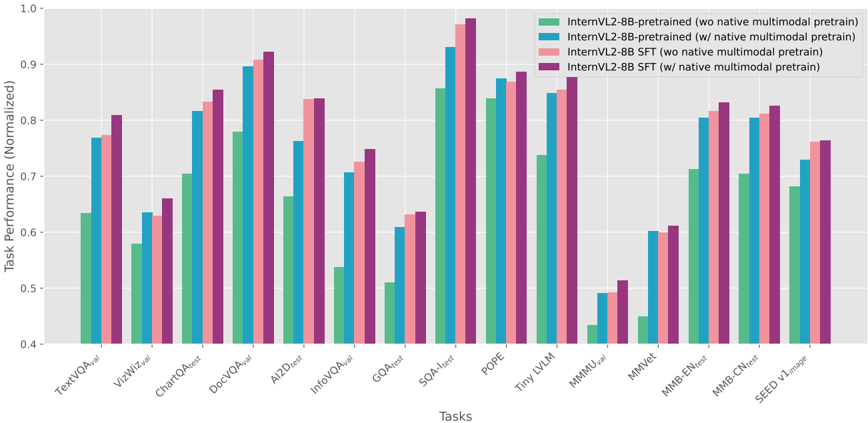
- Native multimodal pre-training is effective: replacing InternVL2-8B’s MLP warmup with native multimodal pre-training yields performance on most benchmarks comparable to the fully multi-stage-trained InternVL2-8B baseline, with further gains after instruction tuning on higher-quality data.
- MPO improves multimodal reasoning across seven benchmarks: InternVL3-78B and InternVL3-38B outperform their non-MPO counterparts by 4.1 and 4.5 points overall, respectively, even though MPO training data is a subset of SFT data.
- Test-time scaling with Best-of-8 and VisualPRM improves reasoning: on the Vision-Only split of MathVerse, best-of-8 gives increases of approximately 6.0 and 3.2 percentage points for InternVL3-38B and InternVL3-78B, respectively.
Methods
- Architecture follows “ViT-MLP-LLM”: vision encoder options are InternViT-300M and InternViT-6B; language models are pre-trained Qwen2.5 series and InternLM3-8B base models; the MLP is a two-layer randomly initialized network; pixel unshuffle reduces each 448×448 image tile to 256 visual tokens.
- Native multimodal pre-training jointly optimizes all parameters on multimodal and pure-language corpora, computes loss only on text tokens, and uses square averaging for token weights. Data combines InternVL2.5 pre-training corpus with GUI, tool usage, 3D scene, and video data, plus InternLM2.5 and open-source text data; the chosen language:multimodal ratio is 1:3, totaling about 200B tokens (50B language, 150B multimodal).
- Post-training uses SFT followed by MPO. SFT grows from 16.3M samples in InternVL2.5 to 21.7M in InternVL3; MPO uses about 300K preference samples and combines DPO preference loss, BCO quality loss, and LM generation loss. Test-time scaling uses Best-of-N with VisualPRM-8B as critic; infrastructure extends InternEVO, yielding a 50% to 200% training speedup for comparable-size models under the same compute budget.
Limitations
- The paper states a noticeable performance gap remains between InternVL3 and models like Qwen2.5-VL on certain benchmarks, such as MuirBench, implying future work may need better training data curation and model refinements.
- The paper reports minor declines on some benchmarks, such as MMHal, and states that optimizing data and training strategies for more consistent improvements remains an important future direction.
- The paper states visual grounding gains plateau at larger scales: InternVL2.5-78B reaches an average score of 92.3 while InternVL3-78B shows 91.4; it speculates this is because InternVL3’s training data expansion did not include additional grounding-specific data and the relative reduction in grounding-targeted data may have restricted localization capabilities.
Model-written summary. Check it against the paper before relying on it.
Integrity signals
Registry
Cites
Statistics
Figures
Verification
Claims the paper makes
0 Valid · 1 Not valid · 14 Not checked · 83 Own results and interpretations
A result the paper reports from its own data — it cites no other source for it, so there is none to check. The quote shows it is in the paper.
In the paper
“When compared with other competitive models, such as Qwen2-VL-72B and Qwen2.5-VL-72B, the InternVL3 series-especially the 78B variant-offers a consistent performance advantage on the multimodal understanding benchmarks.”
§ InternVL3: Exploring Advanced Training and Test-Time Recipes for Open-Source Multimodal Models > 3.6 Comprehensive Multimodal Evaluation
plainstates an association- Asserted: passes — The authors put it forward as true.
- Checkable: passes — It can be checked against evidence.
- Load-bearing: passes — The paper’s conclusions depend on it.
- Based: unclear — It is unclear why the paper says it holds.
A result the paper states — it cites no source for it, so there is none to check. The quote shows it is in the paper.
In the paper
“As a result, the number of training samples grows from 16.3M in InternVL2.5 to 21.7M in InternVL3.”
§ InternVL3: Exploring Advanced Training and Test-Time Recipes for Open-Source Multimodal Models > Data.
plainstates a cause- Asserted: passes — The authors put it forward as true.
- Checkable: passes — It can be checked against evidence.
- Load-bearing: unclear — It is unclear whether the paper’s conclusions depend on it.
- Based: passes — The paper gives a reason why it holds.
A result the paper states — it cites no source for it, so there is none to check. The quote shows it is in the paper.
In the paper
“while also maintaining strong pure-language proficiency.”
§ InternVL3: Exploring Advanced Training and Test-Time Recipes for Open-Source Multimodal Models > Abstract
boosted- Asserted: passes — The authors put it forward as true.
- Checkable: passes — It can be checked against evidence.
- Load-bearing: unclear — It is unclear whether the paper’s conclusions depend on it.
- Based: passes — The paper gives a reason why it holds.
A result the paper reports from its own data — it cites no other source for it, so there is none to check. The quote shows it is in the paper.
In the paper
“Compared with previous models, InternVL3 demonstrates substantial improvements across a wide range of task categories.”
§ InternVL3: Exploring Advanced Training and Test-Time Recipes for Open-Source Multimodal Models > 3.1 Overall Comparison to Other Advanced MLLMs
boosted- Asserted: passes — The authors put it forward as true.
- Checkable: passes — It can be checked against evidence.
- Load-bearing: passes — The paper’s conclusions depend on it.
- Based: passes — The paper gives a reason why it holds.
A result the paper reports from its own data — it cites no other source for it, so there is none to check. The quote shows it is in the paper.
In the paper
“Its capabilities remain highly competitive with leading proprietary models, including ChatGPT-4o, Claude 3.5 Sonnet, and Gemini 2.5 Pro, while also maintaining strong pure-language proficiency.”
§ InternVL3: Exploring Advanced Training and Test-Time Recipes for Open-Source Multimodal Models > Abstract
plain- Asserted: passes — The authors put it forward as true.
- Checkable: passes — It can be checked against evidence.
- Load-bearing: passes — The paper’s conclusions depend on it.
- Based: passes — The paper gives a reason why it holds.
45 more claims
Create a free account to see all 98 claims and every source verdict.
- It may state two separate claims as one. 42
- Probably not a substantial claim. 6
- The quote only partly states this claim. 1
Self-check
Percentages, sums and reported differences re-computed from the paper’s own numbers.
Each contradiction between two passages listed here was confirmed by an independent check.
Rated minor: it would not touch a result — a value no result rests on, a p-value that stays on the same side of the significance level, or a conflict that is clerical, resolved elsewhere in the paper, or outside its own findings.
In the paper
§ InternVL3: Exploring Advanced Training and Test-Time Recipes for Open-Source Multimodal Models > 3.8 Visual Grounding
“InternVL3-8B, InternVL3-9B, and InternVL3-14B yield average scores around 88.2-89.6,reflecting a consistent trend of performance gains as the model size increases.”
§ InternVL3: Exploring Advanced Training and Test-Time Recipes for Open-Source Multimodal Models > 3.6 Comprehensive Multimodal Evaluation
“InternVL3-8B 92.5 94.6 88.0 88.2 92.5 81.8 89.6 90.0 89.6 InternVL3-9B 91.8 93.2 86.6 86.4 91.0 79.9 88.0 88.5 88.2”
Rated minor: it would not touch a result — a value no result rests on, a p-value that stays on the same side of the significance level, or a conflict that is clerical, resolved elsewhere in the paper, or outside its own findings.
In the paper
§ InternVL3: Exploring Advanced Training and Test-Time Recipes for Open-Source Multimodal Models > GPT-4o Gemini 2.0 Claude Aguvis-72B Qwen2.5-VL-72B UI-TARS-72B InternVL3-8B -38B -72B
“The 8B variant (81.4%) already surpasses UI-TARS-72B”
§ InternVL3: Exploring Advanced Training and Test-Time Recipes for Open-Source Multimodal Models > GPT-4o Gemini 2.0 Claude Aguvis-72B Qwen2.5-VL-72B UI-TARS-72B InternVL3-8B -38B -72B
“InternVL3-72B achieves 90.9%, outperforming UI-TARS-72B (90.3%).”
Citations
Cites
Fei-Fei, L., Fergus, R., & Perona, P. (2005) · 2004 Conference on Computer Vision and Pattern Recognition Workshop · doi:10.1109/cvpr.2004.383 · Cited by 2,502
Liu, H., Li, C., Wu, Q., & Lee, Y. J. (2023) · Advances in Neural Information Processing Systems 36 · doi:10.52202/075280-1516 · Cited by 2,428
Making the V in VQA Matter: Elevating the Role of Image Understanding in Visual Question Answering
Goyal, Y., Khot, T., Summers-Stay, D., Batra, D., & Parikh, D. (2017) · 2017 IEEE Conference on Computer Vision and Pattern Recognition (CVPR) · doi:10.1109/cvpr.2017.670 · Cited by 2,287
Chen, Z., Wang, W., Cao, Y., Liu, Y., Gao, Z., Cui, E., Zhu, J., Ye, S., Tian, H., Liu, Z., et al. (2024) · arXiv · doi:10.48550/arxiv.2412.05271 · Cited by 2,204
Self-citationGrounding DINO: Marrying DINO with Grounded Pre-training for Open-Set Object Detection
Liu, S., Zeng, Z., Ren, T., Li, F., Zhang, H., Yang, J., Jiang, Q., Li, C., Yang, J., Su, H., et al. (2025) · Lecture Notes in Computer Science · doi:10.1007/978-3-031-72970-6_3 · Cited by 2,074
Self-citationNatural Questions: A benchmark for question answering research
Kwiatkowski, T., Palomaki, J., Redfield, O., Collins, M., Parikh, A., Alberti, C., Epstein, D., Polosukhin, I., Devlin, J., Lee, K., et al. (2019) · Transactions of the Association for Computational Linguistics · doi:10.1162/tacl_a_00276 · Cited by 2,069
MiniCPM-V: A GPT-4V Level MLLM on Your PhonePreprint
Yao, Y., Yu, T., Zhang, A., Wang, C., Cui, J., Zhu, H., Cai, T., Li, H., Zhao, W., He, Z., et al. (2024) · arXiv · doi:10.48550/arxiv.2408.01800 · Cited by 1,695
Self-citationTriviaQA: A Large Scale Distantly Supervised Challenge Dataset for Reading Comprehension
Joshi, M., Choi, E., Weld, D., & Zettlemoyer, L. (2017) · Proceedings of the 55th Annual Meeting of the Association for Computational Linguistics (Volume 1: Long Papers) · doi:10.18653/v1/p17-1147 · Cited by 1,690
Math-Shepherd: Verify and Reinforce LLMs Step-by-step without Human Annotations
Wang, P., Li, L., Shao, Z., Xu, R., Dai, D., Li, Y., Chen, D., Wu, Y., & Sui, Z. (2024) · Proceedings of the conference - Association for Computational Linguistics. Meeting · doi:10.18653/v1/2024.acl-long.510 · Cited by 1,665
TriviaQA: A Large Scale Distantly Supervised Challenge Dataset for Reading Comprehension
Joshi, M., Choi, E., Weld, D. S., & Zettlemoyer, L. (2017) · arXiv · doi:10.48550/arxiv.1705.03551 · Cited by 1,650
Research works printed but not linked: 6
- Anonymous. CG-bench: Clue-grounded question answering benchmark for long video understanding. In Submitted to The Thirteenth International Conference on Learning Representations, 2024. under review. 14, 15
- Shuai Bai, Keqin Chen, Xuejing Liu, Jialin Wang, Wenbin Ge, Sibo Song, Kai Dang, Peng Wang, Shijie Wang, Jun Tang, et al. Qwen2.5-vl technical report. arXiv preprint arXiv:2502.13923, 2025. 1, 2, 9, 10, 15 · arXiv
- Jie Cao and Jing Xiao. An augmented benchmark dataset for geometric question answering through dual parallel text encoding. In Proceedings of the 29th International Conference on Computational Linguistics, pages 1511-1520, 2022. 6
- Zhe Chen, Weiyun Wang, Hao Tian, Shenglong Ye, Zhangwei Gao, Erfei Cui, Wenwen Tong, Kongzhi Hu, Jiapeng Luo, Zheng Ma, et al. How far are we to gpt-4v? closing the gap to commercial multimodal models with open-source suites. arXiv preprint arXiv:2404.16821, 2024. 2, 3 · arXiv
- Hunter Lightman, Vineet Kosaraju, Yuri Burda, Harrison Edwards, Bowen Baker, Teddy Lee, Jan Leike, John Schulman, Ilya Sutskever, and Karl Cobbe. Let's verify step by step. In The Twelfth International Conference on Learning Representations, 2023. 7
- Minesh Mathew, Viraj Bagal, Rubèn Tito, Dimosthenis Karatzas, Ernest Valveny, and CV Jawahar. Infographicvqa. In Proceedings of the IEEE/CVF Winter Conference on Applications of Computer Vision, pages 1697-1706, 2022. 6, 7, 8, 10
Cited by
Items 2,601–2,641 of 2,641
Multimodal Abstention That Preserves Acquired Correct AnswersPreprint
Zhang, J. (2026) · arXiv · doi:10.48550/arxiv.2611.14311
“5-VL-3B and InternVL3-8B [35].”
Hallucinations Are Not Inevitable: Factual Prompting for Reliable Vision-Language Models
Qiu, W., Hu, X., Jiang, Z., He, T., He, X., & Men, A. (2026) · IEEE International Symposium on Broadband Multimedia Systems and Broadcasting (BMSB) · doi:10.1109/bmsb69102.2026.11760786
Gaudio, L. D., Cuculo, V., & Cucchiara, R. (2026) · Frontiers in Artificial Intelligence · doi:10.3389/frai.2026.1984257
Balyani, H. H. (2026) · arXiv · doi:10.48550/arxiv.2611.19561
“It adds a third model family, InternVL3 2B [27], served through Hugging Face Transformers in fp16; of two new candidates it alone passed the same inclusion screen.”
Qian, S., Zhenyi, H., Maofu, L., Huijun, H., & Xiaokang, Z. (2026) · Journal of Image and Graphics · doi:10.11834/jig.260497
Mental-map: Representing Driver Situational Awareness with Attention-driven Knowledge Graph
Ebzery, D., Blair, R., Phan, T. H., Bhaskar, A., Schroeter, R., & Elhenawy, M. M. Z. (2026) · International Conference on Artificial Intelligence, Blockchain, and Internet of Things (AIBThings) · doi:10.1109/aibthings71029.2026.11771432
“5-VL for semantic reasoning; Qwen 2.5 VL (7B) was selected for contextual scene labeling after evaluation against alternatives including LLaVa, Video-LLaMa [31] and Intern VL3 [32], owing to its superior overall performance [33].”
InfluentialALIVE: Making Streaming Video Models InteractivePreprint
Li, J., Xu, Y., Wu, J., Wang, Y., Lei, Y., Ji, H., Chen, Y., Huang, Z., Zhang, C., Ye, H., et al. (2026) · arXiv · doi:10.48550/arxiv.2611.21366
“5-9B [38], Qwen3-VL-8B [1], and InternVL3-8B [64]), and streaming models (VideoChat3 [26], JoyAI-VL-Interaction [55], and AURA [31]) alongside ALIVE on our FSI-Bench (Table 3).”
Self-citationNie, F., Liu, E. B., Zhu, Y., & Han, J. (2026) · arXiv · doi:10.48550/arxiv.2611.22837
“5-8B [1], InternVL3-8B [41], InternVL3.”
Xu, L., Guo, Y., Li, S., Xuewen, Z., Qian, Y., & Lu, A.-Y. (2026) · arXiv · doi:10.48550/arxiv.2611.22652
“5-VL-7B [2], LLaVA-NeXT-7B [13], Qwen3-VL-8B [1], and the InternVL series [6,32]) [26]) to evaluate resource-constrained performance; (3) A Medical-specific Model (HuatuoGPT-Vision [3]) to investigate anticipated domain advantages; and (4) A Traditional Baseline (BLIP-2 [8]).”
Self-citationGajjar, J., & Subramaniakuppusamy, K. (2026) · arXiv · doi:10.48550/arxiv.2611.21940
“5-VL-3B-Instruct [2] is the main base and InternVL3-2B [54] the second, used for the synthetic pipeline.”
Panel2Protocol: From visual perception to executable protocol for embodied agents
Zhao, Z., Zhang, S., Cao, Z., Yang, X., Guo, Y., Deng, D., & Gao, J. (2026) · Pattern Recognition · doi:10.1016/j.patcog.2026.115257
SEER: Semantic Evidence for Executable Region Propagation in Open-Vocabulary Semantic SegmentationPreprint
Chen, J., Li, X., Qiao, Y., & Li, W. (2026) · arXiv · doi:10.48550/arxiv.2611.24152
“Modern VLMs can answer region-level questions, compare candidate descriptions, and provide visual evidence that is not captured by local score margins Qwen Team (2026); An et al. (2025); Zhu et al. (2025); Clark et al. (2026); Hurst et al. (2024); Bousselham et al. (2024).”
Self-citationNaylor, A., Fugelli, P., Landrø, E., & Blomvik, S. (2026) · NVA (Nasjonalt vitenarkiv)
ChronoPatch: Black-Box Energy-Latency Attacks on Vision-Language ModelsPreprint
Xing, J., Wang, L., Meng, X., Zang, C., Wen, R., & Li, Z. (2026) · arXiv · doi:10.48550/arxiv.2611.26117
“5-7B [24], Qwen3-VL-8B [6], and InternVL3-8B [41], as well as three commercial APIs: ChatGPT-5 [27], Gemini-3.”
Self-citationMKA: Evaluating Multimodal Knowledge Agents on end-to-end professional tasksPreprint
Singh, A., Yogin, S., Kuo, W., Rendulić, I., Jurin, I., Yang, A., Kelly, O., Doshi, R., Ayyubi, H., Bica, I., et al. (2026) · arXiv · doi:10.48550/arxiv.2611.25228
“…far stronger native visual capabilities (Anthropic, 2026; Bai et al., 2025; Google DeepMind, 2025, 2026; Meta AI, 2025, 2026; OpenAI, 2025, 2026; Zhu et al., 2025)— and even when looking at images directly, models remain prone to geometric blindness and strong text-prior bias (Rahmanzadehgervi…”
Harnessing Medical Visual-Language Models with Agentic Evidence ManagementPreprint
Huang, Q., Dong, H., Zhang, J., Shou, M. Z., Xu, X., & Wei, F. (2026) · arXiv · doi:10.48550/arxiv.2611.25840
Evaluating Explanation Integrity in a Vision Language Model for Urban Perception
Shingleton, J., Bicakci, Y. S., Wu, M., Wang, Y., & Basiri, A. (2026) · Transactions in GIS · doi:10.1111/tgis.70475
Self-citationSCG‐VLM: Vision‐Language Model‐Assisted Shared Control for Grasping in Haptic Teleoperation
Yang, D. L., Xie, D., Xu, X. W., Xiong, M., Wang, Z., Su, X., & Steinbach, E. G. (2026) · Advanced Intelligent Systems · doi:10.1002/aisy.70642
Zero-Shot Text-to-Motion Evaluation using Video Language Models
Ji, Y., Wang, D., & Zhang, Y. (2026) · International Conference on Machine Learning
VisualScore: Learning Holistic Visual Quality Scores via Multi-Task Reasoning
Lu, Y., Guan, F., Gao, Y., Zhong, Y., Peng, X., Yuan, J., Liu, Y., Zhang, B., Li, X., Chen, Z., et al. (2026) · International Conference on Machine Learning
Self-citationTowards Multimodal Large Language Models with Both Training and Inference Efficiency
Yuan, Q., Liu, Y., Mo, G., Lu, Y., Lin, H., Zheng, J., He, B., Han, X., & Sun, L. (2026) · International Conference on Machine Learning
Self-citationQin, Z., Chen, J., Zhou, C., Pu, Y., Hu, C., Liu, X., & Ji, S. (2026) · International Conference on Machine Learning
EAGLE: Entity-Aware Grounding with Layered Evidence for High-Resolution Image UnderstandingPreprint
Zou, Z., & Qian, Q. (2026) · arXiv · doi:10.48550/arxiv.2611.27264
“5-VL and InternVL3 further strengthen high-resolution perception [3, 28].”
Mei, J., Wu, X., Ren, H., Zhang, Y., Xia, H., Zhang, B., Sun, P., Zhao, B., & Xiong, Z. (2026) · IEEE/RSJ International Conference on Intelligent Robots and Systems (IROS) · doi:10.1109/iros61738.2026.11776862
“Leveraging a native multimodal pretraining paradigm, it enables tight cross-modal alignment and efficient fusion of visual and linguistic features, laying a solid foundation for semantic understanding and action generation in downstream tasks [26], [28].”
Self-citationGe, Z., Li, A., Geng, K., & Qiu, W. (2026) · arXiv · doi:10.48550/arxiv.2611.26904
“5-VL-7B-Instruct [1] (dynamic resolution, 28 pixels per to-ken), Qwen3-VL-8B-Instruct [2] (32 pixels per token and multi-level “DeepStack” features, which we cache and inject alongside the main tokens) and InternVL3-8B [34] (448-pixel tiles of 256 tokens plus a thumbnail).”
WePM: Hierarchical Conflict Reconciliation for Unified MLLMsPreprint
Yuan, Z., Yan, Q., Yang, L., Liu, J., Liu, Y., Hou, Z., Xu, L., Luo, P., Zhang, J., Deng, Y., et al. (2026) · arXiv · doi:10.48550/arxiv.2611.27365
“As reported in JevBench [90] Open-Jev [91] JevAny (MM) [92] Valen-VDB (Image) [93] Valen-General5k [94] DecisionBench [95] Ave.”
Self-citationLi, G., Zhang, M., & Zhang, W. (2026) · Research Square · doi:10.21203/rs.3.rs-11654739/v1
TouchBench: Can Vision-Language Models Feel Invisible Physical Properties?Preprint
Zeng, Z., Kou, Z., Qin, C., Huang, M., Boldú, R., Fan, Z., Rakita, D., Whitmire, E., & Guan, L. (2026) · arXiv · doi:10.48550/arxiv.2611.26883
Seeing Together, Acting Apart: Shared Environmental Understanding for Multi-Robot NavigationPreprint
Hao, H., Chen, L., Han, M., Yan, C., An, D. U., Yang, Y., Li, C., Guo, M., Khan, S., & Chang, X. (2026) · arXiv · doi:10.48550/arxiv.2611.30310
Seeing Right, Writing Wrong: Where Short Chain-of-Thought Breaks Spatial VQAPreprint
Zhang, C. (2026) · arXiv · doi:10.48550/arxiv.2611.28665
OmniV-Bench: Can MLLMs Comprehend Immersive Spatio-temporal Scenes?Preprint
Yang, L., Duan, H., Gao, Y., Liu, S., Liu, L., Cai, Z., Gu, K., Min, X., Zhang, X., & Zhai, G. (2026) · arXiv · doi:10.48550/arxiv.2611.31022
“…into three groups: (1) proprietary models, including GPT-4o [9], Gemini [6], etc. (2) open-sourced models, including InternVL series [24, 43], Qwen-VL series [2, 17, 19], LLaVA-NeXT [14], LLava-OneVision [1], etc. (3) Spatial-centric MLLMs, including VG-LLM [40], VST [34], Spatial-MLLM…”
Self-citationBeyond Relevance: An Empirical Study of Multimodal LLMs for Diversity-Aware Recommendation RerankingPreprint
Liu, C., Fu, Y., Chen, H., Sarwar, S., & Qi, Q. (2026) · arXiv · doi:10.48550/arxiv.2611.28379
“We evaluate two pretrained MLLMs: InternVL3-38B [33], an open-source model, and Claude Sonnet 4.6 [2], a proprietary API-based model.”
InfluentialBeyond Attention Maps: Understanding and Improving Medical MLLMs via Visual ValuesPreprint
Zhao, Y., Tang, F., Ma, W., Wang, R., Wan, Z., & Zhou, S. K. (2026) · arXiv · doi:10.48550/arxiv.2611.29361
From Reward Engineering to Data-Centric Reinforcement Learning for Effective Agentic Visual Tool UsePreprint
Cui, J., Long, X.-Y., Zhou, J.-P., Zhao, B.-R., Ren, P.-J., & Dong, H. (2026) · arXiv · doi:10.48550/arxiv.2611.28558
“5-VL-7B [2], Qwen3-VL-8B [1], and InternVL3-8B [58].”
Zhang, Z., Ji, X., Li, H., Bai, C., Zhai, R., & Lü, K. (2026) · Knowledge-Based Systems · doi:10.1016/j.knosys.2026.117369
Self-citationCascaded Spatial Prompting for Allocentric Spatial Reasoning in Vision-Language Models
Meng, Y., Zhang, Y., Liang, L., Deng, G., & Zhang, H. (2026) · Conference proceedings/Conference proceedings - IEEE International Conference on Systems, Man, and Cybernetics · doi:10.1109/smc63593.2026.11788845
“5 (2B/8B) [25], InternVL3-14B [26], Qwen2.”
Self-citationDeTA: Prompting Adaptive Multimodal Reasoning via Decoupled Two-stage Alignment
Ji, H., Qing, D., & Li, S. (2026) · Conference proceedings/Conference proceedings - IEEE International Conference on Systems, Man, and Cybernetics · doi:10.1109/smc63593.2026.11789304
“5-7B [3], and InternVL3-8B [28].”
Self-citationAnila, J. B. T., Soriano, A. K. A., & Naval, P. C. (2026) · Communications in computer and information science · doi:10.1007/978-981-92-8113-8_38
Diagnose, Correct, and Learn from Manipulation Failures via Visual Symbols
Zeng, X., Zhou, X., Li, Y., Shi, J., Li, T., Chen, L., Ren, L., & Li, Y.-L. (2025) · arXiv · doi:10.48550/arxiv.2512.02787
“5-VL series [3], Qwen3-VL series [2] and InternVL3 series [44]) and 4 open-source embodied VLMs (RoboBrain2.”
Benchmarking Multimodal Knowledge Conflict for Large Multimodal Models
Jia, Y., Jiang, K., Liang, Y., Ren, Q., Xin, Y., Yang, R., Feng, F., Chen, M., Lu, H., Wang, H., et al. (2025) · arXiv
“5-VL (3B, 7B, 32B, 72B) (Bai et al. 2025), In-ternVL3 (8B, 14B, 38B, 78B) (Zhu et al. 2025), GPT-4o mini (Hurst et al. 2024), and Gemini-2.”
Self-citationAn, A., Sun, S., Huang, D., Cheng, M., Gao, Y., Li, J., Qiao, Y., & Bian, J. (2026) · arXiv · doi:10.48550/arxiv.2603.01083
“Specifically, proprietary VLMs (e.g., GPT series (Achiam et al., 2023)) outperform open-source ones (e.g., Qwen-VL (Wang et al., 2024), Intern-VL (Zhu et al., 2025), LLaVA (Liu et al., 2023)).”
Self-citation
Metadata
- Authors
- Zhu, J., Wang, W., Chen, Z., Liu, Z., Ye, S., Gu, L., Tian, H., Duan, Y., Su, W., Shao, J., Gao, Z., Cui, E., Wang, X., Cao, Y., Liu, Y., Wei, X., Zhang, H., Wang, H., Xu, W., Li, H., Wang, J., Deng, N., Li, S., He, Y., Jiang, T., Luo, J., Wang, Y., He, C., Shi, B., Zhang, X., Shao, W., He, J., Xiong, Y., Qu, W., Sun, P., Jiao, P., Lv, H., Wu, L., Zhang, K., Deng, H., Ge, J., Chen, K., Wang, L., Dou, M., Lu, L., Zhu, X., Lu, T., Lin, D., Qiao, Y., Dai, J., & Wang, W.
- Affiliations
- Shanghai Artificial Intelligence Laboratory (CN)
- Chinese University of Hong Kong (HK)
- Sensetime (China) (CN)
- Shanghai Jiao Tong University (CN)
- ORCID
- Venue
- arXiv
- Publisher
- arXiv
- Published
- 2025
- ISSN
- 2331-8422 (ISSN-L)
- arXiv
- 2504.10479
- OpenAlex
- W4416053382
- Cited by
- 2,644
- References
- 138
- Citations by year
- 2026: 1999 · 2025: 638
- Type
- posted content
- Language
- en
- Open access
- green
- arxiv.org
- Licence
- Locations
- arXiv (submittedVersion, cc-by)
- Topics
- Physical Sciences › Computer Science › Computer Vision and Pattern Recognition › Multimodal Machine Learning Applications
- Physical Sciences › Computer Science › Artificial Intelligence › Domain Adaptation and Few-Shot Learning
- Physical Sciences › Computer Science › Computer Vision and Pattern Recognition › Advanced Neural Network Applications
- Keywords
- multimodal large language models, multimodal pre-training, supervised fine-tuning, test-time scaling
About these checks
Registry, retraction, Cites and statistics results are computed, not judged, with one exception: a printed reference that no index lists is read once by a model before it counts as a citation error. Claims are extracted by a model and kept only when their quote appears verbatim in the text; each cited source is then checked, with a model’s help, for whether it says what the claim relies on. Those verdicts can be wrong — read the claim’s quote and the cited source before relying on one.
A language model drew the claims from the paper on 2026-11-28, under version 3 of the claim definition (model deepseek-v4.1-flash, prompt extract-v3).
A second model labelled each claim on 2026-11-28 (model jev-1.13-20260917, definition revision gold-guideline-v0.2).
Statistics and arithmetic are recomputed, not judged.
Confidence bands are shown only for fields calibrated on our annotated test set. None is calibrated yet, so no band is shown.
What counts as a claim ›How we measure confidence ›How we check this ›
Are you an author, or do you see a problem with this page? Request a review
Data sources
Bibliographic data: Semantic Scholar, OpenAlex, Crossref.
Contains information from the Semantic Scholar Academic Graph Datasets, made available under the ODC Attribution License (ODC-BY 1.0).
Semantic Scholar’s data is described in: Kinney, R., et al. (2023). The Semantic Scholar Open Data Platform. arXiv:2301.10140.
