

InternVL3: Exploring Advanced Training and Test-Time Recipes for Open-Source Multimodal Models
Open accessThe DOI matches its DataCite record; 145 of the 145 references it cites were found in a registry or an index; none of the 38 sources its claims cite is checked for support yet.
Abstract
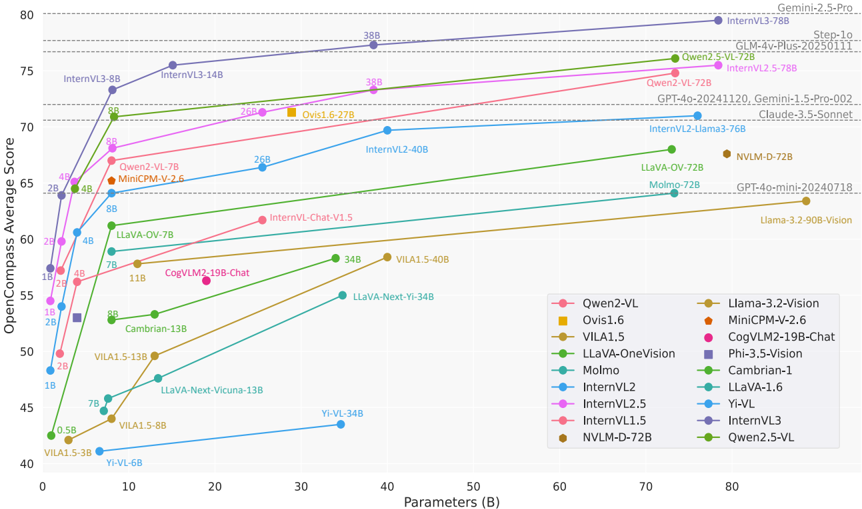
We introduce InternVL3, a significant advancement in the InternVL series featuring a native multimodal pre-training paradigm. Rather than adapting a text-only large language model (LLM) into a multimodal large language model (MLLM) that supports visual inputs, InternVL3 jointly acquires multimodal and linguistic capabilities from both diverse multimodal data and pure-text corpora during a single pre-training stage. This unified training paradigm effectively addresses the complexities and alignment challenges commonly encountered in conventional post-hoc training pipelines for MLLMs. To further improve performance and scalability, InternVL3 incorporates variable visual position encoding (V2PE) to support extended multimodal contexts, employs advanced post-training techniques such as supervised fine-tuning (SFT) and mixed preference optimization (MPO), and adopts test-time scaling strategies alongside an optimized training infrastructure. Extensive empirical evaluations demonstrate that InternVL3 delivers superior performance across a wide range of multi-modal tasks. In particular, InternVL3-78B achieves a score of 72.2 on the MMMU benchmark, setting a new state-of-the-art among open-source MLLMs. Its capabilities remain highly competitive with leading proprietary models, including ChatGPT-4o, Claude 3.5 Sonnet, and Gemini 2.5 Pro, while also maintaining strong pure-language proficiency. In pursuit of open-science principles, we will publicly release both the training data and model weights to foster further research and development in next-generation MLLMs.
Overview
CoChat Summary
TL;DR
InternVL3 introduces a native multimodal pre-training paradigm that jointly learns language and multimodal capabilities in one stage, plus V2PE, SFT/MPO post-training, test-time scaling, and infrastructure optimizations. InternVL3-78B reaches 72.2 on MMMU, setting a new state of the art among open-source MLLMs while remaining competitive with proprietary models.
Key findings
- InternVL3-78B achieves 72.2 on MMMU, 906 on OCRBench, 96.0/98.6 on VCR-EN-Easy (EM/Jaccard), and 89.0/88.7 on MMBench English/Chinese; the paper reports it as a new open-source MLLM state of the art and competitive with ChatGPT-4o, Claude 3.5 Sonnet, and Gemini 2.5 Pro.
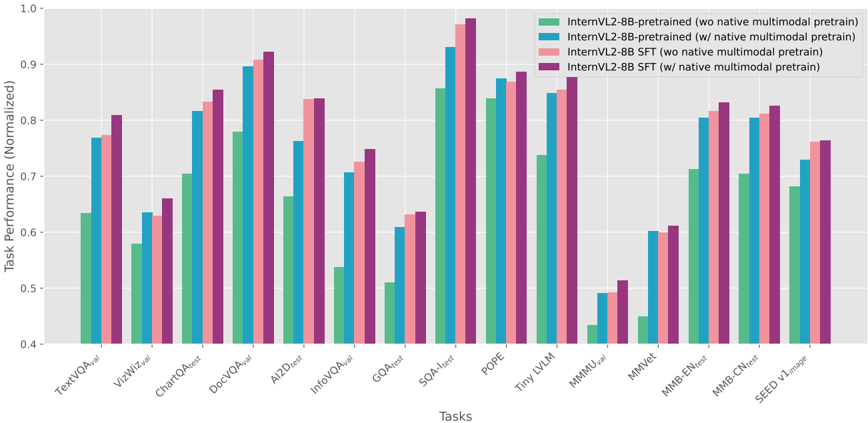
- Native multimodal pre-training is effective: replacing InternVL2-8B’s MLP warmup with native multimodal pre-training yields performance on most benchmarks comparable to the fully multi-stage-trained InternVL2-8B baseline, with further gains after instruction tuning on higher-quality data.
- MPO improves multimodal reasoning across seven benchmarks: InternVL3-78B and InternVL3-38B outperform their non-MPO counterparts by 4.1 and 4.5 points overall, respectively, even though MPO training data is a subset of SFT data.
- Test-time scaling with Best-of-8 and VisualPRM improves reasoning: on the Vision-Only split of MathVerse, best-of-8 gives increases of approximately 6.0 and 3.2 percentage points for InternVL3-38B and InternVL3-78B, respectively.
Methods
- Architecture follows “ViT-MLP-LLM”: vision encoder options are InternViT-300M and InternViT-6B; language models are pre-trained Qwen2.5 series and InternLM3-8B base models; the MLP is a two-layer randomly initialized network; pixel unshuffle reduces each 448×448 image tile to 256 visual tokens.
- Native multimodal pre-training jointly optimizes all parameters on multimodal and pure-language corpora, computes loss only on text tokens, and uses square averaging for token weights. Data combines InternVL2.5 pre-training corpus with GUI, tool usage, 3D scene, and video data, plus InternLM2.5 and open-source text data; the chosen language:multimodal ratio is 1:3, totaling about 200B tokens (50B language, 150B multimodal).
- Post-training uses SFT followed by MPO. SFT grows from 16.3M samples in InternVL2.5 to 21.7M in InternVL3; MPO uses about 300K preference samples and combines DPO preference loss, BCO quality loss, and LM generation loss. Test-time scaling uses Best-of-N with VisualPRM-8B as critic; infrastructure extends InternEVO, yielding a 50% to 200% training speedup for comparable-size models under the same compute budget.
Limitations
- The paper states a noticeable performance gap remains between InternVL3 and models like Qwen2.5-VL on certain benchmarks, such as MuirBench, implying future work may need better training data curation and model refinements.
- The paper reports minor declines on some benchmarks, such as MMHal, and states that optimizing data and training strategies for more consistent improvements remains an important future direction.
- The paper states visual grounding gains plateau at larger scales: InternVL2.5-78B reaches an average score of 92.3 while InternVL3-78B shows 91.4; it speculates this is because InternVL3’s training data expansion did not include additional grounding-specific data and the relative reduction in grounding-targeted data may have restricted localization capabilities.
Model-written summary. Check it against the paper before relying on it.
Integrity signals
Registry
Cites
Statistics
Figures
Verification
Claims the paper makes
0 Valid · 1 Not valid · 14 Not checked · 83 Own results and interpretations
A result the paper reports from its own data — it cites no other source for it, so there is none to check. The quote shows it is in the paper.
In the paper
“When compared with other competitive models, such as Qwen2-VL-72B and Qwen2.5-VL-72B, the InternVL3 series-especially the 78B variant-offers a consistent performance advantage on the multimodal understanding benchmarks.”
§ InternVL3: Exploring Advanced Training and Test-Time Recipes for Open-Source Multimodal Models > 3.6 Comprehensive Multimodal Evaluation
plainstates an association- Asserted: passes — The authors put it forward as true.
- Checkable: passes — It can be checked against evidence.
- Load-bearing: passes — The paper’s conclusions depend on it.
- Based: unclear — It is unclear why the paper says it holds.
A result the paper states — it cites no source for it, so there is none to check. The quote shows it is in the paper.
In the paper
“As a result, the number of training samples grows from 16.3M in InternVL2.5 to 21.7M in InternVL3.”
§ InternVL3: Exploring Advanced Training and Test-Time Recipes for Open-Source Multimodal Models > Data.
plainstates a cause- Asserted: passes — The authors put it forward as true.
- Checkable: passes — It can be checked against evidence.
- Load-bearing: unclear — It is unclear whether the paper’s conclusions depend on it.
- Based: passes — The paper gives a reason why it holds.
A result the paper states — it cites no source for it, so there is none to check. The quote shows it is in the paper.
In the paper
“while also maintaining strong pure-language proficiency.”
§ InternVL3: Exploring Advanced Training and Test-Time Recipes for Open-Source Multimodal Models > Abstract
boosted- Asserted: passes — The authors put it forward as true.
- Checkable: passes — It can be checked against evidence.
- Load-bearing: unclear — It is unclear whether the paper’s conclusions depend on it.
- Based: passes — The paper gives a reason why it holds.
A result the paper reports from its own data — it cites no other source for it, so there is none to check. The quote shows it is in the paper.
In the paper
“Compared with previous models, InternVL3 demonstrates substantial improvements across a wide range of task categories.”
§ InternVL3: Exploring Advanced Training and Test-Time Recipes for Open-Source Multimodal Models > 3.1 Overall Comparison to Other Advanced MLLMs
boosted- Asserted: passes — The authors put it forward as true.
- Checkable: passes — It can be checked against evidence.
- Load-bearing: passes — The paper’s conclusions depend on it.
- Based: passes — The paper gives a reason why it holds.
A result the paper reports from its own data — it cites no other source for it, so there is none to check. The quote shows it is in the paper.
In the paper
“Its capabilities remain highly competitive with leading proprietary models, including ChatGPT-4o, Claude 3.5 Sonnet, and Gemini 2.5 Pro, while also maintaining strong pure-language proficiency.”
§ InternVL3: Exploring Advanced Training and Test-Time Recipes for Open-Source Multimodal Models > Abstract
plain- Asserted: passes — The authors put it forward as true.
- Checkable: passes — It can be checked against evidence.
- Load-bearing: passes — The paper’s conclusions depend on it.
- Based: passes — The paper gives a reason why it holds.
45 more claims
Create a free account to see all 98 claims and every source verdict.
- It may state two separate claims as one. 42
- Probably not a substantial claim. 6
- The quote only partly states this claim. 1
Self-check
Percentages, sums and reported differences re-computed from the paper’s own numbers.
Each contradiction between two passages listed here was confirmed by an independent check.
Rated minor: it would not touch a result — a value no result rests on, a p-value that stays on the same side of the significance level, or a conflict that is clerical, resolved elsewhere in the paper, or outside its own findings.
In the paper
§ InternVL3: Exploring Advanced Training and Test-Time Recipes for Open-Source Multimodal Models > 3.8 Visual Grounding
“InternVL3-8B, InternVL3-9B, and InternVL3-14B yield average scores around 88.2-89.6,reflecting a consistent trend of performance gains as the model size increases.”
§ InternVL3: Exploring Advanced Training and Test-Time Recipes for Open-Source Multimodal Models > 3.6 Comprehensive Multimodal Evaluation
“InternVL3-8B 92.5 94.6 88.0 88.2 92.5 81.8 89.6 90.0 89.6 InternVL3-9B 91.8 93.2 86.6 86.4 91.0 79.9 88.0 88.5 88.2”
Rated minor: it would not touch a result — a value no result rests on, a p-value that stays on the same side of the significance level, or a conflict that is clerical, resolved elsewhere in the paper, or outside its own findings.
In the paper
§ InternVL3: Exploring Advanced Training and Test-Time Recipes for Open-Source Multimodal Models > GPT-4o Gemini 2.0 Claude Aguvis-72B Qwen2.5-VL-72B UI-TARS-72B InternVL3-8B -38B -72B
“The 8B variant (81.4%) already surpasses UI-TARS-72B”
§ InternVL3: Exploring Advanced Training and Test-Time Recipes for Open-Source Multimodal Models > GPT-4o Gemini 2.0 Claude Aguvis-72B Qwen2.5-VL-72B UI-TARS-72B InternVL3-8B -38B -72B
“InternVL3-72B achieves 90.9%, outperforming UI-TARS-72B (90.3%).”
Citations
Cites
Fei-Fei, L., Fergus, R., & Perona, P. (2005) · 2004 Conference on Computer Vision and Pattern Recognition Workshop · doi:10.1109/cvpr.2004.383 · Cited by 2,502
Liu, H., Li, C., Wu, Q., & Lee, Y. J. (2023) · Advances in Neural Information Processing Systems 36 · doi:10.52202/075280-1516 · Cited by 2,428
Making the V in VQA Matter: Elevating the Role of Image Understanding in Visual Question Answering
Goyal, Y., Khot, T., Summers-Stay, D., Batra, D., & Parikh, D. (2017) · 2017 IEEE Conference on Computer Vision and Pattern Recognition (CVPR) · doi:10.1109/cvpr.2017.670 · Cited by 2,287
Chen, Z., Wang, W., Cao, Y., Liu, Y., Gao, Z., Cui, E., Zhu, J., Ye, S., Tian, H., Liu, Z., et al. (2024) · arXiv · doi:10.48550/arxiv.2412.05271 · Cited by 2,204
Self-citationGrounding DINO: Marrying DINO with Grounded Pre-training for Open-Set Object Detection
Liu, S., Zeng, Z., Ren, T., Li, F., Zhang, H., Yang, J., Jiang, Q., Li, C., Yang, J., Su, H., et al. (2025) · Lecture Notes in Computer Science · doi:10.1007/978-3-031-72970-6_3 · Cited by 2,074
Self-citationNatural Questions: A benchmark for question answering research
Kwiatkowski, T., Palomaki, J., Redfield, O., Collins, M., Parikh, A., Alberti, C., Epstein, D., Polosukhin, I., Devlin, J., Lee, K., et al. (2019) · Transactions of the Association for Computational Linguistics · doi:10.1162/tacl_a_00276 · Cited by 2,069
MiniCPM-V: A GPT-4V Level MLLM on Your PhonePreprint
Yao, Y., Yu, T., Zhang, A., Wang, C., Cui, J., Zhu, H., Cai, T., Li, H., Zhao, W., He, Z., et al. (2024) · arXiv · doi:10.48550/arxiv.2408.01800 · Cited by 1,695
Self-citationTriviaQA: A Large Scale Distantly Supervised Challenge Dataset for Reading Comprehension
Joshi, M., Choi, E., Weld, D., & Zettlemoyer, L. (2017) · Proceedings of the 55th Annual Meeting of the Association for Computational Linguistics (Volume 1: Long Papers) · doi:10.18653/v1/p17-1147 · Cited by 1,690
Math-Shepherd: Verify and Reinforce LLMs Step-by-step without Human Annotations
Wang, P., Li, L., Shao, Z., Xu, R., Dai, D., Li, Y., Chen, D., Wu, Y., & Sui, Z. (2024) · Proceedings of the conference - Association for Computational Linguistics. Meeting · doi:10.18653/v1/2024.acl-long.510 · Cited by 1,665
TriviaQA: A Large Scale Distantly Supervised Challenge Dataset for Reading Comprehension
Joshi, M., Choi, E., Weld, D. S., & Zettlemoyer, L. (2017) · arXiv · doi:10.48550/arxiv.1705.03551 · Cited by 1,650
Research works printed but not linked: 6
- Anonymous. CG-bench: Clue-grounded question answering benchmark for long video understanding. In Submitted to The Thirteenth International Conference on Learning Representations, 2024. under review. 14, 15
- Shuai Bai, Keqin Chen, Xuejing Liu, Jialin Wang, Wenbin Ge, Sibo Song, Kai Dang, Peng Wang, Shijie Wang, Jun Tang, et al. Qwen2.5-vl technical report. arXiv preprint arXiv:2502.13923, 2025. 1, 2, 9, 10, 15 · arXiv
- Jie Cao and Jing Xiao. An augmented benchmark dataset for geometric question answering through dual parallel text encoding. In Proceedings of the 29th International Conference on Computational Linguistics, pages 1511-1520, 2022. 6
- Zhe Chen, Weiyun Wang, Hao Tian, Shenglong Ye, Zhangwei Gao, Erfei Cui, Wenwen Tong, Kongzhi Hu, Jiapeng Luo, Zheng Ma, et al. How far are we to gpt-4v? closing the gap to commercial multimodal models with open-source suites. arXiv preprint arXiv:2404.16821, 2024. 2, 3 · arXiv
- Hunter Lightman, Vineet Kosaraju, Yuri Burda, Harrison Edwards, Bowen Baker, Teddy Lee, Jan Leike, John Schulman, Ilya Sutskever, and Karl Cobbe. Let's verify step by step. In The Twelfth International Conference on Learning Representations, 2023. 7
- Minesh Mathew, Viraj Bagal, Rubèn Tito, Dimosthenis Karatzas, Ernest Valveny, and CV Jawahar. Infographicvqa. In Proceedings of the IEEE/CVF Winter Conference on Applications of Computer Vision, pages 1697-1706, 2022. 6, 7, 8, 10
Cited by
Items 701–800 of 2,641
The RoboSense Challenge: Sense Anything, Navigate Anywhere, Adapt Across PlatformsPreprint
Kong, L., Xie, S., Gong, Z., Li, Y., Chu, M., LIANG, A., Dong, Y., Hu, T., Qiu, R., Li, R., et al. (2026) · arXiv · doi:10.48550/arxiv.2601.05014 · Cited by 9
Self-citationWorldVLM: Distilling World Model Imagination into VLMs for Dynamic Spatial Reasoning
Zhang, W., Wu, W., Xu, W., Luo, J., Zhi, H., Huang, Y., Ren, S., Liu, Z., & Zhang, J. (2026) · ACM International Conference on Multimedia (ACM MM) · doi:10.1145/3767308.3835851 · Cited by 9
Self-citationProBench: Benchmarking GUI Agents with Accurate Process Information
Yang, L., Wang, Z., Tang, X., Zhou, S., Chen, D., Jiang, W., & Li, Y. (2026) · Proceedings of the AAAI Conference on Artificial Intelligence · doi:10.1609/aaai.v40i32.39974 · Cited by 9
ZonUI-3B: A Lightweight Vision-Language Model for Cross-Resolution GUI GroundingPreprint
Hsieh, Z., Wei, T.-T., & Yang, S. (2025) · arXiv · doi:10.48550/arxiv.2506.23491 · Cited by 9
Human-MME: A Holistic Evaluation Benchmark for Human-Centric Multimodal Large Language Models
Liu, Y., Tang, H., Peng, J., Zhang, J., Ji, X., He, Q., Wu, W., Luo, D., 甘振业, Zhu, J., et al. (2026) · International Conference on Learning Representations · doi:10.48550/arxiv.2509.26165 · Cited by 9
“5-VL (72B, 32B, 7B) [12], InternVL3-78B [25], InternVL3.”
Self-citationUM-Text: A Unified Multimodal Model for Image Understanding and Visual Text Editing
Ma, L., Fu, X., Zhou, G., Guo, Z., Zhu, T., Liu, Y., Shi, Y., Li, J., & Huang, J. (2026) · Proceedings of the AAAI Conference on Artificial Intelligence · doi:10.1609/aaai.v40i10.37722 · Cited by 9
Self-citationVideoLoom: A Video Large Language Model for Joint Spatial-Temporal Understanding
Shi, J., Wang, J., You, Z., He, B., & Wu, Z. (2026) · International Conference on Machine Learning · doi:10.48550/arxiv.2601.07290 · Cited by 8
“We integrate InternVL3 [76], a multimodal large language model (MLLM), with SAM2 [49], a video segmentation and tracking model, to support both spatial and temporal tasks within a unified framework.”
Self-citationCan Current AI Models Count What We Mean, Not What They See? A Benchmark and Systematic Evaluation
Nguyen, G. K., Huang, Y., & Hoai, M. (2025) · International Conference on Digital Image Computing: Techniques and Applications (DICTA) · doi:10.1109/dicta68720.2025.11302471 · Cited by 8
“5-VL [ 4], InternVL3 [56], and LLaMA-3.”
Unlocking Zero-Shot Geospatial Reasoning via Indirect Rewards
Xu, C., Yu, F., Bianco, M. J., Kovarskiy, J. A., Tang, R., Zhang, Q., Xu, Z., LeVine, W., Dubbs, B., Liao, H., et al. (2026) · International Conference on Machine Learning · doi:10.48550/arxiv.2510.00072 · Cited by 8
“To further verify the universality of our proposed indirect reward and framework, we applied the Geo-R1 post-training paradigm to a different VLM architecture, InternVL3-8B (Zhu et al., 2025), and evaluated it on the out-of-distribution IMAGEO-GSS dataset.”
InfluentialDiagnosing Bottlenecks in Data Visualization Understanding by Vision-Language ModelsPreprint
Tartaglini, A. R., Grant, S., Wurgaft, D., Potts, C. E., & Fan, J. E. (2025) · arXiv · doi:10.48550/arxiv.2510.21740 · Cited by 8
“2B 11B (Grattafiori et al., 2024), LLaVA-OneVision 7B (Li et al., 2024), and InternVL3 14B (Zhu et al., 2025).”
Deep But Reliable: Advancing Multi-turn Reasoning for Thinking with ImagesPreprint
Yang, W.-H., Xia, Y., Huang, J.-L., Lu, S.-Y., Chen, Q.-G., Xu, Z., Luo, W.-H., Zhang, K.-F., Wan, Y., & Zhang, L.-J. (2025) · arXiv.org · doi:10.48550/arxiv.2512.17306 · Cited by 8
“…by connecting a pre-trained ViT [11] to the LLM through a simple projector like MLP. Driven by the rapid advancement of LLMs, a growing family of open-source VLMs has emerged, including LLaVA [23, 28, 29], InternVL [6–8, 50, 62], Qwen-VL [3, 4, 48], Ovis [33, 34], SEED-VL [12], and GLM-VL [47].”
Self-citationMedReason-R1: Learning to Reason for CT Diagnosis with Reinforcement Learning and Local Zoom
Li, Y., Tang, F., Li, Y., & Zhou, S. K. (2026) · IEEE International Symposium on Biomedical Imaging (ISBI) · doi:10.1109/isbi61048.2026.11515758 · Cited by 8
“With the development of Multimodal Large Language Models (MLLMs) [5, 6, 7], general-purpose models have demonstrated strong capabilities in natural image understanding and text generation.”
Colon-X: Advancing Intelligent Colonoscopy toward Clinical ReasoningPreprint
Ji, G.-P., Liu, J., Fan, D.-P., Fu, H., & Barnes, N. (2025) · arXiv · doi:10.48550/arxiv.2512.03667 · Cited by 8
Zhang, X., Ge, J., Zheng, Y., Guo, K., & Liang, J. (2026) · ISPRS Journal of Photogrammetry and Remote Sensing · doi:10.1016/j.isprsjprs.2026.04.036 · Cited by 8
“5-VL series (3B and 7B) (Bai et al., 2025), and the InternVL3 series (2B and 8B) (Zhu et al., 2025).”
InfluentialSelf-citationSciMDR: Advancing Scientific Multimodal Document Reasoning
Chen, Z., Zhao, Y., Wang, C., Han, R., Patwardhan, M., & Cohan, A. (2026) · Proceedings of the conference - Association for Computational Linguistics. Meeting · doi:10.18653/v1/2026.acl-long.2070 · Cited by 8
Self-citationD2E: Scaling Vision-Action Pretraining on Desktop Data for Transfer to Embodied AI
Choi, S., Jae-Yoon, J., Seong, H., Kim, M., Kim, M., Cho, Y., Kim, Y., Park, Y., Yu, Y., & Lee, Y. (2026) · International Conference on Learning Representations · doi:10.48550/arxiv.2510.05684 · Cited by 8
“For LIBERO (Liu et al., 2023) evaluation, we train a manipulation policy identical to openvla-oft (Kim et al., 2025), except that the vision–language backbone is replaced with InternVL3-1B (or its OWA variant).”
InfluentialBenchmarking Compact VLMs for Clip-Level Surveillance Anomaly Detection Under Weak Supervision
Borodin, K., Kondrashov, K., Vasiliev, N., Gladkova, K., Larina, I., Gorodnichev, M. G., & Mkrtchian, G. (2025) · Journal of Imaging · doi:10.3390/jimaging11110400 · Cited by 8
“Clip-level performance is reported using Accuracy (Equation (1)), Precision (Equation (2)), Recall (Equation (3)), F1 (Equation (4)), and ROC-AUC (Equation (5)) to match the binary abnormal versus normal framing; thresholded metrics are computed from predicted scores via a fixed decision threshold (0.5), while ROC-AUC…”
InfluentialYang, Z., Xu, D., Pang, W., & Yuan, Y. (2025) · Transactions on machine learning research · doi:10.48550/arxiv.2512.01949 · Cited by 8
“5-VL and InternVL3, we observe that these models are more sensitive to visual token pruning compared to the LLaVA series.”
InfluentialVGent: Visual Grounding via Modular Design for Disentangling Reasoning and PredictionPreprint
Kang, W., Kuen, J., Ren, M., Wei, Z., Yan, Y., & Liu, K. (2025) · arXiv · doi:10.48550/arxiv.2512.11099 · Cited by 8
VisReason: A Large-Scale Dataset for Visual Chain-of-Thought Reasoning
Li, L., Wang, Y., Gao, X., Tang, C., Yue, X., & You, C. (2026) · Lecture notes in computer science · doi:10.1007/978-3-032-37531-5_17 · Cited by 8
Self-citationZhang, Z., Wu, X., Huang, D., Yan, S., Peng, C., & Cao, X. (2025) · ACM International Conference on Multimedia (ACM MM) · doi:10.1145/3746027.3762014 · Cited by 8
“Inspired by the distillation strategy in Intern-VL series VLMs [8, 50], we propose the Ternary-Coupled Re-finement Distillation (TCRD) stage.”
Multi-Dimensional Quality Assessment for AI-Generated Human-Centric Videos: Dataset and Model
Wu, S., Li, Y., Duan, H., Zhu, Y., Min, X., Callet, P. L., & Zhai, G. (2026) · IEEE Transactions on Circuits and Systems for Video Technology · doi:10.1109/tcsvt.2026.3716410 · Cited by 8
“Specifically, we uniformly sample 5 key frames V k for each input video, and use the pretrained InternViT [99] as the vision encoder E S .”
InfluentialVDRive: Leveraging Reinforced VLA and Diffusion Policy for End-to-end Autonomous DrivingPreprint
Guo, Z., & Zhang, Z. (2025) · arXiv · doi:10.48550/arxiv.2510.15446 · Cited by 8
VLMs have Tunnel Vision: Evaluating Nonlocal Visual Reasoning in Leading VLMs
Berman, S., & Deng, J. (2025) · neural information processing systems · doi:10.52202/085713-2642 · Cited by 8
“VLMs achieve strong performance on many complex tasks, including OCR, image captioning, and scene understanding [17, 2, 5, 22, 1, 15].”
Zhong, Y., Jin, R., Dou, Q., & Li, X. (2025) · arXiv · doi:10.48550/arxiv.2506.17337 · Cited by 8
“To benchmark these against the broader state-of-the-art, we also include the flagship close-weight generalist models from SenseTime (InternVL3 [27]), OpenAI (o3), and Google (Gemini 2.5 Pro) in the OTS settings.”
InfluentialMLLM-Guided Autonomous Object Detection for Open-World UnderstandingPreprint
Mumcu, F., Jones, M., Cherian, A., & Yılmaz, Y. (2025) · arXiv · doi:10.48550/arxiv.2507.10844 · Cited by 8
“5-9B [36], and InternVL3-8B [58].”
Unsupervised document and template clustering using multimodal embeddings
Sampaio, P. R., & Maxcici, H. (2026) · International Journal on Document Analysis and Recognition (IJDAR) · doi:10.1007/s10032-026-00591-9 · Cited by 8
“Althoughthelatterapproachdelegates the optimal strategy for projecting the final hidden states to the trained model itself, it typically demands substantial amounts of training data and considerable computational resources.”
MARC: Memory-Augmented RL Token Compression for Efficient Video Understanding
Wu, P., Yu, Z., Liu, Y., Wu, C.-H., Zhou, E., & Shen, J. (2026) · International Conference on Learning Representations · doi:10.48550/arxiv.2510.07915 · Cited by 8
“Recent advances in large language models (LLMs) have enabled visual language models (VLMs) to reason over multimodal inputs that combine text and images (Liu et al., 2023; Zhu et al., 2025; Bai et al., 2025).”
Self-citationDo MLLMs Really Understand the Charts?Preprint
Zhang, X., Li, D., Xiang, L., Zhang, Y., Zhong, C., & He, Z. (2025) · arXiv · doi:10.48550/arxiv.2509.04457 · Cited by 8
Self-citationFarSLIP: Discovering Effective CLIP Adaptation for Fine-Grained Remote Sensing UnderstandingPreprint
Li, Z., Yu, W., Muhtar, D., Zhang, X., Xiao, P., Ghamisi, P., & Zhu, X. X. (2025) · arXiv · doi:10.48550/arxiv.2511.14901 · Cited by 8
“We perform recaptioning using InternVL3 [75] to generate global descriptions of images by incorporating both the image itself and its associated object information.”
Self-citationClinFusion: A Vision-Centric Multimodal LLM System for Holistic Medical UnderstandingPreprint
Yuan, H., Qian, Y., Tang, Z., Xu, X., Yang, S., Wu, L., Wang, J., Wang, P., Zeng, Z., Han, Y., et al. (2026) · arXiv · doi:10.48550/arxiv.2607.24743 · Cited by 8
Self-citationTangramPuzzle: Evaluating Multimodal Large Language Models with Compositional Spatial ReasoningPreprint
Liu, D., Kuang, J., Li, Y., Li, Y., Yin, D., Cao, H., Sun, X., Shen, Y., Zheng, H.-T., Lin, L., et al. (2026) · arXiv · doi:10.48550/arxiv.2601.16520 · Cited by 8
MUSE: Resolving Manifold Misalignment in Visual Tokenization via Topological Orthogonality
Yang, P., Jing, H., Chao, J., Xiang, T., Lin, L., Hu, Y., Luo, Y., & Ma, Y. (2026) · International Conference on Machine Learning · doi:10.48550/arxiv.2605.05646 · Cited by 8
Empowering Multimodal LLMs with External Tools: A Comprehensive SurveyPreprint
An, W., Nie, J., Wu, Y., Tian, F., Lu, S., & Zheng, Q. (2025) · arXiv · doi:10.48550/arxiv.2508.10955 · Cited by 8
“Recently, the research on Multimodal Large Language Models (MLLMs) [9], [10], [11], [12], [13] has been developed extensively and intensively.”
EvoMemNav: Efficient Self-Evolving Fine-Grained Memory for Zero-Shot Embodied NavigationPreprint
Ge, Z., Jia, X., Wu, C., Zhou, Y., Wu, Z., & Jiang, Y.-G. (2026) · arXiv · doi:10.48550/arxiv.2606.03509 · Cited by 8
Nie, Z., Fu, C., Zhang, D., Wu, J., Guan, W., Wang, P., Xu, J., & Zheng, B. (2025) · arXiv · doi:10.48550/arxiv.2511.12449 · Cited by 8
“To further compare with open-source MLLM on product understanding tasks, we also include InternVL3-2B [56] and Qwen2.”
ScreenParse: Moving Beyond Sparse Grounding with Complete Screen Parsing Supervision
Gurbuz, A. S., Hong, S., Nassar, A., Pollefeys, M., & Staar, P. (2026) · International Conference on Machine Learning · doi:10.48550/arxiv.2602.14276 · Cited by 8
“Despite this shift, ScreenVLM remains the strongest VLM baseline, achieving PageIoU 0.251 and Label PageIoU 0.043 , compared to Qwen3-VL-8B at 0.060 / 0.010 and InternVL3-2B at 0.025 / 0.006 .”
InfluentialBe My Eyes: Extending Large Language Models to New Modalities Through Multi-Agent CollaborationPreprint
Huang, J. Y., Zhang, S., Liu, Q., Qin, G., Zhu, T., Naumann, T., Chen, M., & Poon, H. (2025) · arXiv · doi:10.48550/arxiv.2511.19417 · Cited by 8
“The dominant approach involves modality fine-tuning of a pre-trained LLM [2, 16, 20, 21, 40], leveraging paired language–modality data along with modality-specific instruction datasets.”
Ma, X., Wang, S., Li, X., Liu, H., Pei, C., & li, J. (2026) · ACM International Conference on Multimedia (ACM MM) · doi:10.48550/arxiv.2607.10120 · Cited by 8
Video2Code: Generating Interactive Webpages from UI Videos via Action-Aware Revisit
Xu, M. D., Yang, Z., Wang, Y., Wang, Y., Liu, X., Dou, Z., Hong, W., Gu, X., Xu, B., & Tang, J. (2026) · Conference on Empirical Methods in Natural Language Processing (EMNLP) · doi:10.18653/2026.emnlp-main.2243 · Cited by 8
Self-citationPhysBrain 1.5: From Vision-Language Models to Physical Foundation ModelsPreprint
DeepCybo Team, Bin, Y., Cao, H., Chang, Z., Chen, K., Chen, Y., Deng, K., Du, Y., Fu, X., Ge, H., et al. (2026) · arXiv · doi:10.48550/arxiv.2609.14973 · Cited by 8
Self-citationSWIRL: A Staged Workflow for Interleaved Reinforcement Learning in Mobile GUI ControlPreprint
Lu, Q., Ma, Z., Zhong, S., Wang, J., Yu, D., Ng, M. K., & Luo, P. (2025) · arXiv · doi:10.48550/arxiv.2508.20018 · Cited by 8
Self-citationAgriGPT-Omni: A Unified Speech–Vision–Text Framework for Multilingual Agricultural Intelligence
Yang, B., Feng, L., Chen, Y., Zhang, Y., Zhang, J., Xu, X., Aierken, N., & Li, S. (2026) · International World Wide Web Conference (WWW) · doi:10.1145/3774904.3792971 · Cited by 8
Self-citationSelect Less, Reason More: Prioritizing Evidence Purity for Video ReasoningPreprint
Li, X., Li, X., Hu, S., & Huang, K. (2025) · arXiv · doi:10.48550/arxiv.2510.15440 · Cited by 8
“Video Large Language Models (Video LLMs) have made substantial progress in video understanding, primarily owing to their seamless integration of robust visual feature extraction with the advanced capabilities of LLMs [1, 7, 19, 23, 35, 52–54, 56, 73].”
Zou, J., Li, Q., Lian, C., Liu, L., Yan, X., Wang, S., & Qin, J. (2025) · arXiv · doi:10.48550/arxiv.2505.12057 · Cited by 8
CodecSight: Leveraging Video Codec Signals for Efficient Streaming VLM InferencePreprint
Zou, Y., Chen, W., Chen, Y., Rajan, A., Park, J., Nitin, S., Tao, L., Romero, F., & Ustiugov, D. (2026) · arXiv · doi:10.48550/arxiv.2604.06036 · Cited by 8
ToG-Bench: Task-Oriented Spatio-Temporal Grounding in Egocentric VideosPreprint
Xu, Q., Qian, T., Fu, Y., Li, K., Jiao, Y., Zhang, J., Wang, X., & He, L. J. (2025) · arXiv · doi:10.48550/arxiv.2512.03666 · Cited by 8
“5-VL-7B [3], VideoLLaMA3-7B [35], InternVL3-8B [37], and InternVL3.”
Self-citationXie, X., Liu, J., Lin, Z., Fan, H., Han, Z., Tang, Y., & Qu, L. (2026) · Proceedings of the AAAI Conference on Artificial Intelligence · doi:10.1609/aaai.v40i13.38089 · Cited by 8
Qu, Y., Sheng, Z., Huang, Z., Chen, J., Luo, Y., Wang, T., Feng, Y., Labi, S., & Chen, S. (2026) · Communications in Transportation Research · doi:10.26599/commtr.2026.9640027 · Cited by 8
Look Light, Think Heavy: What Multimodal Chain-of-Thought Reasoning Can and Cannot Do
Jin, Z., Zhu, K., Yuan, H., Hao, Y., Cao, P., Chen, Y., Liu, K., & Zhao, J. (2026) · Proceedings of the conference - Association for Computational Linguistics. Meeting · doi:10.18653/v1/2026.acl-long.387 · Cited by 8
SDEval: Safety Dynamic Evaluation for Multimodal Large Language ModelsPreprint
Wang, H., Tian, Y., Liu, M., Zhang, Z., & Zhu, X. (2025) · AAAI Publications (The Association for the Advancement of Artificial Intelligence (AAAI)) · doi:10.48550/arxiv.2508.06142 · Cited by 8
Self-citationD-ORCA: Dialogue-Centric Optimization for Robust Audio-Visual CaptioningPreprint
Tang, C., Wang, T., Rao, F., Lyu, J., & Zhang, C. (2026) · arXiv · doi:10.48550/arxiv.2602.07960 · Cited by 8
See Less, See Right: Bi-directional Perceptual Shaping For Multimodal ReasoningPreprint
Zhang, S., Zhang, Y., Fu, J., Song, L., Bian, J., Yang, Y., & Wang, R. (2025) · arXiv · doi:10.48550/arxiv.2512.22120 · Cited by 8
“Our open-source comparisons include general models such as InternVL3-8B [59] and Qwen2.”
Shi, J., Yue, X., Liu, W., Chen, Y., & Dong, F. (2026) · Proceedings of the AAAI Conference on Artificial Intelligence · doi:10.1609/aaai.v40i30.39727 · Cited by 8
IF-Bench: Benchmarking and Enhancing MLLMs for Infrared Images with Generative Visual PromptingPreprint
Zhang, T., Hong, Y., Xia, Y., Ding, K., Zhang, Z., Wang, Y., Xiang, S., & Pan, C. (2025) · arXiv · doi:10.48550/arxiv.2512.09663 · Cited by 8
Self-citation3D-RFT: Reinforcement Fine-Tuning for Video-based 3D Scene Understanding
Linghu, X.-K., Huang, J., Jia, B., & Huang, S. (2026) · arXiv.org · doi:10.48550/arxiv.2603.04976 · Cited by 3
BTL-UI: Blink-Think-Link Reasoning Model for GUI Agent
Zhang, S., Zhang, R., Fu, P., Wang, S., Yang, J., Du, X., Cui, S., Qin, B., Huang, Y., Luo, Z., et al. (2025) · neural information processing systems · doi:10.52202/085713-1876 · Cited by 8
CARES: Collaborative Agentic Reasoning for Error Detection in SurgeryPreprint
Low, C. H., Zhuo, Z., Wang, Z., Xu, J., Liu, H., Sirajudeen, N., Boal, M. W. E., Edwards, P., Stoyanov, D. V., Francis, N. K., et al. (2025) · arXiv · doi:10.48550/arxiv.2508.08764 · Cited by 8
“5-8B (Chen et al. 2024), InternVL3-9B (Zhu et al. 2025), Qwen2.”
OmniScript: Towards Audio-Visual Script Generation for Long-Form Cinematic Video
Pu, J., Chen, Y., Wang, T., & Shan, Y. (2026) · Lecture notes in computer science · doi:10.1007/978-3-032-37225-3_31 · Cited by 8
Predicting Brain Responses To Natural Movies With Multimodal LLMsPreprint
Villanueva, C. K. T., Tu, J. C., Tripathy, M., Lane, C., Iyer, R., & Scotti, P. S. (2025) · arXiv · doi:10.48550/arxiv.2507.19956 · Cited by 8
“We utilized two state-of-the-art multimodal LLMs, InternVL3 [3] and Qwen2.”
MarineEval: Assessing the Marine Intelligence of Vision-Language Models
Wong, Y. K., To, T.-A., Zhang, J., Zheng, Z., & Yeung, S.-K. (2026) · IEEE Winter Conference on Applications of Computer Vision · doi:10.1109/wacv61042.2026.00148 · Cited by 7
ProactiveBench: Benchmarking Proactiveness in Multimodal Large Language Models
Min, T. D., Roy, S., Lathuilière, S., Ricci, E., & Mancini, M. (2026) · Lecture notes in computer science · doi:10.1007/978-3-032-37235-2_30 · Cited by 7
MTBBench: A Multimodal Sequential Clinical Decision-Making Benchmark in OncologyPreprint
Vasilev, K., Misrahi, A., Jain, E., Cheng, P. F., Liakopoulos, P., Michielin, O. A., Moor, M., & Bunne, C. (2025) · arXiv · doi:10.48550/arxiv.2511.20490 · Cited by 7
“We benchmark the following models: gemma-3-12b, gemma-3-27b (Team et al., 2025), gpt4o (OpenAI et al., 2024), o4-mini, internvl3-38b, internvl3-78b (Zhu et al., 2025), llama90b, llama31-8b, llama33-70b (Grattafiori et al., 2024), mistralsmall, qwen25-7b, qwen25-32b (Bai et al., 2025), qwen3-8b,…”
A Comprehensive Information-Decomposition Analysis of Large Vision-Language Models
Xiu, L., Luo, X., & Nakayama, H. (2026) · International Conference on Learning Representations · doi:10.48550/arxiv.2603.29676 · Cited by 7
“To trace the internal information flow, we conduct a layer-wise PID analysis on three representative model families: InternVL3-2B/8B, Qwen2.”
InfluentialKVSwap: Disk-aware KV Cache Offloading for Long-Context On-device Inference
Zhang, H., Xia, C., & Wang, Z. (2026) · International Conference on Mobile Systems, Applications, and Services · doi:10.1145/3745756.3809234 · Cited by 7
Self-citationScaling Learned Image Compression Models up to 1 BillionPreprint
Li, Y., Zhang, H., Li, L., Liu, D., & Wu, F. (2025) · arXiv · doi:10.48550/arxiv.2508.09075 · Cited by 7
“For vision foundation models (VFMs) and multimodal LLMs (MLLMs), works like DINOv2 [51], ViT-22B [12], and InternVL3 [63] show that larger models pretrained on large, high-quality datasets deliver more transferable features and better zero/few-shot performance, with compute-optimal trends extending…”
Self-citationLi, Z., Zhao, Y., Zhang, J., Wang, S., Yao, Y., Zhao, R., Song, J., Zheng, B., & Wei, Z. (2026) · International Conference on Learning Representations · doi:10.48550/arxiv.2509.22746 · Cited by 7
DriveRX: A Vision-Language Reasoning Model for Cross-Task Autonomous DrivingPreprint
Diao, M., Yang, L., Yin, H., Wang, Z., Wang, Y., Tian, D., Liang, K., & Ma, Z. (2025) · arXiv · doi:10.48550/arxiv.2505.20665 · Cited by 7
“5 7B [44], LLaVA-NeXT 7B [45], InternVL3 8B/78B [46], Qwen2.”
Self-citationHide to See: Reasoning-prefix Masking for Visual-anchored Thinking in VLM DistillationPreprint
Yu, S., Nam, D., Lee, B.-K., & Son, J. (2026) · arXiv · doi:10.48550/arxiv.2605.11651 · Cited by 7
“We compare Pass@1 results of our Masking KD with open-source VLM models [18, 39, 29, 33, 3] on multimodal reasoning benchmarks in Tab.”
PostAlign: Multimodal Grounding as a Corrective Lens for MLLMs
Wu, Y., Zhang, Y., Wu, J., Torr, P., & Gu, J. (2026) · International Conference on Learning Representations · doi:10.48550/arxiv.2506.17901 · Cited by 7
“Additionally, our selective reasoning in textual grounding adapts the model’s reasoning strategy based on query complexity, allowing for more accurate and contextually relevant responses for tasks of varying complexity levels.”
Wu, Z., Wang, T., Wang, S., Liu, N., & Zhang, Y. (2026) · arXiv · doi:10.48550/arxiv.2604.24339 · Cited by 7
“To comprehensively evaluate the proposed method, we conducted comparative experiments against a diverse set of state-of-the-art (SOTA) VLMs. Baselines include Open-Source models like InternVL3-8B [68], Qwen2.”
STVG-R1: Incentivizing Instance-Level Reasoning and Grounding in Videos via Reinforcement Learning
Zhang, X., Gao, Z., Jiao, L., Li, L., & Li, Q. (2026) · International Conference on Learning Representations · doi:10.48550/arxiv.2602.11730 · Cited by 7
Self-citationZhang, L., Yang, J., Krishnan, S., Majmudar, J., Ge, X., Puri, P., Saraf, P. N., Bhargava, S., Piraviperumal, D., Ling, Y., et al. (2026) · arXiv · doi:10.48550/arxiv.2605.02130 · Cited by 7
“…this architecture has been adapted for the temporal domain, leading to the rapid development of video-based MLLMs [4, 32, 35, 36, 44, 56, 86, 88, 90, 91] sampling separate frames in video and concatenating their per frame features, which are expected to serve as foundation for real-world…”
Beyond Zooming: Learning Multi-Tool Visual Reasoning for Ultra-High-Resolution Remote SensingPreprint
Wang, F., Huang, J., Chen, M., Li, Y., Shi, Y., Luo, J., Wang, H., Li, Y., Zhang, J., Zhao, H., et al. (2026) · arXiv · doi:10.48550/arxiv.2607.25993 · Cited by 7
Self-citationAutomated worker action recognition in construction videos via domain-adapted vision-language fusion
Chen, Q., Yin, X., Gong, Y., & Seo, J. (2026) · Automation in Construction · doi:10.1016/j.autcon.2026.106932 · Cited by 7
EVADE-Bench: Multimodal Benchmark for Evaluating and Enhancing Evasive Content Detection
Xu, A., Yang, Z., Li, J., Yuan, G., Chen, L., Yan, L., Zhou, J., Qin, Z., Chang, H., Chen, Y., et al. (2026) · International ACM SIGIR Conference on Research and Development in Information Retrieval (SIGIR) · doi:10.1145/3805712.3808579 · Cited by 7
SCALE: Self-uncertainty Conditioned Adaptive Looking and Execution for Vision-Language-Action Models
Choi, H., Ahn, D., Lee, Y., Kang, T., Cho, S., & Choi, J. (2026) · International Conference on Machine Learning · doi:10.48550/arxiv.2602.04208 · Cited by 7
Video-LevelGauge: Investigating Contextual Positional Bias in Large Video Language Models
Xia, H., Fu, Z., Ling, F., Li, J., Tu, Y., Mao, Z., & Zhang, Y. (2026) · International Conference on Learning Representations · doi:10.48550/arxiv.2508.19650 · Cited by 7
“Besides, InternVL3 [54], Video-LLaMA3 [48], and LLaVA-Video [51] are also impressive in terms of reduced positional bias.”
InfluentialPerson-Centric Annotations of LAION-400M: Auditing Bias and Its Transfer to Models
Girrbach, L., Alaniz, S., Smith, G., Darrell, T., & Akata, Z. (2026) · International Conference on Learning Representations · doi:10.48550/arxiv.2510.03721 · Cited by 7
“The models used for labeling are InternVL3-2B (Zhu et al., 2025), Phi-3.”
InfluentialDescribe Anything Model for Visual Question Answering on Text-Rich Images
Vu, Y.-L., Duong, D.-T., Duong, T.-B., Nguyen, A.-K., Nguyen, T.-H., Nguyen, L. T., Xing, J., Li, X. S., Wang, T., Bağcı, U., et al. (2025) · IEEE International Conference on Computer Vision Workshops · doi:10.1109/iccvw69036.2025.00776 · Cited by 7
“In-ternVL3 [60] added native multimodal pretraining and variable visual encoding, rivaling proprietary models like Gem-ini 2.5 [46].”
InfluentialAbstracting Concept-Changing Rules for Solving Raven’s Progressive Matrix Problems
Shi, F., Li, B., & Xue, X. (2026) · IEEE Transactions on Pattern Analysis and Machine Intelligence · doi:10.1109/tpami.2026.3656670 · Cited by 7
Hou, K., Zhao, M., Xu, L., Fan, Y., & Jiang, X. (2025) · arXiv · doi:10.48550/arxiv.2504.03748 · Cited by 7
ExpertNeurons at SciVQA-2025: Retrieval Augmented VQA with Vision Language Model (RAVQA-VLM)
Bhat, N. N., Mondal, J., & Sarkar, S. (2025) · Workshop on Scholarly Document Processing (SDP) · doi:10.18653/v1/2025.sdp-1.20 · Cited by 7
Multimodal Prompt Optimization: Why Not Leverage Multiple Modalities for MLLMs
Choi, Y., Kim, D., Baek, J., & Hwang, S. J. (2026) · International Conference on Learning Representations · doi:10.48550/arxiv.2510.09201 · Cited by 7
“Recently, on top of the LLMs, Multimodal Large Language Models (MLLMs) have been proposed, which process not only text but also images, videos, and other modalities (such as molecules) (Ope-nAI, 2023; Zhu et al., 2025; Bai et al., 2025; Gemini, 2025).”
Huang, J., Tan, Z., Gong, S., Zeng, F., Zhou, J. T., Miao, C., Tan, H., Yao, W., & Li, J. (2025) · arXiv · doi:10.48550/arxiv.2509.10026 · Cited by 7
Embodied3DBench: Benchmarking Low-Level Embodied Spatial Intelligence of Vision Language Models
Zhang, J., Zhang, M., Peng, Y., Liu, H., Wang, C., Long, Y., Huang, H., Li, D., Duan, N., Shen, H., et al. (2026) · ACM International Conference on Multimedia (ACM MM) · doi:10.1145/3767308.3836261 · Cited by 7
OWLViz: An Open-World Benchmark for Visual Question Answering
Nguyen, T., Nguyen, D., Nguyen, H. H., Luong, T., Dernoncourt, F., Dang, L. H., & Lai, V. D. (2026) · Adaptive Agents and Multi-Agents Systems · doi:10.65109/epvo9609 · Cited by 7
How Well Do Vision-Language Models Understand Movies?
Zaranis, E., Farinhas, A., Santos, S., Canaverde, B., Ramos, M. M., Mohammed, W., Attanasio, G., Zerva, C., Sivakumaran, N., Yu, S., et al. (2026) · Conference on Empirical Methods in Natural Language Processing (EMNLP) · doi:10.18653/2026.emnlp-main.1702 · Cited by 7
DomainCQA: Crafting Knowledge-Intensive QA from Domain-Specific ChartsPreprint
Lu, Y., Zhong, L., Yang, J., Li, W., Wei, P., Wang, Y., Duan, M., & Zhang, Q. (2025) · AAAI Publications (The Association for the Advancement of Artificial Intelligence (AAAI)) · doi:10.48550/arxiv.2503.19498 · Cited by 7
Self-citationSpectrumWorld: Artificial Intelligence Foundation for SpectroscopyPreprint
Yang, Z., Xie, J., Shen, S., Wang, D., Chen, Y., Gao, B., Sun, S., Qi, B., Zhou, D., Bai, L., et al. (2025) · arXiv · doi:10.48550/arxiv.2508.01188 · Cited by 7
“The platform currently supports benchmarking for over 20 MLLMs, including prominent open-source models such as InternVL3 [49] and proprietary models like GPT-4o [33], across 14 specific tasks.”
CyberV: Cybernetics for Test-time Scaling in Video UnderstandingPreprint
Meng, J., Sun, S., Tan, Y., Lu, Q., Tong, Y., Li, X., & Wen, L. (2025) · arXiv · doi:10.48550/arxiv.2506.07971 · Cited by 7
“Existing approaches [5, 13, 24, 29, 65, 66] often apply static inference strategies that do not adapt to input difficulty, uncertainty, or reasoning failure, leading to inefficiencies and suboptimal performance.”
InfluentialMMEmb-R1: Reasoning-Enhanced Multimodal Embedding with Pair-Aware Selection and Adaptive Control
Wang, Y., Yang, D., Yu, H., Bian, W., Long, J., Liang, X., Feng, C., & Li, H. (2026) · Conference on Empirical Methods in Natural Language Processing (EMNLP) · doi:10.18653/2026.emnlp-main.2419 · Cited by 7
Self-citationPark, S., Kim, Y., Kim, S. Y., & Ro, Y. M. (2025) · arXiv · doi:10.48550/arxiv.2506.21863 · Cited by 7
“The overall impression is of a small, close-knit community living in a rural environment. . . . and Language Models (LVLMs) have emerged demonstrating successful applications of LLMs into visual domains [9], [39], [13], [40], [12], [41], [14], [42], [43], [44].”
SUPERGLASSES: Benchmarking Vision Language Models as Intelligent Agents for AI Smart GlassesPreprint
Jiang, Z., Yuan, X., Qu, H., Lin, S., Liu, K., Fan, W., & Li, Q. (2026) · arXiv · doi:10.48550/arxiv.2602.22683 · Cited by 7
“Driven by progress in AI techniques, particularly Large Language Models ( LLMs ) [5, 8, 31, 36, 41] and Vision Language Models ( VLMs ) [4, 16, 48, 50], modern smart glasses are now capable of seamlessly integrating contextual digital information into the user’s visual field, thereby enhancing…”
VLN-MME: Diagnosing MLLMs as Language-guided Visual Navigation Agents
Zhao, X., Zhou, G., & Wu, Q. (2026) · Proceedings of the conference - Association for Computational Linguistics. Meeting · doi:10.18653/v1/2026.acl-long.1300 · Cited by 7
HyLaR: Hybrid Latent Reasoning with Decoupled Policy Optimization
Cheng, T., Chen, S., Zhang, H., Qin, Y., Luo, J., & Wei, Z. (2026) · Lecture notes in computer science · doi:10.1007/978-3-032-37592-6_35 · Cited by 7
Self-citationTempCore: Are Video QA Benchmarks Temporally Grounded?
Ok, H., & Lee, J. (2026) · Conference on Empirical Methods in Natural Language Processing (EMNLP) · doi:10.18653/2026.emnlp-main.125 · Cited by 7
Multi-Paradigm Collaborative Adversarial Attack Against Multi-Modal Large Language ModelsPreprint
Li, Y., Xu, T., Hu, C., Zhou, T., Wu, X.-J., & Kittler, J. (2026) · arXiv · doi:10.48550/arxiv.2603.04846 · Cited by 7
M3MAD-Bench: Multi-Dimensional Evaluation of Multi-Agent Debate Across Domains and Modalities
Li, A., Zhang, J., Li, L., Duan, Y., Gao, L., Chen, M., Qin, W., Li, S., Ji, F., Liu, N., et al. (2026) · ACM International Conference on Multimedia (ACM MM) · doi:10.1145/3767308.3835372 · Cited by 7
“This surge stems primarily from the extensive context needed to maintain debate history (Input Tokens) and the cumulative responses generated by multiple agents (Output Tokens).”
Self-citationDecodable Is Not Grounded: A Vision-Ablation Arbiter for VLM Spatial ReasoningPreprint
Liao, C.-T., Shen, F., Cao, X., & Chua, T.-S. (2026) · arXiv · doi:10.48550/arxiv.2606.31257 · Cited by 7
Metadata
- Authors
- Zhu, J., Wang, W., Chen, Z., Liu, Z., Ye, S., Gu, L., Tian, H., Duan, Y., Su, W., Shao, J., Gao, Z., Cui, E., Wang, X., Cao, Y., Liu, Y., Wei, X., Zhang, H., Wang, H., Xu, W., Li, H., Wang, J., Deng, N., Li, S., He, Y., Jiang, T., Luo, J., Wang, Y., He, C., Shi, B., Zhang, X., Shao, W., He, J., Xiong, Y., Qu, W., Sun, P., Jiao, P., Lv, H., Wu, L., Zhang, K., Deng, H., Ge, J., Chen, K., Wang, L., Dou, M., Lu, L., Zhu, X., Lu, T., Lin, D., Qiao, Y., Dai, J., & Wang, W.
- Affiliations
- Shanghai Artificial Intelligence Laboratory (CN)
- Chinese University of Hong Kong (HK)
- Sensetime (China) (CN)
- Shanghai Jiao Tong University (CN)
- ORCID
- Venue
- arXiv
- Publisher
- arXiv
- Published
- 2025
- ISSN
- 2331-8422 (ISSN-L)
- arXiv
- 2504.10479
- OpenAlex
- W4416053382
- Cited by
- 2,644
- References
- 138
- Citations by year
- 2026: 1999 · 2025: 638
- Type
- posted content
- Language
- en
- Open access
- green
- arxiv.org
- Licence
- Locations
- arXiv (submittedVersion, cc-by)
- Topics
- Physical Sciences › Computer Science › Computer Vision and Pattern Recognition › Multimodal Machine Learning Applications
- Physical Sciences › Computer Science › Artificial Intelligence › Domain Adaptation and Few-Shot Learning
- Physical Sciences › Computer Science › Computer Vision and Pattern Recognition › Advanced Neural Network Applications
- Keywords
- multimodal large language models, multimodal pre-training, supervised fine-tuning, test-time scaling
About these checks
Registry, retraction, Cites and statistics results are computed, not judged, with one exception: a printed reference that no index lists is read once by a model before it counts as a citation error. Claims are extracted by a model and kept only when their quote appears verbatim in the text; each cited source is then checked, with a model’s help, for whether it says what the claim relies on. Those verdicts can be wrong — read the claim’s quote and the cited source before relying on one.
A language model drew the claims from the paper on 2026-11-28, under version 3 of the claim definition (model deepseek-v4.1-flash, prompt extract-v3).
A second model labelled each claim on 2026-11-28 (model jev-1.13-20260917, definition revision gold-guideline-v0.2).
Statistics and arithmetic are recomputed, not judged.
Confidence bands are shown only for fields calibrated on our annotated test set. None is calibrated yet, so no band is shown.
What counts as a claim ›How we measure confidence ›How we check this ›
Are you an author, or do you see a problem with this page? Request a review
Data sources
Bibliographic data: Semantic Scholar, OpenAlex, Crossref.
Contains information from the Semantic Scholar Academic Graph Datasets, made available under the ODC Attribution License (ODC-BY 1.0).
Semantic Scholar’s data is described in: Kinney, R., et al. (2023). The Semantic Scholar Open Data Platform. arXiv:2301.10140.
