

Topic Is Not Agenda: A Citation-Community Audit of Text Embeddings
Open accessThe DOI matches its DataCite record; 18 of the 18 references it cites were found in a registry or an index; none of the 14 sources its claims cite is checked for support yet.
Abstract
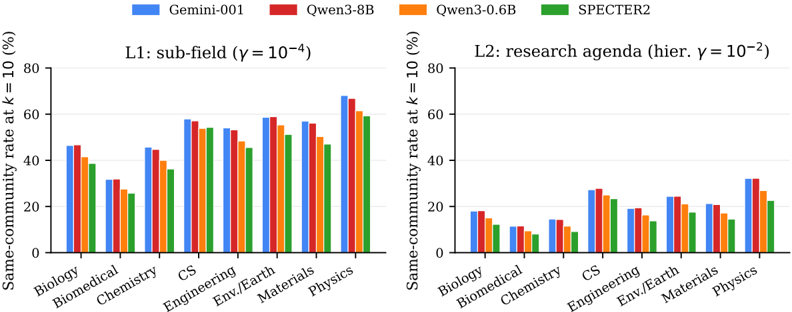
Vector search and retrieval-augmented generation (RAG) rest on the assumption that cosine similarity between text embeddings reflects conceptual relatedness. We measure where this assumption breaks. We build an augmented citation graph over 3.58M scientific papers and partition it via Leiden CPM at two granularities: sub-field (L1) and research-agenda (L2, hierarchical inside each L1). Four state-of-the-art embeddings (Gemini, Qwen3-8B, Qwen3-0.6B, SPECTER2) clear the L1 bar reasonably (45-52% top-10 same-rate) but stop working at L2: only 15-21% of top-10 neighbors share the query's research agenda. In absolute terms, 8 of every 10 retrieved papers are off-agenda. The failure is universal across eight scientific domains and all four models; SPECTER2, despite its citation-based contrastive training, is the weakest. As a diagnostic probe, we test whether the same augmented graph also functions as a retrieval signal: a deliberately simple citation-count rerank reaches 57.7% top-1 L2 on top of LLM-expanded Boolean retrieval and 59.6% on top of plain BM25, on 80 curated agenda queries -- about 9 points above the best cosine retriever (Gemini, 50.6%) and 20 points above BM25 alone (39.3%). The probe isolates a slice of the agenda-matching signal the graph carries but the embeddings miss, connecting recent theoretical limits on single-vector retrieval to a concrete failure mode of scientific RAG.
Overview
CoChat Summary
TL;DR
This paper audits whether cosine similarity between text embeddings tracks citation-community structure at sub-field versus research-agenda granularity. It finds embeddings clear the sub-field bar but fail at the agenda level, while a simple citation-count rerank recovers part of the missing signal.
Key findings
- On 1.6M papers, four embeddings place 45–52% of top-10 neighbors in the same L1 sub-field but only 15–21% in the same L2 research agenda; 8 of every 10 retrieved papers are off-agenda. Gemini reaches 21.0% L2 and SPECTER2 15.2%; at L1 Gemini reaches 52.4% and SPECTER2 44.7%.
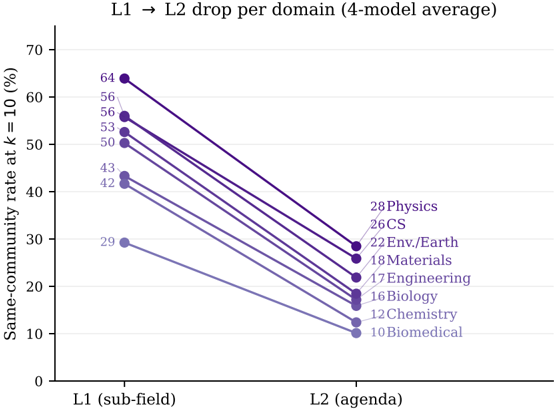
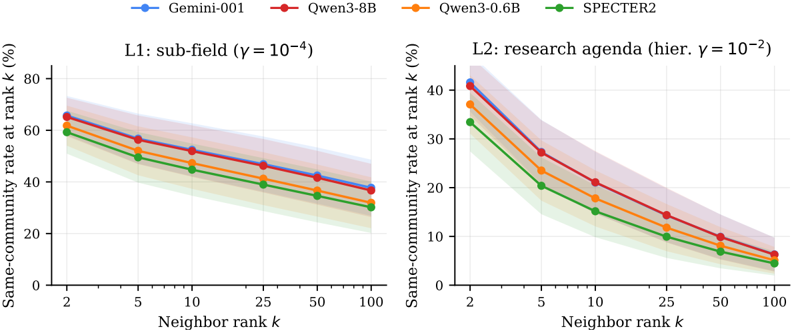
- The L1→L2 drop is 19–35 percentage points per domain and holds across all eight domains and four models. At k=2, L2 same-rate is only 36–44%; at k=100 it falls to 5–9%.
- Model ordering is stable: Gemini ≈ Qwen3-8B > Qwen3-0.6B > SPECTER2. Scaling Qwen3 from 0.6B to 8B lifts L2 by only 3–5 percentage points, and SPECTER2 is weakest despite citation-based contrastive training.
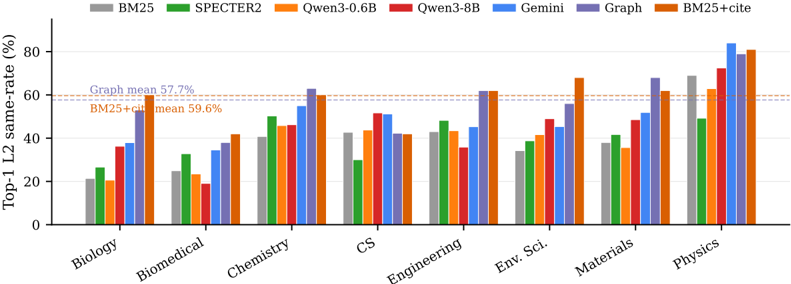
- On 80 curated agenda queries, citation-count rerank reaches 57.7% top-1 L2 (Graph) and 59.6% (BM25+cite), versus 50.6% for the best cosine retriever (Gemini) and 39.3% for BM25 alone; RRF baselines reach only 47.9–55.3%.
Methods
- Built an augmented citation graph over 3.58M papers (153.18M edges) from OpenAlex, PubMed, Semantic Scholar, and publisher websites, combining direct citation, bibliographic coupling, and co-citation. Leiden CPM partitions it into 73,477 L1 sub-field communities and 328,738 hierarchical L2 research-agenda communities.
- Evaluated four embeddings (Gemini, Qwen3-8B, Qwen3-0.6B, SPECTER2) on a standardized 1.6M-paper pool (200K per domain across eight domains), retrieving top-100 cosine neighbors via FAISS and measuring same-community rates at k ∈ {2, 5, 10, 25, 50, 100}.
- Ran a diagnostic retrieval probe on 80 curated agenda queries (10 per domain), comparing BM25, four cosine retrievers, a Graph retriever (LLM-expanded Boolean queries + citation rerank), a BM25+cite variant, and RRF baselines, using top-1 L2 same-rate as the metric.
Limitations
- Paper-stated: citation communities are a proxy for research-agenda structure, and the hard partition slightly over-counts disagreement for cross-agenda papers; the Graph retriever’s query expander and relevance judge are both gemini-flash-lite 2.5, from the same model family as Gemini Embedding, though BM25+cite removes the LLM candidate-stage confound and reproduces the gain; query selection kept agendas with the largest Boolean-search result sets, biasing toward well-populated agendas; the measurement covers scientific literature only; and the citation-graph rerank is a deliberately simple diagnostic probe, not a proposed learned method.
- Text-evident: L2 communities are often small (non-singleton mean size 19, maximum 1,712; 51.2% of papers sit in L2 communities of 10–99 papers), so the same-community metric may be sensitive to partition granularity; manual validation covers only 16 representative queries; and a fully non-Gemini Graph configuration is left to future work.
Model-written summary. Check it against the paper before relying on it.
Integrity signals
Registry
Cites
Statistics
Figures
Verification
Claims the paper makes
0 Valid · 3 Not valid · 10 Not checked · 107 Own results and interpretations
A result the paper reports from its own data — it cites no other source for it, so there is none to check. The quote shows it is in the paper.
In the paper
“a trivial citation-count rerank reaches 57.7%-59.6%top-1 L2, isolating the missed signal”
§ Topic Is Not Agenda: A Citation-Community Audit of Text Embeddings > 6 Conclusion
plainstates a cause- Asserted: passes — The authors put it forward as true.
- Checkable: passes — It can be checked against evidence.
- Load-bearing: passes — The paper’s conclusions depend on it.
- Based: passes — The paper gives a reason why it holds.
A result the paper reports from its own data — it cites no other source for it, so there is none to check. The quote shows it is in the paper.
In the paper
“The ordering holds in every (model, domain) cell with one exception: at L1 in Computer Science, SPECTER2 narrowly beats Qwen3-0.6B(54.3% vs. 53.8%).”
§ Topic Is Not Agenda: A Citation-Community Audit of Text Embeddings > 4.3 Model Ordering: SPECTER2 Is Weakest at Both Levels
plain- Asserted: passes — The authors put it forward as true.
- Checkable: passes — It can be checked against evidence.
- Load-bearing: passes — The paper’s conclusions depend on it.
- Based: passes — The paper gives a reason why it holds.
A result the paper states — it cites no source for it, so there is none to check. The quote shows it is in the paper.
In the paper
“the best retriever still misses 40% of top-1 agendas”
§ Topic Is Not Agenda: A Citation-Community Audit of Text Embeddings > 4.6 A Diagnostic Probe: Citation-Graph Rerank Recovers the Missing Signal
plain- Asserted: passes — The authors put it forward as true.
- Checkable: passes — It can be checked against evidence.
- Load-bearing: passes — The paper’s conclusions depend on it.
- Based: passes — The paper gives a reason why it holds.
A result the paper reports from its own data — it cites no other source for it, so there is none to check. The quote shows it is in the paper.
In the paper
“Without citation rerank (BM25 lexical retrieval, four cosine models): top-1 L2 hovers at 39-51%.”
§ Topic Is Not Agenda: A Citation-Community Audit of Text Embeddings > I Curated Research-Agenda Queries
plain- Asserted: passes — The authors put it forward as true.
- Checkable: passes — It can be checked against evidence.
- Load-bearing: passes — The paper’s conclusions depend on it.
- Based: passes — The paper gives a reason why it holds.
A result the paper reports from its own data — it cites no other source for it, so there is none to check. The quote shows it is in the paper.
In the paper
“Citation-rerank wins five of the six domains where the embedding cannot rely on named-subfield surface vocabulary (Biology, Biomedical, Chemistry, Engineering, Env.Sci., Materials), with margins of 3.5-16 pp.”
§ Topic Is Not Agenda: A Citation-Community Audit of Text Embeddings > 4.6 A Diagnostic Probe: Citation-Graph Rerank Recovers the Missing Signal
plainstates an association- Asserted: passes — The authors put it forward as true.
- Checkable: passes — It can be checked against evidence.
- Load-bearing: passes — The paper’s conclusions depend on it.
- Based: passes — The paper gives a reason why it holds.
54 more claims
Create a free account to see all 120 claims and to verify the 13 references still open.
- It may state two separate claims as one. 49
- Borderline: one of the tests for a substantial claim is unclear. 1
- Probably not a substantial claim. 15
- The quote only partly states this claim. 1
Self-check
Percentages, sums and reported differences re-computed from the paper’s own numbers.
Each contradiction between two passages listed here was confirmed by an independent check.
Rated major: it would touch a result — a value a result rests on, reported and recomputed p-values on opposite sides of the significance level, two passages that conflict with no sign which is right, or a cited work retracted before this paper was published.
In the paper
§ Topic Is Not Agenda: A Citation-Community Audit of Text Embeddings > 4.6 A Diagnostic Probe: Citation-Graph Rerank Recovers the Missing Signal
“For each query and retriever we report top-1 L2 same-rate: the fraction of queries whose rank-1 retrieved paper shares an L2 community with at least one representative paper of the agenda.”
§ Topic Is Not Agenda: A Citation-Community Audit of Text Embeddings > I Curated Research-Agenda Queries
“| | Biology | | 21.4 | 26.6 | | 20.6 | 36.3 | 37.9 | 53.0 | 60.0 |”
Rated major: it would touch a result — a value a result rests on, reported and recomputed p-values on opposite sides of the significance level, two passages that conflict with no sign which is right, or a cited work retracted before this paper was published.
In the paper
§ Topic Is Not Agenda: A Citation-Community Audit of Text Embeddings > 3.4 Hierarchical Neighbor Analysis
“Let nn k (p) be the k-th neighbor and c ℓ (•) the community label at level ℓ ∈ {L1, L2}.Our primary observable is the rank-k same-community rate s”
§ Topic Is Not Agenda: A Citation-Community Audit of Text Embeddings > Abstract
“In absolute terms, 8 of every 10 retrieved papers are off-agenda.”
Rated minor: it would not touch a result — a value no result rests on, a p-value that stays on the same side of the significance level, or a conflict that is clerical, resolved elsewhere in the paper, or outside its own findings.
In the paper
§ Topic Is Not Agenda: A Citation-Community Audit of Text Embeddings > Retriever pipeline.
“BM25 lexical retrieval (default rank_bm25 parameters, top-10 over title + abstract)”
§ Topic Is Not Agenda: A Citation-Community Audit of Text Embeddings > G Compute Resources
“BM25 indexing on 4M paper title + abstract via the bm25s library: ∼ 5 min total.”
Citations
Cites
Fast unfolding of communities in large networks
Blondel, V. D., Guillaume, J.-L., Lambiotte, R., & Lefebvre, E. (2008) · Journal of Statistical Mechanics: Theory and Experiment · doi:10.1088/1742-5468/2008/10/p10008 · Cited by 21,424
From Louvain to Leiden: guaranteeing well-connected communities
Traag, V. A., Waltman, L., & van Eck, N. J. (2019) · Scientific Reports · doi:10.1038/s41598-019-41695-z · Cited by 5,635
Co‐citation in the scientific literature: A new measure of the relationship between two documents
Small, H. (1973) · Journal of the American Society for Information Science · doi:10.1002/asi.4630240406 · Cited by 5,345
Billion-scale similarity search with GPUs
Johnson, J., Douze, M., & Jegou, H. (2021) · IEEE Transactions on Big Data · doi:10.1109/tbdata.2019.2921572 · Cited by 4,228
Dense passage retrieval for open-domain question answering
Karpukhin, V., Oguz, B., Min, S., Lewis, P., Wu, L., Edunov, S., Chen, D., & Yih, W.-T. (2020) · Proceedings of the 2020 Conference on Empirical Methods in Natural Language Processing (EMNLP) · doi:10.18653/v1/2020.emnlp-main.550 · Cited by 3,575
Bibliographic coupling between scientific papers
Kessler, M. M. (1963) · American Documentation · doi:10.1002/asi.5090140103 · Cited by 2,855
Qwen3 Embedding: Advancing Text Embedding and Reranking Through Foundation ModelsPreprint
Zhang, Y., Li, M., Long, D., Zhang, X., Lin, H., Yang, B., Xie, P., Yang, A., Liu, D., Lin, J., et al. (2025) · arXiv (Cornell University) · doi:10.48550/arxiv.2506.05176 · Cited by 2,388
SPECTER: Document-level Representation Learning using Citation-informed Transformers
Cohan, A., Feldman, S., Beltagy, I., Downey, D., & Weld, D. (2020) · Proceedings of the 58th Annual Meeting of the Association for Computational Linguistics · doi:10.18653/v1/2020.acl-main.207 · Cited by 1,108
MTEB: Massive Text Embedding Benchmark
Muennighoff, N., Tazi, N., Magne, L., & Reimers, N. (2023) · Proceedings of the 17th Conference of the European Chapter of the Association for Computational Linguistics · doi:10.18653/v1/2023.eacl-main.148 · Cited by 548
Precise Zero-Shot Dense Retrieval without Relevance Labels
Gao, L., Ma, X., Lin, J., & Callan, J. (2022) · arXiv · doi:10.48550/arxiv.2212.10496 · Cited by 362
Precise Zero-Shot Dense Retrieval without Relevance Labels
Gao, L., Ma, X., Lin, J., & Callan, J. (2023) · Proceedings of the 61st Annual Meeting of the Association for Computational Linguistics (Volume 1: Long Papers) · doi:10.18653/v1/2023.acl-long.99 · Cited by 362
SciRepEval: A Multi-Format Benchmark for Scientific Document Representations
Singh, A., D’Arcy, M., Cohan, A., Downey, D., & Feldman, S. (2023) · Proceedings of the 2023 Conference on Empirical Methods in Natural Language Processing · doi:10.18653/v1/2023.emnlp-main.338 · Cited by 321
Gemini Embedding: Generalizable Embeddings from GeminiPreprint
Lee, J., Chen, F., Dua, S., Cer, D. M., Shanbhogue, M., Naim, I., Ábrego, G. H., Li, Z., Chen, K., Vera, H. S., et al. (2025) · arXiv (Cornell University) · doi:10.48550/arxiv.2503.07891 · Cited by 248
From local to global: a graph rag approach to query-focused summarization
Edge, D., Trinh, H., Cheng, N., Bradley, J., Chao, A., Mody, A., Truitt, S., Metropolitansky, D., Ness, R. O., & Larson, J. (2024) · arXiv · doi:10.48550/arxiv.2404.16130 · Cited by 159
Is Cosine-Similarity of Embeddings Really About Similarity?
Steck, H., Ekanadham, C., & Kallus, N. (2024) · Companion Proceedings of the ACM Web Conference 2024 · doi:10.1145/3589335.3651526 · Cited by 137
SciRepEval: A Multi-Format Benchmark for Scientific Document Representations
Singh, A., D'Arcy, M., Cohan, A., Downey, D., & Feldman, S. (2022) · arXiv · doi:10.48550/arxiv.2211.13308 · Cited by 76 · cited 2×
“Within scientific embeddings, SPECTER [Cohan et al., 2020], SPECTER2 [Singh et al., 2023], and SciNCL [Osten-dorff et al., 2022] use direct citations as a contrastive training signal; one of our findings is that this training does not transfer to cosine neighborhoods that match a well-constructed…”
Neighborhood Contrastive Learning for Scientific Document Representations with Citation Embeddings
Ostendorff, M., Rethmeier, N., Augenstein, I., Gipp, B., & Rehm, G. (2022) · Proceedings of the 2022 Conference on Empirical Methods in Natural Language Processing · doi:10.18653/v1/2022.emnlp-main.802 · Cited by 56
On the Theoretical Limitations of Embedding-Based Retrieval
Weller, O., Boratko, M., Naim, I., & Lee, J. (2025) · arXiv · doi:10.48550/arxiv.2508.21038
Cited by
Still being checked.
Metadata
- Authors
- Yoo, J.
- Corresponding author
- Yoo, Junseon
- Venue
- arXiv
- Publisher
- arXiv
- Published
- 2026
- ISSN
- 2331-8422 (ISSN-L)
- arXiv
- 2605.07158
- OpenAlex
- W7160879074
- Cited by
- 0
- References
- 15
- Type
- posted content
- Language
- en
- Open access
- green
- arxiv.org
- Licence
- Locations
- arXiv (Cornell University) (submittedVersion, cc-by)
- arXiv (Cornell University) (cc-by)
- Topics
- Physical Sciences › Computer Science › Artificial Intelligence › Topic Modeling
- Physical Sciences › Computer Science › Information Systems › Information Retrieval and Search Behavior
- Physical Sciences › Computer Science › Information Systems › Recommender Systems and Techniques
- Keywords
- text embeddings, cosine similarity, research agenda, citation networks, retrieval-augmented generation, vector search, conceptual relatedness, BM25, scientific information retrieval
About these checks
Registry, retraction, Cites and statistics results are computed, not judged, with one exception: a printed reference that no index lists is read once by a model before it counts as a citation error. Claims are extracted by a model and kept only when their quote appears verbatim in the text; each cited source is then checked, with a model’s help, for whether it says what the claim relies on. Those verdicts can be wrong — read the claim’s quote and the cited source before relying on one.
A language model drew the claims from the paper on 2026-11-23, under version 3 of the claim definition (model deepseek-v4.1-flash, prompt extract-v3).
A second model labelled each claim on 2026-11-23 (model jev-1.13-20260917, definition revision gold-guideline-v0.2).
Statistics and arithmetic are recomputed, not judged.
Confidence bands are shown only for fields calibrated on our annotated test set. None is calibrated yet, so no band is shown.
What counts as a claim ›How we measure confidence ›How we check this ›
Are you an author, or do you see a problem with this page? Request a review
Data sources
Bibliographic data: Semantic Scholar, OpenAlex, Crossref.
Contains information from the Semantic Scholar Academic Graph Datasets, made available under the ODC Attribution License (ODC-BY 1.0).
Semantic Scholar’s data is described in: Kinney, R., et al. (2023). The Semantic Scholar Open Data Platform. arXiv:2301.10140.
