

Latency, Speech Recognition and Turn-Taking in Voice Agents for Spanish Phone Negotiation: An Externally Measured Comparison of Pipecat, LiveKit and GPT-Live
Open accessThe DOI matches its DataCite record; 27 of the 27 references it cites were found in a registry or an index; none of the 22 sources its claims cite is checked for support yet.
Abstract
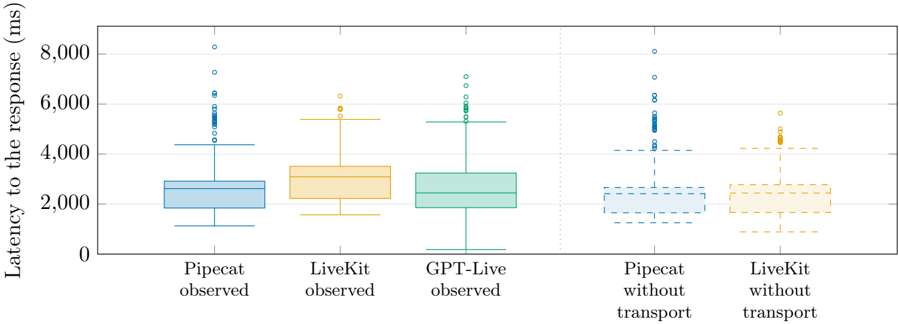
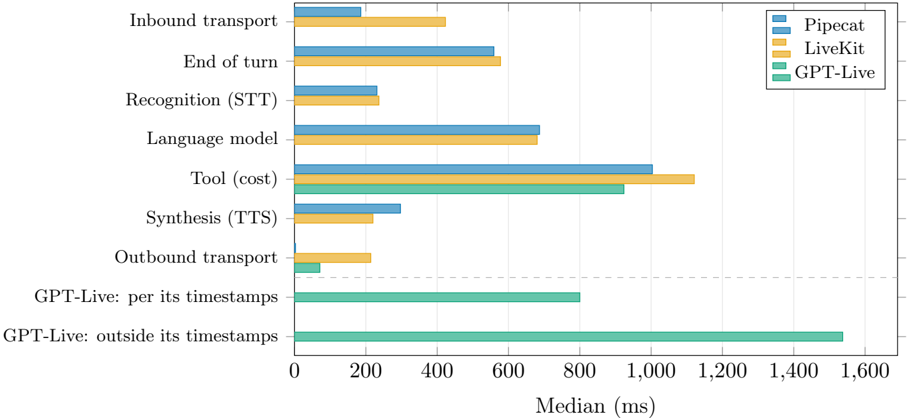
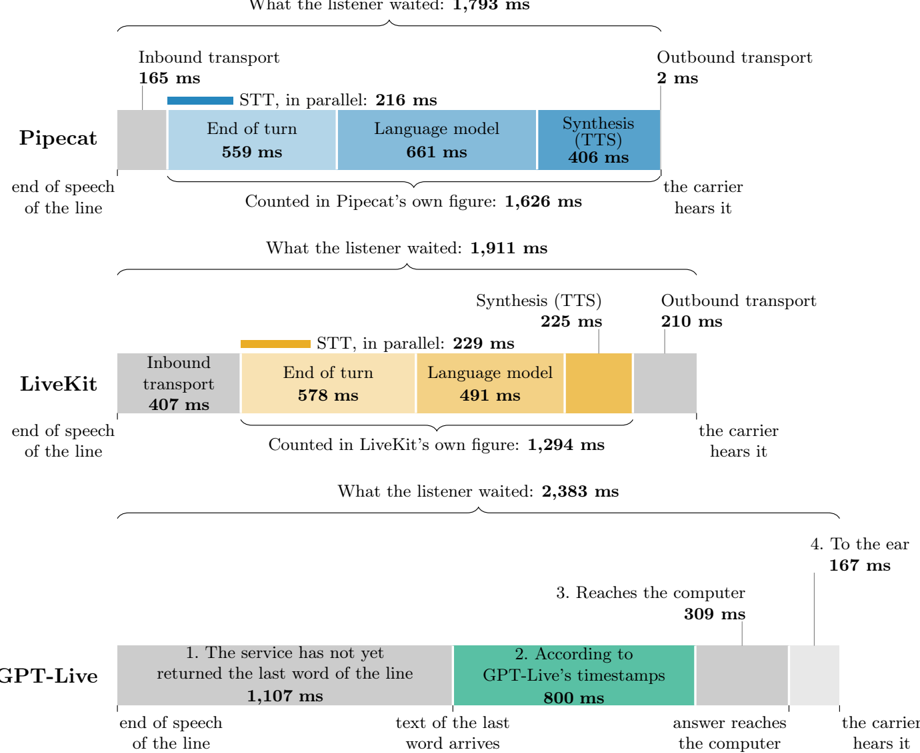
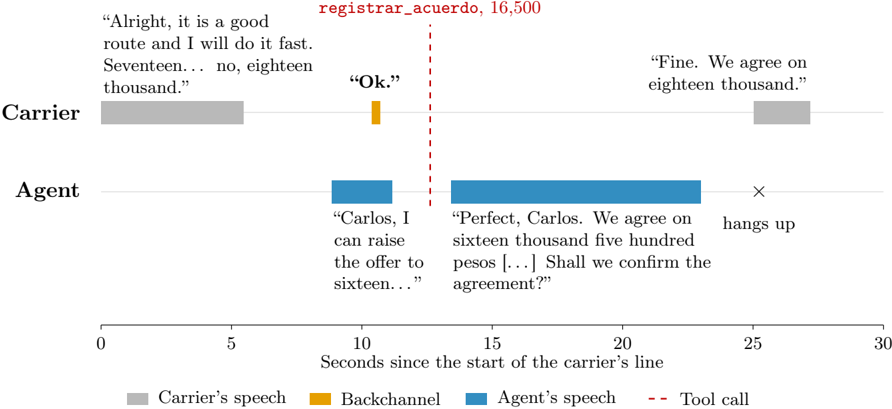
A voice agent that negotiates by phone must answer quickly, understand spoken amounts and cope with a caller who talks over it. We compared three architectures for such an agent, negotiating freight rates in Spanish: two cascades (speech recognition, language model and speech synthesis) orchestrated by Pipecat and by LiveKit Agents, and GPT-Live, an OpenAI speech model that listens and speaks without separate stages. A program played the carrier with the same 47 recordings of one speaker for all agents, without the telephone network, in 77 calls per architecture over five negotiation scenarios, and measured latency on the listener's side with a validated instrument. Median latency to the content response was 2,616.0 ms (Pipecat), 3,090.0 ms (LiveKit) and 2,444.8 ms (GPT-Live); the confidence interval of GPT-Live's 171.2 ms advantage over Pipecat includes zero. According to its own timestamps, GPT-Live began to answer 800 ms after the end of the line, close to the 0.8 s published by OpenAI; most of the remaining wait, about 1,367 ms and nearly constant, is the audio's round trip through OpenAI's service. A tool call added 0.9-1.1 s in every architecture, more than any difference between them, and the frameworks' self-reported latency fell short of the listener's wait by 9% (Pipecat) and 22% (LiveKit). Word error rates were low (6.03, 4.93 and 1.47%), but the error on amounts was 13.01% and 12.61% in the cascades, against 2.86% in GPT-Live. With default settings, Pipecat and LiveKit stopped at almost every backchannel and often took it as the carrier's answer: an "ok" spoken over the agent ended in a registered agreement in 3 of 15 Pipecat calls, 2 of 15 LiveKit calls and no GPT-Live call (descriptive counts, not tested). Latency should therefore be measured on the listener's side, and a cascade needs safeguards for spoken amounts and backchannels.
Overview
CoChat Summary
TL;DR
This paper externally compares Pipecat, LiveKit Agents, and GPT-Live voice architectures for Spanish phone negotiation, using the same recorded carrier lines and listener-side latency measurement. It finds the architectures differed less in latency than in handling spoken amounts and backchannels, and that framework-reported latency hid transport costs.
Key findings
- Median latency to the content response was 2,616.0 ms for Pipecat, 3,090.0 ms for LiveKit, and 2,444.8 ms for GPT-Live; GPT-Live’s 171.2 ms advantage over Pipecat had a 95% CI including zero, while LiveKit was 474.0 ms behind Pipecat and 645.2 ms behind GPT-Live, mostly from transport. A tool call added 0.9–1.1 s in every architecture, more than any difference between them; Pipecat and LiveKit self-reported latency fell short of the listener’s wait by 9% and 22%.
- Word error rates were low (6.03% Pipecat, 4.93% LiveKit, 1.47% GPT-Live), but error on amounts was 13.01% and 12.61% in the cascades versus 2.86% in GPT-Live. On a self-correction from 18,000 to 18,500, Pipecat understood 18,000 in 7 of 8 responses showing the amount, LiveKit in 4 of 4, and GPT-Live understood 18,500 in 7 of 7.
- With default settings, Pipecat and LiveKit stopped at almost every backchannel (26/28 and 21/22) and often treated it as the carrier’s answer; an “ok” spoken over the agent ended in a registered agreement in 3 of 15 Pipecat calls, 2 of 15 LiveKit calls, and no GPT-Live call. Agreements were registered without carrier acceptance in 5 of 12 Pipecat agreements, 7 of 13 LiveKit agreements, and 1 of 10 GPT-Live agreements.
- All three stopped and answered a real interruption; Pipecat stopped fastest (median 344 ms), then LiveKit (878 ms), then GPT-Live (1,242 ms). GPT-Live began to answer 800 ms after the end of the line according to its own timestamps, close to OpenAI’s published 0.8 s, but about 1,367 ms of the wait was the audio’s round trip through OpenAI’s service and was nearly constant.
Methods
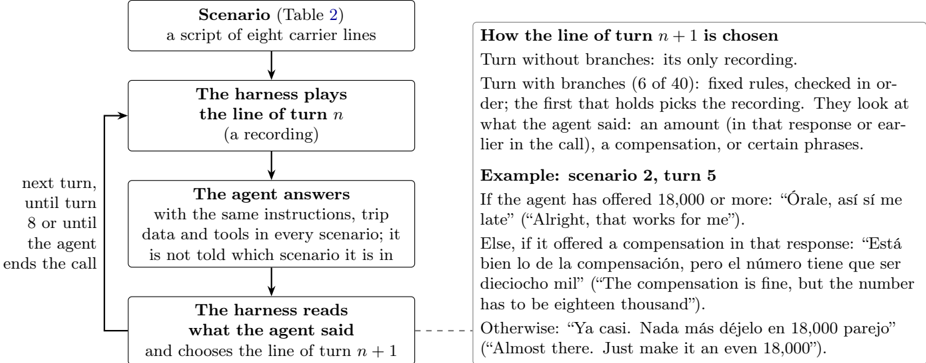
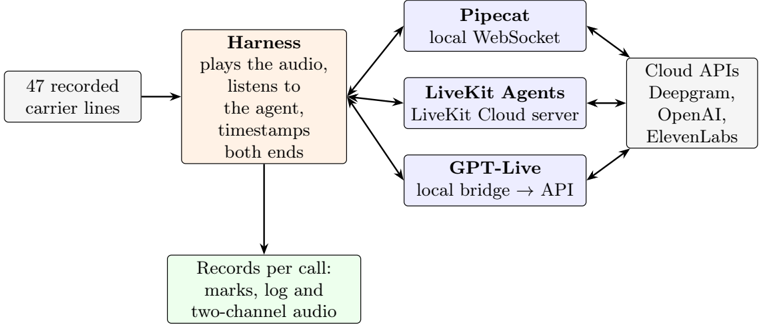
- The study compared three architectures under identical conditions: Pipecat and LiveKit cascades using Deepgram nova-3 and ElevenLabs, and GPT-Live as a native speech model with tool calls delegated to gpt-4.1-mini. A harness played 47 recorded carrier lines from one speaker, processed to 8 kHz µ-law telephone format with added noise, across five negotiation scenarios of eight turns each; after exclusions, 77 calls per architecture remained, with 558 measured responses in Pipecat, 536 in LiveKit, and 563 in GPT-Live.
- Latency was measured externally on the listener’s side with a validated harness, checked against a simulated agent with known delay over each architecture’s audio path. The main measure was latency to the content response, with latency to first sound also reported; observed latency was decomposed into inbound transport, framework processing, and outbound transport, and tool-call cost was estimated as the median difference between responses with and without a tool.
- Speech recognition was evaluated by WER and error on amounts computed per call, with amounts extracted and normalized; comprehension of one self-corrected amount was classified blind by one rater. Turn-taking was tested in a separate interruption scenario with interruption, backchannel, and control events, using each framework’s default settings; statistical analysis used medians, bootstrap 95% CIs resampling whole calls, a pre-set 200 ms margin, and rank tests with Bonferroni correction.
Limitations
- The paper states six main limitations: the carrier was simulated with one recorded speaker and no telephone network; GPT-Live ran 18 days later on a different day and model version; not all architectures heard the same mix of lines because of branches and closing points; the harness did not hear GPT-Live as a telephone would; a single rater classified resumptions and understood amounts, with comprehension resting on one script line and 13 calls per architecture; and each framework ran only with its default configuration and only in Spanish.
- The text also makes evident that several comparisons are descriptive and untested, including the backchannel agreement counts, and that uncontrolled differences remain: transport paths differed (Pipecat local, LiveKit Cloud, GPT-Live API), voice activity detector silence thresholds differed (0.2 s Pipecat, 0.55 s LiveKit, unknown GPT-Live), Deepgram defaults were not equalized, tool/filler behavior differed, and GPT-Live’s inbound transport could not be measured.
Model-written summary. Check it against the paper before relying on it.
Integrity signals
Registry
Cites
Statistics
Figures
Verification
Claims the paper makes
0 Valid · 1 Not valid · 16 Not checked · 147 Own results and interpretations
A result the paper reports from its own data — it cites no other source for it, so there is none to check. The quote shows it is in the paper.
In the paper
“Without transport, Pipecat and LiveKit are equivalent in practice (-25.2 ms).”
§ Latency, Speech Recognition and Turn-Taking in Voice Agents for Spanish Phone Negotiation: An Externally Measured Comparison of Pipecat, LiveKit and GPT-Live > 3.1 Response latency
plain- Asserted: passes — The authors put it forward as true.
- Checkable: passes — It can be checked against evidence.
- Load-bearing: passes — The paper’s conclusions depend on it.
- Based: passes — The paper gives a reason why it holds.
A result the paper reports from its own data — it cites no other source for it, so there is none to check. The quote shows it is in the paper.
In the paper
“Faced with a backchannel, Pipecat and LiveKit almost always stopped: with their default settings they treated the”
§ Latency, Speech Recognition and Turn-Taking in Voice Agents for Spanish Phone Negotiation: An Externally Measured Comparison of Pipecat, LiveKit and GPT-Live > 3.8 Interruptions and backchannels
plainstates a cause- Asserted: passes — The authors put it forward as true.
- Checkable: passes — It can be checked against evidence.
- Load-bearing: passes — The paper’s conclusions depend on it.
- Based: passes — The paper gives a reason why it holds.
A result the paper reports from its own data — it cites no other source for it, so there is none to check. The quote shows it is in the paper.
In the paper
“On the Pipecat path, which does not depend on any external service, the largest error in any turn was 86.4 ms, well below the 200 ms margin used to judge differences”
§ Latency, Speech Recognition and Turn-Taking in Voice Agents for Spanish Phone Negotiation: An Externally Measured Comparison of Pipecat, LiveKit and GPT-Live > 2.5 Harness validation
plain- Asserted: passes — The authors put it forward as true.
- Checkable: passes — It can be checked against evidence.
- Load-bearing: passes — The paper’s conclusions depend on it.
- Based: passes — The paper gives a reason why it holds.
A result the paper reports from its own data — it cites no other source for it, so there is none to check. The quote shows it is in the paper.
In the paper
“GPT-Live had the lowest WER in all five scenarios.”
§ Latency, Speech Recognition and Turn-Taking in Voice Agents for Spanish Phone Negotiation: An Externally Measured Comparison of Pipecat, LiveKit and GPT-Live > 3.6 Speech recognition
plain- Asserted: passes — The authors put it forward as true.
- Checkable: passes — It can be checked against evidence.
- Load-bearing: passes — The paper’s conclusions depend on it.
- Based: passes — The paper gives a reason why it holds.
A result the paper reports from its own data — it cites no other source for it, so there is none to check. The quote shows it is in the paper.
In the paper
“the confidence interval of GPT-Live's 171.2 ms advantage over Pipecat includes zero”
§ Latency, Speech Recognition and Turn-Taking in Voice Agents for Spanish Phone Negotiation: An Externally Measured Comparison of Pipecat, LiveKit and GPT-Live > Abstract
plain- Asserted: passes — The authors put it forward as true.
- Checkable: passes — It can be checked against evidence.
- Load-bearing: passes — The paper’s conclusions depend on it.
- Based: passes — The paper gives a reason why it holds.
38 more claims
Create a free account to see all 164 claims and every source verdict.
- Probably not a substantial claim. 40
- It may state two separate claims as one. 106
- The quote only partly states this claim. 3
Citations
Cites
An Introduction to the Bootstrap
Efron, B., & Tibshirani, R. J. (1994) · doi:10.1201/9780429246593 · Cited by 40,500
An Introduction to the Bootstrap
Efron, B., & Tibshirani, R. J. (1993) · doi:10.1007/978-1-4899-4541-9 · Cited by 21,230
Individual Comparisons by Ranking Methods
Wilcoxon, F. (1945) · Biometrics Bulletin · doi:10.2307/3001968 · Cited by 15,354
Use of Ranks in One-Criterion Variance Analysis
Kruskal, W. H., & Wallis, W. A. (1952) · Journal of the American Statistical Association · doi:10.1080/01621459.1952.10483441 · Cited by 13,912
Multiple comparisons among means
Dunn, O. J. (1961) · Journal of the American Statistical Association · doi:10.1080/01621459.1961.10482090 · Cited by 5,006
Universals and cultural variation in turn-taking in conversation
Stivers, T., Enfield, N. J., Brown, P., Englert, C., Hayashi, M., Heinemann, T., Hoymann, G., Rossano, F., de Ruiter, J. P., Yoon, K.-E., et al. (2009) · Proceedings of the National Academy of Sciences · doi:10.1073/pnas.0903616106 · Cited by 1,533
Sample Quantiles in Statistical Packages
Hyndman, R. J., & Fan, Y. (1996) · The American Statistician · doi:10.1080/00031305.1996.10473566 · Cited by 1,183
Moshi: a speech-text foundation model for real-time dialogue
Défossez, A., Mazaré, L., Orsini, M., Royer, A., Pérez, P., Jégou, H., Grave, E., & Zeghidour, N. (2024) · arXiv · doi:10.48550/arxiv.2410.00037 · Cited by 1,027
Timing in turn-taking and its implications for processing models of language
Levinson, S. C., & Torreira, F. (2015) · Frontiers in Psychology · doi:10.3389/fpsyg.2015.00731 · Cited by 686
Pauses, gaps and overlaps in conversations
Heldner, M., & Edlund, J. (2010) · Journal of Phonetics · doi:10.1016/j.wocn.2010.08.002 · Cited by 575
Research works printed but not linked: 1
- Yngve, V.H.: On getting a word in edgewise. In: Papers from the Sixth Regional Meeting of the Chicago Linguistic Society, pp. 567-578. Chicago Linguistic Society, Chicago (1970)
Cited by
Still being checked.
Metadata
- Authors
- Moran, J. P., de Avila-Armenta, E., Aquino-Ibarra, R. A., Nicolás-Díaz, J. O., & Leon-Dominguez, U.
- Venue
- arXiv
- Publisher
- arXiv
- Published
- 2026
- ISSN
- 2331-8422 (ISSN-L)
- arXiv
- 2611.19118
- OpenAlex
- W7235265433
- Semantic Scholar
- ef83dcd5ff9ccad42e9b14b23c1699e3708b8534
- Cited by
- 0
- References
- 25
- Type
- posted content
- Language
- en
- Open access
- green
- arxiv.org
- Licence
- Locations
- arXiv (Cornell University) (submittedVersion, cc-by)
- arXiv (Cornell University) (cc-by)
- Topics
- Physical Sciences › Computer Science › Artificial Intelligence › Speech and dialogue systems
- Physical Sciences › Computer Science › Artificial Intelligence › Speech Recognition and Synthesis
- Social Sciences › Business, Management and Accounting › Marketing › AI in Service Interactions
- Keywords
- voice assistants, turn-taking, backchannels, word error rate, Spanish speech
About these checks
Registry, retraction, Cites and statistics results are computed, not judged, with one exception: a printed reference that no index lists is read once by a model before it counts as a citation error. Claims are extracted by a model and kept only when their quote appears verbatim in the text; each cited source is then checked, with a model’s help, for whether it says what the claim relies on. Those verdicts can be wrong — read the claim’s quote and the cited source before relying on one.
A language model drew the claims from the paper on 2026-11-22, under version 3 of the claim definition (model deepseek-v4.1-flash, prompt extract-v3).
A second model labelled each claim on 2026-11-22 (model jev-1.13-20260917, definition revision gold-guideline-v0.2).
Statistics and arithmetic are recomputed, not judged.
Confidence bands are shown only for fields calibrated on our annotated test set. None is calibrated yet, so no band is shown.
What counts as a claim ›How we measure confidence ›How we check this ›
Are you an author, or do you see a problem with this page? Request a review
How to cite
Cite CoChat for the checks on this page, and the paper for its own findings.
- This page
- CoChat. (2026). Citation check: Latency, Speech Recognition and Turn-Taking in Voice Agents for Spanish Phone Negotiation: An Externally Measured Comparison of Pipecat, LiveKit and GPT-Live. https://app.cochat.ai/papers/10.48550/arxiv.2611.19118
- The paper
- Moran, J. P., de Avila-Armenta, E., Aquino-Ibarra, R. A., Nicolás-Díaz, J. O., & Leon-Dominguez, U. (2026). Latency, Speech Recognition and Turn-Taking in Voice Agents for Spanish Phone Negotiation: An Externally Measured Comparison of Pipecat, LiveKit and GPT-Live. arXiv. https://doi.org/10.48550/arxiv.2611.19118
Data sources
Bibliographic data: Semantic Scholar, OpenAlex, Crossref.
Contains information from the Semantic Scholar Academic Graph Datasets, made available under the ODC Attribution License (ODC-BY 1.0).
Semantic Scholar’s data is described in: Kinney, R., et al. (2023). The Semantic Scholar Open Data Platform. arXiv:2301.10140.
