

High-Intensity Interval Training and Moderate-Intensity Continuous Training Affect Running Economy in Endurance Runners: A Systematic Review and Meta-Analysis of Randomized Controlled Trials
Open accessThe DOI matches its Crossref record; 111 of the 113 references it cites were found in a registry or an index; 14 of the 44 sources its claims cite were checked for support.
Abstract
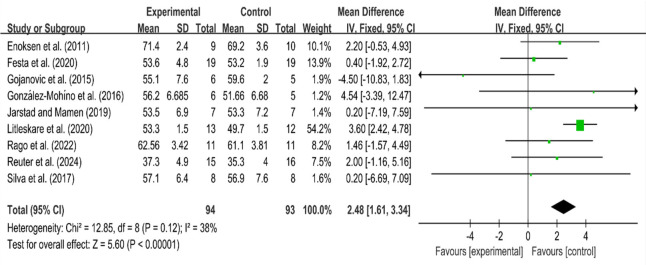
This systematic review evaluated the effects of high-intensity interval training (HIIT) and moderate-intensity continuous training (MICT) on running economy (RE) in endurance runners. The search was completed in March 2024 based on research databases, and the language of publication was restricted to English. The primary outcome measure was RE, and it was categorized into three subgroups: Zone 1 (Z1), Zone 2 (Z2), and Zone 3 (Z3). The secondary outcomes assessed were maximal oxygen uptake (VO2max) and blood lactate concentration. HIIT significantly improved RE compared to MICT (SMD = 0.44, 95% CI [0.15, 0.72], Z = 3.01, p < 0.05). MICT showed a greater effect on VO2max (MD = 2.48, 95% CI [1.61, 3.34], Z = 5.60, p < 0.05). HIIT was more effective at reducing blood lactate levels (MD = −0.15, 95% CI [−0.28, −0.02], Z = 2.20, p < 0.05). The results indicate that HIIT was more effective than MICT in enhancing RE and delaying lactate accumulation. HIIT can further improve RE and postpone blood lactate accumulation when performed at or below the lactate threshold (≤ Z2). VO2max was more pronounced with MICT. These findings suggest that endurance runners and coaches should choose appropriate methods to optimize physiological adaptations.
Overview
CoChat Summary
## TL;DR
This systematic review and meta-analysis of 9 randomized controlled trials found that HIIT improved running economy more than MICT in endurance runners, with the clearest benefit at intensities at or below the lactate threshold (Z2). MICT was more effective for improving VO2max, while HIIT reduced blood lactate more.
## Key findings
- Across 9 RCTs (168 participants: 110 males, 48 females), HIIT improved running economy versus MICT overall: SMD = 0.44, 95% CI [0.15, 0.72], Z = 3.01, p < 0.05.
- By intensity zone, HIIT improved running economy in Z1 (SMD = 0.40, 95% CI [0.04, 0.76], p < 0.05) and Z2 (SMD = 0.68, 95% CI [0.13, 1.24], p < 0.05), but not in Z3 (SMD = 0.14, 95% CI [−0.60, 0.88], p > 0.05).
- MICT produced greater VO2max gains than HIIT: MD = 2.48, 95% CI [1.61, 3.34], Z = 5.60, p < 0.05.
- HIIT reduced blood lactate more than MICT: MD = −0.15, 95% CI [−0.28, −0.02], Z = 2.20, p < 0.05.
## Methods
- Systematic review and meta-analysis registered in INPLASY (INPLASY2024110120) and conducted according to PRISMA; databases searched were PubMed, Embase, Scopus, and Web of Science from inception to March 2024, with English-language RCTs only.
- Included endurance runners in studies comparing interval training (HIIT) with continuous training (MICT), lasting at least 4 weeks, and reporting running economy or energy expenditure; secondary outcomes included VO2max and blood lactate.
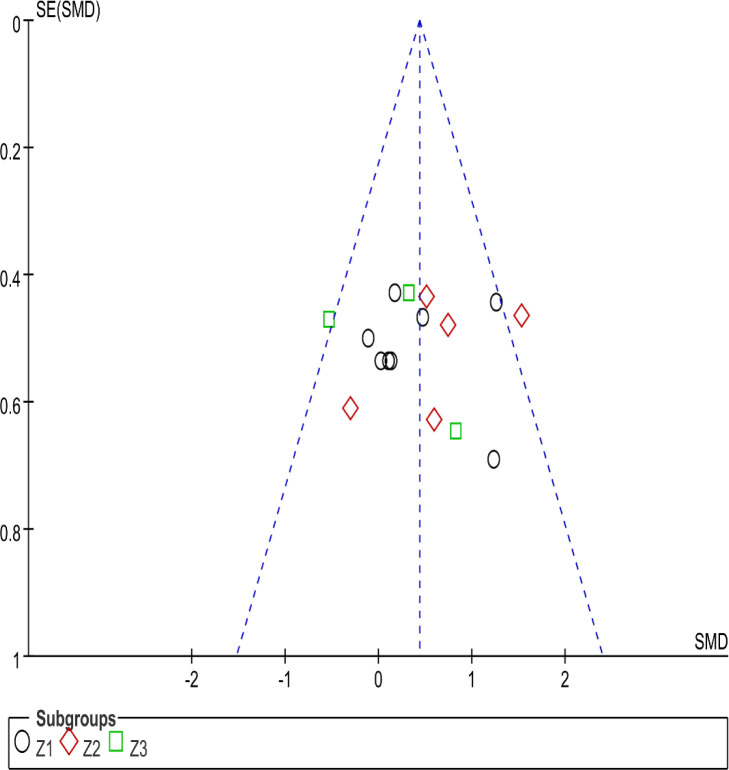
- Two reviewers screened studies, extracted data, and assessed risk of bias with the Cochrane tool; meta-analysis used RevMan 5.3.5, Hedges’ g/SMD for continuous outcomes, random-effects models when heterogeneity was significant, and subgroup/sensitivity analyses plus funnel plot/Egger’s test for publication bias.
## Limitations
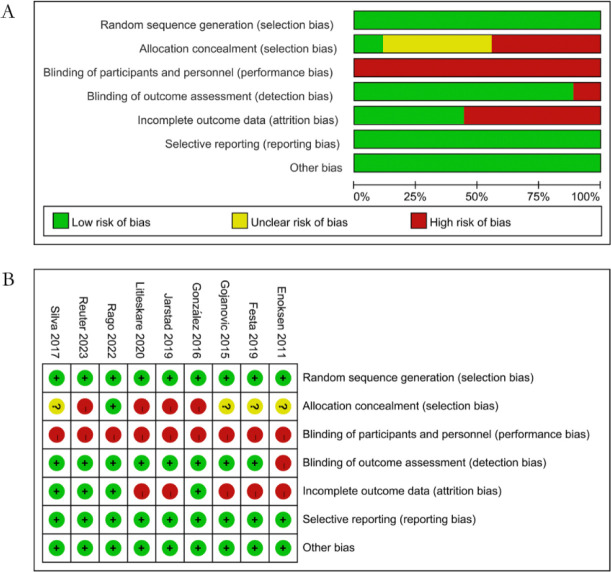
- The paper states that there was methodological and statistical heterogeneity, and some included studies had risk of bias due to methodological weaknesses such as lack of blinding.
- The paper states that measurement methods varied, and that subgroup analysis could not account for all individual-level moderators; it also notes unmeasured factors like environmental conditions, sleep, diet, and psychological stress.
- The paper states that the review was restricted to English-language studies and running, limiting generalizability; additionally, the text makes evident that only 9 RCTs were included, with some outcomes based on fewer studies, which limits precision and breadth of inference.
Model-written summary. Check it against the paper before relying on it.
Integrity signals
Registry
Cites
Statistics
Figures



Verification
Claims the paper makes
12 Valid · 1 Not valid · 17 Not checked · 50 Own results and interpretations
At least one cited source doesn’t support this claim or points to a different paper, and none confirmed it — see the verdicts below.
In the paper
“During a 12-month follow-up, MICT participants were more likely to complete training (Taylor et al., 2020).”
§ High-Intensity Interval Training and Moderate-Intensity Continuous Training Affect Running Economy in Endurance Runners: A Systematic Review and Meta-Analysis of Randomized Controlled Trials > Discussion
What the sources say
- Disputedcites Taylor et al., 2020 sourceExperimental — accuracy not yet measured
The Exercise Adherence section reports that over 12 months, adherence was 41% for MICT and 53% for HIIT, with no statistically significant difference (P = .35). It does not support the claim that MICT participants were more likely to complete training; the observed difference was in the opposite direction. (LLM, conf=0.91)
Checked by a reasoning model — may be wrong.
plainstates an association- Asserted: passes — The authors put it forward as true.
- Checkable: passes — It can be checked against evidence.
- Load-bearing: unclear — It is unclear whether the paper’s conclusions depend on it.
- Based: passes — The paper gives a reason why it holds.
- Disputed
The cited sources support only part of this claim — read each source’s verdict below.
In the paper
“The injury risk associated with different interval duration and intensities during HIIT may lead to musculoskeletal pain, especially at higher running speeds (Leite et al., 2023; Wiewelhove et al., 2016).”
§ High-Intensity Interval Training and Moderate-Intensity Continuous Training Affect Running Economy in Endurance Runners: A Systematic Review and Meta-Analysis of Randomized Controlled Trials > Discussion
What the sources say
- Supportedcites Leite et al., 2023 source
The Discussion reports that HIIT-related muscle damage depends on exercise intensity and duration, and that high-intensity protocols may lead to injury. It also reports greater muscle damage and pain with sprint protocols than with longer, submaximal intervals; the cited comparison concerns interval running protocols. This supports the claim’s qualified wording. (LLM, conf=0.84)
- Not matchedcites Wiewelhove et al., 2016
Couldn’t be matched to a paper in Crossref, so it can’t be checked.
hedgedstates a possible cause- Asserted: passes — The authors put it forward as true.
- Checkable: passes — It can be checked against evidence.
- Load-bearing: unclear — It is unclear whether the paper’s conclusions depend on it.
- Based: passes — The paper gives a reason why it holds.
- Supported
The cited sources support only part of this claim — read each source’s verdict below.
In the paper
“Additionally, it can lead to decreased adherence to training, particularly in unsupervised settings (Ekkekakis and Biddle, 2023; Santos et al., 2023).”
§ High-Intensity Interval Training and Moderate-Intensity Continuous Training Affect Running Economy in Endurance Runners: A Systematic Review and Meta-Analysis of Randomized Controlled Trials > Discussion
What the sources say
- Not checked — no full text of the sourcecites Ekkekakis and Biddle, 2023 source
- Partly supportedcites Santos et al., 2023 sourceExperimental — accuracy not yet measured
The Conclusions report 63% adherence to unsupervised HIIT, compared with 89% compliance in supervised HIIT. But these are different outcomes measured in different settings, not evidence that HIIT causes adherence to decrease; unsupervised HIIT adherence was also comparable to MICT, and the authors caution that the adherence evidence is very low quality. (LLM, conf=0.85)
plainstates a cause- Asserted: passes — The authors put it forward as true.
- Checkable: passes — It can be checked against evidence.
- Load-bearing: unclear — It is unclear whether the paper’s conclusions depend on it.
- Based: passes — The paper gives a reason why it holds.
The cited sources support only part of this claim — read each source’s verdict below.
In the paper
“HIIT for recreational runners may increase their risk of muscle injuries (Leite et al., 2023; Nuuttila et al., 2022).”
§ High-Intensity Interval Training and Moderate-Intensity Continuous Training Affect Running Economy in Endurance Runners: A Systematic Review and Meta-Analysis of Randomized Controlled Trials > Discussion
What the sources say
- Partly supportedcites Leite et al., 2023 sourceExperimental — accuracy not yet measured
The Discussion (p. not provided) says high-intensity HIIT protocols may compromise muscle fibers and lead to injuries, and the Results include running-based HIIT studies. The review does not establish an increased injury risk specifically for recreational runners; it primarily examines markers of muscle damage after a single session. (LLM, conf=0.82)
- Partly supportedcites Nuuttila et al., 2022 sourceExperimental — accuracy not yet measured
The Discussion reports increased muscle soreness in the HIIT group and suggests that HIIT running may place more strain on running muscles than low-intensity training. The Conclusions describe less “margin for error” with the HIIT block, but the paper does not report muscle injuries or establish an increased injury risk. (LLM, conf=0.78)
hedgedstates a possible cause- Asserted: passes — The authors put it forward as true.
- Checkable: passes — It can be checked against evidence.
- Load-bearing: unclear — It is unclear whether the paper’s conclusions depend on it.
- Based: passes — The paper gives a reason why it holds.
- Partly supported
A result the paper reports from its own data — it cites no other source for it, so there is none to check. The quote shows it is in the paper.
In the paper
“which indicates that there was no significant difference in subjects’ running economy between HIIT and MICT at speeds exceeding the lactate threshold.”
§ High-Intensity Interval Training and Moderate-Intensity Continuous Training Affect Running Economy in Endurance Runners: A Systematic Review and Meta-Analysis of Randomized Controlled Trials > Results > Primary Outcomes
hedged- Asserted: passes — The authors put it forward as true.
- Checkable: passes — It can be checked against evidence.
- Load-bearing: unclear — It is unclear whether the paper’s conclusions depend on it.
- Based: passes — The paper gives a reason why it holds.
33 more claims
Create a free account to see all 80 claims and to verify the 3 references still open.
- Probably not a substantial claim. 15
- It may state two separate claims as one. 37
Statistics recomputed
Every reported test result, recomputed from its test statistic and degrees of freedom. A result shows as not adding up only once an independent check has confirmed it.
- Consistentz = 3.01reported p < .05 · recomputed p = .003
“Z = 3.01, p < .05”
- Consistentz = 5.6reported p < .05 · recomputed p < .001
“Z = 5.60, p < .05”
- Consistentz = 2.2reported p < .05 · recomputed p = .028
“Z = 2.20, p < .05”
- Consistentz = 2.16reported p < .05 · recomputed p = .031
“(Z = 2.16, p < .05”
- Consistentz = 2.4reported p < .05 · recomputed p = .016
“(Z = 2.40, p < .05”
4 more recomputed tests
Create a free account to see every test the Stats check recomputed.
Self-check
Percentages, sums and reported differences re-computed from the paper’s own numbers.
Rated major: it would touch a result — a value a result rests on, reported and recomputed p-values on opposite sides of the significance level, two passages that conflict with no sign which is right, or a cited work retracted before this paper was published.
In the paper
“A total of 168 participants (110 males and 48 females) were included in the analysis,”
§ High-Intensity Interval Training and Moderate-Intensity Continuous Training Affect Running Economy in Endurance Runners: A Systematic Review and Meta-Analysis of Randomized Controlled Trials > Results > Study Characteristics
Reported 168 · recomputed 158
Citations
Cites
The PRISMA 2020 statement: An updated guideline for reporting systematic reviews
Page, M. J., McKenzie, J. E., Bossuyt, P. M., Boutron, I., Hoffmann, T. C., Mulrow, C. D., Shamseer, L., Tetzlaff, J. M., Akl, E. A., Brennan, S. E., et al. (2021) · BMJ · doi:10.1136/bmj.n71 · Cited by 108,283
Measuring inconsistency in meta-analyses
Higgins, J. P. T., Thompson, S. G., Deeks, J. J., & Altman, D. G. (2003) · BMJ · doi:10.1136/bmj.327.7414.557 · Cited by 63,139 · cited 1×
“Then, statistical heterogeneity was discussed using the I² statistic, where values of 25%, 50%, and 75% indicated low, moderate, and high heterogeneity, respectively (Higgins et al., 2003).”
Effect size, confidence interval and statistical significance: a practical guide for biologists
Nakagawa, S., & Cuthill, I. C. (2007) · Biological Reviews · doi:10.1111/j.1469-185x.2007.00027.x · Cited by 3,835 · cited 1×
“We calculated Hedges’ g, which represented standardized mean differences (SMD), to assess the magnitude of changes in outcomes between the pre ‐ training and post ‐ training periods (Nakagawa and Cuthill, 2007).”
Endurance exercise performance: the physiology of champions
Joyner, M. J., & Coyle, E. F. (2008) · The Journal of Physiology · doi:10.1113/jphysiol.2007.143834 · Cited by 1,307 · cited 1×
“This may be attributed to an increased muscle oxidative capacity and associated changes in motor unit recruitment patterns, as well as muscle adaptations, enhanced glycolytic capacity, increased oxidative activity, and alterations in lactate transport (Denadai et al., 2006; Joyner and Coyle, 2008).”
Factors affecting running economy in trained distance runners
Saunders, P. U., Pyne, D. B., Telford, R. D., & Hawley, J. A. (2004) · Sports Medicine · doi:10.2165/00007256-200434070-00005 · Cited by 975 · cited 3×
“Mechanical energy is stored in the muscles, tendons, and ligaments acting across the joints (Saunders et al., 2004).”
Buchheit, M., & Laursen, P. B. (2013) · Sports Medicine · doi:10.1007/s40279-013-0066-5 · Cited by 869 · cited 1×
“These adaptations contribute to the overall efficiency of both aerobic and anaerobic energy systems (Bogdanis et al., 2013; Buchheit and Laursen, 2013).”
Ramos, J. S., Dalleck, L. C., Tjonna, A. E., Beetham, K. S., & Coombes, J. S. (2015) · Sports Medicine · doi:10.1007/s40279-015-0321-z · Cited by 715 · cited 1×
“…both muscles and the cardiovascular system, enhance muscle pumping function and stroke volume (Dolan et al., 2024; Rakobowchuk et al., 2008; Ramos et al., 2015; Seo et al., 2024), increase mitochondrial volume, and reduce plasma H ⁺ concentration (Perry et al., 2008; Ruegsegger et al.,…”
Seiler, K. S., & Kjerland, G. Ø. (2006) · Scandinavian Journal of Medicine & Science in Sports · doi:10.1111/j.1600-0838.2004.00418.x · Cited by 643 · cited 1×
“The first lactate threshold (LT1) occurs at approximately 2 mmol ∙ L ⁻ ¹, while the second lactate threshold (LT2) is observed at approximately 4 mmol ∙ L ⁻ ¹ (Seiler and Kjerland, 2006).”
Schommer, N. C., Hellhammer, D. H., & Kirschbaum, C. (2003) · Psychosomatic Medicine · doi:10.1097/01.psy.0000035721.12441.17 · Cited by 561 · cited 1×
“Psychological stress can also impact performance by altering hormone levels, such as cortisol and adrenaline (Rimmele et al., 2009; Schommer et al., 2003).”
Rognmo, Ø., Moholdt, T., Bakken, H., Hole, T., Mølstad, P., Myhr, N. E., Grimsmo, J., & Wisløff, U. (2012) · Circulation · doi:10.1161/circulationaha.112.123117 · Cited by 511 · cited 1×
“HIIT also carries higher risks, with the incidence of acute cardiac events nearly six times higher (Rognmo et al., 2012), and muscle function impairment linked to elevated blood lactate concentration (Thomas et al., 2004).”
Research works printed but not linked: 6
- 10.1097/00005768-199808000-00011Furrer · doi:10.1097/00005768-199808000-00011furrer
- Khanna, G. L., & Manna, I. (2005). Supplementary effect of carbohydrate-electrolyte drink on sports performance, lactate removal & cardiovascular response of athletes. Indian Journal of Medical Research, 121(5), 665–669.
- Moritani, T., & deVries, H. A. (1979). Neural factors versus hypertrophy in the time course of muscle strength gain. American Journal of Physical Medicine, 58(3), 115–130.
- Phillips, S. M., & Van Loon, L. J. C. (2011). Dietary protein for athletes: from requirements to metabolic advantage. Applied Physiology, Nutrition, and Metabolism, 36(5), 683–694.
- Wang, T. Y., Ho, C. F., Chan, K. H., Lee, W. C., & Hsu, M. C. (2012). Effects of consecutive 7-day high- versus moderate-intensity training on endurance determinants and muscle damage in basketball players. International SportMed Journal, 13(1), 18–28.
- Wiewelhove, T., Fernandez-Fernandez, J., Raeder, C., Kappenstein, J., Meyer, T., Kellmann, M., Pfeiffer, M., & Ferrauti, A. (2016). Acute responses and muscle damage in different high-intensity interval running protocols. Journal of Sports Medicine and Physical Fitness, 56(5), 606–615.
Cited by
Wulandari, F. Y., Pambudi, N. A., Jatmikanto, R. S., Hafidz, A., Fajar, M. K., Daulay, D. A. A., Widohardhono, R., Andriana, L. M., & Adi, S. (2026) · Physical Education Theory and Methodology · doi:10.17309/tmfv.2026.1.19 · Cited by 5
“Its combination of high metabolic stress, broad motor-unit recruitment, enhanced mitochondrial and neuromuscular adaptation, and superior autonomic recovery explains its superiority over Fartlek and MCT. Variability in previous studies is largely explained by differences in sample and protocol characteristics, whereas…”
InfluentialSteidle, T., Meixner, B. J., Lenk, M., Schaffarczyk, M., & Sperlich, B. (2026) · Frontiers in Sports and Active Living · doi:10.3389/fspor.2026.1936767
Metadata
- Authors
- Feng, Y., Li, D., Liu, Y., & Tang, D.
- Affiliations
- Qinghai Normal University (CN)
- Beijing Normal University (CN)
- Corresponding author
- Tang, Donghui
- Venue
- Journal of Human Kinetics
- Publisher
- Termedia Sp. z.o.o.
- Published
- 2025-09-23
- Volume
- 100
- Pages
- 113-134
- ISSN
- 1640-5544 (ISSN-L)
- 1899-7562
- PMC
- PMC12946864
- OpenAlex
- W4414449060
- Cited by
- 3
- References
- 113
- Citations by year
- 2026: 3
- FWCI
- 0.65
- Type
- journal article
- Language
- en
- Open access
- diamond
- doi.org
- Licence
- cc-by
- creativecommons.org/licenses/by/4.0/ (vor)
- creativecommons.org/licenses/by/4.0/ (am)
- creativecommons.org/licenses/by/4.0/ (tdm)
- Locations
- Journal of Human Kinetics (publishedVersion, cc-by)
- PubMed (publishedVersion)
- PubMed Central (publishedVersion, cc-by)
- Topics
- Health Sciences › Medicine › Orthopedics and Sports Medicine › Sports Performance and Training
- Health Sciences › Medicine › Physiology (medical) › Cardiovascular and exercise physiology
- Health Sciences › Nursing › Nutrition and Dietetics › Muscle metabolism and nutrition
- Keywords
- high-intensity interval training, moderate-intensity continuous training, running economy, endurance runners, VO2max, blood lactate, lactate threshold, training zones, exercise training effects
About these checks
Registry, retraction, Cites and statistics results are computed, not judged, with one exception: a printed reference that no index lists is read once by a model before it counts as a citation error. Claims are extracted by a model and kept only when their quote appears verbatim in the text; each cited source is then checked, with a model’s help, for whether it says what the claim relies on. Those verdicts can be wrong — read the claim’s quote and the cited source before relying on one.
The claim verdicts this report counts are experimental: their accuracy is not yet measured.
A language model drew the claims from the paper on 2026-10-10, under version 3 of the claim definition (model deepseek-v4.1-flash, prompt extract-v3).
A second model labelled each claim on 2026-10-10 (model jev-1.13-20260917, definition revision gold-guideline-v0.2).
Cited sources are checked with a language model’s help (gpt-6-sol).
Statistics and arithmetic are recomputed, not judged.
Confidence bands are shown only for fields calibrated on our annotated test set. None is calibrated yet, so no band is shown.
What counts as a claim ›How we measure confidence ›How we check this ›
Are you an author, or do you see a problem with this page? Request a review
How to cite
Cite CoChat for the checks on this page, and the paper for its own findings.
- This page
- CoChat. (2026). Citation check: High-Intensity Interval Training and Moderate-Intensity Continuous Training Affect Running Economy in Endurance Runners: A Systematic Review and Meta-Analysis of Randomized Controlled Trials. https://app.cochat.ai/papers/10.5114/jhk/205427
- The paper
- Feng, Y., Li, D., Liu, Y., & Tang, D. (2025). High-Intensity Interval Training and Moderate-Intensity Continuous Training Affect Running Economy in Endurance Runners: A Systematic Review and Meta-Analysis of Randomized Controlled Trials. Journal of Human Kinetics. https://doi.org/10.5114/jhk/205427
Data sources
Bibliographic data: Semantic Scholar, OpenAlex, Crossref.
Contains information from the Semantic Scholar Academic Graph Datasets, made available under the ODC Attribution License (ODC-BY 1.0).
Semantic Scholar’s data is described in: Kinney, R., et al. (2023). The Semantic Scholar Open Data Platform. arXiv:2301.10140.
