

Assessing the Perceptibility of Prehistoric Monuments on their Landscape. An Exploratory Approach Using Agent-Based Modelling
Open accessThe DOI matches its Crossref record; 41 of the 41 references it cites were found in a registry or an index; none of the 33 sources its claims cite is checked for support yet.
Abstract
The perceptibility of a prehistoric monument (the property of being perceptible from its surrounding landscape) can be quite difficult to analyse by means of traditional static models. Such difficulty lies in the fact that perceptibility depends upon many other factors beyond simple topographical position, such as size, colour, contrast with the surroundings or even the specific circumstances of the audience, many such circumstances being of an immaterial nature. In this paper, we explore the potential use of Agent-Based Modelling for the analysis of archaeological perceptibility.
Overview
CoChat Summary
TL;DR
This exploratory paper uses an agent-based model in NetLogo to assess how perceptible prehistoric mounds and petroglyphs in the Barbanza Peninsula (Galicia, NW Spain) would have been to mobile walkers under varying monument and audience characteristics. It finds low overall perceptibility, especially for petroglyphs, with contrast and size strongly affecting mound perception and expertise strongly affecting petroglyph perception.
Key findings
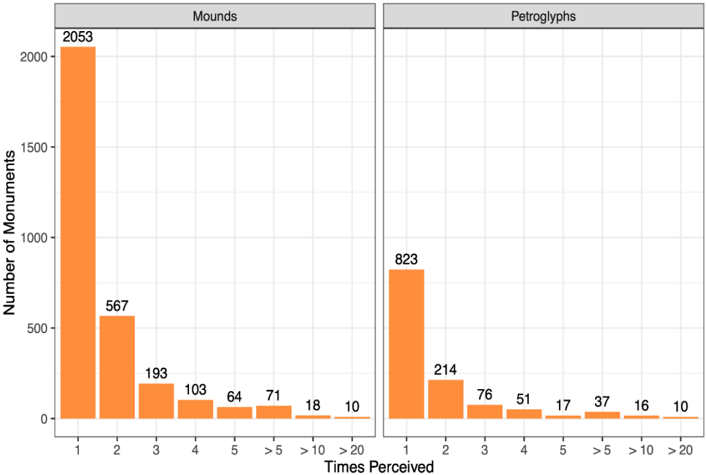
- Across 160 simulations (16 experiments × 10 runs, 1000 ticks each), only 8.82% of mounds (3079) and 2.24% of petroglyphs (1244) were perceived at least once; mounds were perceived 5584 times (average 1.96 per experiment) and petroglyphs 2957 times (average 1.74 per simulation).
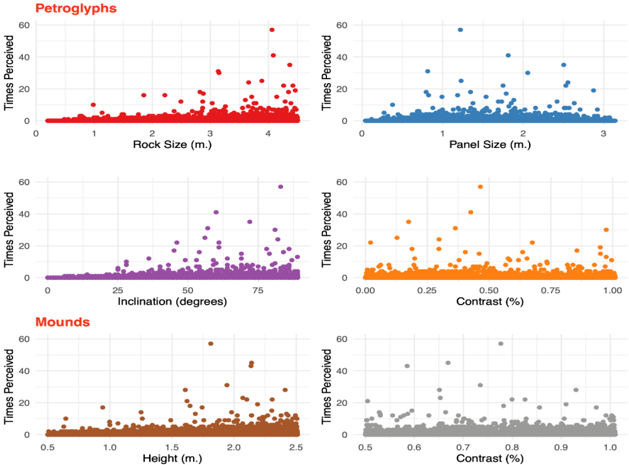
- GLMs showed mound size (estimate 1.1392) and contrast (1.0746) significantly affected the probability of perception; for petroglyphs, contrast (3.3016), panel size (1.0723), and inclination (0.0311) were significant, while rock size was not (0.1045, p=0.225). Kendall’s tau correlations with number of perceptions were statistically significant but very weak (tau 0.03–0.14).
- Real location significantly increased mound perceptions (estimate 0.0361, p=0.0065) but not petroglyph perceptions (estimate -0.0138, p=0.320).
- For audience variables, only walking strategy was significant for mounds (estimate -0.2451, p<2e-16); only Expertise was significant for petroglyphs (estimate 1.3851, p<2e-16). With Expertise disabled, petroglyphs were perceived 448 times versus 4203 for mounds; with Expertise enabled, petroglyphs rose to 2509 versus 1381 for mounds.
Methods
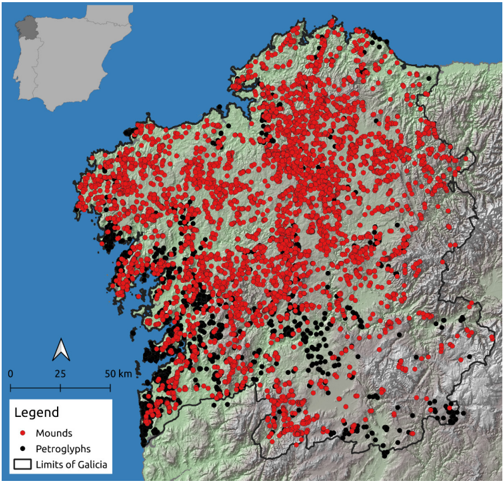
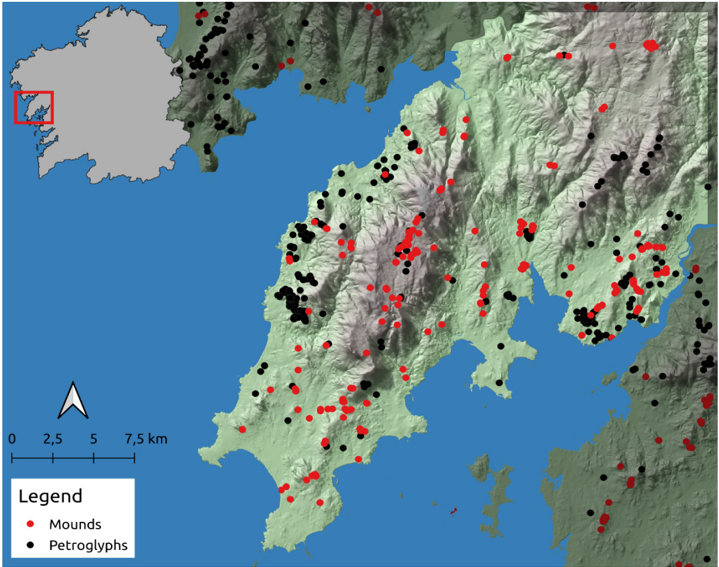
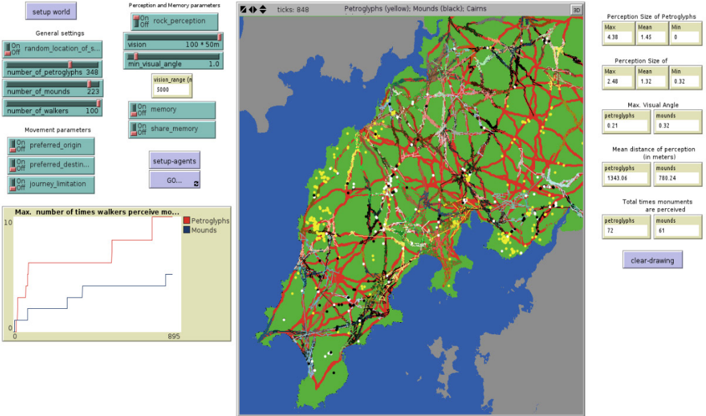
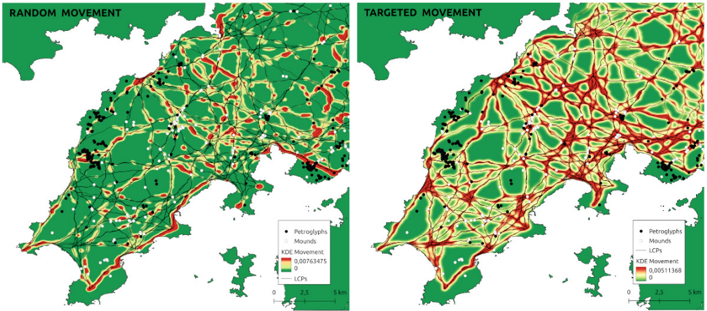
- An agent-based model was built in NetLogo on a semi-realistic Barbanza Peninsula environment with land/sea patches; walker movement was restricted to 250 least-cost paths calculated in GRASS GIS using r.walk and r.drain. Agents included walkers (up to 150, sight limit up to 5 km, visual acuity 0.01–10°), petroglyphs (up to 500; 348 in real locations), and mounds (up to 250; 223 in real locations).
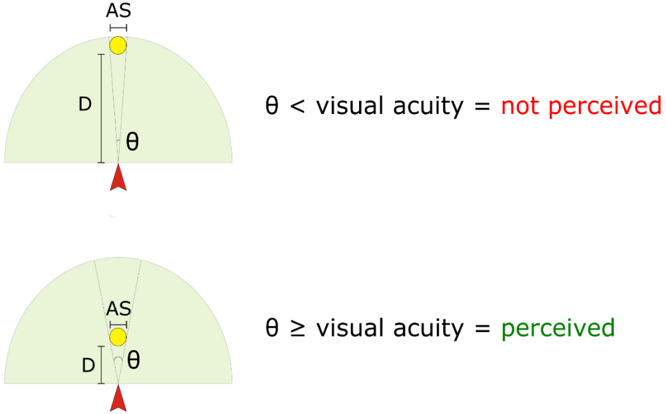
- Perception was simulated with a 180° field-of-view cone and depth 0–5000 m; targets were perceived if their visual angle exceeded the walker’s acuity threshold. Apparent size was calculated as AS=(Size*sin(Inclination))*Contrast for petroglyphs and AS=Size*Contrast for mounds. Audience options included Expertise, Memory, Cultural Transmission, and random versus targeted walking.
- The study ran 16 experiments × 10 runs = 160 simulations of 1000 ticks each. Analyses used Generalized Linear Models with perception as a binary response, Kendall’s tau correlation for number of perceptions, and a Monte Carlo-like comparison of real versus random monument locations.
Limitations
- The paper states the approach is exploratory; the simulation of contrast is “quite abstract and simplistic”; the visual acuity threshold of 1° was extremely conservative and likely produced low perception counts; and the model was originally devised for rock art, fitting petroglyphs better than mounds.
- The paper states that Memory and Cultural Transmission did not significantly affect perceptions, possibly because simulations were too short, and suggests longer runs (10,000 or 20,000 ticks) for future work.
- The text makes evident that walker movement was constrained to precomputed least-cost path corridors rather than full terrain, and the authors note they did not consider altitude, slope, and other topographic features in the model’s movement.
Model-written summary. Check it against the paper before relying on it.
Integrity signals
Registry
Cites
Statistics
Figures
Verification
Claims the paper makes
0 Valid · 10 Not valid · 24 Not checked · 68 Own results and interpretations
A result the paper reports from its own data — it cites no other source for it, so there is none to check. The quote shows it is in the paper.
In the paper
“However, the estimated value of this variable (-0.24) suggests that such effect would not have been particularly powerful.”
§ Assessing the Perceptibility of Prehistoric Monuments on their Landscape. An Exploratory Approach Using Agent-Based Modelling Evaluación de la perceptibilidad en el paisaje de los monumentos prehistóricos. Un enfoque exploratorio por medio de la modelización basada en agentes > 3.2. Impact of the character of audiences on the perceptibility of monuments
hedged- Asserted: passes — The authors put it forward as true.
- Checkable: passes — It can be checked against evidence.
- Load-bearing: unclear — It is unclear whether the paper’s conclusions depend on it.
- Based: passes — The paper gives a reason why it holds.
In the paper
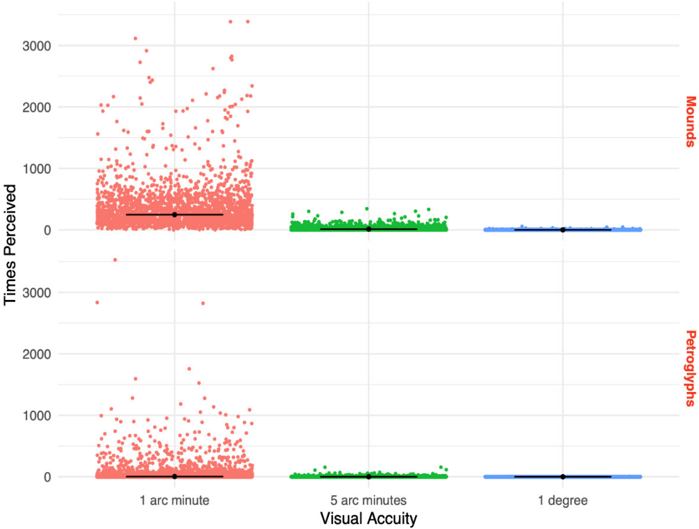
“For example, a threshold of 1 arc minute resulted in petroglyphs and burial mounds being perceived at distances greater than four or even five kilometers”
§ Assessing the Perceptibility of Prehistoric Monuments on their Landscape. An Exploratory Approach Using Agent-Based Modelling Evaluación de la perceptibilidad en el paisaje de los monumentos prehistóricos. Un enfoque exploratorio por medio de la modelización basada en agentes > 2.2.4. Simulating the impact of memory, experience, and cultural transmission
What the sources say
- Not checked yetcites Ogburn, 2006 matched to “Assessing the level of visibility of cultural objects in past landscapes” (2006) source
plainstates a cause- Asserted: passes — The authors put it forward as true.
- Checkable: passes — It can be checked against evidence.
- Load-bearing: passes — The paper’s conclusions depend on it.
- Based: passes — The paper gives a reason why it holds.
A result the paper reports from its own data — it cites no other source for it, so there is none to check. The quote shows it is in the paper.
In the paper
“In comparison, the average perceptual distances for the 1° threshold simulations have ranged from 20 to 2700 meters”
§ Assessing the Perceptibility of Prehistoric Monuments on their Landscape. An Exploratory Approach Using Agent-Based Modelling Evaluación de la perceptibilidad en el paisaje de los monumentos prehistóricos. Un enfoque exploratorio por medio de la modelización basada en agentes > 2.2.4. Simulating the impact of memory, experience, and cultural transmission
plain- Asserted: passes — The authors put it forward as true.
- Checkable: passes — It can be checked against evidence.
- Load-bearing: passes — The paper’s conclusions depend on it.
- Based: passes — The paper gives a reason why it holds.
A result the paper states — it cites no source for it, so there is none to check. The quote shows it is in the paper.
In the paper
“The transmission of knowledge about the existence of a monument (i.e., pointing out its location from afar) accelerates the process of perception by naïve observers.”
§ Assessing the Perceptibility of Prehistoric Monuments on their Landscape. An Exploratory Approach Using Agent-Based Modelling Evaluación de la perceptibilidad en el paisaje de los monumentos prehistóricos. Un enfoque exploratorio por medio de la modelización basada en agentes > 2.2.4. Simulating the impact of memory, experience, and cultural transmission
plainstates a cause- Asserted: passes — The authors put it forward as true.
- Checkable: passes — It can be checked against evidence.
- Load-bearing: passes — The paper’s conclusions depend on it.
- Based: passes — The paper gives a reason why it holds.
A result the paper reports from its own data — it cites no other source for it, so there is none to check. The quote shows it is in the paper.
In the paper
“The GLM results suggest that almost all the explanatory variables considered had a significant impact on the probability that a given monument would be noticed by walkers (Table 2).”
§ Assessing the Perceptibility of Prehistoric Monuments on their Landscape. An Exploratory Approach Using Agent-Based Modelling Evaluación de la perceptibilidad en el paisaje de los monumentos prehistóricos. Un enfoque exploratorio por medio de la modelización basada en agentes > 3.1. Impact of the characteristics of monuments on their perceptibility
hedgedstates an association- Asserted: passes — The authors put it forward as true.
- Checkable: passes — It can be checked against evidence.
- Load-bearing: passes — The paper’s conclusions depend on it.
- Based: passes — The paper gives a reason why it holds.
41 more claims
Create a free account to see all 102 claims and to verify the 9 references still open.
- Probably not a substantial claim. 43
- It may state two separate claims as one. 23
- The quote only partly states this claim. 1
Self-check
Percentages, sums and reported differences re-computed from the paper’s own numbers.
Each contradiction between two passages listed here was confirmed by an independent check.
Rated minor: it would not touch a result — a value no result rests on, a p-value that stays on the same side of the significance level, or a conflict that is clerical, resolved elsewhere in the paper, or outside its own findings.
In the paper
§ Assessing the Perceptibility of Prehistoric Monuments on their Landscape. An Exploratory Approach Using Agent-Based Modelling Evaluación de la perceptibilidad en el paisaje de los monumentos prehistóricos. Un enfoque exploratorio por medio de la modelización basada en agentes > 2.2.2. Choosing the protagonists
“-Inclination of the rock: established randomly between 0 and 90º to the horizontal.”
§ Assessing the Perceptibility of Prehistoric Monuments on their Landscape. An Exploratory Approach Using Agent-Based Modelling Evaluación de la perceptibilidad en el paisaje de los monumentos prehistóricos. Un enfoque exploratorio por medio de la modelización basada en agentes > 3.1. Impact of the characteristics of monuments on their perceptibility
“inclination of the panel (degrees to the vertical)”
Rated minor: it would not touch a result — a value no result rests on, a p-value that stays on the same side of the significance level, or a conflict that is clerical, resolved elsewhere in the paper, or outside its own findings.
In the paper
“Intercept -0.6923 0.0104 66.408 <2e-16 ***”
§ Assessing the Perceptibility of Prehistoric Monuments on their Landscape. An Exploratory Approach Using Agent-Based Modelling Evaluación de la perceptibilidad en el paisaje de los monumentos prehistóricos. Un enfoque exploratorio por medio de la modelización basada en agentes > Additional information
Reported 66.408 · recomputed -66.567308
Rated minor: it would not touch a result — a value no result rests on, a p-value that stays on the same side of the significance level, or a conflict that is clerical, resolved elsewhere in the paper, or outside its own findings.
In the paper
“mounds have been perceived by walkers 5584 times, an average of 1.96 times per experiment.”
§ Assessing the Perceptibility of Prehistoric Monuments on their Landscape. An Exploratory Approach Using Agent-Based Modelling Evaluación de la perceptibilidad en el paisaje de los monumentos prehistóricos. Un enfoque exploratorio por medio de la modelización basada en agentes > Additional information
Reported 1.96 · recomputed 349
Rated minor: it would not touch a result — a value no result rests on, a p-value that stays on the same side of the significance level, or a conflict that is clerical, resolved elsewhere in the paper, or outside its own findings.
In the paper
§ Assessing the Perceptibility of Prehistoric Monuments on their Landscape. An Exploratory Approach Using Agent-Based Modelling Evaluación de la perceptibilidad en el paisaje de los monumentos prehistóricos. Un enfoque exploratorio por medio de la modelización basada en agentes > 2.2.3. Simulating perception
“on a near-horizontal rock (10º), with a size of 1.20 meters and a very low contrast (10%)”
§ Assessing the Perceptibility of Prehistoric Monuments on their Landscape. An Exploratory Approach Using Agent-Based Modelling Evaluación de la perceptibilidad en el paisaje de los monumentos prehistóricos. Un enfoque exploratorio por medio de la modelización basada en agentes > 2.2.3. Simulating perception
“Its Apparent Size will be: (1.20 * sin (20)) * 0.1 = 0.04 meters.”
Citations
Cites
(2010) · Oxford University Press eBooks · doi:10.1093/acref/9780199571123.001.0001 · Cited by 1,610
Extending GIS-based visual analysis: the concept of visualscapes
Llobera, M. (2003) · International Journal of Geographical Information Science · doi:10.1080/713811741 · Cited by 404
Assessing the level of visibility of cultural objects in past landscapes
Ogburn, D. E. (2006) · Journal of Archaeological Science · doi:10.1016/j.jas.2005.08.005 · Cited by 185
The Appropriation of Nature: Essays on Human Ecology and Social Relations
McCay, B. J., & Ingold, T. (1988) · Anthropological Quarterly · doi:10.2307/3317792 · Cited by 185
Megalitos, espacio, pensamiento
Boado, F. C. (1989) · Trabajos de Prehistoria · doi:10.3989/tp.1989.v46.i0.588 · Cited by 132
The powers of rocks: Topography and monument construction on Bodmin Moor
Tilley, C. (1996) · World Archaeology · doi:10.1080/00438243.1996.9980338 · Cited by 112
Reconstructing visual landscapes
Llobera, M. (2007) · World Archaeology · doi:10.1080/00438240601136496 · Cited by 104
Introduction to Agent-Based Modeling
Crooks, A. T., Malleson, N., Manley, E., & Heppenstall, A. (2019) · SAGE Publications Ltd eBooks · doi:10.4135/9781529793543.n2 · Cited by 103
Rock art research as landscape archaeology: A pilot study in Galicia, north‐west Spain
Bradley, R., Boado, F. C., & Valcarce, R. F. (1994) · World Archaeology · doi:10.1080/00438243.1994.9980252 · Cited by 85
Rewriting landscape: Incorporating sacred landscapes into cultural traditions
Parcero‐Oubiña, C., Boado, F. C., & Estévez, M. S. (1998) · World Archaeology · doi:10.1080/00438243.1998.9980403 · Cited by 74
Research works printed but not linked: 4
- FábRegas ValCaRCe, R.; RodRíguez Rellán, C.; bustelo abuín, J.; baRbeito Pose, V. (2018): «Building up the land: A new appraisal to the megalithic phenomenon in the Barbanza peninsula (Galicia, NW Spain)», en J. C. senna-maRtinez; M. diniz and A.F. CaRValho (eds.), De Gibraltar aos Pirinéus. Megalitismo, Vida e Morte na Fachada Atlântica Peninsular, Fundação Lapa do Lobo, Nelas: 85-98.
- RodRíguez-Rellán, C.; FábRegas ValCaRCe, R. (2017): «Monuments on the move. Assessing megaliths' interaction with the NW Iberian landscapes», en M. hinz (ed.), Megaliths, Societies and Landscapes: Early Monumentality and Social Differentiation in Neolithic Europe, Universität zu Kiel, Kiel, vol. 2: 621-640.
- WRen, C.D.; CRabtRee, S.A. (2021): Agent-based modeling for archaeology: simulating the complexity of societies, SFI Press, Santa Fe.
- sWeaReR, J. (2011): «Visual Angle», en J.S. kReutzeR; J. deluCa; B. CaPlan (eds.), Encyclopedia of Clinical Neuropsychology, Springer, New York: 2626-2627.
Cited by
Carrero-Pazos, M. (2023) · Archaeopress Publishing Ltd eBooks · doi:10.2307/jj.15135982 · Cited by 10
Approach to the visual landscape of the Gor river megalithic necropolises (Granada, Spain)
González, C. C., Almonacid, A. G., & Serrano, J. A. C. (2024) · Digital Applications in Archaeology and Cultural Heritage · doi:10.1016/j.daach.2024.e00335 · Cited by 8
A multiscalar methodology for holistic analysis of prehistoric rock carvings in Scotland
Barnett, T., Valdez-Tullett, J., Bjerketvedt, L. M., Alexander-Reid, F., Hoole, M., Jeffrey, S., & Robin, G. (2024) · Heritage Science · doi:10.1186/s40494-024-01183-8 · Cited by 6
A larger-scale study of the visual dominance at the Gor River megalithic landscape (Granada, Spain)
González, C. C., Serrano, J. A. C., & Cuenca, E. C. (2024) · Journal of Archaeological Science Reports · doi:10.1016/j.jasrep.2024.104912 · Cited by 6
Laguna-Palma, D. (2025) · Institutional Repository of the University of Granada (University of Granada) · Cited by 1
Metadata
- Authors
- Rodríguez Rellán, C., & Fábregas Valcarce, R.
- Venue
- Vegueta: Anuario de la Facultad de Geografía e Historia
- Published
- 2023-02-06
- Pages
- 115-145
- ISSN
- 1133-598X (ISSN-L)
- 2341-1112
- OpenAlex
- W4318763463
- Semantic Scholar
- 4a42a961738c7d9135b31f2aaba551fbcb5b9c03
- Cited by
- 6
- References
- 41
- Citations by year
- 2025: 2 · 2024: 3 · 2023: 1
- FWCI
- 2.55
- Type
- journal article
- Language
- en
- Open access
- hybrid
- doi.org
- Licence
- Locations
- Vegueta Anuario de la Facultad de Geografía e Historia (publishedVersion, cc-by-nc-nd)
- Institutional Repository of the University of Granada (University of Granada) (submittedVersion, cc-by-nc-nd)
- Funders
- Junta de Andalucía
- Topics
- Social Sciences › Archeology › Archaeological Research and Protection
- Social Sciences › Arts and Humanities › Archeology (arts and humanities) › Archaeological and Geological Studies
- Social Sciences › Arts and Humanities › Archeology (arts and humanities) › Archaeology and Cultural Heritage
- Keywords
- prehistoric monuments, perceptibility, archaeological landscape, agent-based modeling, visibility analysis, audience perception
About these checks
Registry, retraction, Cites and statistics results are computed, not judged, with one exception: a printed reference that no index lists is read once by a model before it counts as a citation error. Claims are extracted by a model and kept only when their quote appears verbatim in the text; each cited source is then checked, with a model’s help, for whether it says what the claim relies on. Those verdicts can be wrong — read the claim’s quote and the cited source before relying on one.
A language model drew the claims from the paper on 2026-11-24, under version 3 of the claim definition (model deepseek-v4.1-flash, prompt extract-v3).
A second model labelled each claim on 2026-11-24 (model jev-1.13-20260917, definition revision gold-guideline-v0.2).
Statistics and arithmetic are recomputed, not judged.
Confidence bands are shown only for fields calibrated on our annotated test set. None is calibrated yet, so no band is shown.
What counts as a claim ›How we measure confidence ›How we check this ›
Are you an author, or do you see a problem with this page? Request a review
Data sources
Bibliographic data: Semantic Scholar, OpenAlex, Crossref.
Contains information from the Semantic Scholar Academic Graph Datasets, made available under the ODC Attribution License (ODC-BY 1.0).
Semantic Scholar’s data is described in: Kinney, R., et al. (2023). The Semantic Scholar Open Data Platform. arXiv:2301.10140.
