

The DOI matches its Crossref record; 24 of the 24 references it cites were found in a registry or an index.
Analysis of emission data from global commercial aviation: 2004 and 2006
Open accessPublished version of a preprint
Abstract
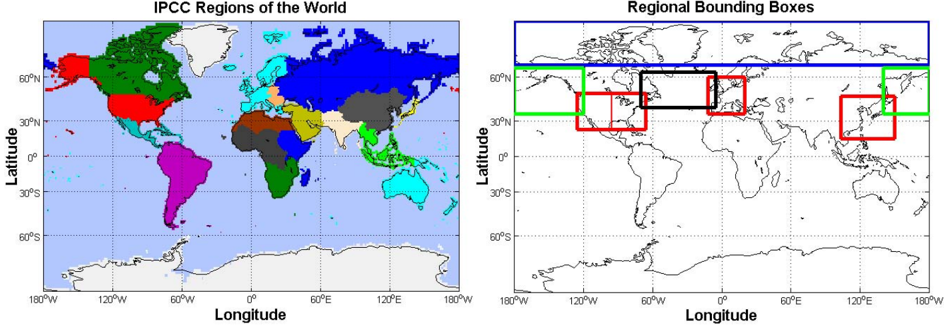
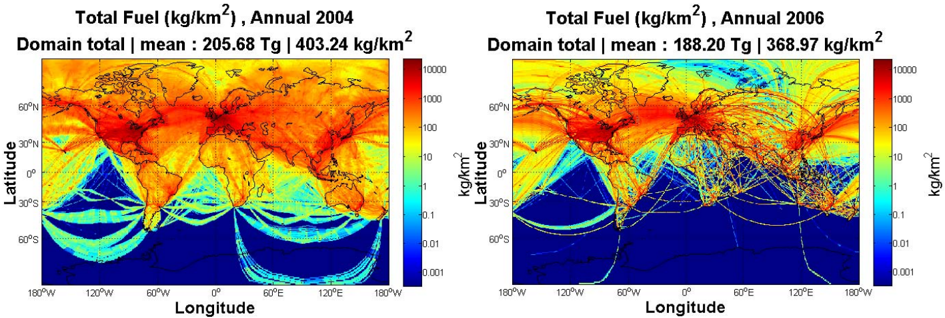
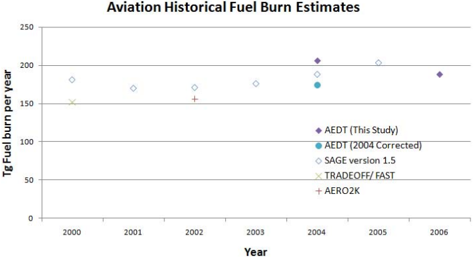
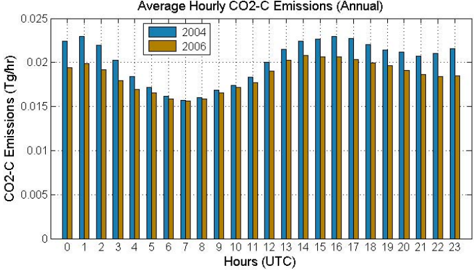
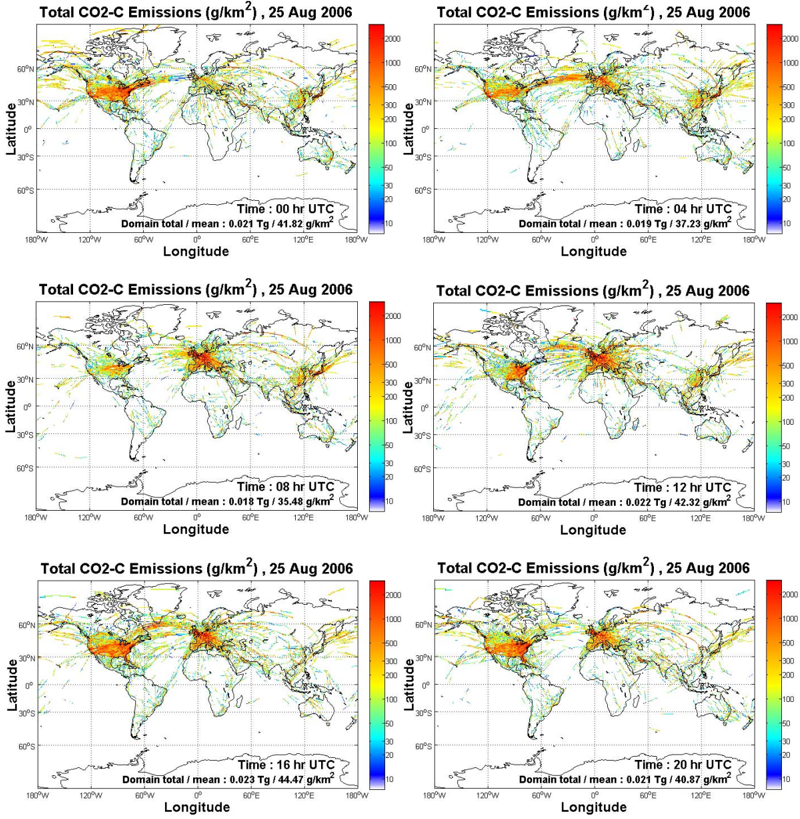
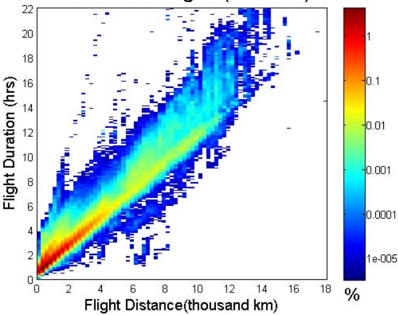
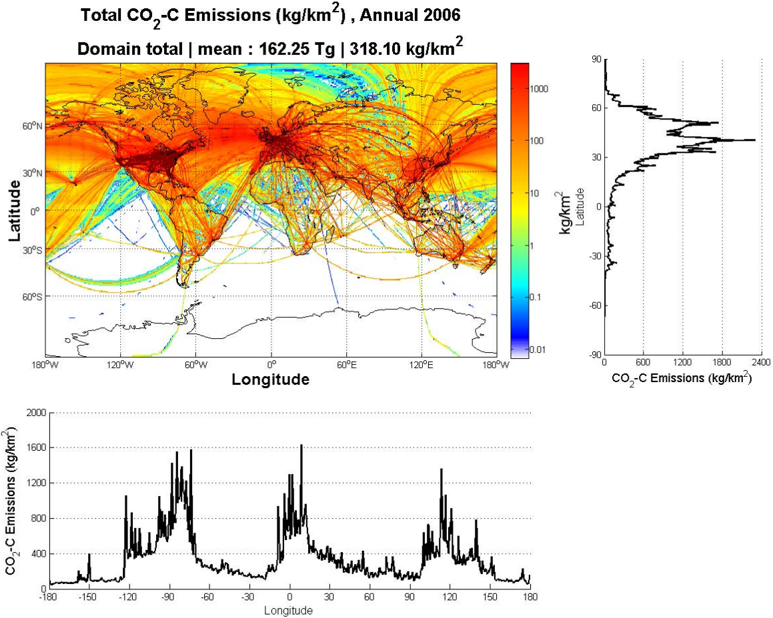
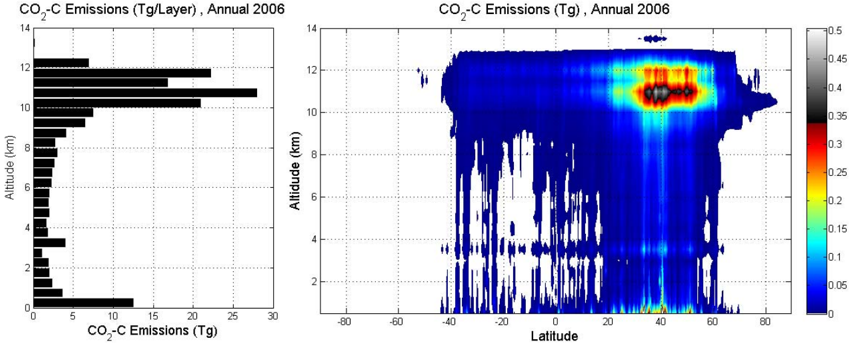
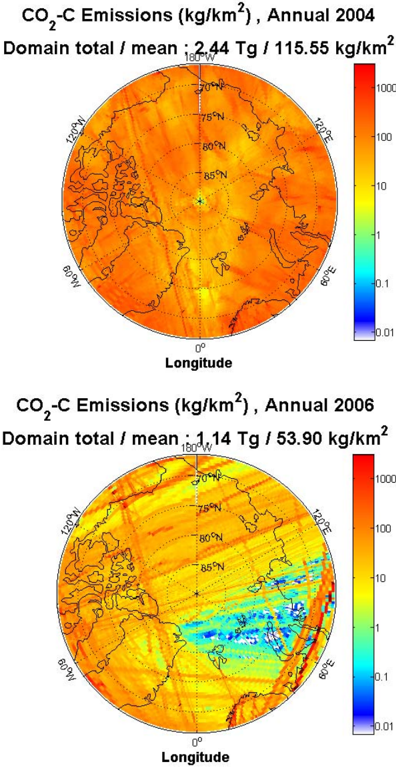
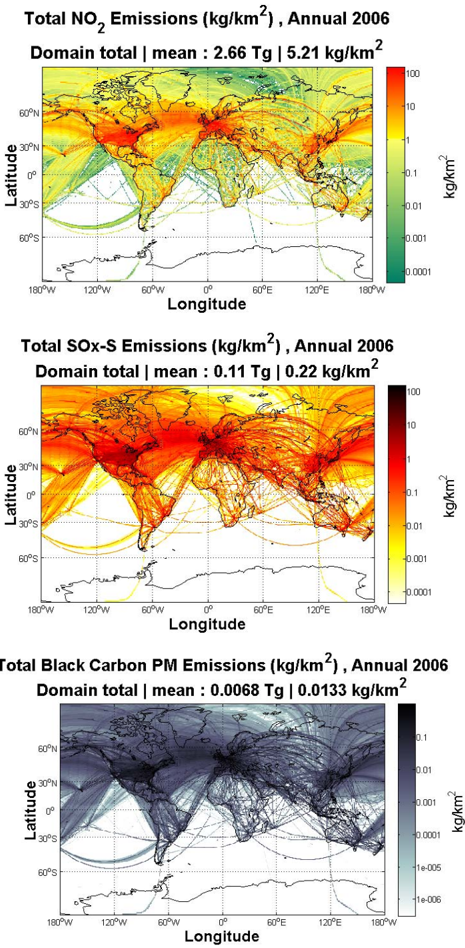
Abstract. The global commercial aircraft fleet in 2006 flew 31.26 million flights, burned 188.20 million metric tons of fuel, and covered 38.68 billion kilometers. This activity emitted substantial amounts of fossil-fuel combustion products within the upper troposphere and lower stratosphere that affect atmospheric composition and climate. The emissions products, such as carbon monoxide, carbon dioxide, oxides of nitrogen, sulfur compounds, and particulate matter, are not emitted uniformly over the Earth, so understanding the temporal and spatial distributions is important for modeling aviation's climate impacts. Global commercial aircraft emission data for 2004 and 2006, provided by the Volpe National Transportation Systems Center, were computed using the Federal Aviation Administration's Aviation Environmental Design Tool (AEDT). Continuous improvement in methodologies, including changes in AEDT's horizontal track methodologies, and an increase in availability of data make some differences between the 2004 and 2006 inventories incomparable. Furthermore, the 2004 inventory contained a significant over-count due to an imperfect data merge and daylight savings error. As a result, the 2006 emissions inventory is considered more representative of actual flight activity. Here, we analyze both 2004 and 2006 emissions, focusing on the latter, and provide corrected totals for 2004. Analysis of 2006 flight data shows that 92.5% of fuel was burned in the Northern Hemisphere, 69.0% between 30N and 60N latitudes, and 74.6% was burned above 7 km. This activity led to 162.25 Tg of carbon from CO2 emitted globally in 2006, more than half over three regions: the United States (25.5%), Europe (14.6), and East Asia (11.1). Despite receiving less than one percent of global emissions, the Arctic receives a uniformly dispersed concentration of emissions with 95.2% released at altitude where they have longer residence time than surface emissions. Finally, 85.2% of all flights by number in 2006 were short-haul missions, yet those flights were responsible for only 39.7% of total carbon from CO2. The following is a summary of these data which illustrates the global and regional aviation emissions footprints for 2004 and 2006, and provides temporal and spatial distribution statistics.
Overview
The claims and statistics of this paper haven’t been checked yet.
Run the check — free, no account needed. It reads the open-access text and checks the sources it cites.
Integrity signals
Registry
Cites
Statistics
Figures
Verification
Claims the paper makes
The claims and statistics of this paper haven’t been checked yet.
Run the check — free, no account needed. It reads the open-access text and checks the sources it cites.
Claims other papers make about this one
Each is checked against this paper’s own text: does it say what the citing paper says it does?
In the citing paper
“Short haul flights up to 1.5 to 3 h with utmost 100 passengers have the potential to be electrified according to Wilkerson et al. [91] and Mueller et al. [80].”
From Global Transportation Demand Development with Impacts on the Energy Demand and Greenhouse Gas Emissions in a Climate-Constrained World (2019) · cites this paper as [91]
Self-check
Percentages, sums and reported differences re-computed from the paper’s own numbers.
The self-check needs the paper’s full text.
Citations
Cites
CO2 emissions from fuel combustion: highlights
Eng, P. (2009) · Cited by 1,609
Transport impacts on atmosphere and climate: Aviation
Lee, D. S., Pitari, G., Grewe, V., Gierens, K., Penner, J. E., Petzold, A., Prather, M. J., Schumann, U., Bais, A., & Berntsen, T. (2010) · Atmospheric Environment · doi:10.1016/j.atmosenv.2009.06.005 · Cited by 765
Aviation radiative forcing in 2000: an update on IPCC (1999)
Sausen, R., Isaksen, I., Grewe, V., Hauglustaine, D., Lee, D. S., Myhre, G., Köhler, M. O., Pitari, G., Schumann, U., Stordal, F., et al. (2005) · Meteorologische Zeitschrift · doi:10.1127/0941-2948/2005/0049 · Cited by 318
Transport impacts on atmosphere and climate
SAUSEN, R. (2010) · Atmospheric Environment · doi:10.1016/j.atmosenv.2010.02.033 · Cited by 250
Scheduled civil aircraft emission inventories for 1992: Database development and analysis
Baughcum, S. L., Tritz, T. G., Henderson, S., & Pickett, D. C. (1996) · NASA Technical Reports Server (NASA) · Cited by 189
Image team, Eickhout, B., Mnv, & Lbg (2001) · Socio-Environmental Systems Modeling · Cited by 189
“Fuel Flow Method2” for Estimating Aircraft Emissions
DuBois, D., & Paynter, G. C. (2006) · SAE technical papers on CD-ROM/SAE technical paper series · doi:10.4271/2006-01-1987 · Cited by 166
Kim, B. Y., Fleming, G. G., Lee, J. J., Waitz, I. A., Clarke, J.-P., Balasubramanian, S., Malwitz, A., Klima, K., Locke, M., Holsclaw, C. A., et al. (2007) · Transportation Research Part D Transport and Environment · doi:10.1016/j.trd.2007.03.007 · Cited by 134
Self-citationImpact of aircraft NO x emissions on the atmosphere – tradeoffs to reduce the impact
Gauss, M., Isaksen, I. S. A., Lee, D. S., & Søvde, O. A. (2006) · Atmospheric chemistry and physics · doi:10.5194/acp-6-1529-2006 · Cited by 113
Methodology to Estimate Particulate Matter Emissions from Certified Commercial Aircraft Engines
Wayson, R. L., Fleming, G. G., & Iovinelli, R. (2009) · Journal of the Air & Waste Management Association · doi:10.3155/1047-3289.59.1.91 · Cited by 108
Self-citation
Research works printed but not linked: 3
- Kim, B. Y., Fleming, G. G., Balasubramanian, S., Malwitz, A., Lee, J. J., Ruggiero, J., Waitz, I. A., Klima, K., Locke, M., Holsclaw, C. A., Morales, A., McQueen, E., and Gillette, W.: System for assessing Aviation's Global Emissions (SAGE) Version 1.5: System Revision History, FAA, Ed., Office of Environment and Energy, 21, 2005a.
- MOCA, India Ministry of Civil Aviation; 2006–07 Annual Report: http://civilaviation.nic.in/reports/an_rep0607eng/Chapter-1.pdf (last access: 18 July 2009), 2007.
- OAG: Airlines Offer Record Number Of Seats In July, available online at: http://www.oag.com/oag/website/com/en/Press+Room/Press+Releases+2007/Airlines+Offer+Record+Number+Of+Seats+In+July, (last access: 27 May 2010), 2007.
Cited by
Sorted by citations
Items 201–275 of 275
Reduced Order Modeling of Contrails: Jet Induction and Vortex Phases
Inamdar, A. R., Lele, S. K., & Jacobson, M. Z. (2016) · AIAA Atmospheric and Space Environments Conference · doi:10.2514/6.2016-3136 · Cited by 1
Self-citationEnvironmental Cost-Benefit Analysis of Ultra Low Sulfur Jet Fuel
Gilmore, C. K., Barrett, S. R. H., Yim, S. H. L., Murray, L. T., Kuhn, S. R., & Reduction, E. (2011) · Cited by 1
Vennam, L. P., Arunachalam, S., Baek, B. H., Omary, M., Binkowski, F. S., Olsen, S. C., Mathur, R., Vizuete, W., & Fleming, G. G. (2014) · Springer proceedings in complexity · doi:10.1007/978-3-319-04379-1_32 · Cited by 1
Self-citationWhat Problems Are We Trying to Solve?
Jacobson, M. Z. (2020) · Cambridge University Press eBooks · doi:10.1017/9781108786713.002 · Cited by 1
Self-citationBoone, S., Penn, S. L., Levy, J. I., & Arunachalam, S. (2016) · Springer proceedings in complexity · doi:10.1007/978-3-319-24478-5_41 · Cited by 1
Wang, J., Lin, Y., Wang, X., Gu, Y., & Yim, S. H. L. (2023) · The Science of The Total Environment · doi:10.1016/j.scitotenv.2023.168656 · Cited by 1
Arunachalam, S., Valencia, A., Silva, R. A., Huang, J., Omary, M., & Vennam, L. P. (2017) · Springer proceedings in complexity · doi:10.1007/978-3-319-57645-9_83 · Cited by 1
Why Some Technologies Are Not Included
Jacobson, M. Z. (2020) · Cambridge University Press eBooks · doi:10.1017/9781108786713.004 · Cited by 1
Self-citationSensitivity of particle loss to the Kelvin effect in LES of young contrailsPreprint
Inamdar, A. R., Naiman, A. D., Lele, S. K., & Jacobson, M. Z. (2016) · doi:10.5194/acp-2016-817 · Cited by 1
Self-citationImpact of host climate model on contrail cirrus effective radiative forcing estimatesPreprint
Zhang, W., Weverberg, K. V., Morcrette, C. J., Feng, W., Furtado, K., Field, P. R., Chen, C., Gettelman, A., Forster, P. M. D. F., Marsh, D. R., et al. (2024) · doi:10.5194/egusphere-2024-1573 · Cited by 1
Emission prediction model for a multidisciplinary assessment framework
AB, A., Fahmi, M., & Nur, S. (2015) · International Conference on Advances in Mechanical, Aeronautical and Production Techniques (MAPT) · doi:10.15224/978-1-63248-059-0-68
Studies towards assessing the effects of aviation on climate
Khodayari, A. (2013) · Illinois Digital Environment for Access to Learning and Scholarship (University of Illinois at Urbana-Champaign)
Assessing the Environmental Benefits of NextGen Improvements in the National Airspace System
Truong, P. M., & Post, J. A. (2013) · AIAA Aviation Technology, Integration, and Operations Conference (ATIO) · doi:10.2514/6.2013-4314
Turgut, E. T. (2017) · International Conference on Mechanical and Aerospace Engineering · doi:10.1109/icmae.2017.8038684
Using Higher Order Sensitivity Approaches to Assess Aircraft Emissions Impacts on O3 and PM2.5
Arter, C. A., & Arunachalam, S. (2019) · Springer proceedings in complexity · doi:10.1007/978-3-030-22055-6_17
Impact of Aviation on Climate: FAA's Aviation Climate Change Research Initiative (ACCRI) Phase II.
Brasseur, G. P., Gupta, M. L., Anderson, B. E., Balasubramanian, S., Barrett, S. R. H., Duda, D. P., Fleming, G. G., Forster, P. M. D. F., Fuglestvedt, J. S., Gettelman, A., et al. (2016) · White Rose Research Online (University of Leeds, The University of Sheffield, University of York)
Self-citationKossakowska, M., & Kaminski, J. W. (2020) · Acta Geophysica · doi:10.1007/s11600-020-00444-x
Jacobson, M. Z. (2020) · Cambridge University Press eBooks · doi:10.1017/9781108786713.011
Self-citationPhotovoltaics and Solar Radiation
Jacobson, M. Z. (2020) · Cambridge University Press eBooks · doi:10.1017/9781108786713.006
Self-citationReply to reviewers on acp-2021-210
Gettelman, A. (2021) · Atmospheric chemistry and physics · doi:10.5194/acp-2021-210-ac1
Verma, P., & Burkhardt, U. (2021) · Atmospheric chemistry and physics · doi:10.5194/acp-2021-497-rc1
Bolvashenkov, I., Kammermann, J., Rubinraut, A., Herzog, H., & Frenkel, I. (2021) · SpringerBriefs in applied sciences and technology · doi:10.1007/978-3-030-81740-4_2
Verma, P. (2021) · doi:10.5194/acp-2021-497-ac3
Woody, M. (2019) · Carolina Digital Repository (University of North Carolina at Chapel Hill) · doi:10.17615/v9w1-8p32
Verma, P. (2021) · Atmospheric chemistry and physics · doi:10.5194/acp-2021-497-ac5
Verma, P. (2021) · doi:10.5194/acp-2021-497-ac2
Verma, P. (2021) · doi:10.5194/acp-2021-497-ac1
Verma, P. (2021) · Atmospheric chemistry and physics · doi:10.5194/acp-2021-497-ac4
Verma, P. (2021) · Atmospheric chemistry and physics · doi:10.5194/acp-2021-497-ac6
Wind-Water-Solar (WWS) and Storage Solution
Jacobson, M. Z. (2020) · Cambridge University Press eBooks · doi:10.1017/9781108786713.003
Self-citationSteps in Developing 100 Percent All-Sector WWS and Storage Roadmaps
Jacobson, M. Z. (2020) · Cambridge University Press eBooks · doi:10.1017/9781108786713.008
Self-citationJacobson, M. Z. (2020) · Cambridge University Press eBooks · doi:10.1017/9781108786713.012
Self-citationJacobson, M. Z. (2020) · Cambridge University Press eBooks · doi:10.1017/9781108786713.005
Self-citationJacobson, M. Z. (2020) · Cambridge University Press eBooks · doi:10.1017/9781108786713.013
Self-citationJacobson, M. Z. (2020) · Cambridge University Press eBooks · doi:10.1017/9781108786713.009
Self-citationEvolution of the 100 Percent Movement and Policies Needed for a WWS Solution
Jacobson, M. Z. (2020) · Cambridge University Press eBooks · doi:10.1017/9781108786713.010
Self-citationJacobson, M. Z. (2020) · Cambridge University Press eBooks · doi:10.1017/9781108786713.001
Self-citation(2021) · Atmospheric chemistry and physics · doi:10.5194/acp-2021-210-rc2
Gettelman, A., Chen, C.-C., & Bardeen, C. (2021) · Atmospheric chemistry and physics · doi:10.5194/acp-2021-210-rc1
Schumann, U. (2021) · Atmospheric chemistry and physics · doi:10.5194/acp-2021-62-ac2
Jacobson, M. Z. (2020) · Cambridge University Press eBooks · doi:10.1017/9781108786713.014
Self-citationSupplementary material to "Emission metrics for quantifying regional climate impacts of aviation"
Lund, M. T., Aamaas, B., Berntsen, T. K., Bock, L., Burkhardt, U., Fuglestvedt, J. S., & Shine, K. P. (2017) · doi:10.5194/esd-2017-11-supplement
Verma, P., & Burkhardt, U. (2021) · Atmospheric chemistry and physics · doi:10.5194/acp-2021-497-cc1
(2019) · Atmospheric Chemistry and Physics Discussions · doi:10.5194/acp-2018-601-rc2
(2022) · Atmospheric chemistry and physics · doi:10.5194/acp-2022-222-rc2
Multimodel Integration for Fuel-Related Aircraft Emission Estimation on Boeing 777
Schuster, E., & de Haag, M. U. (2022) · Journal of Aerospace Information Systems · doi:10.2514/1.i011042
Hauglustaine, D. A. (2022) · Atmospheric chemistry and physics · doi:10.5194/acp-2022-222-ac2
Hauglustaine, D. A. (2022) · Atmospheric chemistry and physics · doi:10.5194/acp-2022-222-ac1
Comment on egusphere-2022-1198
Dang, R., Jacob, D. J., Shah, V. N., et al. (2022) · doi:10.5194/egusphere-2022-1198-rc1
Comment on egusphere-2022-1198
Dang, R., Jacob, D. J., Shah, V. N., et al. (2022) · doi:10.5194/egusphere-2022-1198-rc2
Author response to reviewer comments
Dang, R. (2023) · doi:10.5194/egusphere-2022-1198-ac1
Eastham, S. D., Chossière, G. P., Speth, R. L., et al. (2023) · doi:10.5194/egusphere-2023-695-rc1
Eastham, S. D., Chossière, G. P., Speth, R. L., et al. (2023) · doi:10.5194/egusphere-2023-695-rc2
Eastham, S. D., ̈re, G. P. C., Speth, R. L., et al. (2023) · doi:10.5194/egusphere-2023-695-rc3
Eastham, S. D., ̈re, G. P. C., Speth, R. L., et al. (2023) · doi:10.5194/egusphere-2023-695-ec1
Response to reviews (RC1-3, EC1)
Eastham, S. D. (2023) · doi:10.5194/egusphere-2023-695-ac1
Singh, D. K., Sanyal, S., & Wuebbles, D. J. (2024) · doi:10.5194/egusphere-2024-127-rc1
Singh, D. K., Sanyal, S., & Wuebbles, D. J. (2024) · doi:10.5194/egusphere-2024-127-rc2
Monitoring multi-pathogens and SARS-CoV-2 variants in aircraft and airport wastewaterPreprint
Tay, M., Lee, B., Ismail, M. H., Yam, J., Maliki, D., Gin, K. Y., Chae, S., Ho, Z. J. M., Teoh, Y. L., Ng, L. C., et al. (2024) · medRxiv · doi:10.1101/2024.05.11.24307221
Engberg, Z., Teoh, R., Abbott, T. H., Dean, T., Stettler, M. E. J., & Shapiro, M. (2024) · doi:10.5194/egusphere-2024-1361-supplement
Xue, D., Yu, S., Li, J., Liu, Z., Chen, X. M., Jiang, C., Li, L., Wu, C., Chan, F. K. S., Su, H., et al. (2025) · Research Square · doi:10.21203/rs.3.rs-6538724/v1
Reducing contrail formation by engine design and operating point adaptation of aircraft engines
Callard, J., Klumpp, C., Weintraub, D., Henninger, S., & Jeschke, P. (2025) · CEAS Aeronautical Journal · doi:10.1007/s13272-025-00887-2
Zhang, W., Field, P. R., Weverberg, K. V., Forster, P. M. D. F., Morcrette, C. J., & Rap, A. (2025) · Atmospheric chemistry and physics · doi:10.5194/acp-25-14153-2025
Global Fuel Burn and Emissions to 2050
Fleming, G. G., Balasubramanian, S., & Malwitz, A. (2014) · Transportation Research Board 93rd Annual MeetingTransportation Research Board
Self-citationLarge present-day and future climate forcing due to non-CO2 emissions from global transport
Hendricks, J., Righi, M., Brinkop, S., Dahlmann, K., Mertens, M., Beer, C. G., Grewe, V., Kaiser, C., & Ponater, M. (2026) · npj Climate and Atmospheric Science · doi:10.1038/s41612-026-01383-y
Cheng, X., Lang, J., Fu, Y., Zhou, Y., Wen, C., Yang, Z., & Chen, B. (2026) · Journal of Hazardous Materials · doi:10.1016/j.jhazmat.2026.142451
Impact of aircraft CO, NO 2 , and SO 2 emissions on public health in Chinese airports
Wu, J., & Cui, Q. (2026) · Journal of Global Health · doi:10.7189/jogh.16.04210
Kim, H. D., Efstathiou, C., Ramarao, M. V. S., Durant, J. L., Hudda, N., Lane, K. J., Levy, J. I., & Arunachalam, S. (2026) · ACS ES&T Air · doi:10.1021/acsestair.6c00146
Chen, J., Wang, J., Cao, L., Liang, R., & Zou, L. (2026) · Atmosphere · doi:10.3390/atmos17100942
Metadata
- Authors
- Wilkerson, J. T., Jacobson, M. Z., Malwitz, A., Balasubramanian, S., Wayson, R., Fleming, G., Naiman, A. D., & Lele, S. K.
- Affiliations
- Stanford University (US)
- Volpe National Transportation Systems Center (US)
- Venue
- Atmospheric Chemistry and Physics
- Publisher
- Copernicus GmbH
- Published
- 2010-07-14
- Volume
- 10
- Issue
- 13
- Pages
- 6391-6408
- ISSN
- 1680-7316 (ISSN-L)
- 1680-7324
- OpenAlex
- W2097270364
- Cited by
- 275
- References
- 24
- Citations by year
- 2026: 9 · 2025: 11 · 2024: 23 · 2023: 17 · 2022: 28 · 2021: 27 · 2020: 28 · 2019: 17 · 2018: 8 · 2017: 11 · 2016: 15 · 2015: 13 · 2014: 17 · 2013: 24 · 2012: 12
- FWCI
- 14.69
- Type
- journal article
- Language
- en
- Open access
- gold
- doi.org
- Licence
- Locations
- Atmospheric chemistry and physics (publishedVersion, cc-by)
- DOAJ (DOAJ: Directory of Open Access Journals) (submittedVersion, cc-by-sa)
- Funders
- Federal Aviation Administration
- Topics
- Physical Sciences › Engineering › Aerospace Engineering › Advanced Aircraft Design and Technologies
- Physical Sciences › Environmental Science › Environmental Engineering › Maritime Transport Emissions and Efficiency
- Physical Sciences › Engineering › Automotive Engineering › Vehicle emissions and performance
- Keywords
- aviation emissions, commercial aircraft, CO2 emissions, aviation climate impact, emission inventory, upper troposphere and lower stratosphere, short-haul flights, fuel consumption, carbon monoxide, nitrogen oxides, sulfur compounds, particulate matter, spatial distribution of emissions, Aviation Environmental Design Tool
About these checks
Registry, retraction, Cites and statistics results are computed, not judged, with one exception: a printed reference that no index lists is read once by a model before it counts as a citation error. Claims are extracted by a model and kept only when their quote appears verbatim in the text; each cited source is then checked, with a model’s help, for whether it says what the claim relies on. Those verdicts can be wrong — read the claim’s quote and the cited source before relying on one.
Statistics and arithmetic are recomputed, not judged.
Confidence bands are shown only for fields calibrated on our annotated test set. None is calibrated yet, so no band is shown.
What counts as a claim ›How we measure confidence ›How we check this ›
Are you an author, or do you see a problem with this page? Request a review
