

Future impact of traffic emissions on atmospheric ozone and OH based on two scenarios
Open accessPublished version of a preprint
The DOI matches its Crossref record; 57 of the 58 references it cites were found in a registry or an index.
Abstract
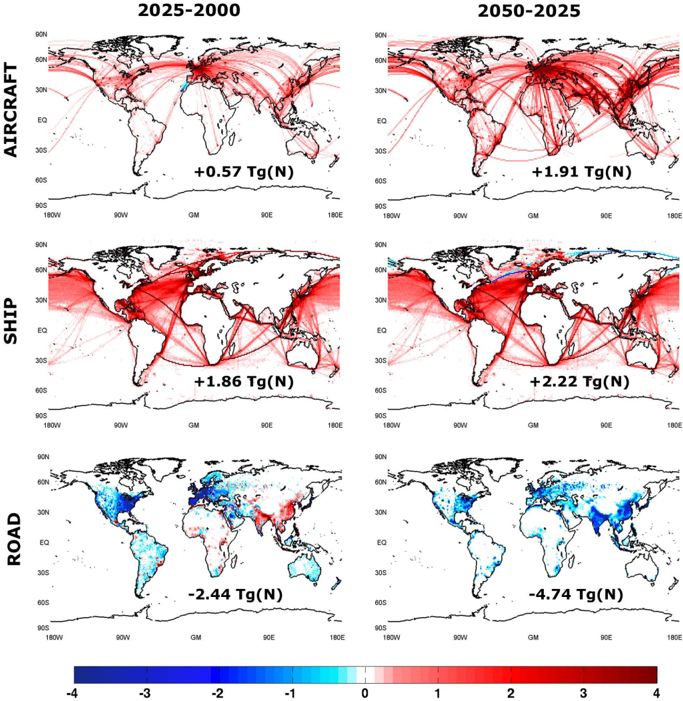
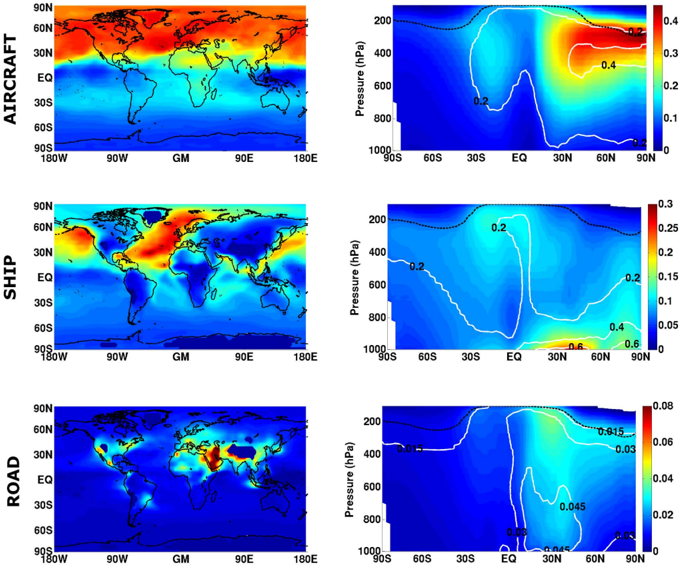
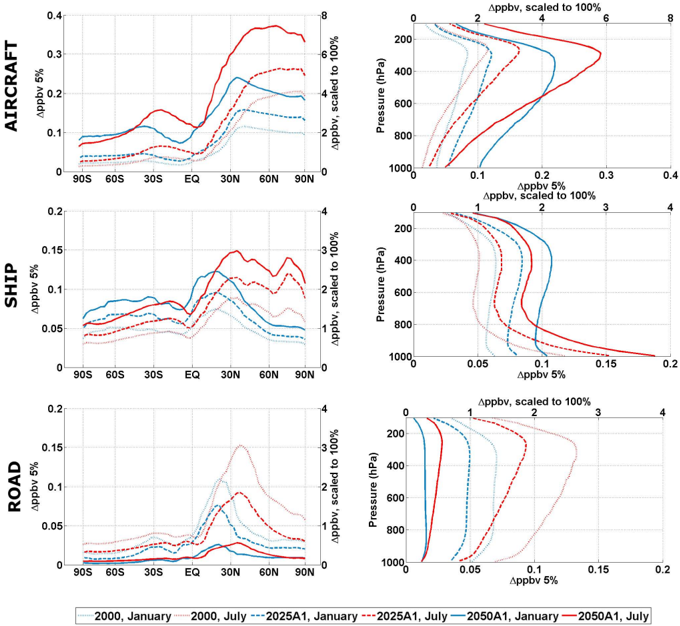
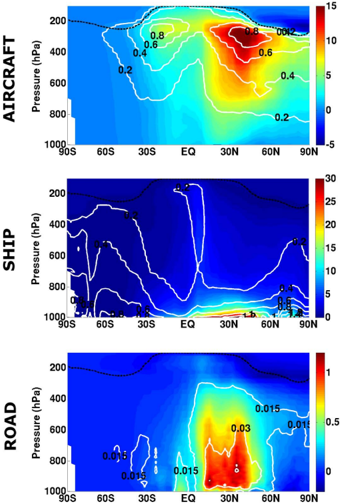
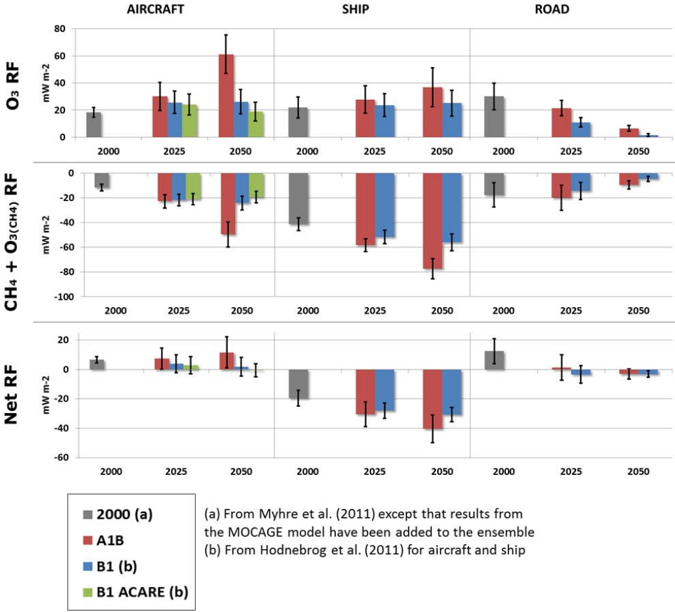
The future impact of traffic emissions on atmospheric ozone and OH has been investigated separately for the three sectors AIRcraft, maritime SHIPping and ROAD traffic. To reduce uncertainties we present results from an ensemble of six different atmospheric chemistry models, each simulating the atmospheric chemical composition in a possible high emission scenario (A1B), and with emissions from each transport sector reduced by 5% to estimate sensitivities. Our results are compared with optimistic future emission scenarios (B1 and B1 ACARE), presented in a companion paper, and with the recent past (year 2000). Present-day activity indicates that anthropogenic emissions so far evolve closer to A1B than the B1 scenario. As a response to expected changes in emissions, AIR and SHIP will have increased impacts on atmospheric O3 and OH in the future while the impact of ROAD traffic will decrease substantially as a result of technological improvements. In 2050, maximum aircraft-induced O3 occurs near 80° N in the UTLS region and could reach 9 ppbv in the zonal mean during summer. Emissions from ship traffic have their largest O3 impact in the maritime boundary layer with a maximum of 6 ppbv over the North Atlantic Ocean during summer in 2050. The O3 impact of road traffic emissions in the lower troposphere peaks at 3 ppbv over the Arabian Peninsula, much lower than the impact in 2000. Radiative forcing (RF) calculations show that the net effect of AIR, SHIP and ROAD combined will change from a marginal cooling of −0.44 ± 13 mW m−2 in 2000 to a relatively strong cooling of −32 ± 9.3 (B1) or −32 ± 18 mW m−2 (A1B) in 2050, when taking into account RF due to changes in O3, CH4 and CH4-induced O3. This is caused both by the enhanced negative net RF from SHIP, which will change from −19 ± 5.3 mW m−2 in 2000 to −31 ± 4.8 (B1) or −40 ± 9 mW m−2 (A1B) in 2050, and from reduced O3 warming from ROAD, which is likely to turn from a positive net RF of 12 ± 8.5 mW m−2 in 2000 to a slightly negative net RF of −3.1 ± 2.2 (B1) or −3.1 ± 3.4 (A1B) mW m−2 in the middle of this century. The negative net RF from ROAD is temporary and induced by the strong decline in ROAD emissions prior to 2050, which only affects the methane cooling term due to the longer lifetime of CH4 compared to O3. The O3 RF from AIR in 2050 is strongly dependent on scenario and ranges from 19 ± 6.8 (B1 ACARE) to 61 ± 14 mW m−2 (A1B). There is also a considerable span in the net RF from AIR in 2050, ranging from −0.54 ± 4.6 (B1 ACARE) to 12 ± 11 (A1B) mW m−2 compared to 6.6 ± 2.2 mW m−2 in 2000.
Overview
The claims and statistics of this paper haven’t been checked yet.
Free: it reads the open-access text and checks the first 5 claims that cite a source we can check. Create a free account to check every claim.
Integrity signals
Registry
Cites
Statistics
Figures
Verification
Claims the paper makes
The claims and statistics of this paper haven’t been checked yet.
Free: it reads the open-access text and checks the first 5 claims that cite a source we can check. Create a free account to check every claim.
Self-check
Percentages, sums and reported differences re-computed from the paper’s own numbers.
The self-check needs the paper’s full text.
Citations
Cites
Special report on emissions scenarios
Nakićenović, N., Alcamo, J. M., Davis, G. F., de Vries, B. J. M., Fenhann, J. V., Gaffin, S. R., Gregory, K., Griibler, A., Jung, T. Y., Kram, T., et al. (2000) · eScholarship (California Digital Library) · Cited by 3,423
Interannual variability in global biomass burning emissions from 1997 to 2004
van der Werf, G. R., Randerson, J. T., Giglio, L., Collatz, G. J., Kasibhatla, P. S., & Arellano, A. F. (2006) · Atmospheric Chemistry and Physics · doi:10.5194/acp-6-3423-2006 · Cited by 1,656
Aviation and global climate change in the 21st century
Lee, D. S., Fahey, D. W., Forster, P. M., Newton, P. J., Wit, R. C. N., Lim, L. L., Owen, B., & Sausen, R. (2009) · Atmospheric Environment · doi:10.1016/j.atmosenv.2009.04.024 · Cited by 1,072 · cited 2×
“(2011) for a discussion of RF uncertainties when modelling aviation NOx), the uncertainty is mostly induced by the large spread of emissions between the various scenarios (Lee et al., 2010), whereas the ensemble mean O 3 RF is 61 (± 14) mW m−2 for the A1B scenario and only 19 (± 6.8) mW m−2 for B1 ACARE in 2050, just…”
ResultInfluentialTransport impacts on atmosphere and climate: Shipping
Eyring, V., Isaksen, I. S. A., Berntsen, T., Collins, W. J., Corbett, J. J., Endresen, O., Grainger, R. G., Moldanova, J., Schlager, H., & Stevenson, D. S. (2010) · Atmospheric Environment · doi:10.1016/j.atmosenv.2009.04.059 · Cited by 955 · cited 2×
“Estimates from the multi-model study of Eyring et al. (2007) were much lower than in this study with O 3 RF from SHIP of 14 mW m−2 for 2030, and 9.8 mW m−2 for 2000. Part of the reason is the magnitude of ship NO x emissions which was lower in their study, but it can also be related to the different geographical emiss…”
MethodInfluentialSelf-citationRapid growth in CO2 emissions after the 2008–2009 global financial crisis
Peters, G. P., Marland, G., Le Quéré, C., Boden, T., Canadell, J. G., & Raupach, M. R. (2012) · Nature Climate Change · doi:10.1038/nclimate1332 · Cited by 869 · cited 2×
“Global CO2 emissions from fossil fuel and industrial processes for 2010 are estimated to be 9.14 Gt C (Peters et al., 2012), indicating that the emission activity so far is closer to the evolution of the high A1B scenario (9.68 Gt C), which is the focus of this study (for O3 precursors), than to…”
BackgroundInfluentialTransport impacts on atmosphere and climate: Aviation
Lee, D. S., Pitari, G., Grewe, V., Gierens, K., Penner, J. E., Petzold, A., Prather, M. J., Schumann, U., Bais, A., & Berntsen, T. (2010) · Atmospheric Environment · doi:10.1016/j.atmosenv.2009.06.005 · Cited by 765
Self-citationGauss, M., Myhre, G., Pitari, G., Prather, M. J., Isaksen, I. S. A., Berntsen, T. K., Brasseur, G. P., Dentener, F. J., Derwent, R. G., Hauglustaine, D. A., et al. (2003) · Journal of Geophysical Research: Atmospheres · doi:10.1029/2002jd002624 · Cited by 548 · cited 2×
“OsloCTM2 (Gauss et al., 2003a; Søvde et al., 2008) was operated by the University of Oslo and set up with both tropospheric and stratospheric chemistry, T42 horizontal resolution, and 60 vertical layers.”
BackgroundMethodSelf-citationJöckel, P., Tost, H., Pozzer, A., Brühl, C., Buchholz, J., Ganzeveld, L., Hoor, P., Kerkweg, A., Lawrence, M. G., Sander, R., et al. (2006) · Atmospheric Chemistry and Physics · doi:10.5194/acp-6-5067-2006 · Cited by 483
Hauglustaine, D. A., Hourdin, F., Jourdain, L., Filiberti, M. ‐., Walters, S., Lamarque, J. ‐., & Holland, E. A. (2004) · Journal of Geophysical Research: Atmospheres · doi:10.1029/2003jd003957 · Cited by 430
Global radiative forcing from contrail cirrus
Burkhardt, U., & Kärcher, B. (2011) · Nature Climate Change · doi:10.1038/nclimate1068 · Cited by 414
Jöckel, P., Tost, H., Pozzer, A., et al. (2006) · doi:10.5194/acpd-6-6957-2006 · Cited by 412
Transport impacts on atmosphere and climate: Land transport
Uherek, E., Halenka, T., Borken-Kleefeld, J., Balkanski, Y., Berntsen, T., Borrego, C., Gauss, M., Hoor, P., Juda-Rezler, K., & Lelieveld, J. (2010) · Atmospheric Environment · doi:10.1016/j.atmosenv.2010.01.002 · Cited by 378 · cited 6×
“…2009; Hoor et al., 2009; Skeie et al., 2009; Balkanski et al., 2010; Eyring et al., 2010; Huszar et al., 2010; Koffi et al., 2010; Lee et al., 2010; Uherek et al., 2010; Dahlmann et al., 2011; Hodnebrog et al., 2011; Myhre et al., 2011; Grewe et al., 2012; Olivié et al., 2012), and have been…”
BackgroundInfluentialSelf-citationClimate forcing from the transport sectors
Fuglestvedt, J., Berntsen, T., Myhre, G., Rypdal, K., & Skeie, R. B. (2008) · Proceedings of the National Academy of Sciences · doi:10.1073/pnas.0702958104 · Cited by 334 · cited 4×
“…tropospheric O3 constitutes the second largest positive radiative forcing (RF) term (after CO2) due to present-day (year 2000) traffic emissions (Fuglestvedt et al., 2008), and one study predicts that in 2030 the traffic sector will constitute 29 % of the total anthropogenic ozone RF (Unger et…”
BackgroundInfluentialSelf-citationA historical reconstruction of ships' fuel consumption and emissions
Endresen, Ø., Sørgård, E., Behrens, H. L., Brett, P. O., & Isaksen, I. S. A. (2007) · Journal of Geophysical Research: Atmospheres · doi:10.1029/2006jd007630 · Cited by 284
Self-citationTransport impacts on atmosphere and climate
Sausen, R. (2010) · Atmospheric Environment · doi:10.1016/j.atmosenv.2010.02.033 · Cited by 248
Flying into the Future: Aviation Emissions Scenarios to 2050
Owen, B., Lee, D. S., & Lim, L. (2010) · Environmental Science & Technology · doi:10.1021/es902530z · Cited by 234
Folberth, G. A., Hauglustaine, D. A., Lathière, J., & Brocheton, F. (2006) · Atmospheric Chemistry and Physics · doi:10.5194/acp-6-2273-2006 · Cited by 230
Indirect long‐term global radiative cooling from NOx Emissions
Wild, O., Prather, M. J., & Akimoto, H. (2001) · Geophysical Research Letters · doi:10.1029/2000gl012573 · Cited by 204
Self-citationAirClim: an efficient tool for climate evaluation of aircraft technology
Grewe, V., & Stenke, A. (2008) · Atmospheric Chemistry and Physics · doi:10.5194/acp-8-4621-2008 · Cited by 161
Self-citationThe impact of traffic emissions on atmospheric ozone and OH: Results from QUANTIFY
Hoor, P., Borken-Kleefeld, J., Caro, D., Dessens, O., Endresen, O., Gauss, M., Grewe, V., Hauglustaine, D., Isaksen, I. S. A., Jöckel, P., et al. (2009) · Atmospheric chemistry and physics · doi:10.5194/acp-9-3113-2009 · Cited by 160
Self-citationResponse of climate to regional emissions of ozone precursors: sensitivities and warming potentials
Berntsen, T. K., Fuglestvedt, J. S., Joshi, M., Shine, K. P., Stuber, N., Ponater, M., SAUSEN, R., Hauglustaine, D. A., & Li, L. (2005) · Tellus B · doi:10.1111/j.1600-0889.2005.00152.x · Cited by 144
Self-citationEyring, V., Stevenson, D. S., Lauer, A., Dentener, F. J., Butler, T., Collins, W. J., Ellingsen, K., Gauss, M., Hauglustaine, D. A., Isaksen, I. S. A., et al. (2007) · Atmospheric Chemistry and Physics · doi:10.5194/acp-7-757-2007 · Cited by 141
Self-citationQuantifying the contributions of individual NOx sources to the trend in ozone radiative forcing
Dahlmann, K., Grewe, V., Ponater, M., & Matthes, S. (2011) · Atmospheric Environment · doi:10.1016/j.atmosenv.2011.02.071 · Cited by 134 · cited 1×
“…Skeie et al., 2009; Balkanski et al., 2010; Eyring et al., 2010; Huszar et al., 2010; Koffi et al., 2010; Lee et al., 2010; Uherek et al., 2010; Dahlmann et al., 2011; Hodnebrog et al., 2011; Myhre et al., 2011; Grewe et al., 2012; Olivié et al., 2012), and have been initiated in the…”
BackgroundSelf-citationAccounting for non-linear chemistry of ship plumes in the GEOS-Chem global chemistry transport model
Vinken, G. C. M., Boersma, K. F., Jacob, D. J., & Meijer, E. W. (2011) · Atmospheric Chemistry and Physics · doi:10.5194/acp-11-11707-2011 · Cited by 115
Diagnosing the stratosphere‐to‐troposphere flux of ozone in a chemistry transport model
Hsu, J., Prather, M. J., & Wild, O. (2005) · Journal of Geophysical Research: Atmospheres · doi:10.1029/2005jd006045 · Cited by 110
Self-citationTeyssèdre, H., Michou, M., Clark, H. L., Josse, B., Karcher, F., Olivié, D., Peuch, V.-H., Saint-Martin, D., Cariolle, D., Attié, J.-L., et al. (2007) · Atmospheric Chemistry and Physics · doi:10.5194/acp-7-5815-2007 · Cited by 107
Self-citationExcitation of the primary tropospheric chemical mode in a global three‐dimensional model
Wild, O., & Prather, M. J. (2000) · Journal of Geophysical Research: Atmospheres · doi:10.1029/2000jd900399 · Cited by 106
Self-citationGlobal temperature change from the transport sectors: Historical development and future scenarios
Skeie, R. B., Fuglestvedt, J. S., Berntsen, T. K., Lund, M. T., Myhre, G., & Rypdal, K. (2009) · Atmospheric Environment · doi:10.1016/j.atmosenv.2009.05.025 · Cited by 101
Self-citationAttributing ozone to NOx emissions: Implications for climate mitigation measures
Grewe, V., Dahlmann, K., Matthes, S., & Steinbrecht, W. (2012) · Atmospheric Environment · doi:10.1016/j.atmosenv.2012.05.002 · Cited by 101 · cited 4×
“This paper follows a series of recent studies that have quantified impacts of transport emissions on atmospheric chemistry and climate (Fuglestvedt et al., 2008; Cariolle et al., 2009; Hoor et al., 2009; Skeie et al., 2009; Balkanski et al., 2010; Eyring et al., 2010; Huszar et al., 2010; Koffi et al., 2010; Lee et al…”
BackgroundInfluentialSelf-citationRadiative forcing due to changes in ozone and methane caused by the transport sector
Myhre, G., Shine, K. P., Rädel, G., Gauss, M., Isaksen, I. S. A., Tang, Q., Prather, M. J., Williams, J. E., van Velthoven, P., Dessens, O., et al. (2011) · Atmospheric Environment · doi:10.1016/j.atmosenv.2010.10.001 · Cited by 93
Self-citationGrewe, V., Tsati, E., & Hoor, P. (2010) · Geoscientific Model Development · doi:10.5194/gmd-3-487-2010 · Cited by 85
Self-citationHuszar, P., Cariolle, D., Paoli, R., Halenka, T., Belda, M., Schlager, H., Miksovsky, J., & Pisoft, P. (2010) · Atmospheric Chemistry and Physics · doi:10.5194/acp-10-6645-2010 · Cited by 79
Direct radiative effect of aerosols emitted by transport: from road, shipping and aviation
Balkanski, Y., Myhre, G., Gauss, M., Rädel, G., Highwood, E. J., & Shine, K. P. (2010) · Atmospheric Chemistry and Physics · doi:10.5194/acp-10-4477-2010 · Cited by 78
Self-citationUncertainties in climate assessment for the case of aviation NO
Holmes, C. D., Tang, Q., & Prather, M. J. (2011) · Proceedings of the National Academy of Sciences · doi:10.1073/pnas.1101458108 · Cited by 74 · cited 1×
“Although there is a considerable spread between the models (see Holmes et al. (2011) for a discussion of RF uncertainties when modelling aviation NOx), the uncertainty is mostly induced by the large spread of emissions between the various scenarios (Lee et al., 2010), whereas the ensemble mean O3…”
BackgroundSelf-citationRadiative forcing due to stratospheric water vapour from CH4 oxidation
Myhre, G., Nilsen, J. S., Gulstad, L., Shine, K. P., Rognerud, B., & Isaksen, I. S. A. (2007) · Geophysical Research Letters · doi:10.1029/2006gl027472 · Cited by 73 · cited 1×
“33 – – – – – – Owen et al. (2010) Ship 4.”
Self-citationImpact of aircraft emissions on tropospheric and stratospheric ozone. Part I
Grooß, J., Brühl, C., & Peter, T. (1998) · Atmospheric Environment · doi:10.1016/s1352-2310(98)00016-8 · Cited by 71 · cited 1×
“The reason is that increased emissions normally leads to a smaller positive ozone perturbation per aircraft emitted NOx-molecule due to the non-linear nature of the ozone production (e.g. Grooß et al., 1998; Grewe et al., 1999, 2012).”
BackgroundWild, O., Sundet, J. K., Prather, M. J., Isaksen, I. S. A., Akimoto, H., Browell, E. V., & Oltmans, S. J. (2003) · Journal of Geophysical Research: Atmospheres · doi:10.1029/2002jd003283 · Cited by 71 · cited 1×
“The second CH4 RF term is known as the primary mode and represents the negative longterm effect of the methane perturbation on O3 (e.g. Wild and Prather, 2000; Wild et al., 2001).”
BackgroundSelf-citationAir pollution radiative forcing from specific emissions sectors at 2030
Unger, N., Shindell, D. T., Koch, D. M., & Streets, D. G. (2008) · Journal of Geophysical Research Atmospheres · doi:10.1029/2007jd008683 · Cited by 66
The impact of road traffic on global tropospheric ozone
Granier, C., & Brasseur, G. P. (2003) · Geophysical Research Letters · doi:10.1029/2002gl015972 · Cited by 62
Global impact of road traffic emissions on tropospheric ozone
Matthes, S., Grewe, V., SAUSEN, R., & Roelofs, G. J. (2007) · Atmospheric chemistry and physics · doi:10.5194/acp-7-1707-2007 · Cited by 61
Self-citationBorken, J., Steller, H., Merétei, T., & Vanhove, F. (2007) · Transportation Research Record: Journal of the Transportation Research Board · doi:10.3141/2011-14 · Cited by 60
Impact of H2O emissions from cryoplanes and kerosene aircraft on the atmosphere
Gauss, M., Isaksen, I. S. A., Wong, S., & Wang, W. ‐. (2003) · Journal of Geophysical Research Atmospheres · doi:10.1029/2002jd002623 · Cited by 60 · cited 2×
“OsloCTM2 (Gauss et al., 2003a; Søvde et al., 2008) was operated by the University of Oslo and set up with both tropospheric and stratospheric chemistry, T42 horizontal resolution, and 60 vertical layers.”
BackgroundMethodSelf-citationEvaluation of the chemical transport model Oslo CTM2 with focus on arctic winter ozone depletion
Søvde, O. A., Gauss, M., Smyshlyaev, S. P., & Isaksen, I. S. A. (2008) · Journal of Geophysical Research: Atmospheres · doi:10.1029/2007jd009240 · Cited by 59 · cited 1×
“OsloCTM2 (Gauss et al., 2003a; Søvde et al., 2008) was operated by the University of Oslo and set up with both tropospheric and stratospheric chemistry, T42 horizontal resolution, and 60 vertical layers.”
MethodSelf-citationGlobal impact of road traffic on atmospheric chemical composition and on ozone climate forcing
Niemeier, U., Granier, C., Kornblueh, L., Walters, S., & Brasseur, G. P. (2006) · Journal of Geophysical Research Atmospheres · doi:10.1029/2005jd006407 · Cited by 49
Koffi, B., Szopa, S., Cozic, A., Hauglustaine, D., & van Velthoven, P. (2010) · Atmospheric Chemistry and Physics · doi:10.5194/acp-10-11681-2010 · Cited by 44
Self-citationCariolle, D., Caro, D., Paoli, R., Hauglustaine, D. A., Cuénot, B., Cozic, A., & Paugam, R. (2009) · Journal of Geophysical Research: Atmospheres · doi:10.1029/2009jd011873 · Cited by 42 · cited 7×
“, 2008; Cariolle et al., 2009; Hoor et al., 2009; Skeie et al., 2009; Balkanski et al., 2010; Eyring et al., 2010; Huszar et al., 2010; Koffi et al., 2010; Lee et al., 2010; Uherek et al., 2010; Dahlmann et al., 2011; Hodnebrog et al., 2011; Myhre et al., 2011; Grewe et al., 2012; Olivi é et al., 2012), and have been…”
BackgroundResultInfluentialTime evolution of tropospheric ozone and its radiative forcing
Berntsen, T. K., Myhre, G., Stordal, F., & Isaksen, I. S. A. (2000) · Journal of Geophysical Research: Atmospheres · doi:10.1029/1999jd901139 · Cited by 40 · cited 1×
“However, as the NRFs are dependent on both the region and altitude of the resulting O3 change (Berntsen et al., 2000; Gauss et al., 2003b) it is important to use separate NRFs for each traffic sector due to the different locations of emissions from each sector.”
BackgroundSelf-citationOlivié, D. J. L., Cariolle, D., Teyssèdre, H., Salas, D., Voldoire, A., Clark, H., Saint-Martin, D., Michou, M., Karcher, F., Balkanski, Y., et al. (2012) · Atmospheric Chemistry and Physics · doi:10.5194/acp-12-1449-2012 · Cited by 39
Self-citationKraabøl, A. G., Berntsen, T. K., Sundet, J. K., & Stordal, F. (2002) · Journal of Geophysical Research: Atmospheres · doi:10.1029/2001jd001019 · Cited by 39 · cited 2×
“The scaling approach of Lee et al. (2009) yielded even higher aircraft-induced O 3 RF for 2050, with a range 59– 110 mW m−2, but the NOx emissions used in that study were also higher. The emission scenarios show a smaller spread for SHIP, and therefore the differences in the future O 3 RF due to shipping are also smal…”
BackgroundMethodInfluentialSelf-citationThe effects of the conversion of nitrogen oxides in aircraft exhaust plumes in global models
Meijer, E., van Velthoven, P. F. J., Wauben, W. M. F., Beck, J., & Velders, G. J. M. (1997) · Geophysical Research Letters · doi:10.1029/97gl53156 · Cited by 36 · cited 1×
“Phys., 12, 12211–12225, 2012 www.atmos-chem-phys.net/12/12211/2012/ large grid box (e.g., Meijer et al., 1997; Kraabøl et al., 2002; Franke et al., 2008; Paoli et al., 2011; Vinken et al., 2011).”
Hodnebrog, Ø., Berntsen, T. K., Dessens, O., Gauss, M., Grewe, V., Isaksen, I. S. A., Koffi, B., Myhre, G., Olivié, D., Prather, M. J., et al. (2011) · Atmospheric chemistry and physics · doi:10.5194/acp-11-11293-2011 · Cited by 36 · cited 3×
“…resulting RF in a high emission scenario for all three transport sectors, while the impacts of a low emission scenario, including a mitigation scenario for AIR, have been investigated for AIR and SHIP in a recently published companion paper (Hodnebrog et al., 2011, hereafter referred to as H2011).”
BackgroundSelf-citationReview of effective emissions modeling and computation
Paoli, R., Cariolle, D., & SAUSEN, R. (2011) · Geoscientific model development · doi:10.5194/gmd-4-643-2011 · Cited by 35
Impact of future subsonic aircraft NOx emissions on the atmospheric composition
Grewe, V., Dameris, M., Hein, R., Köhler, I., & Sausen, R. (1999) · Geophysical Research Letters · doi:10.1029/1998gl900249 · Cited by 28 · cited 1×
“The reason is that increased emissions normally leads to a smaller positive ozone perturbation per aircraft emitted NOx-molecule due to the non-linear nature of the ozone production (e.g. Grooß et al., 1998; Grewe et al., 1999, 2012).”
BackgroundSelf-citationWilliams, J. E., Scheele, M. P., van Velthoven, P. F. J., Thouret, V., Saunois, M., Reeves, C. E., & Cammas, J. (2010) · Atmospheric chemistry and physics · doi:10.5194/acp-10-9797-2010 · Cited by 27
Self-citationComparison and visualisation of high‐resolution transport modelling with aircraft measurements
O'Connor, F. M., Carver, G. D., Savage, N. H., Pyle, J. A., Methven, J., Arnold, S. R., Dewey, K., & Kent, J. (2005) · Atmospheric Science Letters · doi:10.1002/asl.111 · Cited by 24
Radiative forcing due to changes in tropospheric ozone in the period 1980 to 1996
Myhre, G., Karlsdóttir, S., Isaksen, I. S. A., & Stordal, F. (2000) · Journal of Geophysical Research: Atmospheres · doi:10.1029/2000jd900187 · Cited by 23 · cited 1×
“We have used the Oslo radiative transfer model (Myhre et al., 2000) to calculate cloudy-sky O3 radiative forcings with stratospheric temperature adjustment included.”
MethodSelf-citationToward effective emissions of ships in global models
Franke, K., Eyring, V., Sander, R., Hendricks, J., Lauer, A., & SAUSEN, R. (2008) · Meteorologische Zeitschrift · doi:10.1127/0941-2948/2008/0277 · Cited by 21 · cited 1×
“large grid box (e.g., Meijer et al., 1997; Kraabøl et al., 2002; Franke et al., 2008; Paoli et al., 2011; Vinken et al., 2011).”
Research works printed but not linked: 2
- IPCC: Climate Change 2001: The Scientific Basis. Contribution of Working Group I to the Third Assessment Report of the Inter- governmental Panel on Climate Change, edited by: Houghton, J.T., Ding, Y., Griggs, D.J., Noguer, M., van der Linden, P. J., Dai, X., Maskell, K., and Johnson, C. A., Cambridge University Press, Cambridge, United Kingdom and New York, NY, USA., 881 pp., 2001.
- Schnadt Poberaj, C., Staehelin, J., Bintania, R., van Velthoven, P., Dessens, O., Gauss, M., Isaksen, I. S. A., Grewe, V., Jöckel, P., Hoor, P., Koffi, B., Hauglustaine, D., and Olivié, D.: QUANTIFY model evaluation of global chemistry models: carbon monox- ide, Proceedings of the 2nd International Conference on Trans- port, Atmosphere and Climate, Aachen, Germany, 22-25 June 2009, DLR Forschungsbericht 2010-10, ISSN 1434-8454,163- 168, 2010,
Cited by
The contribution of global aviation to anthropogenic climate forcing for 2000 to 2018
Lee, D. S., Fahey, D. W., Skowron, A., Allen, M. R., Burkhardt, U., Chen, Q., Doherty, S. J., Freeman, S., Forster, P. M., Fuglestvedt, J., et al. (2021) · Atmospheric Environment · doi:10.1016/j.atmosenv.2020.117834 · Cited by 1,957
Self-citationRighi, M., Hendricks, J., & Sausen, R. (2013) · Atmospheric chemistry and physics · doi:10.5194/acp-13-9939-2013 · Cited by 96
“…transport, shipping, and aviation mainly focused on atmospheric gas-phase chemistry, particularly of ozone (Hoor et al., 2009; Koffi et al., 2010; Hodnebrog et al., 2012) or on the RF and climate impacts (Fuglestvedt et al., 2008; Skeie et al., 2009; Balkanski et al., 2010; Myhre et al., 2011;…”
BackgroundSkowron, A., Lee, D. S., De León, R. R., Lim, L. L., & Owen, B. (2021) · Nature Communications · doi:10.1038/s41467-020-20771-3 · Cited by 88
Søvde, O. A., Matthes, S., Skowron, A., Iachetti, D., Lim, L., Owen, B., Hodnebrog, Ø., Di Genova, G., Pitari, G., Lee, D. S., et al. (2014) · Atmospheric Environment · doi:10.1016/j.atmosenv.2014.06.049 · Cited by 88
Self-citationTerrenoire, E., Hauglustaine, D. A., Cohen, Y., Cozic, A., Valorso, R., Lefèvre, F., & Matthes, S. (2022) · Atmospheric chemistry and physics · doi:10.5194/acp-22-11987-2022 · Cited by 83
“For this reason, a transient correction factor was applied to the total methane forcing by 930 Myhre et al. (2011), Hodnebrog et al. (2011; 2012), Matthes et al. (2021) and in the best estimate provided by Lee et al. (2021).”
BackgroundMethodResultInfluential
Metadata
- Authors
- Hodnebrog, Ø., Berntsen, T. K., Dessens, O., Gauss, M., Grewe, V., Isaksen, I. S. A., Koffi, B., Myhre, G., Olivié, D., Prather, M. J., Stordal, F., Szopa, S., Tang, Q., van Velthoven, P., & Williams, J. E.
- Affiliations
- University of Oslo (NO)
- University of Cambridge (GB)
- Norwegian Meteorological Institute (NO)
- Deutsches Zentrum für Luft- und Raumfahrt e. V. (DLR) (DE)
- Laboratoire des Sciences du Climat et de l'Environnement (FR)
- CICERO Center for International Climate Research (NO)
- Centre National de la Recherche Scientifique (FR)
- University of California, Irvine (US)
- Royal Netherlands Meteorological Institute (NL)
- Corresponding author
- Grewe, V.
- Myhre, G.
- Prather, M. J.
- Stordal, F.
- Szopa, S.
- Tang, Q.
- ORCID
- Venue
- Atmospheric chemistry and physics
- Publisher
- Copernicus GmbH
- Published
- 2012-12-21
- Volume
- 12
- Issue
- 24
- Pages
- 12211-12225
- ISSN
- 1680-7316 (ISSN-L)
- 1680-7324
- OpenAlex
- W2163706778
- Cited by
- 20
- References
- 58
- Citations by year
- 2026: 2 · 2025: 1 · 2024: 1 · 2023: 1 · 2022: 5 · 2021: 1 · 2020: 1 · 2015: 1 · 2014: 4 · 2013: 3
- FWCI
- 1.75
- Type
- journal article
- Language
- en
- Open access
- gold
- doi.org
- Licence
- Locations
- Atmospheric chemistry and physics (publishedVersion, cc-by)
- elib (German Aerospace Center) (acceptedVersion)
- HAL (submittedVersion, other-oa)
- DOAJ (DOAJ: Directory of Open Access Journals) (submittedVersion, cc-by-sa)
- UCL Discovery (University College London) (submittedVersion)
- eScholarship (California Digital Library) (submittedVersion, cc-by)
- Funders
- European Commission
- Norges Forskningsråd
- Sixth Framework Programme
- Topics
- Physical Sciences › Earth and Planetary Sciences › Atmospheric Science › Atmospheric chemistry and aerosols
- Physical Sciences › Earth and Planetary Sciences › Atmospheric Science › Atmospheric Ozone and Climate
- Physical Sciences › Engineering › Aerospace Engineering › Advanced Aircraft Design and Technologies
- Keywords
- vehicle emissions, atmospheric ozone, hydroxyl radicals, aviation emissions, ship emissions, road traffic emissions, emission scenarios, A1B scenario, B1 scenario, radiative forcing, upper troposphere and stratosphere, methane, Arabian Peninsula, North Atlantic, Arctic ozone
About these checks
Registry, retraction, Cites and statistics results are computed, not judged, with one exception: a printed reference that no index lists is read once by a model before it counts as a citation error. Claims are extracted by a model and kept only when their quote appears verbatim in the text; each cited source is then checked, with a model’s help, for whether it says what the claim relies on. Those verdicts can be wrong — read the claim’s quote and the cited source before relying on one.
Statistics and arithmetic are recomputed, not judged.
Confidence bands are shown only for fields calibrated on our annotated test set. None is calibrated yet, so no band is shown.
What counts as a claim ›How we measure confidence ›How we check this ›
Are you an author, or do you see a problem with this page? Request a review
Data sources
Bibliographic data: Semantic Scholar, OpenAlex, Crossref.
Contains information from the Semantic Scholar Academic Graph Datasets, made available under the ODC Attribution License (ODC-BY 1.0).
Semantic Scholar’s data is described in: Kinney, R., et al. (2023). The Semantic Scholar Open Data Platform. arXiv:2301.10140.
