

Climate and air quality trade-offs in altering ship fuel sulfur content
Open accessPublished version of a preprint
The DOI matches its Crossref record; 54 of the 54 references it cites were found in a registry or an index.
Abstract
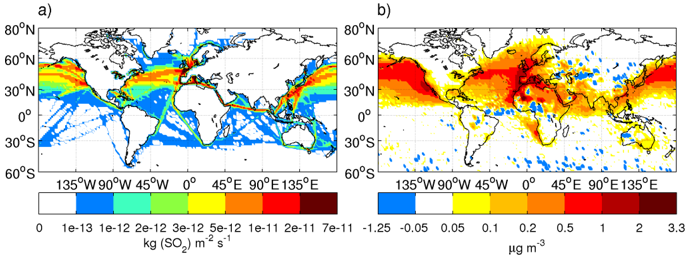
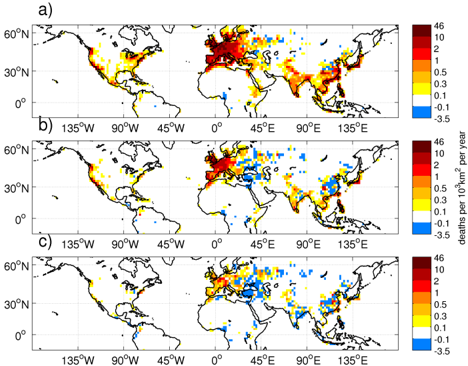
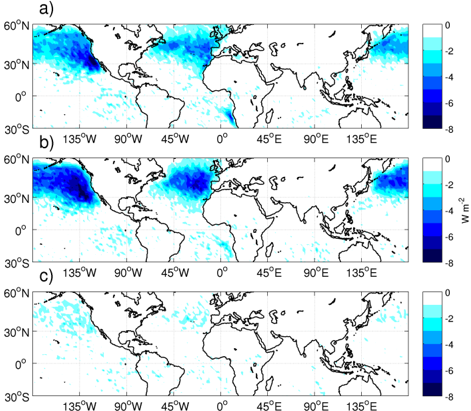
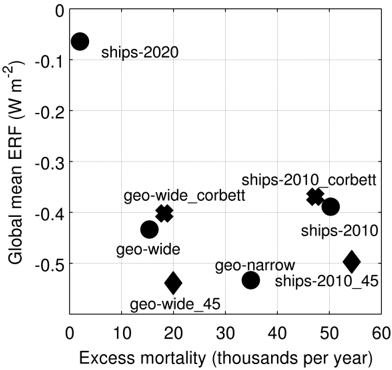
Aerosol particles from shipping emissions both cool the climate and cause adverse health effects. The cooling effect is, however, declining because of shipping emission controls aiming to improve air quality. We used an aerosol-climate model ECHAM-HAMMOZ to test whether by altering ship fuel sulfur content, the present-day aerosol-induced cooling effect from shipping could be preserved, while at the same time reducing premature mortality rates related to shipping emissions. We compared the climate and health effects of a present-day shipping emission scenario (ship fuel sulfur content of 2.7%) with (1) a simulation with strict emission controls in the coastal waters (ship fuel sulfur content of 0.1%) and twofold the present-day fuel sulfur content (i.e. 5.4%) elsewhere; and (2) a scenario with global strict shipping emission controls (ship fuel sulfur content of 0.1% in coastal waters and 0.5% elsewhere) roughly corresponding to international agreements to be enforced by the year 2020. Scenario 1 had a slightly stronger aerosol-induced effective radiative forcing (ERF) from shipping than the present-day scenario (−0.43 W m−2 vs. −0.39 W m−2) while reducing premature mortality from shipping by 69% (globally 34 900 deaths avoided per year). Scenario 2 decreased the ERF to −0.06 W m−2 and annual deaths by 96% (globally 48 200 deaths avoided per year) compared to present-day. Our results show that the cooling effect of present-day emissions could be retained with simultaneous notable improvements in air quality, even though the shipping emissions from the open ocean clearly have a significant effect on continental air quality. However, increasing ship fuel sulfur content in the open ocean would violate existing international treaties, could cause detrimental side-effects, and could be classified as geoengineering.
Overview
The claims and statistics of this paper haven’t been checked yet.
Free: it reads the open-access text and checks the first 5 claims that cite a source we can check. Create a free account to check every claim.
Integrity signals
Registry
Cites
Statistics
Figures
Verification
Claims the paper makes
The claims and statistics of this paper haven’t been checked yet.
Free: it reads the open-access text and checks the first 5 claims that cite a source we can check. Create a free account to check every claim.
Claims other papers make about this one
Each is checked against this paper’s own text: does it say what the citing paper says it does?
The source backs part of the claim, not all of it — or backs it for a different population, condition or comparison.
In the citing paper
“Our estimate of radiative forcing from IMO2020 is well within the range of estimates of the total forcing from shipping emissions in the literature22–25.”
From Abrupt reduction in shipping emission as an inadvertent geoengineering termination shock produces substantial radiative warming (2024) · cites this paper as [25]
Experimental — accuracy not yet measured
Self-check
Percentages, sums and reported differences re-computed from the paper’s own numbers.
The self-check needs the paper’s full text.
Citations
Cites
The ERA‐Interim reanalysis: configuration and performance of the data assimilation system
Dee, D. P., Uppala, S. M., Simmons, A. J., Berrisford, P., Poli, P., Kobayashi, S., Andrae, U., Balmaseda, M. A., Balsamo, G., Bauer, P., et al. (2011) · Quarterly Journal of the Royal Meteorological Society · doi:10.1002/qj.828 · Cited by 24,480
Health Effects of Fine Particulate Air Pollution: Lines that Connect
Pope, C. A., & Dockery, D. W. (2006) · Journal of the Air & Waste Management Association · doi:10.1080/10473289.2006.10464485 · Cited by 6,583
RCP 8.5—A scenario of comparatively high greenhouse gas emissions
Riahi, K., Rao, S., Krey, V., Cho, C., Chirkov, V., Fischer, G., Kindermann, G., Nakicenovic, N., & Rafaj, P. (2011) · Climatic Change · doi:10.1007/s10584-011-0149-y · Cited by 2,791 · cited 3×
“5 scenario (Riahi et al., 2007, 2011), the total global shipping emissions were almost the same in both ships-2010 and ships2010_corbett (Table 1).”
Global indirect aerosol effects: a review
Lohmann, U., & Feichter, J. (2005) · Atmospheric Chemistry and Physics · doi:10.5194/acp-5-715-2005 · Cited by 2,606
Global indirect aerosol effects: a reviewPreprint
Lohmann, U., & Feichter, J. (2004) · doi:10.5194/acpd-4-7561-2004 · Cited by 1,861
Albedo enhancement by stratospheric sulfur injections: a contribution to resolve a policy dilemma?
Crutzen, P. J. (2006) · Climatic Change · doi:10.1007/s10584-006-9101-y · Cited by 1,541 · cited 1×
“However, several technologies using controlled aerosol emissions to cool the climate have been proposed in recent years (e.g. marine cloud whitening, Latham, 1990, and stratospheric sulfur injections, Crutzen, 2006).”
Scenarios of long-term socio-economic and environmental development under climate stabilization
Riahi, K., Grübler, A., & Nakicenovic, N. (2007) · Technological Forecasting and Social Change · doi:10.1016/j.techfore.2006.05.026 · Cited by 1,152 · cited 4×
“The total global shipping emissions are almost equal in the ACCMIP data set and in the combined data set from Wang et al. (2008) and Corbett et al.”
InfluentialThe Global Burden of Disease Due to Outdoor Air Pollution
Cohen, A. J., Ross Anderson, H., Ostro, B., Pandey, K. D., Krzyzanowski, M., Künzli, N., Gutschmidt, K., Pope, A., Romieu, I., Samet, J. M., et al. (2005) · Journal of Toxicology and Environmental Health, Part A · doi:10.1080/15287390590936166 · Cited by 1,124 · cited 4×
“Corbett et al. (2007) and Winebrake et al. (2009) estimated a contribution of ship traffic to PM2.”
InfluentialMortality from Ship Emissions: A Global Assessment
Corbett, J. J., Winebrake, J. J., Green, E. H., Kasibhatla, P., Eyring, V., & Lauer, A. (2007) · Environmental Science & Technology · doi:10.1021/es071686z · Cited by 1,083 · cited 2×
“Corbett et al. (2007) and Winebrake et al. (2009) estimated a contribution of ship traffic to PM2.”
The aerosol-climate model ECHAM5-HAM
Stier, P., Feichter, J., Kinne, S., Kloster, S., Vignati, E., Wilson, J., Ganzeveld, L., Tegen, I., Werner, M., Balkanski, Y., et al. (2005) · Atmospheric Chemistry and Physics · doi:10.5194/acp-5-1125-2005 · Cited by 1,010
Research works printed but not linked: 1
- Lin, H. and Leaitch, W.: Development of an in-cloud aerosol acti- vation parameterization for climate modelling, in: Proceedings of the WMO Workshop on Measurement of Cloud Properties for Forecasts of Weather, Air Quality and Climate, Mexico City, Publisher is World Meteorological Organization (WMO), 328- 335, 1997.
Cited by
(2023) · Climate Change 2021 – The Physical Science Basis · doi:10.1017/9781009157896.008 · Cited by 637
The impact of residential combustion emissions on atmospheric aerosol, human health, and climate
Butt, E. W., Rap, A., Schmidt, A., Scott, C. E., Pringle, K. J., Reddington, C. L., Richards, N. A. D., Woodhouse, M. T., Ramirez-Villegas, J., Yang, H., et al. (2016) · Atmospheric Chemistry and Physics · doi:10.5194/acp-16-873-2016 · Cited by 162
Self-citationMueller, N., Westerby, M., & Nieuwenhuijsen, M. J. (2022) · Environmental Research · doi:10.1016/j.envres.2022.114460 · Cited by 193
Substantial Cloud Brightening From Shipping in Subtropical Low Clouds
Diamond, M. S., Director, H. M., Eastman, R., Possner, A., & Wood, R. (2020) · AGU Advances · doi:10.1029/2019av000111 · Cited by 151
Feng, J., Zhang, Y., Li, S., Mao, J., Patton, A. P., Zhou, Y., Ma, W., Liu, C., Kan, H., Huang, C. Y., et al. (2019) · Atmospheric chemistry and physics · doi:10.5194/acp-19-6167-2019 · Cited by 130
Wood, R. (2021) · Atmospheric Chemistry and Physics · doi:10.5194/acp-21-14507-2021 · Cited by 104
Projection of ship emissions and their impact on air quality in 2030 in Yangtze River delta, China
Zhao, J., Zhang, Y., Patton, A. P., Ma, W., Kan, H., Wu, L., Fung, F., Wang, S., Ding, D., & Walker, K. D. (2020) · Environmental Pollution · doi:10.1016/j.envpol.2020.114643 · Cited by 90
Kleinschmitt, C., Boucher, O., & Platt, U. (2018) · Atmospheric Chemistry and Physics · doi:10.5194/acp-18-2769-2018 · Cited by 84
Yuan, T., Song, H., Oreopoulos, L., Wood, R., Bian, H., Breen, K., Chin, M., Yu, H., Barahona, D., Meyer, K., et al. (2024) · Communications Earth & Environment · doi:10.1038/s43247-024-01442-3 · Cited by 79
“Our estimate of radiative forcing from IMO2020 is well withinthe range of estimatesof the total forcing from shipping emissions in the literature 22 – 25 .”
Global reduction in ship-tracks from sulfur regulations for shipping fuel
Yuan, T., Song, H., Wood, R., Wang, C., Oreopoulos, L., Platnick, S. E., von Hippel, S., Meyer, K., Light, S., & Wilcox, E. (2022) · Science Advances · doi:10.1126/sciadv.abn7988 · Cited by 76
Diamond, M. S. (2023) · Atmospheric Chemistry and Physics · doi:10.5194/acp-23-8259-2023 · Cited by 72
“These IMO 2020 fuel sulfur regulations and the resulting decrease in sulfate aerosol (airborne particulates) are expected to have large benefits to public health (Partanen et al., 2013; Sofiev et al., 2018; Zhang et al., 2021).”
BackgroundPossner, A., Wang, H., Wood, R., Caldeira, K., & Ackerman, T. P. (2018) · Atmospheric Chemistry and Physics · doi:10.5194/acp-18-17475-2018 · Cited by 63
“GCM estimates provide a wide range of CRE changes between −0.6 Wm−2 and −0.07 Wm−2 (Lauer et al., 2007; Righi et al., 2011; Peters et al., 2012; Partanen et al., 2013) due to open-ocean shipping.”
InfluentialGrönholm, T., Mäkelä, T., Hatakka, J., Jalkanen, J.-P., Kuula, J., Laurila, T., Laakso, L., & Kukkonen, J. (2021) · Environmental Science & Technology · doi:10.1021/acs.est.1c03293 · Cited by 74
Self-citationJin, Q., Grandey, B. S., Rothenberg, D., Avramov, A., & Wang, C. (2018) · Atmospheric chemistry and physics · doi:10.5194/acp-18-16793-2018 · Cited by 48
Rantanen, M., & Laaksonen, A. (2024) · npj Climate and Atmospheric Science · doi:10.1038/s41612-024-00582-9 · Cited by 41
Contribution of ship traffic to aerosol particle concentrations downwind of a major shipping lane
Kivekäs, N., Maßling, A., Grythe, H., Lange, R. G., Rusnak, V., Carreno, S. D. C., Skov, H., Swietlicki, E., Nguyen, Q., Glasius, M., et al. (2014) · Atmospheric chemistry and physics · doi:10.5194/acp-14-8255-2014 · Cited by 49
Climate and health implications of future aerosol emission scenarios
Partanen, A., Landry, J., & Matthews, H. D. (2018) · Environmental Research Letters · doi:10.1088/1748-9326/aaa511 · Cited by 49
Self-citationWesterlund, J., Hallquist, M., & Hallquist, Å. M. (2015) · Atmospheric Environment · doi:10.1016/j.atmosenv.2015.04.018 · Cited by 41
Seppälä, S., Kuula, J., Hyvärinen, A., Saarikoski, S., Rönkkö, T., Keskinen, J., Jalkanen, J.-P., & Timonen, H. (2021) · Atmospheric chemistry and physics · doi:10.5194/acp-21-3215-2021 · Cited by 39
Bilsback, K. R., Kerry, D., Croft, B., Ford, B., Jathar, S. H., Carter, E. M., Martin, R. V., & Pierce, J. R. (2020) · Environmental Research Letters · doi:10.1088/1748-9326/abc718 · Cited by 45
“The high forcing estimate in Lauer et al (2009) was driven by a large AIE, while Partanen et al (2013) did not estimate the DRE and AIE separately.”
BackgroundResultInfluentialStrategies of stakeholders’ selection of shore-to-ship power in China
Sheng, J., Tang, L., Yang, Z., Yu, M., & Liu, X. (2023) · Transportation Research Part D Transport and Environment · doi:10.1016/j.trd.2023.103729 · Cited by 33
Possner, A., Zubler, E. M., Lohmann, U., & Schär, C. (2016) · Journal of Geophysical Research Atmospheres · doi:10.1002/2015jd024685 · Cited by 30
IMO2020 Regulations Accelerate Global Warming by up to 3 Years in UKESM1
Jordan, G., & Henry, M. (2024) · Earth s Future · doi:10.1029/2024ef005011 · Cited by 42
Quaglia, I., & Visioni, D. (2024) · Earth System Dynamics · doi:10.5194/esd-15-1527-2024 · Cited by 40
“37 W m − across different studies; see Partanen et al., 2013; Yuan et al., 2024; Yoshioka et al., 2024; Skeie et al., 2024; Forster et al., 2024) This indicates that CESM can better capture short-term forcing changes if the proper emission changes are accounted for, and being more consistent with…”
The impact of the 2020 global sulfur cap on maritime CO2 emissions
Zisi, V., Psaraftis, H. N., & Zis, T. P. V. (2021) · Maritime Business Review · doi:10.1108/mabr-12-2020-0069 · Cited by 24
Peters, K., Quaas, J., Stier, P., & Graßl, H. (2014) · Tellus B · doi:10.3402/tellusb.v66.24054 · Cited by 26
“…al., 2000b; Christensen and Stephens, 2011; Peters et al., 2011; Chen et al., 2012; Goren and Rosenfeld, 2012) and modelling (e.g. Capaldo et al., 1999; Lauer et al., 2007; Wang and Feingold, 2009; Righi et al., 2011; Lund et al., 2012; Peters et al., 2012, 2013; Partanen et al., 2013) approaches.”
BackgroundInfluentialReal-case simulations of aerosol–cloud interactions in ship tracks over the Bay of Biscay
Possner, A., Zubler, E. M., Lohmann, U., & Schär, C. (2015) · Atmospheric chemistry and physics · doi:10.5194/acp-15-2185-2015 · Cited by 19
“Global general circulation model (GCM) simulations yield globally averaged ACIs due to ship emissions between −0.6 and −0.07 Wm−2 (Lauer et al., 2007; Righi et al., 2011; Peters D iscussion P aper | D iscussion P aper | D iscussion P aper | D iscussion P aper | et al., 2012; Partanen et al., 2013).”
BackgroundInfluentialQuantifying the air quality-CO2 tradeoff potential for airports
Ashok, A., Dedoussi, I. C., Yim, S. H. L., Balakrishnan, H., & Barrett, S. R. H. (2014) · Atmospheric Environment · doi:10.1016/j.atmosenv.2014.10.024 · Cited by 23
“…context of household fuel usage (Bailis et al., 2005; Freeman and Zerriffi, 2012), power plants with carbon capture technologies (Koornneef et al., 2010; Tzimas et al., 2007), and alternative-fueled automobiles and marine vessels (Partanen et al., 2013; Lack et al., 2011; MacLean and Lave, 2000).”
BackgroundOn the presence of giant particles downwind of ships in the marine boundary layer
Sorooshian, A., Prabhakar, G., Jonsson, H. H., Woods, R. K., Flagan, R. C., & Seinfeld, J. H. (2015) · Geophysical Research Letters · doi:10.1002/2015gl063179 · Cited by 21
“Most observational studies have focused on particulate emissions with diameters below roughly 1–2μm from marine vessels [e.g., Petzold et al., 2008, 2010; Juwono et al., 2013; Russell et al., 2013; Cappa et al., 2014].”
BackgroundLiu, Z., Zhang, H., Zhang, Y., Liu, X., Ma, Z., Xue, L., Peng, X., Zhao, J., Gong, W., Peng, Q., et al. (2021) · The Science of The Total Environment · doi:10.1016/j.scitotenv.2021.151319 · Cited by 16
Effects of ambient air pollution from shipping on mortality: A systematic review
Kiihamäki, S.-P., Korhonen, M., Kukkonen, J., Shiue, I., & Jaakkola, J. J. K. (2024) · The Science of The Total Environment · doi:10.1016/j.scitotenv.2024.173714 · Cited by 26
Health impact assessment of port-sourced air pollution in Barcelona
Mueller, N., Cirach, M., Ambrós, A., Daher, C., Nieuwenhuijsen, M. J., & Basagaña, X. (2024) · PLoS ONE · doi:10.1371/journal.pone.0305236 · Cited by 18
Multi-model effective radiative forcing of the 2020 sulfur cap for shipping
Skeie, R. B., Byrom, R., Hodnebrog, Ø., Jouan, C., & Myhre, G. (2024) · Atmospheric chemistry and physics · doi:10.5194/acp-24-13361-2024 · Cited by 24
“To calculate the ERF of the 2020 shipping emission regulation in this study, the shipping emission is scaled by a single factor so that the total emission from the shipping sector is reduced by 80%.”
InfluentialImpacts of emission reductions on aerosol radiative effects
Pietikäinen, J., Kupiainen, K., Klimont, Z., Makkonen, R., Korhonen, H., Karinkanta, R., Hyvärinen, A., Karvosenoja, N., Laaksonen, A., Lihavainen, H., et al. (2015) · Atmospheric chemistry and physics · doi:10.5194/acp-15-5501-2015 · Cited by 14
“, 2009; Raes and Seinfeld, 2009) and generated discussions on how to optimally realize future emission reductions (Löndahl et al., 2010; Shindell et al., 2012; Shoemaker et al., 2013; Smith and Mizrahi, 2013; Partanen et al., 2013).”
BackgroundSelf-citationReducing Planetary Health Risks Through Short‐Lived Climate Forcer Mitigation
Zheng, Y., & Unger, N. (2021) · GeoHealth · doi:10.1029/2021gh000422 · Cited by 9
“Shipping has received substantial attention in the sector-based health impacts community in part because of the new fuel-sulfur cap implemented by the International Maritime Organization on January 1, 2020 (Bilsback et al., 2020; Partanen et al., 2013; Sofiev et al., 2018; Winebrake et al., 2009).”
BackgroundMaragkidou, A., Grönholm, T., Rautiainen, L., Nikmo, J., Jalkanen, J.-P., Mäkelä, T., Anttila, T., Laakso, L., & Kukkonen, J. (2025) · Atmospheric chemistry and physics · doi:10.5194/acp-25-2443-2025 · Cited by 8
Self-citationXie, X., Zhang, X., Wang, Y., Lyu, R., Zhou, G., Cheng, T., Liu, Y., Peng, Y., He, Q., Gao, W., et al. (2019) · Aerosol and Air Quality Research · doi:10.4209/aaqr.2018.11.0415 · Cited by 5
Ming, T., de Richter, R. K., Felzer, B. S., & Li, W. (2025) · Atmosphere · doi:10.3390/atmos16040406 · Cited by 5
From nuclear power to coal power: Aerosol‐induced health and radiative effects
Mielonen, T., Laakso, A., Karhunen, A., Kokkola, H., Partanen, A., Korhonen, H., Romakkaniemi, S., & Lehtinen, K. E. J. (2015) · Journal of Geophysical Research Atmospheres · doi:10.1002/2015jd024183 · Cited by 3
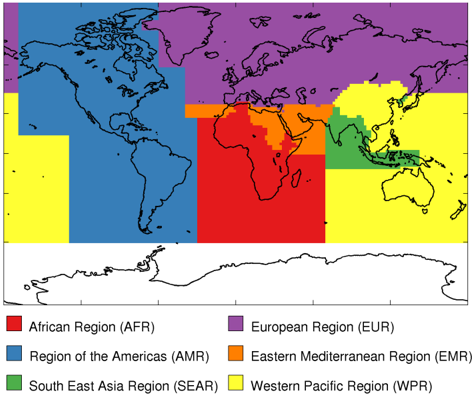
“…mortality rates and the fraction of people in the exposed age group were calculated using data provided by theWorld Health Organization [2008] based on six WHO regions (WHO, www.who.int/about/regions/ en/index.html) [see Partanen et al., 2013, Figure 2] gridded onto themodel grid resolution.”
MethodSelf-citationBaiman, R. P., Baiman, R., Bishop, R., Elsworth, C., Gadian, A. M., Melton, B., Petersen, O., & Tao, Y. (2024) · Oxford Open Climate Change · doi:10.1093/oxfclm/kgae008 · Cited by 3
Substantial Radiative Warming by an Inadvertent Geoengineering Experiment from 2020 Fuel RegulationsPreprint
Yuan, T., Song, H., Oreopoulos, L., Wood, R., Bian, H., Breen, K. H., Chin, M., Yu, H., Barahona, D., Meyer, K., et al. (2023) · Research Square · doi:10.21203/rs.3.rs-3490826/v1 · Cited by 2
Soot particles from shipping: Analysing emission factors
Mauritzson, N. (2015) · Lund University Publications Student Papers (Lund University) · Cited by 1
Wood, R. (2021) · Atmospheric chemistry and physics · doi:10.5194/acp-2021-327-ac1
Wood, R. (2021) · Atmospheric chemistry and physics · doi:10.5194/acp-2021-327-ac2
(2021) · Atmospheric chemistry and physics · doi:10.5194/acp-2021-327-rc1
(2021) · Atmospheric chemistry and physics · doi:10.5194/acp-2021-327-rc2
Diamond, M. (2023) · doi:10.5194/egusphere-2023-971-ac2
Diamond, M. (2023) · doi:10.5194/egusphere-2023-971-ac1
Baiman, R. P., Baiman, R., Bishop, R., Elsworth, C., Gadian, A. M., Melton, B., Petersen, O., & Tao, Y. (2024) · doi:10.22541/essoar.171690792.20111702/v1
Ryan, R. G., Harrison, D. P., Johansson, L., & Schofield, R. (2026) · Communications Earth & Environment · doi:10.1038/s43247-025-03088-1 · Cited by 1
“The overall radiative impact has been modelled on global 15,36 and regional 37,38 scales, with Partanen et al. (2013) determining that the effective radiative forcing from shipping aerosol emissions in 2010 was − 0.39 W m − 2 39 .”
InfluentialHighly light-absorbing particle emissions from low-sulfur marine fuels
Kokkola, T., Sipkens, T. A., Paul, A., Shukla, D., Ihalainen, M., Das, A., Scott, J., Passig, J., Kalamašņikovs, A., Etzien, U., et al. (2026) · npj Climate and Atmospheric Science · doi:10.1038/s41612-026-01369-w · Cited by 1
Kleinschmitt, C. (2017) · theses.fr (ABES) · doi:10.70675/78b286c0z85dfz4f7azb135z7e846d9b03e1 · Cited by 3
Large present-day and future climate forcing due to non-CO2 emissions from global transport
Hendricks, J., Righi, M., Brinkop, S., Dahlmann, K., Mertens, M., Beer, C. G., Grewe, V., Kaiser, C., & Ponater, M. (2026) · npj Climate and Atmospheric Science · doi:10.1038/s41612-026-01383-y
Metadata
- Authors
- Partanen, A. I., Laakso, A., Schmidt, A., Kokkola, H., Kuokkanen, T., Pietikäinen, J.-P., Kerminen, V.-M., Lehtinen, K. E. J., Laakso, L., & Korhonen, H.
- Affiliations
- Finnish Meteorological Institute (FI)
- University of Leeds (GB)
- University of Eastern Finland (FI)
- University of Helsinki (FI)
- ORCID
- Venue
- Atmospheric Chemistry and Physics
- Publisher
- Copernicus GmbH
- Published
- 2013-12-12
- Volume
- 13
- Issue
- 23
- Pages
- 12059-12071
- ISSN
- 1680-7316 (ISSN-L)
- 1680-7324
- OpenAlex
- W2014356338
- Cited by
- 55
- References
- 53
- Citations by year
- 2026: 3 · 2025: 2 · 2024: 9 · 2023: 8 · 2022: 2 · 2021: 10 · 2020: 3 · 2019: 2 · 2018: 4 · 2017: 1 · 2016: 2 · 2015: 6 · 2014: 3
- FWCI
- 3.04
- Type
- journal article
- Language
- en
- Open access
- gold
- doi.org
- Licence
- Locations
- Atmospheric chemistry and physics (publishedVersion, cc-by)
- White Rose Research Online (University of Leeds, The University of Sheffield, University of York) (acceptedVersion)
- DOAJ (DOAJ: Directory of Open Access Journals) (submittedVersion, cc-by-sa)
- Funders
- National Aeronautics and Space Administration
- University of Oxford
- University of Leeds
- Academy of Finland (250348)
- Eidgenössische Technische Hochschule Zürich
- Forschungszentrum Jülich
- Maj ja Tor Nesslingin Säätiö
- Topics
- Physical Sciences › Environmental Science › Environmental Engineering › Maritime Transport Emissions and Efficiency
- Physical Sciences › Environmental Science › Global and Planetary Change › Atmospheric aerosols and clouds
- Physical Sciences › Earth and Planetary Sciences › Atmospheric Science › Atmospheric chemistry and aerosols
- Keywords
- ship emissions, aerosol-climate interactions, effective radiative forcing, premature mortality, air quality, marine aerosols, geoengineering
About these checks
Registry, retraction, Cites and statistics results are computed, not judged, with one exception: a printed reference that no index lists is read once by a model before it counts as a citation error. Claims are extracted by a model and kept only when their quote appears verbatim in the text; each cited source is then checked, with a model’s help, for whether it says what the claim relies on. Those verdicts can be wrong — read the claim’s quote and the cited source before relying on one.
Statistics and arithmetic are recomputed, not judged.
Confidence bands are shown only for fields calibrated on our annotated test set. None is calibrated yet, so no band is shown.
What counts as a claim ›How we measure confidence ›How we check this ›
Are you an author, or do you see a problem with this page? Request a review
Data sources
Bibliographic data: Semantic Scholar, OpenAlex, Crossref.
Contains information from the Semantic Scholar Academic Graph Datasets, made available under the ODC Attribution License (ODC-BY 1.0).
Semantic Scholar’s data is described in: Kinney, R., et al. (2023). The Semantic Scholar Open Data Platform. arXiv:2301.10140.
