

Climate and air quality trade-offs in altering ship fuel sulfur content
Open accessPublished version of a preprint
The DOI matches its Crossref record; 54 of the 54 references it cites were found in a registry or an index.
Abstract
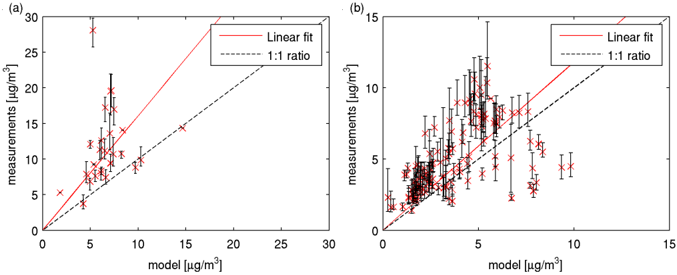
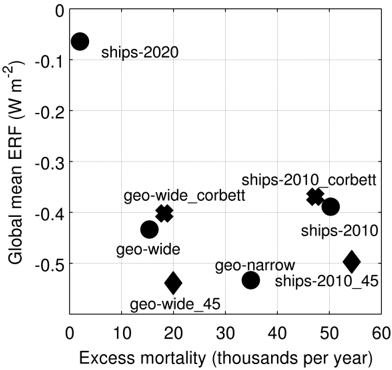
Aerosol particles from shipping emissions both cool the climate and cause adverse health effects. The cooling effect is, however, declining because of shipping emission controls aiming to improve air quality. We used an aerosol-climate model ECHAM-HAMMOZ to test whether by altering ship fuel sulfur content, the present-day aerosol-induced cooling effect from shipping could be preserved, while at the same time reducing premature mortality rates related to shipping emissions. We compared the climate and health effects of a present-day shipping emission scenario (ship fuel sulfur content of 2.7%) with (1) a simulation with strict emission controls in the coastal waters (ship fuel sulfur content of 0.1%) and twofold the present-day fuel sulfur content (i.e. 5.4%) elsewhere; and (2) a scenario with global strict shipping emission controls (ship fuel sulfur content of 0.1% in coastal waters and 0.5% elsewhere) roughly corresponding to international agreements to be enforced by the year 2020. Scenario 1 had a slightly stronger aerosol-induced effective radiative forcing (ERF) from shipping than the present-day scenario (−0.43 W m−2 vs. −0.39 W m−2) while reducing premature mortality from shipping by 69% (globally 34 900 deaths avoided per year). Scenario 2 decreased the ERF to −0.06 W m−2 and annual deaths by 96% (globally 48 200 deaths avoided per year) compared to present-day. Our results show that the cooling effect of present-day emissions could be retained with simultaneous notable improvements in air quality, even though the shipping emissions from the open ocean clearly have a significant effect on continental air quality. However, increasing ship fuel sulfur content in the open ocean would violate existing international treaties, could cause detrimental side-effects, and could be classified as geoengineering.
Overview
The claims and statistics of this paper haven’t been checked yet.
Free: it reads the open-access text and checks the first 5 claims that cite a source we can check. Create a free account to check every claim.
Integrity signals
Registry
Cites
Statistics
Figures
Verification
Claims the paper makes
The claims and statistics of this paper haven’t been checked yet.
Free: it reads the open-access text and checks the first 5 claims that cite a source we can check. Create a free account to check every claim.
Claims other papers make about this one
Each is checked against this paper’s own text: does it say what the citing paper says it does?
The source backs part of the claim, not all of it — or backs it for a different population, condition or comparison.
In the citing paper
“Our estimate of radiative forcing from IMO2020 is well within the range of estimates of the total forcing from shipping emissions in the literature22–25.”
From Abrupt reduction in shipping emission as an inadvertent geoengineering termination shock produces substantial radiative warming (2024) · cites this paper as [25]
Experimental — accuracy not yet measured
Self-check
Percentages, sums and reported differences re-computed from the paper’s own numbers.
The self-check needs the paper’s full text.
Citations
Cites
The ERA‐Interim reanalysis: configuration and performance of the data assimilation system
Dee, D. P., Uppala, S. M., Simmons, A. J., Berrisford, P., Poli, P., Kobayashi, S., Andrae, U., Balmaseda, M. A., Balsamo, G., Bauer, P., et al. (2011) · Quarterly Journal of the Royal Meteorological Society · doi:10.1002/qj.828 · Cited by 24,480
Health Effects of Fine Particulate Air Pollution: Lines that Connect
Pope, C. A., & Dockery, D. W. (2006) · Journal of the Air & Waste Management Association · doi:10.1080/10473289.2006.10464485 · Cited by 6,583
RCP 8.5—A scenario of comparatively high greenhouse gas emissions
Riahi, K., Rao, S., Krey, V., Cho, C., Chirkov, V., Fischer, G., Kindermann, G., Nakicenovic, N., & Rafaj, P. (2011) · Climatic Change · doi:10.1007/s10584-011-0149-y · Cited by 2,791 · cited 3×
“5 scenario (Riahi et al., 2007, 2011), the total global shipping emissions were almost the same in both ships-2010 and ships2010_corbett (Table 1).”
Global indirect aerosol effects: a review
Lohmann, U., & Feichter, J. (2005) · Atmospheric Chemistry and Physics · doi:10.5194/acp-5-715-2005 · Cited by 2,606
Global indirect aerosol effects: a reviewPreprint
Lohmann, U., & Feichter, J. (2004) · doi:10.5194/acpd-4-7561-2004 · Cited by 1,861
Albedo enhancement by stratospheric sulfur injections: a contribution to resolve a policy dilemma?
Crutzen, P. J. (2006) · Climatic Change · doi:10.1007/s10584-006-9101-y · Cited by 1,541 · cited 1×
“However, several technologies using controlled aerosol emissions to cool the climate have been proposed in recent years (e.g. marine cloud whitening, Latham, 1990, and stratospheric sulfur injections, Crutzen, 2006).”
Scenarios of long-term socio-economic and environmental development under climate stabilization
Riahi, K., Grübler, A., & Nakicenovic, N. (2007) · Technological Forecasting and Social Change · doi:10.1016/j.techfore.2006.05.026 · Cited by 1,152 · cited 4×
“The total global shipping emissions are almost equal in the ACCMIP data set and in the combined data set from Wang et al. (2008) and Corbett et al.”
InfluentialThe Global Burden of Disease Due to Outdoor Air Pollution
Cohen, A. J., Ross Anderson, H., Ostro, B., Pandey, K. D., Krzyzanowski, M., Künzli, N., Gutschmidt, K., Pope, A., Romieu, I., Samet, J. M., et al. (2005) · Journal of Toxicology and Environmental Health, Part A · doi:10.1080/15287390590936166 · Cited by 1,124 · cited 4×
“Corbett et al. (2007) and Winebrake et al. (2009) estimated a contribution of ship traffic to PM2.”
InfluentialMortality from Ship Emissions: A Global Assessment
Corbett, J. J., Winebrake, J. J., Green, E. H., Kasibhatla, P., Eyring, V., & Lauer, A. (2007) · Environmental Science & Technology · doi:10.1021/es071686z · Cited by 1,083 · cited 2×
“Corbett et al. (2007) and Winebrake et al. (2009) estimated a contribution of ship traffic to PM2.”
The aerosol-climate model ECHAM5-HAM
Stier, P., Feichter, J., Kinne, S., Kloster, S., Vignati, E., Wilson, J., Ganzeveld, L., Tegen, I., Werner, M., Balkanski, Y., et al. (2005) · Atmospheric Chemistry and Physics · doi:10.5194/acp-5-1125-2005 · Cited by 1,010
Radiative forcing of the direct aerosol effect from AeroCom Phase II simulations
Myhre, G., Samset, B. H., Schulz, M., Balkanski, Y., Bauer, S., Berntsen, T. K., Bian, H., Bellouin, N., Chin, M., Diehl, T., et al. (2013) · Atmospheric Chemistry and Physics · doi:10.5194/acp-13-1853-2013 · Cited by 978 · cited 2×
“We followed the recommendations by Ostro (2004) to calculate the premature mortality from lung cancer (Trachea, bronchus and lung cancers) and cardiopulmonary diseases (cardiovascular diseases and chronic obstructive pulmonary disease) due to long-term exposure to shipping emissions.”
InfluentialTransport impacts on atmosphere and climate: Shipping
Eyring, V., Isaksen, I. S. A., Berntsen, T., Collins, W. J., Corbett, J. J., Endresen, O., Grainger, R. G., Moldanova, J., Schlager, H., & Stevenson, D. S. (2010) · Atmospheric Environment · doi:10.1016/j.atmosenv.2009.04.059 · Cited by 955 · cited 5×
“Different shipping emission inventories differ greatly from each other with respect to both the spatial distribution and the global sum of the emissions (Eyring et al., 2010).”
InfluentialA parameterization of aerosol activation: 2. Multiple aerosol types
Abdul‐Razzak, H., & Ghan, S. J. (2000) · Journal of Geophysical Research: Atmospheres · doi:10.1029/1999jd901161 · Cited by 897 · cited 8×
“First, they used an empirical parameterization (Lin and Leaitch, 1997) for cloud droplet activation as opposed to the physically based parameterization (Abdul-Razzak and Ghan, 2000) in our study.”
InfluentialDentener, F., Kinne, S., Bond, T., Boucher, O., Cofala, J., Generoso, S., Ginoux, P., Gong, S., Hoelzemann, J. J., Ito, A., et al. (2006) · Atmospheric Chemistry and Physics · doi:10.5194/acp-6-4321-2006 · Cited by 887
Black carbon semi-direct effects on cloud cover: review and synthesis
Koch, D., & Del Genio, A. D. (2010) · Atmospheric Chemistry and Physics · doi:10.5194/acp-10-7685-2010 · Cited by 629
M7: An efficient size‐resolved aerosol microphysics module for large‐scale aerosol transport models
Vignati, E., Wilson, J., & Stier, P. (2004) · Journal of Geophysical Research: Atmospheres · doi:10.1029/2003jd004485 · Cited by 514
20 reasons why geoengineering may be a bad idea
Robock, A., Jerch, K., & Bunzl, M. (2008) · Bulletin of the Atomic Scientists · doi:10.1080/00963402.2008.11461140 · Cited by 448
Doney, S. C., Mahowald, N., Lima, I., Feely, R. A., Mackenzie, F. T., Lamarque, J.-F., & Rasch, P. J. (2007) · Proceedings of the National Academy of Sciences · doi:10.1073/pnas.0702218104 · Cited by 403 · cited 2×
“However, the coastal areas, which are most vulnerable to acidification (Doney et al., 2007), had either present-day or decreased sulfur emissions in our simulations, although the coastal impact of acidifying compounds transported from the open oceans cannot be totally excluded based on our simulations.”
Effect of Ship-Stack Effluents on Cloud Reflectivity
Coakley, J. A., Bernstein, R. L., & Durkee, P. A. (1987) · Science · doi:10.1126/science.237.4818.1020 · Cited by 358 · cited 4×
“8 million premature deaths per year (Cohen et al., 2005). Particulate emissions from international shipping have been considered responsible for 18 900– 90 600 deaths per year (Corbett et al., 2007; Winebrake et al., 2009). As the knowledge of the adverse health and environmental effects of shipping emissions has incr…”
InfluentialZhang, K., O'Donnell, D., Kazil, J., Stier, P., Kinne, S., Lohmann, U., Ferrachat, S., Croft, B., Quaas, J., Wan, H., et al. (2012) · Atmospheric Chemistry and Physics · doi:10.5194/acp-12-8911-2012 · Cited by 337 · cited 4×
“We used AEROCOMII ACCMIP data for anthropogenic aerosol emissions and biomass burning emissions for the year 2010 (Riahi et al., 2007, 2011) and natural aerosol emissions as described by Zhang et al. (2012).”
InfluentialArctic shipping emissions inventories and future scenarios
Corbett, J. J., Lack, D. A., Winebrake, J. J., Harder, S., Silberman, J. A., & Gold, M. (2010) · Atmospheric Chemistry and Physics · doi:10.5194/acp-10-9689-2010 · Cited by 270 · cited 3×
“Phys., 13, 12059–12071, 2013 simulations that used the combined shipping emission data compiled by Corbett et al. (2010) for the Arctic and by Wang et al. (2008) for the rest of the world.”
LATHAM, J. (1990) · Nature · doi:10.1038/347339b0 · Cited by 250 · cited 2×
“However, several technologies using controlled aerosol emissions to cool the climate have been proposed in recent years (e.g. marine cloud whitening, Latham, 1990, and stratospheric sulfur injections, Crutzen, 2006).”
Particulate emissions from commercial shipping: Chemical, physical, and optical properties
Lack, D. A., Corbett, J. J., Onasch, T., Lerner, B., Massoli, P., Quinn, P. K., Bates, T. S., Covert, D. S., Coffman, D., Sierau, B., et al. (2009) · Journal of Geophysical Research: Atmospheres · doi:10.1029/2008jd011300 · Cited by 220
Petzold, A., Hasselbach, J., Lauer, P., Baumann, R., Franke, K., Gurk, C., Schlager, H., & Weingartner, E. (2008) · Atmospheric Chemistry and Physics · doi:10.5194/acp-8-2387-2008 · Cited by 218
Winebrake, J. J., Corbett, J. J., Green, E. H., Lauer, A., & Eyring, V. (2009) · Environmental Science & Technology · doi:10.1021/es803224q · Cited by 216 · cited 7×
“Corbett et al. (2007) and Winebrake et al. (2009) estimated a contribution of ship traffic to PM2.”
InfluentialImproving Spatial Representation of Global Ship Emissions Inventories
Wang, C., Corbett, J. J., & Firestone, J. (2008) · Environmental Science & Technology · doi:10.1021/es0700799 · Cited by 208 · cited 4×
“Phys., 13, 12059–12071, 2013 simulations that used the combined shipping emission data compiled by Corbett et al. (2010) for the Arctic and by Wang et al. (2008) for the rest of the world.”
InfluentialClimate impacts of geoengineering marine stratocumulus clouds
Jones, A., Haywood, J., & Boucher, O. (2009) · Journal of Geophysical Research: Atmospheres · doi:10.1029/2008jd011450 · Cited by 191
Lack, D. A., & Corbett, J. J. (2012) · Atmospheric Chemistry and Physics · doi:10.5194/acp-12-3985-2012 · Cited by 186
Total aerosol effect: radiative forcing or radiative flux perturbation?
Lohmann, U., Rotstayn, L., Storelvmo, T., Jones, A., Menon, S., Quaas, J., Ekman, A. M. L., Koch, D., & Ruedy, R. (2010) · Atmospheric Chemistry and Physics · doi:10.5194/acp-10-3235-2010 · Cited by 184
Christensen, M. W., & Stephens, G. L. (2011) · Journal of Geophysical Research · doi:10.1029/2010jd014638 · Cited by 172 · cited 10×
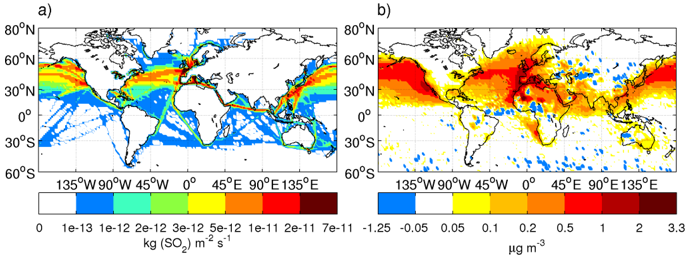
“, 2007, 2011) for the year 2010 (Fig. 1a) in the simulation ships-2010. For the rest of the simulations, we defined the coastal zones within one or two (depending on the simulation) model grid cells away from the continent as emission control areas where fuel sulfur content was assumed to be 0.1 %, corresponding to th…”
InfluentialSensitivity studies of different aerosol indirect effects in mixed-phase clouds
Lohmann, U., & Hoose, C. (2009) · Atmospheric Chemistry and Physics · doi:10.5194/acp-9-8917-2009 · Cited by 167
Shipping contributes to ocean acidification
Hassellöv, I., Turner, D. R., Lauer, A., & Corbett, J. J. (2013) · Geophysical Research Letters · doi:10.1002/grl.50521 · Cited by 141
Shipping Emissions: From Cooling to Warming of Climate—and Reducing Impacts on Health
Fuglestvedt, J., Berntsen, T., Eyring, V., Isaksen, I., Lee, D. S., & Sausen, R. (2009) · Environmental Science & Technology · doi:10.1021/es901944r · Cited by 138 · cited 5×
“While it is important to remember that carbon dioxide emissions from shipping will in the long term dominate over the aerosol emissions when the total radiative impact of shipping emissions is assessed (Fuglestvedt et al., 2009), the change in the fuel sulfur content, which is the focus of this study, is unlikely to h…”
InfluentialGeoengineering by cloud seeding: influence on sea ice and climate system
Rasch, P. J., Latham, J., & Chen, C.-C. (. (2009) · Environmental Research Letters · doi:10.1088/1748-9326/4/4/045112 · Cited by 128
Methane emission from animals: A Global High‐Resolution Data Base
Lerner, J. A., Matthews, E., & FUNG, I. Y. (1988) · Global Biogeochemical Cycles · doi:10.1029/gb002i002p00139 · Cited by 124 · cited 2×
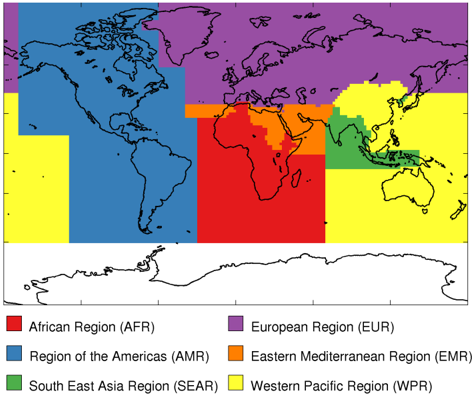
“Definition of the WHO regions based on a list of countries in each region (WHO, 2012) and gridded data set of the world’s countries (Lerner et al., 1988). the major shipping routes passing through the English Channel and Mediterranean Sea (Fig.”
Management of trade-offs in geoengineering through optimal choice of non-uniform radiative forcing
MacMartin, D. G., Keith, D. W., Kravitz, B., & Caldeira, K. (2012) · Nature Climate Change · doi:10.1038/nclimate1722 · Cited by 114
Brovkin, V., Petoukhov, V., Claussen, M., Bauer, E., Archer, D., & Jaeger, C. (2009) · Climatic Change · doi:10.1007/s10584-008-9490-1 · Cited by 104
Size-resolved particle emission factors for individual ships
Jonsson, Å. M., Westerlund, J., & Hallquist, M. (2011) · Geophysical Research Letters · doi:10.1029/2011gl047672 · Cited by 98 · cited 1×
“, 2008; Jonsson et al., 2011). Our choice of diameter for carbonaceous aerosols is close to the value reported by Petzold et al. (2008), who measured the number density of the non-volatile combustion mode to be dominated by particles with radius of 40 nm.”
Precipitation response to regional radiative forcing
Shindell, D. T., Voulgarakis, A., Faluvegi, G., & Milly, G. P. (2012) · Atmospheric chemistry and physics · doi:10.5194/acp-12-6969-2012 · Cited by 97
International Council on Clean Transportation (ICCT) (2007) · Maritime Studies · doi:10.1080/07266472.2007.10878845 · Cited by 92
Nonlinear climate response to regional brightening of tropical marine stratocumulus
Hill, S., & Ming, Y. (2012) · Geophysical Research Letters · doi:10.1029/2012gl052064 · Cited by 72
Direct and indirect effects of sea spray geoengineering and the role of injected particle size
Partanen, A., Kokkola, H., Romakkaniemi, S., Kerminen, V., Lehtinen, K. E. J., Bergman, T., Arola, A., & Korhonen, H. (2012) · Journal of Geophysical Research: Atmospheres · doi:10.1029/2011jd016428 · Cited by 67
Self-citationStevens, R., Pierce, J. R., Brock, C. A., Reed, M. K., Crawford, J. H., Holloway, J. S., Ryerson, T. B., Huey, L. G., & Nowak, J. B. (2012) · Atmospheric chemistry and physics · doi:10.5194/acp-12-189-2012 · Cited by 65
A semi-analytical method for calculating rates of new sulfate aerosol formation from the gas phase
Kazil, J., & Lovejoy, E. R. (2007) · Atmospheric chemistry and physics · doi:10.5194/acp-7-3447-2007 · Cited by 61
Lauer, A., Eyring, V., Corbett, J. J., Wang, C., & Winebrake, J. J. (2009) · Environmental Science & Technology · doi:10.1021/es900922h · Cited by 59 · cited 7×
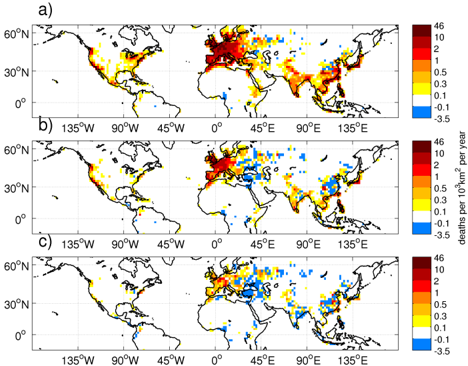
“Furthermore, our model indicates that the shipping emission regulation planned for the year 2020 would substantially reduce both the cooling effect (83 %) and global premature mortality (96 %) caused by aerosol emissions from shipping, confirming the findings of previous studies (Lauer et al., 2009; Winebrake et al.,…”
InfluentialLuo, G., & Yu, F. (2011) · Atmospheric chemistry and physics · doi:10.5194/acp-11-1949-2011 · Cited by 47
Global Indirect Radiative Forcing Caused by Aerosols
Haywood, J., Donner, L., Jones, A., & Golaz, J.-C. (2009) · Clouds in the Perturbed Climate System · doi:10.7551/mitpress/9780262012874.003.0019 · Cited by 40 · cited 2×
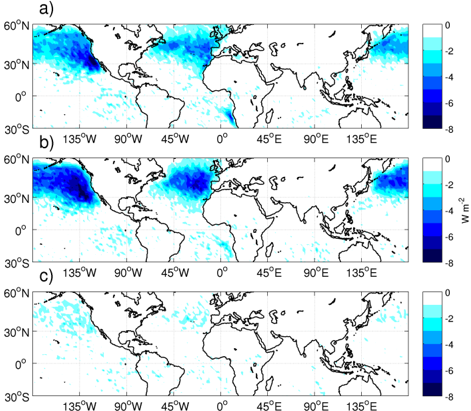
“We estimated the radiative effect of shipping emissions as effective radiative forcing (ERF, also known as radiative flux perturbation, RFP) (Haywood et al., 2009) (i.e. the difference of all-sky top-of-the-atmosphere net (down minus up) total (short- and longwave) radiation between two simulations with fixed sea surf…”
Peters, K., Stier, P., Quaas, J., & Graßl, H. (2012) · Atmospheric Chemistry and Physics · doi:10.5194/acp-12-5985-2012 · Cited by 38 · cited 8×
“The chosen mode diameters are smaller than the default sizes in ECHAM-HAM (Stier et al., 2005; Zhang et al., 2012) reflecting recent measurements of ship emissions (e.g., Petzold et al., 2008; Jonsson et al., 2011).”
InfluentialKling, K. I., Rosenørn, T., Pedersen, J., Larsson, D., Kling, J., Fuglsang, K., & Bilde, M. (2013) · Aerosol Science and Technology · doi:10.1080/02786826.2013.813012 · Cited by 36 · cited 1×
“Lieke et al. (2013) measured also crystalline salts in the ship ex- hausts.”
Löndahl, J., Swietlicki, E., Lindgren, E., & Loft, S. H. (2010) · Atmospheric chemistry and physics · doi:10.5194/acp-10-9441-2010 · Cited by 33
Global Indirect Radiative Forcing Caused by Aerosols: IPCC (2007) and Beyond
Haywood, J., Donner, L. J., Jones, A., & Golaz, J. (2009) · The MIT Press eBooks · doi:10.7551/mitpress/8300.003.0021 · Cited by 24
Fox, T. A., & Chapman, L. (2011) · Meteorological Applications · doi:10.1002/met.245 · Cited by 22 · cited 1×
“In a broader context, these technologies are known as solar radiation management (SRM) or geoengineering (Fox and Chapman, 2011).”
Peters, K., Stier, P., Quaas, J., & Graßl, H. (2013) · Atmospheric Chemistry and Physics · doi:10.5194/acp-13-6429-2013 · Cited by 17 · cited 7×
“There are two major differences between our study and the simulations by Peters et al. (2012).”
InfluentialRedgwell, C. J. (2011) · Carbon & Climate Law Review · doi:10.21552/cclr/2011/2/177 · Cited by 16
Research works printed but not linked: 1
- Lin, H. and Leaitch, W.: Development of an in-cloud aerosol acti- vation parameterization for climate modelling, in: Proceedings of the WMO Workshop on Measurement of Cloud Properties for Forecasts of Weather, Air Quality and Climate, Mexico City, Publisher is World Meteorological Organization (WMO), 328- 335, 1997.
Cited by
(2023) · Climate Change 2021 – The Physical Science Basis · doi:10.1017/9781009157896.008 · Cited by 637
The impact of residential combustion emissions on atmospheric aerosol, human health, and climate
Butt, E. W., Rap, A., Schmidt, A., Scott, C. E., Pringle, K. J., Reddington, C. L., Richards, N. A. D., Woodhouse, M. T., Ramirez-Villegas, J., Yang, H., et al. (2016) · Atmospheric Chemistry and Physics · doi:10.5194/acp-16-873-2016 · Cited by 162
Self-citationMueller, N., Westerby, M., & Nieuwenhuijsen, M. J. (2022) · Environmental Research · doi:10.1016/j.envres.2022.114460 · Cited by 193
Substantial Cloud Brightening From Shipping in Subtropical Low Clouds
Diamond, M. S., Director, H. M., Eastman, R., Possner, A., & Wood, R. (2020) · AGU Advances · doi:10.1029/2019av000111 · Cited by 151
Feng, J., Zhang, Y., Li, S., Mao, J., Patton, A. P., Zhou, Y., Ma, W., Liu, C., Kan, H., Huang, C. Y., et al. (2019) · Atmospheric chemistry and physics · doi:10.5194/acp-19-6167-2019 · Cited by 130
Metadata
- Authors
- Partanen, A. I., Laakso, A., Schmidt, A., Kokkola, H., Kuokkanen, T., Pietikäinen, J.-P., Kerminen, V.-M., Lehtinen, K. E. J., Laakso, L., & Korhonen, H.
- Affiliations
- Finnish Meteorological Institute (FI)
- University of Leeds (GB)
- University of Eastern Finland (FI)
- University of Helsinki (FI)
- ORCID
- Venue
- Atmospheric Chemistry and Physics
- Publisher
- Copernicus GmbH
- Published
- 2013-12-12
- Volume
- 13
- Issue
- 23
- Pages
- 12059-12071
- ISSN
- 1680-7316 (ISSN-L)
- 1680-7324
- OpenAlex
- W2014356338
- Cited by
- 55
- References
- 53
- Citations by year
- 2026: 3 · 2025: 2 · 2024: 9 · 2023: 8 · 2022: 2 · 2021: 10 · 2020: 3 · 2019: 2 · 2018: 4 · 2017: 1 · 2016: 2 · 2015: 6 · 2014: 3
- FWCI
- 3.04
- Type
- journal article
- Language
- en
- Open access
- gold
- doi.org
- Licence
- Locations
- Atmospheric chemistry and physics (publishedVersion, cc-by)
- White Rose Research Online (University of Leeds, The University of Sheffield, University of York) (acceptedVersion)
- DOAJ (DOAJ: Directory of Open Access Journals) (submittedVersion, cc-by-sa)
- Funders
- National Aeronautics and Space Administration
- University of Oxford
- University of Leeds
- Academy of Finland (250348)
- Eidgenössische Technische Hochschule Zürich
- Forschungszentrum Jülich
- Maj ja Tor Nesslingin Säätiö
- Topics
- Physical Sciences › Environmental Science › Environmental Engineering › Maritime Transport Emissions and Efficiency
- Physical Sciences › Environmental Science › Global and Planetary Change › Atmospheric aerosols and clouds
- Physical Sciences › Earth and Planetary Sciences › Atmospheric Science › Atmospheric chemistry and aerosols
- Keywords
- ship emissions, aerosol-climate interactions, effective radiative forcing, premature mortality, air quality, marine aerosols, geoengineering
About these checks
Registry, retraction, Cites and statistics results are computed, not judged, with one exception: a printed reference that no index lists is read once by a model before it counts as a citation error. Claims are extracted by a model and kept only when their quote appears verbatim in the text; each cited source is then checked, with a model’s help, for whether it says what the claim relies on. Those verdicts can be wrong — read the claim’s quote and the cited source before relying on one.
Statistics and arithmetic are recomputed, not judged.
Confidence bands are shown only for fields calibrated on our annotated test set. None is calibrated yet, so no band is shown.
What counts as a claim ›How we measure confidence ›How we check this ›
Are you an author, or do you see a problem with this page? Request a review
Data sources
Bibliographic data: Semantic Scholar, OpenAlex, Crossref.
Contains information from the Semantic Scholar Academic Graph Datasets, made available under the ODC Attribution License (ODC-BY 1.0).
Semantic Scholar’s data is described in: Kinney, R., et al. (2023). The Semantic Scholar Open Data Platform. arXiv:2301.10140.
