

Global anthropogenic emissions of particulate matter including black carbon
Open accessPublished version of a preprint
The DOI matches its Crossref record; 224 of the 226 references it cites were found in a registry or an index.
Abstract
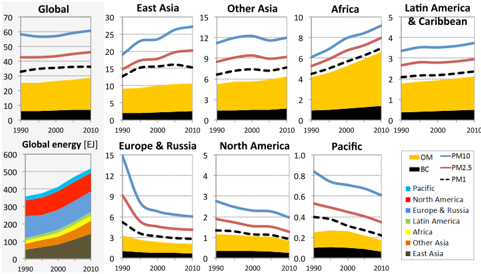
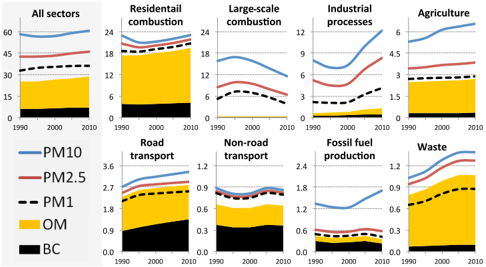
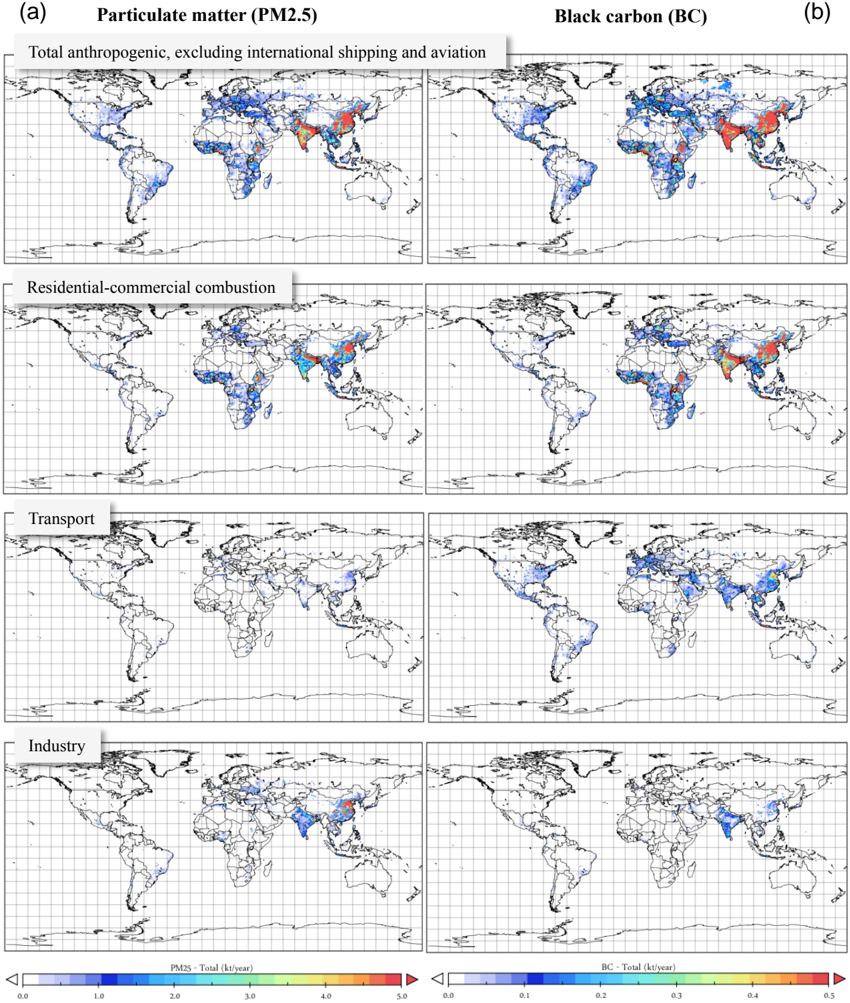
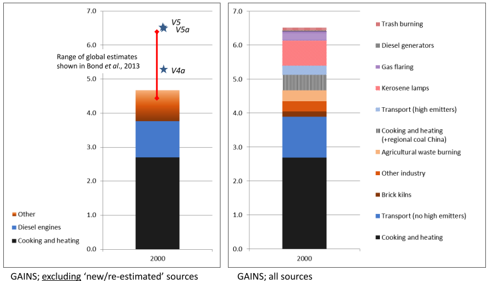
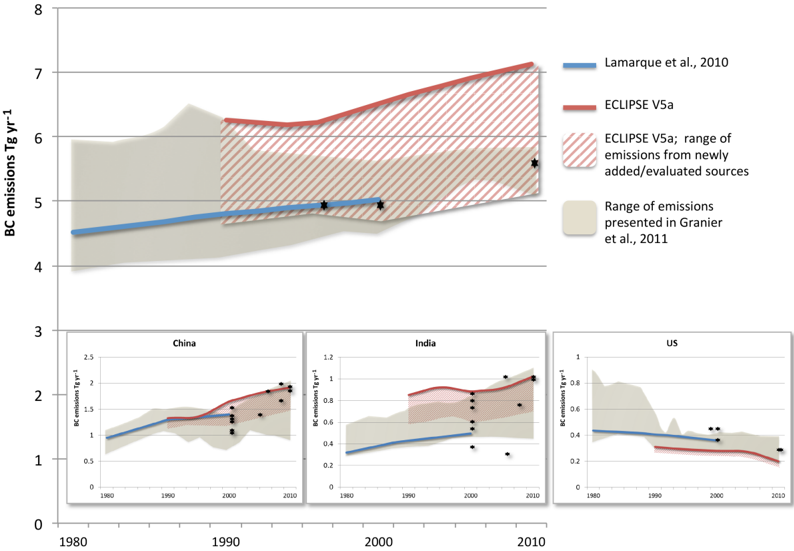
This paper presents a comprehensive assessment of historical (1990–2010) global anthropogenic particulate matter (PM) emissions including the consistent and harmonized calculation of mass-based size distribution (PM1, PM2. 5, PM10), as well as primary carbonaceous aerosols including black carbon (BC) and organic carbon (OC). The estimates were developed with the integrated assessment model GAINS, where source- and region-specific technology characteristics are explicitly included. This assessment includes a number of previously unaccounted or often misallocated emission sources, i.e. kerosene lamps, gas flaring, diesel generators, refuse burning; some of them were reported in the past for selected regions or in the context of a particular pollutant or sector but not included as part of a total estimate. Spatially, emissions were calculated for 172 source regions (as well as international shipping), presented for 25 global regions, and allocated to 0.5° × 0.5° longitude–latitude grids. No independent estimates of emissions from forest fires and savannah burning are provided and neither windblown dust nor unpaved roads emissions are included. We estimate that global emissions of PM have not changed significantly between 1990 and 2010, showing a strong decoupling from the global increase in energy consumption and, consequently, CO2 emissions, but there are significantly different regional trends, with a particularly strong increase in East Asia and Africa and a strong decline in Europe, North America, and the Pacific region. This in turn resulted in important changes in the spatial pattern of PM burden, e.g. European, North American, and Pacific contributions to global emissions dropped from nearly 30 % in 1990 to well below 15 % in 2010, while Asia's contribution grew from just over 50 % to nearly two-thirds of the global total in 2010. For all PM species considered, Asian sources represented over 60 % of the global anthropogenic total, and residential combustion was the most important sector, contributing about 60 % for BC and OC, 45 % for PM2. 5, and less than 40 % for PM10, where large combustion sources and industrial processes are equally important. Global anthropogenic emissions of BC were estimated at about 6.6 and 7.2 Tg in 2000 and 2010, respectively, and represent about 15 % of PM2. 5 but for some sources reach nearly 50 %, i.e. for the transport sector. Our global BC numbers are higher than previously published owing primarily to the inclusion of new sources. This PM estimate fills the gap in emission data and emission source characterization required in air quality and climate modelling studies and health impact assessments at a regional and global level, as it includes both carbonaceous and non-carbonaceous constituents of primary particulate matter emissions. The developed emission dataset has been used in several regional and global atmospheric transport and climate model simulations within the ECLIPSE (Evaluating the Climate and Air Quality Impacts of Short-Lived Pollutants) project and beyond, serves better parameterization of the global integrated assessment models with respect to representation of black carbon and organic carbon emissions, and built a basis for recently published global particulate number estimates.
Overview
The claims and statistics of this paper haven’t been checked yet.
Free: it reads the open-access text and checks the first 5 claims that cite a source we can check. Create a free account to check every claim.
Integrity signals
Registry
Cites
Statistics
Figures
Verification
Claims the paper makes
The claims and statistics of this paper haven’t been checked yet.
Free: it reads the open-access text and checks the first 5 claims that cite a source we can check. Create a free account to check every claim.
Claims other papers make about this one
Each is checked against this paper’s own text: does it say what the citing paper says it does?
The source backs part of the claim, not all of it — or backs it for a different population, condition or comparison.
In the citing paper
“specifically, it contributes 11% to total global particulate matter <2.5 µm (PM2.5) emissions and 6–7% to total global black carbon (BC) emissions31,32.”
From Potential for future reductions of global GHG and air pollutants from circular waste management systems (2022) · cites this paper as [32]
Experimental — accuracy not yet measuredThe source backs part of the claim, not all of it — or backs it for a different population, condition or comparison.
In the citing paper
“However, comparing CH4 emissions from MSW in the Eclipse_V5a32 to this study, we can see that the estimate in the latter is 6% higher.”
From Potential for future reductions of global GHG and air pollutants from circular waste management systems (2022) · cites this paper as [32]
Experimental — accuracy not yet measuredThe cited source says what the claim attributes to it.
In the citing paper
“In contrast, our results for particulate matter are 60% higher than those from ref. 32.”
From Potential for future reductions of global GHG and air pollutants from circular waste management systems (2022) · cites this paper as [32]
The cited source says what the claim attributes to it.
In the citing paper
“and 57% higher than the estimate of ref. 32”
From Potential for future reductions of global GHG and air pollutants from circular waste management systems (2022) · cites this paper as [32]
Self-check
Percentages, sums and reported differences re-computed from the paper’s own numbers.
The self-check needs the paper’s full text.
Citations
Cites
Items 201–224 of 224
Armas, O., Gómez, A., & Herreros, J. M. (2007) · Measurement Science and Technology · doi:10.1088/0957-0233/18/7/044 · Cited by 24
[Emission characteristics of fine particles from grate firing boilers].
Wang, S., Zhao, X., Li, X., Wei, W., & Hao, J. (2009) · PubMed · Cited by 24
Russia's black carbon emissions: focus on diesel sources
Kholod, N., Evans, M., & Kuklinski, T. (2016) · Atmospheric chemistry and physics · doi:10.5194/acp-16-11267-2016 · Cited by 24 · cited 1×
“The contribution from diesel engines used in agriculture, construction, mining, rail, shipping, and as back-up generators has been increasing, not least because the emission legislation lags behind that for road transport, but has been receiving more attention recently (e.g., Kholod et al., 2016).”
BackgroundTang, N., Apte, J. S., Martien, P. T., & Kirchstetter, T. W. (2015) · Atmospheric Environment · doi:10.1016/j.atmosenv.2015.05.001 · Cited by 22 · cited 2×
“2), more recent emission factors for diesel locomotives (e.g., Johnson et al., 2013; Tang et al., 2015) are compared with GAINS in Table S4.”
BackgroundResultInfluential(2014) · Carbon Management · doi:10.4155/cmt.13.82 · Cited by 16
Louhelainen, K., Vilhunen, P., Kangas, J., & Eo, T. (1987) · PubMed · Cited by 16
CDM potential of SPV lighting systems in India
Purohit, P., & Michaelowa, A. (2007) · Mitigation and Adaptation Strategies for Global Change · doi:10.1007/s11027-006-9078-x · Cited by 15 · cited 1×
“For India, information about the share of lighting devices (i.e., wick lamps, hurricane lanterns), operating hours, specific kerosene consumption are derived from regional studies (Desai et al., 2010; Mahapatra et al., 2009; Purohit and Michaelowa, 2008).”
BackgroundSelf-citationJacobson, A. E., Bond, T. C., Lam, N. L., & Hultman, N. (2013) · OSTI OAI (U.S. Department of Energy Office of Scientific and Technical Information) · Cited by 15
The Technology-Energy-Environment-Health (TEEH) Chain in China: A Case Study of Cokemaking
Polenske, K. R. (2006) · Alliance for Global Sustainability bookseries · doi:10.1007/1-4020-4236-1 · Cited by 14 · cited 1×
“China’s coke sector undergoes a significant transformation moving from low efficiency and high emission indigenous ovens to highly mechanized recovery ovens, following the world trend (Huo et al., 2012; Polenske, 2006).”
BackgroundFuture Arctic temperature change resulting from a range of aerosol emissions scenarios
Wobus, C. W., Flanner, M. G., Sarofim, M. C., Moura, M. C. P., & Smith, S. J. (2016) · Earth s Future · doi:10.1002/2016ef000361 · Cited by 14
Mukai, S., Nakata, M., Yasumoto, M., Sano, I., & Kokhanovsky, A. A. (2015) · Frontiers in Environmental Science · doi:10.3389/fenvs.2015.00057 · Cited by 12 · cited 1×
“These 5 emissions have been also linked with heavy smog and haze episodes (e.g., Mukai et al., 2015; Stohl et al., 2007).”
BackgroundPaasonen, P., Visshedjik, A., Kupiainen, K., Klimont, Z., van der Gon, H. D., & Kulmala, M. (2013) · IIASA PURE (International Institute of Applied Systems Analysis) · Cited by 12
Self-citationCoquelin, L., Fischer, N., Motzkus, C., Macé, T., Gensdarmes, F., Brusquet, L. L., & Fleury, G. (2013) · Journal of Physics Conference Series · doi:10.1088/1742-6596/429/1/012018 · Cited by 11 · cited 1×
“(2013) discussed specific issues related to BC and OC aerosols, while for PM size distribution there exists specific analysis for particular measurement equipment (e.g. Armas et al., 2007; Coquelin et al., 2013) and most of the studies reporting measurements of size distribution estimate uncertainties for each size ca…”
BackgroundCurrent and near-term emission control strategies for diesel powered generator sets
Herzog, J. W. (2003) · International Telecommunications Energy Conference (INTELEC) · doi:10.1109/intlec.2002.1048686 · Cited by 11 · cited 3×
“In case new information will become available and for future implementation of respective policies, the GAINS model includes a number of post-combustion control technologies such as diesel particulate 30 filters (DPFs), diesel oxidation catalysts (DOC), and fuel-borne catalysts (FBC) offering reduction of gaseous and…”
BackgroundMethodA Module to Calculate Primary Particulate Matter Emissions and Abatement Measures in Europe
Lükewille, A., Bertok, I., Amann, M. C., Cofała, J., Gyarfas, F., Johansson, M., Klimont, Z., Pacyna, E. G., & Pacyna, J. M. (2001) · Water Air & Soil Pollution · doi:10.1023/a:1013807101561 · Cited by 9 · cited 1×
“Such an approach has been an integral part of the GAINS model development for both particulate matter (e.g., Klimont et al., 2002b; Lükewille et al., 2001) and other pollutants (e.g., Amann et al., 2011; Cofala and Syri, 1998; Klimont et al., 2002a); 20 the details for PM are documented in Klimont…”
MethodSelf-citationREMOTE SENSING MEASUREMENTS OF REAL WORLD HIGH EXHAUST EMITTERS.
McClintock, P. V. E. (1999) · ROSA P · Cited by 9
Wood-Smoke Handbook: Woodheaters, Firewood and Operator Practice
Todd, J. J. (2003) · eCite Digital Repository (University of Tasmania) · Cited by 8
Emissions removal efficiency from diesel gensets using aftermarket PM controls
Yelverton, T. L. B., Holder, A. L., & Pavlovic, J. (2015) · Clean Technologies and Environmental Policy · doi:10.1007/s10098-015-0900-6 · Cited by 6 · cited 1×
“…as diesel particulate filters (DPFs), diesel oxidation catalysts (DOC), and fuel-borne catalysts (FBC) offer an array of options for mitigation or elimination of gaseous and particulate emissions, and can be utilized for both on- and off-road applications (Herzog, 2002; Yelverton et al., 2016).”
BackgroundOpen burning of domestic wastes: The single largest source of dioxin?
Neurath, C. (2003) · Organohalogen compounds · Cited by 4
Assessment of Environmental Impact of Power Generation in Banking Industry
Ani, V. A., Nnene, E. A., & Ani, E. O. (2013) · Journal of Energy Environment and Carbon Credits · Cited by 2
An inventory of primary gaseous emissions from Thailand with spatial and temporal allocation profile
Vongmahadlek, C., Thao, P. T. B., Satayopas, B., & Thongboonchu, N. (2008) · International Conference on Energy & Environment · Cited by 1
A Model Municipal By-Law for regulating wood burning appliances
Germain, A., Granger, F., & Gosselin, A. (2008) · WIT transactions on ecology and the environment · doi:10.2495/air080631 · Cited by 1 · cited 1×
“…papers (e.g., Klimont 25 et al., 2009; Lewis and Pattanayak, 2012; Li et al., 2016; Pine et al., 2011; Ruiz-Mercado et al., 2011; Shrimali et al., 2011; Silk et al., 2012; Troncoso et al., 2011), and published reports (Adria and Bethge, 2013; Germain et al., 2008; Scott, 2005; Todd, 2003).”
BackgroundSupplemental Material to `Effect of E85 on Tailpipe Emissions from Light-Duty Vehicles`
Cadle, S. H., Ayala, A., Black, K. N., Graze, R. R., Koupal, J. W., Minassian, F., Murray, H. B., Natarajan, M., Zhu, F., Takaoka, M., et al. (2009) · Journal of the Air & Waste Management Association · doi:10.3155/1047-3289.59.2.172_supplmaterial · Cited by 1
Das Rednerkatapult: Warum Kongresse kreative Vorträge brauchen
Danz, G. (2014) · Springer eBooks · doi:10.1007/978-3-658-04148-9_3 · Cited by 1
Research works printed but not linked: 9
- 61. Desai, S., Dubey, A., Joshi, B. L., Sen, M., Shariff, A., and Vanne- man, R.: Human Development in India: Challenges for a Society in Transition, Oxford University Press, New Delhi, India, 2010.
- 82. GEA: Global Energy Assessment: Toward a Sustainable Future, Cambridge University Press, UK, 2012.
- 147. Lawson, D. R.: (On-Road) Mobile Source Emissions and Mitigation Potential, Workshop on Addressing Black Carbon and Ozone as Short-Lived Climate Forcers, Chapel Hill, North Carolina, US, 3-4 March 2010.
- 168. Maíz, P.: Experiencias en Medición de Emisiones en Hornos para Manufactura Artesanal de Ladrillos en Mexico, available at: http://www.inecc.gob.mx/descargas/dgcenica/2012_ladrilleras_ pon_s4_pmaiz_eng.pdf (last access: 4 July 2017), a presentation at: Workshop on public policies to mitigate environmental impact of artisanal brick production, Guanajuato, Mexico, 4-6 September 2012.
- 182. NEA: A Year in Review: Fiscal Year 2011/2012, Nepal Electricity Authority (NEA), Kathmandu, 2012.
- 219. Riahi, K., Dentener, F., Gielen, D., Grubler, A., Jewell, J., Klimont, Z., Krey, V., McCollum, D., Pachauri, S., Rao, S., van Ruijven, B., van Vuuren, D. P., and Wilson, C.: Chapter 17 -Energy Pathways for Sustainable Development, in Global Energy As- sessment -Toward a Sustainable Future, 1203-1306, Cambridge University Press, Cambridge, UK and New York, NY, USA and the International Institute for Applied Systems Analysis, Lax- enburg, Austria, available at: www.globalenergyassessment.org (last access: 4 July 2017), 2012.
- 227. Schilderman, T. and Mason, K.: Using residues as fuel in small- scale brickmaking, in Proceedings of the 11th International Con- ference on Non-conventional Materials and Technologies (NOC- MAT 2009), Bath, UK, 6-9 September 2009.
- 234. Shafizadeh, K., Niemeier, D., and Eisinger, D. S.: Gross Emit- ting Vehicles: A Review of the Literature, Caltrans Air Quality Project, US Davis, 2004.
- 270. US EPA: Compilation of Air Pollutant Emission Factors -Volume I: Stationary Point and Area Sources. AP-42 5th Edition, US Environmental Protection Agency (US EPA), Springfield, VA, 1995.
Cited by
Hoesly, R. M., Smith, S. J., Feng, L., Klimont, Z., Janssens-Maenhout, G., Pitkanen, T., Seibert, J. J., Vu, L., Andres, R. J., Bolt, R. M., et al. (2018) · Geoscientific Model Development · doi:10.5194/gmd-11-369-2018 · Cited by 2,203
“Klimont et al. (2017a) recently estimated BC and OC emissions from this sector, estimating that 875 from 115 to 160 Tg of waste was openly burned, while Wiedinmyer et al.”
BackgroundMethodInfluentialSelf-citationPollution and health: a progress update
Fuller, R., Landrigan, P. J., Balakrishnan, K., Bathan, G., Bose-O'Reilly, S., Brauer, M., Caravanos, J., Chiles, T., Cohen, A., Corra, L., et al. (2022) · The Lancet Planetary Health · doi:10.1016/s2542-5196(22)00090-0 · Cited by 2,143
Anthropogenic emission inventories in China: a review
Li, M., Liu, H., Geng, G., Hong, C., Liu, F., Song, Y., Tong, D., Zheng, B., Cui, H., Man, H., et al. (2017) · National Science Review · doi:10.1093/nsr/nwx150 · Cited by 1,304
Effect of restricted emissions during COVID-19 on air quality in India
Sharma, S., Zhang, M., Anshika, Gao, J., Zhang, H., & Kota, S. H. (2020) · Science of The Total Environment · doi:10.1016/j.scitotenv.2020.138878 · Cited by 1,150
“5 could be due to its greater contribution from anthropogenic sources (Klimont et al., 2017).”
BackgroundAtmospheric transport is a major pathway of microplastics to remote regions
Evangeliou, N., Grythe, H., Klimont, Z., Heyes, C., Eckhardt, S., Lopez-Aparicio, S., & Stohl, A. (2020) · Nature Communications · doi:10.1038/s41467-020-17201-9 · Cited by 1,118
Self-citation
Metadata
- Authors
- Klimont, Z., Kupiainen, K., Heyes, C., Purohit, P., Cofala, J., Rafaj, P., Borken-Kleefeld, J., & Schöpp, W.
- Affiliations
- International Institute for Applied Systems Analysis (AT)
- Corresponding author
- Klimont, Zbigniew
- Venue
- Atmospheric Chemistry and Physics
- Publisher
- Copernicus GmbH
- Published
- 2017-07-17
- Volume
- 17
- Issue
- 14
- Pages
- 8681-8723
- ISSN
- 1680-7316 (ISSN-L)
- 1680-7324
- OpenAlex
- W2537132227
- Cited by
- 878
- References
- 226
- Citations by year
- 2026: 59 · 2025: 84 · 2024: 80 · 2023: 108 · 2022: 143 · 2021: 165 · 2020: 90 · 2019: 65 · 2018: 48 · 2017: 26
- FWCI
- 36.31
- Type
- journal article
- Language
- en
- Open access
- gold
- doi.org
- Licence
- Locations
- Atmospheric chemistry and physics (publishedVersion, cc-by)
- IIASA PURE (International Institute of Applied Systems Analysis) (acceptedVersion)
- IIASA PURE (International Institute of Applied Systems Analysis) (submittedVersion)
- DOAJ (DOAJ: Directory of Open Access Journals) (submittedVersion, cc-by-sa)
- Zenodo (CERN European Organization for Nuclear Research) (submittedVersion, cc-by)
- Funders
- Seventh Framework Programme (282688)
- Topics
- Physical Sciences › Earth and Planetary Sciences › Atmospheric Science › Atmospheric chemistry and aerosols
- Physical Sciences › Environmental Science › Health, Toxicology and Mutagenesis › Air Quality and Health Impacts
- Physical Sciences › Environmental Science › Environmental Engineering › Maritime Transport Emissions and Efficiency
- Keywords
- black carbon, organic carbon, PM2.5, PM10, PM1, size distribution, residential combustion, kerosene lamps, gas flaring, diesel generator, waste burning, GAINS model, East Asia
About these checks
Registry, retraction, Cites and statistics results are computed, not judged, with one exception: a printed reference that no index lists is read once by a model before it counts as a citation error. Claims are extracted by a model and kept only when their quote appears verbatim in the text; each cited source is then checked, with a model’s help, for whether it says what the claim relies on. Those verdicts can be wrong — read the claim’s quote and the cited source before relying on one.
Statistics and arithmetic are recomputed, not judged.
Confidence bands are shown only for fields calibrated on our annotated test set. None is calibrated yet, so no band is shown.
What counts as a claim ›How we measure confidence ›How we check this ›
Are you an author, or do you see a problem with this page? Request a review
Data sources
Bibliographic data: Semantic Scholar, OpenAlex, Crossref.
Contains information from the Semantic Scholar Academic Graph Datasets, made available under the ODC Attribution License (ODC-BY 1.0).
Semantic Scholar’s data is described in: Kinney, R., et al. (2023). The Semantic Scholar Open Data Platform. arXiv:2301.10140.
