

Global anthropogenic emissions of particulate matter including black carbon
Open accessPublished version of a preprint
The DOI matches its Crossref record; 224 of the 226 references it cites were found in a registry or an index.
Abstract
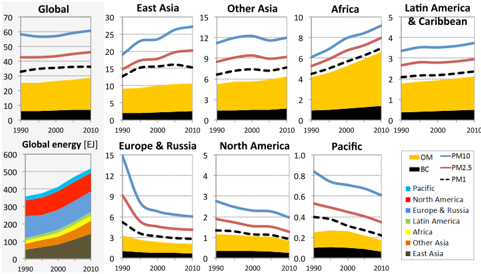
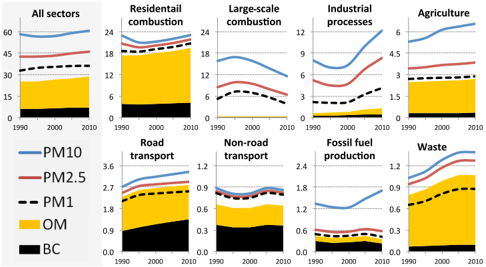
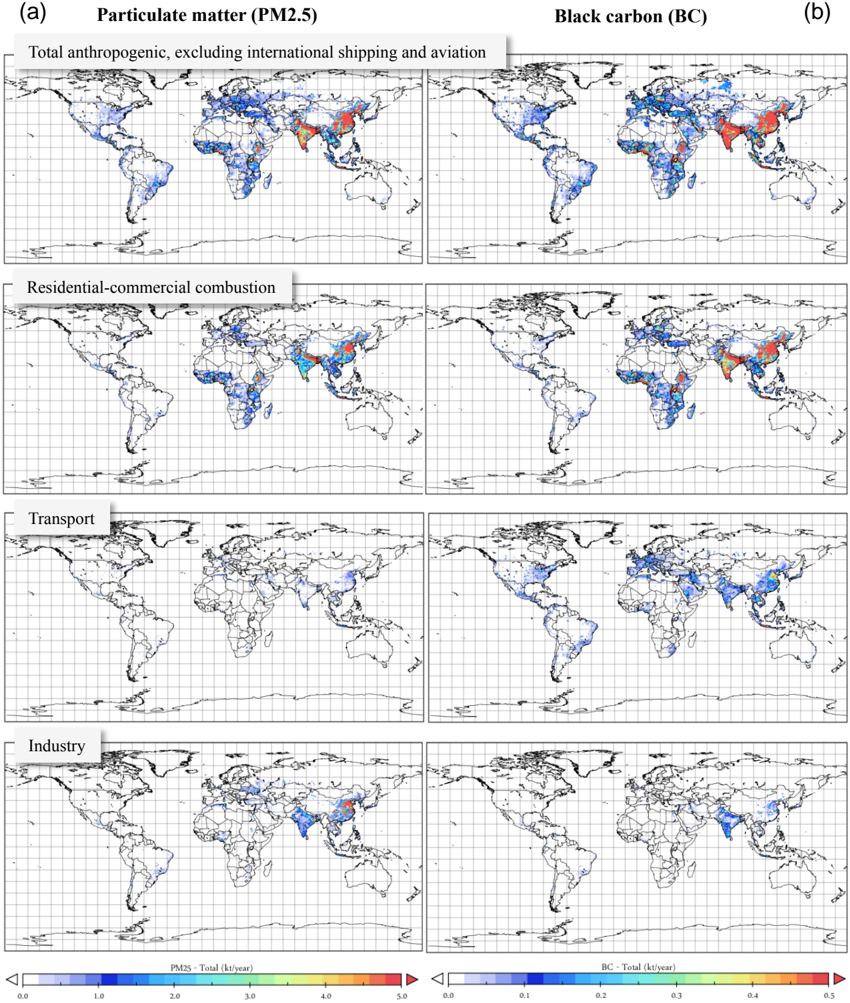
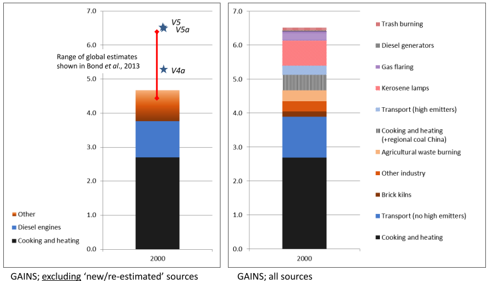
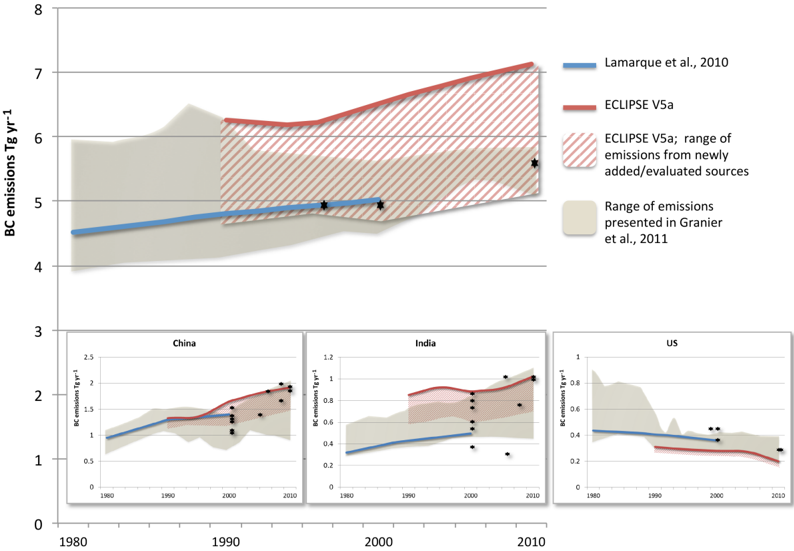
This paper presents a comprehensive assessment of historical (1990–2010) global anthropogenic particulate matter (PM) emissions including the consistent and harmonized calculation of mass-based size distribution (PM1, PM2. 5, PM10), as well as primary carbonaceous aerosols including black carbon (BC) and organic carbon (OC). The estimates were developed with the integrated assessment model GAINS, where source- and region-specific technology characteristics are explicitly included. This assessment includes a number of previously unaccounted or often misallocated emission sources, i.e. kerosene lamps, gas flaring, diesel generators, refuse burning; some of them were reported in the past for selected regions or in the context of a particular pollutant or sector but not included as part of a total estimate. Spatially, emissions were calculated for 172 source regions (as well as international shipping), presented for 25 global regions, and allocated to 0.5° × 0.5° longitude–latitude grids. No independent estimates of emissions from forest fires and savannah burning are provided and neither windblown dust nor unpaved roads emissions are included. We estimate that global emissions of PM have not changed significantly between 1990 and 2010, showing a strong decoupling from the global increase in energy consumption and, consequently, CO2 emissions, but there are significantly different regional trends, with a particularly strong increase in East Asia and Africa and a strong decline in Europe, North America, and the Pacific region. This in turn resulted in important changes in the spatial pattern of PM burden, e.g. European, North American, and Pacific contributions to global emissions dropped from nearly 30 % in 1990 to well below 15 % in 2010, while Asia's contribution grew from just over 50 % to nearly two-thirds of the global total in 2010. For all PM species considered, Asian sources represented over 60 % of the global anthropogenic total, and residential combustion was the most important sector, contributing about 60 % for BC and OC, 45 % for PM2. 5, and less than 40 % for PM10, where large combustion sources and industrial processes are equally important. Global anthropogenic emissions of BC were estimated at about 6.6 and 7.2 Tg in 2000 and 2010, respectively, and represent about 15 % of PM2. 5 but for some sources reach nearly 50 %, i.e. for the transport sector. Our global BC numbers are higher than previously published owing primarily to the inclusion of new sources. This PM estimate fills the gap in emission data and emission source characterization required in air quality and climate modelling studies and health impact assessments at a regional and global level, as it includes both carbonaceous and non-carbonaceous constituents of primary particulate matter emissions. The developed emission dataset has been used in several regional and global atmospheric transport and climate model simulations within the ECLIPSE (Evaluating the Climate and Air Quality Impacts of Short-Lived Pollutants) project and beyond, serves better parameterization of the global integrated assessment models with respect to representation of black carbon and organic carbon emissions, and built a basis for recently published global particulate number estimates.
Overview
The claims and statistics of this paper haven’t been checked yet.
Free: it reads the open-access text and checks the first 5 claims that cite a source we can check. Create a free account to check every claim.
Integrity signals
Registry
Cites
Statistics
Figures
Verification
Claims the paper makes
The claims and statistics of this paper haven’t been checked yet.
Free: it reads the open-access text and checks the first 5 claims that cite a source we can check. Create a free account to check every claim.
Claims other papers make about this one
Each is checked against this paper’s own text: does it say what the citing paper says it does?
The source backs part of the claim, not all of it — or backs it for a different population, condition or comparison.
In the citing paper
“specifically, it contributes 11% to total global particulate matter <2.5 µm (PM2.5) emissions and 6–7% to total global black carbon (BC) emissions31,32.”
From Potential for future reductions of global GHG and air pollutants from circular waste management systems (2022) · cites this paper as [32]
Experimental — accuracy not yet measuredThe source backs part of the claim, not all of it — or backs it for a different population, condition or comparison.
In the citing paper
“However, comparing CH4 emissions from MSW in the Eclipse_V5a32 to this study, we can see that the estimate in the latter is 6% higher.”
From Potential for future reductions of global GHG and air pollutants from circular waste management systems (2022) · cites this paper as [32]
Experimental — accuracy not yet measuredThe cited source says what the claim attributes to it.
In the citing paper
“In contrast, our results for particulate matter are 60% higher than those from ref. 32.”
From Potential for future reductions of global GHG and air pollutants from circular waste management systems (2022) · cites this paper as [32]
The cited source says what the claim attributes to it.
In the citing paper
“and 57% higher than the estimate of ref. 32”
From Potential for future reductions of global GHG and air pollutants from circular waste management systems (2022) · cites this paper as [32]
Self-check
Percentages, sums and reported differences re-computed from the paper’s own numbers.
The self-check needs the paper’s full text.
Citations
Cites
Lim, S. S., Vos, T., Flaxman, A. D., Danaei, G., Shibuya, K., Adair-Rohani, H., AlMazroa, M. A., Amann, M., Anderson, H. R., Andrews, K. G., et al. (2012) · The Lancet · doi:10.1016/s0140-6736(12)61766-8 · Cited by 11,805 · cited 1×
“There is well-documented evidence that exposure to PM results in adverse effects on human health (e.g., Anenberg et al., 2012; Lim et al., 2012; WHO, 2004).”
BackgroundAtmospheric Chemistry and Physics: From Air Pollution to Climate Change
Seinfeld, J. H., Pandis, S. N., & Noone, K. (1998) · Physics Today · doi:10.1063/1.882420 · Cited by 8,731
The representative concentration pathways: an overview
van Vuuren, D. P., Edmonds, J., Kainuma, M., Riahi, K., Thomson, A., Hibbard, K., Hurtt, G. C., Kram, T., Krey, V., Lamarque, J.-F., et al. (2011) · Climatic Change · doi:10.1007/s10584-011-0148-z · Cited by 7,741 · cited 1×
“The data originates from a study by Lee et al. (2009) and were used in the development of the RCPs (Van Vuuren et al., 2011).”
MethodRiahi, K., van Vuuren, D. P., Kriegler, E., Edmonds, J., O’Neill, B. C., Fujimori, S., Bauer, N., Calvin, K., Dellink, R., Fricko, O., et al. (2017) · Global Environmental Change · doi:10.1016/j.gloenvcha.2016.05.009 · Cited by 6,607
Self-citationBounding the role of black carbon in the climate system: A scientific assessment
Bond, T. C., Doherty, S. J., Fahey, D. W., Forster, P. M., Berntsen, T., DeAngelo, B. J., Flanner, M. G., Ghan, S., Kärcher, B., Koch, D., et al. (2013) · Journal of Geophysical Research: Atmospheres · doi:10.1002/jgrd.50171 · Cited by 6,385
Self-citationEmission of trace gases and aerosols from biomass burning
Andreae, M. O., & Merlet, P. (2001) · Global Biogeochemical Cycles · doi:10.1029/2000gb001382 · Cited by 3,902
(2010) · doi:10.5194/acp-10-11707-2010 · Cited by 2,859
A new scenario framework for climate change research: the concept of shared socioeconomic pathways
O’Neill, B. C., Kriegler, E., Riahi, K., Ebi, K. L., Hallegatte, S., Carter, T. R., Mathur, R., & van Vuuren, D. P. (2014) · Climatic Change · doi:10.1007/s10584-013-0905-2 · Cited by 2,716 · cited 1×
“Furthermore, elements of the ECLIPSE data have been part of the contribution towards improved representation of carbonaceous aerosols in the large-scale integrated assessment models used in the development of the shared socio-economic pathways (SSPs) (O’Neill et al., 2014; Rao et al., 2017; Riahi et al., 2017).”
MethodA technology‐based global inventory of black and organic carbon emissions from combustion
Bond, T. C., Streets, D. G., Yarber, K. F., Nelson, S. M., Woo, J., & Klimont, Z. (2004) · Journal of Geophysical Research: Atmospheres · doi:10.1029/2003jd003697 · Cited by 2,393
Self-citationLamarque, J.-F., Bond, T. C., Eyring, V., Granier, C., Heil, A., Klimont, Z., Lee, D., Liousse, C., Mieville, A., Owen, B., et al. (2010) · Atmospheric Chemistry and Physics · doi:10.5194/acp-10-7017-2010 · Cited by 2,105 · cited 2×
“GAINS is comparable with the RCP input (Lamarque et al., 2010) for 19901995, while for the last decade is consistently higher or at the top of the range, which in Granier et al. (2011) is”
Self-citation
Research works printed but not linked: 9
- 61. Desai, S., Dubey, A., Joshi, B. L., Sen, M., Shariff, A., and Vanne- man, R.: Human Development in India: Challenges for a Society in Transition, Oxford University Press, New Delhi, India, 2010.
- 82. GEA: Global Energy Assessment: Toward a Sustainable Future, Cambridge University Press, UK, 2012.
- 147. Lawson, D. R.: (On-Road) Mobile Source Emissions and Mitigation Potential, Workshop on Addressing Black Carbon and Ozone as Short-Lived Climate Forcers, Chapel Hill, North Carolina, US, 3-4 March 2010.
- 168. Maíz, P.: Experiencias en Medición de Emisiones en Hornos para Manufactura Artesanal de Ladrillos en Mexico, available at: http://www.inecc.gob.mx/descargas/dgcenica/2012_ladrilleras_ pon_s4_pmaiz_eng.pdf (last access: 4 July 2017), a presentation at: Workshop on public policies to mitigate environmental impact of artisanal brick production, Guanajuato, Mexico, 4-6 September 2012.
- 182. NEA: A Year in Review: Fiscal Year 2011/2012, Nepal Electricity Authority (NEA), Kathmandu, 2012.
- 219. Riahi, K., Dentener, F., Gielen, D., Grubler, A., Jewell, J., Klimont, Z., Krey, V., McCollum, D., Pachauri, S., Rao, S., van Ruijven, B., van Vuuren, D. P., and Wilson, C.: Chapter 17 -Energy Pathways for Sustainable Development, in Global Energy As- sessment -Toward a Sustainable Future, 1203-1306, Cambridge University Press, Cambridge, UK and New York, NY, USA and the International Institute for Applied Systems Analysis, Lax- enburg, Austria, available at: www.globalenergyassessment.org (last access: 4 July 2017), 2012.
- 227. Schilderman, T. and Mason, K.: Using residues as fuel in small- scale brickmaking, in Proceedings of the 11th International Con- ference on Non-conventional Materials and Technologies (NOC- MAT 2009), Bath, UK, 6-9 September 2009.
- 234. Shafizadeh, K., Niemeier, D., and Eisinger, D. S.: Gross Emit- ting Vehicles: A Review of the Literature, Caltrans Air Quality Project, US Davis, 2004.
- 270. US EPA: Compilation of Air Pollutant Emission Factors -Volume I: Stationary Point and Area Sources. AP-42 5th Edition, US Environmental Protection Agency (US EPA), Springfield, VA, 1995.
Cited by
Hoesly, R. M., Smith, S. J., Feng, L., Klimont, Z., Janssens-Maenhout, G., Pitkanen, T., Seibert, J. J., Vu, L., Andres, R. J., Bolt, R. M., et al. (2018) · Geoscientific Model Development · doi:10.5194/gmd-11-369-2018 · Cited by 2,203
“Klimont et al. (2017a) recently estimated BC and OC emissions from this sector, estimating that 875 from 115 to 160 Tg of waste was openly burned, while Wiedinmyer et al.”
BackgroundMethodInfluentialSelf-citationPollution and health: a progress update
Fuller, R., Landrigan, P. J., Balakrishnan, K., Bathan, G., Bose-O'Reilly, S., Brauer, M., Caravanos, J., Chiles, T., Cohen, A., Corra, L., et al. (2022) · The Lancet Planetary Health · doi:10.1016/s2542-5196(22)00090-0 · Cited by 2,143
Anthropogenic emission inventories in China: a review
Li, M., Liu, H., Geng, G., Hong, C., Liu, F., Song, Y., Tong, D., Zheng, B., Cui, H., Man, H., et al. (2017) · National Science Review · doi:10.1093/nsr/nwx150 · Cited by 1,304
Effect of restricted emissions during COVID-19 on air quality in India
Sharma, S., Zhang, M., Anshika, Gao, J., Zhang, H., & Kota, S. H. (2020) · Science of The Total Environment · doi:10.1016/j.scitotenv.2020.138878 · Cited by 1,150
“5 could be due to its greater contribution from anthropogenic sources (Klimont et al., 2017).”
BackgroundAtmospheric transport is a major pathway of microplastics to remote regions
Evangeliou, N., Grythe, H., Klimont, Z., Heyes, C., Eckhardt, S., Lopez-Aparicio, S., & Stohl, A. (2020) · Nature Communications · doi:10.1038/s41467-020-17201-9 · Cited by 1,118
Self-citation(2019) · doi:10.5194/gmd-12-1443-2019 · Cited by 1,093
“Values for 2015 were approximated by extending fossil fuel consumption using aggregate energy statistics (BP, 2016) and trends in emissions factors from the GAINS ECLIPSE V5a inventory (Klimont et al., 2017; Stohl et al., 2015).”
MethodEmission of trace gases and aerosols from biomass burning – an updated assessment
Andreae, M. O. (2019) · Atmospheric Chemistry and Physics · doi:10.5194/acp-19-8523-2019 · Cited by 1,091
“…2.1 Pg a−1 (Fernandes et al., 2007), 2.5 Pg a−1 (Steven J. Smith, personal communication, 2019, based on the Community Emissions Data System (CEDS) model; Hoesly et al., 2018), and 2.3 Pg a−1 (Zbigniew Klimont, personal communication, 2019, based on the methodology in Klimont et al., 2017).”
MethodInfluentialGridded emissions of air pollutants for the period 1970–2012 within EDGAR v4.3.2
Crippa, M., Guizzardi, D., Muntean, M., Schaaf, E., Dentener, F., van Aardenne, J. A., Monni, S., Doering, U., Olivier, J. G. J., Pagliari, V., et al. (2018) · Earth System Science Data · doi:10.5194/essd-10-1987-2018 · Cited by 889
“2 (Janssens-Maenhout et al., 2015), MACCity (Granier et al., 2011), CEDS (Hoesly et al., 2017), ECLIPSEV5a (Klimont et al., 2017), and that of Lamarque et al. (2010) and Klimont et al. (2013).”
InfluentialGlobal Estimates and Long-Term Trends of Fine Particulate Matter Concentrations (1998–2018)
Hammer, M. S., van Donkelaar, A., Li, C., Lyapustin, A., Sayer, A. M., Hsu, N. C., Levy, R. C., Garay, M. J., Kalashnikova, O. V., Kahn, R. A., et al. (2020) · Environmental Science & Technology · doi:10.1021/acs.est.0c01764 · Cited by 845
McDuffie, E. E., Smith, S. J., O'Rourke, P., Tibrewal, K., Venkataraman, C., Marais, E. A., Zheng, B., Crippa, M., Brauer, M., & Martin, R. V. (2020) · Earth System Science Data · doi:10.5194/essd-12-3413-2020 · Cited by 714
Global Environment Outlook – GEO-6: Healthy Planet, Healthy People
(2019) · Cambridge University Press eBooks · doi:10.1017/9781108627146 · Cited by 642
(2023) · Climate Change 2021 – The Physical Science Basis · doi:10.1017/9781009157896.008 · Cited by 637
Health co-benefits from air pollution and mitigation costs of the Paris Agreement: a modelling study
Markandya, A., Sampedro, J., Smith, S. J., Van Dingenen, R., Pizarro-Irizar, C., Arto, I., & González-Eguino, M. (2018) · The Lancet Planetary Health · doi:10.1016/s2542-5196(18)30029-9 · Cited by 583
Constraining the atmospheric limb of the plastic cycle
Brahney, J., Mahowald, N., Prank, M., Cornwell, G., Klimont, Z., Matsui, H., & Prather, K. A. (2021) · Proceedings of the National Academy of Sciences · doi:10.1073/pnas.2020719118 · Cited by 575
Self-citationMicroplastics and nanoplastics in the marine-atmosphere environment
Allen, D., Allen, S., Abbasi, S., Baker, A., Bergmann, M., Brahney, J., Butler, T., Duce, R. A., Eckhardt, S., Evangeliou, N., et al. (2022) · Nature Reviews Earth & Environment · doi:10.1038/s43017-022-00292-x · Cited by 485
Kurokawa, J., & Ohara, T. (2020) · Atmospheric Chemistry and Physics · doi:10.5194/acp-20-12761-2020 · Cited by 483
Tang, L., Qu, J., Mi, Z., Bo, X., Chang, X., Anadón, L. D., Wang, S., Xue, X., Li, S., Wang, X., et al. (2019) · Nature Energy · doi:10.1038/s41560-019-0468-1 · Cited by 483
Evaluating the climate and air quality impacts of short-lived pollutants
Stohl, A., Aamaas, B., Amann, M., Baker, L. H., Bellouin, N., Berntsen, T. K., Boucher, O., Cherian, R., Collins, W., Daskalakis, N., et al. (2015) · Atmospheric Chemistry and Physics · doi:10.5194/acp-15-10529-2015 · Cited by 455
Self-citationAre we on the right path to achieve the sustainable development goals?
Moyer, J. D., & Hedden, S. (2020) · World Development · doi:10.1016/j.worlddev.2019.104749 · Cited by 405
The Copernicus Atmosphere Monitoring Service global and regional emissions (April 2019 version)
Granier, C., Darras, S., van der Gon, H. D., Ďoubalová, J., Elguindi, N., Galle, B., Gauss, M., Guevara, M., Jalkanen, J.-P., Kuenen, J. J. P., et al. (2019) · HAL (Le Centre pour la Communication Scientifique Directe) · doi:10.24380/d0bn-kx16 · Cited by 376
Particulate matter pollution over China and the effects of control policies
Wang, J., Zhao, B., Wang, S., Yang, F., Xing, J., Morawska, L., Ding, A., Kulmala, M., Kerminen, V.-M., Kujansuu, J., et al. (2017) · Science of The Total Environment · doi:10.1016/j.scitotenv.2017.01.027 · Cited by 355
Strengthening and Implementing the Global Response
(2022) · Global Warming of 1.5°C · doi:10.1017/9781009157940.006 · Cited by 352
A review of black carbon in snow and ice and its impact on the cryosphere
Kang, S., Zhang, Y., Qian, Y., & Wang, H. (2020) · Earth-Science Reviews · doi:10.1016/j.earscirev.2020.103346 · Cited by 346
Global and regional trends of atmospheric sulfur
Aas, W., Mortier, A., Bowersox, V., Cherian, R., Faluvegi, G., Fagerli, H., Hand, J., Klimont, Z., Galy-Lacaux, C., Lehmann, C. M. B., et al. (2019) · Scientific Reports · doi:10.1038/s41598-018-37304-0 · Cited by 342
Self-citationTargeted emission reductions from global super-polluting power plant units
Tong, D., Zhang, Q., Davis, S. J., Liu, F., Zheng, B., Geng, G., Xue, T., Li, M., Hong, C., Lu, Z., et al. (2018) · Nature Sustainability · doi:10.1038/s41893-017-0003-y · Cited by 322
Kuenen, J., Dellaert, S., Visschedijk, A., Jalkanen, J.-P., Super, I., & Denier van der Gon, H. (2022) · Earth System Science Data · doi:10.5194/essd-14-491-2022 · Cited by 312
Gómez-Sanabria, A., Kiesewetter, G., Klimont, Z., Schoepp, W., & Haberl, H. (2022) · Nature Communications · doi:10.1038/s41467-021-27624-7 · Cited by 306
Self-citationSyvitski, J., Waters, C. N., Day, J., Milliman, J. D., Summerhayes, C., Steffen, W., Zalasiewicz, J., Cearreta, A., Gałuszka, A., Hajdas, I., et al. (2020) · Communications Earth & Environment · doi:10.1038/s43247-020-00029-y · Cited by 306
Global Plastics Outlook: Policy Scenarios to 2060
OECD (2022) · OECD eBooks · doi:10.1787/aa1edf33-en · Cited by 293
The generation of gridded emissions data for CMIP6
Feng, L., Smith, S. J., Braun, C., Crippa, M., Gidden, M. J., Hoesly, R., Klimont, Z., van Marle, M., van den Berg, M., & van der Werf, G. R. (2020) · Geoscientific Model Development · doi:10.5194/gmd-13-461-2020 · Cited by 245
Self-citationSource influence on emission pathways and ambient PM 2.5 pollution over India (2015–2050)
Venkataraman, C., Brauer, M., Tibrewal, K., Sadavarte, P., Ma, Q., Cohen, A., Chaliyakunnel, S., Frostad, J., Klimont, Z., Martin, R. V., et al. (2018) · Atmospheric Chemistry and Physics · doi:10.5194/acp-18-8017-2018 · Cited by 278
“Emission magnitudes of PM 2.5 and precursors in present inventory are in good agreement with those in ECLIPSE V5a for 2010; however, those of precursor gases are somewhat lower (about 30”
InfluentialSelf-citationReduction in greenhouse gas and other emissions from ship engines: Current trends and future options
Aakko-Saksa, P. T., Lehtoranta, K., Kuittinen, N., Järvinen, A., Jalkanen, J.-P., Johnson, K., Jung, H., Ntziachristos, L., Gagné, S., Takahashi, C., et al. (2023) · Progress in Energy and Combustion Science · doi:10.1016/j.pecs.2022.101055 · Cited by 265
Zhang, A., Wang, Y., Zhang, Y., Weber, R. J., Song, Y., Ke, Z., & Zou, Y. (2020) · Atmospheric Chemistry and Physics · doi:10.5194/acp-20-1901-2020 · Cited by 236
Baumstark, L., Bauer, N., Benke, F., Bertram, C., Bi, S., Gong, C. C., Dietrich, J. P., Dirnaichner, A., Giannousakis, A., Hilaire, J., et al. (2021) · Geoscientific Model Development · doi:10.5194/gmd-14-6571-2021 · Cited by 218
Characteristics and source apportionment of black carbon in the Helsinki metropolitan area, Finland
Helin, A., Niemi, J. V., Virkkula, A., Pirjola, L., Teinilä, K., Backman, J., Aurela, M., Saarikoski, S., Rönkkö, T., Asmi, E., et al. (2018) · Atmospheric Environment · doi:10.1016/j.atmosenv.2018.07.022 · Cited by 227
“For example in Western Europe, the contribution of BC from transport and residential biomass burning sources was estimated to be 62% and 28%, respectively (Klimont et al., 2017).”
BackgroundInfluentialOutlook for clean air in the context of sustainable development goals
Rafaj, P., Kiesewetter, G., Gül, T., Schöpp, W., Cofala, J., Klimont, Z., Purohit, P., Heyes, C., Amann, M., Borken-Kleefeld, J., et al. (2018) · Global Environmental Change · doi:10.1016/j.gloenvcha.2018.08.008 · Cited by 217
Self-citationLocal Arctic Air Pollution: A Neglected but Serious Problem
Schmale, J., Arnold, S. R., Law, K. S., Thorp, T., Anenberg, S., Simpson, W. R., Mao, J., & Pratt, K. A. (2018) · Earth's Future · doi:10.1029/2018ef000952 · Cited by 221
“These emissions were designed using updates to population data and activity location data used in the RCP emissions while also specifying monthly temporally distributed emissions for all sources (Klimont et al., 2017; Stohl et al., 2015).”
MethodReviews and syntheses: Arctic fire regimes and emissions in the 21st century
McCarty, J. L., Aalto, J., Paunu, V.-V., Arnold, S. R., Eckhardt, S., Klimont, Z., Fain, J. J., Evangeliou, N., Venäläinen, A., Tchebakova, N. M., et al. (2021) · Biogeosciences · doi:10.5194/bg-18-5053-2021 · Cited by 183
“The GAINS model explicitly considers environmental policies and assesses their impact on current and future emissions (Amann et al., 2011; Klimont et al., 2017; Amann et al., 2020) and projects emissions from various anthropogenic sectors until 2050; here we compare emissions estimated for 2010,…”
InfluentialSelf-citationGuevara, M., Jorba, O., Tena, C., Denier van der Gon, H., Kuenen, J., Elguindi, N., Darras, S., Granier, C., & Pérez García-Pando, C. (2021) · Earth System Science Data · doi:10.5194/essd-13-367-2021 · Cited by 167
“5) included in the agr and GNFR_L sectors, we used the monthly gridded profiles reported by Klimont et al. (2017) for the agricultural-waste burning category.”
InfluentialMitigation Pathways Compatible with 1.5°C in the Context of Sustainable Development
(2022) · Global Warming of 1.5°C · doi:10.1017/9781009157940.004 · Cited by 154
Eckhardt, S., Quennehen, B., Olivié, D. J. L., Berntsen, T. K., Cherian, R., Christensen, J. H., Collins, W., Crepinsek, S., Daskalakis, N., Flanner, M., et al. (2015) · Atmospheric Chemistry and Physics · doi:10.5194/acp-15-9413-2015 · Cited by 187
“Furthermore, there were two different types of off-line models used, namely Eulerian chemistry transport models (CTMs) and one Lagrangian particle dispersion model (LPDM).”
MethodInfluentialSelf-citationRobust evidence for reversal of the trend in aerosol effective climate forcing
Quaas, J., Jia, H., Smith, C., Albright, A. L., Aas, W., Bellouin, N., Boucher, O., Doutriaux-Boucher, M., Forster, P. M., Grosvenor, D., et al. (2022) · Atmospheric Chemistry and Physics · doi:10.5194/acp-22-12221-2022 · Cited by 153
“…2020), the different emission inventories generally agree on the sign of the historical trends at regional and global levels (Granier et al., 2011; Klimont et al., 2017; Hoesly et al., 2018; Aas et al., 2019; Elguindi et al., 2020), especially over Europe and North America (Elguindi et al., 2020).”
BackgroundSelf-citationAn, J., Huang, Y., Huang, C., Wang, X., Yan, R., Wang, Q., Wang, H., Jing, S., Zhang, Y., Liu, Y., et al. (2021) · Atmospheric Chemistry and Physics · doi:10.5194/acp-21-2003-2021 · Cited by 182
Philip, S., Martin, R. V., Snider, G., Weagle, C. L., van Donkelaar, A., Brauer, M., Henze, D. K., Klimont, Z., Venkataraman, C., Guttikunda, S. K., et al. (2017) · Environmental Research Letters · doi:10.1088/1748-9326/aa65a4 · Cited by 164
“For each of the emission sources, the models applied to calculate these inventories define activity rate, unabated emission factors, penetration and removal efficiency of applicable emission control technologies (Lei et al 2011, Klimont et al 2016).”
BackgroundMethodInfluentialSelf-citationToxic potency-adjusted control of air pollution for solid fuel combustion
Wu, D., Zheng, H., Li, Q., Jin, L., Lyu, R., Ding, X., Huo, Y., Zhao, B., Jiang, J., Chen, J., et al. (2022) · Nature Energy · doi:10.1038/s41560-021-00951-1 · Cited by 174
Myhre, G., Aas, W., Cherian, R., Collins, W., Faluvegi, G., Flanner, M., Forster, P., Hodnebrog, Ø., Klimont, Z., Lund, M. T., et al. (2017) · Atmospheric Chemistry and Physics · doi:10.5194/acp-17-2709-2017 · Cited by 154
“S2 presents trends in the tropospheric column and surface ozone from the models, showing a much larger difference between surface and column than for aerosols.”
Self-citationLaj, P., Bigi, A., Rose, C., Andrews, E. J., Myhre, C. L., Coen, M. C., Lin, Y., Wiedensohler, A., Schulz, M., OGREN, J. A., et al. (2020) · Atmospheric measurement techniques · doi:10.5194/amt-13-4353-2020 · Cited by 173
Anenberg, S. C., Miller, J., Henze, D. K., Minjares, R., & Achakulwisut, P. (2019) · Environmental Research Letters · doi:10.1088/1748-9326/ab35fc · Cited by 169
Comparison of emissions inventories of anthropogenic air pollutants and greenhouse gases in China
Saikawa, E., Kim, H., Zhong, M., Avramov, A., Zhao, Y., Janssens‐Maenhout, G., Kurokawa, J.-I., Klimont, Z., Wagner, F., Naïk, V., et al. (2017) · Atmospheric chemistry and physics · doi:10.5194/acp-17-6393-2017 · Cited by 168
“…use estimates from energy, domestic, transport, and industry sectors for the years 2000 and 2005, using the global dataset developed within the European Union project ECLIPSE (version V5a, http://www.iiasa.ac.at/web/home/ research/researchPrograms/air/Global_emissions.html) (Klimont et al., 2016).”
MethodSelf-citationHodžić, A., Campuzano‐Jost, P., Bian, H., Chin, M., Colarco, P. R., Day, D. A., Froyd, K. D., Heinold, B., Jo, D. S., Katich, J. M., et al. (2020) · Atmospheric chemistry and physics · doi:10.5194/acp-20-4607-2020 · Cited by 164
Doumbia, T., Granier, C., Elguindi, N., Bouarar, I., Darras, S., Brasseur, G. P., Gaubert, B., Liu, Y., Shi, X., Stavrakou, T., et al. (2021) · Earth system science data · doi:10.5194/essd-13-4191-2021 · Cited by 152
Shakoor, A., Chen, X., Farooq, T. H., Shahzad, U., Ashraf, F., Rehman, A., Sahar, N. E., & Yan, W. (2020) · Air Quality Atmosphere & Health · doi:10.1007/s11869-020-00888-6 · Cited by 152
Wilcox, L. J., Liu, Z., Samset, B. H., Hawkins, E., Lund, M. T., Nordling, K., Undorf, S., Bollasina, M. A., Ekman, A. M. L., Krishnan, S., et al. (2020) · Atmospheric chemistry and physics · doi:10.5194/acp-20-11955-2020 · Cited by 154
Impact of the COVID-19 Pandemic Lockdown on Air Pollution in 20 Major Cities around the World
Fu, F., Purvis‐Roberts, K. L., & Williams, B. (2020) · Atmosphere · doi:10.3390/atmos11111189 · Cited by 148
“, power plants), industrial processes, agriculture and transportation (road and non-road) [16].”
BackgroundGalimova, T., Ram, M., & Breyer, C. (2022) · Energy Reports · doi:10.1016/j.egyr.2022.10.343 · Cited by 167
Woo, J., Kim, Y., Kim, H.-K., Choi, K.-C., Eum, J.-H., Lee, J.-B., Lim, J., Kim, J.-Y., & Seong, M. (2020) · Sustainability · doi:10.3390/su12197930 · Cited by 144
“1) [44], MICS (the Model Inter-Comparison Study for Asia) [45], CLIPSE v5a [46], and EDGAR v4.”
BackgroundA multi-model assessment of the co-benefits of climate mitigation for global air quality
Rao, S., Klimont, Z., Leitao, J., Riahi, K., van Dingenen, R., Reis, L. A., Calvin, K., Dentener, F., Drouet, L., Fujimori, S., et al. (2016) · Environmental Research Letters · doi:10.1088/1748-9326/11/12/124013 · Cited by 124
Self-citationSpatial variation of modelled total, dry and wet nitrogen deposition to forests at global scale
Schwede, D., Simpson, D. M., Tan, J., Fu, J. S., Dentener, F. J., Du, E., & VRIES, W. D. (2018) · Environmental Pollution · doi:10.1016/j.envpol.2018.09.084 · Cited by 138
Description of the REMIND Model (Version 1.6)Preprint
Luderer, G., Leimbach, M., Bauer, N., Kriegler, E., Baumstark, L., Bertram, C., Giannousakis, A., Hilaire, J., Klein, D., Levesque, A., et al. (2015) · SSRN Electronic Journal · doi:10.2139/ssrn.2697070 · Cited by 177
Variation of Absorption Ångström Exponent in Aerosols From Different Emission Sources
Helin, A., Virkkula, A., Backman, J., Pirjola, L., Sippula, O., Aakko-Saksa, P. T., Väätäinen, S., Mylläri, F., Järvinen, A., Bloss, M., et al. (2021) · Journal of Geophysical Research Atmospheres · doi:10.1029/2020jd034094 · Cited by 132
“These presented examples are relevant, considering that the PM and BC emissions from these sources can be relatively high even on a global scale (Klimont et al., 2017).”
BackgroundSource apportionment of circum-Arctic atmospheric black carbon from isotopes and modeling
Winiger, P., Barrett, T. E., Sheesley, R. J., Huang, L., Sharma, S., Barrie, L. A., Yttri, K. E., Evangeliou, N., Eckhardt, S., Stohl, A., et al. (2019) · Science Advances · doi:10.1126/sciadv.aau8052 · Cited by 132
Self-citationDiao, M., Holloway, T., Choi, S., O’Neill, S. M., Al‐Hamdan, M. Z., van Donkelaar, A., Martin, R. V., Jin, X., Fiore, A. M., Henze, D. K., et al. (2019) · Journal of the Air & Waste Management Association · doi:10.1080/10962247.2019.1668498 · Cited by 139
“In an annual trend analysis, the global and regional emissions of PM species are often found to be correlated with energy consumption (Klimont et al. 2017).”
BackgroundSource attribution of black carbon and its direct radiative forcing in China
Yang, Y., Wang, H., Smith, S. J., Ma, P., & Rasch, P. J. (2017) · Atmospheric chemistry and physics · doi:10.5194/acp-17-4319-2017 · Cited by 130
“The total rest of the world emissions other than China, which appear to be a major contributor to burdens over western regions, are within 1 % of those from Klimont et al. (2016).”
BackgroundMethodMitigation pathways towards national ambient air quality standards in India
Purohit, P., Amann, M. C., Kiesewetter, G., Rafaj, P., Chaturvedi, V., Dholakia, H. H., Koti, P. N., Klimont, Z., Borken, J., Gómez-Sanabria, A., et al. (2019) · Environment International · doi:10.1016/j.envint.2019.105147 · Cited by 131
“The GAINS model developed by the International Institute for Applied Systems Analysis (IIASA) provides an authoritative framework for assessing strategies that reduce emissions of multiple air pollutants and greenhouse gases (GHGs) at least costs, and minimize their negative effects on human health, ecosystems and cli…”
BackgroundMethodSelf-citationSiberian Arctic black carbon sources constrained by model and observation
Winiger, P., Andersson, A., Eckhardt, S., Stohl, A., Semiletov, I. P., Dudarev, O. V., Charkin, A., Shakhova, N., Klimont, Z., Heyes, C., et al. (2017) · Proceedings of the National Academy of Sciences · doi:10.1073/pnas.1613401114 · Cited by 126
“In this regard, the ECLIPSE EI (32) is not much different from most recent estimates of Russian anthropogenic biofuels emission (24).”
BackgroundMethodInfluentialSelf-citationCrippa, M., Janssens-Maenhout, G., Guizzardi, D., Van Dingenen, R., & Dentener, F. (2019) · Atmospheric Chemistry and Physics · doi:10.5194/acp-19-5165-2019 · Cited by 117
“5 represents one of the most uncertain pollutant due to very different combustion conditions, different fuel qualities and lack of control measures (Klimont et al., 2017).”
BackgroundMhawish, A., Sorek‐Hamer, M., Chatfield, R. B., Banerjee, T., Bilal, M., Kumar, M., Sarangi, C., Franklin, M., Chau, K., Garay, M. J., et al. (2021) · Remote Sensing of Environment · doi:10.1016/j.rse.2021.112410 · Cited by 122
Roberts, G., & Wooster, M. J. (2021) · Atmospheric Environment · doi:10.1016/j.atmosenv.2021.118210 · Cited by 126
Wang, X., Lei, Y., Li, Y., Liu, T., Zhang, Q., & He, K. (2019) · The Science of The Total Environment · doi:10.1016/j.scitotenv.2019.04.241 · Cited by 118
Huneeus, N., van der Gon, H. D., Castesana, P. S., Menares, C., Granier, C., Granier, L., Alonso, M. F., Andrade, M. D. F., Dawidowski, L. E., Gallardo, L., et al. (2020) · Atmospheric Environment · doi:10.1016/j.atmosenv.2020.117606 · Cited by 116
Self-citationContinental anthropogenic primary particle number emissions
Paasonen, P., Kupiainen, K., Klimont, Z., Visschedijk, A. J. H., van der Gon, H. D., & Amann, M. C. (2016) · Atmospheric chemistry and physics · doi:10.5194/acp-16-6823-2016 · Cited by 109
“Phys., 16, 6823–6840, 2016 www.atmos-chem-phys.net/16/6823/2016/ tion baseline scenario (ETP_CLE_v5, Klimont et al., 2016a, b; Stohl et al., 2015).”
MethodSelf-citationTang, L., Xue, X., Qu, J., Mi, Z., Bo, X., Chang, X., Wang, S., Li, S., Cui, W., & Dong, G. (2020) · Scientific Data · doi:10.1038/s41597-020-00665-1 · Cited by 109
Mitigation of ozone damage to the world’s land ecosystems by source sector
Unger, N., Zheng, Y., Yue, X., & Harper, K. (2020) · Nature Climate Change · doi:10.1038/s41558-019-0678-3 · Cited by 108
Air quality, health, and climate implications of China’s synthetic natural gas development
Qin, Y., Wagner, F., Scovronick, N., Peng, W., Yang, J., Zhu, T., Smith, K. R., & Mauzerall, D. L. (2017) · Proceedings of the National Academy of Sciences · doi:10.1073/pnas.1703167114 · Cited by 110
Annex III: Scenarios and Modelling Methods
Change, I. P. O. C. (2023) · Cambridge University Press eBooks · doi:10.1017/9781009157926.022 · Cited by 125
Curbing global solid waste emissions toward net-zero warming futures
Hoy, Z. X., Woon, K. S., Chin, W. C., Fan, Y. V., & Yoo, S. J. (2023) · Science · doi:10.1126/science.adg3177 · Cited by 110
Climate responses to anthropogenic emissions of short-lived climate pollutants
Baker, L. H., Collins, W. J., Olivié, D. J. L., Cherian, R., Hodnebrog, Ø., Myhre, G., & Quaas, J. (2015) · Atmospheric Chemistry and Physics · doi:10.5194/acp-15-8201-2015 · Cited by 92
“0a for the year 2008 (Klimont et al., 2013, 2015), for all models except CESM-CAM4 which used ECLIPSE V5.”
Lee, H., Iraqui, O., Gu, Y., Yim, S. H. L., Chulakadabba, A., Tonks, A. Y. M., Yang, Z., & Wang, C. (2018) · Atmospheric chemistry and physics · doi:10.5194/acp-18-6141-2018 · Cited by 113
Liu, J., Kiesewetter, G., Klimont, Z., Cofała, J., Heyes, C., Schöpp, W., Zhu, T., Cao, G., Gómez-Sanabria, A., Sander, R., et al. (2019) · Environment International · doi:10.1016/j.envint.2018.09.059 · Cited by 104
“…updates, which use literature reported measurements of emissions from residential combustion sources in China (Cao et al., 2008; Chen et al., 2009; Li et al., 2009; Zhi et al., 2008, 2009) as well as local information on parameters to calculate emission factors from large stationary combustion…”
BackgroundSelf-citationKanaya, Y., Yamaji, K., Miyakawa, T., Taketani, F., Zhu, C., Choi, Y., Komazaki, Y., Ikeda, K., Kondo, Y., & Klimont, Z. (2020) · Atmospheric chemistry and physics · doi:10.5194/acp-20-6339-2020 · Cited by 105
Self-citationModeling emissions for three-dimensional atmospheric chemistry transport models
Matthias, V., Arndt, J. A., Aulinger, A., Bieser, J., van der Gon, H. D., Kranenburg, R., Kuenen, J. J. P., Neumann, D., Pouliot, G., & Quante, M. (2018) · Journal of the Air & Waste Management Association · doi:10.1080/10962247.2018.1424057 · Cited by 101
“More details can be found in Klimont et al. (2017) and Stohl et al. (2015).”
BackgroundA Mineralogy‐Based Anthropogenic Combustion‐Iron Emission Inventory
Rathod, S., Hamilton, D. S., Mahowald, N. M., Klimont, Z., Corbett, J. J., & Bond, T. C. (2020) · Journal of Geophysical Research Atmospheres · doi:10.1029/2019jd032114 · Cited by 104
“As with technology distribution, high‐income countries are generally assigned a comparatively higher fraction of efficient control methods than most middle‐ and low‐income countries in the year 2010 (Amann et al., 2013; Bond et al., 2004, 2007; Crippa et al., 2018; Klimont et al., 2017).”
BackgroundMethodInfluentialSelf-citationA review on ambient and indoor air pollution status in Africa
Agbo, K. E., Walgraeve, C., Eze, J. I., Ugwoke, P. E., Ukoha, P. O., & Langenhove, H. R. V. (2020) · Atmospheric Pollution Research · doi:10.1016/j.apr.2020.11.006 · Cited by 104
Guevara, M., Tena, C., Porquet, M., Jorba, O., & García‐Pando, C. P. (2019) · Geoscientific model development · doi:10.5194/gmd-12-1885-2019 · Cited by 103
“, 2015) and the Evaluating the Climate and Air Quality Impacts of Short-Lived Pollutants project (ECLIPSEv5.a; Klimont et al., 2017).”
BackgroundShu, Y., Hu, J., Zhang, S., Schöpp, W., Tang, W., Du, J., Cofała, J., Kiesewetter, G., Sander, R., Winiwarter, W., et al. (2022) · Journal of Environmental Management · doi:10.1016/j.jenvman.2022.115455 · Cited by 96
Self-citationGuevara, M., Tena, C., Porquet, M., Jorba, O., & García‐Pando, C. P. (2020) · Geoscientific model development · doi:10.5194/gmd-13-873-2020 · Cited by 95
“, 2018) and the dataset derived from the Evaluating the Climate and Air Quality Impacts of Short-Lived Pollutants project (ECLIPSEv5.a; Klimont et al., 2017).”
Population-weighted exposure to PM2.5 pollution in China: An integrated approach
Aunan, K., Ma, Q., Lund, M. T., & Wang, S. (2018) · Environment International · doi:10.1016/j.envint.2018.07.042 · Cited by 97
Evangeliou, N., Kylling, A., Eckhardt, S., Myroniuk, V., Stebel, K., Paugam, R., Zibtsev, S., & Stohl, A. (2019) · Atmospheric chemistry and physics · doi:10.5194/acp-19-1393-2019 · Cited by 98
“For the anthropogenic emissions, we used the ECLIPSE (Evaluating the Climate and Air Quality Impacts Of Short-Lived Pollutants) version 5 (Klimont et al., 2017) emission data set.”
MethodCytotoxic Free Radicals on Air-Borne Soot Particles Generated by Burning Wood or Low-Maturity Coals
Jia, H., Li, S., Wu, L., Li, S., Sharma, V. K., & Yan, B. (2020) · Environmental Science & Technology · doi:10.1021/acs.est.9b06395 · Cited by 94
A number-based inventory of size-resolved black carbon particle emissions by global civil aviation
Zhang, X., Chen, X., & Wang, J. (2019) · Nature Communications · doi:10.1038/s41467-019-08491-9 · Cited by 91
African anthropogenic emissions inventory for gases and particles from 1990 to 2015
Keita, S., Liousse, C., Assamoi, E.-M., Doumbia, T., Touré, N. E., Gnamien, S., Elguindi, N., Granier, C., & Yoboué, V. (2021) · Earth system science data · doi:10.5194/essd-13-3691-2021 · Cited by 98
Mandal, M., Popek, R., Przybysz, A., Roy, A., Das, S., & Sarkar, A. (2023) · Plants · doi:10.3390/plants12071545 · Cited by 103
“Any fuel that burns produces PM, including wood, gas [68], diesel from crude oil, and gasoline [69].”
BackgroundLu, Z., Huang, L. Q., Liu, J., Zhou, Y., Chen, M., & Hu, J. (2019) · Resources Conservation & Recycling X · doi:10.1016/j.rcrx.2019.100006 · Cited by 90
Co-benefits of air pollution control and climate change mitigation strategies in Pakistan
Mir, K. A., Purohit, P., Cail, S., & Kim, S. (2022) · Environmental Science & Policy · doi:10.1016/j.envsci.2022.03.008 · Cited by 96
Self-citationBessagnet, B., Allemand, N., Putaud, J., Couvidat, F., André, J.-M., Simpson, D. M., Pisoni, E., Murphy, B. N., & Thunis, P. (2022) · Applied Sciences · doi:10.3390/app12073623 · Cited by 101
“Sectoral emissions of particulate matter in 2010, ECLIPSE V5a, Gg year−1 [30].”
BackgroundChanges in black carbon emissions over Europe due to COVID-19 lockdowns
Evangeliou, N., Platt, S. M., Eckhardt, S., Myhre, C. L., Laj, P., Alados‐Arboledas, L., Backman, J., Brem, B. T., Fiebig, M., Flentje, H., et al. (2021) · Atmospheric chemistry and physics · doi:10.5194/acp-21-2675-2021 · Cited by 91
“BC emissions in Eastern Europe were slightly increased during the 2020 lockdown as compared to the same period in the last 5 years (28 to 31 kt).”
BackgroundMethodInfluentialVenkataraman, C., Bhushan, M., Dey, S., Ganguly, D., Gupta, T., Habib, G., Kesarkar, A. P., Phuleria, H. C., & Raman, R. S. (2020) · Bulletin of the American Meteorological Society · doi:10.1175/bams-d-19-0030.1 · Cited by 90
EURODELTA-Trends, a multi-model experiment of air quality hindcast in Europe over 1990–2010
Colette, A., Andersson, C., Manders, A., Mar, K. A., Mircea, M., Pay, M.-T., Raffort, V., Tsyro, S. G., Cuvelier, C., Adani, M., et al. (2017) · Geoscientific model development · doi:10.5194/gmd-10-3255-2017 · Cited by 85
Self-citationDecline in bulk deposition of air pollutants in China lags behind reductions in emissions
Zhao, Y., Xi, M., Zhang, Q., Dong, Z., Ma, M., Zhou, K., Xu, W. H., Xing, J., Zheng, B., Wen, Z. Y., et al. (2022) · Nature Geoscience · doi:10.1038/s41561-022-00899-1 · Cited by 91
Urban versus rural health impacts attributable to PM 2.5 and O 3 in northern India
Karambelas, A., Holloway, T., Kinney, P. L., Fiore, A. M., DeFries, R., Kiesewetter, G., & Heyes, C. (2018) · Environmental Research Letters · doi:10.1088/1748-9326/aac24d · Cited by 91
“Annual total anthropogenic emissions for 2010 are from the GAINS Model gridded globally following the ECLIPSE (Evaluating the Climate and Air Quality Impacts of Short-Lived Pollutants) project version 5a (Stohl et al 2015, Klimont et al 2017).”
MethodSelf-citation
Metadata
- Authors
- Klimont, Z., Kupiainen, K., Heyes, C., Purohit, P., Cofala, J., Rafaj, P., Borken-Kleefeld, J., & Schöpp, W.
- Affiliations
- International Institute for Applied Systems Analysis (AT)
- Corresponding author
- Klimont, Zbigniew
- Venue
- Atmospheric Chemistry and Physics
- Publisher
- Copernicus GmbH
- Published
- 2017-07-17
- Volume
- 17
- Issue
- 14
- Pages
- 8681-8723
- ISSN
- 1680-7316 (ISSN-L)
- 1680-7324
- OpenAlex
- W2537132227
- Cited by
- 878
- References
- 226
- Citations by year
- 2026: 59 · 2025: 84 · 2024: 80 · 2023: 108 · 2022: 143 · 2021: 165 · 2020: 90 · 2019: 65 · 2018: 48 · 2017: 26
- FWCI
- 36.31
- Type
- journal article
- Language
- en
- Open access
- gold
- doi.org
- Licence
- Locations
- Atmospheric chemistry and physics (publishedVersion, cc-by)
- IIASA PURE (International Institute of Applied Systems Analysis) (acceptedVersion)
- IIASA PURE (International Institute of Applied Systems Analysis) (submittedVersion)
- DOAJ (DOAJ: Directory of Open Access Journals) (submittedVersion, cc-by-sa)
- Zenodo (CERN European Organization for Nuclear Research) (submittedVersion, cc-by)
- Funders
- Seventh Framework Programme (282688)
- Topics
- Physical Sciences › Earth and Planetary Sciences › Atmospheric Science › Atmospheric chemistry and aerosols
- Physical Sciences › Environmental Science › Health, Toxicology and Mutagenesis › Air Quality and Health Impacts
- Physical Sciences › Environmental Science › Environmental Engineering › Maritime Transport Emissions and Efficiency
- Keywords
- black carbon, organic carbon, PM2.5, PM10, PM1, size distribution, residential combustion, kerosene lamps, gas flaring, diesel generator, waste burning, GAINS model, East Asia
About these checks
Registry, retraction, Cites and statistics results are computed, not judged, with one exception: a printed reference that no index lists is read once by a model before it counts as a citation error. Claims are extracted by a model and kept only when their quote appears verbatim in the text; each cited source is then checked, with a model’s help, for whether it says what the claim relies on. Those verdicts can be wrong — read the claim’s quote and the cited source before relying on one.
Statistics and arithmetic are recomputed, not judged.
Confidence bands are shown only for fields calibrated on our annotated test set. None is calibrated yet, so no band is shown.
What counts as a claim ›How we measure confidence ›How we check this ›
Are you an author, or do you see a problem with this page? Request a review
Data sources
Bibliographic data: Semantic Scholar, OpenAlex, Crossref.
Contains information from the Semantic Scholar Academic Graph Datasets, made available under the ODC Attribution License (ODC-BY 1.0).
Semantic Scholar’s data is described in: Kinney, R., et al. (2023). The Semantic Scholar Open Data Platform. arXiv:2301.10140.
