

Influence of atmospheric conditions on the role of trifluoroacetic acid in atmospheric sulfuric acid–dimethylamine nucleation
Open accessPublished version of a preprint
The DOI matches its Crossref record; 48 of the 49 references it cites were found in a registry or an index.
Abstract
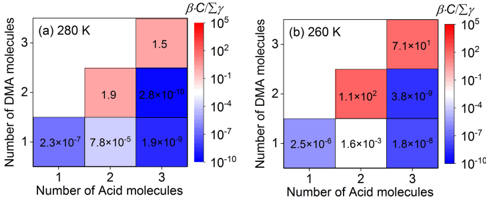
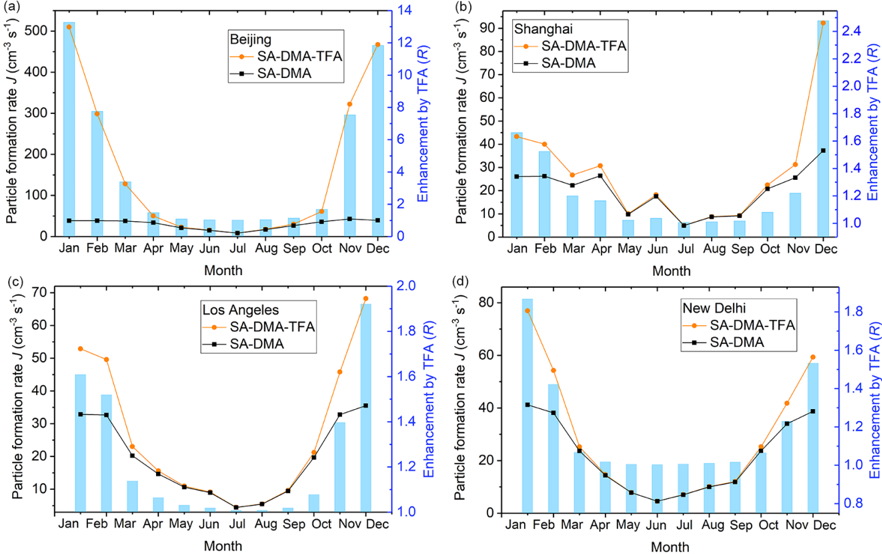
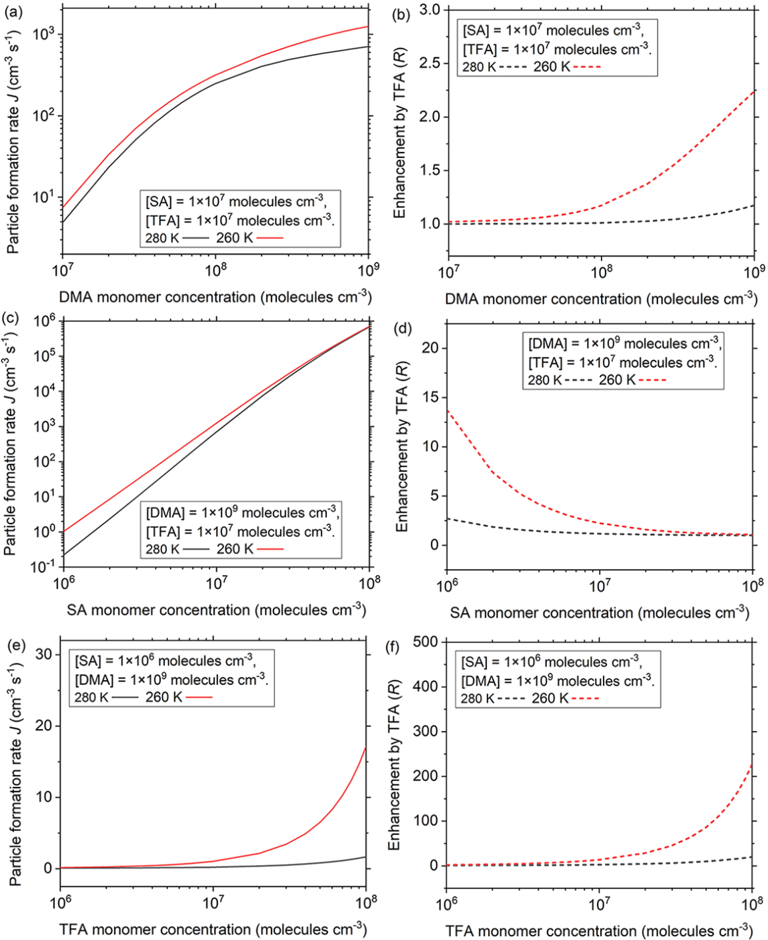
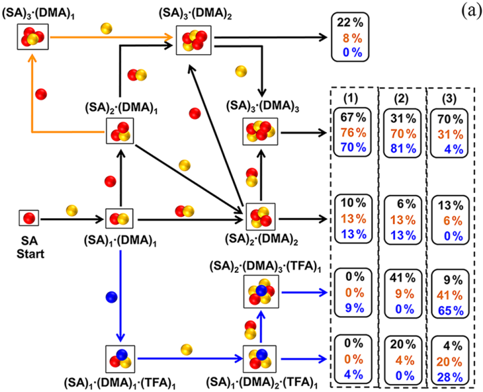
Ambient measurements combined with theoretical simulations have shown evidence that the tropospheric degradation end-products of Freon alternatives, trifluoroacetic acid (TFA), one of the most important and abundant atmospheric organic substances, can enhance the nucleation process based on sulfuric acid (SA) and dimethylamine (DMA) in urban environments. However, TFA is widespread all over the world under different atmospheric conditions, such as temperature and nucleation precursor concentration, which are the most important factors potentially influencing the atmospheric nucleation process and thus inducing different nucleation mechanisms. Herein, using the density functional theory combined with the Atmospheric Cluster Dynamics Code, the influence of temperature and nucleation precursor concentrations on the role of TFA in the SA–DMA nucleation has been investigated. The results indicate that the growth trends of clusters involving TFA can increase with the decrease in temperature. The enhancement on particle formation rate by TFA and the contributions of the SA–DMA–TFA cluster to the cluster formation pathways can be up to 227-fold and 95 %, respectively, at relatively low temperature, low SA concentration, high TFA concentration, and high DMA concentration, such as in winter, at the relatively high atmospheric boundary layer, or in megacities far away from industrial sources of sulfur-containing pollutants. These results provide the perspective of the realistic role of TFA in different atmospheric environments, revealing the potential influence of the tropospheric degradation of Freon alternatives under a wide range of atmospheric conditions.
Overview
The claims and statistics of this paper haven’t been checked yet.
Free: it reads the open-access text and checks the first 5 claims that cite a source we can check. Create a free account to check every claim.
Integrity signals
Registry
Cites
Statistics
Figures
Verification
Claims the paper makes
The claims and statistics of this paper haven’t been checked yet.
Free: it reads the open-access text and checks the first 5 claims that cite a source we can check. Create a free account to check every claim.
Claims other papers make about this one
Each is checked against this paper’s own text: does it say what the citing paper says it does?
In the citing paper
“TFA enhances the formation rate of new dimethylamine/sulfuric particles significantly (up to 227-fold [278]), but only under conditions of relatively low temperatures and sulfuric acid concentrations, and relatively high TFA and dimethylamine concentration.”
From Changes in tropospheric air quality related to the protection of stratospheric ozone in a changing climate (2023) · cites this paper as [278]
Self-check
Percentages, sums and reported differences re-computed from the paper’s own numbers.
The self-check needs the paper’s full text.
Citations
Cites
Multiwfn: A multifunctional wavefunction analyzer
Lu, T., & Chen, F. (2012) · Journal of Computational Chemistry · doi:10.1002/jcc.22885 · Cited by 45,371 · cited 1×
“8 program (Lu and Chen, 2012), kB is the Boltzmann constant, T is the temperature, and μ=mimj/(mi +mj ) is the reduced mass.”
BackgroundZhao, Y., & Truhlar, D. G. (2008) · Theoretical Chemistry Accounts · doi:10.1007/s00214-007-0310-x · Cited by 30,302
Shampine, L. F., & Reichelt, M. W. (1997) · SIAM Journal on Scientific Computing · doi:10.1137/s1064827594276424 · Cited by 3,599
Chapman, S., & Cowling, T. G. (1970) · University Press eBooks · Cited by 1,514
Direct Observations of Atmospheric Aerosol Nucleation
Kulmala, M., Kontkanen, J., Junninen, H., Lehtipalo, K., Manninen, H. E., Nieminen, T., Petäjä, T., Sipilä, M., Schobesberger, S., Rantala, P., et al. (2013) · Science · doi:10.1126/science.1227385 · Cited by 1,197
Untangling aerosol effects on clouds and precipitation in a buffered system
Stevens, B., & Feingold, G. (2009) · Nature · doi:10.1038/nature08281 · Cited by 1,180 · cited 1×
“Atmospheric aerosols have significant adverse impacts on climate and human health (Kulmala et al., 2007; Stevens and Feingold, 2009).”
BackgroundImpact of nucleation on global CCN
Merikanto, J., Spracklen, D. V., Mann, G. W., Pickering, S. J., & Carslaw, K. S. (2009) · Atmospheric Chemistry and Physics · doi:10.5194/acp-9-8601-2009 · Cited by 851
Atmospheric new particle formation from sulfuric acid and amines in a Chinese megacity
Yao, L., Garmash, O., Bianchi, F., Zheng, J., Yan, C., Kontkanen, J., Junninen, H., Mazon, S. B., Ehn, M., Paasonen, P., et al. (2018) · Science · doi:10.1126/science.aao4839 · Cited by 747
New particle formation in the free troposphere: A question of chemistry and timing
Bianchi, F., Tröstl, J., Junninen, H., Frege, C., Henne, S., Hoyle, C. R., Molteni, U., Herrmann, E., Adamov, A., Bukowiecki, N., et al. (2016) · Science · doi:10.1126/science.aad5456 · Cited by 546
On the formation, growth and composition of nucleation mode particles
Kulmala, M., Maso, M. D., Mäkela, J. M., Pirjola, L., Väkevä, M., Aalto, P., Miikkulainen, P., Hämeri, K., & O’dowd, C. D. (2001) · Tellus B: Chemical and Physical Meteorology · doi:10.3402/tellusb.v53i4.16622 · Cited by 528 · cited 1×
“Time development of the concentration of each cluster was solved by integrating the birth–death equation numerically (Kulmala et al., 2001) using the ode15s solver in the MATLABR2013a program (Shampine and Reichelt, 1997).”
Method
Research works printed but not linked: 1
- Elm, J., Merete, B., and Mikkelsen, K. V.: Assessment of binding energies of atmospherically relevant clus- ters, Phys. Chem. Chem. Phys., 15, 16442-16445, https://doi.org/10.1039/c3cp52616j, 2013. · DOI · Paper page
Cited by
The Global Threat from the Irreversible Accumulation of Trifluoroacetic Acid (TFA)
Arp, H. P. H., Gredelj, A., Glüge, J., Scheringer, M., & Cousins, I. T. (2024) · Environmental Science & Technology · doi:10.1021/acs.est.4c06189 · Cited by 283
“Obvious places to start would be to limit the direct production of TFA, and more importantly, of TFA-precursors, such as HFOs (like HFO-1234yf) and pesticides such as flufenacet.”
Barnes, P. W., Robson, T. M., Neale, P. J., Williamson, C. E., Zepp, R. G., Madronich, S., Wilson, S. R., Andrady, A. L., Heikkilä, A. M., Bernhard, G. H., et al. (2022) · Photochemical & Photobiological Sciences · doi:10.1007/s43630-022-00176-5 · Cited by 121
“The formation of SOA can also be affected by TFA, which has recently been shown to enhance the formation of dimethylamine-sulphuric acid particles (up to two orders of magnitude under certain atmospheric conditions) [51, 52].”
Rapid sulfuric acid–dimethylamine nucleation enhanced by nitric acid in polluted regions
Liu, L., Yu, F., Du, L., Yang, Z., Francisco, J. S., & Zhang, X. (2021) · Proceedings of the National Academy of Sciences · doi:10.1073/pnas.2108384118 · Cited by 66
Self-citationMadronich, S., Sulzberger, B., Longstreth, J. D., Schikowski, T., Andersen, M. P. S., Solomon, K. R., & Wilson, S. R. (2023) · Photochemical & Photobiological Sciences · doi:10.1007/s43630-023-00369-6 · Cited by 64
Ma, F., Xie, H., Zhang, R., Su, L., Jiang, Q., Tang, W., Chen, J., Engsvang, M., Elm, J., & He, X. (2023) · Environmental Science & Technology · doi:10.1021/acs.est.3c01034 · Cited by 44
Tsona, N. T., Du, L., Liu, L., & Zhang, X. (2022) · Atmospheric chemistry and physics · doi:10.5194/acp-22-1951-2022 · Cited by 20
“This is as expected since the promotion of new particle formation at cold temperatures has previously been evidenced (Lu et al., 2020; Liu et al., 2021).”
BackgroundSelf-citationThe role of trifluoroacetic acid in new particle formation from methanesulfonic acid-methylamine
Hu, Y., Chen, S., Ye, S., Wei, S., Chu, B., Wang, R., Li, H., & Zhang, T. (2023) · Atmospheric Environment · doi:10.1016/j.atmosenv.2023.120001 · Cited by 22
Peng, C., Deng, C., Lei, T., Zheng, J., Zhao, J., Wang, D., Wu, Z., Wang, L., Chen, Y., Liu, M., et al. (2022) · Journal of Environmental Sciences · doi:10.1016/j.jes.2022.03.006 · Cited by 19
Zhang, X., Tan, S., Chen, X., & Yin, S. (2022) · Chemosphere · doi:10.1016/j.chemosphere.2022.136109 · Cited by 18
Self-citationMethanesulfonic acid and iodous acid nucleation: a novel mechanism for marine aerosols
Wu, N., An, N., Liu, L., Zu, H., Liang, D., & Zhang, X. (2023) · Physical Chemistry Chemical Physics · doi:10.1039/d3cp01198d · Cited by 16
Self-citationMadronich, S., Bernhard, G. H., Neale, P. J., Heikkilä, A., Andersen, M. P. S., Andrady, A. L., Aucamp, P. J., Bais, A. F., Banaszak, A. T., Barnes, P. J., et al. (2024) · Photochemical & Photobiological Sciences · doi:10.1007/s43630-024-00577-8 · Cited by 15
“Based on quantum chemical calculations, PFPrA, like TFA, may form hydrogen-bonded clusters with other atmospheric molecules and thus participate in initial nucleation processes of new particle formation in the atmosphere (secondary organic aerosol formation) [169, 170].”
Rapid iodine oxoacid nucleation enhanced by dimethylamine in broad marine regions
Zu, H., Chu, B., Lu, Y., Liu, L., & Zhang, X. (2024) · Atmospheric chemistry and physics · doi:10.5194/acp-24-5823-2024 · Cited by 15
“Notably, the HIO 3 –HIO 2 –DMA ternary mechanism is more significant when [HIO 2 ] and [DMA] are similar. contrast, when DMA (HIO 2 ) is much more abundant than HIO 2 (DMA), the pathways are overwhelmingly dominated by rapid binary nucleation involving HIO 3 and DMA (HIO 2 ) with higher…”
BackgroundSelf-citationMattila, J. M., & Offenberg, J. H. (2024) · Journal of the Air & Waste Management Association · doi:10.1080/10962247.2024.2366491 · Cited by 14
“Its emission to the air may also impact atmospheric aerosol nucleation (Liu et al. 2021).”
Wang, R., Cheng, Y., Chen, S., Li, R., Hu, Y., Guo, X., Zhang, T., Song, F., & Li, H. (2024) · Atmospheric chemistry and physics · doi:10.5194/acp-24-4029-2024 · Cited by 13
“…the products of NH 2 SO 3 H, HOOCOOSO 3 H, CH 3 OSO 3 H, and HOCCOOSO 3 H from the reactions of SO 3 with NH 3 (H. et al., 2018), H 2 C 2 O 4 (Yang et al., 2021), CH 3 OH (Liu et al., 2019) and HOOCCHO (Rong et al., 2020) all have a catalytic effect on the formation of new particles in…”
Namdari, S., Ajayi, T., Choi, Y., Crosbie, E., DiGangi, J. P., Diskin, G. S., Kirschler, S., Liu, H., Nowak, J. B., Shook, M. A., et al. (2024) · Atmospheric Environment · doi:10.1016/j.atmosenv.2024.120831 · Cited by 11
Mondal, K., Biswas, S., Melbourne, N. W., Sun, R., & Kaiser, R. I. (2025) · Chemical Science · doi:10.1039/d5sc01698c · Cited by 8
Wang, H., Wei, S., Yang, J., Yang, Y., Li, R., Wang, R., Zhu, C., Zhang, T., & Zhang, C. (2025) · Atmospheric chemistry and physics · doi:10.5194/acp-25-2829-2025 · Cited by 8
Enhancing SO 3 hydrolysis and nucleation: the role of formic sulfuric anhydride
Wang, R., Li, R., Chen, S., Mu, R., Zhang, C., Ma, X., Khan, M., & Zhang, T. (2025) · Atmospheric chemistry and physics · doi:10.5194/acp-25-5695-2025 · Cited by 7
“…down (or evaporates) into i and j clusters Additionally, Q i accounts for any possible external source of i cluster To consider the external losses of i cluster, a coagulation sink coefficient of 2 × 10 2 was used, aligning with values typically found in polluted environments (Liu et al., 2021b .”
Shen, J., Zhao, B., Wang, S., An, N., Li, Y., Cai, R., Gao, D., Chu, B., Gao, Y., Shrivastava, M., et al. (2024) · Atmospheric chemistry and physics · doi:10.5194/acp-24-10261-2024 · Cited by 7
Self-citationLiu, J., Ni, S., & Pan, X. (2022) · The Journal of Physical Chemistry A · doi:10.1021/acs.jpca.2c05135 · Cited by 6
Enhancement of Formic Acid on New Particle Formation Involving Methanesulfonic Acid and Ethanolamine
Jiang, S., Bai, X., Lian, Y., Yuan, R., Peng, J., & Mao, H. (2026) · Journal of Geophysical Research Atmospheres · doi:10.1029/2025jd044331 · Cited by 4
Mao, J., Jiang, L., Feng, Z., Li, J., Zhu, Y., Qin, M., Guo, S., Hu, M., & Hu, J. (2025) · Geoscientific model development · doi:10.5194/gmd-18-8423-2025 · Cited by 3
The synergistic effect of organic and inorganic sulfonic acids promotes new particle formation
Ji, Y., Wu, Z., Wang, J., Ma, X., Shi, Q., Luo, W., Ji, Y., Gao, Y., & An, T. (2023) · The Science of The Total Environment · doi:10.1016/j.scitotenv.2023.163611 · Cited by 1
Lyu, J., Zhang, R., Yin, R., Shang, D., Peng, J., Guo, S., Hu, M., Chen, J., He, X., & Xie, H. (2026) · Journal of Geophysical Research Atmospheres · doi:10.1029/2025jd045515 · Cited by 1
“Among them, trifluoroacetic acid (TFA) exhibits a significant enhancement under typical atmospheric conditions (L. Liu et al., 2021; Y. Lu et al., 2020), while most other OAs only enhance nucleation under low temperature conditions or at the upper end of their observed ambient concentration ranges…”
InfluentialHe, A., Li, F., Li, J., Sun, F., Fang, H., Sun, X., Guo, Y., Wang, H., Wang, Y., & Jiang, G. (2026) · Journal of Hazardous Materials · doi:10.1016/j.jhazmat.2026.142482 · Cited by 1
Cai, R., Li, X., Yin, R., Zhao, B., Yan, C., Kangasluoma, J., Zhang, X., Zheng, J., Xie, H., Kerminen, V., et al. (2026) · Chemical Reviews · doi:10.1021/acs.chemrev.5c00684 · Cited by 2
Self-citation(2021) · Atmospheric chemistry and physics · doi:10.5194/acp-2021-784-rc2
Tsona, N. T. (2021) · Atmospheric chemistry and physics · doi:10.5194/acp-2021-784-ac1
Tsona, N. T. (2021) · Atmospheric chemistry and physics · doi:10.5194/acp-2021-784-ac2
(2021) · Atmospheric chemistry and physics · doi:10.5194/acp-2021-784-rc1
Zhang, T. (2024) · doi:10.5194/egusphere-2023-2009-ac3
Zhang, T. (2024) · doi:10.5194/egusphere-2023-2009-ac4
Zhang, T. (2024) · doi:10.5194/egusphere-2023-2009-ac2
Zhang, T. (2024) · doi:10.5194/egusphere-2023-2009-ac1
Atmospheric Transformation of Refrigerants: Current Research Developments and Knowledge Gaps
Salvador, C. M., Chele, F. S., Stevenson, L., Dolislager, F., Armstrong, A., Mathews, T. J., & Motta, S. Y. (2024) · OSTI OAI (U.S. Department of Energy Office of Scientific and Technical Information) · Cited by 1
Xiao, W., An, N., Liu, Y., Yang, X., Liu, L., & Zhang, X. (2025) · Chinese Chemical Letters · doi:10.1016/j.cclet.2025.112175
Self-citationJiang, H., Xie, C., Liu, Y., Li, M., Xiao, C., Zhang, W., Li, H., Qi, F., Long, B., Dong, W., et al. (2026) · Chinese Chemical Letters · doi:10.1016/j.cclet.2026.112656
Mechanistic Insights into Acetic Acid-Enhanced Iodine Oxoacids Nucleation in the Marine Atmosphere
Zhang, Y., Zhang, R., Liu, X., & Xie, H. (2026) · Communications in Computational Chemistry · doi:10.4208/cicc.2026.45.01
“Iodine oxoacids can form hydrogen bonds (HBs) and halogen bonds (XBs) with OAs[26, 27, 29, 30], therefore OAs have potential to bind with iodine oxoacids to form clusters.”
Guo, X., Li, Y., Su, R., Yang, Y., Feng, X., Wang, G., Zuo, Y., Wang, R., & Zhang, T. (2026) · doi:10.5194/egusphere-2026-2831
Liu, L., Cai, Z., An, N., Chu, B., Zu, H., Li, J., Tang, J., & Zhang, X. (2026) · doi:10.5194/egusphere-2026-2877
Self-citationWang, G., Zhang, C., Guo, X., Su, R., Cai, X., Zuo, Y., & 张田雷 (2026) · doi:10.5194/egusphere-2026-3408
Metadata
- Authors
- Liu, L., Yu, F., Tu, K., Yang, Z., & Zhang, X.
- Affiliations
- Beijing Institute of Technology (CN)
- University at Albany, State University of New York (US)
- Corresponding author
- Liu, Ling
- Yu, Fangqun
- Zhang, Xiuhui
- Venue
- Atmospheric Chemistry and Physics
- Publisher
- Copernicus GmbH
- Published
- 2021-04-26
- Volume
- 21
- Issue
- 8
- Pages
- 6221-6230
- ISSN
- 1680-7316 (ISSN-L)
- 1680-7324
- OpenAlex
- W3121228002
- Semantic Scholar
- 95d668c50dd737f26ac2a81133883fe4e8a75370
- Cited by
- 41
- References
- 49
- Citations by year
- 2026: 4 · 2025: 6 · 2024: 14 · 2023: 7 · 2022: 5 · 2021: 5
- FWCI
- 2.72
- Type
- journal article
- Language
- en
- Open access
- gold
- doi.org
- Licence
- Locations
- Atmospheric chemistry and physics (publishedVersion, cc-by)
- DOAJ (DOAJ: Directory of Open Access Journals) (submittedVersion, cc-by-sa)
- Funders
- National Science Foundation (1550816)
- Helsingin Yliopisto
- National Natural Science Foundation of China (21673175, 21976015)
- China Postdoctoral Science Foundation (2020M680013)
- National Supercomputing Center, Korea Institute of Science and Technology Information
- Topics
- Physical Sciences › Earth and Planetary Sciences › Atmospheric Science › Atmospheric chemistry and aerosols
- Physical Sciences › Environmental Science › Global and Planetary Change › Atmospheric aerosols and clouds
- Physical Sciences › Earth and Planetary Sciences › Atmospheric Science › Atmospheric Ozone and Climate
- Keywords
- trifluoroacetic acid, sulfuric acid, dimethylamine, atmospheric nucleation, tropospheric degradation, temperature effects, cluster growth, particle formation rate, atmospheric organic compounds, urban aerosols
About these checks
Registry, retraction, Cites and statistics results are computed, not judged, with one exception: a printed reference that no index lists is read once by a model before it counts as a citation error. Claims are extracted by a model and kept only when their quote appears verbatim in the text; each cited source is then checked, with a model’s help, for whether it says what the claim relies on. Those verdicts can be wrong — read the claim’s quote and the cited source before relying on one.
Statistics and arithmetic are recomputed, not judged.
Confidence bands are shown only for fields calibrated on our annotated test set. None is calibrated yet, so no band is shown.
What counts as a claim ›How we measure confidence ›How we check this ›
Are you an author, or do you see a problem with this page? Request a review
Data sources
Bibliographic data: Semantic Scholar, OpenAlex, Crossref.
Contains information from the Semantic Scholar Academic Graph Datasets, made available under the ODC Attribution License (ODC-BY 1.0).
Semantic Scholar’s data is described in: Kinney, R., et al. (2023). The Semantic Scholar Open Data Platform. arXiv:2301.10140.
