

Influence of atmospheric conditions on the role of trifluoroacetic acid in atmospheric sulfuric acid–dimethylamine nucleation
Open accessPublished version of a preprint
The DOI matches its Crossref record; 48 of the 49 references it cites were found in a registry or an index.
Abstract
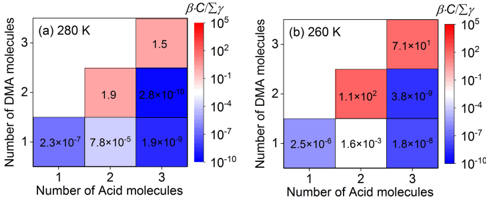
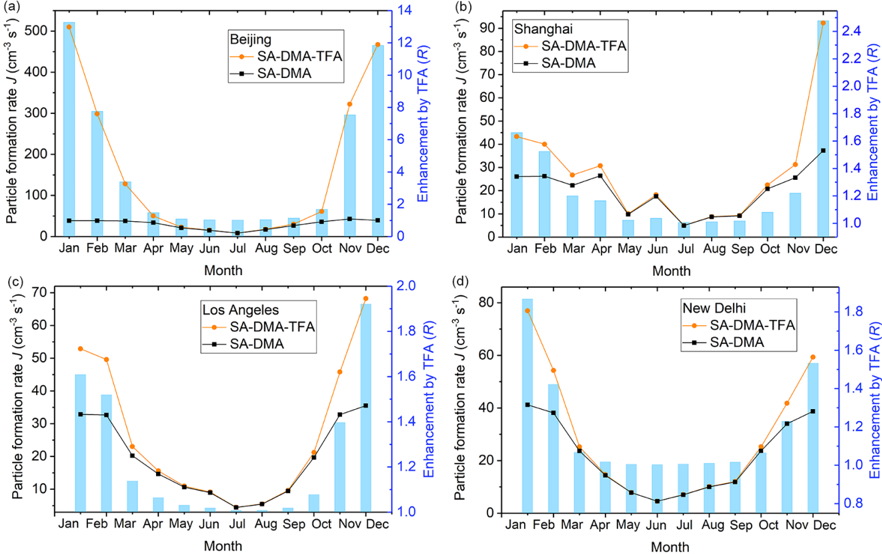
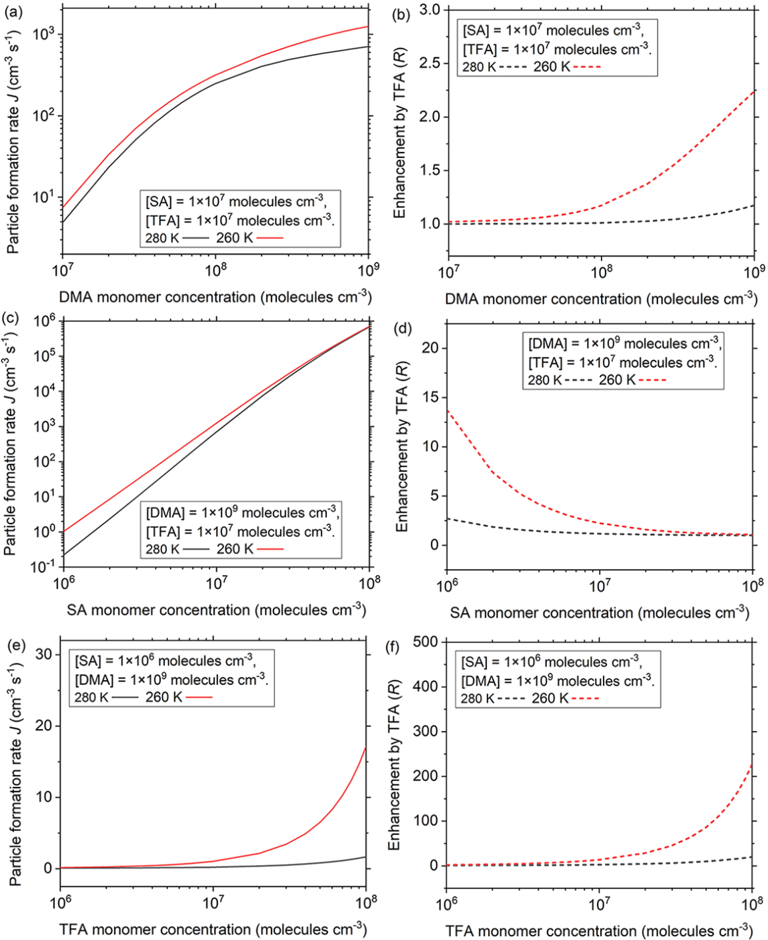
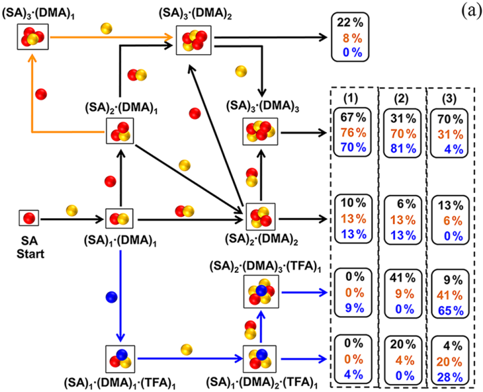
Ambient measurements combined with theoretical simulations have shown evidence that the tropospheric degradation end-products of Freon alternatives, trifluoroacetic acid (TFA), one of the most important and abundant atmospheric organic substances, can enhance the nucleation process based on sulfuric acid (SA) and dimethylamine (DMA) in urban environments. However, TFA is widespread all over the world under different atmospheric conditions, such as temperature and nucleation precursor concentration, which are the most important factors potentially influencing the atmospheric nucleation process and thus inducing different nucleation mechanisms. Herein, using the density functional theory combined with the Atmospheric Cluster Dynamics Code, the influence of temperature and nucleation precursor concentrations on the role of TFA in the SA–DMA nucleation has been investigated. The results indicate that the growth trends of clusters involving TFA can increase with the decrease in temperature. The enhancement on particle formation rate by TFA and the contributions of the SA–DMA–TFA cluster to the cluster formation pathways can be up to 227-fold and 95 %, respectively, at relatively low temperature, low SA concentration, high TFA concentration, and high DMA concentration, such as in winter, at the relatively high atmospheric boundary layer, or in megacities far away from industrial sources of sulfur-containing pollutants. These results provide the perspective of the realistic role of TFA in different atmospheric environments, revealing the potential influence of the tropospheric degradation of Freon alternatives under a wide range of atmospheric conditions.
Overview
The claims and statistics of this paper haven’t been checked yet.
Free: it reads the open-access text and checks the first 5 claims that cite a source we can check. Create a free account to check every claim.
Integrity signals
Registry
Cites
Statistics
Figures
Verification
Claims the paper makes
The claims and statistics of this paper haven’t been checked yet.
Free: it reads the open-access text and checks the first 5 claims that cite a source we can check. Create a free account to check every claim.
Claims other papers make about this one
Each is checked against this paper’s own text: does it say what the citing paper says it does?
In the citing paper
“TFA enhances the formation rate of new dimethylamine/sulfuric particles significantly (up to 227-fold [278]), but only under conditions of relatively low temperatures and sulfuric acid concentrations, and relatively high TFA and dimethylamine concentration.”
From Changes in tropospheric air quality related to the protection of stratospheric ozone in a changing climate (2023) · cites this paper as [278]
Self-check
Percentages, sums and reported differences re-computed from the paper’s own numbers.
The self-check needs the paper’s full text.
Citations
Cites
Multiwfn: A multifunctional wavefunction analyzer
Lu, T., & Chen, F. (2012) · Journal of Computational Chemistry · doi:10.1002/jcc.22885 · Cited by 45,371 · cited 1×
“8 program (Lu and Chen, 2012), kB is the Boltzmann constant, T is the temperature, and μ=mimj/(mi +mj ) is the reduced mass.”
BackgroundZhao, Y., & Truhlar, D. G. (2008) · Theoretical Chemistry Accounts · doi:10.1007/s00214-007-0310-x · Cited by 30,302
Shampine, L. F., & Reichelt, M. W. (1997) · SIAM Journal on Scientific Computing · doi:10.1137/s1064827594276424 · Cited by 3,599
Chapman, S., & Cowling, T. G. (1970) · University Press eBooks · Cited by 1,514
Direct Observations of Atmospheric Aerosol Nucleation
Kulmala, M., Kontkanen, J., Junninen, H., Lehtipalo, K., Manninen, H. E., Nieminen, T., Petäjä, T., Sipilä, M., Schobesberger, S., Rantala, P., et al. (2013) · Science · doi:10.1126/science.1227385 · Cited by 1,197
Untangling aerosol effects on clouds and precipitation in a buffered system
Stevens, B., & Feingold, G. (2009) · Nature · doi:10.1038/nature08281 · Cited by 1,180 · cited 1×
“Atmospheric aerosols have significant adverse impacts on climate and human health (Kulmala et al., 2007; Stevens and Feingold, 2009).”
BackgroundImpact of nucleation on global CCN
Merikanto, J., Spracklen, D. V., Mann, G. W., Pickering, S. J., & Carslaw, K. S. (2009) · Atmospheric Chemistry and Physics · doi:10.5194/acp-9-8601-2009 · Cited by 851
Atmospheric new particle formation from sulfuric acid and amines in a Chinese megacity
Yao, L., Garmash, O., Bianchi, F., Zheng, J., Yan, C., Kontkanen, J., Junninen, H., Mazon, S. B., Ehn, M., Paasonen, P., et al. (2018) · Science · doi:10.1126/science.aao4839 · Cited by 747
New particle formation in the free troposphere: A question of chemistry and timing
Bianchi, F., Tröstl, J., Junninen, H., Frege, C., Henne, S., Hoyle, C. R., Molteni, U., Herrmann, E., Adamov, A., Bukowiecki, N., et al. (2016) · Science · doi:10.1126/science.aad5456 · Cited by 546
On the formation, growth and composition of nucleation mode particles
Kulmala, M., Maso, M. D., Mäkela, J. M., Pirjola, L., Väkevä, M., Aalto, P., Miikkulainen, P., Hämeri, K., & O’dowd, C. D. (2001) · Tellus B: Chemical and Physical Meteorology · doi:10.3402/tellusb.v53i4.16622 · Cited by 528 · cited 1×
“Time development of the concentration of each cluster was solved by integrating the birth–death equation numerically (Kulmala et al., 2001) using the ode15s solver in the MATLABR2013a program (Shampine and Reichelt, 1997).”
MethodToward Direct Measurement of Atmospheric Nucleation
Kulmala, M., Riipinen, I., Sipilä, M., Manninen, H. E., Petäjä, T., Junninen, H., Maso, M. D., Mordas, G., Mirme, A., Vana, M., et al. (2007) · Science · doi:10.1126/science.1144124 · Cited by 465
Atmospheric Cluster Dynamics Code: a flexible method for solution of the birth-death equations
McGrath, M. J., Olenius, T., Ortega, I. K., Loukonen, V., Paasonen, P., Kurtén, T., Kulmala, M., & Vehkamäki, H. (2012) · Atmospheric Chemistry and Physics · doi:10.5194/acp-12-2345-2012 · Cited by 345
Self-Nucleation in the Sulfuric Acid-Water System
Doyle, G. J. (1961) · The Journal of Chemical Physics · doi:10.1063/1.1701218 · Cited by 282 · cited 1×
“Sulfuric acid has been well recognized as the key nucleation precursor (Doyle, 1961; Kulmala et al., 1995, 2013; Berndt et al., 2005).”
BackgroundOn the formation, growth and composition of nucleation mode particles
Kulmala, M., Maso, M. D., Mäkelä, J. M., Pirjola, L., Väkeva, M., AALTO, P., Miikkulainen, P., Hämeri, K. J., & O'Dowd, C. D. (2001) · Tellus B · doi:10.1034/j.1600-0889.2001.d01-33.x · Cited by 254
Free energy barrier in the growth of sulfuric acid–ammonia and sulfuric acid–dimethylamine clusters
Olenius, T., Kupiainen-Määttä, O., Ortega, I. K., Kurtén, T., & Vehkamäki, H. (2013) · The Journal of Chemical Physics · doi:10.1063/1.4819024 · Cited by 245
Calibration of a Chemical Ionization Mass Spectrometer for the Measurement of Gaseous Sulfuric Acid
Kürten, A., Rondo, L., Ehrhart, S., & Curtius, J. (2012) · The Journal of Physical Chemistry A · doi:10.1021/jp212123n · Cited by 245 · cited 2×
“The common atmospheric [SA] is in the range of 1.0× 10⁶ to 1.0× 10⁸ molec. cm−3 from clean areas to highly polluted areas (Kürten et al., 2012; Yao et al., 2018; Zheng et al., 2015).”
BackgroundInfluentialMultiphase chemistry of atmospheric amines
Qiu, C., & Zhang, R. (2013) · Physical Chemistry Chemical Physics · doi:10.1039/c3cp43446j · Cited by 235 · cited 1×
“However, because of the relatively short atmospheric lifetime of DMA concerning chemical reaction loss (Carl and Crowley, 1998; Qiu and Zhang, 2013), whether the concentration of DMA ([DMA]) can be relatively high or not remains to be determined.”
BackgroundAtmospheric Degradation of Ozone Depleting Substances, Their Substitutes, and Related Species
Burkholder, J. B., Cox, R. A., & Ravishankara, A. R. (2015) · Chemical Reviews · doi:10.1021/cr5006759 · Cited by 226 · cited 2×
“drochlorofluorocarbons (HCFCs), and hydrofluoro-olefins (HFOs) (Kazil et al., 2014; Burkholder et al., 2015; Pickard et al., 2018).”
BackgroundTian, Y., Yao, Y., Chang, S., Zhao, Z., Zhao, Y., Yuan, X., Wu, F., & Sun, H. (2018) · Environmental Science & Technology · doi:10.1021/acs.est.7b05385 · Cited by 223
Elm, J., Bilde, M., & Mikkelsen, K. V. (2012) · Journal of Chemical Theory and Computation · doi:10.1021/ct300192p · Cited by 206 · cited 2×
“The M06-2X functional has been successfully used to describe noncovalent interaction (Elm et al., 2012; Zhao and Truhlar, 2008) and estimate the thermochemistry and equilibrium structures of atmospheric clusters (Bork et al.”
MethodSeasonal Characteristics of New Particle Formation and Growth in Urban Beijing
Deng, C., Fu, Y., Dada, L., Yan, C., Cai, R., Yang, D., Zhou, Y., Yin, R., Lu, Y., Li, X., et al. (2020) · Environmental Science & Technology · doi:10.1021/acs.est.0c00808 · Cited by 202 · cited 1×
“Although the sulfuric acid (SA) and dimethylamine (DMA) nucleation mechanism has been observed in various places around the world (Yao et al., 2018; Deng et al., 2020; Brean et al., 2020), there are still a lot of species observed in the atmosphere but not fully assigned molecular formulas because…”
BackgroundRapid Formation of Sulfuric Acid Particles at Near-Atmospheric Conditions
Berndt, T., Böge, O., Stratmann, F., Heintzenberg, J., & Kulmala, M. (2005) · Science · doi:10.1126/science.1104054 · Cited by 175
Nadykto, A. B., Yu, F., Jakovleva, M. V., Herb, J., & Xu, Y. (2011) · Entropy · doi:10.3390/e13020554 · Cited by 169
Self-citationKürten, A., Li, C., Bianchi, F., Curtius, J., Dias, A., Donahue, N. M., Duplissy, J., Flagan, R. C., Hakala, J., Jokinen, T., et al. (2018) · Atmospheric Chemistry and Physics · doi:10.5194/acp-18-845-2018 · Cited by 166
Assessment of binding energies of atmospherically relevant clusters
Elm, J., Bilde, M., & Mikkelsen, K. V. (2013) · Physical Chemistry Chemical Physics · doi:10.1039/c3cp52616j · Cited by 161 · cited 1×
“The M06-2X functional has been successfully used to describe noncovalent interaction (Elm et al., 2012; Zhao and Truhlar, 2008) and estimate the thermochemistry and equilibrium structures of atmospheric clusters (Bork et al., 2014; Elm et al., 2012, 2013).”
MethodMethane sulfonic acid-enhanced formation of molecular clusters of sulfuric acid and dimethyl amine
Bork, N., Elm, J., Olenius, T., & Vehkamäki, H. (2014) · Atmospheric chemistry and physics · doi:10.5194/acp-14-12023-2014 · Cited by 152 · cited 3×
“, 2012; Zhao and Truhlar, 2008) and estimate the thermochemistry and equilibrium structures of atmospheric clusters (Bork et al., 2014; Elm et al., 2012, 2013).”
BackgroundMethodThe fate and persistence of trifluoroacetic and chloroacetic acids in pond waters
Ellis, D. A., Hanson, M. L., Sibley, P. K., Shahid, T., Fineberg, N. A., Solomon, K. R., Muir, D. C. G., & Mabury, S. A. (2001) · Chemosphere · doi:10.1016/s0045-6535(00)00066-7 · Cited by 148 · cited 1×
“The concentration of TFA is relatively high in regions with scant rainfall because precipitation is the only predominant environmental sink of TFA (Ellis et al., 2001).”
BackgroundOlenius, T., Halonen, R., Kurtén, T., Henschel, H., Kupiainen-Määttä, O., Ortega, I. K., Jen, C. N., Vehkamäki, H., & Riipinen, I. (2017) · Journal of Geophysical Research Atmospheres · doi:10.1002/2017jd026501 · Cited by 145
Li, H., Zhong, J. P., Vehkamäki, H., Kurtén, T., Wang, W., Ge, M., Zhang, S., Li, Z., Zhang, X., Francisco, J. S., et al. (2018) · Journal of the American Chemical Society · doi:10.1021/jacs.8b04928 · Cited by 134
Self-citationPotential accumulation of a CFC-replacement degradation product in seasonal wetlands
Tromp, T. K., Ko, M. K. W., Rodríguez, J. M., & Sze, N. D. (1995) · Nature · doi:10.1038/376327a0 · Cited by 130
Modeling of gaseous methylamines in the global atmosphere: impacts of oxidation and aerosol uptake
Yu, F., & Luo, G. (2014) · Atmospheric chemistry and physics · doi:10.5194/acp-14-12455-2014 · Cited by 127
Self-citationPaasonen, P., Olenius, T., Kupiainen, O., Kurtén, T., Petäjä, T., Birmili, W., Hamed, A., Hu, M., Huey, L. G., Plass-Duelmer, C., et al. (2012) · Atmospheric chemistry and physics · doi:10.5194/acp-12-9113-2012 · Cited by 126
Wang, Q., Ruan, Y., Lin, H., & Lam, P. K. S. (2020) · Science of The Total Environment · doi:10.1016/j.scitotenv.2020.139804 · Cited by 114
Pickard, H. M., Criscitiello, A. S., Spencer, C., Sharp, M. J., Muir, D. C. G., De Silva, A. O., & Young, C. J. (2018) · Atmospheric Chemistry and Physics · doi:10.5194/acp-18-5045-2018 · Cited by 103
Molecular insights into new particle formation in Barcelona, Spain
Brean, J., Beddows, D. C. S., Shi, Z., Temime‐Roussel, B., Marchand, N., Querol, X., Alástuey, A., Minguillón, M. C., & Harrison, R. M. (2020) · Atmospheric chemistry and physics · doi:10.5194/acp-20-10029-2020 · Cited by 88
Atmospheric Sulfuric Acid‐Dimethylamine Nucleation Enhanced by Trifluoroacetic Acid
Lu, Y., Liu, L., Ning, A., Yang, G., Liu, Y., Kurtén, T., Vehkamäki, H., Zhang, X., & Wang, L. (2020) · Geophysical Research Letters · doi:10.1029/2019gl085627 · Cited by 84
Self-citationLarge ternary hydrogen-bonded pre-nucleation clusters in the Earth’s atmosphere
Herb, J., Nadykto, A. B., & Yu, F. (2011) · Chemical Physics Letters · doi:10.1016/j.cplett.2011.10.035 · Cited by 81 · cited 1×
“Furthermore, the 6-311++G(3df,3pd) basis set was chosen based on its excellent performance to estimate the properties of atmospheric relevant clusters when used in conjunction with the M06-2X functional (Herb et al., 2011, 2013; Nadykto et al., 2011, 2009).”
MethodSelf-citationMadronich, S., Shao, M., Wilson, S. R., Solomon, K. R., Longstreth, J. D., & Tang, X. Y. (2014) · Photochemical & Photobiological Sciences · doi:10.1039/c4pp90037e · Cited by 79
Carl, S. A., & Crowley, J. N. (1998) · The Journal of Physical Chemistry A · doi:10.1021/jp9821937 · Cited by 78
Airborne Trifluoroacetic Acid and Its Fraction from the Degradation of HFC-134a in Beijing, China
Wu, J., Martin, J. W., Zhai, Z., Lu, K., Li, L., Fang, X., Jin, H., Hu, J., & Zhang, J. (2014) · Environmental Science & Technology · doi:10.1021/es4050264 · Cited by 73 · cited 1×
“The SA concentration ([SA]) and TFA concentration ([TFA]) were chosen to be relatively low and high, 5.0×10⁶ and 1.0×10⁸ molec. cm−3 (Wu et al., 2014) respectively.”
BackgroundInfluentialMao, J., Yu, F., Zhang, Y., An, J., Wang, L., Zheng, J., Yao, L., Luo, G., Ma, W., Qi, Y., et al. (2018) · Atmospheric chemistry and physics · doi:10.5194/acp-18-7933-2018 · Cited by 72
Self-citationHerb, J., Xu, Y., Yu, F., & Nadykto, A. B. (2012) · The Journal of Physical Chemistry A · doi:10.1021/jp3088435 · Cited by 59 · cited 1×
“Furthermore, the 6-311++G(3df,3pd) basis set was chosen based on its excellent performance to estimate the properties of atmospheric relevant clusters when used in conjunction with the M06-2X functional (Herb et al., 2011, 2013; Nadykto et al., 2011, 2009).”
MethodSelf-citationKazil, J., McKeen, S., Kim, S. ‐., Ahmadov, R., Grell, G. A., Talukdar, R. K., & Ravishankara, A. R. (2014) · Journal of Geophysical Research: Atmospheres · doi:10.1002/2014jd022058 · Cited by 56 · cited 2×
“drochlorofluorocarbons (HCFCs), and hydrofluoro-olefins (HFOs) (Kazil et al., 2014; Burkholder et al., 2015; Pickard et al., 2018).”
BackgroundSimulations on the effect of sulphuric acid formation on atmospheric aerosol concentrations
Kulmala, M., Kerminen, V., & Laaksonen, A. (1995) · Atmospheric Environment · doi:10.1016/1352-2310(94)00255-j · Cited by 47 · cited 1×
“Sulfuric acid has been well recognized as the key nucleation precursor (Doyle, 1961; Kulmala et al., 1995, 2013; Berndt et al., 2005).”
BackgroundGas-phase hydration of glyoxylic acid: Kinetics and atmospheric implications
Liu, L., Zhang, X., Li, Z., Zhang, Y., & Ge, M. (2017) · Chemosphere · doi:10.1016/j.chemosphere.2017.08.007 · Cited by 43 · cited 1×
“Previous studies have identified that some acids, such as methane sulfonic acid, sulfamic acid, and glyoxylic acid, can enhance the SA-based particle formation (Bork et al., 2014; Li et al., 2018; Liu et al., 2017).”
BackgroundSelf-citationZheng, J., Yang, D., Ma, Y., Chen, M., Jin, C., Li, S., & Wang, M. (2015) · Atmospheric Environment · doi:10.1016/j.atmosenv.2015.08.028 · Cited by 32 · cited 1×
“The common atmospheric [SA] is in the range of 1.0× 10⁶ to 1.0× 10⁸ molec. cm−3 from clean areas to highly polluted areas (Kürten et al., 2012; Yao et al., 2018; Zheng et al., 2015).”
BackgroundInfluentialNadykto, A. B., Yu, F., & Herb, J. (2009) · Atmospheric chemistry and physics · doi:10.5194/acp-9-4031-2009 · Cited by 27 · cited 1×
“Furthermore, the 6-311++G(3df,3pd) basis set was chosen based on its excellent performance to estimate the properties of atmospheric relevant clusters when used in conjunction with the M06-2X functional (Herb et al., 2011, 2013; Nadykto et al., 2011, 2009).”
MethodSelf-citationCheng, S., Du, L., & George, C. (2020) · Journal of Geophysical Research Atmospheres · doi:10.1029/2019jd032182 · Cited by 16 · cited 1×
“Due to their worldwide distribution, chemical stability, and potential biological toxicity, PFCAs are generally believed to be an important class of environmental contaminants present in various environments (Wang et al., 2020; Cheng et al., 2020).”
Background
Research works printed but not linked: 1
- Elm, J., Merete, B., and Mikkelsen, K. V.: Assessment of binding energies of atmospherically relevant clus- ters, Phys. Chem. Chem. Phys., 15, 16442-16445, https://doi.org/10.1039/c3cp52616j, 2013. · DOI · Paper page
Cited by
The Global Threat from the Irreversible Accumulation of Trifluoroacetic Acid (TFA)
Arp, H. P. H., Gredelj, A., Glüge, J., Scheringer, M., & Cousins, I. T. (2024) · Environmental Science & Technology · doi:10.1021/acs.est.4c06189 · Cited by 283
“Obvious places to start would be to limit the direct production of TFA, and more importantly, of TFA-precursors, such as HFOs (like HFO-1234yf) and pesticides such as flufenacet.”
Barnes, P. W., Robson, T. M., Neale, P. J., Williamson, C. E., Zepp, R. G., Madronich, S., Wilson, S. R., Andrady, A. L., Heikkilä, A. M., Bernhard, G. H., et al. (2022) · Photochemical & Photobiological Sciences · doi:10.1007/s43630-022-00176-5 · Cited by 121
“The formation of SOA can also be affected by TFA, which has recently been shown to enhance the formation of dimethylamine-sulphuric acid particles (up to two orders of magnitude under certain atmospheric conditions) [51, 52].”
Rapid sulfuric acid–dimethylamine nucleation enhanced by nitric acid in polluted regions
Liu, L., Yu, F., Du, L., Yang, Z., Francisco, J. S., & Zhang, X. (2021) · Proceedings of the National Academy of Sciences · doi:10.1073/pnas.2108384118 · Cited by 66
Self-citationMadronich, S., Sulzberger, B., Longstreth, J. D., Schikowski, T., Andersen, M. P. S., Solomon, K. R., & Wilson, S. R. (2023) · Photochemical & Photobiological Sciences · doi:10.1007/s43630-023-00369-6 · Cited by 64
Ma, F., Xie, H., Zhang, R., Su, L., Jiang, Q., Tang, W., Chen, J., Engsvang, M., Elm, J., & He, X. (2023) · Environmental Science & Technology · doi:10.1021/acs.est.3c01034 · Cited by 44
Metadata
- Authors
- Liu, L., Yu, F., Tu, K., Yang, Z., & Zhang, X.
- Affiliations
- Beijing Institute of Technology (CN)
- University at Albany, State University of New York (US)
- Corresponding author
- Liu, Ling
- Yu, Fangqun
- Zhang, Xiuhui
- Venue
- Atmospheric Chemistry and Physics
- Publisher
- Copernicus GmbH
- Published
- 2021-04-26
- Volume
- 21
- Issue
- 8
- Pages
- 6221-6230
- ISSN
- 1680-7316 (ISSN-L)
- 1680-7324
- OpenAlex
- W3121228002
- Cited by
- 41
- References
- 49
- Citations by year
- 2026: 4 · 2025: 6 · 2024: 14 · 2023: 7 · 2022: 5 · 2021: 5
- FWCI
- 2.72
- Type
- journal article
- Language
- en
- Open access
- gold
- doi.org
- Licence
- Locations
- Atmospheric chemistry and physics (publishedVersion, cc-by)
- DOAJ (DOAJ: Directory of Open Access Journals) (submittedVersion, cc-by-sa)
- Funders
- National Science Foundation (1550816)
- Helsingin Yliopisto
- National Natural Science Foundation of China (21673175, 21976015)
- China Postdoctoral Science Foundation (2020M680013)
- National Supercomputing Center, Korea Institute of Science and Technology Information
- Topics
- Physical Sciences › Earth and Planetary Sciences › Atmospheric Science › Atmospheric chemistry and aerosols
- Physical Sciences › Environmental Science › Global and Planetary Change › Atmospheric aerosols and clouds
- Physical Sciences › Earth and Planetary Sciences › Atmospheric Science › Atmospheric Ozone and Climate
- Keywords
- trifluoroacetic acid, sulfuric acid, dimethylamine, atmospheric nucleation, tropospheric degradation, temperature effects, cluster growth, particle formation rate, atmospheric organic compounds, urban aerosols
About these checks
Registry, retraction, Cites and statistics results are computed, not judged, with one exception: a printed reference that no index lists is read once by a model before it counts as a citation error. Claims are extracted by a model and kept only when their quote appears verbatim in the text; each cited source is then checked, with a model’s help, for whether it says what the claim relies on. Those verdicts can be wrong — read the claim’s quote and the cited source before relying on one.
Statistics and arithmetic are recomputed, not judged.
Confidence bands are shown only for fields calibrated on our annotated test set. None is calibrated yet, so no band is shown.
What counts as a claim ›How we measure confidence ›How we check this ›
Are you an author, or do you see a problem with this page? Request a review
Data sources
Bibliographic data: Semantic Scholar, OpenAlex, Crossref.
Contains information from the Semantic Scholar Academic Graph Datasets, made available under the ODC Attribution License (ODC-BY 1.0).
Semantic Scholar’s data is described in: Kinney, R., et al. (2023). The Semantic Scholar Open Data Platform. arXiv:2301.10140.
