

Stratospherically induced circulation changes under the extreme conditions of the no-Montreal-Protocol scenario
Open accessPublished version of a preprint
The DOI matches its Crossref record; 61 of the 62 references it cites were found in a registry or an index, and 1 are not checked yet.
Abstract
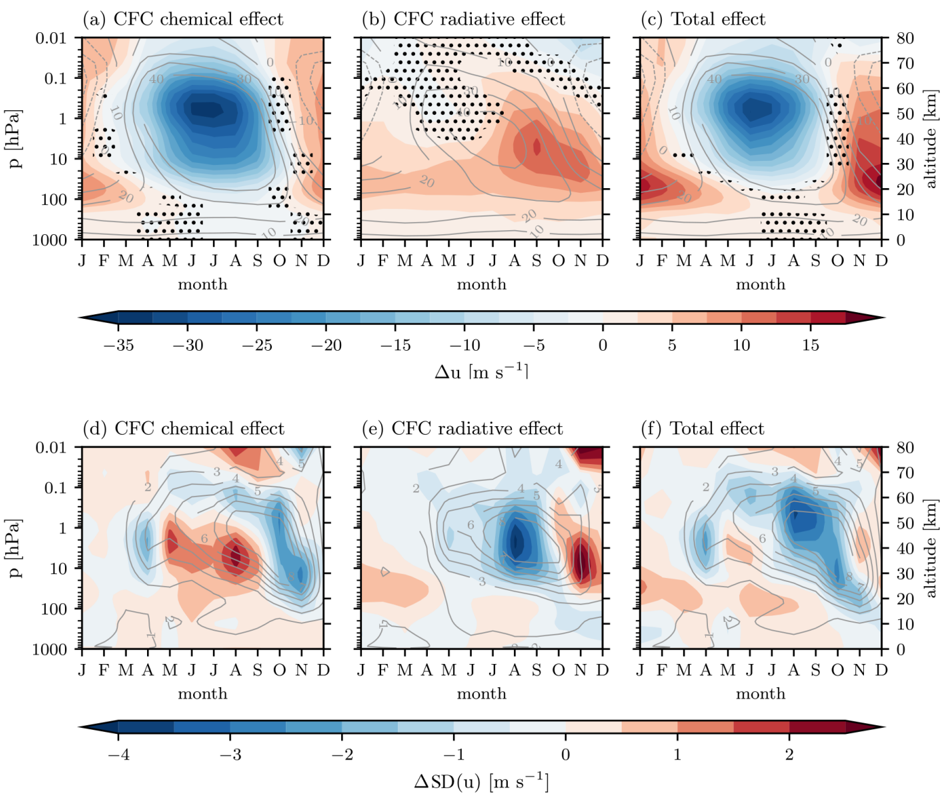
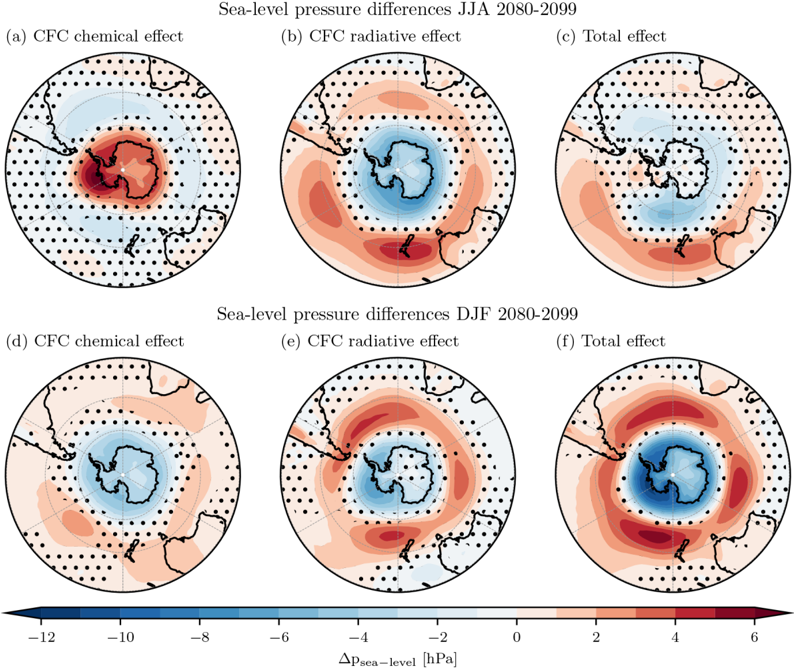
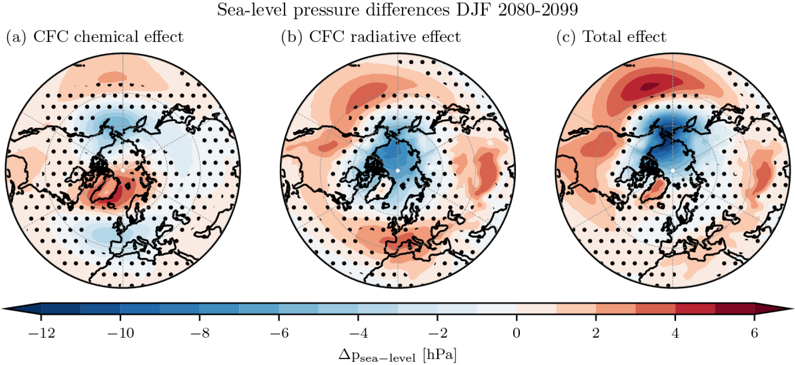
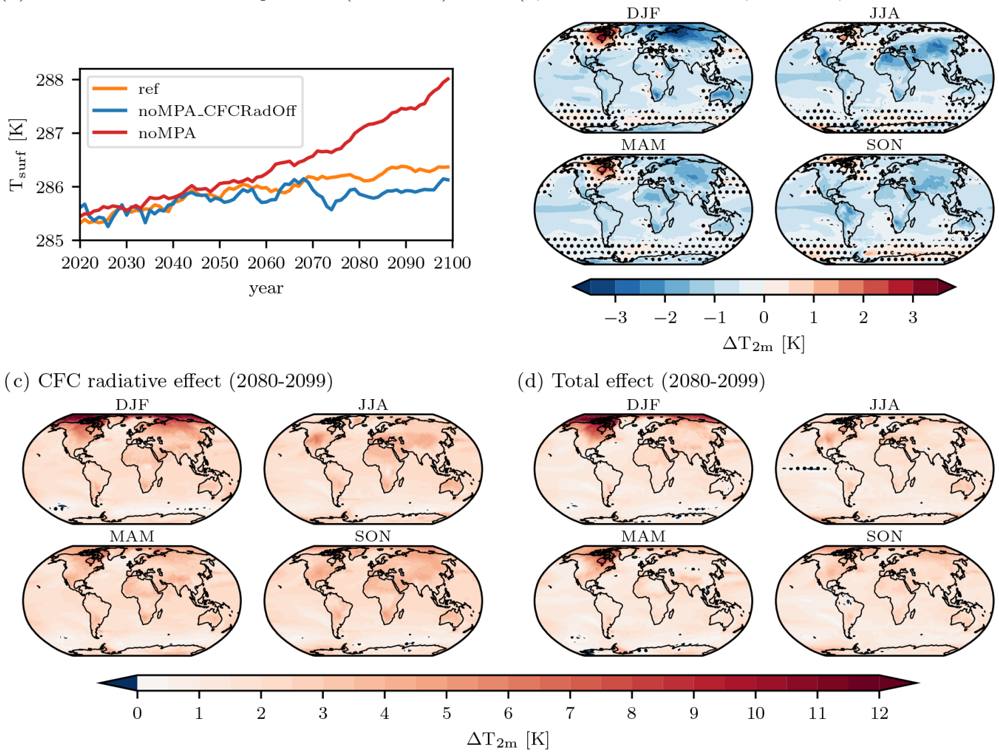
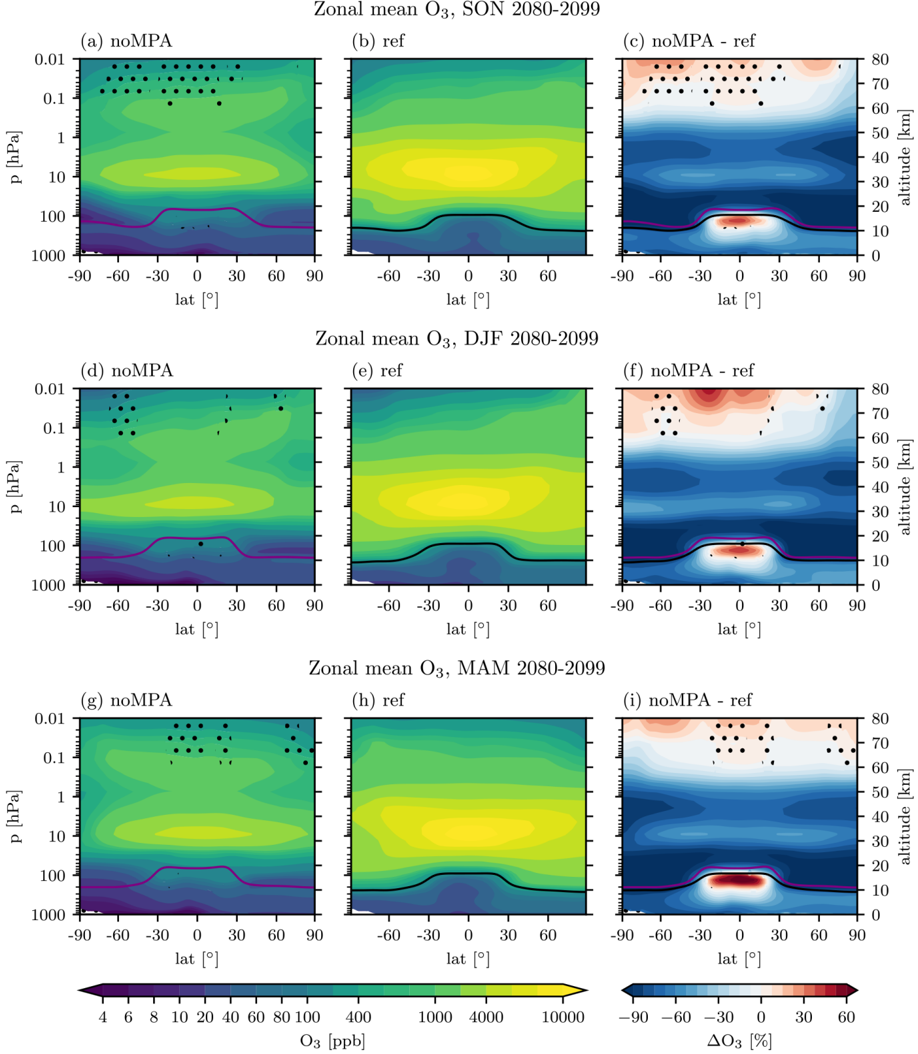
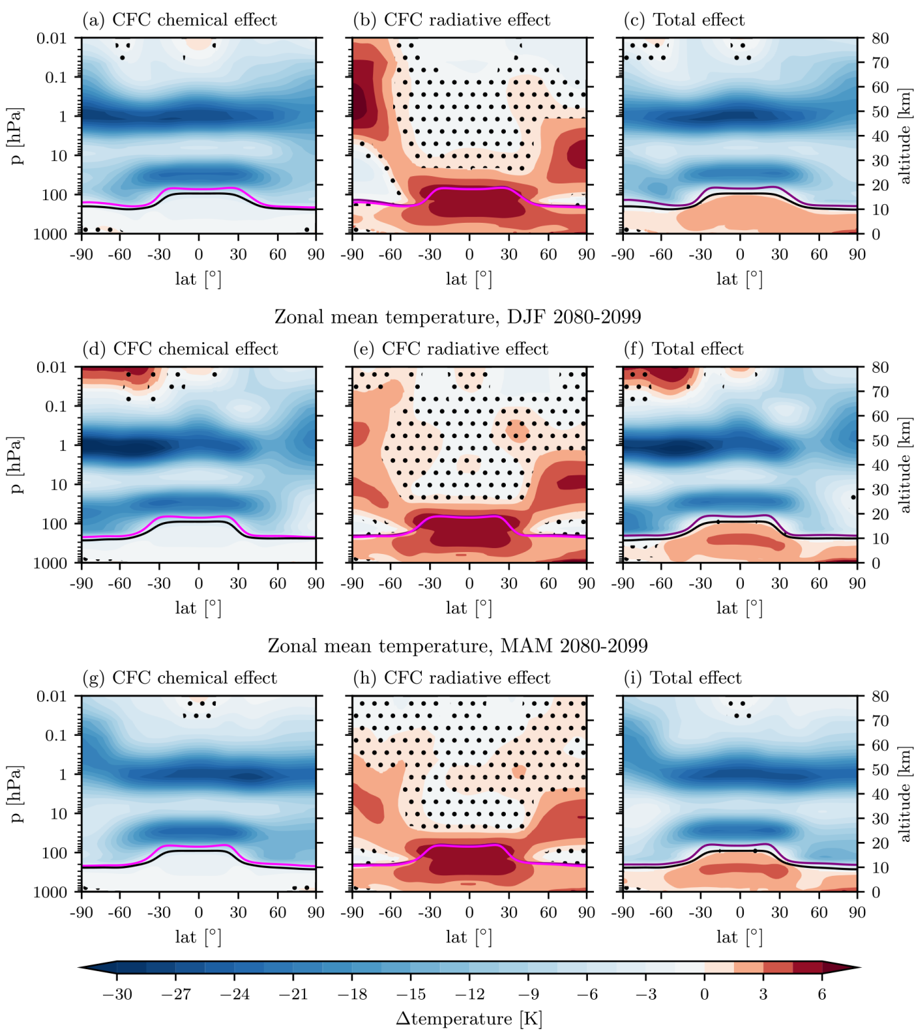
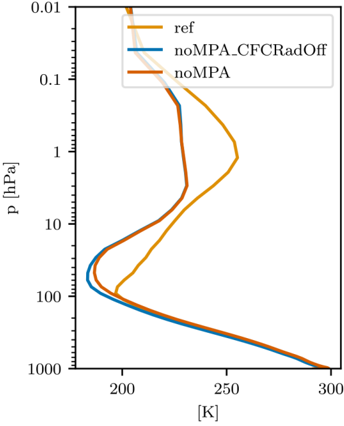
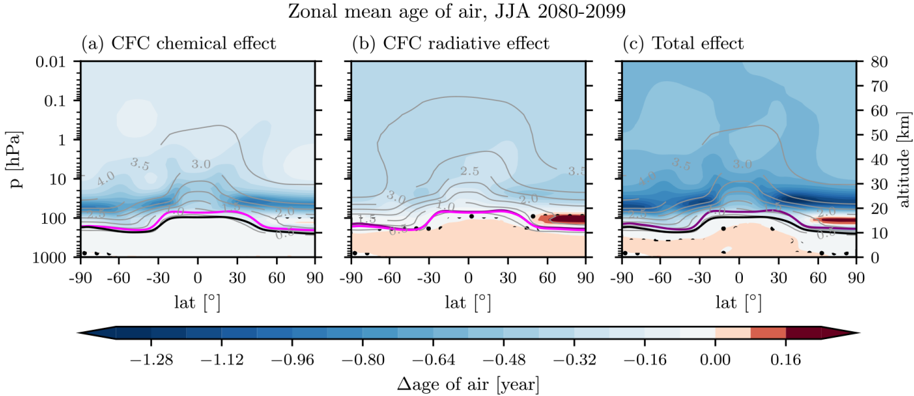
The Montreal Protocol and its amendments (MPA) have been a huge success in preserving the stratospheric ozone layer from being destroyed by unabated chlorofluorocarbon (CFC) emissions. The phaseout of CFCs has not only prevented serious impacts on our health and climate, but also avoided strong alterations of atmospheric circulation patterns. With the Earth system model SOCOLv4, we study the dynamical and climatic impacts of a scenario with unabated CFC emissions by 2100, disentangling radiative and chemical (ozone-mediated) effects of CFCs. In the stratosphere, chemical effects of CFCs (i.e., the resulting ozone loss) are the main drivers of circulation changes, weakening wintertime polar vortices and speeding up the Brewer–Dobson circulation. These dynamical impacts during wintertime are due to low-latitude ozone depletion and the resulting reduction in the Equator-to-pole temperature gradient. Westerly winds in the lower stratosphere strengthen, which is for the Southern Hemisphere (SH) similar to the effects of the Antarctic ozone hole over the second half of the 20th century. Furthermore, the winter and spring stratospheric wind variability increases in the SH, whereas it decreases in summer and fall. This seasonal variation in wind speed in the stratosphere has substantial implications for the major modes of variability in the tropospheric circulation in the scenario without the MPA (No-MPA). We find coherent changes in the troposphere, such as patterns that are reminiscent of negative Southern and Northern Annular modes (SAM and NAM) and North Atlantic Oscillation (NAO) anomalies during seasons with a weakened vortex (winter and spring); the opposite occurs during seasons with strengthened westerlies in the lower stratosphere and troposphere (summer). In the troposphere, radiative heating by CFCs prevails throughout the year, shifting the SAM into a positive phase and canceling out the ozone-induced effects on the NAO, whereas the North Pacific sector shows an increase in the meridional sea-level pressure gradient as both CFC heating and ozone-induced effects reinforce each other there. Furthermore, global warming is amplified by 1.7 K with regionally up to a 12 K increase over eastern Canada and the western Arctic. Our study sheds light on the adverse effects of a non-adherence to the MPA on the global atmospheric circulation, uncovering the roles of the underlying physical mechanisms. In so doing, our study emphasizes the importance of the MPA for Earth's climate to avoid regional amplifications of negative climate impacts.
Overview
The claims and statistics of this paper haven’t been checked yet.
Free: it reads the open-access text and checks the first 5 claims that cite a source we can check. Create a free account to check every claim.
Integrity signals
Registry
Cites
Statistics
Figures
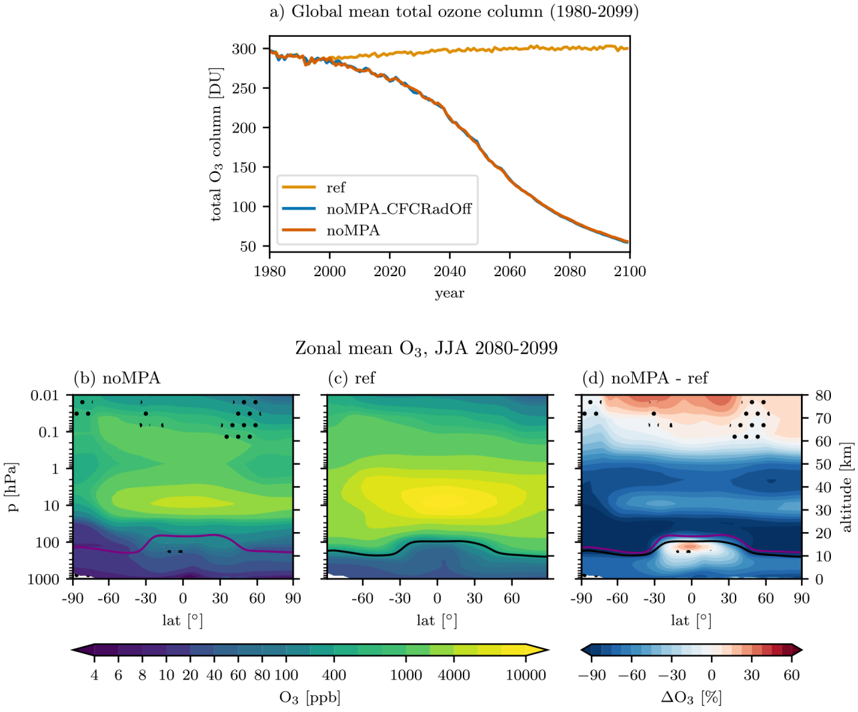
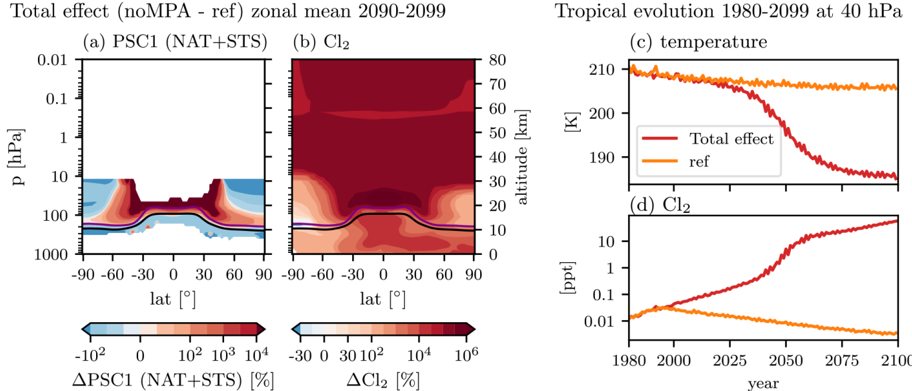
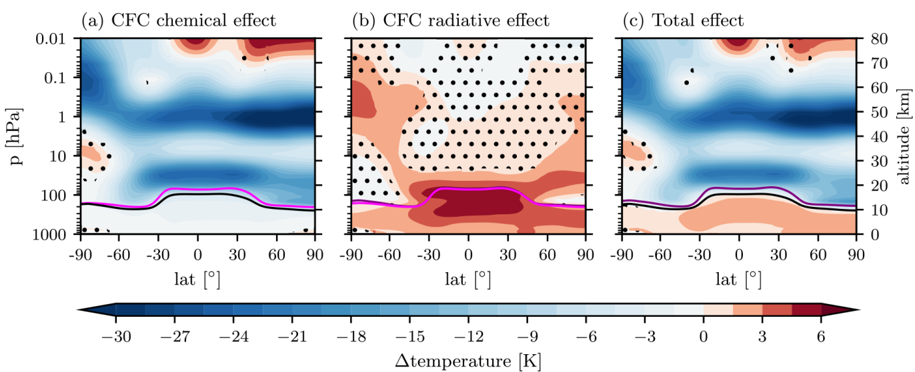
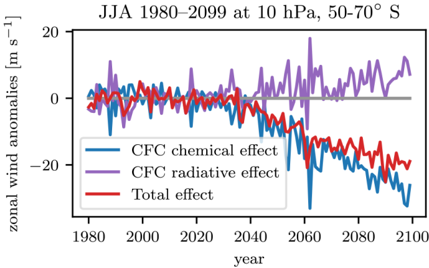
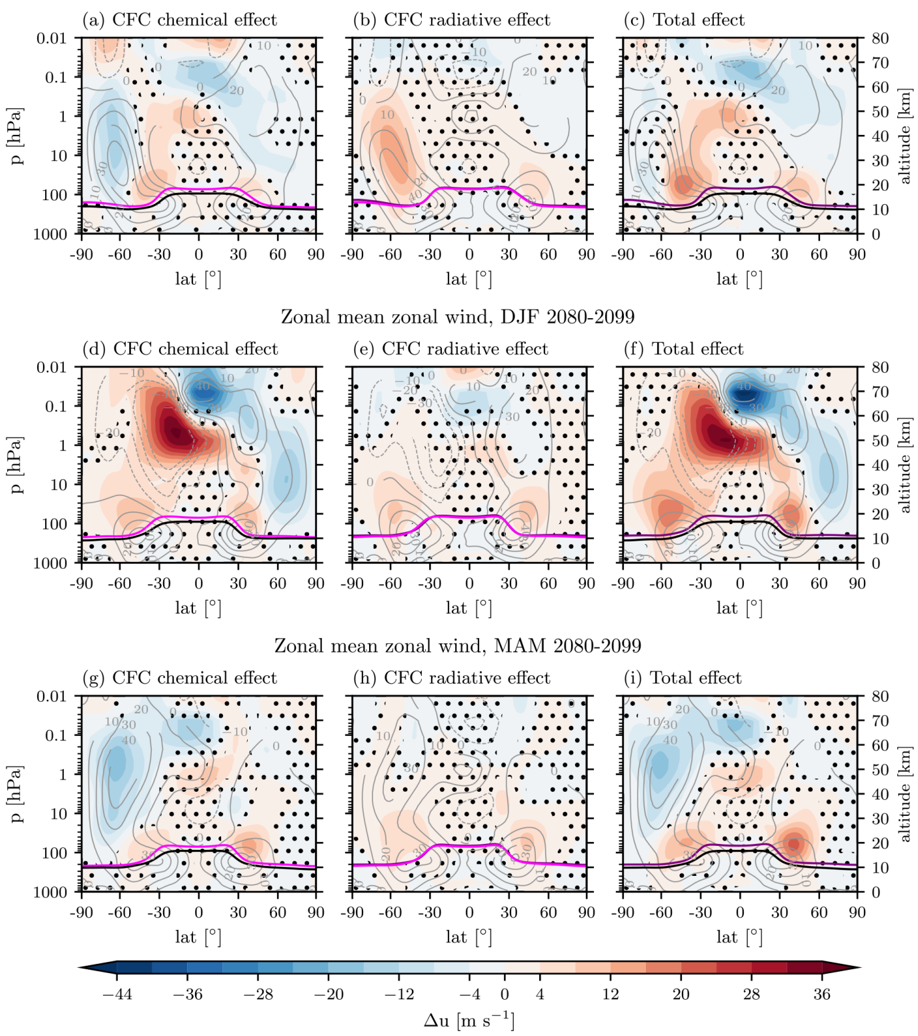
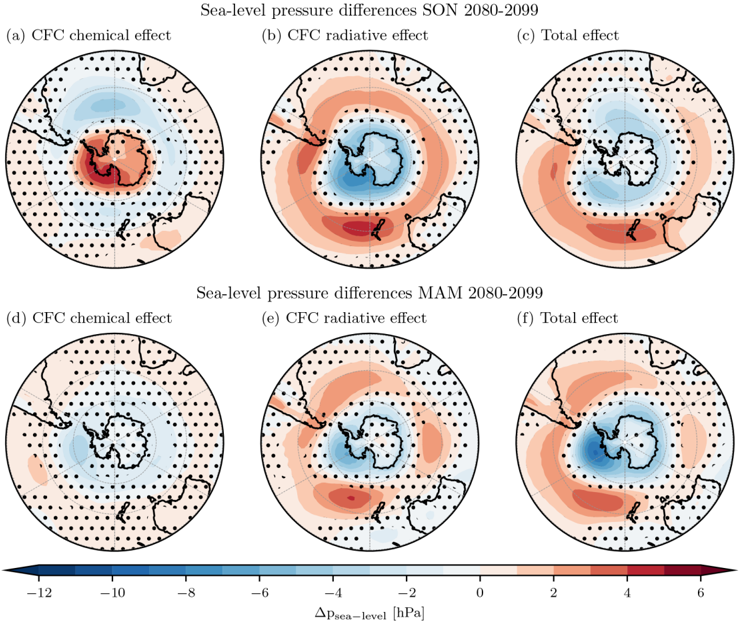
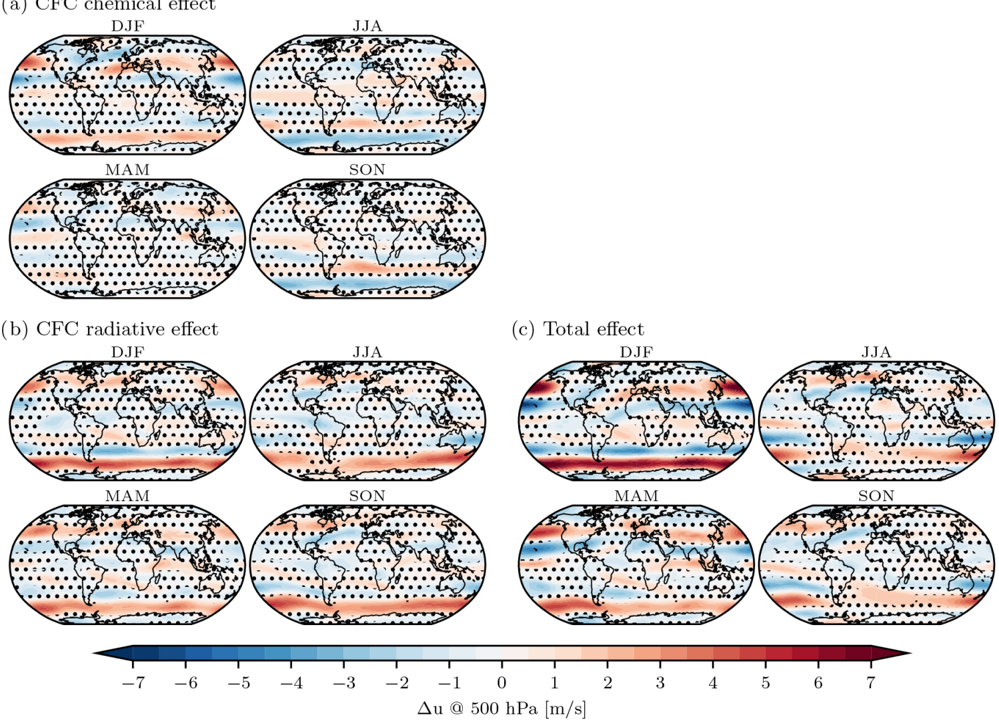
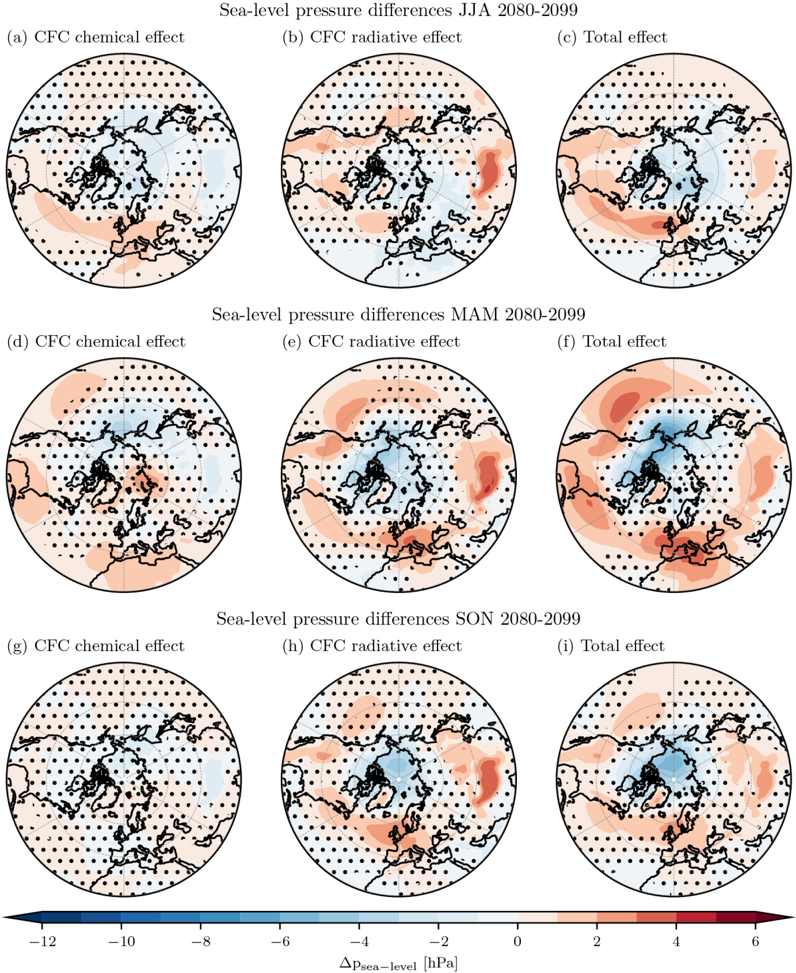
Verification
Claims the paper makes
The claims and statistics of this paper haven’t been checked yet.
Free: it reads the open-access text and checks the first 5 claims that cite a source we can check. Create a free account to check every claim.
Claims other papers make about this one
Each is checked against this paper’s own text: does it say what the citing paper says it does?
The cited source doesn’t support the claim as written.
In the citing paper
“This would have also pushed the jet streams and climate zones equatorward in both hemispheres, leading to substantial changes in large-scale circulation and resulting in increased precipitation in the Arctic, the Amazon, Indonesia, India, the Sahel, Australia, the Southern Ocean and coastal areas of Antarctica, and decreased rainfall in the Rocky Mountains, Southern Europe, the Mediterranean, the”
From Environmental consequences of interacting effects of changes in stratospheric ozone, ultraviolet radiation, and climate: UNEP Environmental Effects Assessment Panel, Update 2024 (2025) · cites this paper as [3]
Checked by a reasoning model — may be wrong.
Experimental — accuracy not yet measuredThe source backs part of the claim, not all of it — or backs it for a different population, condition or comparison.
In the citing paper
“According to the new studies [3, 4], continued emissions of ODS would have increased the average global surface temperature by 2.3 °C over the twenty-first century, with the strongest warming by up to 12 °C predicted over parts of the Arctic.”
From Environmental consequences of interacting effects of changes in stratospheric ozone, ultraviolet radiation, and climate: UNEP Environmental Effects Assessment Panel, Update 2024 (2025) · cites this paper as [3]
Experimental — accuracy not yet measuredThe cited source says what the claim attributes to it.
In the citing paper
“According to new single-model world-avoided studies based on the SSP2-4.5 scenario [3, 4], these large decreases in tropical ozone would have drastically cooled the tropical tropopause, thereby reducing the equator-to-pole temperature gradient and weakening the winter polar vortices in both hemispheres.”
Self-check
Percentages, sums and reported differences re-computed from the paper’s own numbers.
The self-check needs the paper’s full text.
Citations
Cites
Decadal Trends in the North Atlantic Oscillation: Regional Temperatures and Precipitation
Hurrell, J. W. (1995) · Science · doi:10.1126/science.269.5224.676 · Cited by 7,879
(IPCC), I. P. O. C. C. (2023) · doi:10.1017/9781009157896 · Cited by 6,972
Riahi, K., van Vuuren, D. P., Kriegler, E., Edmonds, J., O’Neill, B. C., Fujimori, S., Bauer, N., Calvin, K., Dellink, R., Fricko, O., et al. (2017) · Global Environmental Change · doi:10.1016/j.gloenvcha.2016.05.009 · Cited by 6,607
Stratospheric ozone depletion: A review of concepts and history
Solomon, S. (1999) · Reviews of Geophysics · doi:10.1029/1999rg900008 · Cited by 2,008
Interpretation of Recent Southern Hemisphere Climate Change
Thompson, D. W. J., & Solomon, S. (2002) · Science · doi:10.1126/science.1069270 · Cited by 1,904
Mauritsen, T., Bader, J., Becker, T., Behrens, J., Bittner, M., Brokopf, R., Brovkin, V., Claussen, M., Crueger, T., Esch, M., et al. (2019) · Journal of Advances in Modeling Earth Systems · doi:10.1029/2018ms001400 · Cited by 1,520
Stratospheric influence on tropospheric jet streams, storm tracks and surface weather
Kidston, J., Scaife, A. A., Hardiman, S. C., Mitchell, D. M., Butchart, N., Baldwin, M. P., & Gray, L. J. (2015) · Nature Geoscience · doi:10.1038/ngeo2424 · Cited by 765
Future Global Climate: Scenario-based Projections and Near-term Information
(2023) · Climate Change 2021 – The Physical Science Basis · doi:10.1017/9781009157896.006 · Cited by 654
The North Atlantic Oscillation: Past, present, and future
Visbeck, M. H., Hurrell, J. W., Polvani, L., & Cullen, H. M. (2001) · Proceedings of the National Academy of Sciences · doi:10.1073/pnas.231391598 · Cited by 609
Simulation of Recent Southern Hemisphere Climate Change
Gillett, N. P., & Thompson, D. W. J. (2003) · Science · doi:10.1126/science.1087440 · Cited by 606
The importance of the Montreal Protocol in protecting climate
Velders, G. J. M., Andersen, S. O., Daniel, J. S., Fahey, D. W., & McFarland, M. (2007) · Proceedings of the National Academy of Sciences · doi:10.1073/pnas.0610328104 · Cited by 562
Regional climate impacts of the Southern Annular Mode
Gillett, N. P., Kell, T. D., & Jones, P. D. (2006) · Geophysical Research Letters · doi:10.1029/2006gl027721 · Cited by 524
Contributions of Anthropogenic and Natural Forcing to Recent Tropopause Height Changes
Santer, B. D., Wehner, M. F., Wigley, T. M. L., Sausen, R., Meehl, G. A., Taylor, K. E., Ammann, C., Arblaster, J., Washington, W. M., Boyle, J. S., et al. (2003) · Science · doi:10.1126/science.1084123 · Cited by 471
Ozone depletion, ultraviolet radiation, climate change and prospects for a sustainable future
Barnes, P. W., Williamson, C. E., Lucas, R. M., Robinson, S. A., Madronich, S., Paul, N. D., Bornman, J. F., Bais, A. F., Sulzberger, B., Wilson, S. R., et al. (2019) · Nature Sustainability · doi:10.1038/s41893-019-0314-2 · Cited by 360
Human Influence on the Climate System
(2023) · Climate Change 2021 – The Physical Science Basis · doi:10.1017/9781009157896.005 · Cited by 351
Stratosphere–Troposphere Coupling in the Southern Hemisphere
Thompson, D. W. J., Baldwin, M. P., & Solomon, S. (2005) · Journal of the Atmospheric Sciences · doi:10.1175/jas-3321.1 · Cited by 252
Neale, R. E., Barnes, P. W., Robson, T. M., Neale, P. J., Williamson, C. E., Zepp, R. G., Wilson, S. R., Madronich, S., Andrady, A. L., Heikkilä, A. M., et al. (2021) · Photochemical & Photobiological Sciences · doi:10.1007/s43630-020-00001-x · Cited by 225
What would have happened to the ozone layer if chlorofluorocarbons (CFCs) had not been regulated?
Newman, P. A., Oman, L. D., Douglass, A. R., Fleming, E. L., Frith, S. M., Hurwitz, M. M., Kawa, S. R., Jackman, C. H., Krotkov, N. A., Nash, E. R., et al. (2009) · Atmospheric Chemistry and Physics · doi:10.5194/acp-9-2113-2009 · Cited by 220
A two‐dimensional model of sulfur species and aerosols
Weisenstein, D. K., Yue, G. K., Ko, M. K. W., Sze, N., Rodriguez, J. M., & Scott, C. J. (1997) · Journal of Geophysical Research: Atmospheres · doi:10.1029/97jd00901 · Cited by 203
A pause in Southern Hemisphere circulation trends due to the Montreal Protocol
Banerjee, A., Fyfe, J. C., Polvani, L. M., Waugh, D., & Chang, K.-L. (2020) · Nature · doi:10.1038/s41586-020-2120-4 · Cited by 199
Change, I. P. O. C. (2023) · Cambridge University Press eBooks · doi:10.1017/9781009157896.021 · Cited by 199
Stratospheric drivers of extreme events at the Earth’s surface
Domeisen, D. I. V., & Butler, A. H. (2020) · Communications Earth & Environment · doi:10.1038/s43247-020-00060-z · Cited by 176
Climate system response to stratospheric ozone depletion and recovery
Previdi, M., & Polvani, L. M. (2014) · Quarterly Journal of the Royal Meteorological Society · doi:10.1002/qj.2330 · Cited by 174
New Insights on the Impact of Ozone‐Depleting Substances on the Brewer‐Dobson Circulation
Abalos, M., Polvani, L., Calvo, N., Kinnison, D., Ploeger, F., Randel, W., & Solomon, S. (2019) · Journal of Geophysical Research: Atmospheres · doi:10.1029/2018jd029301 · Cited by 119
The World Avoided by the Montreal Protocol
Morgenstern, O., Braesicke, P., Hurwitz, M. M., O'Connor, F. M., Bushell, A. C., Johnson, C. E., & Pyle, J. A. (2008) · Geophysical Research Letters · doi:10.1029/2008gl034590 · Cited by 115
Photochemistry and Transport of Carbon Monoxide in the Middle Atmosphere
Solomon, S., García, R. R., Olivero, J. J., Bevilacqua, R. M., Schwartz, P. R., Clancy, R. T., & Muhleman, D. O. (1985) · Journal of the Atmospheric Sciences · doi:10.1175/1520-0469(1985)042<1072:patocm>2.0.co;2 · Cited by 115
On the surface impact of Arctic stratospheric ozone extremes
Calvo, N., Polvani, L. M., & Solomon, S. (2015) · Environmental Research Letters · doi:10.1088/1748-9326/10/9/094003 · Cited by 113
Continuous rise of the tropopause in the Northern Hemisphere over 1980–2020
Meng, L., Liu, J. J., Tarasick, D. W., Randel, W. J., Steiner, A. K., Wilhelmsen, H., Wang, L., & Haimberger, L. (2021) · Science Advances · doi:10.1126/sciadv.abi8065 · Cited by 107
The Montreal Protocol protects the terrestrial carbon sink
Young, P. J., Harper, A., Huntingford, C., PAUL, N. D., Morgenstern, O., Newman, P. A., Oman, L. D., Madronich, S., & García, R. R. (2021) · Nature · doi:10.1038/s41586-021-03737-3 · Cited by 102
Effect of zonal asymmetries in stratospheric ozone on simulated Southern Hemisphere climate trends
Waugh, D. W., Oman, L., Newman, P. A., Stolarski, R. S., Pawson, S., Nielsen, J. E., & Perlwitz, J. (2009) · Geophysical Research Letters · doi:10.1029/2009gl040419 · Cited by 88
Observed connections of Arctic stratospheric ozone extremes to Northern Hemisphere surface climate
Ivy, D. J., Solomon, S., Calvo, N., & Thompson, D. W. J. (2017) · Environmental Research Letters · doi:10.1088/1748-9326/aa57a4 · Cited by 88
Randel, W. J., Smith, A. K., Wu, F., Zou, C.-Z., & Qian, H. (2016) · Journal of Climate · doi:10.1175/jcli-d-15-0629.1 · Cited by 86
Reduction in surface climate change achieved by the 1987 Montreal Protocol
Goyal, R., England, M. H., Sen Gupta, A., & Jucker, M. (2019) · Environmental Research Letters · doi:10.1088/1748-9326/ab4874 · Cited by 86
Feinberg, A., Sukhodolov, T., Luo, B.-P., Rozanov, E., Winkel, L. H. E., Peter, T., & Stenke, A. (2019) · Geoscientific Model Development · doi:10.5194/gmd-12-3863-2019 · Cited by 84
Self-citationDrivers of changes in stratospheric and tropospheric ozone between year 2000 and 2100
Banerjee, A., Maycock, A. C., Archibald, A. T., Abraham, N. L., Telford, P., Braesicke, P., & Pyle, J. A. (2016) · Atmospheric Chemistry and Physics · doi:10.5194/acp-16-2727-2016 · Cited by 80
On the modelled thermal response of the Antarctic stratosphere to a depletion of ozone
Shine, K. P. (1986) · Geophysical Research Letters · doi:10.1029/gl013i012p01331 · Cited by 78
Springtime arctic ozone depletion forces northern hemisphere climate anomalies
Friedel, M., Chiodo, G., Stenke, A., Domeisen, D. I. V., Fueglistaler, S., Anet, J. G., & Peter, T. (2022) · Nature Geoscience · doi:10.1038/s41561-022-00974-7 · Cited by 77
Self-citationFunke, B., López‐Puertas, M., García-Comas, M., Stiller, G. P., von Clarmann, T., Höpfner, M., Glatthor, N., Grabowski, U., Kellmann, S., & Linden, A. (2009) · Atmospheric chemistry and physics · doi:10.5194/acp-9-2387-2009 · Cited by 76
Polvani, L. M., Wang, L., Abalos, M., Butchart, N., Chipperfield, M. P., Dameris, M., Deushi, M., Dhomse, S. S., Jöckel, P., Kinnison, D., et al. (2019) · Journal of Geophysical Research: Atmospheres · doi:10.1029/2018jd029516 · Cited by 72
Two‐dimensional modelling of the Antarctic lower stratosphere
Chipperfield, M. P., & Pyle, J. A. (1988) · Geophysical Research Letters · doi:10.1029/gl015i008p00875 · Cited by 69
The Response of the Ozone Layer to Quadrupled CO2 Concentrations: Implications for Climate
Chiodo, G., & Polvani, L. M. (2019) · Journal of Climate · doi:10.1175/jcli-d-19-0086.1 · Cited by 53
Self-citationAttribution of historical ozone forcing to anthropogenic emissions
Shindell, D. T., Faluvegi, G., Nazarenko, L., Bowman, K. W., Lamarque, J., Voulgarakis, A., Schmidt, G. A., Pechony, O. B., & Ruedy, R. A. (2013) · Nature Climate Change · doi:10.1038/nclimate1835 · Cited by 52
The Role of Stratospheric Polar Vortex Breakdown in Southern Hemisphere Climate Trends
Sun, L., Chen, G., & Robinson, W. A. (2014) · Journal of the Atmospheric Sciences · doi:10.1175/jas-d-13-0290.1 · Cited by 51
Atmosphere–ocean–aerosol–chemistry–climate model SOCOLv4.0: description and evaluation
Sukhodolov, T., Egorova, T., Stenke, A., Ball, W. T., Brodowsky, C., Chiodo, G., Feinberg, A., Friedel, M., Karagodin-Doyennel, A., Peter, T., et al. (2021) · Geoscientific Model Development · doi:10.5194/gmd-14-5525-2021 · Cited by 50
Self-citation“World avoided” simulations with the Whole Atmosphere Community Climate Model
Garcia, R. R., Kinnison, D. E., & Marsh, D. R. (2012) · Journal of Geophysical Research: Atmospheres · doi:10.1029/2012jd018430 · Cited by 49
Ivanciu, I., Matthes, K., Biastoch, A., Wahl, S., & Harlaß, J. (2022) · Weather and Climate Dynamics · doi:10.5194/wcd-3-139-2022 · Cited by 46
Montreal Protocol Benefits simulated with CCM SOCOL
Egorova, T., Rozanov, E., Gröbner, J., Hauser, M., & Schmutz, W. (2013) · Atmospheric Chemistry and Physics · doi:10.5194/acp-13-3811-2013 · Cited by 44
Self-citationReappraisal of the Climate Impacts of Ozone‐Depleting Substances
Morgenstern, O., O'Connor, F. M., Johnson, B. T., Zeng, G., Mulcahy, J. P., Williams, J., Teixeira, J., Michou, M., Nabat, P., Horowitz, L. W., et al. (2020) · Geophysical Research Letters · doi:10.1029/2020gl088295 · Cited by 34
CO as an important high‐altitude tracer of dynamics in the polar stratosphere and mesosphere
Zafra, R. L. D., & Muscari, G. (2004) · Journal of Geophysical Research Atmospheres · doi:10.1029/2003jd004099 · Cited by 31
Morgenstern, O., Kinnison, D. E., Mills, M. J., Michou, M., Horowitz, L. W., Lin, P., Deushi, M., Yoshida, K., O’Connor, F. M., Tang, Y., et al. (2022) · Journal of Geophysical Research Atmospheres · doi:10.1029/2022jd037123 · Cited by 29
Self-citationMontreal Protocol's impact on the ozone layer and climate
Egorova, T., Sedlacek, J., Sukhodolov, T., Karagodin-Doyennel, A., Zilker, F., & Rozanov, E. (2023) · Atmospheric Chemistry and Physics · doi:10.5194/acp-23-5135-2023 · Cited by 29
Self-citationHaase, S. P., Fricke, J., Kruschke, T., Wahl, S., & Matthes, K. (2020) · Atmospheric chemistry and physics · doi:10.5194/acp-20-14043-2020 · Cited by 28
Direct and ozone‐mediated forcing of the Southern Annular Mode by greenhouse gases
Morgenstern, O., Zeng, G., Dean, S. M., Joshi, M., Abraham, N. L., & Osprey, A. (2014) · Geophysical Research Letters · doi:10.1002/2014gl062140 · Cited by 27
Tropical circulation and precipitation response to ozone depletion and recovery
Brönnimann, S., Jacques‐Coper, M., Rozanov, E., Fischer, A. M., Morgenstern, O., Zeng, G., Akiyoshi, H., & Yamashita, Y. (2017) · Environmental Research Letters · doi:10.1088/1748-9326/aa7416 · Cited by 25
Self-citationSteiner, M., Luo, B., Peter, T., Pitts, M. C., & Stenke, A. (2021) · Geoscientific model development · doi:10.5194/gmd-14-935-2021 · Cited by 25
Self-citationThe effect of ozone depletion on the Southern Annular Mode and stratosphere‐troposphere coupling
Dennison, F. W., McDonald, A. J., & Morgenstern, O. (2015) · Journal of Geophysical Research Atmospheres · doi:10.1002/2014jd023009 · Cited by 23
Calvo, N., García, R. R., & Kinnison, D. E. (2017) · Geophysical Research Letters · doi:10.1002/2017gl072792 · Cited by 21
New Insights on the Radiative Impacts of Ozone‐Depleting Substances
Chiodo, G., & Polvani, L. M. (2022) · Geophysical Research Letters · doi:10.1029/2021gl096783 · Cited by 19
Self-citationMorgenstern, O., Frith, S. M., Bodeker, G. E., Fioletov, V., & Ronald van der, A. (2021) · Geophysical Research Letters · doi:10.1029/2021gl095376 · Cited by 16
A technique to identify vortex air using carbon monoxide observations
McDonald, A. J., & Smith, M. L. (2013) · Journal of Geophysical Research Atmospheres · doi:10.1002/2012jd019257 · Cited by 12
Atmosphere-Ocean-Aerosol-Chemistry-Climate Model SOCOLv4.0: description and evaluationPreprint
Sukhodolov, T., Egorova, T. A., Stenke, A., et al. (2021) · doi:10.5194/gmd-2021-35 · Cited by 9
Self-citationMontreal Protocol's impact on the ozone layer and climate
Sedláčék, J., Egorova, T. A., Sukhodolov, T., Karagodin‐Doyennel, A., Zilker, F., & Rozanov, E. (2023) · doi:10.5194/egusphere-egu23-13881 · Cited by 3
Self-citation
Cited by
Neale, P. J., Hylander, S., Banaszak, A. T., Häder, D.-P., Rose, K. C., Vione, D., Wängberg, S.-Å., Jansen, M. A. K., Busquets, R., Andersen, M. P. S., et al. (2025) · Photochemical & Photobiological Sciences · doi:10.1007/s43630-025-00687-x · Cited by 32
“5 scenario [3, 4], these large decreases in tropical ozone would have drastically cooled the tropical tropopause, thereby reducing the equator-to-pole temperature gradient and weakening the winter polar vortices in both hemispheres.”
InfluentialSelf-citationThe influence of future changes in springtime Arctic ozone on stratospheric and surface climate
Chiodo, G., Friedel, M., Seeber, S., Domeisen, D., Stenke, A., Sukhodolov, T., & Zilker, F. (2023) · Atmospheric Chemistry and Physics · doi:10.5194/acp-23-10451-2023 · Cited by 10
Self-citationFriedel, M., Chiodo, G., Weber, K., Polvani, L. M., Daniel, J. S., Abraham, N. L., Davis, S. M., Deushi, M., Oshima, N., Horowitz, L. W., et al. (2026) · npj Climate and Atmospheric Science · doi:10.1038/s41612-026-01398-5
Self-citation
Metadata
- Authors
- Zilker, F., Sukhodolov, T., Chiodo, G., Friedel, M., Egorova, T., Rozanov, E., Sedlacek, J., Seeber, S., & Peter, T.
- Affiliations
- Swiss Federal Institute for Forest, Snow and Landscape Research (CH)
- St Petersburg University (RU)
- ETH Zurich (CH)
- Physikalisch-Meteorologisches Observatorium Davos (CH)
- Corresponding author
- Zilker, Franziska
- ORCID
- Venue
- Atmospheric Chemistry and Physics
- Publisher
- Copernicus GmbH
- Published
- 2023-10-24
- Volume
- 23
- Issue
- 20
- Pages
- 13387-13411
- ISSN
- 1680-7316 (ISSN-L)
- 1680-7324
- OpenAlex
- W4387895117
- Semantic Scholar
- a7fb6733ba53a5ee02c4f3f9ed0c5622cc2756cf
- Cited by
- 3
- References
- 60
- Citations by year
- 2026: 1 · 2025: 1 · 2023: 1
- FWCI
- 0.33
- Type
- journal article
- Language
- en
- Open access
- gold
- doi.org
- Licence
- Locations
- Atmospheric chemistry and physics (publishedVersion, cc-by)
- DOAJ (DOAJ: Directory of Open Access Journals) (submittedVersion, cc-by-sa)
- DORA WSL (Swiss Federal Institute for Forest, Snow and Landscape Research) (submittedVersion, cc-by)
- Repository for Publications and Research Data (ETH Zurich) (submittedVersion, cc-by)
- ETH Zürich Research Collection
- Funders
- Schweizerischer Nationalfonds zur Förderung der Wissenschaftlichen Forschung (200020-182239, PZ00P2_180043)
- Topics
- Physical Sciences › Earth and Planetary Sciences › Atmospheric Science › Atmospheric Ozone and Climate
- Physical Sciences › Environmental Science › Global and Planetary Change › Climate variability and models
- Physical Sciences › Earth and Planetary Sciences › Atmospheric Science › Meteorological Phenomena and Simulations
- Keywords
- Montreal Protocol, chlorofluorocarbons, stratospheric ozone depletion, Brewer-Dobson circulation, polar vortex, stratospheric circulation, Southern Annular Mode, Arctic Oscillation, North Atlantic Oscillation, radiative heating, sea level pressure gradient, stratosphere-troposphere coupling
About these checks
Registry, retraction, Cites and statistics results are computed, not judged, with one exception: a printed reference that no index lists is read once by a model before it counts as a citation error. Claims are extracted by a model and kept only when their quote appears verbatim in the text; each cited source is then checked, with a model’s help, for whether it says what the claim relies on. Those verdicts can be wrong — read the claim’s quote and the cited source before relying on one.
Statistics and arithmetic are recomputed, not judged.
Confidence bands are shown only for fields calibrated on our annotated test set. None is calibrated yet, so no band is shown.
What counts as a claim ›How we measure confidence ›How we check this ›
Are you an author, or do you see a problem with this page? Request a review
Data sources
Bibliographic data: Semantic Scholar, OpenAlex, Crossref.
Contains information from the Semantic Scholar Academic Graph Datasets, made available under the ODC Attribution License (ODC-BY 1.0).
Semantic Scholar’s data is described in: Kinney, R., et al. (2023). The Semantic Scholar Open Data Platform. arXiv:2301.10140.
