

Nitric Acid Trihydrate (NAT) formation at low NAT supersaturation in Polar Stratospheric Clouds (PSCs)
Open accessPublished version of a preprint
The DOI matches its Crossref record; 53 of the 53 references it cites were found in a registry or an index.
Abstract
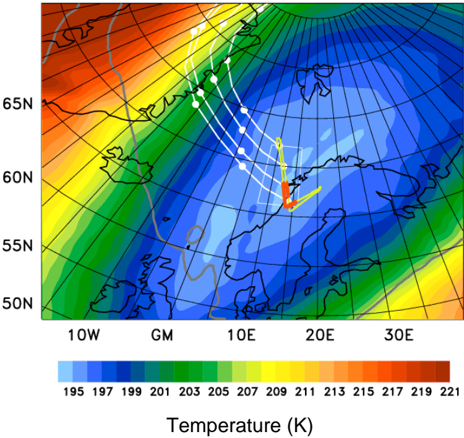
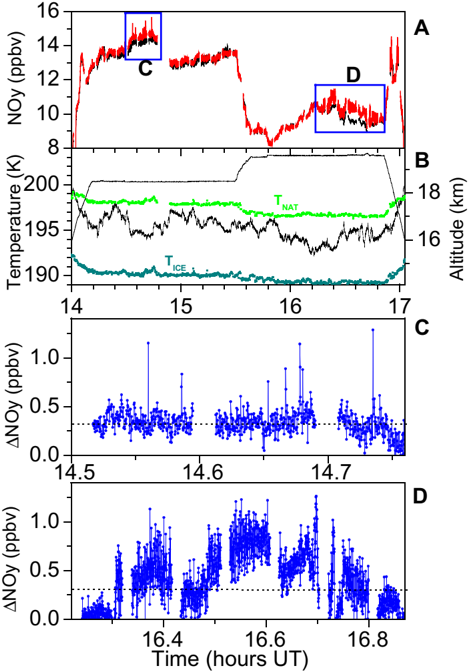
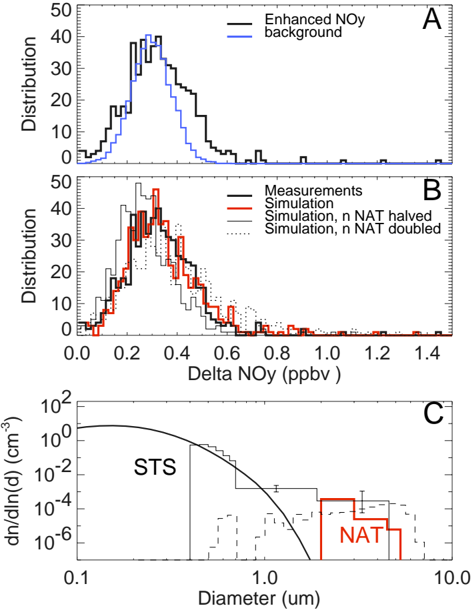
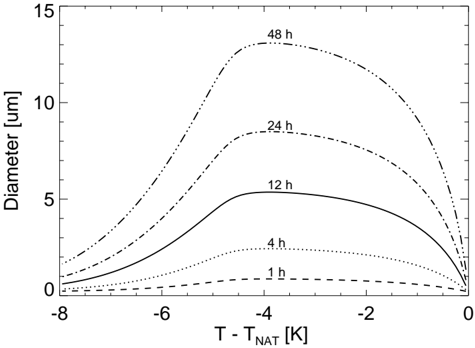
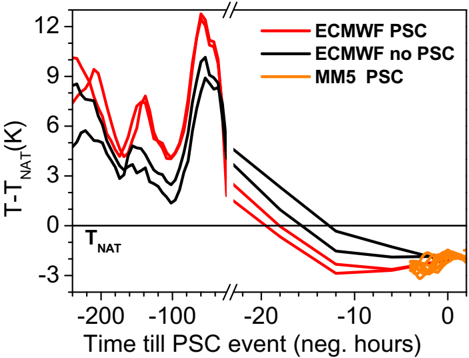
A PSC was detected on 6 February 2003 in the Arctic stratosphere by in-situ measurements onboard the high-altitude research aircraft Geophysica. Low number densities (~10-4cm-3) of small nitric acid (HNO3) containing particles (d<6µm) were observed at altitudes between 18 and 20km. Provided the temperatures remain below the NAT equilibrium temperature TNAT, these NAT particles have the potential to grow further and to remove HNO3 from the stratosphere, thereby enhancing polar ozone loss. Interestingly, the NAT particles formed in less than a day at temperatures just slightly below TNAT (T>TNAT-3.1K). This unique measurement of PSC formation at extremely low NAT saturation ratios (SNAT≤10) constrains current NAT nucleation theories. We suggest, that the NAT particles have formed heterogeneously, but for certain not on ice. Conversely, meteoritic particles may be favorable candidates for triggering NAT nucleation at the observed low number densities.
Overview
The claims and statistics of this paper haven’t been checked yet.
Free: it reads the open-access text and checks the first 5 claims that cite a source we can check. Create a free account to check every claim.
Integrity signals
Registry
Cites
Statistics
Figures
Verification
Claims the paper makes
The claims and statistics of this paper haven’t been checked yet.
Free: it reads the open-access text and checks the first 5 claims that cite a source we can check. Create a free account to check every claim.
Claims other papers make about this one
Each is checked against this paper’s own text: does it say what the citing paper says it does?
The source backs part of the claim, not all of it — or backs it for a different population, condition or comparison.
In the citing paper
“Novel ice nuclei can have a large effect even at low concentrations because polar stratospheric clouds nucleate on a small fraction of the particles (19).”
From Metals from spacecraft reentry in stratospheric aerosol particles (2023) · cites this paper as [19]
Experimental — accuracy not yet measured
Self-check
Percentages, sums and reported differences re-computed from the paper’s own numbers.
The self-check needs the paper’s full text.
Citations
Cites
Water activity as the determinant for homogeneous ice nucleation in aqueous solutions
Koop, T., Luo, B., Tsias, A., & Peter, T. (2000) · Nature · doi:10.1038/35020537 · Cited by 1,495 · cited 2×
“At temperatures below the frost point TICE (∼190 K), ice can nucleate in the supercooled ternary solution (STS) droplets (Koop et al., 2000), and the cloud Correspondence to:C. Voigt (christiane.voigt@dlr.de) may become visible as a colourful iridescent ice PSC. PSCs consisting of NAT particles…”
BackgroundSelf-citationSciENTIFIC AssESSMENT OF OzoNE DEPLETION: 1998
Albritton, D. L., Aucamp, P. J., Megie, G. J., Watson, R. T., Prinn, R. G., Rodríguez, J. M., Ennis, C. A., Boville, B. A., Brasseur, G. P., Angell, J. K., et al. (2012) · Cited by 919
Laboratory studies of the nitric acid trihydrate: Implications for the south polar stratosphere
Hanson, D., & Mauersberger, K. (1988) · Geophysical Research Letters · doi:10.1029/gl015i008p00855 · Cited by 755 · cited 2×
“The dashed black line shows the detection limit for particle NOy. lated from Hanson and Mauersberger (1988) using the water vapour and the gas phase NOy profiles measured onboard the Geophysica.”
MethodMurphy, D. M., Thomson, D. S., & Mahoney, M. J. (1998) · Science · doi:10.1126/science.282.5394.1664 · Cited by 571 · cited 1×
“Mass spectrometric measurements detected meteoritic inclusions in half of the stratospheric particles (Murphy et al., 1998; Cziczo et al., 2001).”
BackgroundCarslaw, K. S., Luo, B. P., Clegg, S. L., Peter, T., Brimblecombe, P., & Crutzen, P. J. (1994) · Geophysical Research Letters · doi:10.1029/94gl02799 · Cited by 374 · cited 1×
“PSCs form in the winter polar stratosphere at low temperatures by uptake of water and nitric acid into stratospheric sulfate aerosol (Carslaw et al., 1994; Schreiner et al., 1999; Voigt et al., 2000b).”
BackgroundSelf-citationThe Detection of Large HNO 3 -Containing Particles in the Winter Arctic Stratosphere
Fahey, D. W., Gao, R. S., Carslaw, K. S., Kettleborough, J., Popp, P. J., Northway, M. J., Holecek, J. C., Ciciora, S. C., McLaughlin, R. J., Thompson, T. L., et al. (2001) · Science · doi:10.1126/science.1057265 · Cited by 287 · cited 6×
“In winter 1999/2000, NOy containing particles with low number densities (n∼10−4 cm−3) but larger diameters (10µm<d<20µm) have been detected in the Arctic stratosphere (Fahey et al., 2001; Northway et al., 2002).”
BackgroundMethodInfluentialSelf-citationMICROPHYSICS AND HETEROGENEOUS CHEMISTRY OF POLAR STRATOSPHERIC CLOUDS
Peter, T. (1997) · Annual Review of Physical Chemistry · doi:10.1146/annurev.physchem.48.1.785 · Cited by 282 · cited 1×
“These dense PSCs provide sites for heterogeneous reactions that activate halogen species (Peter, 1997) leading to polar ozone destruction.”
BackgroundSelf-citationVapor Pressures of Solid Hydrates of Nitric Acid: Implications for Polar Stratospheric Clouds
Worsnop, D. R., Zahniser, M. S., Fox, L. E., & Wofsy, S. C. (1993) · Science · doi:10.1126/science.259.5091.71 · Cited by 247
Single particle measurements of the chemical composition of cirrus ice residue during CRYSTAL‐FACE
Cziczo, D. J., Murphy, D. M., Hudson, P. K., & Thomson, D. S. (2004) · Journal of Geophysical Research: Atmospheres · doi:10.1029/2003jd004032 · Cited by 238
Nitric Acid Trihydrate (NAT) in Polar Stratospheric Clouds
Voigt, C., Schreiner, J., Kohlmann, A., Zink, P., Mauersberger, K., Larsen, N., Deshler, T., Kröger, C., Rosen, J., Adriani, A., et al. (2000) · Science · doi:10.1126/science.290.5497.1756 · Cited by 212 · cited 3×
“PSCs form in the winter polar stratosphere at low temperatures by uptake of water and nitric acid into stratospheric sulfate aerosol (Carslaw et al., 1994; Schreiner et al., 1999; Voigt et al., 2000b).”
BackgroundMethodInfluentialSelf-citation
Research works printed but not linked: 2
- Hinds, W. C.: Aerosol technology: properties, behaviour, and mea- surement of airborne particles, 2nd ed., John Wiley & Sons, Inc., New York, 1999.
- Schmitt, J.: Aufbau und Erprobung eines in-situ NO/NOy-Mess- Systems am Höhenforschungsflugzeug Geophysica, PhD Thesis, edited by: DLR, D-51170 Köln, ISRN DLR-FB-2003-21, 2004.
Cited by
Global dust model intercomparison in AeroCom phase I
Huneeus, N., Schulz, M., Balkanski, Y., Griesfeller, J., Prospero, J., Kinne, S., Bauer, S., Boucher, O., Chin, M., Dentener, F., et al. (2011) · Atmospheric Chemistry and Physics · doi:10.5194/acp-11-7781-2011 · Cited by 1,074
The Mesosphere and Metals: Chemistry and Changes
Plane, J. M. C., Feng, W., & Dawkins, E. C. M. (2015) · Chemical Reviews · doi:10.1021/cr500501m · Cited by 344
Ice structures, patterns, and processes: A view across the icefields
Bartels-Rausch, T., Bergeron, V., Cartwright, J. H. E., Escribano, R., Finney, J. L., Grothe, H., Gutiérrez, P. J., Haapala, J., Kuhs, W. F., Pettersson, J. B. C., et al. (2012) · Reviews of Modern Physics · doi:10.1103/revmodphys.84.885 · Cited by 361
“Nitric acid hydrates also form in the troposphere by nucleation on pre-existing ice particles (Voigt et al., 2003) or on meteor ablations (Curtius et al., 2005; Voigt et al., 2005).”
BackgroundCosmic dust in the earth's atmosphere
Plane, J. M. C. (2012) · Chemical Society Reviews · doi:10.1039/c2cs35132c · Cited by 325
Polar Stratospheric Clouds: Satellite Observations, Processes, and Role in Ozone Depletion
Tritscher, I., Pitts, M. C., Poole, L. R., Alexander, S. P., Cairo, F., Chipperfield, M. P., Grooß, J., Höpfner, M., Lambert, A., Luo, B., et al. (2021) · Reviews of Geophysics · doi:10.1029/2020rg000702 · Cited by 151
“To complete the picture, the response of the distribution of HNO3 is shown by the MLS observations in Figure 32e, where depletion of HNO3 from the gas-phase is associated with synoptic scale STS PSCs close to the pole, and localized depletion of HNO3 is associated with NAT PSCs in the polar belt.”
BackgroundInfluentialSelf-citationAnsmann, A., Ohneiser, K., Mamouri, R., Knopf, D., Veselovskii, I. A., Baars, H., Engelmann, R., Foth, A., Jiménez, C., Seifert, P., et al. (2021) · Atmospheric chemistry and physics · doi:10.5194/acp-21-9779-2021 · Cited by 169
In-situ observations of young contrails – overview and selected results from the CONCERT campaign
Voigt, C., Schumann, U., Jurkat, T., Schäuble, D., Schlager, H., Petzold, A., Gayet, J.-F., Krämer, M., Schneider, J., Borrmann, S., et al. (2010) · Atmospheric Chemistry and Physics · doi:10.5194/acp-10-9039-2010 · Cited by 147
“The NOy instrument is described in detail by Ziereis et al. (2004) and Voigt et al. (2005).”
MethodSelf-citationPolar stratospheric cloud microphysics and chemistry
Lowe, D., & MacKenzie, A. R. (2007) · Journal of Atmospheric and Solar-Terrestrial Physics · doi:10.1016/j.jastp.2007.09.011 · Cited by 154
Global and temporal distribution of meteoric smoke: A two‐dimensional simulation study
Megner, L., Siskind, D. E., Rapp, M., & Gumbel, J. (2008) · Journal of Geophysical Research: Atmospheres · doi:10.1029/2007jd009054 · Cited by 113
The 2009–2010 Arctic polar stratospheric cloud season: a CALIPSO perspective
Pitts, M. C., POOLE, L. R., Dörnbrack, A., & Thomason, L. W. (2011) · Atmospheric chemistry and physics · doi:10.5194/acp-11-2161-2011 · Cited by 121
“The detection of NAT particles in December, prior to any observed mountain wave ice PSCs, corroborates the conclusions of Voigt et al. (2005) and Pagan et al. (2004) that ice nuclei are not a prerequisite for NAT formation.”
Self-citationCurtius, J., Weigel, R., Vössing, H.-J., Wernli, H., Werner, A., Volk, C.-M., Konopka, P., Krebsbach, M., Schiller, C., Roiger, A., et al. (2005) · Atmospheric Chemistry and Physics · doi:10.5194/acp-5-3053-2005 · Cited by 116
Self-citationMIPAS detects Antarctic stratospheric belt of NAT PSCs caused by mountain waves
Höpfner, M., Larsen, N., Spang, R., Luo, B., Ma, J., Svendsen, S. H., Eckermann, S. D., Knudsen, B. M., Massoli, P., Cairo, F., et al. (2006) · Atmospheric chemistry and physics · doi:10.5194/acp-6-1221-2006 · Cited by 113
Self-citationMetals from spacecraft reentry in stratospheric aerosol particles
Murphy, D. M., Abou-Ghanem, M., Cziczo, D. J., Froyd, K. D., Jacquot, J., Lawler, M. J., Maloney, C., Plane, J. M. C., Ross, M. N., Schill, G. P., et al. (2023) · Proceedings of the National Academy of Sciences · doi:10.1073/pnas.2313374120 · Cited by 107
Hoyle, C. R., Engel, I., Luo, B., Pitts, M. C., POOLE, L. R., Grooß, J., & Peter, T. (2013) · Atmospheric chemistry and physics · doi:10.5194/acp-13-9577-2013 · Cited by 105
“It was argued by Voigt et al. (2005) that the heterogeneous NAT nucleation rates on mete-oritic material measured by Biermann et al. (1996), while too low to be responsible for dense NAT clouds, might actually be suf fi cient to produce low NAT number densities within a few hours.”
Self-citationContribution of mixing to upward transport across the tropical tropopause layer (TTL)
Konopka, P., Günther, G., Muller, R. H., dos Santos, F. H. S., Schiller, C., Ravegnani, F., Ulanovsky, A., Schlager, H., Volk, C. M., Viciani, S., et al. (2007) · Atmospheric chemistry and physics · doi:10.5194/acp-7-3285-2007 · Cited by 104
Self-citationTemperature thresholds for chlorine activation and ozone loss in the polar stratosphere
Drdla, K., & Muller, R. H. (2012) · Annales Geophysicae · doi:10.5194/angeo-30-1055-2012 · Cited by 88
“One set of Arctic observations found NAT particle concentrations of 1.6× 10⁻⁴cm−3 in air that had been at temperatures betweenTNAT−3 K andTNAT for ∼ 20 h (Voigt et al., 2005).”
BackgroundInfluentialHeterogeneous chlorine activation on stratospheric aerosols and clouds in the Arctic polar vortex
Wegner, T., Grooß, J., von Hobe, M., Stroh, F., Sumińska-Ebersoldt, O., Volk, C. M., Hösen, E., Mitev, V., Shur, G. N., & Muller, R. H. (2012) · Atmospheric chemistry and physics · doi:10.5194/acp-12-11095-2012 · Cited by 88
Self-citationvon Hobe, M., Bekki, S., Borrmann, S., Cairo, F., D’Amato, F., Donfrancesco, G. D., Dörnbrack, A., Ebersoldt, A., Ebert, M., Emde, C., et al. (2013) · Atmospheric chemistry and physics · doi:10.5194/acp-13-9233-2013 · Cited by 86
“The conventional understanding of PSC formation based on NAT nucleation depending on prior ice formation has been questioned based on in situ and ground-based lidar observations (Drdla et al., 2003; Pagan et al., 2004; Voigt et al., 2005).”
Self-citationNitric acid trihydrate nucleation and denitrification in the Arctic stratosphere
Grooß, J., Engel, I., Borrmann, S., Frey, W., Günther, G., Hoyle, C. R., Kivi, R., Luo, B., Molleker, S., Peter, T., et al. (2014) · Atmospheric chemistry and physics · doi:10.5194/acp-14-1055-2014 · Cited by 84
“For the winter 2002/2003, a simulation with the nucleation rate derived from a single observation, where the NAT nucleation rate in the absence of ice could be constrained (Voigt et al., 2005), reproduced the basic features of the observed denitrification and nitrification (Grooß et al., 2005).”
MethodSelf-citationPre-activation of aerosol particles by ice preserved in pores
Marcolli, C. (2017) · Atmospheric chemistry and physics · doi:10.5194/acp-17-1595-2017 · Cited by 80
Schneider, J., Weigel, R., Klimach, T., Dragoneas, A., Appel, O., Hünig, A., Molleker, S., Köllner, F., Clemen, H.-C., Eppers, O., et al. (2021) · Atmospheric chemistry and physics · doi:10.5194/acp-21-989-2021 · Cited by 81
Self-citationMolleker, S., Borrmann, S., Schlager, H., Luo, B., Frey, W., Klingebiel, M., Weigel, R., Ebert, M., Mitev, V., Matthey, R., et al. (2014) · Atmospheric chemistry and physics · doi:10.5194/acp-14-10785-2014 · Cited by 78
“Reactive Nitrogen ( NO y ) instrument: the optical particle measurements were juxtaposed with data from the NO y instrument SIOUX (Voigt et al., 2005), which was sampling with one forward and one rear facing inlet measuring total and gas phase NO y , respectively.”
Self-citationOelhaf, H., Sinnhuber, B., Woiwode, W., Bönisch, H., Bozem, H., Engel, A., Fix, A. R., Friedl-Vallon, F., Grooß, J., Hoor, P. M., et al. (2019) · Bulletin of the American Meteorological Society · doi:10.1175/bams-d-18-0181.1 · Cited by 74
Self-citationVoigt, C., Schlager, H., Ziereis, H., Kärcher, B., Luo, B. P., Schiller, C., Krämer, M., Popp, P. J., Irie, H., & Kondo, Y. (2006) · Geophysical Research Letters · doi:10.1029/2005gl025159 · Cited by 70
“[6] The NOy instrument [Voigt et al., 2005] measures gas phase reactive nitrogen NOy,gas through a rear facing inlet and particulate NOy,part through a forward facing inlet, each with a separate detection channel.”
Self-citationFrey, W., Borrmann, S., Kunkel, D., Weigel, R., de Reus, M., Schlager, H., Roiger, A., Voigt, C., Hoor, P. M., Curtius, J., et al. (2011) · Atmospheric chemistry and physics · doi:10.5194/acp-11-5569-2011 · Cited by 72
“Nitrogen oxide, NO, and reactive nitrogen species, NOy were measured aboard the M-55 Geophysica with the StratospherIc Observation Unit for nitrogen oXides (SIOUX) two channel NOy instrument (Voigt et al., 2005, 2007, 2008).”
Self-citationMeteor smoke particle properties derived from Arecibo incoherent scatter radar observations
Strelnikova, I., Rapp, M., Raizada, S., & Sulzer, M. P. (2007) · Geophysical Research Letters · doi:10.1029/2007gl030635 · Cited by 71
An assessment of CALIOP polar stratospheric cloud composition classification
Pitts, M. C., POOLE, L. R., Lambert, A., & Thomason, L. W. (2013) · Atmospheric chemistry and physics · doi:10.5194/acp-13-2975-2013 · Cited by 72
Simulation of Record Arctic Stratospheric Ozone Depletion in 2020
Grooß, J., & Müller, R. (2021) · Journal of Geophysical Research: Atmospheres · doi:10.1029/2020jd033339 · Cited by 65
“NAT particles have much lower particle number densities than liquid particles so the heterogeneous reaction rates for liquid particles exceed those for NAT (Portmann et al., 1996; Tritscher et al., 2021; Voigt et al., 2005; Ward et al., 2014; Wegner et al., 2012).”
BackgroundInfluentialMeteoric smoke particles: Evidence from rocket and radar techniques
Rapp, M., Strelnikova, I., & Gumbel, J. (2007) · Advances in Space Research · doi:10.1016/j.asr.2006.11.021 · Cited by 67
Weigel, R., Hermann, M., Curtius, J., Voigt, C., Walter, S., Böttger, T., Lepukhov, B., Belyaev, G. V., & Borrmann, S. (2009) · Atmospheric measurement techniques · doi:10.5194/amt-2-243-2009 · Cited by 65
Self-citationRapp, M., Plane, J. M. C., Strelnikov, B., Stober, G., Ernst, S. M., Hedin, J., Friedrich, M., & Hoppe, U. ‐. (2012) · Annales Geophysicae · doi:10.5194/angeo-30-1661-2012 · Cited by 63
“…the D-region charge balance (e.g., Rapp and Lübken, 2001), the heterogeneous formation of water vapour in the mesosphere (Summers et al., 2001), and even the nucleation of polar stratospheric cloud particles which play a major role in the formation of the ozone hole (e.g., Voigt et al., 2005).”
BackgroundInteractions of meteoric smoke particles with sulphuric acid in the Earth's stratosphere
Saunders, R. W., Dhomse, S., Tian, W. S., Chipperfield, M. P., & Plane, J. M. C. (2012) · Atmospheric Chemistry and Physics · doi:10.5194/acp-12-4387-2012 · Cited by 57
Cairo, F., Pommereau, J., Law, K. S., Schlager, H., Garnier, A. E., Fierli, F., Ern, M., Streibel, M., Arabas, S., Borrmann, S., et al. (2010) · Atmospheric chemistry and physics · doi:10.5194/acp-10-2237-2010 · Cited by 61
Self-citationLangowski, M., von Savigny, C., Burrows, J. P., Feng, W., Plane, J. M. C., Marsh, D. R., Janches, D., Sinnhuber, M., Aikin, A. C., & Liebing, P. (2015) · Atmospheric chemistry and physics · doi:10.5194/acp-15-273-2015 · Cited by 60
Weigel, R., Volk, C. M., Kandler, K., Hösen, E., Günther, G., Vogel, B., Grooß, J.-U., Khaykin, S., Belyaev, G. V., & Borrmann, S. (2014) · Atmospheric Chemistry and Physics · doi:10.5194/acp-14-12319-2014 · Cited by 56
“During the ESSenCe winter extended fields of persisting synoptic scale PSCs were observed and probed (Molleker et al., 2014; Woiwode et al., 2014).”
BackgroundInfluentialSelf-citationPeter, T., & Grooß, J. (2011) · Royal Society of Chemistry eBooks · doi:10.1039/9781849733182-00108 · Cited by 56
Self-citationRapp, M., Strelnikova, I., Strelnikov, B., Hoffmann, P., Friedrich, M., Gumbel, J., Megner, L., Hoppe, U. ‐., Robertson, S., Knappmiller, S., et al. (2010) · Journal of Geophysical Research Atmospheres · doi:10.1029/2009jd012725 · Cited by 55
Evidence for heterogeneous chlorine activation in the tropical UTLS
von Hobe, M., Grooß, J., Günther, G., Konopka, P., Gensch, I., Krämer, M., Spelten, N., Afchine, A., Schiller, C., Ulanovsky, A., et al. (2011) · Atmospheric chemistry and physics · doi:10.5194/acp-11-241-2011 · Cited by 55
“SIOUX includes two channels for detection of nitric oxides (NO), total reactive nitrogen (NOy), and NOy contained in particles larger than about 1 µm in diameter (Schmitt, 2003; Voigt et al., 2005).”
BackgroundSelf-citationVoigt, C., Dörnbrack, A., Wirth, M., Groß, S., Pitts, M. C., POOLE, L. R., Baumann, R., Ehard, B., Sinnhuber, B., Woiwode, W., et al. (2018) · Atmospheric chemistry and physics · doi:10.5194/acp-18-15623-2018 · Cited by 55
Self-citationDenitrification and polar stratospheric cloud formation during the Arctic winter 2009/2010
Khosrawi, F., Urban, J., Pitts, M. C., Voelger, P., Achtert, P., Kaphlanov, M., Santee, M. L., Manney, G. L., Murtagh, D. P., & Fricke, K. H. (2011) · Atmospheric chemistry and physics · doi:10.5194/acp-11-8471-2011 · Cited by 56
“In general, homogeneous formation processes have been assumed, but measurements have indicated that solid PSC particles can also be formed heterogeneously (e.g.Koop et al., 1997; Voigt et al., 2005).”
BackgroundKirner, O., Muller, R. H., Ruhnke, R., & Fischer, H. (2015) · Atmospheric chemistry and physics · doi:10.5194/acp-15-2019-2015 · Cited by 54
“In other studies (e.g., Northway et al., 2002; Voigt et al., 2005; Pitts et al., 2011) different NAT number densities and particle size distributions are observed.”
BackgroundLambert, A., Santee, M. L., Wu, D. L., & Chae, J. H. (2012) · Atmospheric chemistry and physics · doi:10.5194/acp-12-2899-2012 · Cited by 55
Nucleation of nitric acid hydrates in polar stratospheric clouds by meteoric material
James, A. D., Brooke, J. S. A., Mangan, T. P., Whale, T. F., Plane, J. M. C., & Murray, B. J. (2018) · Atmospheric chemistry and physics · doi:10.5194/acp-18-4519-2018 · Cited by 52
Daerden, F. W., Larsen, N., Chabrillat, S., Errera, Q., Bonjean, S., Fonteyn, D., Hoppel, K. W., & Fromm, M. D. (2007) · Atmospheric chemistry and physics · doi:10.5194/acp-7-1755-2007 · Cited by 49
Wohltmann, I., Wegner, T., Muller, R. H., Lehmann, R., Rex, M., Manney, G. L., Santee, M. L., Bernath, P. F., Sumińska-Ebersoldt, O., Stroh, F., et al. (2013) · Atmospheric chemistry and physics · doi:10.5194/acp-13-3909-2013 · Cited by 46
On the efficiency of rocket-borne particle detection in the mesosphere
Hedin, J., Gumbel, J., & Rapp, M. (2007) · Atmospheric chemistry and physics · doi:10.5194/acp-7-3701-2007 · Cited by 46
“In addition to these interactions in the mesosphere, smoke particles could play important roles in the formation of polar stratospheric clouds (Voigt et al., 2005) and as a tracer of atmospheric circulation in ice cores (Gabrielli et al.”
BackgroundBrooke, J. S. A., Feng, W., Carrillo‐Sánchez, J. D., Mann, G. W., James, A. D., Bardeen, C., Marshall, L., Dhomse, S. S., & Plane, J. M. C. (2017) · Journal of Geophysical Research Atmospheres · doi:10.1002/2017jd027143 · Cited by 51
“Nucleation of polar stratospheric clouds (PSCs) has been proposed to occur on MSPs (Voigt et al., 2005).”
BackgroundRapp, M., & Strelnikova, I. (2008) · Journal of Atmospheric and Solar-Terrestrial Physics · doi:10.1016/j.jastp.2008.06.002 · Cited by 43
Comparison between CALIPSO and MIPAS observations of polar stratospheric clouds
Höpfner, M., Pitts, M. C., & POOLE, L. R. (2009) · Journal of Geophysical Research Atmospheres · doi:10.1029/2009jd012114 · Cited by 43
Rapp, M. (2009) · Annales Geophysicae · doi:10.5194/angeo-27-2417-2009 · Cited by 38
In-situ observations and modeling of small nitric acid-containing ice crystals
Voigt, C., Kärcher, B., Schlager, H., Schiller, C., Krämer, M., de Reus, M., Vössing, H., Borrmann, S., & Mitev, V. (2007) · Atmospheric Chemistry and Physics · doi:10.5194/acp-7-3373-2007 · Cited by 36
“Here we concentrate on measurements of NOy,t through the forward facing inlet of the NOy instrument (Voigt et al., 2005).”
MethodSelf-citationTobo, Y., Iwasaka, Y., Shi, G., Kim, Y., Ohashi, T., Tamura, K., & Zhang, D. (2006) · Atmospheric Research · doi:10.1016/j.atmosres.2006.08.003 · Cited by 37
Fentzke, J. T., Janches, D., Strelnikova, I., & Rapp, M. (2009) · Journal of Atmospheric and Solar-Terrestrial Physics · doi:10.1016/j.jastp.2009.09.002 · Cited by 37
Zhu, Y., Toon, O. B., Lambert, A., Kinnison, D. E., Brakebusch, M., Bardeen, C., Mills, M. J., & English, J. M. (2015) · Journal of Advances in Modeling Earth Systems · doi:10.1002/2015ms000427 · Cited by 36
Lagrangian simulation of ice particles and resulting dehydration in the polar winter stratosphere
Tritscher, I., Grooß, J., Spang, R., Pitts, M. C., POOLE, L. R., Muller, R. H., & Riese, M. (2019) · Atmospheric chemistry and physics · doi:10.5194/acp-19-543-2019 · Cited by 38
“Recently, Voigt et al. (2017) ::: This :::::::: pathway 35”
MethodCan gravity waves significantly impact PSC occurrence in the Antarctic?
McDonald, A., George, S. E., & Woollands, R. M. (2009) · Atmospheric chemistry and physics · doi:10.5194/acp-9-8825-2009 · Cited by 35
“Voigt et al. (2005) detailed measurements where the conditions of particle formation are well enough constrained to conclude that a PSC is observed in air parcels that spent less than a day (approximately 18 h) at temperatures no lower than 3K below T NAT .”
BackgroundMeasurements of meteor smoke particles during the ECOMA-2006 campaign: 2. Results
Strelnikova, I., Rapp, M., Strelnikov, B., Baumgarten, G., Brattli, A., Svenes, K. R., Hoppe, U. ‐., Friedrich, M., Gumbel, J., & Williams, B. P. (2008) · Journal of Atmospheric and Solar-Terrestrial Physics · doi:10.1016/j.jastp.2008.07.011 · Cited by 33
Impact of rocket exhaust plumes on atmospheric composition and climate ― an overview
Voigt, C., Schumann, U., Graf, K., & Gottschaldt, K.-D. (2013) · Progress in Propulsion Physics · doi:10.1051/eucass/201304657 · Cited by 40
“There, the meteoritic particles remain for more than a year, they become well-mixed and are partly incorporated into the stratospheric sulfate aerosol [25, 26].”
BackgroundSelf-citationLangowski, M., von Savigny, C., Burrows, J. P., Fussen, D., Dawkins, E. C. M., Feng, W., Plane, J. M. C., & Marsh, D. R. (2017) · Atmospheric measurement techniques · doi:10.5194/amt-10-2989-2017 · Cited by 30
“These meteoric smoke particles are thought to play a significant role in the formation of noctilucent clouds (see, e.g., Rapp and Thomas, 2006) in the summer polar mesosphere and for aerosols and clouds in the stratosphere (see, e.g., Murphy et al., 1998; Voigt et al., 2005; Curtius et al., 2005).”
Voigt, C., Schlager, H., Roiger, A., Stenke, A., de Reus, M., Borrmann, S., Jensen, E. J., Schiller, C., Konopka, P., & Sitnikov, N. (2008) · Atmospheric chemistry and physics · doi:10.5194/acp-8-7421-2008 · Cited by 30
Self-citationQuasi‐Lagrangian measurements of nitric acid trihydrate formation over Antarctica
Ward, S. M., Deshler, T., & Hertzog, A. (2013) · Journal of Geophysical Research Atmospheres · doi:10.1002/2013jd020326 · Cited by 28
“Assuming NAT does not require temperatures below TICE to nucleate, the rate of this nucleation has been modeled to match observations [Voigt et al., 2005; Davies et al., 2005; Larsen et al., 2004; Grooβ et al., 2005; Tabazadeh et al., 2001].”
ResultZiereis, H., Hoor, P. M., Grooß, J., Zahn, A., Stratmann, G., Stock, P., Lichtenstern, M., Krause, J., Bense, V., Afchine, A., et al. (2022) · Atmospheric chemistry and physics · doi:10.5194/acp-22-3631-2022 · Cited by 28
Self-citationDo NAD and NAT Form in Liquid Stratospheric Aerosols by Pseudoheterogeneous Nucleation?
Knopf, D. (2006) · The Journal of Physical Chemistry A · doi:10.1021/jp055376j · Cited by 26
The MAGIC meteoric smoke particle sampler
Hedin, J., Giovane, F., Waldemarsson, T., Gumbel, J., Blum, J., Stroud, R. M., Marlin, L., Moser, J., Siskind, D. E., Jansson, K., et al. (2014) · Journal of Atmospheric and Solar-Terrestrial Physics · doi:10.1016/j.jastp.2014.03.003 · Cited by 25
The observation of nitric acid-containing particles in the tropical lower stratospherePreprint
Popp, P. J., Marcy, T. P., Jensen, E. J., Kärcher, B., Fahey, D. W., Gao, R. S., Thompson, T. L., Rosenlof, K. H., Richard, E. C., Herman, R. L., et al. (2005) · doi:10.5194/acpd-5-10097-2005 · Cited by 25
Nakajima, H., Wohltmann, I., Wegner, T., Takeda, M., Pitts, M. C., POOLE, L. R., Lehmann, R., Santee, M. L., & Rex, M. (2016) · Atmospheric chemistry and physics · doi:10.5194/acp-16-3311-2016 · Cited by 24
Möhler, O., Bunz, H., & Stetzer, O. (2006) · Atmospheric chemistry and physics · doi:10.5194/acp-6-3035-2006 · Cited by 25
Steiner, M., Luo, B., Peter, T., Pitts, M. C., & Stenke, A. (2021) · Geoscientific model development · doi:10.5194/gmd-14-935-2021 · Cited by 25
Self-citationUpdate on Polar Ozone : past, Present, and Future
Dameris, M., Godin-Beekmann, S. M., Alexander, S. P., Braesicke, P., Chipperfield, M. P., de Laat, J., Orsolini, Y., Rex, M., Santee, M. L., van der A, R., et al. (2014) · elib (German Aerospace Center) · Cited by 26
Sensitivity of polar stratospheric cloud formation to changes in water vapour and temperature
Khosrawi, F., Urban, J., Loßow, S., Stiller, G. P., Weigel, K., Braesicke, P., Pitts, M. C., Rozanov, A. V., Burrows, J. P., & Murtagh, D. P. (2016) · Atmospheric chemistry and physics · doi:10.5194/acp-16-101-2016 · Cited by 22
“Heterogeneous nucleation on particles such as meteoric smoke has been suggested to be a potential pathway for NAT formation (Bogdan et al., 2003; Voigt et al., 2005).”
BackgroundMetastable Nitric Acid Trihydrate in Ice Clouds
Weiss, F., Kubel, F., Gálvez, Ó., Hoelzel, M., Parker, S. F., Baloh, P., Iannarelli, R., Rossi, M. J., & Grothe, H. (2016) · Angewandte Chemie International Edition · doi:10.1002/anie.201510841 · Cited by 22
Sub-micrometer refractory carbonaceous particles in the polar stratosphere
Schütze, K., Wilson, J. C., Weinbruch, S., Benker, N., Ebert, M., Günther, G., Weigel, R., & Borrmann, S. (2017) · Atmospheric chemistry and physics · doi:10.5194/acp-17-12475-2017 · Cited by 24
“In addition, the particles can serve as surfaces for the heterogeneous condensation of saturated gases in the polar stratosphere (Saunders et al. 2010, 2012; Voigt et al. 2005).”
BackgroundSelf-citationMetastable nitric acidhydrates—possible constituents of polar stratospheric clouds?
Grothe, H., Tizek, H., & Ortega, I. K. (2007) · Faraday Discussions · doi:10.1039/b702343j · Cited by 21
Keim, C., Liu, G. Y., Blom, C. E., Fischer, H., Gulde, T., Höpfner, M., Piesch, C., Ravegnani, F., Roiger, A., Schlager, H., et al. (2008) · Atmospheric chemistry and physics · doi:10.5194/acp-8-4891-2008 · Cited by 21
Self-citationJumelet, J., Bekki, S., David, C., Keckhut, P. L., & Baumgarten, G. (2009) · Journal of Geophysical Research Atmospheres · doi:10.1029/2008jd010119 · Cited by 20
Arctic stratospheric dehydration – Part 2: Microphysical modeling
Engel, I., Luo, B., Khaykin, S., Wienhold, F. G., Vömel, H., Kivi, R., Hoyle, C. R., Grooß, J., Pitts, M. C., & Peter, T. (2014) · Atmospheric chemistry and physics · doi:10.5194/acp-14-3231-2014 · Cited by 20
Self-citationLambert, A., Santee, M. L., & Livesey, N. J. (2016) · Atmospheric chemistry and physics · doi:10.5194/acp-16-15219-2016 · Cited by 19
Bones, D. L., Sanchez, J. D. C., Connell, S. D., Kulak, A. N., Mann, G. W., & Plane, J. M. C. (2022) · Earth and Space Science · doi:10.1029/2021ea001884 · Cited by 19
“Indeed, many stratospheric particles have been shown to contain refractory cores (Curtius et al., 2005; Cziczo et al., 2001; Ebert et al., 2016; Murphy et al., 1998; Voigt et al., 2005; Weigel et al., 2014), and chemical analysis (Ebert et al.”
BackgroundAlfred, J., Fromm, M. D., Bevilacqua, R. M., Nedoluha, G., Strawa, A. W., POOLE, L. R., & Wickert, J. (2007) · Atmospheric chemistry and physics · doi:10.5194/acp-7-2151-2007 · Cited by 18
Tripathi, O. P., Godin-Beekmann, S. M., Lefèvre, F., Marchand, M., Pazmiño, A., Hauchecorne, A., Goutail, F., Schlager, H., Volk, C. M., Johnson, B. J. J., et al. (2006) · Journal of Atmospheric Chemistry · doi:10.1007/s10874-006-9028-8 · Cited by 18
Self-citationMIPAS observation of polar stratospheric clouds in the Arctic 2002/2003 and Antarctic 2003 winters
Spang, R., Remedios, J. J., Tilmes, S., & Riese, M. (2005) · Advances in Space Research · doi:10.1016/j.asr.2005.03.092 · Cited by 18
Chemical Composition of the Atmosphere
Schlager, H., Grewe, V., & Roiger, A. (2012) · Research topics in aerospace · doi:10.1007/978-3-642-30183-4_2 · Cited by 18
“Thus, these particles did not form on ice but potentially on meteoritic condensation nuclei (Voigt et al. 2005).”
BackgroundSelf-citationLambert, A., & Santee, M. L. (2018) · Atmospheric chemistry and physics · doi:10.5194/acp-18-1945-2018 · Cited by 18
Blum, U., Khosrawi, F., Baumgarten, G., Stebel, K., Muller, R. H., & Fricke, K. H. (2006) · Annales Geophysicae · doi:10.5194/angeo-24-3267-2006 · Cited by 18
Iannarelli, R., & Rossi, M. J. (2015) · Journal of Geophysical Research Atmospheres · doi:10.1002/2015jd023903 · Cited by 16
Polar stratospheric ice cloud above Spitsbergen
Maturilli, M., & Dörnbrack, A. (2006) · Journal of Geophysical Research Atmospheres · doi:10.1029/2005jd006967 · Cited by 18
“These particles or micrometeorites have been recently suggested to be suitable candidates for the nucleation of PSCs consisting of low number densities of large NAT particles [Voigt et al., 2005].”
BackgroundSelf-citationJames, A. D., Pace, F., Sikora, S. N. F., Mann, G. W., Plane, J. M. C., & Murray, B. J. (2023) · Atmospheric Chemistry and Physics · doi:10.5194/acp-23-2215-2023 · Cited by 15
Liquid particle composition and heterogeneous reactions in a mountain wave Polar Stratospheric Cloud
Lowe, D., MacKenzie, A. R., Schlager, H., Voigt, C., Dörnbrack, A., Mahoney, M. J., & Cairo, F. (2006) · Atmospheric chemistry and physics · doi:10.5194/acp-6-3611-2006 · Cited by 15
Self-citationThe low-frequency Raman and IR spectra of nitric acid hydrates
Escribano, R. M., Fernández‐Torre, D., Herrero, V. J., Martín-Llorente, B., Maté, B., Ortega, I. K., & Grothe, H. (2006) · Vibrational Spectroscopy · doi:10.1016/j.vibspec.2006.10.004 · Cited by 17
Temperature thresholds for polar stratospheric ozone lossPreprint
Drdla, K., & Muller, R. H. (2010) · doi:10.5194/acpd-10-28687-2010 · Cited by 15
“005 μm2cm−3 in a 20-h old PSC (Voigt et al., 2005).”
Antonsen, T., & Havnes, O. (2015) · Review of Scientific Instruments · doi:10.1063/1.4914394 · Cited by 13
Polar stratospheric nitric acid depletion surveyed from a decadal dataset of IASI total columns
Ronsmans, G., Wespes, C., Clarisse, L., Solomon, S., Hurtmans, D. R., Clerbaux, C., & Coheur, P. (2022) · Atmospheric chemistry and physics · doi:10.5194/acp-22-10993-2022 · Cited by 13
“…PSC types, allowing their formation mechanisms to be investigated (Lambert et al., 2016; Pitts et al., 2018; Spang et al., 2018, Tritscher et al., 2021, and references therein); these satellite data complement in situ measurements (Voigt et al., 2005) and ground-based lidar (Snels et al., 2019).”
BackgroundObservations of NO in the upper mesosphere and lower thermosphere during ECOMA 2010
Hedin, J., Rapp, M., Khaplanov, M., Stegman, J., & Witt, G. (2012) · Annales Geophysicae · doi:10.5194/angeo-30-1611-2012 · Cited by 13
“In addition, they are thought to be transported down into the stratosphere where they may take part in the formation of polar stratospheric clouds and, hence, are involved in the destruction of ozone during polar spring (Voigt et al., 2005).”
BackgroundAchtert, P., Khosrawi, F., Blum, U., & Fricke, K. H. (2011) · Journal of Geophysical Research Atmospheres · doi:10.1029/2010jd014803 · Cited by 13
Langowski, M., von Savigny, C., Burrows, J. P., Rozanov, V. V., Dunker, T., Hoppe, U. ‐., Sinnhuber, M., & Aikin, A. C. (2016) · Atmospheric measurement techniques · doi:10.5194/amt-9-295-2016 · Cited by 13
Possible impact of interplanetary and interstellar dust fluxes on the Earth’s climate
Ogurtsov, M. G., & Raspopov, O. M. (2011) · Geomagnetism and Aeronomy · doi:10.1134/s0016793211020137 · Cited by 13
Transport of polar stratospheric clouds from the arctic to Tomsk in January 2010
Cheremisin, A. A., Marichev, V. N., & Novikov, P. V. (2013) · Atmospheric and Oceanic Optics · doi:10.1134/s1024856013060031 · Cited by 12
Ortega, I. K., Maté, B., Moreno, M. A., Herrero, V. J., & Escribano, R. M. (2006) · Geophysical Research Letters · doi:10.1029/2006gl026988 · Cited by 12
“…of ozone, both by providing a site for heterogeneous reactions that activate halogen species, and by contributing to denitrification through sedimentation of large particles [see, e.g., Solomon, 1999; Fahey et al., 2001; Tolbert and Toon, 2001; Voigt et al., 2005, and references therein].”
BackgroundSøvde, O. A., Orsolini, Y., Jackson, D. R., Stordal, F., Isaksen, I. S. A., & Rognerud, B. (2011) · Quarterly Journal of the Royal Meteorological Society · doi:10.1002/qj.740 · Cited by 11
“Above TNAT, however, the calculated ternary solution aerosol will replace the background-aerosol SAD, simulating the uptake of HNO3 on the sulphuric background aerosols.”
BackgroundInfluentialSwarnalingam, N., Janches, D., Sanchez, J. D. C., Pokorný, P., Plane, J. M. C., Sternovsky, Z., & Nesvorný, D. (2019) · The Astronomical Journal · doi:10.3847/1538-3881/ab0ec6 · Cited by 11
“…of mesospheric ice particles, which cause polar mesospheric clouds and polar mesospheric summer echoes (e.g., Rapp & Lübken 2004), as well as for the polar stratospheric cloud particles, which play a major role in the formation of the ozone hole (e.g., Voigt et al. 2005; James et al. 2018).”
Background
Metadata
- Authors
- Voigt, C., Schlager, H., Luo, B. P., Dörnbrack, A., Roiger, A., Stock, P., Curtius, J., Vössing, H., Borrmann, S., Davies, S., Konopka, P., Schiller, C., Shur, G., & Peter, T.
- Affiliations
- Deutsches Zentrum für Luft- und Raumfahrt e. V. (DLR) (DE)
- ETH Zurich (CH)
- Johannes Gutenberg University Mainz (DE)
- University of Leeds (GB)
- Forschungszentrum Jülich (DE)
- ORCID
- Venue
- Atmospheric Chemistry and Physics
- Publisher
- Copernicus GmbH
- Published
- 2005-06-08
- Volume
- 5
- Issue
- 5
- Pages
- 1371-1380
- ISSN
- 1680-7316 (ISSN-L)
- 1680-7324
- OpenAlex
- W2125520235
- Cited by
- 161
- References
- 47
- Citations by year
- 2026: 2 · 2025: 3 · 2024: 1 · 2023: 9 · 2022: 9 · 2021: 15 · 2020: 2 · 2019: 4 · 2018: 6 · 2017: 5 · 2016: 12 · 2015: 7 · 2014: 7 · 2013: 11 · 2012: 13
- FWCI
- 6.81
- Type
- journal article
- Language
- en
- Open access
- gold
- doi.org
- Licence
- Locations
- Atmospheric chemistry and physics (publishedVersion, cc-by)
- Repository for Publications and Research Data (ETH Zurich) (publishedVersion, cc-by-nc-sa)
- HAL (submittedVersion, other-oa)
- DOAJ (DOAJ: Directory of Open Access Journals) (submittedVersion, cc-by-sa)
- Max Planck Institute for Plasma Physics (submittedVersion)
- elib (German Aerospace Center) (submittedVersion)
- JuSER (Forschungszentrum Jülich) (submittedVersion, cc-by-nc-sa)
- MPG.PuRe (Max Planck Society) (submittedVersion)
- ETH Zürich Research Collection
- Funders
- European Centre for Medium-Range Weather Forecasts
- Topics
- Physical Sciences › Earth and Planetary Sciences › Atmospheric Science › Atmospheric Ozone and Climate
- Physical Sciences › Earth and Planetary Sciences › Atmospheric Science › Atmospheric chemistry and aerosols
- Physical Sciences › Environmental Science › Global and Planetary Change › Atmospheric aerosols and clouds
- Keywords
- nitric acid trihydrate, polar stratospheric clouds, heterogeneous nucleation, low supersaturation, nitric acid, stratospheric ozone depletion, Arctic stratosphere, ice nucleation
About these checks
Registry, retraction, Cites and statistics results are computed, not judged, with one exception: a printed reference that no index lists is read once by a model before it counts as a citation error. Claims are extracted by a model and kept only when their quote appears verbatim in the text; each cited source is then checked, with a model’s help, for whether it says what the claim relies on. Those verdicts can be wrong — read the claim’s quote and the cited source before relying on one.
Statistics and arithmetic are recomputed, not judged.
Confidence bands are shown only for fields calibrated on our annotated test set. None is calibrated yet, so no band is shown.
What counts as a claim ›How we measure confidence ›How we check this ›
Are you an author, or do you see a problem with this page? Request a review
Data sources
Bibliographic data: Semantic Scholar, OpenAlex, Crossref.
Contains information from the Semantic Scholar Academic Graph Datasets, made available under the ODC Attribution License (ODC-BY 1.0).
Semantic Scholar’s data is described in: Kinney, R., et al. (2023). The Semantic Scholar Open Data Platform. arXiv:2301.10140.
