

Nitric Acid Trihydrate (NAT) formation at low NAT supersaturation in Polar Stratospheric Clouds (PSCs)
Open accessPublished version of a preprint
The DOI matches its Crossref record; 53 of the 53 references it cites were found in a registry or an index.
Abstract
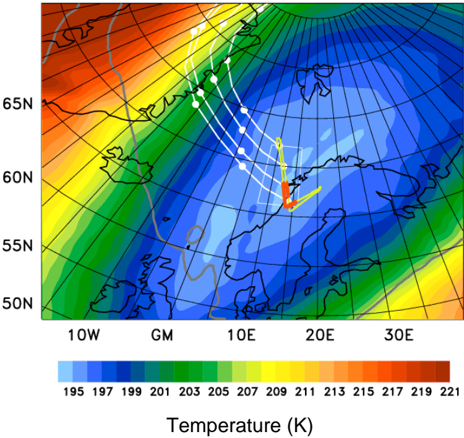
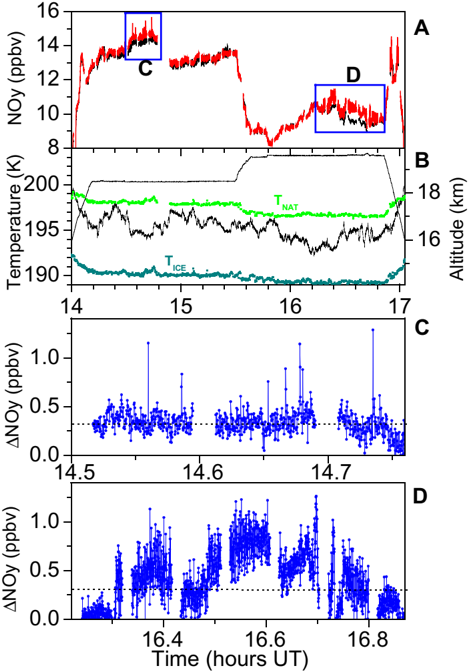
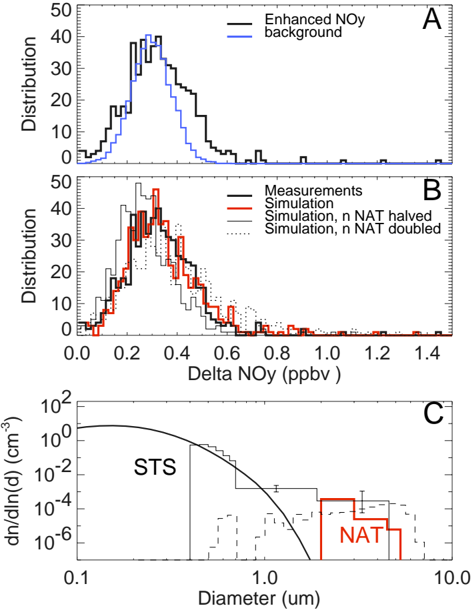
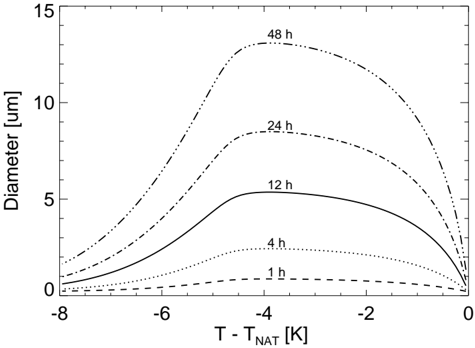
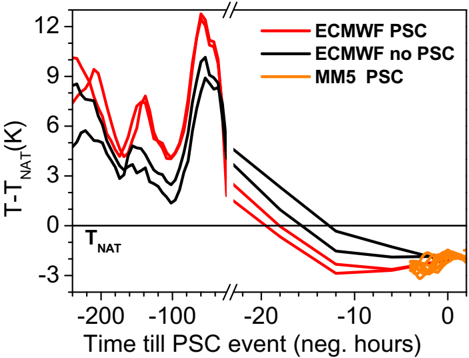
A PSC was detected on 6 February 2003 in the Arctic stratosphere by in-situ measurements onboard the high-altitude research aircraft Geophysica. Low number densities (~10-4cm-3) of small nitric acid (HNO3) containing particles (d<6µm) were observed at altitudes between 18 and 20km. Provided the temperatures remain below the NAT equilibrium temperature TNAT, these NAT particles have the potential to grow further and to remove HNO3 from the stratosphere, thereby enhancing polar ozone loss. Interestingly, the NAT particles formed in less than a day at temperatures just slightly below TNAT (T>TNAT-3.1K). This unique measurement of PSC formation at extremely low NAT saturation ratios (SNAT≤10) constrains current NAT nucleation theories. We suggest, that the NAT particles have formed heterogeneously, but for certain not on ice. Conversely, meteoritic particles may be favorable candidates for triggering NAT nucleation at the observed low number densities.
Overview
The claims and statistics of this paper haven’t been checked yet.
Free: it reads the open-access text and checks the first 5 claims that cite a source we can check. Create a free account to check every claim.
Integrity signals
Registry
Cites
Statistics
Figures
Verification
Claims the paper makes
The claims and statistics of this paper haven’t been checked yet.
Free: it reads the open-access text and checks the first 5 claims that cite a source we can check. Create a free account to check every claim.
Claims other papers make about this one
Each is checked against this paper’s own text: does it say what the citing paper says it does?
The source backs part of the claim, not all of it — or backs it for a different population, condition or comparison.
In the citing paper
“Novel ice nuclei can have a large effect even at low concentrations because polar stratospheric clouds nucleate on a small fraction of the particles (19).”
From Metals from spacecraft reentry in stratospheric aerosol particles (2023) · cites this paper as [19]
Experimental — accuracy not yet measured
Self-check
Percentages, sums and reported differences re-computed from the paper’s own numbers.
The self-check needs the paper’s full text.
Citations
Cites
Water activity as the determinant for homogeneous ice nucleation in aqueous solutions
Koop, T., Luo, B., Tsias, A., & Peter, T. (2000) · Nature · doi:10.1038/35020537 · Cited by 1,495 · cited 2×
“At temperatures below the frost point TICE (∼190 K), ice can nucleate in the supercooled ternary solution (STS) droplets (Koop et al., 2000), and the cloud Correspondence to:C. Voigt (christiane.voigt@dlr.de) may become visible as a colourful iridescent ice PSC. PSCs consisting of NAT particles…”
BackgroundSelf-citationSciENTIFIC AssESSMENT OF OzoNE DEPLETION: 1998
Albritton, D. L., Aucamp, P. J., Megie, G. J., Watson, R. T., Prinn, R. G., Rodríguez, J. M., Ennis, C. A., Boville, B. A., Brasseur, G. P., Angell, J. K., et al. (2012) · Cited by 919
Laboratory studies of the nitric acid trihydrate: Implications for the south polar stratosphere
Hanson, D., & Mauersberger, K. (1988) · Geophysical Research Letters · doi:10.1029/gl015i008p00855 · Cited by 755 · cited 2×
“The dashed black line shows the detection limit for particle NOy. lated from Hanson and Mauersberger (1988) using the water vapour and the gas phase NOy profiles measured onboard the Geophysica.”
MethodMurphy, D. M., Thomson, D. S., & Mahoney, M. J. (1998) · Science · doi:10.1126/science.282.5394.1664 · Cited by 571 · cited 1×
“Mass spectrometric measurements detected meteoritic inclusions in half of the stratospheric particles (Murphy et al., 1998; Cziczo et al., 2001).”
BackgroundCarslaw, K. S., Luo, B. P., Clegg, S. L., Peter, T., Brimblecombe, P., & Crutzen, P. J. (1994) · Geophysical Research Letters · doi:10.1029/94gl02799 · Cited by 374 · cited 1×
“PSCs form in the winter polar stratosphere at low temperatures by uptake of water and nitric acid into stratospheric sulfate aerosol (Carslaw et al., 1994; Schreiner et al., 1999; Voigt et al., 2000b).”
BackgroundSelf-citationThe Detection of Large HNO 3 -Containing Particles in the Winter Arctic Stratosphere
Fahey, D. W., Gao, R. S., Carslaw, K. S., Kettleborough, J., Popp, P. J., Northway, M. J., Holecek, J. C., Ciciora, S. C., McLaughlin, R. J., Thompson, T. L., et al. (2001) · Science · doi:10.1126/science.1057265 · Cited by 287 · cited 6×
“In winter 1999/2000, NOy containing particles with low number densities (n∼10−4 cm−3) but larger diameters (10µm<d<20µm) have been detected in the Arctic stratosphere (Fahey et al., 2001; Northway et al., 2002).”
BackgroundMethodInfluentialSelf-citationMICROPHYSICS AND HETEROGENEOUS CHEMISTRY OF POLAR STRATOSPHERIC CLOUDS
Peter, T. (1997) · Annual Review of Physical Chemistry · doi:10.1146/annurev.physchem.48.1.785 · Cited by 282 · cited 1×
“These dense PSCs provide sites for heterogeneous reactions that activate halogen species (Peter, 1997) leading to polar ozone destruction.”
BackgroundSelf-citationVapor Pressures of Solid Hydrates of Nitric Acid: Implications for Polar Stratospheric Clouds
Worsnop, D. R., Zahniser, M. S., Fox, L. E., & Wofsy, S. C. (1993) · Science · doi:10.1126/science.259.5091.71 · Cited by 247
Single particle measurements of the chemical composition of cirrus ice residue during CRYSTAL‐FACE
Cziczo, D. J., Murphy, D. M., Hudson, P. K., & Thomson, D. S. (2004) · Journal of Geophysical Research: Atmospheres · doi:10.1029/2003jd004032 · Cited by 238
Nitric Acid Trihydrate (NAT) in Polar Stratospheric Clouds
Voigt, C., Schreiner, J., Kohlmann, A., Zink, P., Mauersberger, K., Larsen, N., Deshler, T., Kröger, C., Rosen, J., Adriani, A., et al. (2000) · Science · doi:10.1126/science.290.5497.1756 · Cited by 212 · cited 3×
“PSCs form in the winter polar stratosphere at low temperatures by uptake of water and nitric acid into stratospheric sulfate aerosol (Carslaw et al., 1994; Schreiner et al., 1999; Voigt et al., 2000b).”
BackgroundMethodInfluentialSelf-citation
Research works printed but not linked: 2
- Hinds, W. C.: Aerosol technology: properties, behaviour, and mea- surement of airborne particles, 2nd ed., John Wiley & Sons, Inc., New York, 1999.
- Schmitt, J.: Aufbau und Erprobung eines in-situ NO/NOy-Mess- Systems am Höhenforschungsflugzeug Geophysica, PhD Thesis, edited by: DLR, D-51170 Köln, ISRN DLR-FB-2003-21, 2004.
Cited by
Items 101–169 of 169
Snels, M., Cairo, F., Liberto, L. D., Scoccione, A., Bracaglia, M., & Deshler, T. (2021) · Journal of Geophysical Research Atmospheres · doi:10.1029/2020jd033572 · Cited by 13
“, 2005), while others have investigated the nucleation rate for NAT using field measurements (Voigt et al., 2005; Ward et al., 2014).”
BackgroundStude, J., Aufmhoff, H., Schlager, H., Rapp, M., Arnold, F., & Strelnikov, B. (2021) · Atmospheric measurement techniques · doi:10.5194/amt-14-983-2021 · Cited by 10
Self-citationPuķīte, J., Borger, C., Dörner, S., Gu, M., & Wagner, T. (2022) · Atmospheric chemistry and physics · doi:10.5194/acp-22-245-2022 · Cited by 9
“While NAT particles that are already formed can exist below a certain temperature TNAT, their formation pathway is supposed to be heterogeneous and is reported to start at about 3 K below this threshold (Peter et al., 1991; Koop et al., 1995; Voigt et al., 2005).”
BackgroundWeimer, M., Kinnison, D. E., Wilka, C., & Solomon, S. (2023) · Atmospheric chemistry and physics · doi:10.5194/acp-23-6849-2023 · Cited by 9
“Voigt et al. (2005) observed a NAT PSC with 10−4 cm−3.”
Jumelet, J., Bekki, S., Seifert, P., Montoux, N., Vernier, J., & Pelon, J. R. (2009) · Journal of Geophysical Research Atmospheres · doi:10.1029/2009jd011776 · Cited by 9
Quantum chemical study of atmospheric aggregates: HCl•HNO3•H2SO4
Verdes, M., & Paniagua, M. (2014) · Journal of Molecular Modeling · doi:10.1007/s00894-014-2232-6 · Cited by 9
“On the other hand, particles in PSC type I are formed by nitric acid [22–24], where HNO3 is joined to one, two or three water molecules (NAM, NAD, NAT), respectively, in nucleation processes [25, 26]; the associated denitrification reactions have been studied by Tabazadeh et al.”
BackgroundFentzke, J. T., Hsu, V., Brum, C. G. M., Strelnikova, I., Rapp, M., & Nicolls, M. J. (2012) · Geophysical Research Letters · doi:10.1029/2012gl053841 · Cited by 8
Hatch, C. D., Gough, R. V., Toon, O. B., & Tolbert, M. A. (2007) · The Journal of Physical Chemistry B · doi:10.1021/jp075828n · Cited by 8
In-flight emission measurements with an autonomous payload behind a turboprop aircraft
Neumann, G., Marsing, A., Harlaß, T., Sauer, D. N., Braun, S., Pühl, M., Heckl, C., Stock, P., Castro, E. D. L. T., Hahn, V., et al. (2025) · Atmospheric measurement techniques · doi:10.5194/amt-18-6795-2025 · Cited by 7
“…(cid:58)(cid:58)(cid:58) (cid:58)(cid:58)(cid:58)(cid:58)(cid:58) (cid:58)(cid:58)(cid:58) (cid:58)(cid:58)(cid:58)(cid:58)(cid:58)(cid:58)(cid:58)(cid:58)(cid:58)(cid:58) (cid:58)(cid:58)(cid:58)(cid:58)(cid:58)(cid:58)(cid:58)(cid:58) (cid:58)(cid:58) (cid:58)…”
Self-citationCharged Aerosol Effects on the Scattering of Radar Waves from the D-Region
Rapp, M., Strelnikova, I., Li, Q., Engler, N., & Teiser, G. (2012) · Springer atmospheric sciences · doi:10.1007/978-94-007-4348-9_19 · Cited by 7
von Hobe, M., Bekki, S., Borrmann, S., Cairo, F., D’Amato, F., Donfrancesco, G. D., Dörnbrack, A., Ebersoldt, A., Ebert, M., Emde, C., et al. (2012) · doi:10.5194/acpd-12-30661-2012 · Cited by 7
Self-citationReichardt, J., Reichardt, S., Hostetler, C. A., Lucker, P. L., McGee, T. J., Twigg, L. W., Dörnbrack, A., Schoeberl, M. R., & Yang, P. X. (2014) · Applied Optics · doi:10.1364/ao.54.00b140 · Cited by 6
Self-citationWagner, R., James, A. D., Frankland, V. L., Möhler, O., Murray, B. J., Plane, J. M. C., Saathoff, H., Weigel, R., & Schnaiter, M. (2023) · Atmospheric chemistry and physics · doi:10.5194/acp-23-6789-2023 · Cited by 6
Aloyan, A. E., Yermakov, А. N., & Arutyunyan, V. O. (2015) · Izvestiya Atmospheric and Oceanic Physics · doi:10.1134/s0001433815030020 · Cited by 6
“The NAT particle formation was observed to occur at tem peratures slightly lower than TNAT and at low supersat uration (SNAT ≤ 10; SNAT is the ratio of partial pressures of nitric acid vapors in air and over NAT particles [27]).”
BackgroundMethodInfluentialEffect of Particles of the Junge Layer on the Length of Ozone Depletion Chains in the Atmosphere
Larin, I. K., Pronchev, G. B., & Yermakov, А. N. (2024) · Russian Journal of Physical Chemistry B · doi:10.1134/s1990793124700258 · Cited by 5
Recent and Future Evolution of the Stratospheric Ozone Layer
Dameris, M., & Loyola, D. (2012) · Research topics in aerospace · doi:10.1007/978-3-642-30183-4_45 · Cited by 5
“So-called ‘NAT rocks’ were detected which did not form on ice but possibly on meteoritic condensation nuclei (Voigt et al. 2005).”
BackgroundChlorine activation of the lower stratosphere at mid-latitudes: Impact on the ozone layer
Larin, I. K., Aloyan, A. E., & Ермаков, А. Н. (2016) · Russian Journal of Physical Chemistry B · doi:10.1134/s1990793116050079 · Cited by 5
Influence of Particles of the Junge Layer on the Rate of Ozone Destruction in the Lower Stratosphere
Larin, I. K., Aloyan, A. E., & Ермаков, А. Н. (2021) · Russian Journal of Physical Chemistry B · doi:10.1134/s199079312103009x · Cited by 5
Funneling of Meteoric Material into the Polar Winter Vortex
Megner, L. (2007) · Springer eBooks · doi:10.1007/978-1-4020-6475-3_170 · Cited by 5
Iannarelli, R., & Rossi, M. J. (2016) · Atmospheric chemistry and physics · doi:10.5194/acp-16-11937-2016 · Cited by 4
Analysis of polar stratospheric cloud observations at Tomsk in January 2016
Cheremisin, A. A., Marichev, V. N., Novikov, P. V., Barashkov, T. O., & Bochkovsky, D. A. (2016) · Proceedings of SPIE, the International Society for Optical Engineering/Proceedings of SPIE · doi:10.1117/12.2248748 · Cited by 4
Woiwode, W. (2013) · Repository KITopen (Karlsruhe Institute of Technology) · doi:10.5445/ksp/1000035958 · Cited by 4
James, A. D., Pace, F., Sikora, S. N. F., Murray, B. J., Mann, G. W., & Plane, J. M. C. (2022) · EGU General Assembly Conference Abstracts · doi:10.5194/egusphere-egu22-4632 · Cited by 4
Airborne Instrumentation for Aerosol Measurements
Stefanutti, L., Donfrancesco, G. D., & Guzzi, R. (2022) · Wiley eBooks · doi:10.1002/9780470027318.a0703.pub3 · Cited by 4
Influence of Sulfate Aerosol in the Lower Stratosphere on the Lifetime of Odd Oxygen
Larin, I. K., Aloyan, A. E., & Yermakov, А. N. (2021) · Russian Journal of Physical Chemistry B · doi:10.1134/s1990793121020081 · Cited by 3
Djikaev, Y. S., & Ruckenstein, E. (2016) · The Journal of Physical Chemistry C · doi:10.1021/acs.jpcc.6b09514 · Cited by 2
A systematic ab initio optimization of monohydrates of HCl•HNO3•H2SO4 aggregates
Verdes, M. (2018) · Journal of Molecular Graphics and Modelling · doi:10.1016/j.jmgm.2018.10.025 · Cited by 2
Polar Stratospheric Clouds in the Arctic
Cairo, F., & Colavitto, T. (2020) · Springer polar sciences · doi:10.1007/978-3-030-33566-3_7 · Cited by 2
Temperature Thresholds for Polar Stratospheric Ozone Loss
Drdla, K. (2005) · JuSER (Forschungszentrum Jülich) · Cited by 2
Airborne Instrumentation for Aerosol Measurements
Stefanutti, L., Donfrancesco, G. D., & Cairo, F. (2009) · Wiley eBooks · doi:10.1002/9780470027318.a0703.pub2 · Cited by 2
Rocket-borne in situ measurements in the middle atmosphere
Hedin, J. (2009) · DiVA (Stockholm University) · Cited by 2
Marsing, A. (2021) · elib (German Aerospace Center) · doi:10.25358/openscience-6263 · Cited by 2
Ogurtsov, M. G. (2020) · Geomagnetism and Aeronomy · doi:10.1134/s0016793220030135 · Cited by 1
The Morphology of the Stratospheric Polar Vortex Under Stratospheric Aerosol Intervention Scenarios
Karami, K., Jacobi, C., & Kumar, A. (2025) · International Journal of Climatology · doi:10.1002/joc.8838 · Cited by 1
“Here, we consider − 78°C as a threshold for the formation of solid NAT PSCs and − 85°C for ice PSCs (Voigt et al. 2005).”
10 Years of Lidar Observations of Polar Stratospheric Clouds at Concordia Station
Liberto, L. D., Colao, F., Serva, F., Bracci, A., Cairo, F., & Snels, M. (2026) · Remote Sensing · doi:10.3390/rs18060874 · Cited by 1
Cosmic and Atmospheric Nanosilicates
Bromley, S. T., & Plane, J. M. C. (2016) · Series in materials science and engineering · doi:10.1201/b19528-17 · Cited by 1
Mechanism and Kinetics of the Formation and Transport of Aerosol Particles in the Lower Stratosphere
Aloyan, A. E., Ермаков, А. Н., & Arutyunyan, V. O. (2018) · Russian Journal of Physical Chemistry A · doi:10.1134/s0036024418030032 · Cited by 1
Perturbations of aerosol in the stratosphere over Tomsk in 2017
Cheremisin, A. A., Marichev, V. N., Novikov, P. V., & Bochkovsky, D. A. (2018) · XXVIII Международный симпозиум «Оптика атмосферы и океана. Физика атмосферы» · doi:10.1117/12.2504632 · Cited by 1
Meteoric Aerosols in the Middle Atmosphere
Megner, L. (2008) · DiVA (Stockholm University) · Cited by 2
Lidar Measurements of Polar Stratospheric Clouds in the Arctic
Achtert, P. (2013) · KTH Publication Database DiVA (KTH Royal Institute of Technology)
Fentzke, J. T., Hsu, V., Brum, C. G. M., Strelnikova, I., & Rapp, M. (2013) · United States National Committee of URSI National Radio Science Meeting · doi:10.1109/usnc-ursi-nrsm.2013.6525104
IN SITU STUDIES OF METEOR SMOKE PARTICLES IN THE MIDDLE ATMOSPHERE DURING THE ECOMA-ROCKET CAMPAIGNS
Strelnikova, I., Rapp, M., Strelnikov, B., Baumgarten, G., Latteck, R., Hoppe, U. ‐., Friedrich, M., & Gumbel, J. (2009)
Metastabiles Salpetersäuretrihydrat in Eiswolken
Weiss, F., Kubel, F., Gálvez, Ó., Hoelzel, M., Parker, S. F., Baloh, P., Iannarelli, R., Rossi, M. J., & Grothe, H. (2016) · Angewandte Chemie · doi:10.1002/ange.201510841
Evaluation of the transport and chemistry of climate-relevant species in the lower stratosphere
Taverna, G. S. (2019) · White Rose eTheses Online (University of Leeds, The University of Sheffield, University of York)
Ziereis, H. (2021) · Atmospheric chemistry and physics · doi:10.5194/acp-2021-707-ac2
(2021) · Atmospheric chemistry and physics · doi:10.5194/acp-2021-707-rc2
Ziereis, H. (2021) · Atmospheric chemistry and physics · doi:10.5194/acp-2021-707-ac1
(2021) · Atmospheric chemistry and physics · doi:10.5194/acp-2021-600-rc1
Wendisch, M., & Brenguier, J. (2013) · Wiley eBooks · doi:10.1002/9783527653218.refs
(2021) · Atmospheric chemistry and physics · doi:10.5194/acp-2021-600-rc2
James, A. D., Brooke, J. S. A., Mangan, T. P., Whale, T. F., Plane, J. M. C., & Murray, B. J. (2017) · Atmospheric Chemistry and Physics Discussions · doi:10.5194/acp-2017-816-supplement
Review of Ziereis et al., 2021
(2021) · Atmospheric chemistry and physics · doi:10.5194/acp-2021-707-rc1
(2022) · Atmospheric chemistry and physics · doi:10.5194/acp-2022-598-rc1
(2022) · Atmospheric chemistry and physics · doi:10.5194/acp-2022-598-rc2
(2022) · Atmospheric chemistry and physics · doi:10.5194/acp-2022-598-ec1
James, A. D. (2022) · Atmospheric chemistry and physics · doi:10.5194/acp-2022-598-ac1
Das, U., Das, A., & Das, A. K. (2023) · Chemistry Teacher International · doi:10.1515/cti-2023-0006
(2023) · Atmospheric chemistry and physics · doi:10.5194/acp-2023-28-rc1
(2023) · Atmospheric chemistry and physics · doi:10.5194/acp-2023-28-rc2
Wagner, R. (2023) · Atmospheric chemistry and physics · doi:10.5194/acp-2023-28-ac2
Wagner, R. (2023) · Atmospheric chemistry and physics · doi:10.5194/acp-2023-28-ac1
Australian bushfire emissions result in enhanced polar stratospheric clouds
Prasanth, S., Sarma, A. N., Sunilkumar, K., Jose, S., Arun, K., Satheesh, S. K., & Moorthy, K. K. (2025) · Atmospheric chemistry and physics · doi:10.5194/acp-25-7161-2025
“…NAT nuclei (Iraci et al., 1995; Koop et al., 1997; Peter and Grooß, 2012) and it occurs even at the low saturation ratio over NAT (S NAT ) of < 10 (Voigt et al., 2005).. Hoyle et al., (2013) made a new parameterization scheme for NAT nucleation on foreign nuclei in immersion mode and reproduced…”
Mann, G. W., Weigel, R., Bardeen, C., Marshall, L., Brodowsky, C., Norgren, M., & Toon, O. B. (2025) · doi:10.22541/essoar.176132663.34828679/v1
The role of clouds and large-scale atmospheric circulation in Arctic amplification in a warmer world
Dutta, D. (2022) · UNSWorks (University of New South Wales, Sydney, Australia) · doi:10.26190/unsworks/24448
Effect of the JUNGE Layer on Chain Processes in the Chapman Cycle
Larin, I. K., Прончев, Г. Б., & Yermakov, A. N. (2026) · Russian Journal of Physical Chemistry B · doi:10.1134/s1990793125701477
Sangha, I., Abraham, N. L., Orr, A., Lu, H., Pitts, M. C., POOLE, L. R., & Weimer, M. (2026) · Geoscientific model development · doi:10.5194/gmd-19-9857-2026
“While the exact mechanisms of NAT nucleation are still not fully understood, the growth of NAT particles occurs over hours to days (Voigt et al., 2005), and are not in equilibrium when they grow to larger sizes (Carslaw et al., 2002).”
Mann, G. W., Weigel, R., Bardeen, C., Marshall, L., Brodowsky, C., Norgren, M., & Toon, O. B. (2026) · doi:10.22541/essoar.176132663.34828679/v2
Mann, G. W., Weigel, R., Bardeen, C., Marshall, L., Brodowsky, C., Norgren, M., & Toon, O. B. (2026) · Journal of Geophysical Research Atmospheres · doi:10.1029/2025jd045615
“In the context of stratospheric ozone depletion (e.g., Tritscher et al., 2021), research indicates solid polar stratospheric cloud particles (NAT and ice PSCs) may form by heterogeneous nucleation on MSPs (Hoyle et al., 2013; Voigt et al., 2005).”
Metadata
- Authors
- Voigt, C., Schlager, H., Luo, B. P., Dörnbrack, A., Roiger, A., Stock, P., Curtius, J., Vössing, H., Borrmann, S., Davies, S., Konopka, P., Schiller, C., Shur, G., & Peter, T.
- Affiliations
- Deutsches Zentrum für Luft- und Raumfahrt e. V. (DLR) (DE)
- ETH Zurich (CH)
- Johannes Gutenberg University Mainz (DE)
- University of Leeds (GB)
- Forschungszentrum Jülich (DE)
- ORCID
- Venue
- Atmospheric Chemistry and Physics
- Publisher
- Copernicus GmbH
- Published
- 2005-06-08
- Volume
- 5
- Issue
- 5
- Pages
- 1371-1380
- ISSN
- 1680-7316 (ISSN-L)
- 1680-7324
- OpenAlex
- W2125520235
- Cited by
- 161
- References
- 47
- Citations by year
- 2026: 2 · 2025: 3 · 2024: 1 · 2023: 9 · 2022: 9 · 2021: 15 · 2020: 2 · 2019: 4 · 2018: 6 · 2017: 5 · 2016: 12 · 2015: 7 · 2014: 7 · 2013: 11 · 2012: 13
- FWCI
- 6.81
- Type
- journal article
- Language
- en
- Open access
- gold
- doi.org
- Licence
- Locations
- Atmospheric chemistry and physics (publishedVersion, cc-by)
- Repository for Publications and Research Data (ETH Zurich) (publishedVersion, cc-by-nc-sa)
- HAL (submittedVersion, other-oa)
- DOAJ (DOAJ: Directory of Open Access Journals) (submittedVersion, cc-by-sa)
- Max Planck Institute for Plasma Physics (submittedVersion)
- elib (German Aerospace Center) (submittedVersion)
- JuSER (Forschungszentrum Jülich) (submittedVersion, cc-by-nc-sa)
- MPG.PuRe (Max Planck Society) (submittedVersion)
- ETH Zürich Research Collection
- Funders
- European Centre for Medium-Range Weather Forecasts
- Topics
- Physical Sciences › Earth and Planetary Sciences › Atmospheric Science › Atmospheric Ozone and Climate
- Physical Sciences › Earth and Planetary Sciences › Atmospheric Science › Atmospheric chemistry and aerosols
- Physical Sciences › Environmental Science › Global and Planetary Change › Atmospheric aerosols and clouds
- Keywords
- nitric acid trihydrate, polar stratospheric clouds, heterogeneous nucleation, low supersaturation, nitric acid, stratospheric ozone depletion, Arctic stratosphere, ice nucleation
About these checks
Registry, retraction, Cites and statistics results are computed, not judged, with one exception: a printed reference that no index lists is read once by a model before it counts as a citation error. Claims are extracted by a model and kept only when their quote appears verbatim in the text; each cited source is then checked, with a model’s help, for whether it says what the claim relies on. Those verdicts can be wrong — read the claim’s quote and the cited source before relying on one.
Statistics and arithmetic are recomputed, not judged.
Confidence bands are shown only for fields calibrated on our annotated test set. None is calibrated yet, so no band is shown.
What counts as a claim ›How we measure confidence ›How we check this ›
Are you an author, or do you see a problem with this page? Request a review
Data sources
Bibliographic data: Semantic Scholar, OpenAlex, Crossref.
Contains information from the Semantic Scholar Academic Graph Datasets, made available under the ODC Attribution License (ODC-BY 1.0).
Semantic Scholar’s data is described in: Kinney, R., et al. (2023). The Semantic Scholar Open Data Platform. arXiv:2301.10140.
