

Post-glacial flooding of the Bering Land Bridge dated to 11 cal ka BP based on new geophysical and sediment records
Open accessPublished version of a preprint
The DOI matches its Crossref record; 59 of the 60 references it cites were found in a registry or an index, and 1 are not checked yet; none of the 43 sources its claims cite is checked for support yet.
Abstract
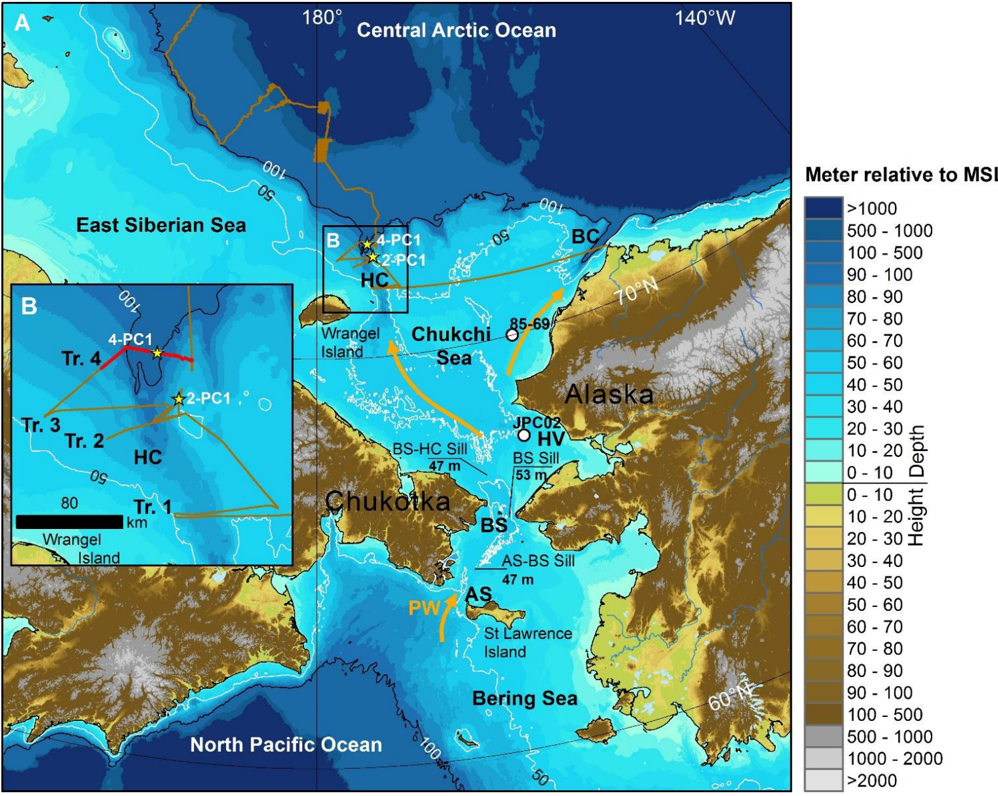
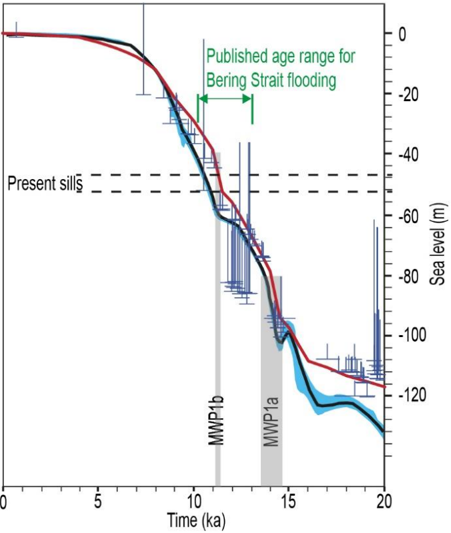
The Bering Strait connects the Arctic and Pacific oceans and separates the North American and Asian landmasses. The presently shallow ( ∼ 53 m) strait was exposed during the sea level lowstand of the last glacial period, which permitted human migration across a land bridge today referred to as the Bering Land Bridge. Proxy studies (stable isotope composition of foraminifera, whale migration into the Arctic Ocean, mollusc and insect fossils and paleobotanical data) have suggested a range of ages for the Bering Strait reopening, mainly falling within the Younger Dryas stadial (12.9–11.7 cal ka BP). Here we provide new information on the deglacial and post-glacial evolution of the Arctic–Pacific connection through the Bering Strait based on analyses of geological and geophysical data from Herald Canyon, located north of the Bering Strait on the Chukchi Sea shelf region in the western Arctic Ocean. Our results suggest an initial opening at about 11 cal ka BP in the earliest Holocene, which is later than in several previous studies. Our key evidence is based on a well-dated core from Herald Canyon, in which a shift from a near-shore environment to a Pacific-influenced open marine setting at around 11 cal ka BP is observed. The shift corresponds to meltwater pulse 1b (MWP1b) and is interpreted to signify relatively rapid breaching of the Bering Strait and the submergence of the large Bering Land Bridge. Although the precise rates of sea level rise cannot be quantified, our new results suggest that the late deglacial sea level rise was rapid and occurred after the end of the Younger Dryas stadial.
Checked 2026-11-24 · 1 reference not checked yet
Overview
CoChat Summary
TL;DR
New geophysical and sediment records from Herald Canyon, north of the Bering Strait, indicate that the Beringia Land Bridge was flooded and the Pacific–Arctic connection re-established at about 11,000 cal yrs BP. This timing is later than several previous estimates and overlaps with Meltwater Pulse 1b.
Key findings
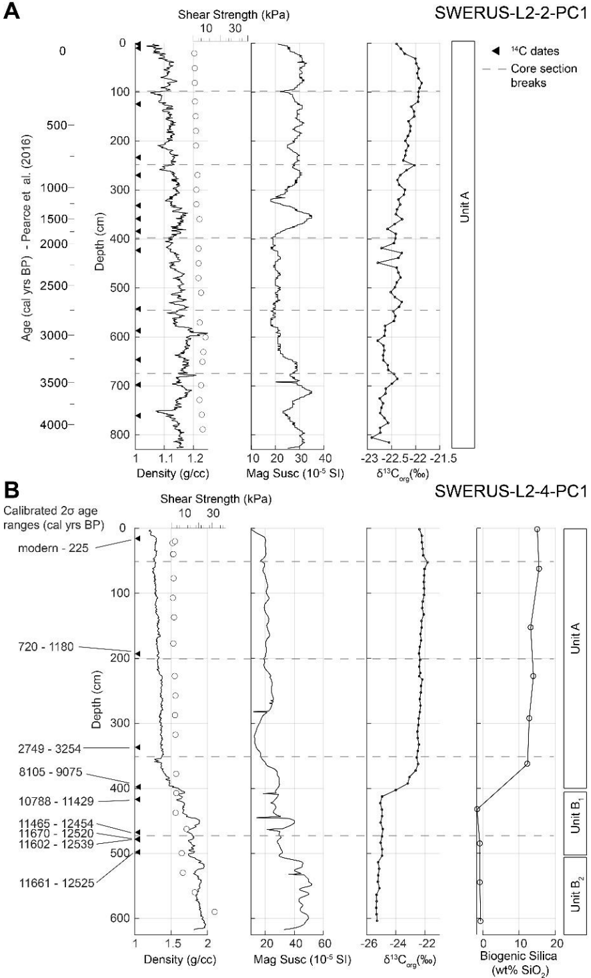
- A shift from a near-shore environment to a Pacific-influenced open marine setting in Core 4-PC1 is dated to ~11,000 cal yrs BP, interpreted as rapid breaching of the Bering Strait and submergence of the Beringia Land Bridge.
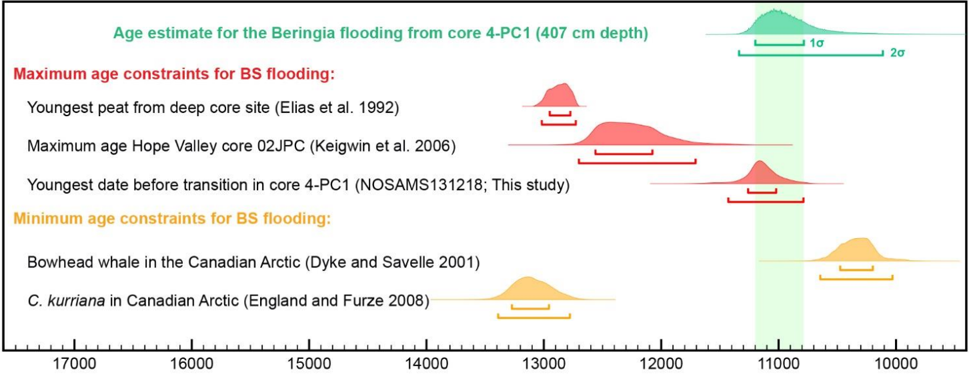
- The midpoint (407 cm) of the δ¹³Corg transition between 412 and 402 cm has a 1σ age range of 10,787–11,209 cal yrs BP; this overlaps Meltwater Pulse 1b between about 11,400 and 11,100 cal yrs BP.
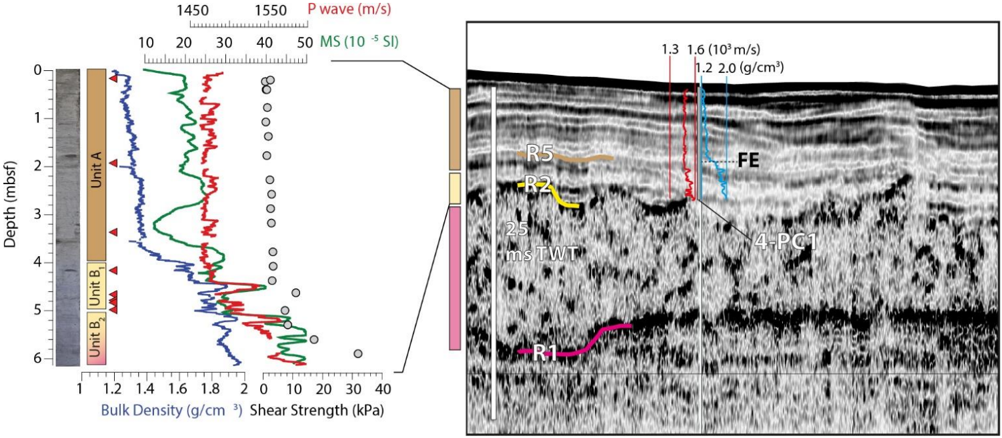
- Proxy evidence includes biogenic silica increasing from ~0–1% below 400 cm to ~15% in upper sediments, δ¹³Corg around -25‰ in the lower half and -22‰ in the upper half, and bulk density increasing from 1.3 g/cm³ to generally >1.6 g/cm³ below 400 cm.
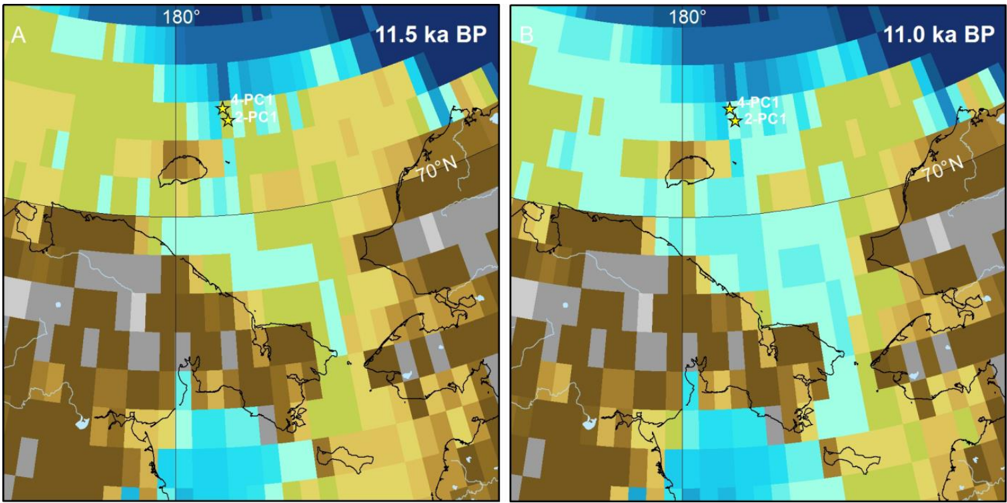
- The new age estimate is compatible with most previous constraints except England and Furze (2008), which predates it by about 2000 years; the ICE-6G_C paleo-topographic model suggests the land bridge was breached at about 11,000 cal yrs BP.
Methods
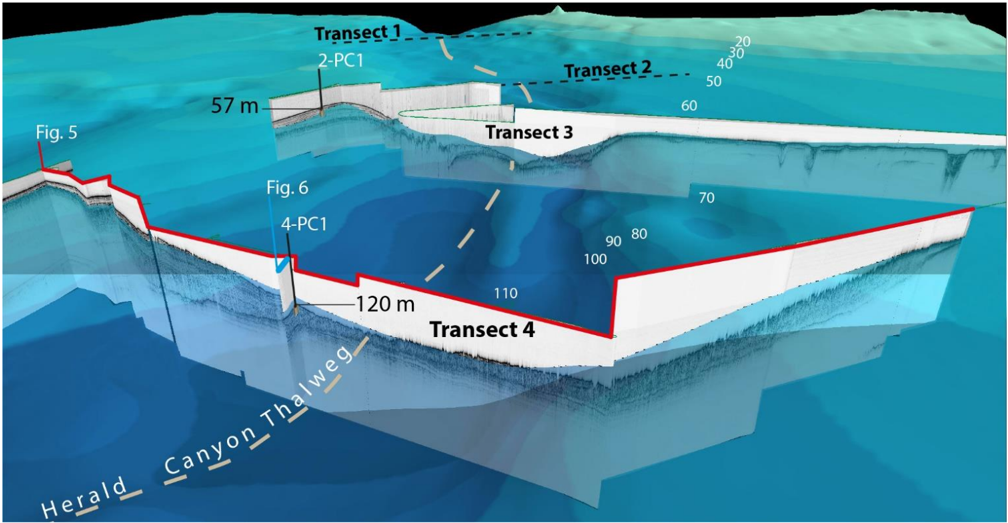
- SWERUS-C3 2014 Expedition Leg 2 on IB Oden collected four transects across Herald Canyon; cores SWERUS-L2-2-PC1 (8.2 m long, 57 m water depth) and SWERUS-L2-4-PC1 (6.1 m long, 120 m water depth) were analyzed.
- Geophysical mapping used a hull-mounted Kongsberg EM 122 multibeam echo-sounder (12 kHz) and SBP 120 chirp sonar (2.5–7 kHz), with CTD/XBT sound-speed data; processing used Caris, Fledermaus-QPS, and OpendTect.
- Sediment analyses included MSCL physical properties, fall-cone shear strength, biogenic silica on 10 samples from Core 4-PC1 via wet alkaline extraction and ICP, δ¹³Corg every 10 cm, and AMS ¹⁴C dating with the Aniakchak CFE II tephra (3.6 ka) and local ΔR values (477 years for 2-PC1; 50 ± 100 below the transition and 300 ± 200 above it in 4-PC1), calibrated with Marine13 and OxCal 4.2 using a Bayesian age-depth approach.
Limitations
- Stated: the flooding age is based on maximum age constraints only, because the short transition interval may include a hiatus, implied by the early Holocene date (8570 cal yrs BP median age) at 399 cm depth.
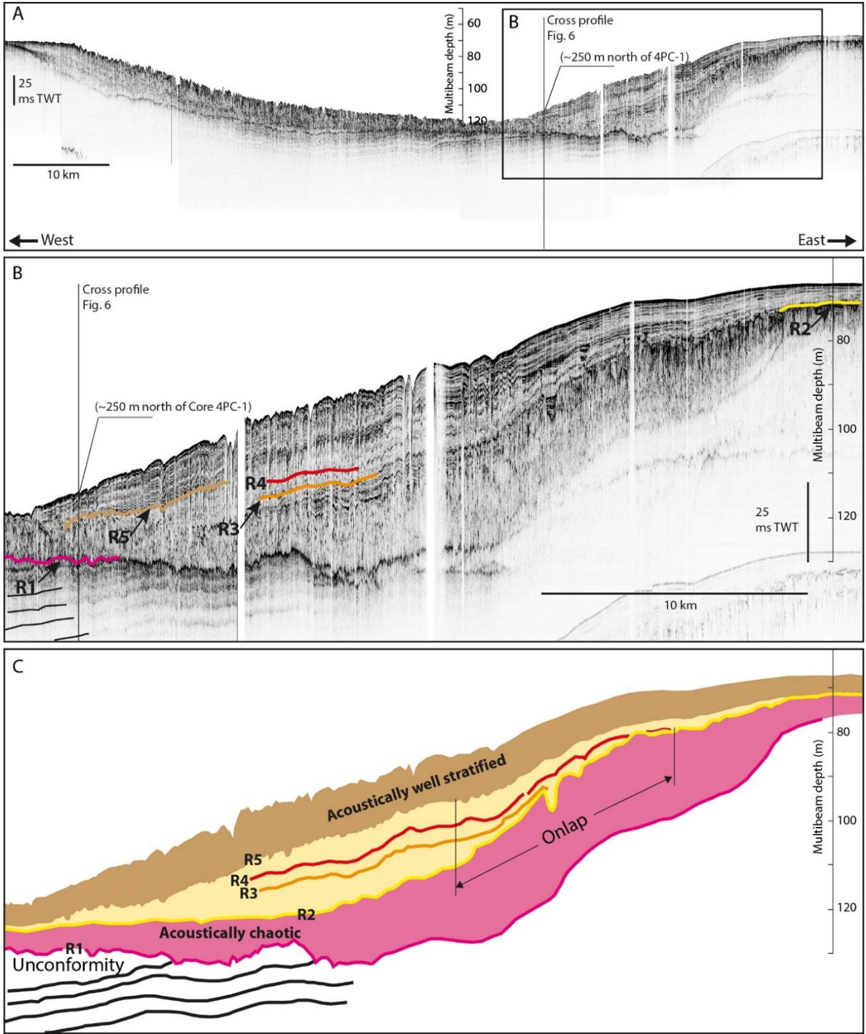
- Stated: core-seismic integration has uncertainty because chirp sonar resolution is on the order of 70 cm; reflector R5 appears just below the bulk density and p-wave velocity increase, Core 4-PC1 may not penetrate all the way to reflector R2, and higher-density subunit B2 may have come from that acoustic unit.
- Stated/evident: sparse geophysical mapping data mean glacial ice shaping the base of Herald Canyon cannot be completely ruled out; multibeam bathymetry did not cover an area large enough to produce a new bathymetric map; biogenic silica uncertainty is as high as ±20%; and no direct age determinations exist for the flooding.
Model-written summary. Check it against the paper before relying on it.
Integrity signals
Registry
Cites
Statistics
Figures

Verification
Claims the paper makes
0 Valid · 0 Not valid · 27 Not checked · 63 Own results and interpretations
A result the paper reports from its own data — it cites no other source for it, so there is none to check. The quote shows it is in the paper.
In the paper
“The upper 400 cm of the core ranges from present day to approximately 8,500 cal yrs BP based on a radiocarbon date at 399 cm, just above the major transition.”
§ Post-glacial flooding of the Beringia Land Bridge dated to 11,000 cal yrs BP based on new geophysical and sediment records > 3.3 Sediment accumulation rates
plain- Asserted: passes — The authors put it forward as true.
- Checkable: passes — It can be checked against evidence.
- Load-bearing: unclear — It is unclear whether the paper’s conclusions depend on it.
- Based: passes — The paper gives a reason why it holds.
A result the paper reports from its own data — it cites no other source for it, so there is none to check. The quote shows it is in the paper.
In the paper
“Similar as for Core 4PC-1 from Herald Canyon, we applied a ΔR = 50 ± 100 for the calibration of this pre-flooding radiocarbon age, resulting in 30 a calibrated age of around 12,500 cal yrs BP (Table 1).”
§ Post-glacial flooding of the Beringia Land Bridge dated to 11,000 cal yrs BP based on new geophysical and sediment records > 4 Discussion
plainstates a causeSingle case- Asserted: passes — The authors put it forward as true.
- Checkable: passes — It can be checked against evidence.
- Load-bearing: passes — The paper’s conclusions depend on it.
- Based: passes — The paper gives a reason why it holds.
A result the paper reports from its own data — it cites no other source for it, so there is none to check. The quote shows it is in the paper.
In the paper
“This transition in Core 4-PC1 is dated to ~11,000 cal yrs BP based on a series of radiocarbon dates predating the shift (Table 1; Fig. 3, 7).”
§ Post-glacial flooding of the Beringia Land Bridge dated to 11,000 cal yrs BP based on new geophysical and sediment records > 4 Discussion
plain- Asserted: passes — The authors put it forward as true.
- Checkable: passes — It can be checked against evidence.
- Load-bearing: passes — The paper’s conclusions depend on it.
- Based: passes — The paper gives a reason why it holds.
A result the paper reports from its own data — it cites no other source for it, so there is none to check. The quote shows it is in the paper.
In the paper
“Our key evidence is based on a well dated core from Herald Canyon, in which a shift 25 from a near-shore environment to a Pacific-influenced open marine setting around 11 ka is observed.”
- Also stated in: § 4 Discussion · hedged
“We interpret the transition in sediment physical and chemical properties in Core 4-PC1 to mark the time when Pacific water began to enter the Arctic Ocean through the Bering Strait (Fig. 3).”
§ Post-glacial flooding of the Beringia Land Bridge dated to 11,000 cal yrs BP based on new geophysical and sediment records > Abstract
plainstates an associationSingle case- Asserted: passes — The authors put it forward as true.
- Checkable: passes — It can be checked against evidence.
- Load-bearing: passes — The paper’s conclusions depend on it.
- Based: passes — The paper gives a reason why it holds.
- Also stated in: § 4 Discussion · hedged
A result the paper reports from its own data — it cites no other source for it, so there is none to check. The quote shows it is in the paper.
In the paper
“The core-seismic integration does not precisely relate this change in acoustic appearance to the change in sediment physical properties, specifically bulk density, measured in Core 4-PC1 at about 400 cm down core, because R5 appears to be situated just below the increase in both bulk density and p-wave velocity (Fig. 6).”
§ Post-glacial flooding of the Beringia Land Bridge dated to 11,000 cal yrs BP based on new geophysical and sediment records > 4 Discussion
hedged- Asserted: passes — The authors put it forward as true.
- Checkable: passes — It can be checked against evidence.
- Load-bearing: unclear — It is unclear whether the paper’s conclusions depend on it.
- Based: passes — The paper gives a reason why it holds.
33 more claims
Create a free account to see all 90 claims and to verify the 34 references still open.
- It may state two separate claims as one. 38
- The quote only partly states this claim. 1
- Probably not a substantial claim. 21
Claims other papers make about this one
Each is checked against this paper’s own text: does it say what the citing paper says it does?
In the citing paper
“observations in sediment cores support an ~11.5-ka-old submergence of the Bering Strait (4–6)”
From Sea level fingerprinting of the Bering Strait flooding history detects the source of the Younger Dryas climate event (2020) · cites this paper as [4]
In the citing paper
“Jakobsson et al. (4) inferred an inundation at ~11 ka ago based on a sharp increase in measured δ13Corg and biosilica content”
From Sea level fingerprinting of the Bering Strait flooding history detects the source of the Younger Dryas climate event (2020) · cites this paper as [4]
In the citing paper
“Observations by Keigwin et al. (5) and Jakobsson et al. (4) point to a flooding event of age 11 to 11.5 ka and suggest that before this time, the Bering Strait sill separated the Pacific from the Arctic Ocean.”
From Sea level fingerprinting of the Bering Strait flooding history detects the source of the Younger Dryas climate event (2020) · cites this paper as [4]
In the citing paper
“For example, at site 4PC-1, rapid sea level rise started at 11.5 to 11 ka ago as the Bering Strait sill deepened, consistent with the increase in Pacific water influence observed by Jakobsson et al. (4) (Fig. 2, teal squares).”
From Sea level fingerprinting of the Bering Strait flooding history detects the source of the Younger Dryas climate event (2020) · cites this paper as [4]
In the citing paper
“Published reservoir ages range from ~450 to 900 years (i.e., ΔR from 50 to 500 years) (4, 34, 35).”
From Sea level fingerprinting of the Bering Strait flooding history detects the source of the Younger Dryas climate event (2020) · cites this paper as [4]
3 more claims about this paper
Create a free account to see every claim other papers make about this one.
Self-check
Percentages, sums and reported differences re-computed from the paper’s own numbers.
Each contradiction between two passages listed here was confirmed by an independent check.
Rated minor: it would not touch a result — a value no result rests on, a p-value that stays on the same side of the significance level, or a conflict that is clerical, resolved elsewhere in the paper, or outside its own findings.
In the paper
§ Post-glacial flooding of the Beringia Land Bridge dated to 11,000 cal yrs BP based on new geophysical and sediment records > 3.3 Sediment accumulation rates
“the 1-sigma 15 age range estimate of the midpoint (407 cm) within the transition in 13 Corg between 412 and 402 cm is 10,787 -11,209 cal yrs BP”
§ Post-glacial flooding of the Beringia Land Bridge dated to 11,000 cal yrs BP based on new geophysical and sediment records > 4 Discussion
“our 1 age-range (10,800 -11,244 cal yrs BP) for the reopening of the Bering Strait”
Citations
Cites
IntCal13 and Marine13 radiocarbon age calibration curves 0–50,000 years cal BP
Reimer, P. J., Bard, E., Bayliss, A., Beck, J. W., Blackwell, P. G., Ramsey, C. B., Buck, C. E., Cheng, H., Edwards, R. L., Friedrich, M., et al. (2013) · Radiocarbon · doi:10.2458/azu_js_rc.55.16947 · Cited by 14,591
Bayesian Analysis of Radiocarbon Dates
Bronk Ramsey, C. (2009) · Radiocarbon · doi:10.1017/s0033822200033865 · Cited by 8,725
Fairbanks, R. G. (1989) · Nature · doi:10.1038/342637a0 · Cited by 4,529
Sea level and global ice volumes from the Last Glacial Maximum to the Holocene
Lambeck, K., Rouby, H., Purcell, A., Sun, Y., & Sambridge, M. (2014) · Proceedings of the National Academy of Sciences · doi:10.1073/pnas.1411762111 · Cited by 2,922
A Reconstruction of Regional and Global Temperature for the Past 11,300 Years
Marcott, S. A., Shakun, J. D., Clark, P. U., & Mix, A. C. (2013) · Science · doi:10.1126/science.1228026 · Cited by 1,659
Space geodesy constrains ice age terminal deglaciation: The global ICE‐6G_C (VM5a) model
Peltier, W. R., Argus, D. F., & Drummond, R. (2015) · Journal of Geophysical Research: Solid Earth · doi:10.1002/2014jb011176 · Cited by 1,470
Peltier, W. R., & Fairbanks, R. G. (2006) · Quaternary Science Reviews · doi:10.1016/j.quascirev.2006.04.010 · Cited by 1,012
The Late Pleistocene Dispersal of Modern Humans in the Americas
Goebel, T., Waters, M. R., & O'Rourke, D. H. (2008) · Science · doi:10.1126/science.1153569 · Cited by 599
Redefining the Age of Clovis: Implications for the Peopling of the Americas
Waters, M. R., & Stafford, T. W. (2007) · Science · doi:10.1126/science.1137166 · Cited by 581 · cited 1×
“The maximum age range for the first appearance of the Clovis culture in North America has been estimated at 13 110 to 12 660 cal yr BP from 14C dating of archaeological finds (Waters and Stafford, 2007).”
BackgroundA Marine Reservoir Correction Database and On-Line Interface
Reimer, P. J., & Reimer, R. W. (2001) · Radiocarbon · doi:10.1017/s0033822200038339 · Cited by 462
Shifting Patterns of Life in the Pacific Arctic and Sub-Arctic Seas
Grebmeier, J. M. (2012) · Annual Review of Marine Science · doi:10.1146/annurev-marine-120710-100926 · Cited by 415
Revising the Bering Strait freshwater flux into the Arctic Ocean
Woodgate, R. A., & Aagaard, K. (2005) · Geophysical Research Letters · doi:10.1029/2004gl021747 · Cited by 363
Deglacial Meltwater Pulse 1B and Younger Dryas Sea Levels Revisited with Boreholes at Tahiti
Bard, E., Hamelin, B., & Delanghe-Sabatier, D. (2010) · Science · doi:10.1126/science.1180557 · Cited by 344
Woodgate, R. A., Weingartner, T. J., & Lindsay, R. (2012) · Geophysical Research Letters · doi:10.1029/2012gl054092 · Cited by 338
Life and times of the Bering Land Bridge
Elias, S. A., Short, S. K., Nelson, C. H., & Birks, H. H. (1996) · Nature · doi:10.1038/382060a0 · Cited by 294
Erlandson, J. M., Graham, M. H., Bourque, B. J., Corbett, D., Estes, J. A., & Steneck, R. S. (2007) · The Journal of Island and Coastal Archaeology · doi:10.1080/15564890701628612 · Cited by 267
Chronology of the Holocene transgression at the North Siberian margin
Bauch, H. A., Mueller-Lupp, T., Taldenkova, E., Spielhagen, R. F., Kassens, H., Grootes, P. M., Thiede, J., Heinemeier, J., & Petryashov, V. V. (2001) · Global and Planetary Change · doi:10.1016/s0921-8181(01)00116-3 · Cited by 254
An interlaboratory comparison for the measurement of biogenic silica in sediments
Conley, D. J. (1998) · Marine Chemistry · doi:10.1016/s0304-4203(98)00049-8 · Cited by 244
Jakobsson, M., Andreassen, K., Bjarnadóttir, L. R., Dove, D., Dowdeswell, J. A., England, J. H., Funder, S., Hogan, K., Ingólfsson, Ó., Jennings, A., et al. (2014) · Quaternary Science Reviews · doi:10.1016/j.quascirev.2013.07.033 · Cited by 241
Self-citationCanadian marine reservoir ages, preliminary data assessment
McNeely, R., Dyke, A. S., & Southon, J. R. (2006) · doi:10.4095/221564 · Cited by 184
Danielson, S. L., Weingartner, T. J., Hedstrom, K. S., Aagaard, K., Woodgate, R., Curchitser, E., & Stabeno, P. J. (2014) · Progress in Oceanography · doi:10.1016/j.pocean.2014.04.006 · Cited by 182
Woodgate, R. A., Stafford, K. M., & Prahl, F. G. (2015) · Oceanography · doi:10.5670/oceanog.2015.57 · Cited by 180
The North Pacific: A Global-Scale Estuary
Stigebrandt, A. (1984) · Journal of Physical Oceanography · doi:10.1175/1520-0485(1984)014<0464:tnpags>2.0.co;2 · Cited by 178
Rapid sea-level rise and Holocene climate in the Chukchi Sea
Keigwin, L. D., Donnelly, J. P., Cook, M. S., Driscoll, N. W., & Brigham-Grette, J. (2006) · Geology · doi:10.1130/g22712.1 · Cited by 161
Conley, D. J., & Schelske, C. L. (2002) · Developments in paleoenvironmental research · doi:10.1007/0-306-47668-1_14 · Cited by 154
Fischer, G. (1991) · Marine Chemistry · doi:10.1016/s0304-4203(09)90044-5 · Cited by 151
Abdul, N. A., Mortlock, R. A., Wright, J. D., & Fairbanks, R. G. (2016) · Paleoceanography · doi:10.1002/2015pa002847 · Cited by 145
The physiography of High Arctic cross-shelf troughs
Batchelor, C. L., & Dowdeswell, J. A. (2013) · Quaternary Science Reviews · doi:10.1016/j.quascirev.2013.05.025 · Cited by 145
Some controls on flow and salinity in Bering Strait
Aagaard, K., Weingartner, T. J., Danielson, S. L., Woodgate, R. A., Johnson, G. C., & Whitledge, T. E. (2006) · Geophysical Research Letters · doi:10.1029/2006gl026612 · Cited by 137
The Settlement of the American Continents : A Multidisciplinary Approach to Human Biogeography
Barton, C. M. (2004) · Cited by 133
Evolution and dynamics of the flow through Herald Canyon in the western Chukchi Sea
Pickart, R. S., Pratt, L. J., Torres, D. J., Whitledge, T. E., Proshutinsky, A. Y., Aagaard, K., Agnew, T. A., Moore, G. W. K., & Dail, H. J. (2009) · Deep Sea Research Part II Topical Studies in Oceanography · doi:10.1016/j.dsr2.2009.08.002 · Cited by 124
Role of the Bering Strait in controlling North Atlantic ocean circulation and climate
Shaffer, G., & Bendtsen, J. (1994) · Nature · doi:10.1038/367354a0 · Cited by 118
Effects of the Bering Strait closure on AMOC and global climate under different background climates
Hu, A., Meehl, G. A., Han, W., Otto‐Bliesner, B. L., Abe‐Ouchi, A., & Rosenbloom, N. A. (2014) · Progress In Oceanography · doi:10.1016/j.pocean.2014.02.004 · Cited by 111
DeMaster, D. J. (2003) · Elsevier eBooks · doi:10.1016/b0-08-043751-6/07095-x · Cited by 98
Hu, A., Meehl, G. A., Han, W., Timmermann, A., Otto-Bliesner, B., Liu, Z., Washington, W. M., Large, W., Abe-Ouchi, A., Kimoto, M., et al. (2012) · Proceedings of the National Academy of Sciences · doi:10.1073/pnas.1116014109 · Cited by 93
Elias, S. A., Short, S. K., & Phillips, R. L. (1992) · Quaternary Research · doi:10.1016/0033-5894(92)90045-k · Cited by 92
Cronin, T. M. (2012) · Quaternary Science Reviews · doi:10.1016/j.quascirev.2012.08.021 · Cited by 87
Self-citationFlow of pacific water in the western Chukchi Sea: Results from the 2009 RUSALCA expedition
Pisareva, M. N., Pickart, R. S., Spall, M. A., Nobre, C., Torres, D. J., Moore, G. W. K., & Whitledge, T. E. (2015) · Deep Sea Research Part I: Oceanographic Research Papers · doi:10.1016/j.dsr.2015.08.011 · Cited by 84
The Bering Strait's grip on the northern hemisphere climate
De Boer, A. M., & Nof, D. (2004) · Deep Sea Research Part I: Oceanographic Research Papers · doi:10.1016/j.dsr.2004.05.003 · Cited by 73
Three-Dimensional Evolution of Large-Amplitude Internal Waves in the Strait of Gibraltar
Vlasenko, V., Sánchez-Garrido, J. C., Stashchuk, N., García‐Lafuente, J., & Losada, M. Á. (2009) · Journal of Physical Oceanography · doi:10.1175/2009jpo4007.1 · Cited by 66
Müller-Lupp, T., Bauch, H. A., Erlenkeuser, H., Hefter, J., Kassens, H., & Thiede, J. (2000) · International Journal of Earth Sciences · doi:10.1007/s005310000128 · Cited by 57
The Exhaust Valve of the North Atlantic
Boer, A. M. D., & Nof, D. (2004) · Journal of Climate · doi:10.1175/1520-0442(2004)017<0417:tevotn>2.0.co;2 · Cited by 56
Watanabe, E., & Hasumi, H. (2009) · Journal of Physical Oceanography · doi:10.1175/2009jpo4010.1 · Cited by 55
Early Holocene climate oscillations—causes and consequences
Hoek, W. Z., & Bos, J. A. A. (2007) · Quaternary Science Reviews · doi:10.1016/j.quascirev.2007.06.008 · Cited by 54
Dyke, A. S., & Savelle, J. M. (2001) · Quaternary Research · doi:10.1006/qres.2001.2228 · Cited by 47
New evidence from the western Canadian Arctic Archipelago for the resubmergence of Bering Strait
England, J. H., & Furze, M. F. A. (2008) · Quaternary Research · doi:10.1016/j.yqres.2008.03.001 · Cited by 46
GLACIATIONS | Late Pleistocene Glacial Events in Beringia
Elias, S. A., & Brigham-Grette, J. (2013) · Encyclopedia of Quaternary Science · doi:10.1016/b978-0-444-53643-3.00116-3 · Cited by 43
Pearce, C., Varhelyi, A., Wastegård, S., Muschitiello, F., Barrientos, N., O'Regan, M., Cronin, T. M., Gemery, L., Semiletov, I., Backman, J., et al. (2017) · Climate of the Past · doi:10.5194/cp-13-303-2017 · Cited by 40
Self-citationDeglacial sea level history of the East Siberian Sea and Chukchi Sea margins
Cronin, T. M., O’Regan, M., Pearce, C., Gemery, L., Toomey, M. R., Semiletov, I., & Jakobsson, M. (2017) · Climate of the past · doi:10.5194/cp-13-1097-2017 · Cited by 39
Self-citationInputs and outputs of salt, fresh water, alkalinity, and silica in the Arctic Ocean
Anderson, L. G., Dyrssen, D. W., Jones, E. P., & Lowings, M. G. (1983) · Deep Sea Research Part A. Oceanographic Research Papers · doi:10.1016/0198-0149(83)90036-5 · Cited by 37
Self-citationPaleodrainage on the Chukchi shelf reveals sea level history and meltwater discharge
Hill, J. C., & Driscoll, N. W. (2008) · Marine Geology · doi:10.1016/j.margeo.2008.05.018 · Cited by 34
Sea-level Data for Parts of the Bering-Chukchi Shelves of Beringia from 19,000 to 10,000 14C yr B.P.
McManus, D. A., & Creager, J. S. (1984) · Quaternary Research · doi:10.1016/0033-5894(84)90071-1 · Cited by 28
Bard, E., Hamelin, B., Deschamps, P., & Camoin, G. (2016) · Paleoceanography · doi:10.1002/2016pa002979 · Cited by 26
Danielson, S., Dobbins, E., Jakobsson, M., Johnson, M., Weingartner, T., Williams, W., & Zarayskaya, Y. (2015) · Eos · doi:10.1029/2015eo040975 · Cited by 22
Self-citationThe Late Quaternary Flow through the Bering Strait Has Been Forced by the Southern Ocean Winds
Ortiz, J. D., Nof, D., Polyak, L., St-Onge, G., Lisé-Pronovost, A., Naidu, S., Darby, D., & Brachfeld, S. (2012) · Journal of Physical Oceanography · doi:10.1175/jpo-d-11-0167.1 · Cited by 10
Sandal, C., & Nof, D. (2008) · Journal of Physical Oceanography · doi:10.1175/2008jpo3877.1 · Cited by 9
Holen, S. R. (2006) · Lincoln (University of Nebraska) · Cited by 6
Deglacial sea-level history of the East Siberian Sea Margin
Cronin, T. M., O'Regan, M., Pearce, C., Gemery, L., Toomey, M., Semiletov, I., & Jakobsson, M. (2017) · doi:10.5194/cp-2017-19 · Cited by 1
Self-citation(1937)
Erratum to “The Bering Strait's grip on the northern hemisphere climate”
Boer, A. M. D., & Nof, D. (2005) · Deep Sea Research Part I: Oceanographic Research Papers · doi:10.1016/j.dsr.2004.11.004
Research works printed but not linked: 3
- Hopkins, D. M.: The Cenozoic history of Beringia-A synthesis, in: The Bering Land Bridge, edited by: Hopkins, D. M., Stanford University Press, Stanford, California, 1967.
- McManus, D. A., Creager, J. S., Echols, R. J., and Holmes, M. L.: The Holocene transgression of the flank of 30 Beringia: Chukchi valley to Chukchi estuary to Chukchi Sea. In: Quaternary Coastlines and Marine Archaeology: Towards the Prehistory of Land Bridges and Continental Shelves Masters, P. M. and Flemming, N. C. (Eds.), Academic Press London, 1983.
- Woodgate, R. A., Weingartner, T. J., and Lindsay, R.: Observed increases in Bering Strait oceanic fluxes from AMS radiocarbon ages and calibrations for core 4-PC1 (Full name SWERUS-L2-4-PC1) and literature dates constraining the Beringia flooding. All ages are calibrated with the Marine13 (Reimer et al. 2013) radiocarbon calibration curve, except Beta-43953 (Elias et al. 1992) which is calibrated using IntCal13 (Reimer et al. 2013). Clim. Past Discuss., doi:10.5194/cp-2017-11, 2017 Manuscript under review for journal Clim. Past Discussion started: 13 February 2017 c Author(s) 2017. CC-BY 3.0 License. · DOI
Cited by
The evolutionary history of dogs in the Americas
Ní Leathlobhair, M., Perri, A. R., Irving-Pease, E. K., Witt, K. E., Linderholm, A., Haile, J., Lebrasseur, O., Ameen, C., Blick, J., Boyko, A. R., et al. (2018) · Science · doi:10.1126/science.aao4776 · Cited by 184
Deglacial floods in the Beaufort Sea preceded Younger Dryas cooling
Keigwin, L. D., Klotsko, S., Zhao, N., Reilly, B., Giosan, L., & Driscoll, N. W. (2018) · Nature Geoscience · doi:10.1038/s41561-018-0169-6 · Cited by 94
The deglaciation of the Americas during the Last Glacial Termination
Palacios, D., Stokes, C. R., Phillips, F. M., Clague, J. J., Alcalá-Reygosa, J., Andrés, N., Angel, I., Blard, P., Briner, J. P., Hall, B. L., et al. (2020) · Earth-Science Reviews · doi:10.1016/j.earscirev.2020.103113 · Cited by 131
The role of Northeast Pacific meltwater events in deglacial climate change
Praetorius, S. K., Condron, A., Mix, A. C., Walczak, M. H., McKay, J. L., & Du, J. (2020) · Science Advances · doi:10.1126/sciadv.aay2915 · Cited by 76
Practical guidelines and recent advances in the Itrax XRF core-scanning procedure
Löwemark, L., Bloemsma, M. R., Croudace, I. W., Daly, J. S., Edwards, R., Francus, P., Galloway, J. M., Gregory, B. R. B., Huang, J. S., Jones, A. F., et al. (2018) · Quaternary International · doi:10.1016/j.quaint.2018.10.044 · Cited by 100
Self-citation
Metadata
- Authors
- Jakobsson, M., Pearce, C., Cronin, T. M., Backman, J., Anderson, L. G., Barrientos, N., Björk, G., Coxall, H., de Boer, A., Mayer, L. A., Mörth, C.-M., Nilsson, J., Rattray, J. E., Stranne, C., Semiletov, I., & O'Regan, M.
- Affiliations
- Stockholm University (SE)
- United States Geological Survey (US)
- University of Gothenburg (SE)
- University of New Hampshire (US)
- Tomsk Polytechnic University (RU)
- Corresponding author
- Jakobsson, Martin
- ORCID
- Venue
- Climate of the Past
- Publisher
- Copernicus GmbH
- Published
- 2017-08-01
- Volume
- 13
- Issue
- 8
- Pages
- 991-1005
- ISSN
- 1814-9324 (ISSN-L)
- 1814-9332
- OpenAlex
- W2588198301
- Cited by
- 163
- References
- 59
- Citations by year
- 2026: 15 · 2025: 20 · 2024: 12 · 2023: 14 · 2022: 19 · 2021: 30 · 2020: 17 · 2019: 13 · 2018: 18 · 2017: 5
- FWCI
- 5.72
- Type
- journal article
- Language
- en
- Open access
- gold
- doi.org
- Licence
- Locations
- Climate of the past (publishedVersion, cc-by)
- DOAJ (DOAJ: Directory of Open Access Journals) (submittedVersion)
- Funders
- Knut och Alice Wallenbergs Stiftelse (SWERUS-C3)
- Vetenskapsrådet (2014-478)
- Office of Polar Programs (PLR-1417789)
- U.S. Geological Survey (Reston)
- Danmarks Frie Forskningsfond (DFF-4002-00098_FNU)
- Topics
- Physical Sciences › Earth and Planetary Sciences › Atmospheric Science › Geology and Paleoclimatology Research
- Physical Sciences › Earth and Planetary Sciences › Oceanography › Marine and environmental studies
- Physical Sciences › Earth and Planetary Sciences › Earth-Surface Processes › Geological formations and processes
- Keywords
- Bering Land Bridge, Bering Strait opening, sea level rise, Meltwater Pulse 1B, Younger Dryas, Holocene, last glacial period
About these checks
Registry, retraction, Cites and statistics results are computed, not judged, with one exception: a printed reference that no index lists is read once by a model before it counts as a citation error. Claims are extracted by a model and kept only when their quote appears verbatim in the text; each cited source is then checked, with a model’s help, for whether it says what the claim relies on. Those verdicts can be wrong — read the claim’s quote and the cited source before relying on one.
A language model drew the claims from the paper on 2026-11-24, under version 3 of the claim definition (model deepseek-v4.1-flash, prompt extract-v3).
A second model labelled each claim on 2026-11-24 (model jev-1.13-20260917, definition revision gold-guideline-v0.2).
Statistics and arithmetic are recomputed, not judged.
Confidence bands are shown only for fields calibrated on our annotated test set. None is calibrated yet, so no band is shown.
What counts as a claim ›How we measure confidence ›How we check this ›
Are you an author, or do you see a problem with this page? Request a review
Data sources
Bibliographic data: Semantic Scholar, OpenAlex, Crossref.
Contains information from the Semantic Scholar Academic Graph Datasets, made available under the ODC Attribution License (ODC-BY 1.0).
Semantic Scholar’s data is described in: Kinney, R., et al. (2023). The Semantic Scholar Open Data Platform. arXiv:2301.10140.
