

Climate-induced speleothem radiocarbon variability on Socotra Island from the Last Glacial Maximum to the Younger Dryas
Open accessPublished version of a preprint
The DOI matches its Crossref record; 59 of the 59 references it cites were found in a registry or an index; none of the 31 sources its claims cite is checked for support yet.
Abstract
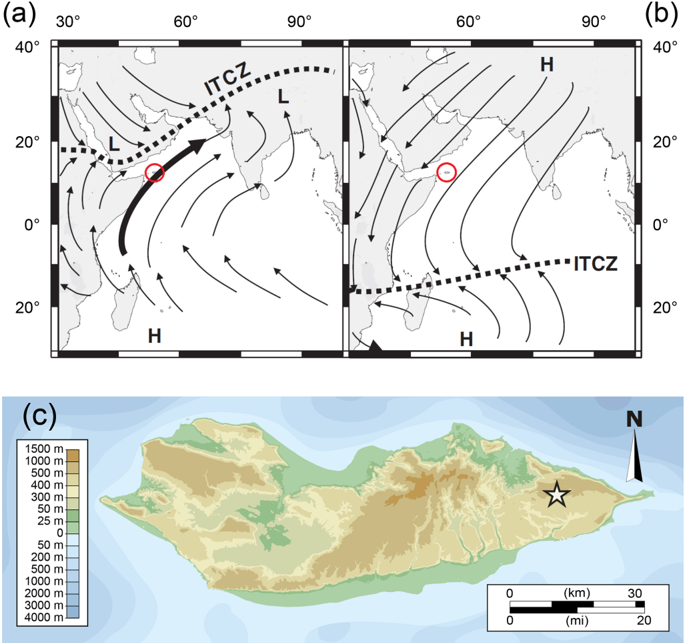
In this study, the dead carbon fraction (DCF) variations in stalagmite M1-5 from Socotra Island in the western Arabian Sea were investigated through a new set of high-precision U-series and radiocarbon ( 14 C) dates. The data reveal an extreme case of very high and also climate-dependent DCF. For M1-5, an average DCF of 56.2±3.4 % is observed between 27 and 18 kyr BP. Such high DCF values indicate a high influence of aged soil organic matter (SOM) and nearly completely closed-system carbonate dissolution conditions. Towards the end of the last glacial period, decreasing Mg∕Ca ratios suggest an increase in precipitation which caused a marked change in the soil carbon cycling as indicated by sharply decreasing DCF. This is in contrast to the relation of soil infiltration and DCF as seen in stalagmites from temperate zones. For Socotra Island, which is influenced by the East African–Indian monsoon, we propose that more humid conditions and enhanced net infiltration after the Last Glacial Maximum (LGM) led to dense vegetation and thus lowered the DCF by increasing 14 CO 2 input into the soil zone. At the onset of the Younger Dryas (YD) a sudden change in DCF towards much higher, and extremely variable, values is observed. Our study highlights the dramatic variability of soil carbon cycling processes and vegetation feedback on Socotra Island manifested in stalagmite DCF on both long-term trends and sub-centennial timescales, thus providing evidence for climate influence on stalagmite radiocarbon. This is of particular relevance for speleothem studies that aim to reconstruct past atmospheric 14 C (e.g., for the purposes of 14 C calibration), as these would rely on largely climate-independent soil carbon cycling above the cave.
Overview
CoChat Summary
TL;DR
Stalagmite M1-5 from Socotra Island records very high and climate-dependent dead carbon fraction (DCF) from the Last Glacial Maximum through the Younger Dryas, with average DCF of 56.2 ± 3.4 % between 27 and 18 kyr BP and a decline after the LGM as precipitation/net infiltration increased. The record shows abrupt, highly variable DCF at the Younger Dryas onset and cannot be used for atmospheric 14C calibration because local soil carbon cycling overprints atmospheric 14C.
Key findings
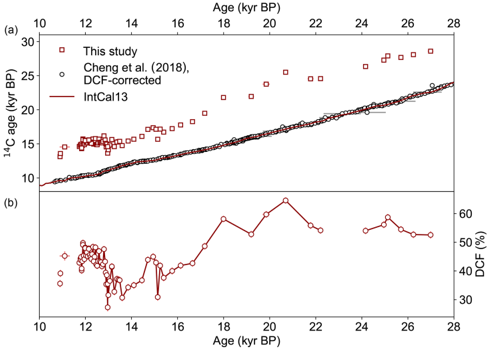
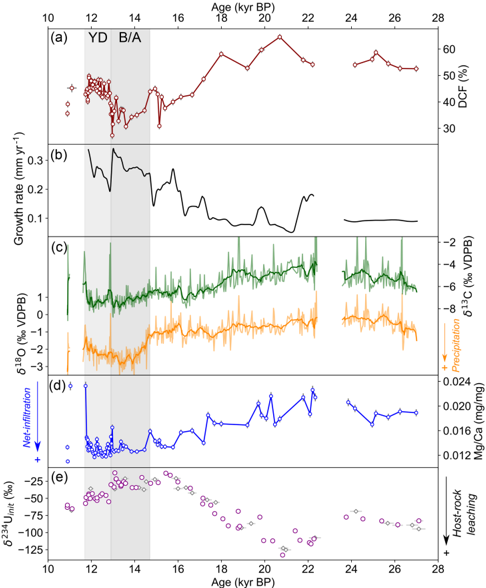
- DCF values range from 27.33 ± 0.24 % at approximately 13 kyr BP to 64.6 ± 1.1 % at 20.7 kyr BP; the average DCF is 56.2 ± 3.4 % between 27 and 18 kyr BP, exceeding the conventional 50 % maximum for closed-system carbonate dissolution and attributed to aged soil organic matter plus near-closed-system conditions.
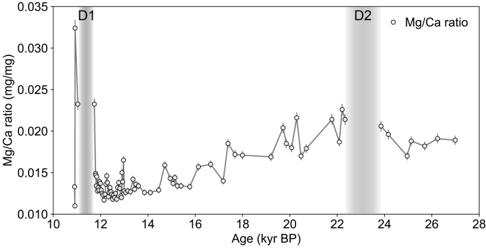
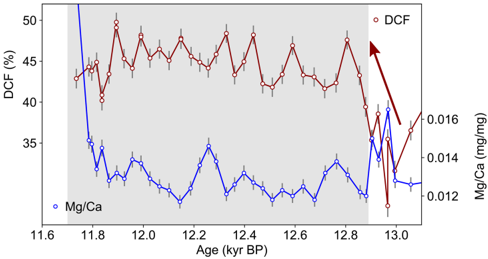
- Mg/Ca decreases from approximately 22 to 12 kyr BP, interpreted as increasing precipitation/net infiltration after the LGM; DCF decreases over the same long-term trend, opposite to the positive soil-humidity–DCF relation seen in temperate/humid settings. At the Younger Dryas onset around 12.9 kyr BP, DCF doubles and becomes extremely variable, including a 9 % drop in only 60 years modeled age at approximately 11.9 kyr BP.
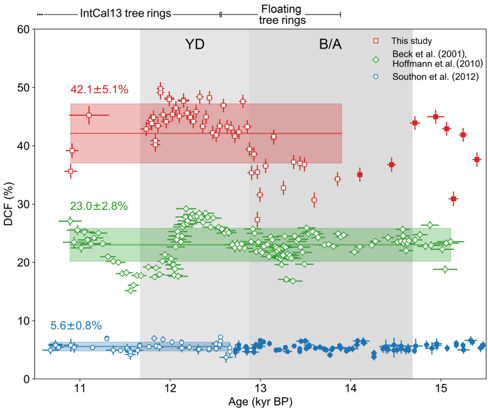
- M1-5 14C ages are significantly older than the contemporaneous atmosphere, and DCF variability on centennial and decadal timescales means M1-5 cannot contribute to atmospheric 14C calibration; this contrasts with Hulu Cave H82, where DCF remains rather constant at 5.6 ± 0.8 %.
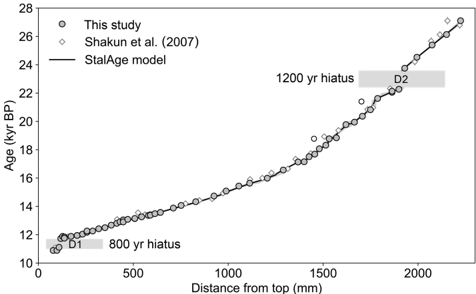
- U-series ages range from 27.11 ± 0.20 to 10.890 ± 0.034 kyr BP; average growth rate is approximately 0.13 mm yr−1 between 27.2 and 11 kyr BP, with an 800-year hiatus from 11.7 to 10.9 kyr BP (D1) and a 1200-year hiatus after 23.5 kyr BP (D2).
Methods
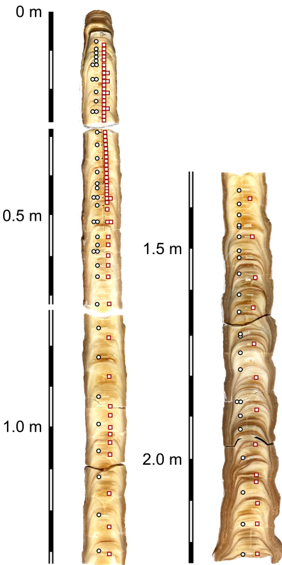
- Sample: stalagmite M1-5 from Moomi Cave, Socotra Island, collected in 2002; 62 U-series age data points are available in total, including 40 new samples analyzed at Heidelberg, plus 78 stalagmite 14C measurements including 6 duplicates, and Mg/Ca measured at each 14C sample point.
- Chronology and DCF: U-series dating by MC-ICP-MS; age-depth modeling with a stepwise StalAge implementation between growth discontinuities; DCF calculated by comparing reconstructed initial 14C activity to atmospheric 14C from Reimer et al. (2013), with 1σ errors from a Monte Carlo approach.
- Proxies: 14C measured by MICADAS AMS; Mg/Ca measured by ICP-QMS and ICP-OES; stable isotope data from Shakun et al. (2007) used in multiproxy comparisons.
Limitations
- The paper states that the direct cause of the observed DCF fluctuations, which are not represented in hydrological proxies, cannot be conclusively derived; the role of the monsoon and seasonal shifts can only be speculated on. It also states that M1-5 cannot be used as a contribution to atmospheric 14C calibration due to its large offset and high variability.
- Evident from the text: the study relies on a single stalagmite from one cave, and DCF depends on the StalAge age model and IntCal13 atmospheric 14C values. The record contains growth discontinuities/hiatuses, and DCF–Mg/Ca correlation during the Younger Dryas is insignificant (r2 = 0.231, p < 0.01), while δ13C–DCF correlation is also not significant (r2 = 0.206, p < 0.01), so the proposed soil-carbon mechanisms are inferred indirectly.
Model-written summary. Check it against the paper before relying on it.
Integrity signals
Registry
Cites
Statistics
Figures
Verification
Claims the paper makes
0 Valid · 1 Not valid · 19 Not checked · 87 Own results and interpretations
A result the paper reports from its own data — it cites no other source for it, so there is none to check. The quote shows it is in the paper.
In the paper
“DCF values for stalagmite M1-5 range from 27.33 ± 0.24 % at approximately 13 kyr BP to values as high as 64.6 ± 1.1 % at 20.7 kyr BP”
§ Climate-induced speleothem radiocarbon variability on Socotra Island from the Last Glacial Maximum to the Younger Dryas > 4.2 Radiocarbon results
plainSingle case- Asserted: passes — The authors put it forward as true.
- Checkable: passes — It can be checked against evidence.
- Load-bearing: passes — The paper’s conclusions depend on it.
- Based: passes — The paper gives a reason why it holds.
A check of a cited source is scheduled, or we don’t hold its full text yet; the claim is checked once it runs.
In the paper
“The 14 C ages of stalagmite M1-5 are significantly older than the contemporaneous atmospheric 14 C calibration curve (Reimer et al., 2013).”
§ Climate-induced speleothem radiocarbon variability on Socotra Island from the Last Glacial Maximum to the Younger Dryas > 4.2 Radiocarbon results
What the sources say
- Not checked yetcites Reimer et al., 2013 matched to “IntCal13 and Marine13 radiocarbon age calibration curves 0–50,000 years cal BP” (2013) source
A check is scheduled.
plainSingle case- Asserted: passes — The authors put it forward as true.
- Checkable: passes — It can be checked against evidence.
- Load-bearing: passes — The paper’s conclusions depend on it.
- Based: passes — The paper gives a reason why it holds.
- Not checked yet
A result the paper reports from its own data — it cites no other source for it, so there is none to check. The quote shows it is in the paper.
In the paper
“For M1-5, an average DCF of 56.2 ± 3.4 % is observed between 27 and 18 kyr BP.”
- Also stated in: § 5.3 Climatic controls of DCF at Moomi Cave · plain
“In our study very high average DCF values of 56.2 ± 3.4 % are revealed during the last glacial period between 18 and 27 kyr BP with a maximum of 65 % at approximately 20.6 kyr BP”
§ Climate-induced speleothem radiocarbon variability on Socotra Island from the Last Glacial Maximum to the Younger Dryas > Abstract
plainSingle case- Asserted: passes — The authors put it forward as true.
- Checkable: passes — It can be checked against evidence.
- Load-bearing: passes — The paper’s conclusions depend on it.
- Based: passes — The paper gives a reason why it holds.
- Also stated in: § 5.3 Climatic controls of DCF at Moomi Cave · plain
A result the paper reports from its own data — it cites no other source for it, so there is none to check. The quote shows it is in the paper.
In the paper
“Mg/Ca ratios range from 0.01100 ± 0.00033 to 0.03217 ± 0.00097 and display a continuous decrease from 22 to 12 kyr BP.”
§ Climate-induced speleothem radiocarbon variability on Socotra Island from the Last Glacial Maximum to the Younger Dryas > 4.3 Mg/Ca ratio
plainstates an association- Asserted: passes — The authors put it forward as true.
- Checkable: passes — It can be checked against evidence.
- Load-bearing: unclear — It is unclear whether the paper’s conclusions depend on it.
- Based: passes — The paper gives a reason why it holds.
A result the paper reports from its own data — it cites no other source for it, so there is none to check. The quote shows it is in the paper.
In the paper
“A doubling of DCF values is observed at the onset of the YD around 12.9 kyr BP”
§ Climate-induced speleothem radiocarbon variability on Socotra Island from the Last Glacial Maximum to the Younger Dryas > 5.2 DCF and implications for radiocarbon calibration
plainstates an association- Asserted: passes — The authors put it forward as true.
- Checkable: passes — It can be checked against evidence.
- Load-bearing: passes — The paper’s conclusions depend on it.
- Based: passes — The paper gives a reason why it holds.
61 more claims
Create a free account to see all 107 claims and to verify the 30 references still open.
- It may state two separate claims as one. 33
- Probably not a substantial claim. 9
Self-check
Percentages, sums and reported differences re-computed from the paper’s own numbers.
Each contradiction between two passages listed here was confirmed by an independent check.
Rated major: it would touch a result — a value a result rests on, reported and recomputed p-values on opposite sides of the significance level, two passages that conflict with no sign which is right, or a cited work retracted before this paper was published.
In the paper
§ Climate-induced speleothem radiocarbon variability on Socotra Island from the Last Glacial Maximum to the Younger Dryas > 5.3 Climatic controls of DCF at Moomi Cave
“no significant correlation between δ 13 C and DCF can be observed”
§ Climate-induced speleothem radiocarbon variability on Socotra Island from the Last Glacial Maximum to the Younger Dryas > 5.3 Climatic controls of DCF at Moomi Cave
“(r 2 = 0.206, p < 0.01)”
Rated major: it would touch a result — a value a result rests on, reported and recomputed p-values on opposite sides of the significance level, two passages that conflict with no sign which is right, or a cited work retracted before this paper was published.
In the paper
§ Climate-induced speleothem radiocarbon variability on Socotra Island from the Last Glacial Maximum to the Younger Dryas > 5.4 Glacial termination climate dynamics on Socotra Island
“correlation in this period is insignificant”
§ Climate-induced speleothem radiocarbon variability on Socotra Island from the Last Glacial Maximum to the Younger Dryas > 5.4 Glacial termination climate dynamics on Socotra Island
“(r 2 = 0.231, p < 0.01)”
Citations
Cites
IntCal13 and Marine13 radiocarbon age calibration curves 0–50,000 years cal BP
Reimer, P. J., Bard, E., Bayliss, A., Beck, J. W., Blackwell, P. G., Ramsey, C. B., Buck, C. E., Cheng, H., Edwards, R. L., Friedrich, M., et al. (2013) · Radiocarbon · doi:10.2458/azu_js_rc.55.16947 · Cited by 14,591
DYKOSKI, C., EDWARDS, R., CHENG, H., YUAN, D., CAI, Y., ZHANG, M., LIN, Y., QING, J., AN, Z., & REVENAUGH, J. (2005) · Earth and Planetary Science Letters · doi:10.1016/j.epsl.2005.01.036 · Cited by 1,988
Holocene Forcing of the Indian Monsoon Recorded in a Stalagmite from Southern Oman
Fleitmann, D., Burns, S. J., Mudelsee, M., Neff, U., Kramers, J., Mangini, A., & Matter, A. (2003) · Science · doi:10.1126/science.1083130 · Cited by 1,690
Self-citationGupta, A. K., Anderson, D. M., & Overpeck, J. T. (2003) · Nature · doi:10.1038/nature01340 · Cited by 1,248
The half-lives of uranium-234 and thorium-230
Cheng, H., Edwards, R. L., Hoff, J., Gallup, C. D., Richards, D. A., & Asmerom, Y. (2000) · Chemical Geology · doi:10.1016/s0009-2541(99)00157-6 · Cited by 1,236
Hendy, C. H. (1971) · Geochimica et Cosmochimica Acta · doi:10.1016/0016-7037(71)90127-x · Cited by 1,087
Holocene ITCZ and Indian monsoon dynamics recorded in stalagmites from Oman and Yemen (Socotra)
Fleitmann, D., Burns, S. J., Mangini, A., Mudelsee, M., Kramers, J., Villa, I., Neff, U., Al-Subbary, A. A., Buettner, A., Hippler, D., et al. (2007) · Quaternary Science Reviews · doi:10.1016/j.quascirev.2006.04.012 · Cited by 1,071
Self-citationCorrelation between Arabian Sea and Greenland climate oscillations of the past 110,000 years
Schulz, von Rad, Erlenkeuser, & von Rad (1998) · Nature · doi:10.1038/31750 · Cited by 828
MICADAS: A new compact radiocarbon AMS system
Synal, H.-A., Stocker, M., & Suter, M. (2007) · Nuclear Instruments and Methods in Physics Research Section B: Beam Interactions with Materials and Atoms · doi:10.1016/j.nimb.2007.01.138 · Cited by 704
The southwest Indian Monsoon over the last 18 000 years
Overpeck, J., Anderson, D., Trumbore, S., & Prell, W. (1996) · Climate Dynamics · doi:10.1007/bf00211619 · Cited by 671
Radiocarbon and Soil Carbon Dynamics
Trumbore, S. (2009) · Annual Review of Earth and Planetary Sciences · doi:10.1146/annurev.earth.36.031207.124300 · Cited by 648
Fairchild, I. J., Borsato, A., Tooth, A. F., Frisia, S., Hawkesworth, C. J., Huang, Y., McDermott, F., & Spiro, B. (2000) · Chemical Geology · doi:10.1016/s0009-2541(99)00216-8 · Cited by 605
Trace elements in speleothems as recorders of environmental change
Fairchild, I. J., & Treble, P. C. (2009) · Quaternary Science Reviews · doi:10.1016/j.quascirev.2008.11.007 · Cited by 593
StalAge – An algorithm designed for construction of speleothem age models
Scholz, D., & Hoffmann, D. L. (2011) · Quaternary Geochronology · doi:10.1016/j.quageo.2011.02.002 · Cited by 389
Age Determinations by Radiocarbon Content: Checks with Samples of Known Age
Arnold, J. R., & Libby, W. F. (1949) · Science · doi:10.1126/science.110.2869.678 · Cited by 355
Extremely Large Variations of Atmospheric 14 C Concentration During the Last Glacial Period
Beck, J. W., Richards, D. A., Lawrence, R., Edwards, Silverman, B. W., Smart, P. L., Donahue, D. J., Hererra-Osterheld, S., Burr, G. S., Calsoyas, L., et al. (2001) · Science · doi:10.1126/science.1056649 · Cited by 352
Indian Ocean Climate and an Absolute Chronology over Dansgaard/Oeschger Events 9 to 13
Burns, S. J., Fleitmann, D., Matter, A., Kramers, J., & Al-Subbary, A. A. (2003) · Science · doi:10.1126/science.1086227 · Cited by 309
Self-citationGenty, D., Baker, A., Massault, M., Proctor, C., Gilmour, M., Pons-Branchu, E., & Hamelin, B. (2001) · Geochimica et Cosmochimica Acta · doi:10.1016/s0016-7037(01)00697-4 · Cited by 279
Variations in tropical convection as an amplifier of global climate change at the millennial scale
IVANOCHKO, T., GANESHRAM, R., BRUMMER, G., GANSSEN, G., JUNG, S., MORETON, S., & KROON, D. (2005) · Earth and Planetary Science Letters · doi:10.1016/j.epsl.2005.04.002 · Cited by 205
Shakun, J. D., Burns, S. J., Fleitmann, D., Kramers, J., Matter, A., & Al-Subary, A. (2007) · Earth and Planetary Science Letters · doi:10.1016/j.epsl.2007.05.004 · Cited by 194
Self-citationCoupled vegetation-precipitation variability observed from satellite and climate records
Lotsch, A., Friedl, M. A., Anderson, B. T., & Tucker, C. J. (2003) · Geophysical Research Letters · doi:10.1029/2003gl017506 · Cited by 192
Chemical kinetics, speleothem growth and climate
Dreybrodt, W. (1999) · Boreas · doi:10.1080/030094899422073 · Cited by 192
Climate variations of Central Asia on orbital to millennial timescales
Cheng, H., Spötl, C., Breitenbach, S. F. M., Sinha, A., Wassenburg, J. A., Jochum, K. P., Scholz, D., Li, X., Yi, L., Peng, Y., et al. (2016) · Scientific Reports · doi:10.1038/srep36975 · Cited by 190
Douville, É., Sallé, E., Frank, N., Eisele, M. H., Pons‐Branchu, E., & Ayrault, S. (2010) · Chemical Geology · doi:10.1016/j.chemgeo.2010.01.007 · Cited by 176
Self-citationA high-resolution record of atmospheric 14C based on Hulu Cave speleothem H82
Southon, J., Noronha, A. L., Cheng, H., Edwards, R. L., & Wang, Y. (2012) · Quaternary Science Reviews · doi:10.1016/j.quascirev.2011.11.022 · Cited by 175
Schlüter, T. (2006) · Springer eBooks · doi:10.1007/3-540-29145-8 · Cited by 175
MAMS – A new AMS facility at the Curt-Engelhorn-Centre for Achaeometry, Mannheim, Germany
Kromer, B., Lindauer, S., Synal, H.-A., & Wacker, L. (2013) · Nuclear Instruments and Methods in Physics Research Section B: Beam Interactions with Materials and Atoms · doi:10.1016/j.nimb.2012.01.015 · Cited by 156
Griffiths, M. L., Drysdale, R. N., Gagan, M. K., Frisia, S., Zhao, J.-X., Ayliffe, L. K., Hantoro, W. S., Hellstrom, J. C., Fischer, M. J., & Feng, Y.-X. (2010) · Earth and Planetary Science Letters · doi:10.1016/j.epsl.2010.01.002 · Cited by 138
Glacial changes in tropical climate amplified by the Indian Ocean
DiNezio, P., Tierney, J. E., Otto‐Bliesner, B. L., Timmermann, A., Bhattacharya, T., Rosenbloom, N. A., & Brady, E. C. (2018) · Science Advances · doi:10.1126/sciadv.aat9658 · Cited by 137
Stalagmite growth and palaeo-climate: the numerical perspective
Kaufmann, G. (2003) · Earth and Planetary Science Letters · doi:10.1016/s0012-821x(03)00369-8 · Cited by 136
Atmospheric 14 C/ 12 C changes during the last glacial period from Hulu Cave
Cheng, H., Edwards, R. L., Southon, J., Matsumoto, K., Feinberg, J. M., Sinha, A., Zhou, W., Li, H., Li, X., Xu, Y., et al. (2018) · Science · doi:10.1126/science.aau0747 · Cited by 135
Towards radiocarbon calibration beyond 28ka using speleothems from the Bahamas
Hoffmann, D. L., Beck, J., Richards, D. A., Smart, P. L., Singarayer, J. S., Ketchmark, T., & Hawkesworth, C. J. (2009) · Earth and Planetary Science Letters · doi:10.1016/j.epsl.2009.10.004 · Cited by 129
Schlüter, T., & Trauth, M. H. (2005) · Cited by 99
Stalagmite growth and palaeo-climate: an inverse approach
Kaufmann, G., & Dreybrodt, W. (2004) · Earth and Planetary Science Letters · doi:10.1016/j.epsl.2004.05.020 · Cited by 98
Scholte, P. T., & Geest, P. D. (2010) · Journal of Arid Environments · doi:10.1016/j.jaridenv.2010.05.017 · Cited by 97
Atmospheric 14C variations derived from tree rings during the early Younger Dryas
Hua, Q., Barbetti, M., Fink, D., Kaiser, K. F., Friedrich, M., Kromer, B., Levchenko, V. A., Zoppi, U., Smith, A. M., & Bertuch, F. (2009) · Quaternary Science Reviews · doi:10.1016/j.quascirev.2009.08.013 · Cited by 96
Genty, D., Massault, M., Gilmour, M., Baker, A., Verheyden, S., & Kepens, E. (1999) · Radiocarbon · doi:10.1017/s003382220005712x · Cited by 90
Warken, S. F., Fohlmeister, J., Schröder‐Ritzrau, A., Constantin, S., Spötl, C., Gerdes, A., Esper, J., Frank, N., Arps, J., Terente, M., et al. (2018) · Earth and Planetary Science Letters · doi:10.1016/j.epsl.2018.07.027 · Cited by 81
Self-citationA Note on Reporting of Reservoir 14 C Disequilibria and Age Offsets
Soulet, G., Skinner, L. C., Beaupré, S. R., & Galy, V. (2016) · Radiocarbon · doi:10.1017/rdc.2015.22 · Cited by 78
Rudzka, D., McDermott, F., Baldini, L. M., Fleitmann, D., Moreno, A., & Stoll, H. (2011) · Geochimica et Cosmochimica Acta · doi:10.1016/j.gca.2011.05.022 · Cited by 75
Self-citationBajo, P., Borsato, A., Drysdale, R. N., Hua, Q., Frisia, S., Zanchetta, G., Hellström, J., & Woodhead, J. D. (2017) · Geochimica et Cosmochimica Acta · doi:10.1016/j.gca.2017.04.038 · Cited by 75
Late Holocene droughts in the Fertile Crescent recorded in a speleothem from northern Iraq
Flohr, P., Fleitmann, D., Zorita, E., Sadekov, A., Cheng, H., Bosomworth, M., Edwards, L. R., Matthews, W., & Matthews, R. (2017) · Geophysical Research Letters · doi:10.1002/2016gl071786 · Cited by 75
Self-citationAdolphi, F., Muscheler, R., Friedrich, M., Güttler, D., Wacker, L., Talamo, S., & Kromer, B. (2017) · Quaternary Science Reviews · doi:10.1016/j.quascirev.2017.06.026 · Cited by 73
Noronha, A. L., Johnson, K. R., Hu, C., Ruan, J., Southon, J. R., & Ferguson, J. E. (2014) · Earth and Planetary Science Letters · doi:10.1016/j.epsl.2014.03.015 · Cited by 69
Hydrological control of the dead carbon fraction in a Holocene tropical speleothem
Griffiths, M. L., Fohlmeister, J., Drysdale, R. N., Hua, Q., Johnson, K. R., Hellstrom, J. C., Gagan, M. K., & Zhao, J.-X. (2012) · Quaternary Geochronology · doi:10.1016/j.quageo.2012.04.001 · Cited by 66
Self-citationZhou, J., Lundstrom, C. C., Fouke, B. W., Panno, S. V., Hackley, K. C., & Curry, B. B. (2005) · Chemical Geology · doi:10.1016/j.chemgeo.2005.02.005 · Cited by 66
Wefing, A., Arps, J., Blaser, P., Wienberg, C., Hebbeln, D., & Frank, N. (2017) · Chemical Geology · doi:10.1016/j.chemgeo.2017.10.036 · Cited by 64
Self-citationFohlmeister, J., Kromer, B., & Mangini, A. (2011) · Radiocarbon · doi:10.1017/s003382220003438x · Cited by 58
Self-citationLateglacial environmental variability from Swiss tree rings
Schaub, M., Büntgen, U., Kaiser, K.-F., Kromer, B., Talamo, S., Andersen, K. K., & Rasmussen, S. O. (2008) · Quaternary Science Reviews · doi:10.1016/j.quascirev.2007.01.017 · Cited by 57
Myers, C. G., Oster, J. L., Sharp, W. D., Bennartz, R., Kelley, N. P., Covey, A. K., & Breitenbach, S. F. M. (2015) · Geophysical Research Letters · doi:10.1002/2015gl063826 · Cited by 54
Hydrological and climatological controls on radiocarbon concentrations in a tropical stalagmite
Lechleitner, F. A., Baldini, J. U. L., Breitenbach, S. F. M., Fohlmeister, J., McIntyre, C., Goswami, B., Jamieson, R. A., van der Voort, T. S., Prufer, K., Marwan, N., et al. (2016) · Geochimica et Cosmochimica Acta · doi:10.1016/j.gca.2016.08.039 · Cited by 42
Self-citationUnkel, I. (2006) · heiDOK (Heidelberg University) · doi:10.11588/heidok.00006311 · Cited by 41
Popov, G. B. (1957) · Journal of the Linnean Society of London Botany · doi:10.1111/j.1095-8339.1957.tb00031.x · Cited by 40
Treble, P. C., Fairchild, I. J., Baker, A., Meredith, K. T., Andersen, M. S., Salmon, S. U., Bradley, C., Wynn, P. M., Hankin, S. I., Wood, A., et al. (2016) · Geochimica et Cosmochimica Acta · doi:10.1016/j.gca.2016.04.017 · Cited by 39
Modelling the 14C bomb-pulse in young speleothems using a soil carbon continuum model
Markowska, M., Fohlmeister, J., Treble, P. C., Baker, A., Andersen, M. S., & Hua, Q. (2019) · Geochimica et Cosmochimica Acta · doi:10.1016/j.gca.2019.04.029 · Cited by 27
Self-citationEffects of wildfire on long-term soil CO2 concentration: implications for karst processes
Coleborn, K., Spate, A., Tozer, M., Andersen, M. S., Fairchild, I. J., MacKenzie, B., Treble, P. C., Meehan, S., Baker, A., & Baker, A. (2016) · Environmental Earth Sciences · doi:10.1007/s12665-015-4874-9 · Cited by 19
Towards ε-Precision of U-series Age Determinations of Secondary Carbonates
Arps, J. (2017) · heiDOK (Heidelberg University) · doi:10.11588/heidok.00023313 · Cited by 19
Self-citationFohlmeister, J., Kromer, B., & Mangini, A. (2010) · EGUGA · Cited by 5
Self-citationU-series and radiocarbon dating results of stalagmite M1-5 from Moomi Cave, Socotra Island
Therre, S., Fohlmeister, J., Fleitmann, D., Matter, A., Burns, S. J., Arps, J., Schröder‐Ritzrau, A., Friedrich, R., & Frank, N. (2019) · Publishing Network for Geoscientific and Environmental Data (PANGAEA) (Alfred Wegener Institute for Polar and Marine Research) · doi:10.1594/pangaea.906003 · Cited by 1
Self-citation
Research works printed but not linked: 1
- Mies, B. and Beyhl, F. E.: The vegetation ecology of Soqotra, in: Proceedings of the First International Symposium on Soqotra Is- land: Present and Future, Aden (March 1996), edited by: Du- mont, H., Vol. 1, 35-82, United Nations Publications, Global Environment Facility, Conservation and Sustainable Use of Bio- diversity of Soqotra Archipelago, Vol. 1, ISBN 90-804341-1-6, New York, NY, USA, 1998.
Cited by
Hajdas, I., Ascough, P., Garnett, M. H., Fallon, S. J., Pearson, C. L., Quarta, G., Spalding, K. L., Yamaguchi, H., & Yoneda, M. (2021) · Nature Reviews Methods Primers · doi:10.1038/s43586-021-00058-7 · Cited by 231
Kurečić, T., Bočić, N., Wacha, L., Bakrač, K., Grizelj, A., Pavičić, D. T., Lüthgens, C., Sironić, A., Radović, S., Redovniković, L., et al. (2021) · Frontiers in Earth Science · doi:10.3389/feart.2021.672229 · Cited by 21
Simultaneous U and Th isotope measurements for U-series dating using MCICPMS
Kerber, I. K., Arps, J., Eichstädter, R., Kontor, F., Dornick, C., Schröder‐Ritzrau, A., Babu, A., Warken, S., & Frank, N. (2023) · Nuclear Instruments and Methods in Physics Research Section B Beam Interactions with Materials and Atoms · doi:10.1016/j.nimb.2023.04.003 · Cited by 20
Self-citationWelte, C., Fohlmeister, J., Wertnik, M., Wacker, L., Hattendorf, B., Eglinton, T. I., & Spötl, C. (2021) · Climate of the past · doi:10.5194/cp-17-2165-2021 · Cited by 13
Self-citationVoarintsoa, N. R. G., & Therre, S. (2022) · Chemical Geology · doi:10.1016/j.chemgeo.2022.121044 · Cited by 7
Self-citation
Metadata
- Authors
- Therre, S., Fohlmeister, J., Fleitmann, D., Matter, A., Burns, S. J., Arps, J., Schröder-Ritzrau, A., Friedrich, R., & Frank, N.
- Affiliations
- Heidelberg University (DE)
- GFZ Helmholtz Centre for Geosciences (DE)
- University of Basel (CH)
- University of Bern (CH)
- University of Massachusetts Amherst (US)
- Curt Engelhorn Centre Archaeometry (DE)
- Corresponding author
- Therre, Steffen
- ORCID
- Venue
- Climate of the Past
- Publisher
- Copernicus GmbH
- Published
- 2020-02-28
- Volume
- 16
- Issue
- 1
- Pages
- 409-421
- ISSN
- 1814-9324 (ISSN-L)
- 1814-9332
- OpenAlex
- W2974702785
- Cited by
- 10
- References
- 59
- Citations by year
- 2026: 1 · 2025: 1 · 2024: 1 · 2023: 1 · 2022: 1 · 2021: 4 · 2020: 1
- FWCI
- 0.49
- Type
- journal article
- Language
- en
- Open access
- gold
- doi.org
- Licence
- Locations
- Climate of the past (publishedVersion, cc-by)
- DOAJ (DOAJ: Directory of Open Access Journals) (submittedVersion)
- edoc (University of Basel) (submittedVersion)
- Publication Database GFZ (GFZ German Research Centre for Geosciences) (submittedVersion, other-oa)
- Publication Database GFZ (GFZ German Research Centre for Geosciences) (submittedVersion, cc-by)
- RENATE (submittedVersion, cc-by)
- Publication Database PIK (Potsdam Institute for Climate Impact Research (PIK)) (submittedVersion, cc-by)
- RENATE (cc-by)
- Funders
- European Commission (820970)
- Deutsche Forschungsgemeinschaft (INST 35-1143-1 FUGG, FR1341/3)
- Topics
- Physical Sciences › Earth and Planetary Sciences › Atmospheric Science › Geology and Paleoclimatology Research
- Social Sciences › Archeology › Archaeology and ancient environmental studies
- Physical Sciences › Earth and Planetary Sciences › Earth-Surface Processes › Karst Systems and Hydrogeology
- Keywords
- stalagmites, soil organic matter, soil carbon cycling, Last Glacial Maximum, Younger Dryas, rainfall variability, Mg/Ca ratio, vegetation feedback, radiocarbon calibration, Socotra Island, Arabian Sea
About these checks
Registry, retraction, Cites and statistics results are computed, not judged, with one exception: a printed reference that no index lists is read once by a model before it counts as a citation error. Claims are extracted by a model and kept only when their quote appears verbatim in the text; each cited source is then checked, with a model’s help, for whether it says what the claim relies on. Those verdicts can be wrong — read the claim’s quote and the cited source before relying on one.
A language model drew the claims from the paper on 2026-11-24, under version 3 of the claim definition (model deepseek-v4.1-flash, prompt extract-v3).
A second model labelled each claim on 2026-11-24 (model jev-1.13-20260917, definition revision gold-guideline-v0.2).
Statistics and arithmetic are recomputed, not judged.
Confidence bands are shown only for fields calibrated on our annotated test set. None is calibrated yet, so no band is shown.
What counts as a claim ›How we measure confidence ›How we check this ›
Are you an author, or do you see a problem with this page? Request a review
Data sources
Bibliographic data: Semantic Scholar, OpenAlex, Crossref.
Contains information from the Semantic Scholar Academic Graph Datasets, made available under the ODC Attribution License (ODC-BY 1.0).
Semantic Scholar’s data is described in: Kinney, R., et al. (2023). The Semantic Scholar Open Data Platform. arXiv:2301.10140.
