

The DOI matches its Crossref record.
Precessional pacing of tropical ocean carbon export during the Late Cretaceous
Published version of a preprint
Abstract
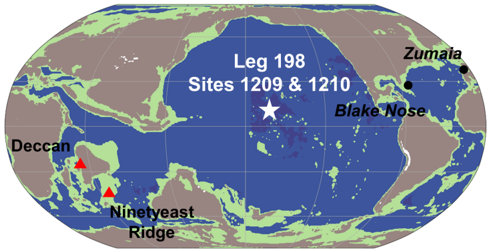
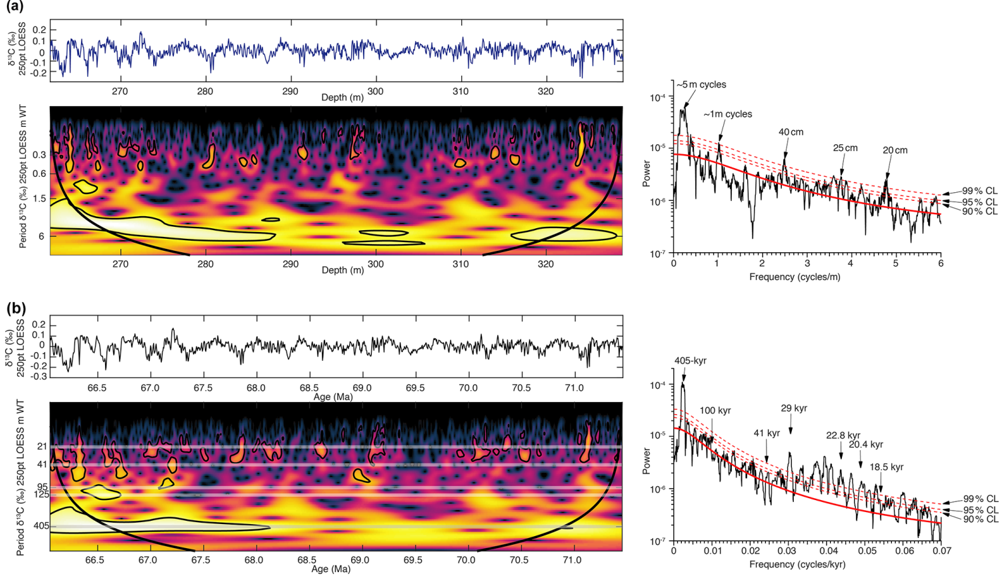
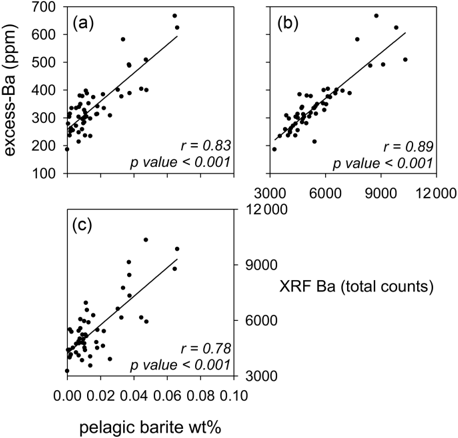
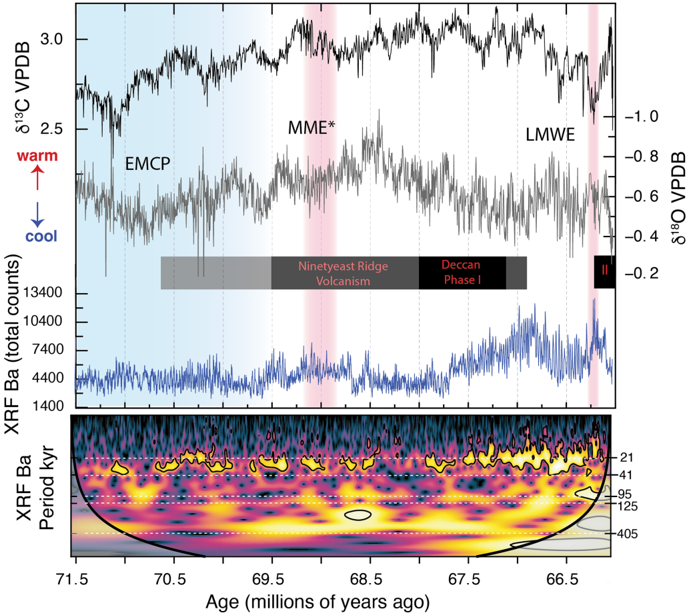
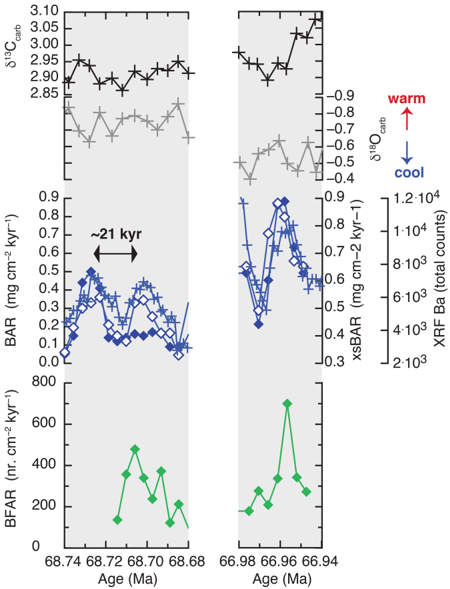
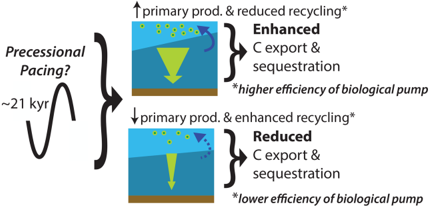
The marine biological carbon pump, which exports organic carbon out of the surface ocean, plays an essential role in sequestering carbon from the atmosphere, thus impacting climate and affecting marine ecosystems. Orbital variations in solar insolation modulate these processes, but their influence on the tropical Pacific during the Late Cretaceous is unknown. Here we present a high-resolution composite record of elemental barium from deep-sea sediments as a proxy for organic carbon export out of the surface oceans (i.e., export production) from Shatsky Rise in the tropical Pacific. Variations in export production in the Pacific during the Maastrichtian, from 71.5 to 66 million years ago, were dominated by precession and less so by eccentricity modulation or obliquity, confirming that tropical surface-ocean carbon dynamics were influenced by seasonal insolation in the tropics during this greenhouse period. We suggest that precession paced primary production in the tropical Pacific and recycling in the euphotic zone by changing water column stratification, upwelling intensity, and continental nutrient fluxes. Benthic foraminiferal accumulation rates covaried with export production, providing evidence for bentho-pelagic coupling of the marine biological carbon pump across these high-frequency changes in a cool greenhouse planet.
Overview
The claims and statistics of this paper haven’t been checked yet.
Run the check — free, no account needed. It reads the open-access text and checks the sources it cites.
Integrity signals
Registry
Cites
Statistics
Figures
Verification
Claims the paper makes
The claims and statistics of this paper haven’t been checked yet.
Run the check — free, no account needed. It reads the open-access text and checks the sources it cites.
Claims other papers make about this one
Each is checked against this paper’s own text: does it say what the citing paper says it does?
In the citing paper
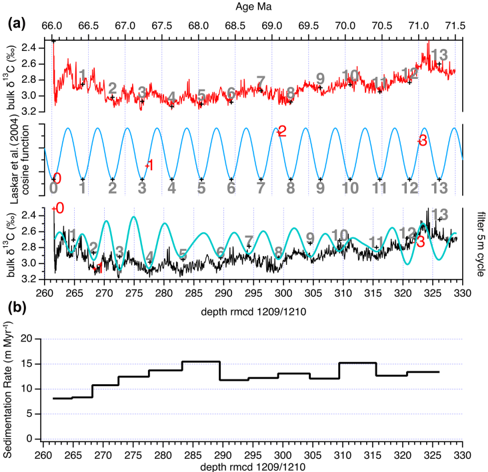
“An age model identifying the long eccentricity cycle in bulk carbonate carbon stable isotope data was recently established for Site 1209 for the interval from 62.5 to 71.28 Ma using this cosine function (42).”
From Earth orbital rhythms links timing of Deccan trap volcanism phases and global climate change (2025) · cites this paper as [42]
Self-check
Percentages, sums and reported differences re-computed from the paper’s own numbers.
The self-check needs the paper’s full text.
Citations
Cites
No references could be resolved yet.
Research works printed but not linked: 67
- Alegret, L. and Thomas, E.: Food supply to the seafloor in the Pacific Ocean after the Cretaceous/Paleogene boundary event, Mar. Micropaleontol., 73, 105–116, 10.1016/j.marmicro.2009.07.005, 2009. · DOI
- Alegret, L., Thomas, E., and Lohmann, K. C.: End-Cretaceous marine mass extinction not caused by productivity collapse, P. Natl. Acad. Sci. USA, 109, 728–732, 10.1073/pnas.1110601109, 2012. · DOI
- Alegret, L., Arreguín-Rodríguez, G. J., Trasviña-Moreno, C. A., and Thomas, E.: Turnover and stability in the deep sea: Benthic foraminifera as tracers of Paleogene global change, Global Planet. Change, 196, 103372, 10.1016/j.gloplacha.2020.103372, 2020. · DOI
- Barnet, J. S., Littler, K., Kroon, D., Leng, M. J., Westerhold, T., Röhl, U., and Zachos, J. C.: A new high-resolution chronology for the Late Maastrichtian warming event: Establishing robust temporal links with the onset of Deccan volcanism, Geology, 46, 147–150, 2018. · DOI · Paper page
- Barnet, J. S., Littler, K., Westerhold, T., Kroon, D., Leng, M. J., Bailey, I., Röhl, U., and Zachos, J. C.: A high-fidelity benthic stable isotope record of Late Cretaceous–Early Eocene climate change and carbon-cycling, Paleoceanography and Paleoclimatology, 34, 672–691, 2019. · DOI
- Batenburg, S. J., Sprovieri, M., Gale, A. S., Hilgen, F. J., Hüsing, S., Laskar, J., Liebrand, D., Lirer, F., Orue-Etxebarria, X., and Pelosi, N.: Cyclostratigraphy and astronomical tuning of the Late Maastrichtian at Zumaia (Basque country, Northern Spain), Earth Planet. Sc. Lett., 359, 264–278, 2012. · DOI · Paper page
- Batenburg, S. J., Gale, A. S., Sprovieri, M., Hilgen, F. J., Thibault, N., Boussaha, M., and Orue-Etxebarria, X.: An astronomical time scale for the Maastrichtian based on the Zumaia and Sopelana sections (Basque country, northern Spain), J. Geol. Soc., 171, 165–180, 2014. · DOI
- Beaufort, L., Bolton, C. T., Sarr, A.-C., Suchéras-Marx, B., Rosenthal, Y., Donnadieu, Y., Barbarin, N., Bova, S., Cornuault, P., Gally, Y., Gray, E., Mazur, J.-C., and Tetard, M.: Cyclic evolution of phytoplankton forced by changes in tropical seasonality, Nature, 601, 79–84, 10.1038/s41586-021-04195-7, 2022. · DOI
- Bralower, T., Premoli Silva, I., and Malone, M.: Leg 198, Proceedings of the Ocean Drilling Program: Initial Reports, College Station, TX (Ocean Drilling Program), 10.2973/odp.proc.ir.198.2002, 2002. · DOI
- Chenet, A.-L., Quidelleur, X., Fluteau, F., Courtillot, V., and Bajpai, S.: 40K–40Ar dating of the Main Deccan large igneous province: Further evidence of KTB age and short duration, Earth Planet. Sc. Lett., 263, 1–15, 2007. · DOI · Paper page
- Clement, A. C., Seager, R., and Cane, M. A.: Orbital controls on the El Niño/Southern Oscillation and the tropical climate, Paleoceanography, 14, 441–456, 10.1029/1999PA900013, 1999. · DOI
- Clement, A. C., Seager, R., and Cane, M. A.: Suppression of El Niño during the mid-Holocene by changes in the Earth's orbit, Paleoceanography, 15, 731–737, 10.1029/1999PA000466, 2000. · DOI · Paper page
- Clement, A. C., Hall, A., and Broccoli, A. J.: The importance of precessional signals in the tropical climate, Clim. Dynam., 22, 327–341, 10.1007/s00382-003-0375-8, 2004. · DOI
- Crowley, T. J., Kim, K.-Y., Mengel, J. G., and Short, D. A.: Modeling 100,000-Year Climate Fluctuations in Pre-Pleistocene Time Series, Science, 255, 705–707, 1992. · DOI
- Dameron, S. N., Leckie, R. M., Clark, K., MacLeod, K. G., Thomas, D. J., and Lees, J. A.: Extinction, dissolution, and possible ocean acidification prior to the Cretaceous/Paleogene (K/Pg) boundary in the tropical Pacific, Palaeogeogr. Palaeocl., 485, 433–454, 2017. · DOI
- Davies, A., Kemp, A. E. S., Weedon, G. P., and Barron, J. A.: El Niño–Southern Oscillation variability from the Late Cretaceous Marca Shale of California, Geology, 40, 15–18, 10.1130/G32329.1, 2012. · DOI
- Dymond, J., Suess, E., and Lyle, M.: Barium in deep-sea sediment: A geochemical proxy for paleoproductivity, Paleoceanography, 7, 163–181, 1992. · DOI
- Eagle, M., Paytan, A., Arrigo, K. R., van Dijken, G., and Murray, R. W.: A comparison between excess barium and barite as indicators of carbon export, Paleoceanography, 18, 1021, 10.1029/2002PA000793, 2003. · DOI
- Fedorov, A. V., Dekens, P. S., McCarthy, M., Ravelo, A. C., deMenocal, P. B., Barreiro, M., Pacanowski, R. C., and Philander, S. G.: The Pliocene Paradox (Mechanisms for a Permanent El Niño), Science, 312, 1485–1489, 10.1126/science.1122666, 2006. · DOI
- Forster, A., Schouten, S., Baas, M., and Sinninghe Damsté, J. S.: Mid-Cretaceous (Albian–Santonian) sea surface temperature record of the tropical Atlantic Ocean, Geology, 35, 919–922, 2007. · DOI
- Frank, T. D., Thomas, D. J., Leckie, R. M., Arthur, M. A., Bown, P. R., Jones, K., and Lees, J. A.: The Maastrichtian record from Shatsky Rise (northwest Pacific): A tropical perspective on global ecological and oceanographic changes, Paleoceanography, 20, PA1008, 10.1029/2004PA001052, 2005. · DOI
- Friedrich, O., Norris, R. D., and Erbacher, J.: Evolution of middle to Late Cretaceous oceans – A 55 m.y. record of Earth's temperature and carbon cycle, Geology, 40, 107–110, 10.1130/g32701.1, 2012. · DOI
- Gilabert, V., Arz, J. A., Arenillas, I., Robinson, S. A., and Ferrer, D.: Influence of the Latest Maastrichtian Warming Event on planktic foraminiferal assemblages and ocean carbonate saturation at Caravaca, Spain, Cretaceous Res., 125, 104844, 10.1016/j.cretres.2021.104844, 2021. · DOI
- Gonneea, M. E. and Paytan, A.: Phase associations of barium in marine sediments, Mar. Chem., 100, 124–135, 2006. · DOI
- Griffith, E. M., Thomas, E., Lewis, A. R., Penman, D. E., Westerhold, T., and Winguth, A. M.: Bentho-Pelagic Decoupling: The Marine Biological Carbon Pump During Eocene Hyperthermals, Paleoceanography and Paleoclimatology, 36, e2020PA004053, 10.1029/2020PA004053, 2021. · DOI
- Grinsted, A., Moore, J. C., and Jevrejeva, S.: Application of the cross wavelet transform and wavelet coherence to geophysical time series, Nonlin. Processes Geophys., 11, 561–566, 10.5194/npg-11-561-2004, 2004. · DOI · Paper page
- Haynes, S. J., MacLeod, K. G., Ladant, J.-B., Guchte, A. V., Rostami, M. A., Poulsen, C. J., and Martin, E. E.: Constraining sources and relative flow rates of bottom waters in the Late Cretaceous Pacific Ocean, Geology, 48, 509–513, 2020. · DOI
- Herbert, T. D. and D'Hondt, S. L.: Precessional climate cyclicity in Late Cretaceous – Early Tertiary marine sediments: a high resolution chronometer of Cretaceous-Tertiary boundary events, Earth Planet. Sc. Lett., 99, 263–275, 10.1016/0012-821X(90)90115-E, 1990. · DOI
- Herbert, T. D., Gee, J., and DiDonna, S.: Precessional cycles in the Upper Cretaceous pelagic sediments of the South Atlantic: Long-term patterns from high-frequency climate variations, Geological Society of America, Special Papers, 105–120, 1999. · DOI
- Huber, B. T., MacLeod, K. G., Watkins, D. K., and Coffin, M. F.: The rise and fall of the Cretaceous Hot Greenhouse climate, Global Planet. Change, 167, 1–23, 2018. · DOI
- Jenkyns, H., Gale, A., and Corfield, R.: Carbon-and oxygen-isotope stratigraphy of the English Chalk and Italian Scaglia and its palaeoclimatic significance, Geol. Mag., 131, 1–34, 10.1017/S0016756800010451, 1994. · DOI
- Jorissen, F. J., Fontanier, C., and Thomas, E.: Chapter Seven Paleoceanographical Proxies Based on Deep-Sea Benthic Foraminiferal Assemblage Characteristics, Developments in Marine Geology, 1, 263–325, 10.1016/S1572-5480(07)01012-3, 2007. · DOI
- Jung, C., Voigt, S., and Friedrich, O.: High-resolution carbon-isotope stratigraphy across the Campanian–Maastrichtian boundary at Shatsky Rise (tropical Pacific), Cretaceous Res., 37, 177–185, 2012. · DOI
- Jung, C., Voigt, S., Friedrich, O., Koch, M. C., and Frank, M.: Campanian-Maastrichtian ocean circulation in the tropical Pacific, Paleoceanogr. Paleocl., 28, 562–573, 2013. · DOI
- Keller, G., Punekar, J., and Mateo, P.: Upheavals during the Late Maastrichtian: Volcanism, climate and faunal events preceding the end-Cretaceous mass extinction, Palaeogeogr. Palaeocl., 441, 137–151, 2016. · DOI
- Kim, H. J., Kim, T., Hyeong, K., Yeh, S., Park, J., Yoo, C. M., and Hwang, J.: Suppressed CO2 outgassing by an enhanced biological pump in the Eastern Tropical Pacific, J. Geophys. Res.-Oceans, 124, 7962–7973, 2019. · DOI
- Laepple, T. and Lohmann, G.: Seasonal cycle as template for climate variability on astronomical timescales, Paleoceanography, 24, PA4201, 10.1029/2008PA001674, 2009. · DOI
- Larson, R., Steiner, M., Erba, E., and Lancelot, Y.: Paleolatitudes and tectonic reconstructions of the oldest portion of the Pacific plate: A comparative study, edited by: Larson, R. L., Lancelot, Y., Fisher, A., and Winterer, E. L., Proceedings of the Ocean Drilling Program, Scientific Results, Leg 129, 615–631, 1992. · DOI
- Laskar, J.: Chapter 4 – Astrochronology, in: Geologic Time Scale 2020, edited by: Gradstein, F. M., Ogg, J. G., Schmitz, M. D., and Ogg, G. M., Elsevier, 139–158, 10.1016/B978-0-12-824360-2.00004-8, 2020. · DOI
- Laskar, J., Robutel, P., Joutel, F., Gastineau, M., Correia, A., and Levrard, B.: A long-term numerical solution for the insolation quantities of the Earth, Astron. Astrophys., 428, 261–285, 2004. · DOI · Paper page
- Laskar, J., Fienga, A., Gastineau, M., and Manche, H.: La2010: a new orbital solution for the long-term motion of the Earth, Astron. Astrophys., 532, A89, 10.1051/0004-6361/201116836, 2011. · DOI
- Li, L. and Keller, G.: Abrupt deep-sea warming at the end of the Cretaceous, Geology, 26, 995–998, 1998. · DOI
- Li, M., Hinnov, L. A., and Kump, L.: Acycle: Time-series analysis software for paleoclimate research and education, Comput. Geosci., 127, 12–21, 2019. · DOI
- Lu, Z., Liu, Z., Chen, G., and Guan, J.: Prominent precession band variance in ENSO intensity over the last 300,000 years, Geophys. Res. Lett., 46, 9786–9795, 10.1029/2019GL083410, 2019. · DOI
- Lyle, M., Dadey, K. A., and Farrell, J. W.: The Late Miocene (11–8 Ma) eastern Pacific carbonate crash: evidence for reorganization of deep-water circulation by the closure of the Panama Gateway, 1995 Proceedings of the Ocean Drilling Program, Scientific Results, 138, 821–837, 1995. · DOI
- MacLeod, K. G. and Huber, B. T.: Reorganization of deep ocean circulation accompanying a Late Cretaceous extinction event, Nature, 380, 422–425, 1996. · DOI
- MacLeod, K. G., Huber, B. T., Pletsch, T., Röhl, U., and Kucera, M.: Maastrichtian foraminiferal and paleoceanographic changes on Milankovitch timescales, Paleoceanography, 16, 133–154, 2001. · DOI
- Murray, J. W., Young, J., Newton, J., Dunne, J., Chapin, T., Paul, B., and McCarthy, J. J.: Export flux of particulate organic carbon from the central equatorial Pacific determined using a combined drifting trap-234Th approach, Deep-Sea Res. Pt. II, 43, 1095–1132, 1996. · DOI
- Murray, R. W., Knowlton, C., Leinen, M., Mix, A. C., and Polsky, C.: Export production and carbonate dissolution in the central equatorial Pacific Ocean over the past 1 Myr, Paleoceanography, 15, 570–592, 2000. · DOI
- Olivarez Lyle, A. and Lyle, M. W.: Missing organic carbon in Eocene marine sediments: Is metabolism the biological feedback that maintains end-member climates?, Paleoceanography, 21, PA2007, 10.1029/2005PA001230, 2006. · DOI
- Pälike, H., Norris, R. D., Herrle, J. O., Wilson, P. A., Coxall, H. K., Lear, C. H., Shackleton, N. J., Tripati, A. K., and Wade, B. S.: The heartbeat of the Oligocene climate system, Science, 314, 1894–1898, 10.1126/science.1133822, 2006. · DOI
- Paytan, A., Kastner, M., and Chavez, F.: Glacial to interglacial fluctuations in productivity in the equatorial Pacific as indicated by marine barite, Science, 274, 1355–1357, 1996. · DOI
- Pena, L. D., Cacho, I., Ferretti, P., and Hall, M. A.: El Niño–Southern Oscillation–like variability during glacial terminations and interlatitudinal teleconnections, Paleoceanography, 23, PA3101, 10.1029/2008PA001620, 2008. · DOI
- Reitz, A., Pfeifer, K., De Lange, G., and Klump, J.: Biogenic barium and the detrital Ba/Al ratio: a comparison of their direct and indirect determination, Mar. Geol., 204, 289–300, 2004. · DOI
- Renne, P. R., Deino, A. L., Hilgen, F. J., Kuiper, K. F., Mark, D. F., Mitchell, W. S., Morgan, L. E., Mundil, R., and Smit, J.: Time scales of critical events around the Cretaceous-Paleogene boundary, Science, 339, 684–687, 2013. · DOI · Paper page
- Sager, W. W., Kim, J., Klaus, A., Nakanishi, M., and Khankishieva, L. M.: Bathymetry of Shatsky Rise, northwest Pacific Ocean: Implications for ocean plateau development at a triple junction, J. Geophys. Res.-Sol. Ea., 104, 7557–7576, 1999. · DOI
- Scudder, R. P., Murray, R. W., Schindlbeck, J. C., Kutterolf, S., Hauff, F., and McKinley, C. C.: Regional-scale input of dispersed and discrete volcanic ash to the Izu-Bonin and Mariana subduction zones, Geochem. Geophy. Geosy., 15, 4369–4379, 2014. · DOI
- Short, D. A., Mengel, J. G., Crowley, T. J., Hyde, W. T., and North, G. R.: Filtering of Milankovitch cycles by Earth's geography, Quaternary Res., 35, 157–173, 1991. · DOI
- Torrence, C. and Compo, G. P.: A Practical Guide to Wavelet Analysis, B. Am. Meteorol. Soc., 79, 61–78, 1998. · DOI
- Trenberth, K. E., Stepaniak, D. P., and Caron, J. M.: The global monsoon as seen through the divergent atmospheric circulation, J. Climate, 13, 3969–3993, 2000. · DOI
- Turk, D., McPhaden, M. J., Busalacchi, A. J., and Lewis, M. R.: Remotely sensed biological production in the Equatorial Pacific, Science, 293, 471–474, 2001. · DOI
- Voigt, S., Gale, A. S., Jung, C., and Jenkyns, H. C.: Global correlation of Upper Campanian - Maastrichtian successions using carbon-isotope stratigraphy: development of a new Maastrichtian timescale, Newsl. Stratigr., 45, 25–53, 2012. · DOI
- Wara, M. W., Ravelo, A. C., and Delaney, M. L.: Permanent El Niño-like conditions during the Pliocene warm period, Science, 309, 758–761, 2005. · DOI
- Westerhold, T., Marwan, N., Drury, A. J., Liebrand, D., Agnini, C., Anagnostou, E., Barnet, J. S., Bohaty, S. M., De Vleeschouwer, D., and Florindo, F.: An astronomically dated record of Earth's climate and its predictability over the last 66 million years, Science, 369, 1383–1387, 2020. · DOI · Paper page
- Zachos, J., Pagani, M., Sloan, L., Thomas, E., and Billups, K.: Trends, rhythms, and aberrations in global climate 65 Ma to present, Science, 292, 686–693, 2001. · DOI · Paper page
- Zeebe, R. E., Westerhold, T., Littler, K., and Zachos, J. C.: Orbital forcing of the Paleocene and Eocene carbon cycle, Paleoceanography, 32, 440–465, 2017. · DOI
- Zhang, S., Yu, Z., Gong, X., Wang, Y., Chang, F., Lohmman, G., Qi, Y., and Li, T.: Precession cycles of the El Niño/Southern oscillation-like system controlled by Pacific upper-ocean stratification, Communications Earth & Environment, 2, 239, 10.1038/s43247-021-00305-5, 2021. · DOI
Cited by
Earth orbital rhythms links timing of Deccan trap volcanism phases and global climate change
Westerhold, T., Dallanave, E., Penman, D., Schoene, B., Röhl, U., Gussone, N., & Kuroda, J. (2025) · Science Advances · doi:10.1126/sciadv.adr8584 · Cited by 17
Self-citation
Metadata
- Authors
- Kim, J.-E., Westerhold, T., Alegret, L., Drury, A. J., Röhl, U., & Griffith, E. M.
- Venue
- Climate of the Past
- Publisher
- Copernicus GmbH
- Published
- 2022-12-16
- Volume
- 18
- Issue
- 12
- Pages
- 2631-2641
- ISSN
- 1814-9332
- Cited by
- 4
- References
- 0
- Language
- en
- Funders
- Deutsche Forschungsgemeinschaft (320221997, 390741603)
- Ministerio de Economía y Competitividad (PID2019-105537RB-I00)
- National Science Foundation (OCE-1536630)
About these checks
Registry, retraction, Cites and statistics results are computed, not judged, with one exception: a printed reference that no index lists is read once by a model before it counts as a citation error. Claims are extracted by a model and kept only when their quote appears verbatim in the text; each cited source is then checked, with a model’s help, for whether it says what the claim relies on. Those verdicts can be wrong — read the claim’s quote and the cited source before relying on one.
Statistics and arithmetic are recomputed, not judged.
Confidence bands are shown only for fields calibrated on our annotated test set. None is calibrated yet, so no band is shown.
What counts as a claim ›How we measure confidence ›How we check this ›
Are you an author, or do you see a problem with this page? Request a review
How to cite
Cite CoChat for the checks on this page, and the paper for its own findings.
- This page
- CoChat. (2026). Citation check: Precessional pacing of tropical ocean carbon export during the Late Cretaceous. https://app.cochat.ai/papers/10.5194/cp-18-2631-2022
- The paper
- Kim, J.-E., Westerhold, T., Alegret, L., Drury, A. J., Röhl, U., & Griffith, E. M. (2022). Precessional pacing of tropical ocean carbon export during the Late Cretaceous. Climate of the Past. https://doi.org/10.5194/cp-18-2631-2022
