

The EDC3 chronology for the EPICA Dome C ice core
Open accessPublished version of a preprint
The DOI matches its Crossref record; 80 of the 83 references it cites were found in a registry or an index, and 3 are not checked yet; none of the 33 sources its claims cite is checked for support yet.
Abstract
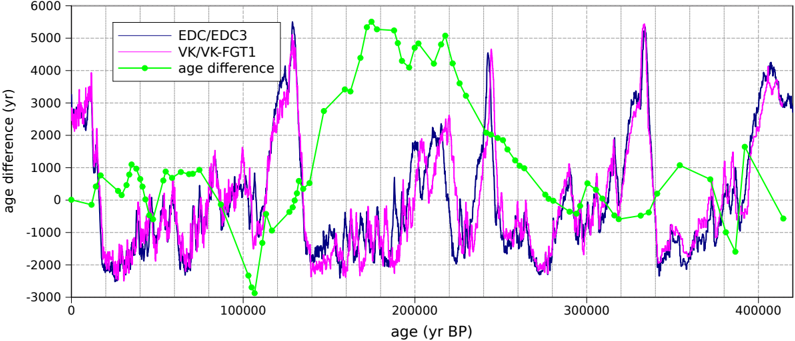
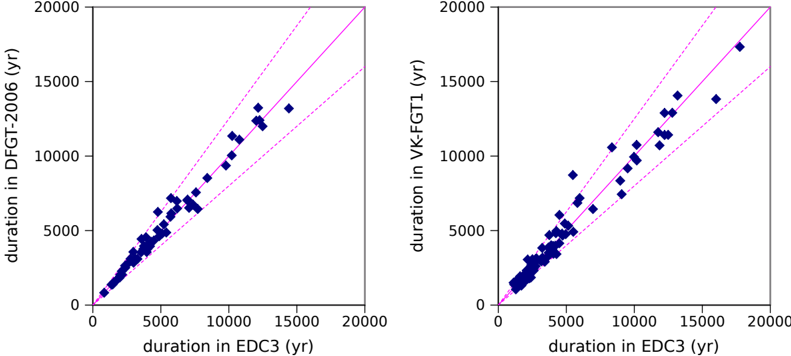
The EPICA (European Project for Ice Coring in Antarctica) Dome C drilling in East Antarctica has now been completed to a depth of 3260 m, at only a few meters above bedrock. Here we present the new EDC3 chronology, which is based on the use of 1) a snow accumulation and mechanical flow model, and 2) a set of independent age markers along the core. These are obtained by pattern matching of recorded parameters to either absolutely dated paleoclimatic records, or to insolation variations. We show that this new time scale is in excellent agreement with the Dome Fuji and Vostok ice core time scales back to 100 kyr within 1 kyr. Discrepancies larger than 3 kyr arise during MIS 5.4, 5.5 and 6, which points to anomalies in either snow accumulation or mechanical flow during these time periods. We estimate that EDC3 gives accurate event durations within 20% (2σ) back to MIS11 and accurate absolute ages with a maximum uncertainty of 6 kyr back to 800 kyr.
Checked 2026-11-23 · 3 references not checked yet
Overview
CoChat Summary
TL;DR
The paper presents EDC3, a new 800 kyr age scale for the EPICA Dome C ice core, built by combining an ice-flow model with independent age markers and a posteriori corrections. EDC3 agrees with Dome Fuji and Vostok within 1 kyr back to 100 kyr and with LR04 within 6 kyr, with estimated event-duration accuracy of 20% back to MIS11 and absolute-age uncertainty up to 6 kyr back to 800 kyr.
Key findings
- EDC3 is an 800 kyr chronology for EPICA Dome C, constructed using a snow accumulation/mechanical flow model plus independent age markers; it was exported to EDML, Dome Fuji, and Vostok by core synchronisation.
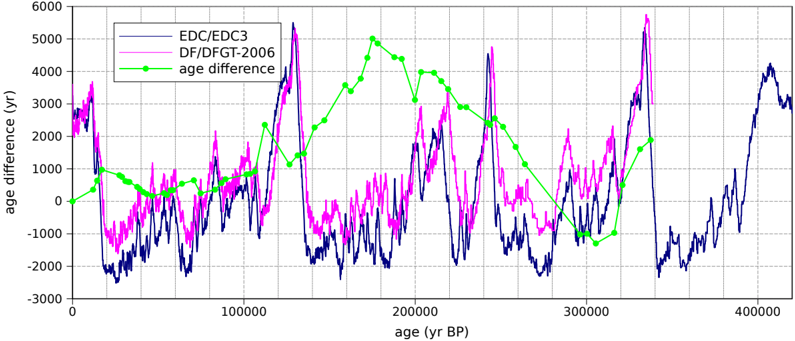
- Agreement with Dome Fuji and Vostok ice core time scales back to 100 kyr is within 1 kyr; discrepancies larger than 3 kyr occur during MIS 5.4, 5.5, and 6, pointing to anomalies in either snow accumulation or mechanical flow during these periods.
- EDC3 gives event durations accurate within 20% (2σ) back to MIS11 and absolute ages with a maximum uncertainty of 6 kyr back to 800 kyr; for the bottom below MIS11, a conservative event-duration accuracy of 40% is more appropriate.
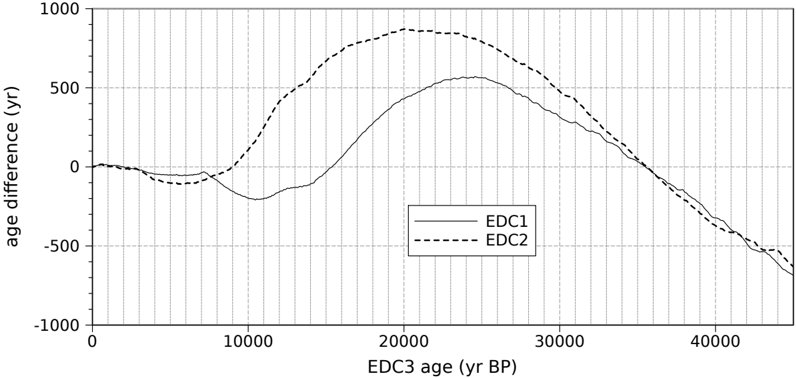
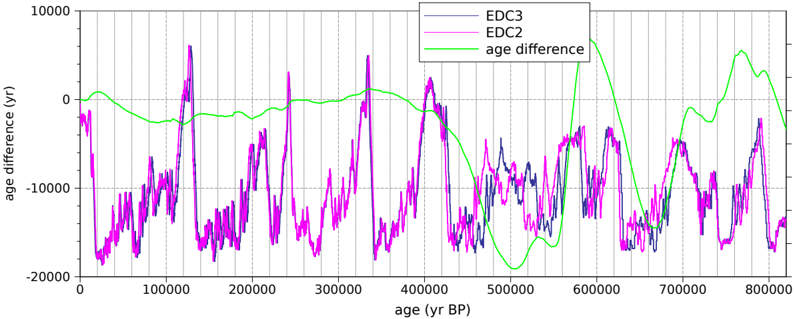
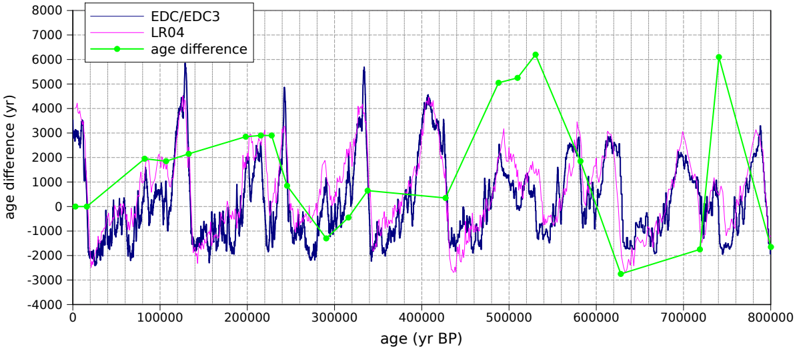
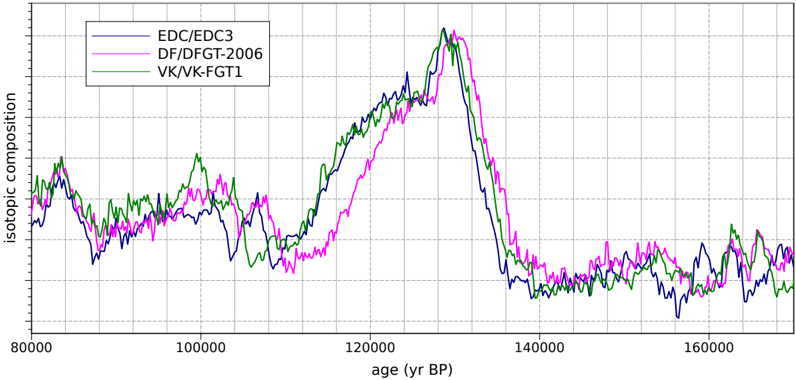
- Compared with LR04, differences never exceed 6 kyr; the previous EDC2 time scale showed disagreements up to 20 kyr older than 400 kyr BP. EDC3 vs EDC2 differs by approximately −1.5 to +3 kyr for the last 400 kyr and by −20 to +7 kyr for 400–800 kyr BP. Termination II is dated at 129.2 kyr BP in EDC3, 129 kyr BP in VK-FGT1, and 129.8 kyr BP in DFGT-2006.
Methods
- Three-stage construction: (1) preliminary dating by ice-flow modelling alone, with poorly known parameters (average Holocene accumulation rate, deuterium–accumulation slope, basal melting, and two velocity-profile parameters) constrained by 21 selected age markers using a Monte Carlo Markov Chain inverse method; (2) a posteriori strict match to dated volcanoes and GICC05 in the top part (last millennium, two 10Be age markers in the last 6 kyr, one methane age marker during the last deglaciation, and the Laschamp age marker at 41.2 kyr BP); (3) correction of the modelled thinning function in the bottom ∼500 m (beyond MIS11, ∼400 kyr BP) to fit δ18Oatm age markers.
- Age markers were derived by pattern matching to absolutely dated paleoclimatic records or insolation variations: volcanic eruptions, 10Be/14C, CH4 transitions, Laschamp, Mt Berlin ash, Termination II, air content, δ18Oatm, and the Brunhes-Matuyama reversal.
- EDC3 was defined on EDC96 depths in the shallow part and EDC99 depths in the bottom part, then transferred via volcanic synchronisation; it was exported to EDML, Dome Fuji, and Vostok via synchronisation. Comparisons were made with EDC1/EDC2, LR04, DFGT-2006, and VK-FGT1, and the confidence interval was evaluated subjectively.
Limitations
- The paper states that confidence interval determination is difficult when no robust statistical information is available and that it was evaluated subjectively using comparisons with other age scales and with the age markers.
- The paper states that discrepancies larger than 3 kyr during MIS 5.4, 5.5, and 6 point to anomalies in either snow accumulation or mechanical flow, and that it is unknown whether these are due to poorly understood processes in the accumulation models or in the mechanical thinning models; a recent study suggests non-unidimensional flow for this period.
- The paper states that the bottom interval beyond MIS11 has less stable age differences and that the ice flow model becomes inaccurate there, requiring a conservative 40% event-duration accuracy. It also states that the inverse method is deterministic and does not statistically account for other non-identified sources of uncertainty, and that orbital tuning age markers depend on assumptions such as constant insolation/climate phasing, a δ18Oatm lag of 5 kyr with 6 kyr uncertainty, and an air-content physical mechanism still under debate.
Model-written summary. Check it against the paper before relying on it.
Integrity signals
Registry
Cites
Statistics
Figures
Verification
Claims the paper makes
0 Valid · 0 Not valid · 24 Not checked · 61 Own results and interpretations
A result the paper reports from its own data — it cites no other source for it, so there is none to check. The quote shows it is in the paper.
In the paper
“Using the rapid methane event marking the end of the deglaciation and corresponding to the end of the Antarctic isotope increase, we obtain 129.2 kyr BP in EDC3, 129 kyr BP in VK-FGT1 and 129.8 kyr BP in DFGT-2006.”
§ Climate of the Past > 4.3 Comparison with DF and VK glaciological chronologies
plainstates a cause- Asserted: passes — The authors put it forward as true.
- Checkable: passes — It can be checked against evidence.
- Load-bearing: unclear — It is unclear whether the paper’s conclusions depend on it.
- Based: passes — The paper gives a reason why it holds.
- Rests on an assumption not shown here.
In the paper
“This age is also in good agreement with estimates based on coral-reef high stands (Waelbroeck et al., 2007 4 ).”
§ Climate of the Past > 4.3 Comparison with DF and VK glaciological chronologies
What the sources say
- Not matchedcites Waelbroeck et al., 2007
An author–year citation the paper’s reference list doesn’t settle. We don’t search these by name.
plainstates an association- Asserted: passes — The authors put it forward as true.
- Checkable: passes — It can be checked against evidence.
- Load-bearing: unclear — It is unclear whether the paper’s conclusions depend on it.
- Based: passes — The paper gives a reason why it holds.
- Not matched
A result the paper reports from its own data — it cites no other source for it, so there is none to check. The quote shows it is in the paper.
In the paper
“In terms of event durations, we estimate the accuracy to be 20% for the top part of the record (back to MIS11), by comparison to Vostok and Dome Fuji glaciological age scales.”
§ Climate of the Past > 5 Confidence interval of the age scale
hedged- Asserted: passes — The authors put it forward as true.
- Checkable: passes — It can be checked against evidence.
- Load-bearing: passes — The paper’s conclusions depend on it.
- Based: passes — The paper gives a reason why it holds.
In the paper
“For the bottom part (below MIS11), a more conservative estimate of 40% is more appropriate because of the flow anomalies (Dreyfus et al., 2007).”
§ Climate of the Past > 5 Confidence interval of the age scale
What the sources say
- Not checked yetcites Dreyfus et al., 2007 matched to “Anomalous flow below 2700 m in the EPICA Dome C ice core detected using δ 18 O of atmospheric oxygen measurements” (2007) source
plainstates a cause- Asserted: passes — The authors put it forward as true.
- Checkable: passes — It can be checked against evidence.
- Load-bearing: passes — The paper’s conclusions depend on it.
- Based: passes — The paper gives a reason why it holds.
A result the paper reports from its own data — it cites no other source for it, so there is none to check. The quote shows it is in the paper.
In the paper
“EDC3 is younger by a few decades for the last 2 kyr.”
§ Climate of the Past > 6 Conclusion and perspectives
plain- Asserted: passes — The authors put it forward as true.
- Checkable: passes — It can be checked against evidence.
- Load-bearing: unclear — It is unclear whether the paper’s conclusions depend on it.
- Based: passes — The paper gives a reason why it holds.
52 more claims
Create a free account to see all 85 claims and to verify the 28 references still open.
- It may state two separate claims as one. 24
- Probably not a substantial claim. 5
Self-check
Percentages, sums and reported differences re-computed from the paper’s own numbers.
Each contradiction between two passages listed here was confirmed by an independent check.
Rated minor: it would not touch a result — a value no result rests on, a p-value that stays on the same side of the significance level, or a conflict that is clerical, resolved elsewhere in the paper, or outside its own findings.
In the paper
§ Climate of the Past > 2.1 Dated volcanic eruptions during the last millenium
“Kuwae, 29.77 m, AD1460±5”
§ Climate of the Past > 6 Conclusion and perspectives
“| Kuwae | 29.27 | 0.492 | 0.005 | | X | |”
Rated minor: it would not touch a result — a value no result rests on, a p-value that stays on the same side of the significance level, or a conflict that is clerical, resolved elsewhere in the paper, or outside its own findings.
In the paper
§ Climate of the Past > 3.1 The EDC3 age scale
“the resulting age scale fits perfectly with: 1) the dated volcanoes of the last millenium; 2) the two 10 Be age markers in the last 6 kyr (Sect.2.2)”
§ Climate of the Past > 6 Conclusion and perspectives
“| 10 Be/ 14 C | 107.83 | 2.716 | 0.05 | X | | |”
Citations
Cites
A Pliocene‐Pleistocene stack of 57 globally distributed benthic δ18O records
Lisiecki, L. E., & Raymo, M. E. (2005) · Paleoceanography · doi:10.1029/2004pa001071 · Cited by 7,377
Climate and atmospheric history of the past 420,000 years from the Vostok ice core, Antarctica
Petit, J. R., Jouzel, J., Raynaud, D., Barkov, N. I., Barnola, J.-M., Basile, I., Bender, M., Chappellaz, J., Davis, M., Delaygue, G., et al. (1999) · Nature · doi:10.1038/20859 · Cited by 6,508
Self-citationIntcal04 Terrestrial Radiocarbon Age Calibration, 0–26 Cal Kyr BP
(2004) · Radiocarbon · doi:10.1017/s0033822200032999 · Cited by 3,673 · cited 1×
“…al., 2002), GICC05 is also in good agreement with the Hulu Cave U-Th chronology (41.4 kyr BP, Wang et al., 2001), and with the Cariaco basin record (Hughen et al., 2004) when its 14C ages are calibrated following the Fairbanks et al. (2005) curve (we obtain again an age of 41.2 kyr BP for the…”
ResultInfluentialMartinson, D. G., Pisias, N. G., Hays, J. D., Imbrie, J., Moore, T. C., & Shackleton, N. J. (1987) · Quaternary Research · doi:10.1016/0033-5894(87)90046-9 · Cited by 3,303
A High-Resolution Absolute-Dated Late Pleistocene Monsoon Record from Hulu Cave, China
Wang, Y. J., Cheng, H., Edwards, R. L., An, Z. S., Wu, J. Y., Shen, C.-C., & Dorale, J. A. (2001) · Science · doi:10.1126/science.1064618 · Cited by 3,208
High-resolution record of Northern Hemisphere climate extending into the last interglacial period
North Greenland Ice Core Project members (2004) · Nature · doi:10.1038/nature02805 · Cited by 3,170
Imbrie, J. Z., Hays, J. D., Martinson, D. G., McIntyre, A., Mix, A. C., Morley, J. J., Pisias, N. G., Prell, W. L., & Shackleton, N. J. (1984) · Helmholtz-Zentrum für Polar-und Meeresforschung (Alfred-Wegener-Institut) · Cited by 2,655
Eight glacial cycles from an Antarctic ice core
members, E. C. (2004) · Nature · doi:10.1038/nature02599 · Cited by 2,415
A new Greenland ice core chronology for the last glacial termination
Rasmussen, S. O., Andersen, K. K., Svensson, A. M., Steffensen, J. P., Vinther, B. M., Clausen, H. B., Siggaard‐Andersen, M. ‐., Johnsen, S. J., Larsen, L. B., Dahl‐Jensen, D., et al. (2006) · Journal of Geophysical Research: Atmospheres · doi:10.1029/2005jd006079 · Cited by 2,304
Self-citationOne-to-one coupling of glacial climate variability in Greenland and Antarctica
Members, E. C. (2006) · Nature · doi:10.1038/nature05301 · Cited by 1,305
Cited by
Items 401–500 of 535
Dating and synchronizing paleoclimatic records over the last interglacial
Capron, É., Landais, A., Tzedakis, P. C., Bard, É., Blunier, T., Dahl‐Jensen, D., Dokken, T., Gersonde, R., Parrenin, F., Schulz, M., et al. (2013) · PAGES news · doi:10.22498/pages.21.1.26 · Cited by 2
Self-citationA reassessment of the Matuyama-Brunhes boundary age
Suganuma, Y. (2012) · The Quaternary Research (Daiyonki-Kenkyu) · doi:10.4116/jaqua.51.297 · Cited by 2
Jiang, X., Wang, X., He, Y., Li, Z., Shen, C., & Bang, Y. A. N. G. (2014) · Chinese Science Bulletin (Chinese Version) · doi:10.1360/n972013-00020 · Cited by 2
Massam, A. (2017) · Durham e-Theses (Durham University) · Cited by 2
Bourdon, B. (2014) · Springer eBooks · doi:10.1007/978-94-007-6326-5_238-1 · Cited by 2
Körner, C. (2021) · Springer eBooks · doi:10.1007/978-3-662-61943-8_22 · Cited by 1
Coherent dating of deep polar ice cores and implications for understanding climate mechanisms
Bouchet, M. (2024) · theses.fr (ABES) · doi:10.70675/0ea23effzdbc9z4f25z8f98z758aa1f1eac5 · Cited by 1
曾, 雅., 陈, 仕., 杨, 少., 梁, 怡., & 汪, 永. (2019) · SCIENTIA SINICA Terrae · doi:10.1360/n072018-00178 · Cited by 1
Boxho, S., Vanderstraeten, A., Mattielli, N., Laruelle, G. G., Bory, A., Gabrielli, P., & Bonneville, S. (2026) · Climate of the past · doi:10.5194/cp-22-1655-2026 · Cited by 1
Reconstructing sea surface temperature in the South Pacific using organic proxies
Ho, S. L. (2012) · Helmholtz-Zentrum für Polar-und Meeresforschung (Alfred-Wegener-Institut) · Cited by 1
Legrain, É. (2023) · theses.fr (ABES) · doi:10.70675/e0683d6dz1959z4d5az8d18zd55d6181f940 · Cited by 1
Variations atmosphériques du CO2 à l'échelle millénaire durant le stade isotopique MIS 6
Shin, J. (2019) · theses.fr (ABES) · doi:10.70675/1543810ez6c34z4e80za0bbz6b8dcd578db1 · Cited by 1
Crotti, I. (2022) · theses.fr (ABES) · doi:10.70675/e364941bzbc62z4b52z95bbz619a4f4a6a42 · Cited by 1
Svensson, A. M. (2015) · Encyclopedia of earth sciences series/Encyclopedia of earth sciences · doi:10.1007/978-94-007-6304-3_159 · Cited by 1
Self-citationTracking past climate and environmental change across continental Eurasia
Laag, C. (2023) · theses.fr (ABES) · doi:10.70675/03a7d16bz4e0cz4016z9839z5a82df954ac2 · Cited by 1
High resolution ice core records of climate variability and forcing
Pedro, J. B. (2012) · UTAS Research Repository · doi:10.25959/23206661 · Cited by 1
Paleo-archives for informing conservation under climate change
Fordham, D., Jackson, S. T., Brown, S. C., & Nogués-Bravo, D. (2020) · Figshare · doi:10.25909/5eaa200e1b2e2 · Cited by 1
Closing the Last Deglacial Global Sea Level Budget by Different Antarctic Deglaciation Models
Lin, Y. (2019) · Durham Research Online (Durham University) · doi:10.25911/5e983487e7b1b · Cited by 1
Roychowdhury, R. (2018) · ScholarWorks@UMassAmherst (University of Massachusetts Amherst) · doi:10.7275/10678045.0 · Cited by 1
Testing Hypotheses About Glacial Dynamics Using a Statistical Model of Paleo-ClimatePreprint
Kaufmann, R. K., & Pretis, F. (2021) · Research Square · doi:10.21203/rs.3.rs-459880/v1 · Cited by 1
The Last Interglacial in the Labrador Sea
Hume, L. (2018) · UEA Digital Repository (University of East Anglia) · Cited by 1
Quantifying the Rhythm of Ice Accumulation in East Antarctica With Varying Temperature
Srivastava, R., Sengupta, D., & Ghosh, P. (2025) · Terra Nova · doi:10.1111/ter.12762 · Cited by 1
Populations- und Vegetationsökologie
Körner, C. (2014) · Springer eBooks · doi:10.1007/978-3-642-54435-4_28 · Cited by 1
(2012) · CHINESE JOURNAL OF POLAR RESEARCH · doi:10.3724/sp.j.1084.2012.00077 · Cited by 1
Cronin, T. M. (2014) · Springer eBooks · doi:10.1007/978-94-007-5784-4_45 · Cited by 1
Wang, H., Pérez‐Mejías, C., Wang, X., Li, T., Yang, C., Li, H., Lei, S., Ning, Y., Edwards, R. L., & Cheng, H. (2025) · Quaternary Science Reviews · doi:10.1016/j.quascirev.2025.109625 · Cited by 1
Srivastava, R., & Sengupta, D. (2026) · Journal of the American Statistical Association · doi:10.1080/01621459.2026.2678606 · Cited by 1
Cambios climáticos a escala orbital y milenaria en el Atlántico norte entre 800.000 y 400.000 años
Alonso‐García, M. (2010) · Gredos (University of Salamanca) · doi:10.14201/gredos.83196 · Cited by 1
Schwander, J. (2007) · Elsevier eBooks · doi:10.1016/b0-444-52747-8/00330-6 · Cited by 1
Self-citationGlacial cycles: exogenous orbital changes vs. endogenous climate dynamicsPreprint
Kaufmann, R. K., & Jusélius, K. (2010) · doi:10.5194/cpd-6-585-2010 · Cited by 1
Gooch, B. T., Carter, S. P., Ghattas, O., Young, D. A., & Blankenship, D. D. (2016) · doi:10.5194/tc-2016-141 · Cited by 1
Constraints on glacier flow from temperature-depth profiles in the ice. Application to EPICA Dome C.Preprint
de Mendoza, I. H., Mareschal, J., & Beltrami, H. (2016) · doi:10.5194/cp-2016-116 · Cited by 1
Localiser une archive glaciaire de 1.5 millions d'années par une approche multi-modèles
Passalacqua, O. (2017) · theses.fr (ABES) · doi:10.70675/25cb0924z6892z4653zbe7bzbcf4fca56590 · Cited by 1
Vereş, D., Bazin, L., Landais, A., Toye, H., Lemieux-Dudon, B., Parrenin, F., Martinerie, P., Blayo, É., Blunier, T., Capron, É., et al. (2012) · doi:10.5194/cpd-8-6011-2012-supplement · Cited by 1
Self-citationICE CORE METHODS | Chronologies
Schwander, J. (2013) · Elsevier eBooks · doi:10.1016/b978-0-444-53643-3.00309-5 · Cited by 1
Self-citationThe carbon cycle during the Mid Pleistocene Transition
Köhler, P., Hönisch, B., & Fischer, H. (2007) · Helmholtz-Zentrum für Polar-und Meeresforschung (Alfred-Wegener-Institut) · Cited by 1
Self-citationValorisation des données altimétriques de SARAL/AltiKa pour l'étude de la calotte Antarctique
Michel, A. (2016) · theses.fr (ABES) · doi:10.70675/7b78b82az9dc7z4986zaceczdcd015ab90e4 · Cited by 1
(2014) · Elsevier eBooks · doi:10.1016/b978-0-12-386913-5.09984-1
Paläoklimatologie und Klimageschichte
Kühl, N. (2024) · Springer eBooks · doi:10.1007/978-3-662-68936-3_2
Condensed Matter Researches in Cryospheric Science
Marcelli, A., Maggi, V., & Xiao, C. (2019) · MDPI eBooks · doi:10.3390/books978-3-03921-324-5
(2022) · Earth system science data · doi:10.5194/essd-2021-422-rc2
Sigl, M. (2022) · Earth system science data · doi:10.5194/essd-2021-422-ac2
(2022) · Earth system science data · doi:10.5194/essd-2021-422-rc1
Sigl, M. (2022) · Earth system science data · doi:10.5194/essd-2021-422-ac1
Marteel, A. (2007) · OpenGrey (Institut de l'Information Scientifique et Technique)
Adams, M. (2016) · Palgrave Macmillan UK eBooks · doi:10.1057/978-1-137-35160-9_2
The evolution of the Antarctic Ice Sheet from inception through the Anthropocene
Lowry, D. P., Duncan, B., Davies, B. J., & Halberstadt, A. R. W. (2024) · Elsevier eBooks · doi:10.1016/b978-0-323-85242-5.00004-x
Mudelsee, M. (2014) · Atmospheric and oceanographic sciences library · doi:10.1007/978-3-319-04450-7_4
(2022) · Climate of the past · doi:10.5194/cp-2022-15-rc1
(2022) · Climate of the past · doi:10.5194/cp-2022-15-rc2
Chadwick, M. (2022) · Climate of the past · doi:10.5194/cp-2022-15-ac2
Chadwick, M. (2022) · Climate of the past · doi:10.5194/cp-2022-15-ac1
Deglacial climate and ice sheet evolution of the Ross Embayment, Antarctica
Lowry, D. P. (2019) · Open Access Victoria University of Wellington | Te Herenga Waka (Figshare) · doi:10.26686/wgtn.17142116.v1
Eling, L. (2019) · Open Access Victoria University of Wellington | Te Herenga Waka (Figshare) · doi:10.26686/wgtn.22783445
Abrupt Climate Change Experiments: The Bølling/Allerød Transition
Lohmann, G., Zhang, X., & Knorr, G. (2015) · Helmholtz-Zentrum für Polar-und Meeresforschung (Alfred-Wegener-Institut)
(2021) · The Cryosphere · doi:10.5194/tc-2021-63-rc2
Gerber, T. A. (2021) · The Cryosphere · doi:10.5194/tc-2021-63-ac2
Gerber, T. A. (2021) · The Cryosphere · doi:10.5194/tc-2021-63-ac1
(2021) · The Cryosphere · doi:10.5194/tc-2021-63-rc1
Khomyakova, V. A., Tebenkova, N. A., Lipenkov, V., & Raynaud, D. (2025) · Izvestiya Atmospheric and Oceanic Physics · doi:10.1134/s0001433825701270
Self-citationSvensson, A. M. (2014) · Springer eBooks · doi:10.1007/978-94-007-6326-5_159-1
Self-citationGhazi, A. E. O. E. (2017) · Dipòsit Digital de la Universitat de Barcelona (Universitat de Barcelona)
Neff, P. D. (2015) · Open Access Victoria University of Wellington | Te Herenga Waka (Figshare) · doi:10.26686/wgtn.17012957
Mudelsee, M. (2014) · Atmospheric and oceanographic sciences library · doi:10.1007/978-3-319-04450-7_9
Mudelsee, M. (2010) · Atmospheric and oceanographic sciences library · doi:10.1007/978-90-481-9482-7_9
Baba, W. A., Kumar, P., Pattanaik, J. K., & Khare, N. (2022) · Earth and environmental sciences library · doi:10.1007/978-3-030-87078-2_5
Temperature Response to External Radiative Forcing: Verification of a Simple Model
Gornostaeva, A. A., Demezhko, D. Y., & Антипин, А. Н. (2021) · Izvestiya Atmospheric and Oceanic Physics · doi:10.1134/s0001433821110037
The Dating of Ice-Core Archives
Parrenin, F. (2020) · Frontiers in earth sciences · doi:10.1007/978-3-030-24982-3_9
Self-citationLopes, R. P., Pereira, J. C., Caron, F., Dillenburg, S. R., Rosa, M. L. C. D. C., Barboza, E. G., Savian, J. F., de Antiqueira, J. A. F., Sawakuchi, A. O., Tatumi, S. H., et al. (2026) · Quaternary Research · doi:10.1017/qua.2026.10108
Deduction of surface accumulation history from ice-core age/depth data
Morland, L. W., & Jacka, T. H. (2013) · Journal of Glaciology · doi:10.3189/2013jog12j102
Nadar, P. M. J., Kleiven, H. F., Ninnemann, U. S., Irvalı, N., Tjiputra, J. F., & Guo, C. (2026) · Communications Earth & Environment · doi:10.1038/s43247-026-03659-w
Stochastic coupling of climate variables and ice volume over the Late Pleistocene glacial cycles
Patra, P., Giorgini, L. T., & Wettlaufer, J. S. (2026) · Chaos An Interdisciplinary Journal of Nonlinear Science · doi:10.1063/5.0336001
Ziegler, E. (2024) · doi:10.5194/egusphere-2024-1396-ac3
A First Principles Approach to the 100,000-year ProblemPreprint
Wheen, L. (2026) · arXiv (Cornell University) · doi:10.48550/arxiv.2604.12143
Webb, E. (2014) · Research Online (Edith Cowan University)
Parmentola, J. (2022) · doi:10.5194/egusphere-2022-569-ac1
Pollak, F., Capron, É., Chase, Z., Tzedakis, P. C., Parrenin, F., & Jong, L. M. (2026) · doi:10.5194/egusphere-2026-6154
Self-citationInterpolation of paleoclimatology datasets
Departamento de Estadística, I. T. A. D. M. (., & Nieto-Barajas, L. E. (2018) · Atmósfera · doi:10.20937/atm.2018.31.02.02
Groot, M. H. M. (2012) · UvA-DARE (University of Amsterdam)
Stuart, R. H. (2024) · doi:10.5194/egusphere-2023-2585-ac1
Interpretation of high frequency climate signals in Antarctic ice cores
Hansen, W. (2019) · CU Scholar (University of Colorado Boulder)
Investigating the interior of West Antarctica with light, radar, and electrical conductance
Fudge, T. J. (2014) · ResearchWorks at the University of Washington (University of Washington)
Condensed Matter Researches in Cryospheric Science
Maggi, V., Xiao, C., & Marcelli, A. (2019) · Condensed Matter · doi:10.3390/condmat4030068
Zweijahresbericht 2006/2007 = Report 2006/2007
(2008) · Helmholtz-Zentrum für Polar-und Meeresforschung (Alfred-Wegener-Institut)
Shiau, L., Clemens, S. C., Chen, M., Yamamoto, M., & Yokoyama, Y. (2014) · doi:10.5194/cpd-10-1857-2014
The microscopic dimension of paleoclimate in the EPICA-DML(Antarctica) deep ice core
Nedelcu, A. F. (2013) · eDiss (Georg-August-Universität Göttingen) · doi:10.53846/goediss-3764
ОРБИТАЛЬНАЯ КОРРЕКТИРОВКА ГЕОТЕРМИЧЕСКИХ РЕКОНСТРУКЦИЙ ПАЛЕОКЛИМАТА
Gornostaeva, A. A., & Антипин, А. Н. (2017) · Izvestiâ Akademii nauk SSSR. Seriâ geografičeskaâ · doi:10.7868/s0373244417030057
Hezel, P. J. (2012) · ResearchWorks at the University of Washington (University of Washington)
Stable isotope records of Arctic and Antarctic ice cores
Gkinis, V., Holme, C. T., & Vinther, B. M. (2018) · Publishing Network for Geoscientific and Environmental Data (PANGAEA) (Alfred Wegener Institute for Polar and Marine Research) · doi:10.1594/pangaea.886048
Guihou, A., Pichat, S., Nave, S. O., Govin, A., Labeyrie, L. D., Michel, É., & Waelbroeck, C. (2008) · AGUFM
Self-citationGoldstein, S. J., & Denton, J. S. (2020) · Earth and Planetary Science Letters · doi:10.1016/j.epsl.2020.116474
Decoupling between the carbon cycle and climate during Pleistocene glaciations
Lisiecki, L. E., & Raynaud, D. (2008) · AGU Fall Meeting Abstracts
Self-citationA Review of the paleoclimatic Studies from Lake Sediments of Schirmacher Oasis, East Antarctica
Govil, P., & Mazumder, A. (2022) · Earth and environmental sciences library · doi:10.1007/978-3-030-87078-2_7
Celestial Mechanics and Estimating the Termination of the HolocenePreprint
Parmentola, J. (2022) · doi:10.1002/essoar.10510312.1
Metadata
- Authors
- Parrenin, F., Barnola, J.-M., Beer, J., Blunier, T., Castellano, E., Chappellaz, J., Dreyfus, G., Fischer, H., Fujita, S., Jouzel, J., Kawamura, K., Lemieux-Dudon, B., Loulergue, L., Masson-Delmotte, V., Narcisi, B., Petit, J.-R., Raisbeck, G., Raynaud, D., Ruth, U., Schwander, J., Severi, M., Spahni, R., Steffensen, J. P., Svensson, A., Udisti, R., Waelbroeck, C., & Wolff, E.
- Affiliations
- Centre National de la Recherche Scientifique (FR)
- Swiss Federal Institute of Aquatic Science and Technology (CH)
- University of Bern (CH)
- University of Florence (IT)
- Alfred-Wegener-Institut Helmholtz-Zentrum für Polar- und Meeresforschung (DE)
- National Institute of Polar Research (JP)
- Tohoku University (JP)
- National Agency for New Technologies, Energy and Sustainable Economic Development (IT)
- University of Copenhagen (DK)
- British Antarctic Survey (GB)
- Corresponding author
- Parrenin, F.
- ORCID
- Venue
- Climate of the Past
- Publisher
- Copernicus GmbH
- Published
- 2007-08-17
- Volume
- 3
- Issue
- 3
- Pages
- 485-497
- ISSN
- 1814-9324 (ISSN-L)
- 1814-9332
- OpenAlex
- W2145370723
- Cited by
- 538
- References
- 77
- Citations by year
- 2026: 15 · 2025: 10 · 2024: 22 · 2023: 28 · 2022: 36 · 2021: 33 · 2020: 19 · 2019: 21 · 2018: 14 · 2017: 20 · 2016: 30 · 2015: 32 · 2014: 35 · 2013: 31 · 2012: 44
- FWCI
- 18.92
- Type
- journal article
- Language
- en
- Open access
- gold
- doi.org
- Licence
- Locations
- Climate of the past (publishedVersion, cc-by-nc-sa)
- DORA Eawag (Swiss Federal Institute of Aquatic Science and Technology (Eawag)) (publishedVersion, cc-by-nc-sa)
- NERC Open Research Archive (Natural Environment Research Council) (acceptedVersion)
- HAL (submittedVersion, other-oa)
- Infoscience (Ecole Polytechnique Fédérale de Lausanne) (submittedVersion, cc-by-nc-sa)
- Funders
- European Commission
- European Science Foundation
- Agence Nationale de la Recherche
- Institut Polaire Français Paul Emile Victor
- Topics
- Physical Sciences › Earth and Planetary Sciences › Atmospheric Science › Geology and Paleoclimatology Research
- Physical Sciences › Earth and Planetary Sciences › Atmospheric Science › Cryospheric studies and observations
- Physical Sciences › Earth and Planetary Sciences › Atmospheric Science › Tree-ring climate responses
- Keywords
- EPICA Dome C, ice core chronology, ice flow model, age markers, pattern matching, paleoclimate records, insolation variation, Marine Isotope Subperiods, Dome Fuji, Vostok, East Antarctica
About these checks
Registry, retraction, Cites and statistics results are computed, not judged, with one exception: a printed reference that no index lists is read once by a model before it counts as a citation error. Claims are extracted by a model and kept only when their quote appears verbatim in the text; each cited source is then checked, with a model’s help, for whether it says what the claim relies on. Those verdicts can be wrong — read the claim’s quote and the cited source before relying on one.
A language model drew the claims from the paper on 2026-11-23, under version 3 of the claim definition (model deepseek-v4.1-flash, prompt extract-v3).
A second model labelled each claim on 2026-11-23 (model jev-1.13-20260917, definition revision gold-guideline-v0.2).
Statistics and arithmetic are recomputed, not judged.
Confidence bands are shown only for fields calibrated on our annotated test set. None is calibrated yet, so no band is shown.
What counts as a claim ›How we measure confidence ›How we check this ›
Are you an author, or do you see a problem with this page? Request a review
Data sources
Bibliographic data: Semantic Scholar, OpenAlex, Crossref.
Contains information from the Semantic Scholar Academic Graph Datasets, made available under the ODC Attribution License (ODC-BY 1.0).
Semantic Scholar’s data is described in: Kinney, R., et al. (2023). The Semantic Scholar Open Data Platform. arXiv:2301.10140.
