

GloFAS-ERA5 operational global river discharge reanalysis 1979–present
Open accessPublished version of a preprint
The DOI matches its Crossref record; 31 of the 31 references it cites were found in a registry or an index; 5 of the 18 sources its claims cite were checked for support.
Abstract
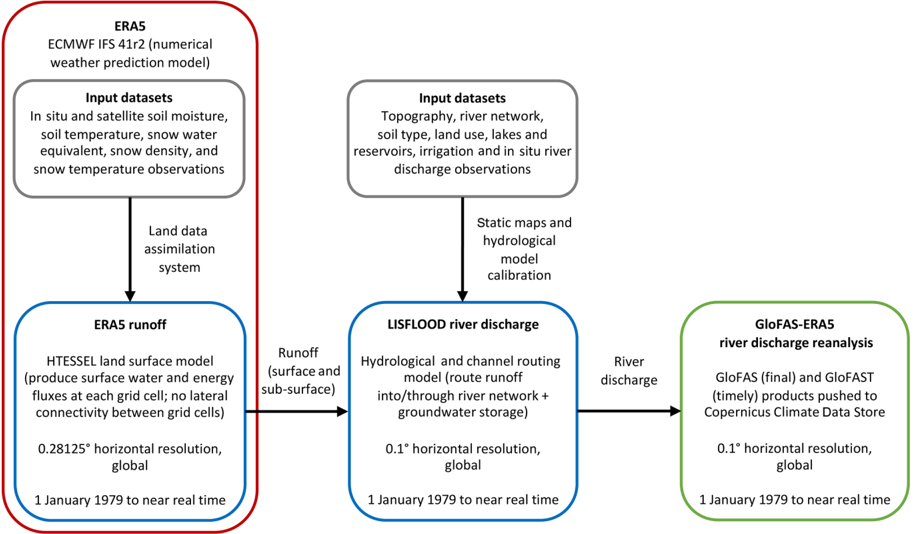
Estimating how much water is flowing through rivers at the global scale is challenging due to a lack of observations in space and time. A way forward is to optimally combine the global network of earth system observations with advanced numerical weather prediction (NWP) models to generate consistent spatio-temporal maps of land, ocean, and atmospheric variables of interest, which is known as a reanalysis. While the current generation of NWP models output runoff at each grid cell, they currently do not produce river discharge at catchment scales directly and thus have limited utility in hydrological applications such as flood and drought monitoring and forecasting. This is overcome in the Global Flood Awareness System (GloFAS; http://www.globalfloods.eu/, last access: 28 June 2020) by coupling surface and sub-surface runoff from the Hydrology Tiled ECMWF Scheme for Surface Exchanges over Land (HTESSEL) land surface model used within ECMWF's latest global atmospheric reanalysis (ERA5) with the LISFLOOD hydrological and channel routing model. The aim of this paper is to describe and evaluate the GloFAS-ERA5 global river discharge reanalysis dataset launched on 5 November 2019 (version 2.1 release). The river discharge reanalysis is a global gridded dataset with a horizontal resolution of 0.1∘ at a daily time step. An innovative feature is that it is produced in an operational environment so is available to users from 1 January 1979 until near real time (2 to 5 d behind real time). The reanalysis was evaluated against a global network of 1801 daily river discharge observation stations. Results found that the GloFAS-ERA5 reanalysis was skilful against a mean flow benchmark in 86 % of catchments according to the modified Kling–Gupta efficiency skill score, although the strength of skill varied considerably with location. The global median Pearson correlation coefficient was 0.61 with an interquartile range of 0.44 to 0.74. The long-term and operational nature of the GloFAS-ERA5 reanalysis dataset provides a valuable dataset to the user community for applications ranging from monitoring global flood and drought conditions to the identification of hydroclimatic variability and change and as raw input for post-processing and machine learning methods that can add further value. The dataset is openly available from the Copernicus Climate Change Service Climate Data Store: https://cds.climate.copernicus.eu/cdsapp#!/dataset/cems-glofas-historical?tab=overview (last access: 28 June 2020) with the following DOI: https://doi.org/10.24381/cds.a4fdd6b9 (C3S, 2019).
Overview
CoChat Summary
TL;DR
This data paper describes and evaluates GloFAS-ERA5 v2.1, an operational global daily river discharge reanalysis from 1979 to near real time at 0.1° resolution, produced by coupling ERA5/HTESSEL runoff with LISFLOOD routing. Against 1801 gauging stations, it is skilful versus a mean-flow benchmark in 86 % of catchments, though skill and bias vary strongly by region.
Key findings
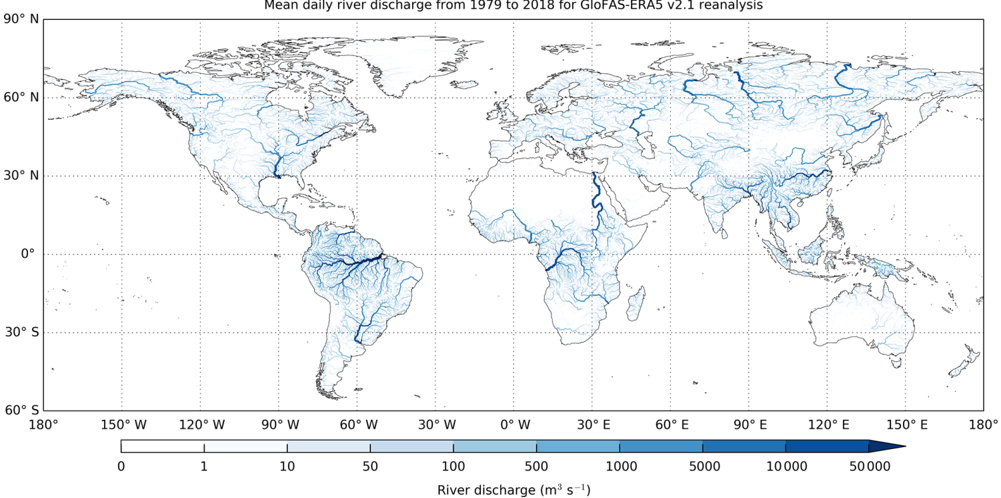
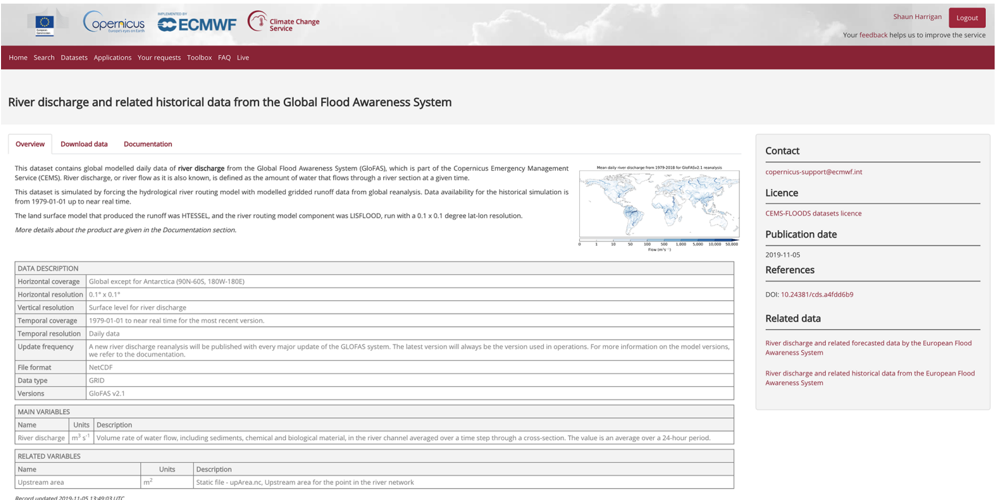
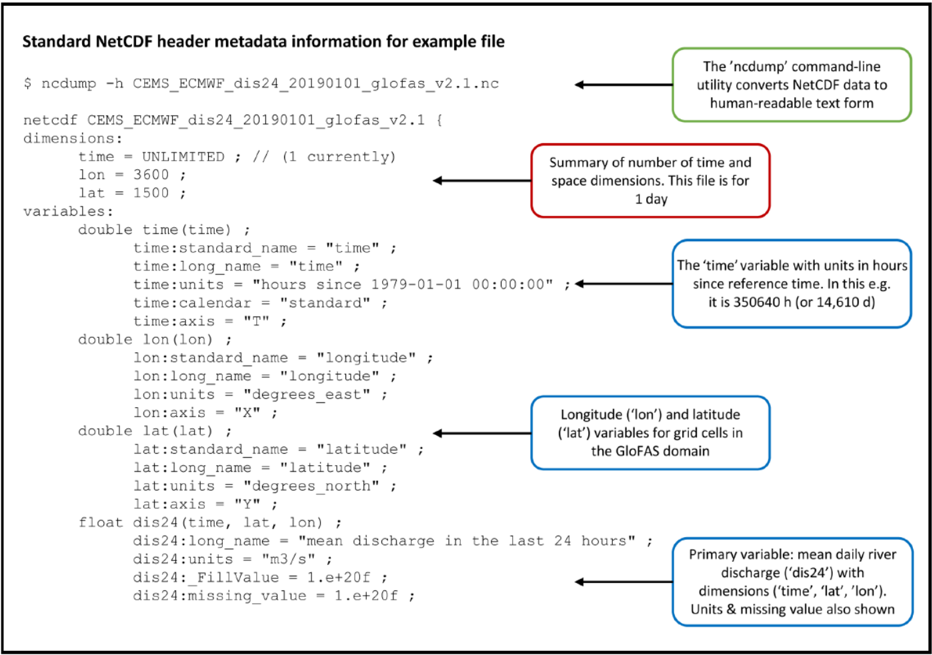
- The dataset is global except Antarctica, daily, 0.1° resolution, from 1 January 1979 to near real time; consolidated GloFAS is 2–3 months behind real time and updated monthly, while intermediate GloFAST is 2–5 d behind and updated daily. Each daily global NetCDF is ∼21.7 MB uncompressed, with the January 1979–October 2019 dataset estimated at ∼320 GB.
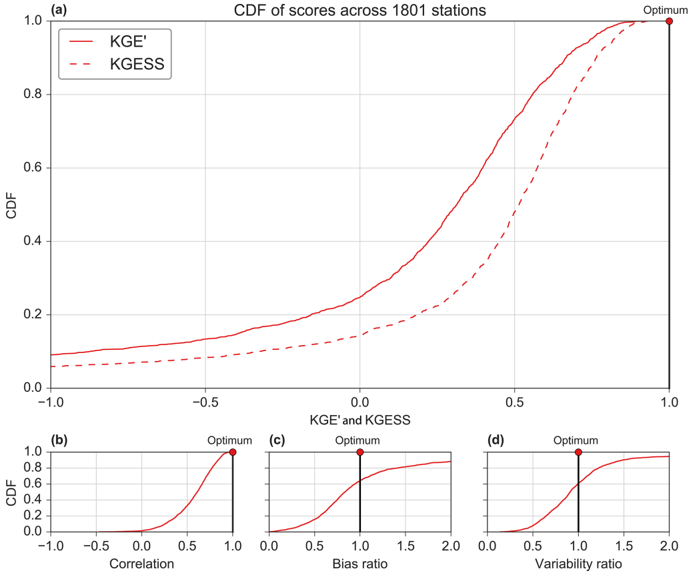
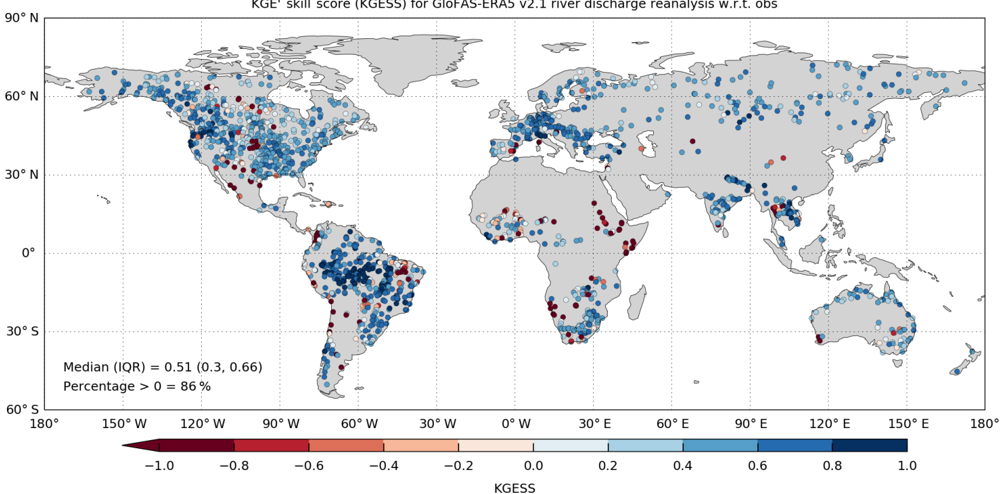
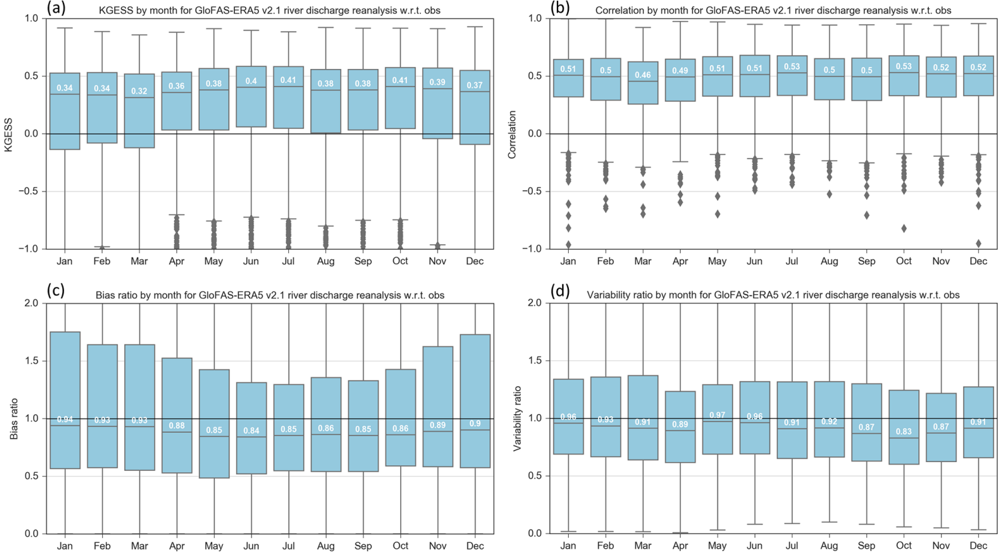
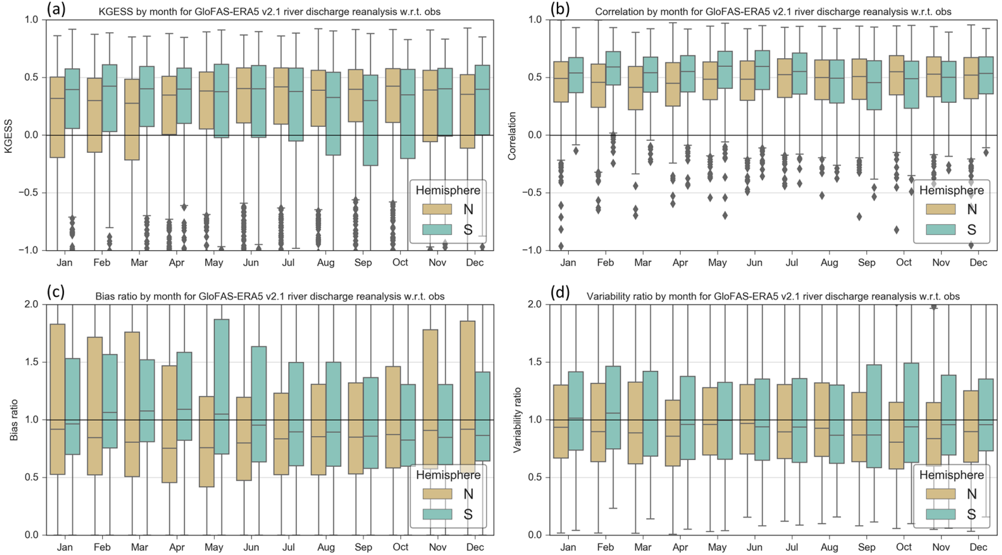
- Evaluation against 1801 stations found skill against the mean-flow benchmark in 86 % of catchments; global median KGESS was 0.51 (KGE 0.31), with IQR 0.30–0.66 (KGE 0.00–0.52). Median Pearson correlation was 0.61 (IQR 0.44–0.74), and 99 % of catchments had positive correlation.
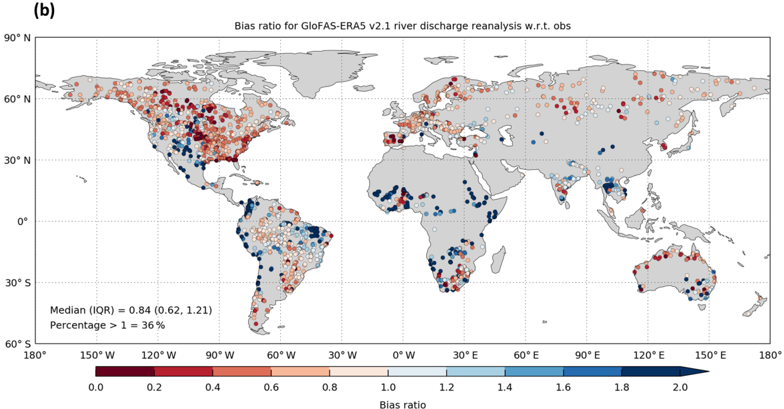
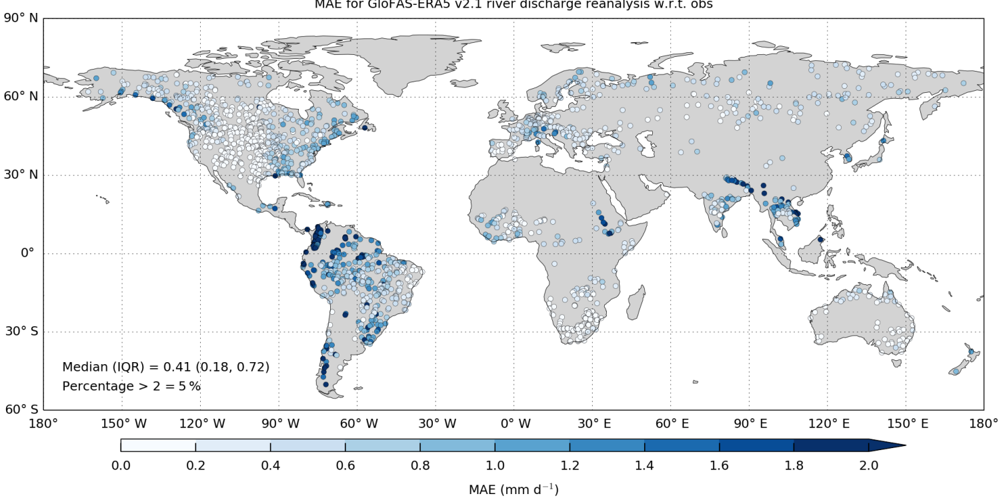
- Negative bias occurred in 64 % of catchments, with median bias ratio 0.84 (IQR 0.62–1.21); only 28 % met a ±20 % bias criterion, and 12 % had bias ratio >2. Lower variability than observations occurred in 61 % of catchments, with median variability ratio 0.91 (IQR 0.69–1.15); global median MAE was 0.41 mm d⁻¹ (IQR 0.18–0.72).
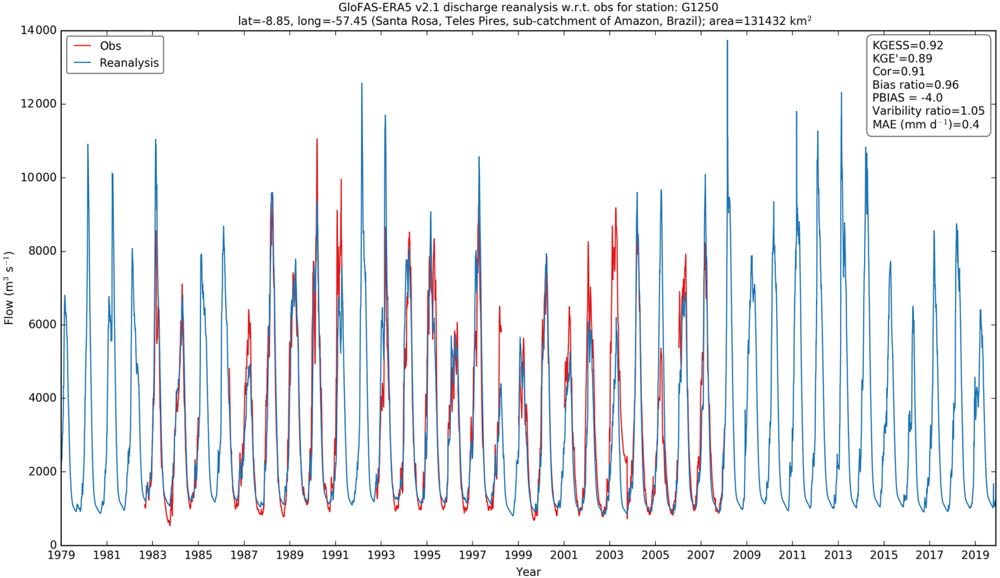
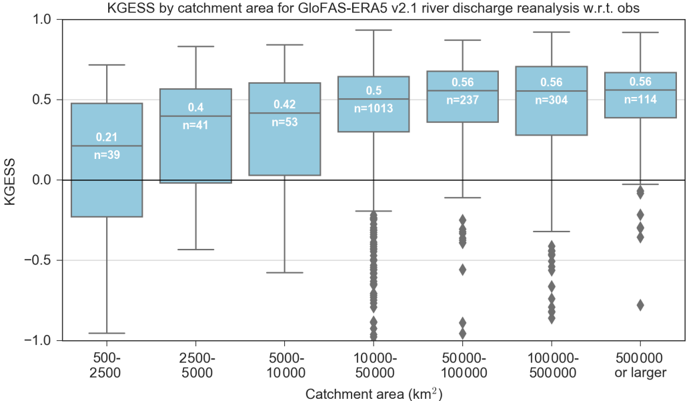
- Performance was best in Brazil (especially the Amazon basin), central Europe, and eastern/western United States, and poor in many catchments in Africa, the North American Great Plains into Mexico, eastern Brazil, Thailand, and southern Spain. Skill was lowest for catchments <10 000 km² (median KGESS 0.21, 0.4, and 0.42 across three categories) and improved for catchments >50 000 km² (median KGESS 0.56).
Methods
- ERA5 HTESSEL surface and sub-surface runoff was coupled with the LISFLOOD hydrological and channel routing model; ERA5 runoff was downscaled by nearest neighbour from the native ERA5 grid to the 0.1° GloFAS grid, with a 1-year spin-up using preliminary ERA5 output for 1978. LISFLOOD parameters were calibrated against daily river discharge observations for 1287 catchments by Hirpa et al. (2018), and the river network includes 463 lakes >100 km² and 667 reservoirs.
- Evaluation used a GloFAS database of 2042 stations filtered to 1801 stations, with criteria including at least 4 years of daily data between 1979 and 2018, minimum upstream area of 500 km², catchment-area mismatch within 20 %, visual quality control, and retaining the longest record per GloFAS river cell. Selected stations had drainage areas from 575 to 4 664 200 km², median 30 046 km².
- Performance was assessed with the modified Kling-Gupta efficiency (KGE), decomposed into Pearson correlation, bias ratio, and variability ratio, and expressed as a skill score (KGESS) against an observed mean-flow benchmark; MAE was also computed after converting discharge to runoff depth in mm d⁻¹, with results grouped by month, hemisphere, and catchment area.
Limitations
- The paper states large biases in several regions, with attribution outside the paper’s scope; possible causes include real-time land data assimilation in HTESSEL (Zsoter et al., 2019) and human modification of catchments and channels. Major dams and reservoirs are represented, but simplified reservoir operating parameters were used based on expert opinion due to lack of global operational release records.
- The paper states that ERA5 has known issues, including rare “rain bombs” (∼10 episodes per year, mostly isolated grid points over orographic areas in Africa) whose hydrological impact has not been assessed, and that long-term trends should be treated with care because discontinuities may arise from changes in the global observing system entering ERA5. The evaluation network is sparse in parts of Africa and Asia, results are biased toward regions with more stations and large basins with many sub-catchments, and catchment-size samples are uneven, with 10 000–50 000 km² catchments dominant (n = 1013) and smaller catchments under-represented; users are advised to conduct regional in-depth evaluations.
- Evident from the text: the intermediate GloFAST stream uses non-quality-assured ERA5T data, the dataset excludes Antarctica, and the paper does not state whether the 1287 calibration catchments overlap with the 1801 evaluation stations, so evaluation independence is not established.
Model-written summary. Check it against the paper before relying on it.
Integrity signals
Registry
Cites
Statistics
Figures
Verification
Claims the paper makes
5 Valid · 0 Not valid · 11 Not checked · 48 Own results and interpretations
Every source the paper cites for this claim was checked and supports it.
In the paper
“The results from the evaluation are comparable with other long-term global river discharge products (e.g.Lin et al., 2019).”
§ GloFAS-ERA5 operational global river discharge reanalysis 1979-present > 6 Conclusions
What the sources say
- Supportedcites Lin et al., 2019 matched to “Global Reconstruction of Naturalized River Flows at 2.94 Million Reaches” (2019) source
The citation is offered as an example of a long-term global river discharge product, and our copy of Lin et al. (2019) is exactly that: the Abstract reports a 35-year daily and monthly global river discharge reconstruction (GRADES) evaluated against over 14,000 gauges, and the Conclusions and Discussions section specifies the 1979–2014 simulation period and the resulting publicly available flow record. The paper therefore IS the kind of thing the citing sentence uses it to exemplify, so the exemplifying citation is supported. (LLM, conf=0.85)
plain- Asserted: passes — The authors put it forward as true.
- Checkable: passes — It can be checked against evidence.
- Load-bearing: unclear — It is unclear whether the paper’s conclusions depend on it.
- Based: passes — The paper gives a reason why it holds.
- Rests on an assumption not shown here.
- Supported
Every source the paper cites for this claim was checked and supports it.
In the paper
“Groundwater and river routing parameters in GloFAS were calibrated against daily river discharge observations for 1287 catchments globally by Hirpa et al. (2018).”
§ GloFAS-ERA5 operational global river discharge reanalysis 1979-present > 2.2 LISFLOOD river discharge
What the sources say
- Supportedcites Hirpa et al., 2018 matched to “Calibration of the Global Flood Awareness System (GloFAS) using daily streamflow data” (2018) source
The Introduction (objectives paragraph) states the work calibrates 'the flow routing and groundwater model parameters' of the operational GloFAS, and the Introduction (p. 2, para 2) plus the Abstract bullet confirm calibration 'using daily streamflow observations from 1287 stations across the globe'. The Streamflow data section (Calibration method and data) details those 1287 stations and their catchment areas (484 km2 to 4.8x10^6 km2), so '1287 catchments globally' and 'daily river discharge observations' are faithful paraphrases of the source. (LLM, conf=0.90)
plainstates a cause- Asserted: passes — The authors put it forward as true.
- Checkable: passes — It can be checked against evidence.
- Load-bearing: unclear — It is unclear whether the paper’s conclusions depend on it.
- Based: passes — The paper gives a reason why it holds.
- Rests on an assumption not shown here.
- Supported
The cited sources support only part of this claim — read each source’s verdict below.
In the paper
“In many parts of the world, there is simply not enough long-term river discharge observations at high enough spatial density, and in the vast majority of countries hydrometric data are not available in real time (Lavers et al., 2019).”
- Also stated in: § 1 Introduction · plain
“The lack of observations is therefore a major barrier in our ability to provide monitoring and early warning of hydrological extremes such as floods and droughts, which have, for example, implications for progressing international disaster risk reduction (UNDRR, 2015).”
§ GloFAS-ERA5 operational global river discharge reanalysis 1979-present > 1 Introduction
What the sources say
- Supportedcites Lavers et al., 2019 matched to “A vision for improving global flood forecasting” (2019) source
Section 2 ('Current observation exchange systems and hydrological barriers') states that the global hydrological observing network is 'less developed and contains much less data' than the meteorological network, that real-time river discharge data are accessible from only 54 countries' own portals, and that GRDC's voluntary-upload process produces 'severe information gaps in space and time' (corroborated by the authors' July 2019 analysis of the 7600 archived stations) — supporting the claim's insufficient long-term/spatially dense observations. The same section lists 'poorly gauged river basins' among the reasons for inadequate data sharing, and the Introduction calls the 'paucity of accessible global real-time river discharge observations' a 'major barrier', covering the real-time part of the claim ('vast majority of countries' follows from only 54 countries publishing). The paraphrase shifts the paper's emphasis slightly from accessibility/sharing to observation supply, but both elements attributed here are stated in our copy. (LLM, conf=0.85)
- Not matchedcites UNDRR, 2015
An author–year citation the paper’s reference list doesn’t settle. We don’t search these by name.
plainstates a cause- Asserted: passes — The authors put it forward as true.
- Checkable: passes — It can be checked against evidence.
- Load-bearing: passes — The paper’s conclusions depend on it.
- Based: passes — The paper gives a reason why it holds.
- Also stated in: § 1 Introduction · plain
Every source the paper cites for this claim was checked and supports it.
In the paper
“Whilst only 28 % of stations meet this criterion for the GloFAS-ERA5 reanalysis, results are in line with simulations in Lin et al. (2019).”
§ GloFAS-ERA5 operational global river discharge reanalysis 1979-present > 4.2 Decomposition into correlation, bias, and variability
What the sources say
- Supportedcites Lin et al., 2019 matched to “Global Reconstruction of Naturalized River Flows at 2.94 Million Reaches” (2019) source
The Results section 'Baseline Model Simulation Performance' (our copy, matched passage) states the criterion the citing sentence attributes to Lin et al.: 'only 24.2% of the gauges have a PBIAS within 20%—not knowing the observational data quality (Kiang et al., 2018), a PBIAS within 20% is used to delineate geographic locations showing very good model performances', with PBIAS defined as (Qm̄−Qō)/Qō×100% (Figure 5 discussion) and applied symmetrically to dry and wet biases. The 28% figure is the citing paper's own GloFAS-ERA5 result, not attributed to Lin, so it need not appear here; Lin's own percentages are 24.2% (baseline) and 35% (after bias correction, 'Global Streamflow Simulation After BC'), which bracket 28% and are consistent with the 'in line with' comparison. (LLM, conf=0.85)
plain- Asserted: passes — The authors put it forward as true.
- Checkable: passes — It can be checked against evidence.
- Load-bearing: unclear — It is unclear whether the paper’s conclusions depend on it.
- Based: passes — The paper gives a reason why it holds.
- Rests on 2 assumptions not shown here.
- Supported
Every source the paper cites for this claim was checked and supports it.
In the paper
“A total of 463 of the largest lakes (surface area > 100 km 2 ) and 667 of the largest reservoirs were incorporated into the GloFAS river network by Zajac et al. (2017).”
§ GloFAS-ERA5 operational global river discharge reanalysis 1979-present > 2.2 LISFLOOD river discharge
What the sources say
- Supportedcites Zajac et al. (2017) matched to “The impact of lake and reservoir parameterization on global streamflow simulation” (2017) source
The Data section (Lakes and reservoirs dataset compilation) states that 463 of the largest lakes and 667 largest reservoirs, selected from GLWD and GRanD, were incorporated into the global model setup and georeferenced to the GloFAS river network. The same passage specifies the lakes were required to have a surface area >100 km² and to lie on main river channels, matching the claim's qualifier. (LLM, conf=0.93)
plain- Asserted: passes — The authors put it forward as true.
- Checkable: passes — It can be checked against evidence.
- Load-bearing: unclear — It is unclear whether the paper’s conclusions depend on it.
- Based: passes — The paper gives a reason why it holds.
- Supported
25 more claims
Create a free account to see all 64 claims and to verify the 10 references still open.
- It may state two separate claims as one. 18
- Probably not a substantial claim. 20
Claims other papers make about this one
Each is checked against this paper’s own text: does it say what the citing paper says it does?
The cited source says what the claim attributes to it.
In the citing paper
“Recent advances in global hydrometeorological modeling, Earth observation, and web-based geospatial technologies offer practical solutions to address these operational needs, particularly in regions with limited data availability [18][19][20].”
Citations
Cites
Hersbach, H., Bell, B., Berrisford, P., Hirahara, S., Horányi, A., Muñoz‐Sabater, J., Nicolas, J., Peubey, C., Radu, R., Schepers, D., et al. (2020) · Quarterly Journal of the Royal Meteorological Society · doi:10.1002/qj.3803 · Cited by 31,882
The ERA‐Interim reanalysis: configuration and performance of the data assimilation system
Dee, D. P., Uppala, S. M., Simmons, A. J., Berrisford, P., Poli, P., Kobayashi, S., Andrae, U., Balmaseda, M. A., Balsamo, G., Bauer, P., et al. (2011) · Quarterly Journal of the Royal Meteorological Society · doi:10.1002/qj.828 · Cited by 24,480
Gupta, H. V., Kling, H., Yilmaz, K. K., & Martinez, G. F. (2009) · Journal of Hydrology · doi:10.1016/j.jhydrol.2009.08.003 · Cited by 6,758
Mapping the world’s free-flowing rivers
Grill, G., Lehner, B., Thieme, M., Geenen, B., Tickner, D., Antonelli, F., Babu, S., Borrelli, P., Cheng, L., Crochetiere, H., et al. (2019) · Nature · doi:10.1038/s41586-019-1111-9 · Cited by 2,473
Runoff conditions in the upper Danube basin under an ensemble of climate change scenarios
Kling, H., Fuchs, M., & Paulin, M. (2012) · Journal of Hydrology · doi:10.1016/j.jhydrol.2012.01.011 · Cited by 1,676
Knoben, W. J. M., Freer, J. E., & Woods, R. A. (2019) · Hydrology and Earth System Sciences · doi:10.5194/hess-23-4323-2019 · Cited by 1,432
A global hydrological model for deriving water availability indicators: model tuning and validation
Döll, P., Kaspar, F., & Lehner, B. (2003) · Journal of Hydrology · doi:10.1016/s0022-1694(02)00283-4 · Cited by 1,174
Balsamo, G., Beljaars, A., Scipal, K., Viterbo, P., van den Hurk, B., Hirschi, M., & Betts, A. K. (2009) · Journal of Hydrometeorology · doi:10.1175/2008jhm1068.1 · Cited by 1,023
A physically based description of floodplain inundation dynamics in a global river routing model
Yamazaki, D., Kanae, S., Kim, H., & Oki, T. (2011) · Water Resources Research · doi:10.1029/2010wr009726 · Cited by 932
Fekete, B. M., Vörösmarty, C. J., & Grabs, W. (2002) · Global Biogeochemical Cycles · doi:10.1029/1999gb001254 · Cited by 697
Cited by
ERA5-Land: a state-of-the-art global reanalysis dataset for land applications
Muñoz-Sabater, J., Dutra, E., Agustí-Panareda, A., Albergel, C., Arduini, G., Balsamo, G., Boussetta, S., Choulga, M., Harrigan, S., Hersbach, H., et al. (2021) · Earth System Science Data · doi:10.5194/essd-13-4349-2021 · Cited by 5,540
Self-citationAn evaluation of ERA5 precipitation for climate monitoring
Lavers, D. A., Simmons, A., Vamborg, F., & Rodwell, M. J. (2022) · Quarterly Journal of the Royal Meteorological Society · doi:10.1002/qj.4351 · Cited by 488
Artificial intelligence for geoscience: Progress, challenges, and perspectives
Zhao, T., Wang, S., Ouyang, C., Chen, M., Liu, C., Zhang, J., Yu, L., Wang, F., Xie, Y., Li, J., et al. (2024) · The Innovation · doi:10.1016/j.xinn.2024.100691 · Cited by 360
Rivers as the largest source of mercury to coastal oceans worldwide
Liu, M., Zhang, Q., Maavara, T., Liu, S., Wang, X., & Raymond, P. A. (2021) · Nature Geoscience · doi:10.1038/s41561-021-00793-2 · Cited by 270
Agricultural pesticide land budget and river discharge to oceans
Maggi, F., Tang, F. H. M., & Tubiello, F. N. (2023) · Nature · doi:10.1038/s41586-023-06296-x · Cited by 224
Evidence of human influence on Northern Hemisphere snow loss
Gottlieb, A. R., & Mankin, J. (2024) · Nature · doi:10.1038/s41586-023-06794-y · Cited by 224
A global streamflow reanalysis for 1980–2018
Alfieri, L., Lorini, V., Hirpa, F. A., Harrigan, S., Zsoter, E., Prudhomme, C., & Salamon, P. (2020) · Journal of Hydrology X · doi:10.1016/j.hydroa.2019.100049 · Cited by 195
Self-citationHunt, K. M. R., Matthews, G. R., Pappenberger, F., & Prudhomme, C. (2022) · Hydrology and Earth System Sciences · doi:10.5194/hess-26-5449-2022 · Cited by 192
Self-citationZhou, Z., Shi, H., Fu, Q., Ding, Y., Li, T., Wang, Y., & Liu, S. (2021) · Journal of Geophysical Research: Atmospheres · doi:10.1029/2020jd033959 · Cited by 188
Plastic in global rivers: are floods making it worse?
Roebroek, C. T. J., Harrigan, S., van Emmerik, T. H. M., Baugh, C., Eilander, D., Prudhomme, C., & Pappenberger, F. (2021) · Environmental Research Letters · doi:10.1088/1748-9326/abd5df · Cited by 185
Self-citationG‐RUN ENSEMBLE: A Multi‐Forcing Observation‐Based Global Runoff Reanalysis
Ghiggi, G., Humphrey, V., Seneviratne, S. I., & Gudmundsson, L. (2021) · Water Resources Research · doi:10.1029/2020wr028787 · Cited by 153
Global riverine land-to-ocean carbon export constrained by observations and multi-model assessment
Liu, М., Raymond, P. A., Lauerwald, R., Zhang, Q., Müller, G., Davis, K. L., Moosdorf, N., Xiao, C., Middelburg, J. J., Bouwman, L., et al. (2024) · Nature Geoscience · doi:10.1038/s41561-024-01524-z · Cited by 151
Applications of Google Earth Engine in fluvial geomorphology for detecting river channel change
Boothroyd, R. J., Williams, R. D., Hoey, T. B., Barrett, B., & Prasojo, O. A. (2021) · WIREs Water · doi:10.1002/wat2.1496 · Cited by 140
Global-scale evaluation of precipitation datasets for hydrological modelling
Gebrechorkos, S. H., Leyland, J., Dadson, S., Cohen, S., Slater, L. J., Wortmann, M., Ashworth, P. J., Bennett, G. L., Boothroyd, R., Cloke, H., et al. (2024) · Hydrology and earth system sciences · doi:10.5194/hess-28-3099-2024 · Cited by 143
Self-citationGRQA: Global River Water Quality Archive
Virro, H., Amatulli, G., Kmoch, A., Shen, L. Q., & Uuemaa, E. (2021) · Earth system science data · doi:10.5194/essd-13-5483-2021 · Cited by 125
Emerton, R., Cloke, H., Ficchì, A., Hawker, L., de Wit, S., Speight, L. J., Prudhomme, C., Rundell, P., West, R., Neal, J. C., et al. (2020) · International Journal of Disaster Risk Reduction · doi:10.1016/j.ijdrr.2020.101811 · Cited by 119
Self-citationNasr, A. A., Wahl, T., Rashid, M. M., Camus, P., & Haigh, I. D. (2021) · Hydrology and earth system sciences · doi:10.5194/hess-25-6203-2021 · Cited by 114
Camus, P., Haigh, I. D., Nasr, A. A., Wahl, T., Darby, S. E., & Nicholls, R. J. (2021) · Natural hazards and earth system sciences · doi:10.5194/nhess-21-2021-2021 · Cited by 111
Harrigan, S., Zsoter, E., Cloke, H., Salamon, P., & Prudhomme, C. (2023) · Hydrology and Earth System Sciences · doi:10.5194/hess-27-1-2023 · Cited by 51
Self-citationHuang, S., Zhang, X., Chen, N., Li, B., Ma, H., Xu, L., Li, R., & Niyogi, D. (2021) · Journal of Hydrology · doi:10.1016/j.jhydrol.2021.127138 · Cited by 106
Evaluation of the Drivers Responsible for Flooding in Africa
Tramblay, Y., Villarini, G., Khalki, E. M. E., Gründemann, G. J., & Hughes, D. A. (2021) · Water Resources Research · doi:10.1029/2021wr029595 · Cited by 103
Customized deep learning for precipitation bias correction and downscaling
Wang, F., Tian, D., & Carroll, M. (2023) · Geoscientific model development · doi:10.5194/gmd-16-535-2023 · Cited by 105
Global Reach-Level 3-Hourly River Flood Reanalysis (1980–2019)
Yang, Y., Pan, M., Lin, P., Beck, H. E., Zeng, Z., Yamazaki, D., David, C. H., Lu, H., Yang, K., Hong, Y., et al. (2021) · Bulletin of the American Meteorological Society · doi:10.1175/bams-d-20-0057.1 · Cited by 91
ERA5–Drought: Global drought indices based on ECMWF reanalysis
Keune, J., Giuseppe, F. D., Barnard, C., da Costa, E. D., & Wetterhall, F. (2025) · Scientific Data · doi:10.1038/s41597-025-04896-y · Cited by 87
Self-citationADHI: the African Database of Hydrometric Indices (1950–2018)
Tramblay, Y., Rouché, N., Paturel, J., Mahé, G., Boyer, J.-F., Amoussou, E., Bodian, A., Dacosta, H., Dakhlaoui, H., Dezetter, A., et al. (2021) · Earth system science data · doi:10.5194/essd-13-1547-2021 · Cited by 88
Grogan, D., Zuidema, S., Prusevich, A., Wollheim, W. M., Glidden, S., & Lammers, R. B. (2022) · Geoscientific model development · doi:10.5194/gmd-15-7287-2022 · Cited by 86
Cantoni, È., Tramblay, Y., Grimaldi, S., Salamon, P., Dakhlaoui, H., Dezetter, A., & Thiemig, V. (2022) · Journal of Hydrology Regional Studies · doi:10.1016/j.ejrh.2022.101169 · Cited by 83
Self-citationMore flow upstream and less flow downstream: The changing form and function of global rivers
Feng, D., & Gleason, C. J. (2024) · Science · doi:10.1126/science.adl5728 · Cited by 82
Odongo, R. A., de Moel, H., & Loon, A. F. V. (2023) · Natural hazards and earth system sciences · doi:10.5194/nhess-23-2365-2023 · Cited by 76
Journal of Geophysical Research: Oceans
Kachelein, L., Wang, J., Lucas, A. J., Delpech, A., Farrar, J. T., Archer, M., Lankhorst, M., Tchonang, B. C., Send, U., Stalin, S. E., et al. (2018) · Journal of Geophysical Research Atmospheres · doi:10.1002/(issn)2156-2202c · Cited by 73
Yang, Y., Feng, D., Beck, H. E., Hu, W., Abbas, A., Sengupta, A., Monache, L. D., Hartman, R. K., Lin, P., Shen, C., et al. (2025) · Water Resources Research · doi:10.1029/2024wr039764 · Cited by 72
Brunner, M. I., Melsen, L. A., Wood, A. W., Rakovec, O., Mizukami, N., Knoben, W. J. M., & Clark, M. (2021) · Hydrology and earth system sciences · doi:10.5194/hess-25-105-2021 · Cited by 70
Mostafiz, R. B., Rohli, R. V., Friedland, C. J., & Lee, Y.-C. (2022) · Frontiers in Earth Science · doi:10.3389/feart.2022.840250 · Cited by 64
Yagoub, M. M., Al-Sereidi, A. A. K., Mohamed, E. A., Periyasamy, P., Alameri, R., Aldarmaki, S., & Alhashmi, Y. (2020) · Natural Hazards · doi:10.1007/s11069-020-04161-y · Cited by 61
Rohmat, F. I. W., Sa’adi, Z., Stamataki, I., Kuntoro, A. A., Farid, M., & Suwarman, R. (2022) · Urban Climate · doi:10.1016/j.uclim.2022.101332 · Cited by 59
Mangukiya, N. K., Kumar, K. B., Dey, P., Sharma, S., Bejagam, V., Mujumdar, P. P., & Sharma, A. (2025) · Earth system science data · doi:10.5194/essd-17-461-2025 · Cited by 61
Towner, J., Ficchì, A., Cloke, H., Bazo, J., de Perez, E. C., & Stephens, E. (2021) · Hydrology and earth system sciences · doi:10.5194/hess-25-3875-2021 · Cited by 61
Self-citationA Vision for Hydrological Prediction
Lavers, D. A., Ramos, M., Magnusson, L., Pechlivanidis, I. G., Klein, B., Prudhomme, C., Arnal, L., Crochemore, L., van den Hurk, B., Weerts, A., et al. (2020) · Atmosphere · doi:10.3390/atmos11030237 · Cited by 54
Self-citationPrecipitation Biases in the ECMWF Integrated Forecasting System
Lavers, D. A., Harrigan, S., & Prudhomme, C. (2021) · Journal of Hydrometeorology · doi:10.1175/jhm-d-20-0308.1 · Cited by 55
Self-citationEmissions and fate of organophosphate esters in outdoor urban environments
Rodgers, T. F. M., Giang, A., Diamond, M. L., Gillies, E. J., & Saini, A. (2023) · Nature Communications · doi:10.1038/s41467-023-36455-7 · Cited by 52
Senent‐Aparicio, J., Blanco-Gómez, P., López-Ballesteros, A., Jimeno‐Sáez, P., & Pérez‐Sánchez, J. (2021) · Remote Sensing · doi:10.3390/rs13163299 · Cited by 52
Multivariate extremes in lakes
Woolway, R. I., Tong, Y., Feng, L., Zhao, G., Dinh, D. A., Shi, H., Zhang, Y., & Shi, K. (2024) · Nature Communications · doi:10.1038/s41467-024-49012-7 · Cited by 51
Reder, A., & Rianna, G. (2021) · Landslides · doi:10.1007/s10346-020-01610-4 · Cited by 51
Vietnam’s Water Resources: Current Status, Challenges, and Security Perspective
Pham, Q.-N., Nguyen, N.-H., Ta, T.-T., & Tran, T.-L. (2023) · Sustainability · doi:10.3390/su15086441 · Cited by 50
Müller, O. V., McGuire, P. C., Vidale, P. L., & Hawkins, E. (2024) · Hydrology and earth system sciences · doi:10.5194/hess-28-2179-2024 · Cited by 51
Xu, T., Wei, Z., Li, S., Susanto, R. D., Radiarta, I. N., Yuan, C., Setiawan, A., Kuswardani, A., Agustiadi, T., & Trenggono, M. (2021) · Remote Sensing · doi:10.3390/rs13142817 · Cited by 51
Linking reported drought impacts with drought indices, water scarcity and aridity: the case of Kenya
Lam, M., Matanó, A., Loon, A. F. V., Odongo, R. A., Teklesadik, A., Wamucii, C. N., den Homberg, M. J. C. V., Waruru, S., & Teuling, A. J. (2023) · Natural hazards and earth system sciences · doi:10.5194/nhess-23-2915-2023 · Cited by 47
Xiong, J., Abhishek, Xu, L., Chandanpurkar, H. A., Famiglietti, J. S., Zhang, C., Ghiggi, G., Guo, S., Pan, Y., & Vishwakarma, B. D. (2023) · Earth system science data · doi:10.5194/essd-15-4571-2023 · Cited by 48
Hydrological Model Application in the Sirba River: Early Warning System and GloFAS Improvements
Passerotti, G., Massazza, G., Pezzoli, A., Bigi, V., Zsótér, E., & Rosso, M. (2020) · Water · doi:10.3390/w12030620 · Cited by 47
Tarpanelli, A., Paris, A., Sichangi, A. W., O`Loughlin, F., & Papa, F. (2023) · Surveys in Geophysics · doi:10.1007/s10712-022-09744-x · Cited by 40
Sanchez Lozano, J., Romero Bustamante, G., Hales, R. C., Nelson, E. J., Williams, G. P., Ames, D. P., & Jones, N. L. (2021) · Hydrology · doi:10.3390/hydrology8020071 · Cited by 46
Chen, Y., Wang, Y., Li, L., Cui, Y., Duan, X., & Long, D. (2024) · Water Resources Research · doi:10.1029/2023wr036450 · Cited by 46
Prudhomme, C., Zsótér, E., Matthews, G., Melet, A., Grimaldi, S., Zuo, H., Hansford, E., Harrigan, S., Mazzetti, C., de Boisséson, E., et al. (2024) · Meteorological Applications · doi:10.1002/met.2192 · Cited by 45
Self-citationLuo, X., Luo, X., Ji, X., Ming, W., Wang, L., Xiao, X., Xu, J., Liu, Y., & Li, Y. (2023) · Atmospheric Research · doi:10.1016/j.atmosres.2023.106913 · Cited by 45
Feng, G., Chen, Y., Mansaray, L. R., Xu, H.-F., Shi, A., & Chen, Y. (2023) · Remote Sensing · doi:10.3390/rs15245678 · Cited by 44
Extending global river gauge records using satellite observations
Riggs, R. M., Allen, G. H., Wang, J., Pavelsky, T. M., Gleason, C. J., David, C. H., & Durand, M. (2023) · Environmental Research Letters · doi:10.1088/1748-9326/acd407 · Cited by 43
Winkelbauer, S., Mayer, M., Seitner, V., Zsótér, E., Zuo, H., & Haimberger, L. (2022) · Hydrology and earth system sciences · doi:10.5194/hess-26-279-2022 · Cited by 43
Key factors influencing the severity of fluvial flood hazard from tropical cyclones
Titley, H. A., Cloke, H., Harrigan, S., Pappenberger, F., Prudhomme, C., Robbins, J., Stephens, E., & Zsótér, E. (2021) · Journal of Hydrometeorology · doi:10.1175/jhm-d-20-0250.1 · Cited by 42
Self-citationAkhundzadah, N. A. (2024) · Climate · doi:10.3390/cli12120196 · Cited by 41
MacLeod, D. A., Easton‐Calabria, E., de Perez, E. C., & Jaime, C. (2021) · Weather and Climate Extremes · doi:10.1016/j.wace.2021.100325 · Cited by 42
Challenges in the attribution of river flood events
Scussolini, P., Luu, L. N., Philip, S. Y., Berghuijs, W. R., Eilander, D., Aerts, J. C. J. H., Kew, S., van Oldenborgh, G. J., Toonen, W. H. J., Volkholz, J., et al. (2023) · Wiley Interdisciplinary Reviews Climate Change · doi:10.1002/wcc.874 · Cited by 41
Izadi, A., Zarei, N., Nikoo, M. R., Al-Wardy, M., & Yazdandoost, F. (2024) · Expert Systems with Applications · doi:10.1016/j.eswa.2024.124139 · Cited by 40
Past and future change in global river flows
Gudmundsson, L., Brunner, M. I., Döll, P., Fluet‐Chouinard, E., Frolova, N., Gosling, S. N., Hirabayashi, Y., Kireeva, M. B., Liu, X., Schmied, H. M., et al. (2025) · Nature Reviews Earth & Environment · doi:10.1038/s43017-025-00745-z · Cited by 40
Uncertainty in the extreme flood magnitude estimates of large-scale flood hazard models
Devitt, L., Neal, J. C., Wagener, T., & Coxon, G. (2021) · Environmental Research Letters · doi:10.1088/1748-9326/abfac4 · Cited by 41
Contrasting biophysical and societal impacts of hydro-meteorological extremes
Orth, R., Sungmin, O., Zscheischler, J., Mahecha, M. D., & Reichstein, M. (2022) · Environmental Research Letters · doi:10.1088/1748-9326/ac4139 · Cited by 41
Insights From Dayflow: A Historical Streamflow Reanalysis Dataset for the Conterminous United States
Ghimire, G. R., Hansen, C. H., Gangrade, S., Kao, S., THORNTON, P. E., & Singh, D. (2023) · Water Resources Research · doi:10.1029/2022wr032312 · Cited by 39
Assessing hydrological sensitivity to future climate change over the Canadian southern boreal forest
He, Z., & Pomeroy, J. W. (2023) · Journal of Hydrology · doi:10.1016/j.jhydrol.2023.129897 · Cited by 39
Global Modeling of Seasonal Mortality Rates From River Floods
Alfieri, L., Dottori, F., Salamon, P., Wu, H., & Feyen, L. (2020) · Earth s Future · doi:10.1029/2020ef001541 · Cited by 37
Self-citationApriansyah, Atmadipoera, A. S., Nugroho, D., Jaya, I., & Akhir, M. F. (2023) · Marine Environmental Research · doi:10.1016/j.marenvres.2023.106012 · Cited by 36
Uncertainties as a Guide for Global Water Model Advancement
Reinecke, R., Stein, L., Gnann, S. J., Andersson, J., Arheimer, B., Bierkens, M. F. P., Bonetti, S., Güntner, A., Kollet, S. J., Mishra, S., et al. (2025) · Wiley Interdisciplinary Reviews Water · doi:10.1002/wat2.70025 · Cited by 33
Self-citationBeck, H. E., Westra, S., Tan, J., Pappenberger, F., Huffman, G. J., McVicar, T. R., Gründemann, G. J., Vergopolan, N., Fowler, H. J., Lewis, E., et al. (2020) · Scientific Data · doi:10.1038/s41597-020-00631-x · Cited by 34
Self-citationPerformance Evaluation of ERA5 Extreme Precipitation in the Yangtze River Delta, China
Shen, L., Wen, J., Zhang, Y., Ullah, S., Meng, X., & Chen, G. (2022) · Atmosphere · doi:10.3390/atmos13091416 · Cited by 32
Pokavanich, T., & Guo, X. (2024) · Journal of Hydrology Regional Studies · doi:10.1016/j.ejrh.2024.101686 · Cited by 32
Tursun, A., Xie, X., Wang, Y., Liu, Y., Peng, D., Rusuli, Y., & Zheng, B. (2024) · Journal of Hydrology Regional Studies · doi:10.1016/j.ejrh.2024.101744 · Cited by 32
Monitoring Suspended Sediment Transport in the Lower Yellow River using Landsat Observations
Duan, M., Qiu, Z., Li, R., Li, K., Yu, S., & Liu, D. (2024) · Remote Sensing · doi:10.3390/rs16020229 · Cited by 32
Complementing ERA5 and E-OBS with high-resolution river discharge over Europe
Hagemann, S., & Stacke, T. (2022) · Oceanologia · doi:10.1016/j.oceano.2022.07.003 · Cited by 36
HERA: a high-resolution pan-European hydrological reanalysis (1951–2020)
Tilloy, A., Paprotny, D., Grimaldi, S., Gomes, G., Bianchi, A., Lange, S., Beck, H. E., Mazzetti, C., & Feyen, L. (2025) · Earth system science data · doi:10.5194/essd-17-293-2025 · Cited by 31
Dayal, D., Gupta, P. K., & Pandey, A. (2021) · Hydrological Sciences Journal · doi:10.1080/02626667.2021.1889557 · Cited by 31
Magnitude, Scale, and Dynamics of the 2020 Mei-yu Rains and Floods over China
Volonté, A., Muetzelfeldt, M., Schiemann, R. K. H., Turner, A. G., & Klingaman, N. P. (2021) · Advances in Atmospheric Sciences · doi:10.1007/s00376-021-1085-z · Cited by 30
Tsering, K., Shrestha, M., Shakya, K., Bajracharya, B., Matin, M. A., Lozano, J. L. S., Nelson, J., Wangchuk, T., Parajuli, B. P., & Bhuyan, M. A. (2021) · Natural Hazards · doi:10.1007/s11069-021-05014-y · Cited by 29
Liu, L., Zhou, L., Gusyev, M., & Ren, Y. (2023) · Journal of Cleaner Production · doi:10.1016/j.jclepro.2023.138282 · Cited by 29
Gehring, J., Duvvuri, B., & Beighley, R. E. (2022) · Remote Sensing · doi:10.3390/rs14153541 · Cited by 28
Thermophysical Characteristics of Clay for Efficient Rammed Earth Wall Construction
Petcu, C., Dobrescu, C. F., Dragomir, C.-S., Ciobanu, A. A., Lăzărescu, A.-V., & Hegyi, A. (2023) · Materials · doi:10.3390/ma16176015 · Cited by 28
Nkiaka, E., Bryant, R. G., Ntajal, J., & Biao, E. I. (2022) · Hydrology and earth system sciences · doi:10.5194/hess-26-5899-2022 · Cited by 27
Yang, F., Lu, H. M., Yang, K., Huang, G., Li, Y., Wang, W., Lu, P., Tian, F., & Huang, Y. (2021) · Journal of Mountain Science · doi:10.1007/s11629-021-6727-1 · Cited by 27
Asmara, B., & Randhir, T. O. (2024) · The Science of The Total Environment · doi:10.1016/j.scitotenv.2024.172456 · Cited by 27
Capecchi, V., Pasi, F., Gozzini, B., & Brandini, C. (2022) · Climate Dynamics · doi:10.1007/s00382-022-06633-2 · Cited by 27
Hydrological Modeling of the Kobo-Golina River in the Data-Scarce Upper Danakil Basin, Ethiopia
Abate, B. Z., Assefa, T. T., Tigabu, T. B., Abebe, W. B., & He, L. R. (2023) · Sustainability · doi:10.3390/su15043337 · Cited by 26
Lyddon, C. E., Chien, N. Q., Vasilopoulos, G., Ridgill, M., Moradian, S., Olbert, A. I., Coulthard, T. J., Barkwith, A. K. A. P., & Robins, P. (2024) · Natural hazards and earth system sciences · doi:10.5194/nhess-24-973-2024 · Cited by 27
Crop yield prediction based on reanalysis and crop phenology data in the agroclimatic zones
Yeşilköy, S., & Demir, İ. (2024) · Theoretical and Applied Climatology · doi:10.1007/s00704-024-05046-x · Cited by 26
Liu, S., Yao, Y., Kuang, X., & Zheng, C. (2021) · Journal of Hydrology · doi:10.1016/j.jhydrol.2021.127066 · Cited by 26
Satellite Requirements to Capture Water Propagation in Earth's Rivers
Cerbelaud, A., David, C. H., Pavelsky, T., Biancamaria, S., Garambois, P. ‐., Kittel, C., Papa, F., Bates, P., Tourian, M. J., Durand, M., et al. (2025) · Reviews of Geophysics · doi:10.1029/2024rg000871 · Cited by 25
Lozano, J. L. S., Lesmes, D. J. R., Bustamante, E. G. R., Hales, R. C., Nelson, E. J., Williams, G. P., Ames, D. P., Jones, N. L., Gutierrez, A. L., & Almeida, C. C. (2024) · Environmental Modelling & Software · doi:10.1016/j.envsoft.2024.106235 · Cited by 26
Uereyen, S., Bachofer, F., Klein, I., & Kuenzer, C. (2022) · The Science of The Total Environment · doi:10.1016/j.scitotenv.2022.157515 · Cited by 25
Long-Term Streamflow Prediction Using Hybrid SVR-ANN Based on Bayesian Model Averaging
Abbasi, M., Dehban, H., Farokhnia, A., Roozbahani, R., & Bahreinimotlagh, M. (2022) · Journal of Hydrologic Engineering · doi:10.1061/(asce)he.1943-5584.0002218 · Cited by 25
Bain, R. L., Shaw, M. J., Geheran, M. P., Tavakoly, A. A., Wahl, M. D., & Zsótér, E. (2022) · Journal of Hydrology · doi:10.1016/j.jhydrol.2022.128624 · Cited by 25
Recent Tangible Natural Variability of Monsoonal Orographic Rainfall in the Eastern Himalayas
Kad, P., & Ha, K. (2023) · Journal of Geophysical Research Atmospheres · doi:10.1029/2023jd038759 · Cited by 25
Sotillo, M. G., Campuzano, F. J., Guihou, K., Lorente, P., Olmedo, E., Matulka, A., Santos, F. A. D., Amo-Baladrón, M. A., & Novellino, A. (2021) · Journal of Marine Science and Engineering · doi:10.3390/jmse9040401 · Cited by 26
Drenkard, E. J., Stock, C. A. A., Ross, A. C., Teng, Y., Cordero, T., Cheng, W., Adcroft, A., Curchitser, E., Dussin, R., Hallberg, R., et al. (2025) · Geoscientific model development · doi:10.5194/gmd-18-5245-2025 · Cited by 24
Unravelling the potential of global streamflow reanalysis in characterizing local flow regime
Zhao, T., Chen, Z., Tu, T., Yan, D., & Chen, X. (2022) · The Science of The Total Environment · doi:10.1016/j.scitotenv.2022.156125 · Cited by 24
Metadata
- Authors
- Harrigan, S., Zsoter, E., Alfieri, L., Prudhomme, C., Salamon, P., Wetterhall, F., Barnard, C., Cloke, H., & Pappenberger, F.
- Affiliations
- European Centre for Medium-Range Weather Forecasts (GB)
- European Commission (BE)
- Loughborough University (GB)
- Uppsala University (SE)
- Corresponding author
- Harrigan, Shaun
- ORCID
- Venue
- Earth System Science Data
- Publisher
- Copernicus GmbH
- Published
- 2020-09-07
- Volume
- 12
- Issue
- 3
- Pages
- 2043-2060
- ISSN
- 1866-3508 (ISSN-L)
- 1866-3516
- OpenAlex
- W2999232952
- Cited by
- 481
- References
- 31
- Citations by year
- 2026: 99 · 2025: 74 · 2024: 84 · 2023: 59 · 2022: 72 · 2021: 80 · 2020: 11
- FWCI
- 16.80
- Type
- journal article
- Language
- en
- Open access
- gold
- doi.org
- Licence
- Locations
- Earth system science data (publishedVersion, cc-by)
- NERC Open Research Archive (Natural Environment Research Council) (acceptedVersion)
- CentAUR (University of Reading) (acceptedVersion)
- Maynooth University ePrints and eTheses Archive (Maynooth University) (submittedVersion, other-oa)
- Uppsala University Publications (Uppsala University) (submittedVersion, other-oa)
- DOAJ (DOAJ: Directory of Open Access Journals) (submittedVersion, cc-by-sa)
- Topics
- Physical Sciences › Environmental Science › Water Science and Technology › Hydrology and Watershed Management Studies
- Physical Sciences › Environmental Science › Global and Planetary Change › Flood Risk Assessment and Management
- Physical Sciences › Environmental Science › Environmental Engineering › Soil Moisture and Remote Sensing
- Keywords
- ERA5 reanalysis, channel routing, operational hydrological forecasting, flood monitoring, drought monitoring, runoff, reanalysis evaluation, hydroclimatic variability, Copernicus Climate Change Service
About these checks
Registry, retraction, Cites and statistics results are computed, not judged, with one exception: a printed reference that no index lists is read once by a model before it counts as a citation error. Claims are extracted by a model and kept only when their quote appears verbatim in the text; each cited source is then checked, with a model’s help, for whether it says what the claim relies on. Those verdicts can be wrong — read the claim’s quote and the cited source before relying on one.
A language model drew the claims from the paper on 2026-11-19, under version 3 of the claim definition (model deepseek-v4.1-flash, prompt extract-v3).
A second model labelled each claim on 2026-11-19 (model jev-1.13-20260917, definition revision gold-guideline-v0.2).
Cited sources are checked with a language model’s help (qwen3.8-omni-flash).
Statistics and arithmetic are recomputed, not judged.
Confidence bands are shown only for fields calibrated on our annotated test set. None is calibrated yet, so no band is shown.
What counts as a claim ›How we measure confidence ›How we check this ›
Are you an author, or do you see a problem with this page? Request a review
Data sources
Bibliographic data: Semantic Scholar, OpenAlex, Crossref.
Contains information from the Semantic Scholar Academic Graph Datasets, made available under the ODC Attribution License (ODC-BY 1.0).
Semantic Scholar’s data is described in: Kinney, R., et al. (2023). The Semantic Scholar Open Data Platform. arXiv:2301.10140.
