

Assessing soil and land health across two landscapes in eastern Rwanda to inform restoration activities
Open accessPublished version of a preprint
The DOI matches its Crossref record; 70 of the 72 references it cites were found in a registry or an index.
Abstract
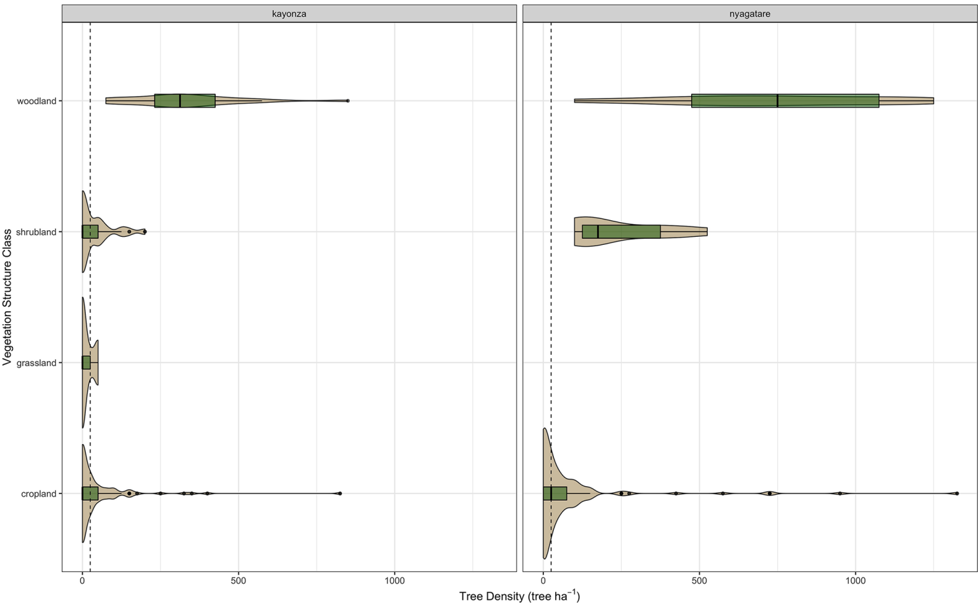
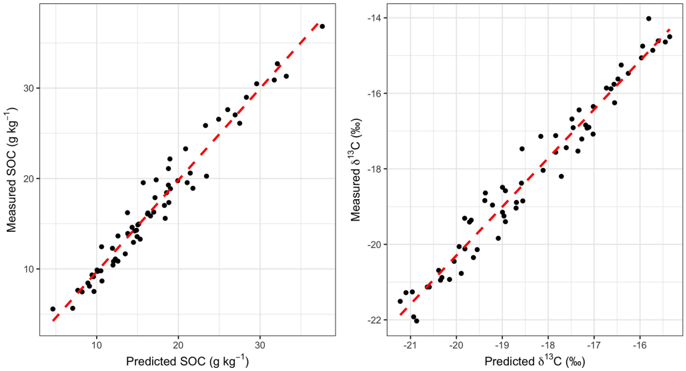
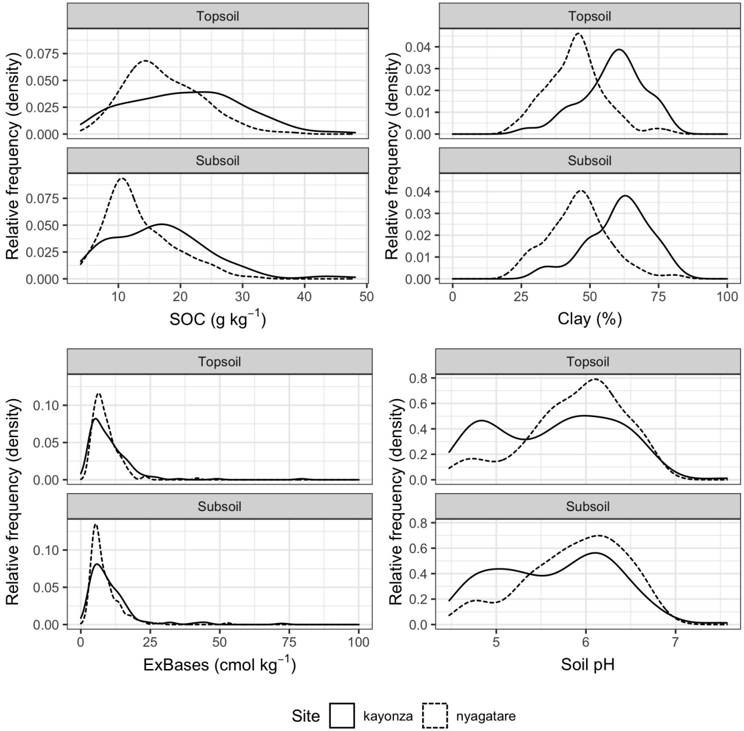
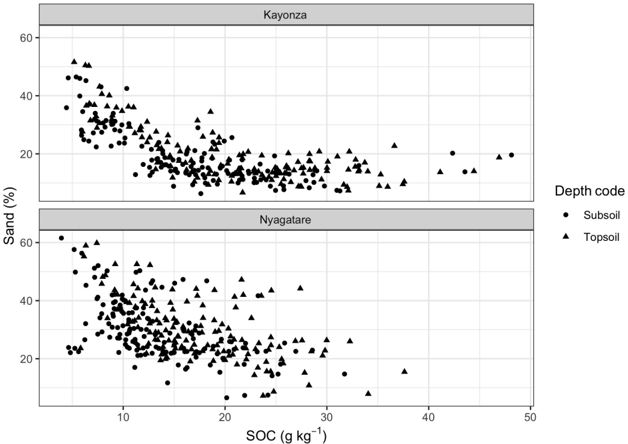
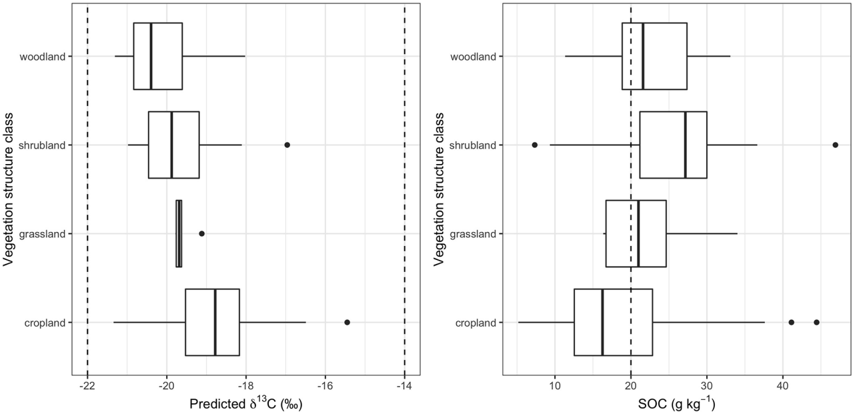
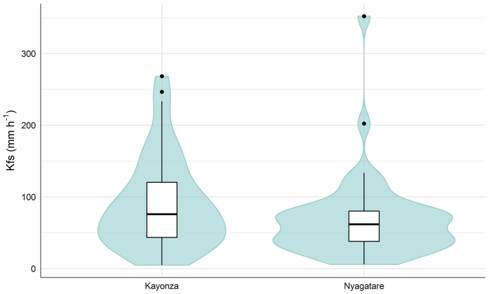
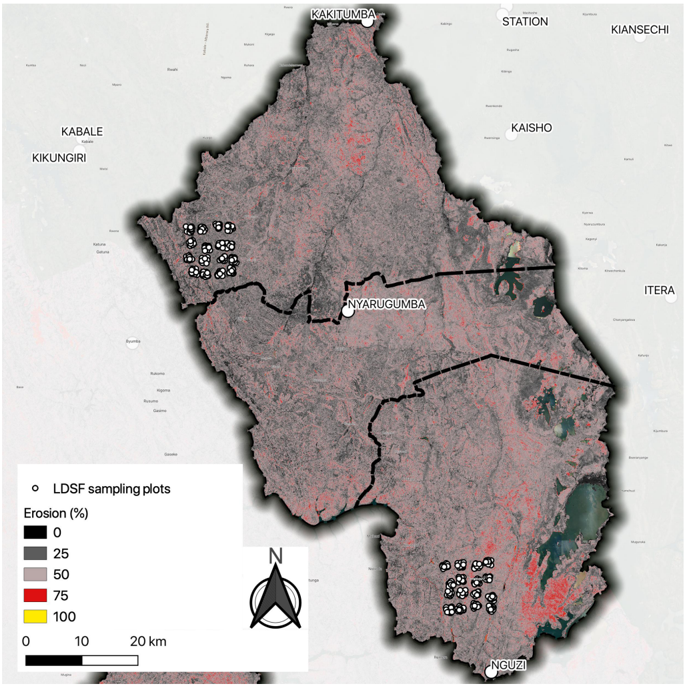
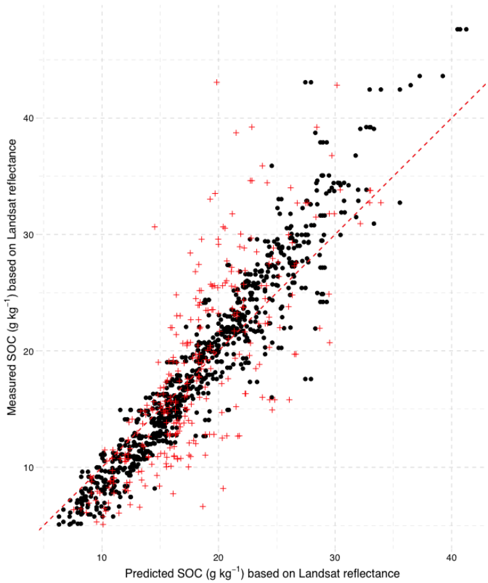
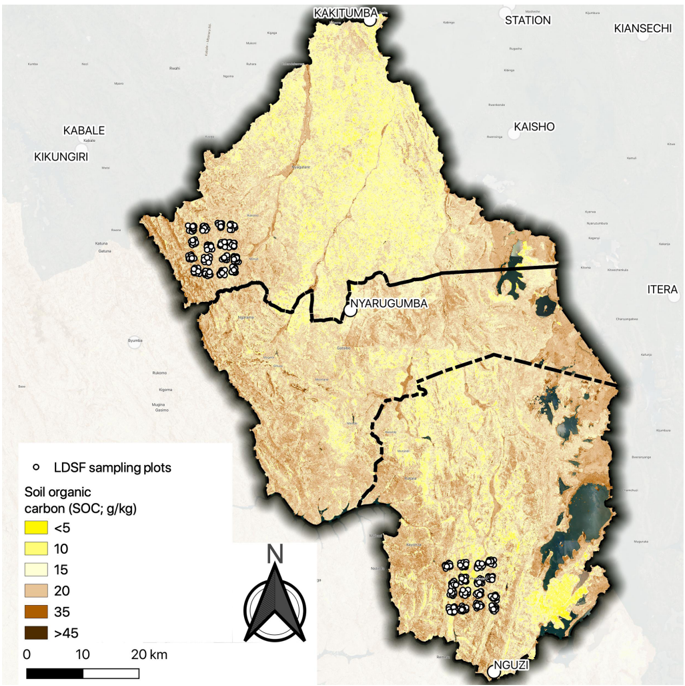
Land degradation negatively impacts water, food, and nutrition security and is leading to increased competition for resources. While landscape restoration has the potential to restore ecosystem function, understanding the drivers of degradation is critical for prioritizing and tracking interventions. We sampled 300–1000 m 2 plots using the Land Degradation Surveillance Framework across Nyagatare and Kayonza districts in Rwanda to assess key soil and land health indicators, including soil organic carbon (SOC), erosion prevalence, vegetation structure and infiltration capacity, and their interactions. SOC content decreased with increasing sand content across both sites and sampling depths and was lowest in croplands and grasslands compared to shrublands and woodlands. Stable carbon isotope values ( δ 13 C) ranged from −15.35 ‰ to −21.34 ‰, indicating a wide range of historic and current plant communities with both C3 and C4 photosynthetic pathways. Field-saturated hydraulic conductivity ( K fs ) was modeled, with a median of 76 mm h −1 in Kayonza and 62 mm h −1 in Nyagatare, respectively. Topsoil OC had a positive effect on K fs , whereas pH, sand, and erosion had negative effects. Soil erosion was highest in plots classified as woodland and shrubland. Maps of soil erosion and SOC at 30 m resolution were produced with high accuracy and showed strong variability across the study landscapes. These data demonstrate the importance of assessing multiple biophysical properties in order to assess land degradation, including the spatial patterns of soil and land health indicators across the landscape. By understanding the dynamics of land degradation and interactions between biophysical indicators, we can better prioritize interventions that result in multiple benefits as well as assess the impacts of restoration options.
Overview
The claims and statistics of this paper haven’t been checked yet.
Free: it reads the open-access text and checks the first 5 claims that cite a source we can check. Create a free account to check every claim.
Integrity signals
Registry
Cites
Statistics
Figures
Verification
Claims the paper makes
The claims and statistics of this paper haven’t been checked yet.
Free: it reads the open-access text and checks the first 5 claims that cite a source we can check. Create a free account to check every claim.
Claims other papers make about this one
Each is checked against this paper’s own text: does it say what the citing paper says it does?
The source backs part of the claim, not all of it — or backs it for a different population, condition or comparison.
In the citing paper
“The LDSF is a framework that offers a hierarchical soil sampling design, along with statistical analysis and inference, achieving high accuracy for local relevance while developing predictive models with global applicability”
From Agroecology for sustainable development: evidence on multidimensional performance from a cross-country TAPE assessment in Africa (2025) · cites this paper as Winowiecki et al., 2021
Experimental — accuracy not yet measured
Self-check
Percentages, sums and reported differences re-computed from the paper’s own numbers.
The self-check needs the paper’s full text.
Citations
Cites
Fitting Linear Mixed-Effects Models Using lme4
Bates, D., Mächler, M., Bolker, B., & Walker, S. (2015) · Journal of Statistical Software · doi:10.18637/jss.v067.i01 · Cited by 86,835
lmerTest Package: Tests in Linear Mixed Effects Models
Kuznetsova, A., Brockhoff, P. B., & Christensen, R. H. B. (2017) · Journal of Statistical Software · doi:10.18637/jss.v082.i13 · Cited by 24,346
(2014) · Climate Change 2013 – The Physical Science Basis · doi:10.1017/cbo9781107415324.004 · Cited by 23,880
The use of the area under the ROC curve in the evaluation of machine learning algorithms
Bradley, A. P. (1997) · Pattern Recognition · doi:10.1016/s0031-3203(96)00142-2 · Cited by 7,217
Griscom, B. W., Adams, J., Ellis, P. W., Houghton, R. A., Lomax, G., Miteva, D. A., Schlesinger, W. H., Shoch, D., Siikamäki, J. V., Smith, P., et al. (2017) · Proceedings of the National Academy of Sciences · doi:10.1073/pnas.1710465114 · Cited by 3,481
Wand, M. P., & Jones, M. C. (1995) · Springer eBooks · doi:10.1007/978-1-4899-4493-1 · Cited by 2,663
The global tree restoration potential
Bastin, J.-F., Finegold, Y., Garcia, C., Mollicone, D., Rezende, M., Routh, D., Zohner, C. M., & Crowther, T. W. (2019) · Science · doi:10.1126/science.aax0848 · Cited by 2,197
The concept and future prospects of soil health
Lehmann, J., Bossio, D. A., Kögel-Knabner, I., & Rillig, M. C. (2020) · Nature Reviews Earth & Environment · doi:10.1038/s43017-020-0080-8 · Cited by 1,791
Beyond Deforestation: Restoring Forests and Ecosystem Services on Degraded Lands
Chazdon, R. L. (2008) · Science · doi:10.1126/science.1155365 · Cited by 1,773
Soil erosion and the global carbon budget
Lal, R. (2003) · Environment International · doi:10.1016/s0160-4120(02)00192-7 · Cited by 1,661
(1980) · Elsevier eBooks · doi:10.1016/c2009-0-03109-2 · Cited by 1,605
Soil Erosion: A Food and Environmental Threat
Pimentel, D. (2006) · Environment, Development and Sustainability · doi:10.1007/s10668-005-1262-8 · Cited by 1,265
An Approach Toward a Physical Interpretation of Infiltration‐Capacity
Horton, R. E. (1941) · Soil Science Society of America Journal · doi:10.2136/sssaj1941.036159950005000c0075x · Cited by 1,031
Soil organic matter stratification ratio as an indicator of soil quality
Franzluebbers, A. J. (2002) · Soil and Tillage Research · doi:10.1016/s0167-1987(02)00018-1 · Cited by 937
Water infiltration and soil structure related to organic matter and its stratification with depth
Franzluebbers, A. J. (2002) · Soil and Tillage Research · doi:10.1016/s0167-1987(02)00027-2 · Cited by 834
Di Sacco, A., Hardwick, K. A., Blakesley, D., Brancalion, P. H. S., Breman, E., Cecilio Rebola, L., Chomba, S., Dixon, K., Elliott, S., Ruyonga, G., et al. (2021) · Global Change Biology · doi:10.1111/gcb.15498 · Cited by 728
Self-citationLand in balance: The scientific conceptual framework for Land Degradation Neutrality
Cowie, A. L., Orr, B. J., Castillo Sanchez, V. M., Chasek, P., Crossman, N. D., Erlewein, A., Louwagie, G., Maron, M., Metternicht, G. I., Minelli, S., et al. (2018) · Environmental Science & Policy · doi:10.1016/j.envsci.2017.10.011 · Cited by 653
Boutton, T. W., Archer, S. R., Midwood, A. J., Zitzer, S. F., & Bol, R. (1998) · Geoderma · doi:10.1016/s0016-7061(97)00095-5 · Cited by 489
Intake Rate: Cylinder Infiltrometer
Bouwer, H. (1986) · SSSA Book Series · doi:10.2136/sssabookser5.1.2ed.c32 · Cited by 484
A Policy‐Driven Knowledge Agenda for Global Forest and Landscape Restoration
Chazdon, R. L., Brancalion, P. H. S., Lamb, D., Laestadius, L., Calmon, M., & Kumar, C. (2017) · Conservation Letters · doi:10.1111/conl.12220 · Cited by 446
Sustainable intensification and the African smallholder farmer
Vanlauwe, B., Coyne, D., Gockowski, J., Hauser, S., Huising, J., Masso, C., Nziguheba, G., Schut, M., & Van Asten, P. (2014) · Current Opinion in Environmental Sustainability · doi:10.1016/j.cosust.2014.06.001 · Cited by 381
Ponded Infiltration From a Single Ring: I. Analysis of Steady Flow
Reynolds, W. D., & Elrick, D. E. (1990) · Soil Science Society of America Journal · doi:10.2136/sssaj1990.03615995005400050006x · Cited by 378
Cole, M. B., Augustin, M. A., Robertson, M. J., & Manners, J. M. (2018) · npj Science of Food · doi:10.1038/s41538-018-0021-9 · Cited by 373
Tracking, targeting, and conserving soil biodiversity
Guerra, C. A., Bardgett, R. D., Caon, L., Crowther, T. W., Delgado-Baquerizo, M., Montanarella, L., Navarro, L. M., Orgiazzi, A., Singh, B. K., Tedersoo, L., et al. (2021) · Science · doi:10.1126/science.abd7926 · Cited by 343
Degradation and resilience of soils
Lal, R. (1997) · Philosophical Transactions of the Royal Society of London. Series B: Biological Sciences · doi:10.1098/rstb.1997.0078 · Cited by 322
HILLEL, D. (1980) · Fundamentals of Soil Physics · doi:10.1016/b978-0-08-091870-9.50006-6 · Cited by 315
Paustian, K., Collier, S., Baldock, J., Burgess, R., Creque, J., DeLonge, M., Dungait, J., Ellert, B., Frank, S., Goddard, T., et al. (2019) · Carbon Management · doi:10.1080/17583004.2019.1633231 · Cited by 272
Land degradation control and its global environmental benefits
Gisladottir, G., & Stocking, M. (2005) · Land Degradation & Development · doi:10.1002/ldr.687 · Cited by 267
Land degradation and climate change: building climate resilience in agriculture
Webb, N. P., Marshall, N. A., Stringer, L. C., Reed, M. S., Chappell, A., & Herrick, J. E. (2017) · Frontiers in Ecology and the Environment · doi:10.1002/fee.1530 · Cited by 255
Monitoring biodiversity change through effective global coordination
Navarro, L. M., Fernández, N., Guerra, C., Guralnick, R., Kissling, W. D., Londoño, M. C., Muller-Karger, F., Turak, E., Balvanera, P., Costello, M. J., et al. (2017) · Current Opinion in Environmental Sustainability · doi:10.1016/j.cosust.2018.02.005 · Cited by 222
Lorenz, K., Lal, R., & Ehlers, K. (2019) · Land Degradation & Development · doi:10.1002/ldr.3270 · Cited by 222
Soil Health Indicators Under Climate Change: A Review of Current Knowledge
Allen, D. E., Singh, B. P., & Dalal, R. C. (2011) · Soil Biology · doi:10.1007/978-3-642-20256-8_2 · Cited by 221
Mapping of soil properties and land degradation risk in Africa using MODIS reflectance
Vågen, T.-G., Winowiecki, L. A., Tondoh, J. E., Desta, L. T., & Gumbricht, T. (2016) · Geoderma · doi:10.1016/j.geoderma.2015.06.023 · Cited by 221
Self-citationScaling up agroforestry requires research ‘in’ rather than ‘for’ development
Coe, R., Sinclair, F., & Barrios, E. (2014) · Current Opinion in Environmental Sustainability · doi:10.1016/j.cosust.2013.10.013 · Cited by 207
Bossio, D., Geheb, K., & Critchley, W. (2010) · Agricultural Water Management · doi:10.1016/j.agwat.2008.12.001 · Cited by 195
Terhoeven-Urselmans, T., Vagen, T.-G., Spaargaren, O., & Shepherd, K. D. (2010) · Soil Science Society of America Journal · doi:10.2136/sssaj2009.0218 · Cited by 195
Self-citationMonitoring the world's agriculture
Sachs, J., Remans, R., Smukler, S., Winowiecki, L., Andelman, S. J., Cassman, K. G., Castle, D., DeFries, R., Denning, G., Fanzo, J., et al. (2010) · Nature · doi:10.1038/466558a · Cited by 189
Self-citationFarm productivity in Rwanda: effects of farm size, erosion, and soil conservation investments
Byiringiro, F. (1996) · Agricultural Economics · doi:10.1016/s0169-5150(96)01201-7 · Cited by 172
The IPBES assessment report on land degradation and restoration.
IPBES (2018) · Zenodo (CERN European Organization for Nuclear Research) · doi:10.5281/zenodo.3237392 · Cited by 162
Schut, M., van Asten, P., Okafor, C., Hicintuka, C., Mapatano, S., Nabahungu, N. L., Kagabo, D., Muchunguzi, P., Njukwe, E., Dontsop-Nguezet, P. M., et al. (2016) · Agricultural Systems · doi:10.1016/j.agsy.2016.03.005 · Cited by 158
Extent of Cropland and Related Soil Erosion Risk in Rwanda
Karamage, F., Zhang, C., Ndayisaba, F., Shao, H., Kayiranga, A., Fang, X., Nahayo, L., Nyesheja, E. M., & Tian, G. (2016) · Sustainability · doi:10.3390/su8070609 · Cited by 125
Vågen, T.-G., & Winowiecki, L. A. (2013) · Environmental Research Letters · doi:10.1088/1748-9326/8/1/015011 · Cited by 122
Self-citationRapid Measurement of Field‐Saturated Hydraulic Conductivity for Areal Characterization
Nimmo, J. R., Schmidt, K. M., Perkins, K. S., & Stock, J. D. (2009) · Vadose Zone Journal · doi:10.2136/vzj2007.0159 · Cited by 117
Kagabo, D. M., Stroosnijder, L., Visser, S. M., & Moore, D. (2012) · Soil and Tillage Research · doi:10.1016/j.still.2012.11.002 · Cited by 114
Prioritizing climate-smart livestock technologies in rural Tanzania: A minimum data approach
Shikuku, K. M., Valdivia, R. O., Paul, B. K., Mwongera, C., Winowiecki, L. A., Läderach, P., Herrero, M., & Silvestri, S. (2016) · Agricultural Systems · doi:10.1016/j.agsy.2016.06.004 · Cited by 113
Self-citationA global agenda for collective action on soil carbon
Vermeulen, S. J., Bossio, D., Lehmann, J. C., Luu, P., Paustian, K. H., Webb, C., Augé, F., Bacudo, I., Baedeker, T., Havemann, T., et al. (2018) · Nature Sustainability · doi:10.1038/s41893-018-0212-z · Cited by 110
Vågen, T.-G., Winowiecki, L. A., Abegaz, A., & Hadgu, K. M. (2013) · Remote Sensing of Environment · doi:10.1016/j.rse.2013.03.006 · Cited by 109
Self-citationBlake, W. H., Rabinovich, A., Wynants, M., Kelly, C., Nasseri, M., Ngondya, I. B., Patrick, A., Mtei, K., Munishi, L. K., Boeckx, P., et al. (2018) · Environmental Research Letters · doi:10.1088/1748-9326/aaea8b · Cited by 103
Falkenmark, M., & Rockström, J. (2008) · Natural Resources Forum · doi:10.1111/j.1477-8947.2008.00177.x · Cited by 99
THE OPTIONS BY CONTEXT APPROACH: A PARADIGM SHIFT IN AGRONOMY
Sinclair, F., & Coe, R. (2019) · Experimental Agriculture · doi:10.1017/s0014479719000139 · Cited by 96
Effects of land cover on ecosystem services in Tanzania: A spatial assessment of soil organic carbon
Winowiecki, L., Vågen, T.-G., & Huising, J. (2016) · Geoderma · doi:10.1016/j.geoderma.2015.03.010 · Cited by 92
Self-citationWinowiecki, L. A., Vågen, T., Massawe, B. H. J., Jelinski, N. A., Lyamchai, C., Sayula, G., & Msoka, E. M. (2015) · Nutrient Cycling in Agroecosystems · doi:10.1007/s10705-015-9750-1 · Cited by 86
Self-citationSoil organic carbon: Towards better soil health, productivity and climate change mitigation
Deb, S., Bhadoria, P. B. S., Mandal, B., Rakshit, A., & Singh, H. B. (2015) · Climate Change and Environmental Sustainability · doi:10.5958/2320-642x.2015.00003.4 · Cited by 85
Assessing farmers’ interest in agroforestry in two contrasting agro-ecological zones of Rwanda
Bucagu, C., Vanlauwe, B., van Wijk, M. T., & Giller, K. E. (2012) · Agroforestry Systems · doi:10.1007/s10457-012-9531-7 · Cited by 81
Technical note: Saturated hydraulic conductivity and textural heterogeneity of soils
García‐Gutiérrez, C., Pachepsky, Y. A., & Martín, M. Á. (2018) · Hydrology and earth system sciences · doi:10.5194/hess-22-3923-2018 · Cited by 76
Financial cost–benefit analysis of bench terraces in Rwanda
Bizoza, A. R., & de Graaff, J. (2012) · Land Degradation & Development · doi:10.1002/ldr.1051 · Cited by 73
nls.multstart: Robust Non-Linear Regression using AIC Scores
Padfield, D., Matheson, G. J., & Windram, F. (2018) · doi:10.32614/cran.package.nls.multstart · Cited by 71
The Effect of Land Use Systems on Soil Properties; A case study from Rwanda
Bizuhoraho, T., Kayiranga, A., Manirakiza, N., & Mourad, K. A. (2018) · Sustainable Agriculture Research · doi:10.5539/sar.v7n2p30 · Cited by 64
Vågen, T., & Winowiecki, L. A. (2019) · Remote Sensing · doi:10.3390/rs11151800 · Cited by 53
Self-citationIiyama, M., Mukuralinda, A., Ndayambaje, J. D., Musana, B., Ndoli, A., Mowo, J., Garrity, D. P., Ling, S., & Ruganzu, V. (2018) · Sustainability · doi:10.3390/su10051360 · Cited by 43
Self-citationAutomated high resolution mapping of coffee in Rwanda using an expert Bayesian network
Mukashema, A., Veldkamp, A., & Vrieling, A. (2014) · International Journal of Applied Earth Observation and Geoinformation · doi:10.1016/j.jag.2014.05.005 · Cited by 37
Calibration and validation of rainfall erosivity estimators for application in Rwanda
Rutebuka, J., Taeye, S. D., Kagabo, D. M., & Verdoodt, A. (2020) · CATENA · doi:10.1016/j.catena.2020.104538 · Cited by 36
Winowiecki, L. A., Vågen, T., Kinnaird, M. F., & O’Brien, T. G. (2018) · Geoderma · doi:10.1016/j.geoderma.2018.04.017 · Cited by 26
Self-citationQuillérou, E., & Thomas, R. J. (2012) · CABI Reviews · doi:10.1079/pavsnnr20127060 · Cited by 25
Winowiecki, L. A., Vågen, T., Boeckx, P., & Dungait, J. A. J. (2017) · Plant and Soil · doi:10.1007/s11104-017-3418-3 · Cited by 25
Self-citationSpatial assessments of soil organic carbon for stakeholder decision-making – a case study from Kenya
Vågen, T., Winowiecki, L. A., Neely, C., Chesterman, S., & Bourne, M. (2018) · SOIL · doi:10.5194/soil-4-259-2018 · Cited by 24
Self-citationJ, C. B., P, B. M. B., De Graaff, J., & Gad, A. (2015) · Journal of Development and Agricultural Economics · doi:10.5897/jdae2013.0481 · Cited by 16
BENNETT, H. H. (1940) · Soil Science Society of America Journal · doi:10.2136/sssaj1940.036159950004000c0119x · Cited by 14
Using sediment fingerprinting to identify erosion hotspots in a sub-catchment of Lake Kivu, Rwanda
Akayezu, P., Musinguzi, L., Natugonza, V., Ogutu‐Ohwayo, R., Mwathe, K., Dutton, C. L., & Manyifika, M. (2020) · Environmental Monitoring and Assessment · doi:10.1007/s10661-020-08774-5 · Cited by 11
Valentin, C., & Bresson, L. M. (2020) · CRC Press eBooks · doi:10.1201/9781003068716-5 · Cited by 10
Biophysical baseline assessment in eastern Rwanda using the LDSF
Winowiecki, L. A., Tobella, A. B., Mukuralinda, A., Mujawamariya, P., Mugayi, A. B., Minani, V., Musengimana, L., Maina, J. T., & Vågen, T. (2021) · World Agroforestry Centre - ICRAF Dataverse · doi:10.34725/dvn/nmyofa · Cited by 1
Self-citation
Research works printed but not linked: 1
- 31. Hillel, D.: Environmental soil physics: Fundamentals, applications, and environmental considerations, Elsevier, Academic Press, 757 pp., 1998.
Cited by
Kaya, F., Keshavarzi, A., Francaviglia, R., Kaplan, G., Başayığıt, L., & Dedeoğlu, M. (2022) · Agriculture · doi:10.3390/agriculture12071062 · Cited by 96
Kuria, A. W., Bolo, P., Adoyo, B., Korir, H., Sakha, M. A., Gumo, P., Mbelwa, M., Orero, L., Ntinyari, W., Syano, N. M., et al. (2024) · Frontiers in Sustainable Food Systems · doi:10.3389/fsufs.2024.1456620 · Cited by 30
Nkurikiye, J. B., Uwizeyimana, V., Ruymbeke, K. V., Vanermen, I., Verbist, B., Bizoza, A. R., & Vranken, L. (2024) · Trees Forests and People · doi:10.1016/j.tfp.2024.100592 · Cited by 28
Assessing the adoption of regenerative agricultural practices in Eastern Africa
Ntawuhiganayo, E. B., Nijman-Ross, E., Geme, T., Negesa, D., & Nahimana, S. (2023) · Frontiers in Sustainability · doi:10.3389/frsus.2023.1105846 · Cited by 25
Self-citationHashakimana, L., Toru, T., Niyitanga, F., Cyamweshi, A. R., & Mukuralinda, A. (2023) · Heliyon · doi:10.1016/j.heliyon.2023.e19041 · Cited by 20
Self-citation
Metadata
- Authors
- Winowiecki, L. A., Bargués-Tobella, A., Mukuralinda, A., Mujawamariya, P., Ntawuhiganayo, E. B., Mugayi, A. B., Chomba, S., & Vågen, T.-G.
- Affiliations
- World Agroforestry Centre (KE)
- Swedish University of Agricultural Sciences (SE)
- World Vision (US)
- World Resources Institute (US)
- Corresponding author
- Winowiecki, Leigh Ann
- Mukuralinda, Athanase
- Ntawuhiganayo, Elisée Bahati
- ORCID
- Venue
- SOIL
- Publisher
- Copernicus GmbH
- Published
- 2021-11-25
- Volume
- 7
- Issue
- 2
- Pages
- 767-783
- ISSN
- 2199-3971 (ISSN-L)
- 2199-398X
- OpenAlex
- W3216933588
- Cited by
- 26
- References
- 72
- Citations by year
- 2026: 5 · 2025: 5 · 2024: 9 · 2023: 4 · 2022: 1 · 2021: 2
- FWCI
- 2.33
- Type
- journal article
- Language
- en
- Open access
- gold
- doi.org
- Licence
- Locations
- SOIL (publishedVersion, cc-by)
- Epsilon Open Archive (Sveriges lantbruksuniversitet biblioteket (Swedish University of Agricultural Sciences)) (acceptedVersion)
- CGSPace A Repository of Agricultural Research Outputs (Consultative Group for International Agricultural Research) (submittedVersion, cc-by)
- DOAJ (DOAJ: Directory of Open Access Journals) (submittedVersion, cc-by-sa)
- Funders
- Directorate-General for Development and Cooperation - EuropeAid (DCI-ENV/2017/387-627)
- Svenska Forskningsrådet Formas (2017-00430)
- Topics
- Life Sciences › Agricultural and Biological Sciences › Soil Science › Soil erosion and sediment transport
- Life Sciences › Agricultural and Biological Sciences › Soil Science › Soil Geostatistics and Mapping
- Life Sciences › Agricultural and Biological Sciences › Soil Science › Soil Carbon and Nitrogen Dynamics
- Keywords
- land degradation, landscape restoration, soil health, soil organic carbon, soil erosion, stable carbon isotopes, C3/C4 vegetation, hydraulic conductivity, infiltration capacity, vegetation structure, Eastern Rwanda
About these checks
Registry, retraction, Cites and statistics results are computed, not judged, with one exception: a printed reference that no index lists is read once by a model before it counts as a citation error. Claims are extracted by a model and kept only when their quote appears verbatim in the text; each cited source is then checked, with a model’s help, for whether it says what the claim relies on. Those verdicts can be wrong — read the claim’s quote and the cited source before relying on one.
Statistics and arithmetic are recomputed, not judged.
Confidence bands are shown only for fields calibrated on our annotated test set. None is calibrated yet, so no band is shown.
What counts as a claim ›How we measure confidence ›How we check this ›
Are you an author, or do you see a problem with this page? Request a review
Data sources
Bibliographic data: Semantic Scholar, OpenAlex, Crossref.
Contains information from the Semantic Scholar Academic Graph Datasets, made available under the ODC Attribution License (ODC-BY 1.0).
Semantic Scholar’s data is described in: Kinney, R., et al. (2023). The Semantic Scholar Open Data Platform. arXiv:2301.10140.
