

Risk Management Model using Cause and Effect Analysis in Industrial Building Project
Open accessThe DOI matches its Crossref record; 6 of the 7 references it cites were found in a registry or an index; 1 of the 3 sources its claims cite were checked for support.
Abstract
The purpose of this study is to determine the main potential risks that occur in the design planning stage of a construction project, especially in an Industrial Building project. Based on the available literature and the experiences of other authors and practitioners, a list of potential risks was developed. Risks events were initially categorized into technical, project management, commercial and external categories. Risks are evaluated by professional practitioners who have experience in construction projects. The evaluation includes the expected likelihood of the event and its impact on changes in scope of work. This study considers each risk among owners, consultants, contractors and others. The data collected were analyzed qualitatively and quantitatively to assess the severity and impact of the event. The recommended responses to major risks are introduced in this study. Keywords: risk management model, planning stage, industrial building.
Overview
CoChat Summary
## TL;DR
This study identifies the main risk factors affecting change in scope of work at the planning stage of an industrial building project, using expert-validated questionnaires, Pareto analysis, and cause-and-effect analysis. The most significant factors were project management risk factors and technical risk factors, and the paper recommends early risk management and preventive actions for the dominant risks.
## Key findings
- The most significant factors affecting change in scope of work were project management risk factors (X2) and technical risk factors (X1).
- The risk assessment identified 11 risk factors with high risk in influencing scope-of-work changes, including:
- X3.4 Design changes by Owner (addition/subtraction)
- X3.3 Change in the shape, size, location of the machine
- X1.2 Completeness data of the site conditions
- X3.2 Machine vendor/supplier change
- X2.5 Inconsistency between construction plans and field implementation
- X1.5 Completeness of DED
- X1.4 Error in design
- X1.1 Site Investigation
- X2.1 Completeness of data to make DED
- X1.3 Limited time to prepare for tender
- X2.14 No quality control system
- The risk register ranked the top risks as:
1. X3.4 Design changes by Owner
2. X3.3 Change in machine shape/size/location
3. X1.2 Completeness data of site conditions
4. X3.2 Machine vendor/supplier change
5. X2.5 Inconsistency between construction plans and field implementation
- Reliability of the questionnaire was reported as Cronbach’s Alpha = 0.918 with 31 items; the validity test used r-table = 0.355 and the paper states the variables were valid.
## Methods
- The study focused on risks from lack of knowledge or failure to apply risk management at the planning stage of an industrial building project.
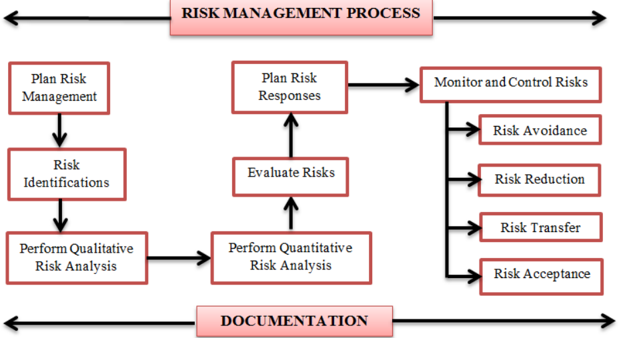
- Potential risks were identified from published research and expert interviews, then categorized using the Risk Breakdown Structure (PMBOK 6th Edition, 2017) into four groups: technical, project management, commercial, and external.
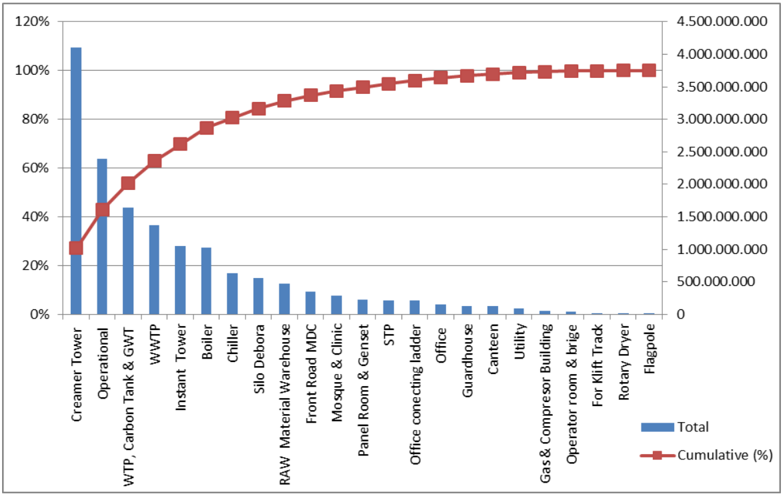
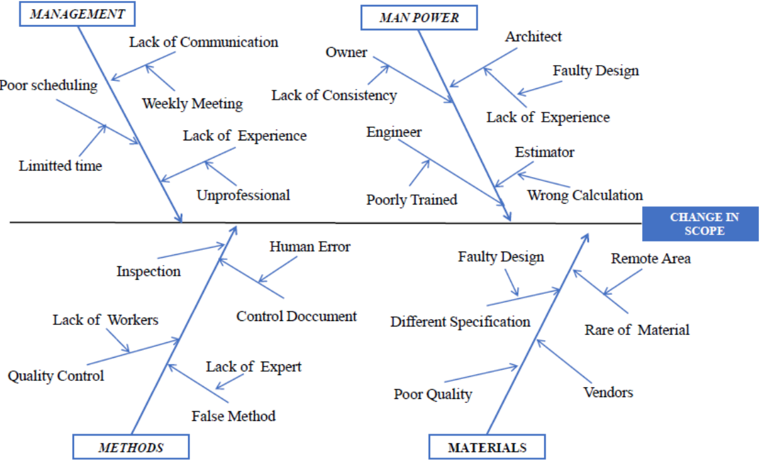
- Data were evaluated by professional practitioners from owners, consultants, contractors, and others; the paper says the data were analyzed qualitatively and quantitatively, using questionnaires, SPSS version 25, multinomial logistic regression, Pareto analysis, and cause-and-effect analysis.
## Limitations
- The paper says it is based on secondary data analysis, expert interviews, and a questionnaire survey, but it does not state a formal limitation section or discuss generalizability. *(Not stated in the paper)*
- The text shows some tables are incomplete or partially displayed, and some figures are not visible in the provided text. *(Evident from the provided text)*
- The sample composition is not fully described beyond mention of professional practitioners and 35 valid cases in the reliability test. *(Evident from the provided text)*
Model-written summary. Check it against the paper before relying on it.
Integrity signals
Registry
Cites
Statistics
Figures
Verification
Claims the paper makes
0 Valid · 1 Not valid · 2 Not checked · 14 Own results and interpretations
At least one cited source doesn’t support this claim or points to a different paper, and none confirmed it — see the verdicts below.
In the paper
“According to research by (Awuni, M.A., 2019) revealed that from the 114 consultants only had minimal knowledge about the implementation of risk management at the planning stage.”
What the sources say
- Disputedcites Awuni, M.A., 2019 matched to “Risk Assessment at the Design Phase of Construction Projects in Ghana” (2019) sourceExperimental — accuracy not yet measured
Awuni (2019) reports the opposite of the attributed finding: both the Abstract and Section 6 (Conclusions) state that the majority of consultants had an *average* knowledge of risk management and that 'the extent of knowledge of consultants in risk assessment at the design phase is average'. The 114 figure is also misused — Section 4 (Methodology)/Table 1 give 114 as the calculated sample drawn from a population of 186, and Section 5 (Discussions) records that of 114 questionnaires sent, only 60 usable responses were analysed, so no knowledge result rests on 114 consultants. The paper's related caveats (Recommendation: 'many respondents identified the lack of theoretical knowledge'; Section 5: 48% use an informal approach) do not amount to only a minimal number having knowledge, and the study covers risk assessment at the design phase rather than 'implementation of risk management at the planning stage'. (LLM, conf=0.75)
Checked by a reasoning model — may be wrong.
plain- Asserted: passes — The authors put it forward as true.
- Checkable: passes — It can be checked against evidence.
- Load-bearing: passes — The paper’s conclusions depend on it.
- Based: passes — The paper gives a reason why it holds.
- Disputed
A result the paper reports from its own data — it cites no other source for it, so there is none to check. The quote shows it is in the paper.
In the paper
“From the table above, 7 work items are selected that have significant influence on change scope of work, which will then be used in the analysis using a Cause and Effect diagram.”
plainstates a cause- Asserted: passes — The authors put it forward as true.
- Checkable: passes — It can be checked against evidence.
- Load-bearing: passes — The paper’s conclusions depend on it.
- Based: passes — The paper gives a reason why it holds.
A result the paper reports from its own data — it cites no other source for it, so there is none to check. The quote shows it is in the paper.
In the paper
“From the results of the research using questionnaires and case study, it is found that several factors are very influential in the change in scope of work in Industrial Building Project.”
plainstates an association- Asserted: passes — The authors put it forward as true.
- Checkable: passes — It can be checked against evidence.
- Load-bearing: passes — The paper’s conclusions depend on it.
- Based: passes — The paper gives a reason why it holds.
- Rests on an assumption not shown here.
A result the paper reports from its own data — it cites no other source for it, so there is none to check. The quote shows it is in the paper.
In the paper
“Table 9. SPSS Regression Multinomial Logistic Test Result X3 and Y”
- Also stated in: § Pareto Analysis · plain
“Final | 32,573 | 39,415 | 15 | ,001”
plainstates an association- Asserted: passes — The authors put it forward as true.
- Checkable: passes — It can be checked against evidence.
- Load-bearing: unclear — It is unclear whether the paper’s conclusions depend on it.
- Based: passes — The paper gives a reason why it holds.
- Also stated in: § Pareto Analysis · plain
A result the paper reports from its own data — it cites no other source for it, so there is none to check. The quote shows it is in the paper.
In the paper
“| Final | 48,609 | 28,560 | 15 | ,018 |”
plain- Asserted: passes — The authors put it forward as true.
- Checkable: passes — It can be checked against evidence.
- Load-bearing: passes — The paper’s conclusions depend on it.
- Based: passes — The paper gives a reason why it holds.
9 more claims
Create a free account to see all 17 claims and every source verdict.
- It may state two separate claims as one. 2
- Probably not a substantial claim. 1
Citations
Cites
Key performance indicators for measuring construction success
Chan, A. P. C., & Chan, A. P. L. (2004) · Benchmarking: An International Journal · doi:10.1108/14635770410532624 · Cited by 968
The risk in early design method
Lough, K. G., Stone, R. B., & Tumer, I. Y. (2008) · Journal of Engineering Design · doi:10.1080/09544820701684271 · Cited by 112 · cited 1×
“For building a fishbone chart we use arrows or branches: (1) primary branch: represents the effect, (2) major branch: corresponds to the major cause, (3) minor branch: corresponds to the causative and more detailed factors.”
MethodApplication of the cause–consequence diagram method to static systems
Andrews, J., & Ridley, L. M. (2002) · Reliability Engineering & System Safety · doi:10.1016/s0951-8320(01)00113-2 · Cited by 30
Lean Techniques in the Management of the Design of an Industrial Project
Deshpande, A. S., Filson, L. E., Salem, O., et al. (2011) · Journal of Management in Engineering · doi:10.1061/(asce)me.1943-5479.0000065 · Cited by 27
Hazard identification, risk analysis and risk assessment on high-rise building construction project
Ratnaningsih, A., Dhokhikah, Y., & Fitria, A. (2018) · AIP conference proceedings · doi:10.1063/1.5042870 · Cited by 9
Risk Assessment at the Design Phase of Construction Projects in Ghana
Awuni, M. A. (2019) · Journal of Building Construction and Planning Research · doi:10.4236/jbcpr.2019.72004 · Cited by 5 · cited 1×
“For building a fishbone chart we use arrows or branches: (1) primary branch: represents the effect, (2) major branch: corresponds to the major cause, (3) minor branch: corresponds to the causative and more detailed factors.”
Method
Research works printed but not linked: 6
- [2]2. Basari, Imayanti. (2107). Estimation Risk of High Rise Building on Contractor. IPTEK, Journal of Engineering.
- [6]6. Sakthiniveditha, V. and , Pradeep, T. (2015). A Study On Risk Assessment In The Construction Of High-Rise Buildings. International Journal of Science and Engineering Research (IJ0SER).
- [7]7. Project Management Institute. (2017). A guide to The Project Management Body of Knowledge (PMBOK Guide) Fourth Edition (6th Editio.). Pennsylvania: Project Management Institute, Inc.
- [9]9. Katebi, A. And Teymourfar, R. (2017). Identification, Analysis and Response to Risk in High-Rise Building Projects in Tehran's Municipality of 22th District Based on Vikor Technique. International Journal of Civil Engineering and Technologi.
- [10]10. El-Dash, K. et al. (2006). Risk Management in the Design Phase of Large Scale Construction Project. Journal of EHAF Consultings, Cairo, Egypt.
- [16]16. Ridley, L.M. and Andrews, J.D. (2009). Application of the Cause-Consequence Diagram Method to Static Systems. Journal of Department of Mathematical Sciences. How to cite this article: Oktaviani O, Susetyo B, Bintoro BPK. Risk management model using cause and effect analysis in industrial building project. International Journal of Research and Review . 2021; 8(8): 227-235. DOI: https://doi. org/10.52403/ijrr.20210832 ******
Cited by
Zhasmukhambetova, A., Evdorides, H. T., & Davies, R. J. (2025) · Future Transportation · doi:10.3390/futuretransp5030085 · Cited by 8
Sivapiran, N., & MURUGESAN, G. (2025) · AMC Indian Journal of Civil Engineering · doi:10.17010/ijce/2025/v8i2/175869
Dewintha, S. N., & Hatmoko, W. (2026) · Jurnal Teknik Media Pengembangan Ilmu dan Aplikasi Teknik · doi:10.55893/jt.vol25no1.829
Metadata
- Authors
- Oktaviani, O., Susetyo, B., & Kusumo Bintoro, B. P.
- Affiliations
- Mercu Buana University (ID)
- Lecturer of Master Civil Engineering, Universitas Bakrie, Jakarta, Indonesia
- Venue
- International Journal of Research and Review
- Published
- 2021-08-17
- Volume
- 8
- Issue
- 8
- Pages
- 227-235
- ISSN
- 2349-9788 (ISSN-L)
- 2454-2237
- OpenAlex
- W3195439032
- Cited by
- 3
- References
- 7
- Citations by year
- 2026: 1 · 2025: 2
- FWCI
- 0.00
- Type
- journal article
- Language
- en
- Open access
- diamond
- doi.org
- Locations
- International Journal of Research and Review (publishedVersion)
- Topics
- Social Sciences › Decision Sciences › Management Science and Operations Research › Construction Project Management and Performance
- Physical Sciences › Engineering › Building and Construction › BIM and Construction Integration
- Social Sciences › Business, Management and Accounting › Strategy and Management › Value Engineering and Management
- Keywords
- construction risk management, industrial buildings, cause-and-effect analysis, risk identification, risk assessment, risk response, scope of work changes, construction project management
About these checks
Registry, retraction, Cites and statistics results are computed, not judged, with one exception: a printed reference that no index lists is read once by a model before it counts as a citation error. Claims are extracted by a model and kept only when their quote appears verbatim in the text; each cited source is then checked, with a model’s help, for whether it says what the claim relies on. Those verdicts can be wrong — read the claim’s quote and the cited source before relying on one.
The claim verdicts this report counts are experimental: their accuracy is not yet measured.
A language model drew the claims from the paper on 2026-10-10, under version 3 of the claim definition (model deepseek-v4.1-flash, prompt extract-v3).
A second model labelled each claim on 2026-10-10 (model jev-1.13-20260917, definition revision gold-guideline-v0.2).
Cited sources are checked with a language model’s help (qwen3.8-omni-flash).
Statistics and arithmetic are recomputed, not judged.
Confidence bands are shown only for fields calibrated on our annotated test set. None is calibrated yet, so no band is shown.
What counts as a claim ›How we measure confidence ›How we check this ›
Are you an author, or do you see a problem with this page? Request a review
How to cite
Cite CoChat for the checks on this page, and the paper for its own findings.
- This page
- CoChat. (2026). Citation check: Risk Management Model using Cause and Effect Analysis in Industrial Building Project. https://app.cochat.ai/papers/10.52403/ijrr.20210832
- The paper
- Oktaviani, O., Susetyo, B., & Kusumo Bintoro, B. P. (2021). Risk Management Model using Cause and Effect Analysis in Industrial Building Project. International Journal of Research and Review. https://doi.org/10.52403/ijrr.20210832
Data sources
Bibliographic data: Semantic Scholar, OpenAlex, Crossref.
Contains information from the Semantic Scholar Academic Graph Datasets, made available under the ODC Attribution License (ODC-BY 1.0).
Semantic Scholar’s data is described in: Kinney, R., et al. (2023). The Semantic Scholar Open Data Platform. arXiv:2301.10140.
