

Assessment of Antibiotic Prescription Pattern Using who Prescribing Indicators and Aware Categorization of Antibiotics
Open accessThe DOI matches its Crossref record; 9 of the 9 references it cites were found in a registry or an index.
Abstract
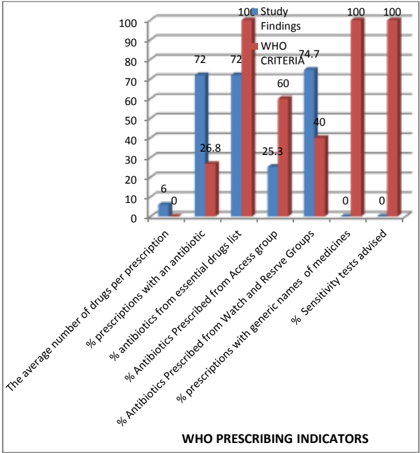
Background: Medicines play a crucial role in the healthcare delivery of a hospital. The appropriate use of medicines gives us assessment of the quality of health services being provided in a particular region. Aim: To evaluate the prescribing practices and antibiotic utilization patterns so that the extent of irrational use can be assessed by comparing them with published ideal values set by WHO. Study design: Retrospective, cross-sectional study. Place and duration of study: Teaching Hospital of Faisalabad: Independent University Hospital (IUH), from Jan 2018 to June/July 2018. Methodology: 200 cases were selected through systematic random sampling from medicine/surgery wards and pharmacy registers. The standard World Health Organization prescribing indicators and AWaRe categorization of antibiotics were used to assess the prescribing practices of physicians/surgeons. Published ideal standards for each of the indicators were compared with study findings to identify extent of irrational drug use. Results: Most of the facility indicators were met with. The Drug and Therapeutic Committee (DTC) was functional. The Standard treatment guideline booklets (STGs) and Essential Drugs List (EDL) of the hospital were available. 88% of the key drugs listed in EDL were available in stock. The expenditure on antibiotics compared to total medicines was 17%. Regarding prescribing indicators: the average number of drugs prescribed per encounter was 6 (optimal value 1.6–1.8). Average no of antibiotic per prescription amounted to almost 1 (0.925). % prescriptions with an antibiotic amounted to 72% (optimal value 20-26.8%).72% antibiotics were prescribed from the EDL formulary of the hospital (optimal value 100%). Conclusion: Regarding compliance with prescribing indicators and AWaRe categorization of antibiotics by WHO, significant deviation was observed. Education and training of physicians according to WHO parameters is required to ensure rational prescribing. Keywords: Prescription pattern, WHO Prescribing Indicators, AWaRe Categorization
Overview
The claims and statistics of this paper haven’t been checked yet.
Free: it reads the open-access text and checks the first 5 claims that cite a source we can check. Create a free account to check every claim.
Integrity signals
Registry
Cites
Statistics
Figures
Verification
Claims the paper makes
The claims and statistics of this paper haven’t been checked yet.
Free: it reads the open-access text and checks the first 5 claims that cite a source we can check. Create a free account to check every claim.
Claims other papers make about this one
Each is checked against this paper’s own text: does it say what the citing paper says it does?
The source backs part of the claim, not all of it — or backs it for a different population, condition or comparison.
In the citing paper
“The WHO Global Programme of Work aimed for at least 60 per cent of total antibiotic prescriptions at the national level to belong to the Access group by 20236.”
From Antibiotic-prescribing patterns in outpatient departments from a tertiary care hospital in Manipur using WHO AWaRe classification (2025) · cites this paper as [6]
Experimental — accuracy not yet measured
Self-check
Percentages, sums and reported differences re-computed from the paper’s own numbers.
The self-check needs the paper’s full text.
Citations
Cites
Antibiotics and Bacterial Resistance in the 21st Century
Fair, R. J., & Tor, Y. (2014) · Perspectives in Medicinal Chemistry · doi:10.4137/pmc.s14459 · Cited by 1,955
Desalegn, A. A. (2013) · BMC Health Services Research · doi:10.1186/1472-6963-13-170 · Cited by 332
(2019) · JAC-Antimicrobial Resistance · doi:10.1093/jacamr/dlz072 · Cited by 218
Jain, S., Jain, P., Moghe, V., Seth, V., Upadhyaya, P., Abhijit, K., & Goyal, J. (2015) · Perspectives in Clinical Research · doi:10.4103/2229-3485.154005 · Cited by 139
WHO/INRUD drug use indicators at primary healthcare centers in Alexandria, Egypt
Akl, O., El.Mahalli, A. A., Elkahky, A. A., & Salem, A. M. (2013) · Journal of Taibah University Medical Sciences · doi:10.1016/j.jtumed.2013.06.002 · Cited by 135
Atif, M., Azeem, M., Sarwar, M. R., Shahid, S., Javaid, S., Ikram, H., Baig, U., & Scahill, S. (2016) · SpringerPlus · doi:10.1186/s40064-016-3615-1 · Cited by 126
Antibiotic utilization at the university hospital after introducing an antibiotic policy
Vlahovic-Palcevski, V., Morović, M., & Palčevski, G. (2000) · European Journal of Clinical Pharmacology · doi:10.1007/s002280050727 · Cited by 104
Atif, M., Azeem, M., Saqib, A., & Scahill, S. L. (2017) · Antimicrobial Resistance and Infection Control · doi:10.1186/s13756-017-0199-7 · Cited by 93
Guide to Drug Financing Mechanisms
Dumoulin, J., WHO, Velasquez, G., & Kaddar, M. (1999) · Chemistry International · doi:10.1515/ci.1999.21.2.50b · Cited by 26
Research works printed but not linked: 1
- [12]12. Akhtar M, Vohora D, Pillai K, Dubey K, Roy M, Najmi A et al. Drug prescribing practices in pediatric department of a North Indian University Teaching Hospital. Asian J Pharm Clin Res. 2012; 5(1):146-9.
Cited by
Saleem, Z., Sheikh, S., Godman, B., Haseeb, A., Afzal, S., Qamar, M. U., Imam, M. T., Abuhussain, S. S. A., & Sharland, M. (2025) · JAC-Antimicrobial Resistance · doi:10.1093/jacamr/dlaf031 · Cited by 73
Palanisamy, P. R. (2023) · Journal of Family Medicine and Primary Care · doi:10.4103/jfmpc.jfmpc_296_23 · Cited by 7
A cross-sectional evaluation of rational antibiotic prescribing in Kabul based on WHO indicators
Ehsan, H., Ibrahimkhil, M. A., Ahmadi, M., Wardak, F. R., Aminpoor, H., Salam, A., Tariq, H., & Mubarak, M. Y. (2025) · BMC Infectious Diseases · doi:10.1186/s12879-025-11826-1 · Cited by 4
What and where should the next antimicrobial resistance policies focus on?
Chan, O. S. K., Tun, H. M., Uchea, C., Wu, P., & Fukuda, K. (2022) · Journal of Global Antimicrobial Resistance · doi:10.1016/j.jgar.2022.08.003 · Cited by 4
Christina, S., Nandeibam, R., R.L., P., Sangma, A. A., & Devi, H. S. (2025) · The Indian journal of medical research · doi:10.25259/ijmr_636_2025 · Cited by 2
“A study conducted at Faisalabad, Pakistan, also reported similar findings aligning to our study, where 25.4 per cent were from the Access group, 72.9 per cent from the Watch group, and 1.8 per cent from the Reserve group of antibiotics 13 .”
Influential
Metadata
- Authors
- Mushtaq, S., Javed, F., Fatimah, M., Sohail Jafar, Z., Zaidi, S. T., Firdous, A., & Fatima, A.
- Corresponding author
- Fatimah, Mufakhara
- ORCID
- Firdous, Asia
- Venue
- Pakistan Journal of Medical and Health Sciences
- Publisher
- Lahore Medical and Dental College
- Published
- 2021-11-30
- Volume
- 15
- Issue
- 11
- Pages
- 2872-2875
- ISSN
- 1996-7195 (ISSN-L)
- OpenAlex
- W3216961616
- Cited by
- 6
- References
- 9
- Citations by year
- 2025: 4 · 2023: 1 · 2022: 1
- FWCI
- 0.29
- Type
- journal article
- Language
- en
- Open access
- diamond
- doi.org
- Licence
- cc-by-nc-sa
- Locations
- Pakistan Journal of Medical and Health Sciences (publishedVersion, cc-by-nc-sa)
- Topics
- Health Sciences › Medicine › Infectious Diseases › Antibiotic Use and Resistance
- Health Sciences › Medicine › Geriatrics and Gerontology › Pharmaceutical Practices and Patient Outcomes
- Health Sciences › Health Professions › General Health Professions › Healthcare cost, quality, practices
- Keywords
- antibiotic prescribing, WHO prescribing indicators, rational drug use, irrational drug use, antibiotic use, essential medicines list, number of drugs per prescription, hospital formulary, physician training
About these checks
Registry, retraction, Cites and statistics results are computed, not judged, with one exception: a printed reference that no index lists is read once by a model before it counts as a citation error. Claims are extracted by a model and kept only when their quote appears verbatim in the text; each cited source is then checked, with a model’s help, for whether it says what the claim relies on. Those verdicts can be wrong — read the claim’s quote and the cited source before relying on one.
Statistics and arithmetic are recomputed, not judged.
Confidence bands are shown only for fields calibrated on our annotated test set. None is calibrated yet, so no band is shown.
What counts as a claim ›How we measure confidence ›How we check this ›
Are you an author, or do you see a problem with this page? Request a review
How to cite
Cite CoChat for the checks on this page, and the paper for its own findings.
- This page
- CoChat. (2026). Citation check: Assessment of Antibiotic Prescription Pattern Using who Prescribing Indicators and Aware Categorization of Antibiotics. https://app.cochat.ai/papers/10.53350/pjmhs2115112872
- The paper
- Mushtaq, S., Javed, F., Fatimah, M., Sohail Jafar, Z., Zaidi, S. T., Firdous, A., & Fatima, A. (2021). Assessment of Antibiotic Prescription Pattern Using who Prescribing Indicators and Aware Categorization of Antibiotics. Pakistan Journal of Medical and Health Sciences. https://doi.org/10.53350/pjmhs2115112872
Data sources
Bibliographic data: Semantic Scholar, OpenAlex, Crossref.
Contains information from the Semantic Scholar Academic Graph Datasets, made available under the ODC Attribution License (ODC-BY 1.0).
Semantic Scholar’s data is described in: Kinney, R., et al. (2023). The Semantic Scholar Open Data Platform. arXiv:2301.10140.
