

The DOI matches its Crossref record; 26 of the 26 references it cites were found in a registry or an index; none of the 51 sources its claims cite is checked for support yet.
Treatment Strategy for Non-Responders to PDE5 Inhibitors
Open accessAbstract
Currently, phosphodiesterase type 5 (PDE5) inhibitors are the initial treatment option for erectile dysfunction. The reported efficacy of PDE5 inhibitors is about 70%, although it is significantly lower in difficult-to-treat subpopulations. Treatment failures might be due to the severity of the underlying pathophysiology, improper use of medication, unrealistic patient expectations, difficult relationship dynamics, severe performance anxiety, and other psychological problems. Physicians must address these issues to identify true treatment failures attributable to the drugs. This article discusses factors that might affect the response to PDE5 inhibitors and develops a strategy to maximize the overall efficacy of PDE5 inhibitors in initial non-responders to PDE5 inhibitors.
Overview
CoChat Summary
TL;DR
This narrative review examines why some men with erectile dysfunction fail to respond to PDE5 inhibitors and proposes a stepwise strategy to convert initial non-responders into responders. It argues that many apparent treatment failures stem from inappropriate use, misdiagnosis, comorbidities, or psychological/partner issues rather than true drug failure.
Key findings
- Reported PDE5 inhibitor efficacy is about 70%, but is significantly lower in difficult-to-treat subpopulations.
- Among 100 consecutive sildenafil non-responders, 56 had used it inappropriately: 45 had never used the highest recommended dose (100 mg), 32 had taken it with a full stomach right after a meal, 22 had taken it just before initiating sexual activity, and 12 were unaware that sexual stimulation is mandatory.
- Inappropriate use of tadalafil and vardenafil was identified in 32% and 38% of patients, respectively; after dose titration to the maximum tolerated dose and instructions to use at least four doses, 32–44% of initial non-responders responded to PDE5 inhibitors.
- With continuous dosing, 11.1% of tadalafil patients and 18.2% of vardenafil patients converted to responders; daily tadalafil significantly improved IIEF EF domain score and SEP question 3 versus on-demand tadalafil (p<0.001).
- Testosterone supplementation may help hypogonadal non-responders: the TADTEST study found benefit in men with baseline testosterone <3 ng/ml, and Shabsigh et al. found benefit in men with morning total testosterone ≤4 ng/ml.
Methods
- Narrative review; the paper states it "examines the factors that might affect the response to PDE5 inhibitors and develops a strategy to maximize the overall efficacy of PDE5 inhibitors in initial non-responders."
- No primary data collection or systematic search is described; evidence is drawn from cited published studies, including trials and uncontrolled studies.
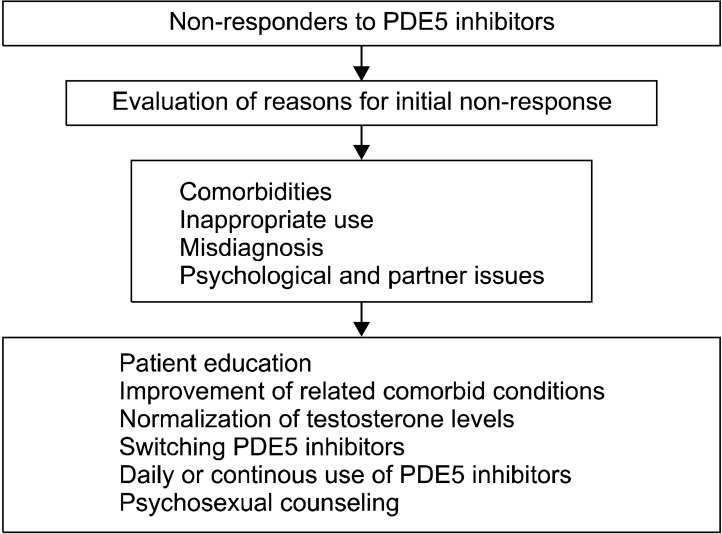
- Proposed management strategy covers patient education (the 'FAST' acronym: Follow-up, Adjusting time of administration, Sexual stimulation, Titration to the maximum tolerated dose), correcting comorbid conditions (e.g., hyperlipidemia with atorvastatin), normalizing testosterone, switching PDE5 inhibitors, daily/continuous dosing, and psychosexual counseling.
Limitations
- The paper does not state explicit limitations.
- Evident from the text: it is a narrative review without a described systematic search or formal evidence appraisal.
- Some supporting evidence is weak or indirect — the text notes "five uncontrolled studies" for added testosterone and that "data on the systemic effects of the continuous inhibition of PDE5 are limited," and it calls for further research into continuous administration.
Model-written summary. Check it against the paper before relying on it.
Integrity signals
Registry
Cites
Statistics
Figures
Verification
Claims the paper makes
0 Valid · 0 Not valid · 44 Not checked · 3 Own results and interpretations
None of the sources cited for this claim have been checked yet.
In the paper
“Testosterone deficiency seems to predict a poor response to sildenafil10-12 or tadalafil13 and the addition of testosterone seemed helpful in five uncontrolled studies.12-14”
§ Treatment Strategy for Non-Responders to PDE5 Inhibitors > REASONS FOR AN INITIAL NON-RESPONSE TO PDE5 INHIBITORS > 3. Misdiagnosis
What the sources say
hedgedstates an association- Asserted: passes — The authors put it forward as true.
- Checkable: passes — It can be checked against evidence.
- Load-bearing: passes — The paper’s conclusions depend on it.
- Based: passes — The paper gives a reason why it holds.
In the paper
“Several recent studies have suggested that ED can be the initial clinical presentation of underlying cardiovascular disease (CVD).4”
§ Treatment Strategy for Non-Responders to PDE5 Inhibitors > REASONS FOR AN INITIAL NON-RESPONSE TO PDE5 INHIBITORS > 1. Comorbidities
What the sources say
- Not checked yetcites [4] Vlachopoulos, 2005, Eur Urol source
hedgedstates an association- Asserted: passes — The authors put it forward as true.
- Checkable: passes — It can be checked against evidence.
- Load-bearing: unclear — It is unclear whether the paper’s conclusions depend on it.
- Based: passes — The paper gives a reason why it holds.
In the paper
“The reported efficacy of PDE5 inhibitors is about 70%, although it is significantly lower in difficult-to-treat subpopulations.”
§ Treatment Strategy for Non-Responders to PDE5 Inhibitors > Abstract
What the sources say
- Not checked yetcites [3] Hatzichristou, 2005, Eur Urol source
plain- Asserted: passes — The authors put it forward as true.
- Checkable: passes — It can be checked against evidence.
- Load-bearing: unclear — It is unclear whether the paper’s conclusions depend on it.
- Based: passes — The paper gives a reason why it holds.
In the paper
“Suetomi et al6 demonstrated the negative impact of MS on the response to sildenafil.”
§ Treatment Strategy for Non-Responders to PDE5 Inhibitors > REASONS FOR AN INITIAL NON-RESPONSE TO PDE5 INHIBITORS > 1. Comorbidities
What the sources say
- Not checked yetcites [6] Suetomi, 2008, J Sex Med source
boostedstates a cause- Asserted: passes — The authors put it forward as true.
- Checkable: passes — It can be checked against evidence.
- Load-bearing: passes — The paper’s conclusions depend on it.
- Based: passes — The paper gives a reason why it holds.
In the paper
“Two reasons for inappropriate use were identified: most patients had tried fewer than four attempts and the highest recommended dose had not been used by 31.3% and 7.9% of the patients in the tadalafil and vardenafil groups, respectively.”
§ Treatment Strategy for Non-Responders to PDE5 Inhibitors > REASONS FOR AN INITIAL NON-RESPONSE TO PDE5 INHIBITORS > 2. Inappropriate use
What the sources say
- Not checked yetcites [7] Hatzimouratidis, 2006, Eur Urol source
plainstates a cause- Asserted: passes — The authors put it forward as true.
- Checkable: passes — It can be checked against evidence.
- Load-bearing: unclear — It is unclear whether the paper’s conclusions depend on it.
- Based: passes — The paper gives a reason why it holds.
37 more claims
Create a free account to see all 47 claims and to verify the 51 references still open.
- Probably not a substantial claim. 2
- It may state two separate claims as one. 3
Citations
Cites
Bhasin, S., Cunningham, G. R., Hayes, F. J., Matsumoto, A. M., Snyder, P. J., Swerdloff, R. S., & Montori, V. M. (2006) · The Journal of Clinical Endocrinology & Metabolism · doi:10.1210/jc.2005-2847 · Cited by 965
SHABSIGH, R., KAUFMAN, J. M., STEIDLE, C., & PADMA-NATHAN, H. (2004) · Journal of Urology · doi:10.1097/01.ju.0000132389.97804.d7 · Cited by 406
Aversa, A., Isidori, A. M., Spera, G., Lenzi, A., & Fabbri, A. (2003) · Clinical Endocrinology · doi:10.1046/j.1365-2265.2003.01764.x · Cited by 343
Androgens Regulate Phosphodiesterase Type 5 Expression and Functional Activity in Corpora Cavernosa
Morelli, A., Filippi, S., Mancina, R., Luconi, M., Vignozzi, L., Marini, M., Orlando, C., Vannelli, G. B., Aversa, A., Natali, A., et al. (2004) · Endocrinology · doi:10.1210/en.2003-1699 · Cited by 286
Effects of Castration and Androgen Replacement on Erectile Function in a Rabbit Model1
Traish, A. M., Park, K., Dhir, V., Kim, N. N., Moreland, R. B., & Goldstein, I. (1999) · Endocrinology · doi:10.1210/endo.140.4.6655 · Cited by 276
Rosano, G. M. C., Aversa, A., Vitale, C., Fabbri, A., Fini, M., & Spera, G. (2005) · European Urology · doi:10.1016/j.eururo.2004.10.002 · Cited by 219
High Proportions of Erectile Dysfunction in Men With the Metabolic Syndrome
Esposito, K., Giugliano, F., Martedì, E., Feola, G., Marfella, R., D’Armiento, M., & Giugliano, D. (2005) · Diabetes Care · doi:10.2337/diacare.28.5.1201 · Cited by 212
Comparison of phosphodiesterase type 5 (PDE5) inhibitors: COMPARISON OF PDE5 INHIBITORS
WRIGHT, P. J. (2006) · International Journal of Clinical Practice · doi:10.1111/j.1742-1241.2006.01049.x · Cited by 138
Buvat, J., Montorsi, F., Maggi, M., Porst, H., Kaipia, A., Colson, M. H., Cuzin, B., Moncada, I., Martin-Morales, A., Yassin, A., et al. (2011) · The Journal of Sexual Medicine · doi:10.1111/j.1743-6109.2010.01956.x · Cited by 131
Vlachopoulos, C., Rokkas, K., Ioakeimidis, N., Aggeli, C., Michaelides, A., Roussakis, G., Fassoulakis, C., Askitis, A., & Stefanadis, C. (2005) · European Urology · doi:10.1016/j.eururo.2005.08.002 · Cited by 131
Research works printed but not linked: 2
- Traish, 1999, Endocrinology, 140, 1861, 10.1210/en.140.4.1861 · DOI · Paper page
- Ozgur, 2009, Urol J, 6, 267
Cited by
Medicinal plants as a potential source of Phosphodiesterase-5 inhibitors: A review
Anand Ganapathy, A., Priya, V. M. H., & Kumaran, A. (2020) · Journal of Ethnopharmacology · doi:10.1016/j.jep.2020.113536 · Cited by 79
Physicians' response to sexual dysfunction presented by a younger vs. An older adult
Gewirtz‐Meydan, A., & Ayalon, L. (2016) · International Journal of Geriatric Psychiatry · doi:10.1002/gps.4638 · Cited by 60
Prakash, S., Muhammed, I., Mohanraj, K. G., Lakshmanan, G., Premavathy, D., Muthu, S., Shimray, K. W., & Sathyanathan, S. B. (2018) · The Aging Male · doi:10.1080/13685538.2018.1439005 · Cited by 60
Canadian Urological Association guideline: Erectile dysfunction
Domes, T., Najafabadi, B. T., Roberts, M., Campbell, J. D., Flannigan, R. K., Bach, P. V., Patel, P., Langille, G. M., Krakowsky, Y., & Violette, P. D. (2021) · Canadian Urological Association Journal · doi:10.5489/cuaj.7572 · Cited by 51
Role of Schwann cells in the regeneration of penile and peripheral nerves
Lin, G., Lue, T., Wang, L., Sanford, M. T., & Xin, Z. (2015) · Asian Journal of Andrology · doi:10.4103/1008-682x.154306 · Cited by 49
Metadata
- Authors
- Park, N. C., Kim, T. N., & Park, H. J.
- Affiliations
- Pusan National University Hospital (KR)
- Corresponding author
- Park, Hyun Jun
- Venue
- The World Journal of Men's Health
- Publisher
- XMLink
- Published
- 2013
- Volume
- 31
- Issue
- 1
- Pages
- 31
- ISSN
- 2287-4208 (ISSN-L)
- 2287-4690
- PMC
- PMC3640150
- OpenAlex
- W2150046906
- Semantic Scholar
- b9c8f2f8127345aa68809070316d4c9d743fc37e
- Cited by
- 41
- References
- 26
- Citations by year
- 2026: 4 · 2025: 3 · 2024: 1 · 2023: 4 · 2022: 2 · 2021: 1 · 2020: 5 · 2019: 2 · 2018: 4 · 2017: 3 · 2016: 3 · 2015: 5 · 2014: 3 · 2013: 1
- FWCI
- 2.30
- Type
- journal article
- Language
- en
- Open access
- diamond
- doi.org
- Licence
- cc-by-nc
- creativecommons.org/licenses/by-nc/3.0/ (tdm)
- Locations
- The World Journal of Men s Health (publishedVersion, cc-by-nc)
- Europe PMC (PubMed Central) (publishedVersion, cc-by-nc)
- PubMed (publishedVersion)
- PubMed Central (publishedVersion, cc-by-nc)
- Funders
- Pusan National University
- Pusan National University Hospital
- Topics
- Health Sciences › Medicine › Psychiatry and Mental health › Sexual function and dysfunction studies
- Health Sciences › Medicine › Urology › Urological Disorders and Treatments
- Health Sciences › Medicine › Rheumatology › Dupuytren's Contracture and Treatments
- Keywords
- erectile dysfunction, phosphodiesterase-5 inhibitors, treatment non-responders, treatment failure, performance anxiety, psychological factors, patient expectations, relational dynamics, treatment options
About these checks
Registry, retraction, Cites and statistics results are computed, not judged, with one exception: a printed reference that no index lists is read once by a model before it counts as a citation error. Claims are extracted by a model and kept only when their quote appears verbatim in the text; each cited source is then checked, with a model’s help, for whether it says what the claim relies on. Those verdicts can be wrong — read the claim’s quote and the cited source before relying on one.
A language model drew the claims from the paper on 2026-11-14, under version 3 of the claim definition (model deepseek-v4.1-flash, prompt extract-v3).
A second model labelled each claim on 2026-11-14 (model jev-1.13-20260917, definition revision gold-guideline-v0.2).
Statistics and arithmetic are recomputed, not judged.
Confidence bands are shown only for fields calibrated on our annotated test set. None is calibrated yet, so no band is shown.
What counts as a claim ›How we measure confidence ›How we check this ›
Are you an author, or do you see a problem with this page? Request a review
How to cite
Cite CoChat for the checks on this page, and the paper for its own findings.
- This page
- CoChat. (2026). Citation check: Treatment Strategy for Non-Responders to PDE5 Inhibitors. https://app.cochat.ai/papers/10.5534/wjmh.2013.31.1.31
- The paper
- Park, N. C., Kim, T. N., & Park, H. J. (2013). Treatment Strategy for Non-Responders to PDE5 Inhibitors. The World Journal of Men's Health. https://doi.org/10.5534/wjmh.2013.31.1.31
Data sources
Bibliographic data: Semantic Scholar, OpenAlex, Crossref.
Contains information from the Semantic Scholar Academic Graph Datasets, made available under the ODC Attribution License (ODC-BY 1.0).
Semantic Scholar’s data is described in: Kinney, R., et al. (2023). The Semantic Scholar Open Data Platform. arXiv:2301.10140.
