

The DOI matches its Crossref record; 49 of the 49 references it cites were found in a registry or an index.
The Role of Bile Acids in Glucose Metabolism and Their Relation with Diabetes
Open accessAbstract
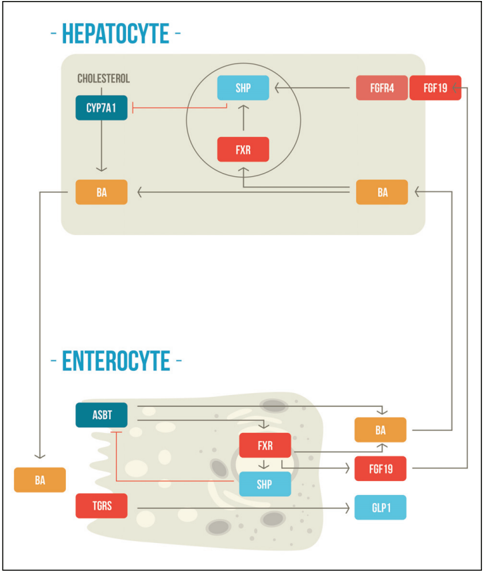
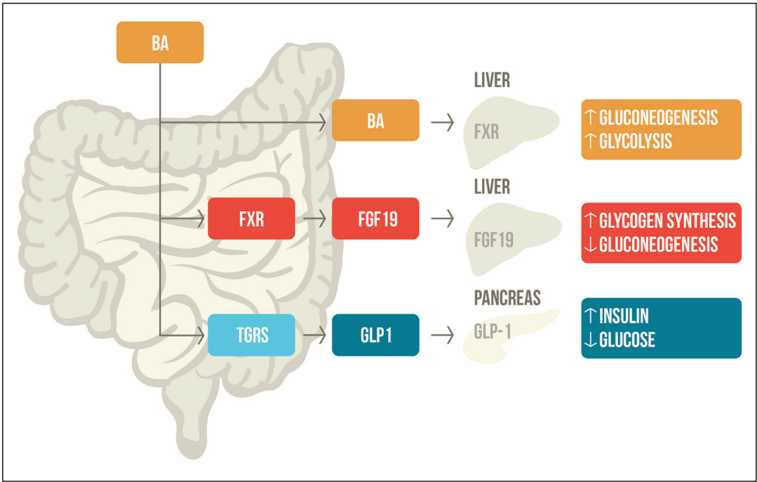
Bile acids (BAs), the end products of cholesterol catabolism, are essential for the absorption of lipids and fat-soluble vitamins; but they have also emerged as novel signaling molecules that act as metabolic regulators. It has been well described that the enterohe-patic circulation, a nuclear (FXR) and a cytoplasmic (TGR5/M-BAR) receptor aid in controlling hepatic bile acid synthesis. Modulating bile acid synthesis greatly impacts in metabolism, because these receptors also are implicated in glucose, lipid, and energy expenditure. Recent studies had revealed the way these receptors participate in regulating gluconeogenesis, peripheral insulin sensitivity, glycogen synthesis, glucagon like peptide 1 (GLP-1) and insulin secretion. Nowadays, it is demonstrated that enhancing bile acid signaling in the intestine contributes to the metabolic benefits of bile acid sequestrants and bariatric surgery on glucose homeos-tasis. This paper discusses the role of bile acid as regulators of glucose metabolism and their potential as therapeutic targets for diabetes.
Overview
The claims and statistics of this paper haven’t been checked yet.
Run the check — free, no account needed. It reads the open-access text and checks the sources it cites.
Integrity signals
Registry
Cites
Statistics
Figures
Verification
Claims the paper makes
The claims and statistics of this paper haven’t been checked yet.
Run the check — free, no account needed. It reads the open-access text and checks the sources it cites.
Claims other papers make about this one
Each is checked against this paper’s own text: does it say what the citing paper says it does?
In the citing paper
“The GM influences BA metabolism, and BAs affect the GM’s composition (296).”
From Signalling cognition: The gut microbiota and hypothalamic-pituitary-adrenal axis (2023) · cites this paper as [296]
Self-check
Percentages, sums and reported differences re-computed from the paper’s own numbers.
The self-check needs the paper’s full text.
Citations
Cites
Stratton, I. M. (2000) · BMJ · doi:10.1136/bmj.321.7258.405 · Cited by 9,059
The Physiology of Glucagon-like Peptide 1
Holst, J. J. (2007) · Physiological Reviews · doi:10.1152/physrev.00034.2006 · Cited by 3,371
Identification of a nuclear receptor for bile acids
Makishima, M., Okamoto, A. Y., Repa, J. J., Tu, H., Learned, R. M., Luk, A., Hull, M. V., Lustig, K. D., Mangelsdorf, D. J., & Shan, B. (1999) · Science · doi:10.1126/science.284.5418.1362 · Cited by 2,714
A regulatory cascade of the nuclear receptors FXR, SHP-1, and LRH-1 represses bile acid biosynthesis
Goodwin, B., Jones, S. A., Price, R. R., Watson, M. A., McKee, D. D., Moore, L. B., Galardi, C., Wilson, J. G., Lewis, M. C., Roth, M. E., et al. (2000) · Molecular Cell · doi:10.1016/s1097-2765(00)00051-4 · Cited by 1,940
TGR5-Mediated Bile Acid Sensing Controls Glucose Homeostasis
Thomas, C., Gioiello, A., Noriega, L., Strehle, A., Oury, J., Rizzo, G., Macchiarulo, A., Yamamoto, H., Mataki, C., Pruzanski, M., et al. (2009) · Cell Metabolism · doi:10.1016/j.cmet.2009.08.001 · Cited by 1,885
Role of Bile Acids and Bile Acid Receptors in Metabolic Regulation
Lefebvre, P., Cariou, B., Lien, F., Kuipers, F., & Staels, B. (2009) · Physiological Reviews · doi:10.1152/physrev.00010.2008 · Cited by 1,678
A G Protein-coupled Receptor Responsive to Bile Acids
Kawamata, Y., Fujii, R., Hosoya, M., Harada, M., Yoshida, H., Miwa, M., Fukusumi, S., Habata, Y., Itoh, T., Shintani, Y., et al. (2003) · Journal of Biological Chemistry · doi:10.1074/jbc.m209706200 · Cited by 1,628
Bile acids: regulation of synthesis
Chiang, J. Y. L. (2009) · Journal of Lipid Research · doi:10.1194/jlr.r900010-jlr200 · Cited by 1,515
Identification of membrane-type receptor for bile acids (M-BAR)
Maruyama, T., Miyamoto, Y., Nakamura, T., Tamai, Y., Okada, H., Sugiyama, E., Nakamura, T., Itadani, H., & Tanaka, K. (2002) · Biochemical and Biophysical Research Communications · doi:10.1016/s0006-291x(02)02550-0 · Cited by 993
Activation of the nuclear receptor FXR improves hyperglycemia and hyperlipidemia in diabetic mice
Zhang, Y., Lee, F. Y., Barrera, G., Lee, H., Vales, C., Gonzalez, F. J., Willson, T. M., & Edwards, P. A. (2006) · Proceedings of the National Academy of Sciences · doi:10.1073/pnas.0506982103 · Cited by 974
Cited by
Sorted by citations
Effect of Diet and Dietary Components on the Composition of the Gut Microbiota
Beam, A., Clinger, E., & Hao, L. (2021) · Nutrients · doi:10.3390/nu13082795 · Cited by 576
Bile Acids Activated Receptors Regulate Innate Immunity
Fiorucci, S., Biagioli, M., Zampella, A., & Distrutti, E. (2018) · Frontiers in Immunology · doi:10.3389/fimmu.2018.01853 · Cited by 580
Metabolomics and lipidomics in NAFLD: biomarkers and non-invasive diagnostic tests
Masoodi, M., Gastaldelli, A., Hyötyläinen, T., Arretxe, E., Alonso, C., Gaggini, M., Brosnan, J., Anstee, Q. M., Millet, O., Ortiz, P., et al. (2021) · Nature Reviews Gastroenterology & Hepatology · doi:10.1038/s41575-021-00502-9 · Cited by 451
Signalling cognition: The gut microbiota and hypothalamic-pituitary-adrenal axis
Rusch, J. A., Layden, B. T., & Dugas, L. R. (2023) · Frontiers in Endocrinology · doi:10.3389/fendo.2023.1130689 · Cited by 415
You Are What You Eat—The Relationship between Diet, Microbiota, and Metabolic Disorders—A Review
Moszak, M., Szulińska, M., & Bogdański, P. (2020) · Nutrients · doi:10.3390/nu12041096 · Cited by 397
Metadata
- Authors
- Alberto González-Regueiro, J., Moreno-Castañeda, L., Uribe, M., & Carlos Chávez-Tapia, N.
- Affiliations
- Hospital Médica Sur (MX)
- ORCID
- Uribe, Misael
- Venue
- Annals of Hepatology
- Publisher
- Elsevier BV
- Published
- 2017-11
- Volume
- 16
- Issue
- Suppl. 1: s3-105.
- Pages
- S15-S20
- ISSN
- 1665-2681 (ISSN-L)
- OpenAlex
- W3194266802
- Cited by
- 247
- References
- 49
- Citations by year
- 2026: 25 · 2025: 26 · 2024: 43 · 2023: 34 · 2022: 34 · 2021: 38 · 2020: 20 · 2019: 12 · 2018: 15
- FWCI
- 5.70
- Type
- journal article
- Language
- en
- Open access
- hybrid
- doi.org
- Licence
- Locations
- Annals of Hepatology (publishedVersion, cc-by-nc-nd)
- PubMed (publishedVersion)
- DOAJ (DOAJ: Directory of Open Access Journals) (submittedVersion, cc-by-sa)
- Funders
- Australian Government
- Topics
- Health Sciences › Medicine › Oncology › Drug Transport and Resistance Mechanisms
- Life Sciences › Biochemistry, Genetics and Molecular Biology › Biochemistry › Cholesterol and Lipid Metabolism
- Life Sciences › Biochemistry, Genetics and Molecular Biology › Molecular Biology › Gut microbiota and health
- Keywords
- bile acids, glucose metabolism, diabetes mellitus, enterohepatic circulation, farnesoid X receptor, TGR5, bile acid synthesis, gluconeogenesis, insulin sensitivity, glycogen synthesis, glucagon-like peptide-1, insulin secretion, bile acid sequestrants, bariatric surgery, glucose homeostasis, therapeutic target
- MeSH terms
- Gastrointestinal Microbiome, Animals, Bacteria, Bile Acids and Salts, Energy Metabolism, Humans, Intestines, Obesity, Signal Transduction, Host-Pathogen Interactions, Dysbiosis
About these checks
Registry, retraction, Cites and statistics results are computed, not judged, with one exception: a printed reference that no index lists is read once by a model before it counts as a citation error. Claims are extracted by a model and kept only when their quote appears verbatim in the text; each cited source is then checked, with a model’s help, for whether it says what the claim relies on. Those verdicts can be wrong — read the claim’s quote and the cited source before relying on one.
Statistics and arithmetic are recomputed, not judged.
Confidence bands are shown only for fields calibrated on our annotated test set. None is calibrated yet, so no band is shown.
What counts as a claim ›How we measure confidence ›How we check this ›
Are you an author, or do you see a problem with this page? Request a review
