

The DOI matches its Crossref record; 31 of the 31 references it cites were found in a registry or an index; none of the 8 sources its claims cite is checked for support yet.
Acute beetroot supplementation may improve blood pressure but not exercise economy in female masters swimmers
Open accessAbstract
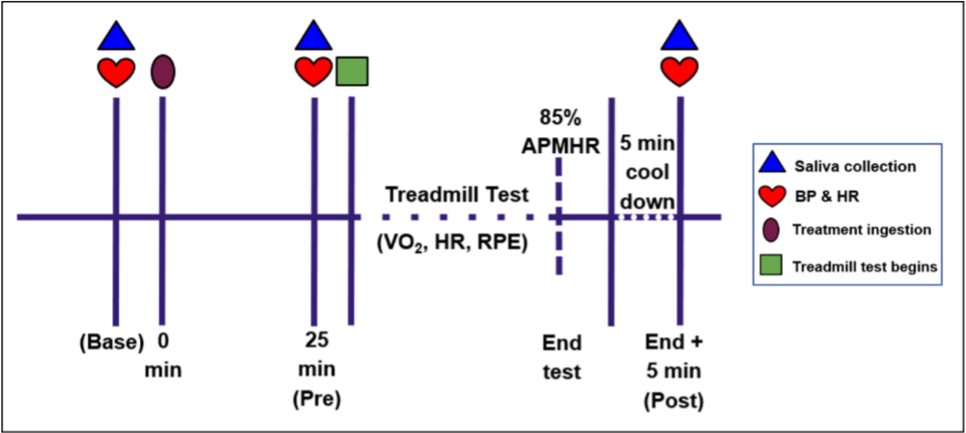
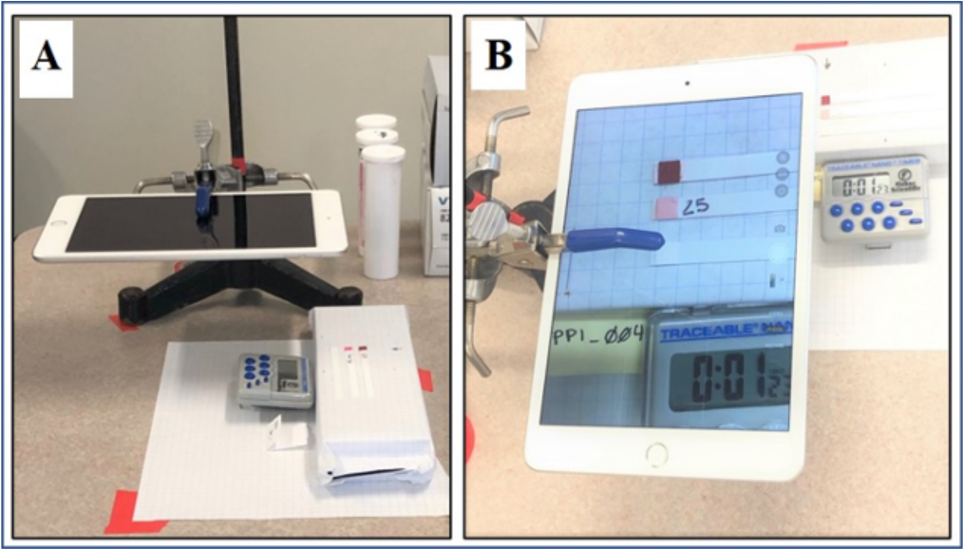
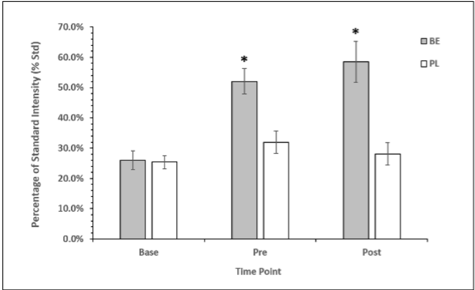
It is known that beetroot supplements may improve exercise economy and blood pressure, but this has mainly been studied in males. Given that older female athletes are underrepresented in the literature, we aimed to determine if acute beetroot supplementation (BRS) improves exercise economy and blood pressure in masters female athletes (swimmers) during a treadmill exercise test. Methods: 11 participants (57.8±10.5 y) underwent 2 randomized, double-blinded trials, ingesting beetroot (BE) or placebo (PL). Salivary NO2- (sNO2-) and blood pressure (BP) were measured pre-ingestion (Base), pre-exercise (Pre), and 5 min post-exercise (Post). Oxygen consumption (VO2) was measured during the modified Balke test until HR reached 85% of age-predicted maximum. Exercise economy (ExEc) was defined as the average relative VO2 during min 3-4.5 of the test. sNO2- was determined using NO2- detection strips. Results: sNO2- increased from Base to Post in BE vs PL (32.5±7.0 vs 2.7±3.9% change, p=0.001). No treatment differences existed for ExEc (BE: 15.51±0.47 vs PL: 15.71±0.53 ml·kg-1·min-1, p=0.48). Diastolic BP was significantly lower in BE vs PL (Base: 74.6±1.7 vs 73.2±2.3, Pre: 73.6±1.8 vs 74.5±2.1, Post: 74.5±1.7 vs 76.1±2.2 mmHg, p=0.03, treatment by time). Conclusion: Acute BRS lowered diastolic BP, but did not improve exercise economy in these trained, normotensive athletes. Further research is warranted in menopausal and post-menopausal females, including those who are hypertensive, and in other female masters athlete groups.
Overview
CoChat Summary
TL;DR
Acute beetroot supplementation increased salivary nitrite and lowered post-exercise diastolic blood pressure but did not improve exercise economy or treadmill test time in female masters swimmers. The authors conclude that acute BRS may improve diastolic BP in this healthy, normotensive trained group, but not ExEc, with dose and timing likely contributing.
Key findings
- Salivary nitrite increased from baseline to post-exercise in beetroot vs placebo: 32.5±7.0% vs 2.7±3.9% change, p=0.001.
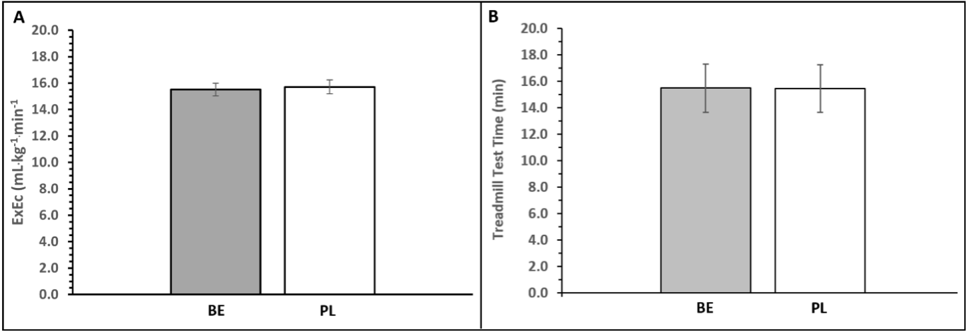
- Exercise economy did not differ between treatments: BE 15.51±0.47 vs PL 15.71±0.53 mL·kg⁻¹·min⁻¹, p=0.48; treadmill test time also did not differ: BE 15.5±1.9 vs PL 15.4±1.8 min, p=0.92.
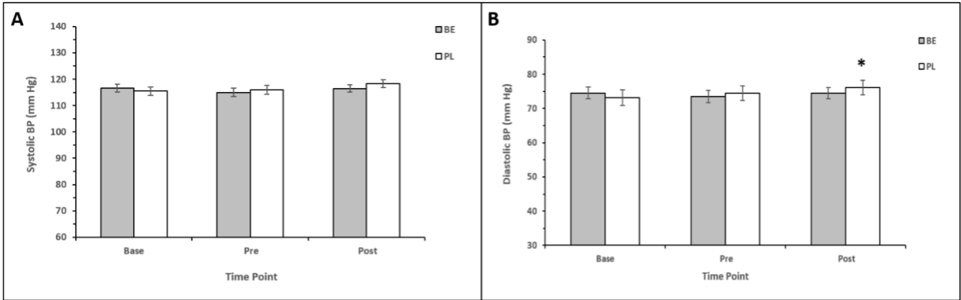
- Diastolic BP was significantly lower with BE vs PL by time and treatment-by-time: Base 74.6±1.7 vs 73.2±2.3, Pre 73.6±1.8 vs 74.5±2.1, Post 74.5±1.7 vs 76.1±2.2 mmHg, p=0.035 time and p=0.026 treatment-by-time; treatment-only difference was not significant, p=0.79.
- Systolic BP showed no treatment difference, p=0.71, though trends existed for time, p=0.059, and treatment-by-time, p=0.053. Heart rate and peak RPE also did not differ between treatments, p=0.12 and p=0.25, respectively.
Methods
- Randomized, double-blind, crossover design with 11 female masters swimmers (age 57.8±10.4 yrs; height 167.8±5.5 cm; body mass 66.7±11.0 kg) who had trained and competed in swimming for at least the last year.
- Participants ingested 10 oz beetroot supplement (BeetElite) or placebo 30 min before a modified Balke treadmill test; salivary NO₂⁻, BP, and HR were measured pre-ingestion, pre-exercise, and 5 min post-exercise. VO₂ was measured every 15 sec, and exercise economy was the average relative VO₂ during minutes 3–4.5; testing ended at 85% of age-predicted maximum HR.
- ExEc, RPE, and treadmill time were analyzed with paired t-tests; salivary NO₂⁻, SBP, DBP, and HR with two-way repeated-measures ANOVA; significance set at p≤0.05; SPSS Version 26 used.
Limitations
- Stated by the authors: starting the treadmill protocol 30 min post-supplementation may have been too soon to detect an oxygen-consumption effect; plasma nitrite and nitrate were not assessed; a treadmill test was used in trained swimmers rather than a swimming test because of VO₂ collection challenges; and the supplement’s nitrate content may have been too low to elicit a physiological effect on oxygen consumption.
- Evident from the text: the sample was small (n=11) and consisted of healthy, normotensive, trained female masters swimmers, limiting generalizability; the study was acute and single-dose, and the authors note that the beetroot supplement contained only 2.16±0.28 mmol NO₃⁻, below the suggested minimal effective dose of at least 5.0 mmol and taken only 30 min before exercise rather than the commonly used 2–3 h.
Model-written summary. Check it against the paper before relying on it.
Integrity signals
Registry
Cites
Statistics
Figures
Verification
Claims the paper makes
0 Valid · 0 Not valid · 7 Not checked · 19 Own results and interpretations
A result the paper reports from its own data — it cites no other source for it, so there is none to check. The quote shows it is in the paper.
In the paper
“No treatment differences existed for ExEc (BE: 15.51±0.47vs PL: 15.71±0.53ml•kg-1•min-1, p = 0.48).”
- Also stated in: § 3.3 Exercise Economy · plain
“There were no significant differences between treatments in ExEc (BE: 15.51±0.47 vs. PL: 15.71±0.53ml•kg-1•min-1, p = 0.48, Fig. 5A).”
- Also stated in: § 5 Conclusion · plain
“Acute beetroot supplementation did not improve exercise economy in this population of trained female masters athletes”
§ ACUTE BEETROOT SUPPLEMENTATION MAY IMPROVE BLOOD PRESSURE BUT NOT EXERCISE ECONOMY IN FEMALE MASTERS SWIMMERS > Abstract
plainn = 11- Asserted: passes — The authors put it forward as true.
- Checkable: passes — It can be checked against evidence.
- Load-bearing: passes — The paper’s conclusions depend on it.
- Based: passes — The paper gives a reason why it holds.
- Also stated in: § 3.3 Exercise Economy · plain
A result the paper reports from its own data — it cites no other source for it, so there is none to check. The quote shows it is in the paper.
In the paper
“There was also no significant difference in treadmill test time between BE and PL (BE: 15.5 ± 1.9 vs. PL: 15.4 ± 1.8 min, p = 0.92, Fig. 5B).”
§ ACUTE BEETROOT SUPPLEMENTATION MAY IMPROVE BLOOD PRESSURE BUT NOT EXERCISE ECONOMY IN FEMALE MASTERS SWIMMERS > 3.3 Exercise Economy
plain- Asserted: passes — The authors put it forward as true.
- Checkable: passes — It can be checked against evidence.
- Load-bearing: passes — The paper’s conclusions depend on it.
- Based: passes — The paper gives a reason why it holds.
A result the paper reports from its own data — it cites no other source for it, so there is none to check. The quote shows it is in the paper.
In the paper
“Peak RPE was not significantly different between treatments (BE: 6.2 ± 0.5 vs. PL: 6.5 ± 0.5, p = 0.25).”
§ ACUTE BEETROOT SUPPLEMENTATION MAY IMPROVE BLOOD PRESSURE BUT NOT EXERCISE ECONOMY IN FEMALE MASTERS SWIMMERS > 3.5 Rating of Perceived Exertion
plain- Asserted: passes — The authors put it forward as true.
- Checkable: passes — It can be checked against evidence.
- Load-bearing: unclear — It is unclear whether the paper’s conclusions depend on it.
- Based: passes — The paper gives a reason why it holds.
A result the paper reports from its own data — it cites no other source for it, so there is none to check. The quote shows it is in the paper.
In the paper
“As shown in Figure 3A, no treatment differences in systolic BP were found between BE and PL (Base: 116.6 ± 1.5 vs. 115.5 ± 1.6, Pre: 115.0 ± 1.7 vs. 116.0± 1.7, Post: 116.5 ± 1.4 vs. 118.3± 1.5 mmHg, respectively, p = 0.71), although trends towards significance existed for differences by time (p = 0.059), and treatment by time (p = 0.053).”
§ ACUTE BEETROOT SUPPLEMENTATION MAY IMPROVE BLOOD PRESSURE BUT NOT EXERCISE ECONOMY IN FEMALE MASTERS SWIMMERS > 3.1 Blood pressure
plain- Asserted: passes — The authors put it forward as true.
- Checkable: passes — It can be checked against evidence.
- Load-bearing: passes — The paper’s conclusions depend on it.
- Based: passes — The paper gives a reason why it holds.
A conclusion the paper draws from its own results — it cites no other source for it, so there is none to check. The quote shows it is in the paper.
In the paper
“Therefore, the timing of our dose in the present study likely contributed to the findings of no difference in ExEc.”
§ ACUTE BEETROOT SUPPLEMENTATION MAY IMPROVE BLOOD PRESSURE BUT NOT EXERCISE ECONOMY IN FEMALE MASTERS SWIMMERS > 4 Discussion
hedgedstates a possible cause- Asserted: passes — The authors put it forward as true.
- Checkable: passes — It can be checked against evidence.
- Load-bearing: passes — The paper’s conclusions depend on it.
- Based: passes — The paper gives a reason why it holds.
2 more claims
Create a free account to see all 26 claims and to verify the 5 references still open.
- It may state two separate claims as one. 10
- Probably not a substantial claim. 12
Self-check
Percentages, sums and reported differences re-computed from the paper’s own numbers.
Each contradiction between two passages listed here was confirmed by an independent check.
Rated minor: it would not touch a result — a value no result rests on, a p-value that stays on the same side of the significance level, or a conflict that is clerical, resolved elsewhere in the paper, or outside its own findings.
In the paper
§ ACUTE BEETROOT SUPPLEMENTATION MAY IMPROVE BLOOD PRESSURE BUT NOT EXERCISE ECONOMY IN FEMALE MASTERS SWIMMERS > 2.1 Experimental Design
“HR and RPE were measured every 60 sec of the treadmill test until participants reached 85% of their APMHR.”
§ ACUTE BEETROOT SUPPLEMENTATION MAY IMPROVE BLOOD PRESSURE BUT NOT EXERCISE ECONOMY IN FEMALE MASTERS SWIMMERS > 2.3.6 Rating of Perceived Exertion
“RPE was assessed every 2 min during the treadmill test using a 1-10 scale”
Rated minor: it would not touch a result — a value no result rests on, a p-value that stays on the same side of the significance level, or a conflict that is clerical, resolved elsewhere in the paper, or outside its own findings.
In the paper
§ ACUTE BEETROOT SUPPLEMENTATION MAY IMPROVE BLOOD PRESSURE BUT NOT EXERCISE ECONOMY IN FEMALE MASTERS SWIMMERS > 3.2 Salivary NO2-
“with significant time and treatment by time effects (p = 0.000).”
§ ACUTE BEETROOT SUPPLEMENTATION MAY IMPROVE BLOOD PRESSURE BUT NOT EXERCISE ECONOMY IN FEMALE MASTERS SWIMMERS > 5 Conclusion
“Significant effects were found for treatment (*p = 0.012), time (p = 0.000), and treatment by time (p = 0.001).”
Rated minor: it would not touch a result — a value no result rests on, a p-value that stays on the same side of the significance level, or a conflict that is clerical, resolved elsewhere in the paper, or outside its own findings.
In the paper
§ ACUTE BEETROOT SUPPLEMENTATION MAY IMPROVE BLOOD PRESSURE BUT NOT EXERCISE ECONOMY IN FEMALE MASTERS SWIMMERS > 3.3 Exercise Economy
“There were no significant differences between treatments in ExEc (BE: 15.51±0.47 vs. PL: 15.71±0.53ml•kg-1•min-1, p = 0.48, Fig. 5A).There was also no significant difference in treadmill test time between BE and PL (BE: 15.5 ± 1.9 vs. PL: 15.4 ± 1.8 min, p = 0.92, Fig. 5B).”
§ ACUTE BEETROOT SUPPLEMENTATION MAY IMPROVE BLOOD PRESSURE BUT NOT EXERCISE ECONOMY IN FEMALE MASTERS SWIMMERS > 5 Conclusion
“(A) Total treadmill time; test was terminated, and the end time recorded, when participants reached 85% of age-predicted maximum heart rate.No difference was found between treatments (p = 0.915.(B) Peak VO 2 during the treadmill test for each treatment; no difference was found between treatments (p = 0.314).”
Rated minor: it would not touch a result — a value no result rests on, a p-value that stays on the same side of the significance level, or a conflict that is clerical, resolved elsewhere in the paper, or outside its own findings.
In the paper
§ ACUTE BEETROOT SUPPLEMENTATION MAY IMPROVE BLOOD PRESSURE BUT NOT EXERCISE ECONOMY IN FEMALE MASTERS SWIMMERS > Abstract
“11 participants (57.8±10.5 y) underwent 2 randomized, double-blinded trials”
§ ACUTE BEETROOT SUPPLEMENTATION MAY IMPROVE BLOOD PRESSURE BUT NOT EXERCISE ECONOMY IN FEMALE MASTERS SWIMMERS > 2.2 Participants
“Eleven female masters swimmers (age 57.8±10.4yrs.; height: 167.8±5.5 cm; body mass: 66.7±11.0kg) enrolled in and completed the study.”
Citations
Cites
Faul, F., Erdfelder, E., Lang, A.-G., & Buchner, A. (2007) · Behavior Research Methods · doi:10.3758/bf03193146 · Cited by 65,971
NIH Image to ImageJ: 25 years of image analysis
Schneider, C. A., Rasband, W. S., & Eliceiri, K. W. (2012) · Nature Methods · doi:10.1038/nmeth.2089 · Cited by 64,638
Age-predicted maximal heart rate revisited
Tanaka, H., Monahan, K. D., & Seals, D. R. (2001) · Journal of the American College of Cardiology · doi:10.1016/s0735-1097(00)01054-8 · Cited by 3,775
Webb, A. J., Patel, N., Loukogeorgakis, S., Okorie, M., Aboud, Z., Misra, S., Rashid, R., Miall, P., Deanfield, J., Benjamin, N., et al. (2008) · Hypertension · doi:10.1161/hypertensionaha.107.103523 · Cited by 1,078
Bailey, S. J., Winyard, P., Vanhatalo, A., Blackwell, J. R., DiMenna, F. J., Wilkerson, D. P., Tarr, J., Benjamin, N., & Jones, A. M. (2009) · Journal of Applied Physiology · doi:10.1152/japplphysiol.00722.2009 · Cited by 759
Inorganic nitrate is a possible source for systemic generation of nitric oxide
Lundberg, J. O., & Govoni, M. (2004) · Free Radical Biology and Medicine · doi:10.1016/j.freeradbiomed.2004.04.027 · Cited by 657
Effects of dietary nitrate on oxygen cost during exercise
Larsen, F. J., Weitzberg, E., Lundberg, J. O., & Ekblom, B. (2007) · Acta Physiologica · doi:10.1111/j.1748-1716.2007.01713.x · Cited by 637
Inorganic Nitrate Supplementation Lowers Blood Pressure in Humans: Role for Nitrite-Derived NO
Kapil, V., Milsom, A. B., Okorie, M., Maleki-Toyserkani, S., Akram, F., Rehman, F., Arghandawi, S., Pearl, V., Benjamin, N., Loukogeorgakis, S., et al. (2010) · Hypertension · doi:10.1161/hypertensionaha.110.153536 · Cited by 621
Spiegelhalder, B., Eisenbrand, G., & Preussmann, R. (1976) · Food and Cosmetics Toxicology · doi:10.1016/s0015-6264(76)80005-3 · Cited by 596
Vanhatalo, A., Bailey, S. J., Blackwell, J. R., DiMenna, F. J., Pavey, T. G., Wilkerson, D. P., Benjamin, N., Winyard, P. G., & Jones, A. M. (2010) · American Journal of Physiology-Regulatory, Integrative and Comparative Physiology · doi:10.1152/ajpregu.00206.2010 · Cited by 529
Research works printed but not linked: 1
- M. Macuh and B. Knap. "Effects of Nitrate Supplementation on Exercise Performance in Humans: A". In: Narrative Review. Nutri- ents 13.9 (2021), p. 3183.
Cited by
Effects of Supplementation in Masters Athletes and Older Adults: A Narrative Review
Nguyen, C., Allen, M. R., Hornburg, K., & Fredericson, M. (2026) · Current Sports Medicine Reports · doi:10.1249/jsr.0000000000001353
Metadata
- Authors
- Eastman, A. Q., Sloop, O., Gokhale, R. A., & Ferguson-Stegall, L. M.
- Affiliations
- Hamline University (US)
- NYU Langone Health (US)
- Venue
- Journal of Kinesiology & Wellness
- Published
- 2023-04-04
- Volume
- 12
- Issue
- 1
- Pages
- 1-9
- ISSN
- 2332-4503 (ISSN-L)
- OpenAlex
- W4387082504
- Semantic Scholar
- 8fa097f2196d8a4e7c6097c27682970530178519
- Cited by
- 1
- References
- 31
- Citations by year
- 2026: 1
- FWCI
- 0.15
- Type
- journal article
- Language
- en
- Open access
- hybrid
- doi.org
- Licence
- Locations
- Journal of Kinesiology & Wellness (publishedVersion, cc-by-nc-nd)
- Funders
- Hamline University
- Topics
- Health Sciences › Medicine › Physiology (medical) › Cardiovascular and exercise physiology
- Health Sciences › Medicine › Physiology (medical) › Exercise and Physiological Responses
- Health Sciences › Medicine › Orthopedics and Sports Medicine › Sports Performance and Training
- Keywords
- blood pressure, exercise economy, nitric oxide, swimmers, treadmill exercise, oxygen consumption, diastolic blood pressure, menopause
About these checks
Registry, retraction, Cites and statistics results are computed, not judged, with one exception: a printed reference that no index lists is read once by a model before it counts as a citation error. Claims are extracted by a model and kept only when their quote appears verbatim in the text; each cited source is then checked, with a model’s help, for whether it says what the claim relies on. Those verdicts can be wrong — read the claim’s quote and the cited source before relying on one.
A language model drew the claims from the paper on 2026-11-14, under version 3 of the claim definition (model deepseek-v4.1-flash, prompt extract-v3).
A second model labelled each claim on 2026-11-14 (model jev-1.13-20260917, definition revision gold-guideline-v0.2).
Statistics and arithmetic are recomputed, not judged.
Confidence bands are shown only for fields calibrated on our annotated test set. None is calibrated yet, so no band is shown.
What counts as a claim ›How we measure confidence ›How we check this ›
Are you an author, or do you see a problem with this page? Request a review
Data sources
Bibliographic data: Semantic Scholar, OpenAlex, Crossref.
Contains information from the Semantic Scholar Academic Graph Datasets, made available under the ODC Attribution License (ODC-BY 1.0).
Semantic Scholar’s data is described in: Kinney, R., et al. (2023). The Semantic Scholar Open Data Platform. arXiv:2301.10140.
