

Wildfire and Spatial Patterns in Forests in Northwestern Mexico: The United States Wishes It Had Similar Fire Problems
Open accessThe DOI matches its Crossref record; 39 of the 39 references it cites were found in a registry or an index.
Abstract
Stephens, S. L., D. L. Fry, and E. Franco-Vizcaíno 2008. Wildfire and spatial patterns in forests in northwestern Mexico: the United States wishes it had similar fire problems. Ecology and Society 13(2): 10. https://doi.org/10.5751/ES-02380-130210
Overview
The claims and statistics of this paper haven’t been checked yet.
Free: it reads the open-access text and checks the first 5 claims that cite a source we can check. Create a free account to check every claim.
Integrity signals
Registry
Cites
Statistics
Figures
Verification
Claims the paper makes
The claims and statistics of this paper haven’t been checked yet.
Free: it reads the open-access text and checks the first 5 claims that cite a source we can check. Create a free account to check every claim.
Claims other papers make about this one
Each is checked against this paper’s own text: does it say what the citing paper says it does?
The source backs part of the claim, not all of it — or backs it for a different population, condition or comparison.
In the citing paper
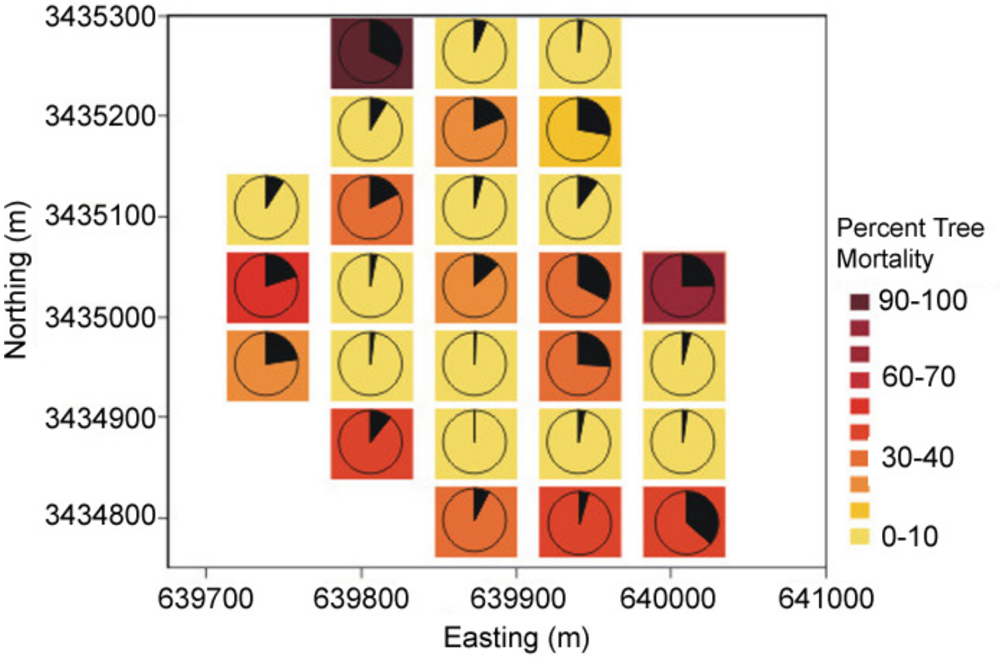
“After the drought ended, a wildfire burned in the northern SSPM in 2003, but only 20% of the trees in this forest died from the combined effects of a severe 4-year drought followed by a wildfire (figure 4; Stephens et al. 2008), demonstrating considerable resilience to drought, tree-killing insects, and wildfire.”
From Drought, Tree Mortality, and Wildfire in Forests Adapted to Frequent Fire (2018) · cites this paper as Stephens et al. 2008
Experimental — accuracy not yet measuredThe cited source says what the claim attributes to it.
In the citing paper
“Lacking the legacy of live trees that historic FF would have left (Stephens et al. 2008), large unburned areas of dead trees may also produce unusual forest succession patterns.”
From Drought, Tree Mortality, and Wildfire in Forests Adapted to Frequent Fire (2018) · cites this paper as Stephens et al. 2008
Self-check
Percentages, sums and reported differences re-computed from the paper’s own numbers.
The self-check needs the paper’s full text.
Citations
Cites
Classification and Regression Trees.
Gordon, A. D., Breiman, L., Friedman, J. H., Olshen, R. A., & Stone, C. J. (1984) · Biometrics · doi:10.2307/2530946 · Cited by 23,522
Classification and Regression Trees.
Ryzin, J. V., Breiman, L., Friedman, J. H., Olshen, R. A., & Stone, C. J. (1986) · Journal of the American Statistical Association · doi:10.2307/2288003 · Cited by 20,825
Classification and regression trees
Praagman, J. (1985) · European Journal of Operational Research · doi:10.1016/0377-2217(85)90321-2 · Cited by 10,053
Warming and earlier spring increase western U.S. forest wildfire activity.
Westerling, A. L., Hidalgo, H. G., Cayan, D. R., & Swetnam, T. W. (2006) · Science · doi:10.1126/science.1128834 · Cited by 5,176 · cited 1×
“Further increases in fire behavior and extent may occur from a predicted lengthening of the fire season due to global warming (McKenzie et al. 2004, Westerling et al. 2006).”
BackgroundCLASSIFICATION AND REGRESSION TREES: A POWERFUL YET SIMPLE TECHNIQUE FOR ECOLOGICAL DATA ANALYSIS
De'ath, G., & Fabricius, K. E. (2000) · Ecology · doi:10.1890/0012-9658(2000)081[3178:cartap]2.0.co;2 · Cited by 3,167
Basic principles of forest fuel reduction treatments
Agee, J. K., & Skinner, C. N. (2005) · Forest Ecology and Management · doi:10.1016/j.foreco.2005.01.034 · Cited by 1,397 · cited 1×
“…and past harvesting have increased surface and ladder fuels, particularly in those US forests that once experienced frequent, lowmoderate severity fire regimes, resulting in many forested areas that are vulnerable to uncharacteristically severe fires (Agee and Skinner 2005, Stephens and Ruth 2005).”
BackgroundClimatic change, wildfire, and conservation
McKENZIE, D., GEDALOF, Z., PETERSON, D. L., & MOTE, P. (2004) · Conservation Biology · doi:10.1111/j.1523-1739.2004.00492.x · Cited by 666 · cited 1×
“Further increases in fire behavior and extent may occur from a predicted lengthening of the fire season due to global warming (McKenzie et al. 2004, Westerling et al. 2006).”
BackgroundFEDERAL FOREST‐FIRE POLICY IN THE UNITED STATES
Stephens, S. L., & Ruth, L. W. (2005) · Ecological Applications · doi:10.1890/04-0545 · Cited by 584
Self-citationChanges in Vegetation, Structure, and Growth of Southwestern Pine Forests since White Settlement
Cooper, C. F. (1960) · Ecological Monographs · doi:10.2307/1948549 · Cited by 534 · cited 1×
“…ponderosa pine (Pinus ponderosa) and mixed conifer forests in western North America that had been subjected to decades of fire exclusion (Cooper 1960, 1961, West 1969, Bonnicksen and Stone 1981, White 1985, Moore et al. 1993, Fulé et al. 2002).”
BackgroundScience basis for changing forest structure to modify wildfire behavior and severity
Graham, R. T., McCaffrey, S., & Jain, T. B. (2004) · doi:10.2737/rmrs-gtr-120 · Cited by 366 · cited 1×
“The most common forest fuel reduction treatment is a thin-from-below to separate overstory tree crowns and maintain a desired basal area within a limited range (Graham et al. 2004).”
BackgroundSnag Characteristics and Dynamics in Douglas-Fir Forests, Western Oregon
Cline, S. P., Berg, A. B., & Wight, H. M. (1980) · The Journal of Wildlife Management · doi:10.2307/3808305 · Cited by 319 · cited 1×
“If the stem was dead, a condition rating of 1-3 was assigned based on decay characteristics (Cline et al. 1980) to distinguish between preexisting snags and wildfire-caused mortality.”
BackgroundPresettlement Regeneration Patterns in a Southwestern Ponderosa Pine Stand
White, A. S. (1985) · Ecology · doi:10.2307/1940407 · Cited by 306 · cited 1×
“…ponderosa pine (Pinus ponderosa) and mixed conifer forests in western North America that had been subjected to decades of fire exclusion (Cooper 1960, 1961, West 1969, Bonnicksen and Stone 1981, White 1985, Moore et al. 1993, Fulé et al. 2002).”
BackgroundClassification and Regression Trees: A Powerful Yet Simple Technique for Ecological Data Analysis
De’ath, G., & Fabricius, K. (2000) · Ecology · doi:10.2307/177409 · Cited by 238
Forest fire causes and extent on United States Forest Service lands
Stephens, S. L. (2005) · International Journal of Wildland Fire · doi:10.1071/wf04006 · Cited by 232 · cited 1×
“We continue to allocate more resources to suppress fires, yet annual area burned continues to rise, particularly in the western US (Stephens 2005, Donovan and Brown 2007, NIFC 2007).”
BackgroundSelf-citationPattern in Ponderosa Pine Forests
Cooper, C. F. (1961) · Ecology · doi:10.2307/1932235 · Cited by 193 · cited 1×
“…ponderosa pine (Pinus ponderosa) and mixed conifer forests in western North America that had been subjected to decades of fire exclusion (Cooper 1960, 1961, West 1969, Bonnicksen and Stone 1981, White 1985, Moore et al. 1993, Fulé et al. 2002).”
BackgroundSixty Years of Change in Californian Conifer Forests of the San Bernardino Mountains
Minnich, R. A., Barbour, M. G., Burk, J. H., & Fernau, R. F. (1995) · Conservation Biology · doi:10.1046/j.1523-1739.1995.09040902.x · Cited by 190 · cited 4×
“Restoring northern Sierra Nevada mixed conifer forest composition and structure with prescribed fires of varying intensities Fire Ecology 2:20-33.”
BackgroundResultInfluentialBe careful what you wish for: the legacy of Smokey Bear
Donovan, G. H., & Brown, T. C. (2007) · Frontiers in Ecology and the Environment · doi:10.1890/1540-9295(2007)5[73:bcwywf]2.0.co;2 · Cited by 167 · cited 1×
“We continue to allocate more resources to suppress fires, yet annual area burned continues to rise, particularly in the western US (Stephens 2005, Donovan and Brown 2007, NIFC 2007).”
BackgroundStephens, S. L., Skinner, C. N., & Gill, S. J. (2003) · Canadian Journal of Forest Research · doi:10.1139/x03-031 · Cited by 165 · cited 4×
“The North American Mediterranean climate zone extends into the SSPM although this area does receive more summer precipitation than most of California (Stephens et al. 2003, Evett et al. 2007a).”
BackgroundSelf-citationMinnich, R. A., Barbour, M. G., Burk, J. H., & Sosa‐Ramírez, J. (2000) · Journal of Biogeography · doi:10.1046/j.1365-2699.2000.00368.x · Cited by 148 · cited 5×
“Similarly, another SSPM study that analyzed photographs to estimate mortality from two fires in 1989 estimated that 65% of pole-sized trees were killed (Minnich et al. 2000).”
BackgroundResultInfluentialNatural variability in forests of the Grand Canyon, USA
Fulé, P. Z., Covington, W. W., Moore, M. M., Heinlein, T. A., & Waltz, A. E. M. (2002) · Journal of Biogeography · doi:10.1046/j.1365-2699.2002.00655.x · Cited by 132 · cited 1×
“…ponderosa pine (Pinus ponderosa) and mixed conifer forests in western North America that had been subjected to decades of fire exclusion (Cooper 1960, 1961, West 1969, Bonnicksen and Stone 1981, White 1985, Moore et al. 1993, Fulé et al. 2002).”
BackgroundStephens, S. L., & Gill, S. J. (2004) · Forest Ecology and Management · doi:10.1016/j.foreco.2004.10.003 · Cited by 111 · cited 16×
“Key Words: Baja California; forest resistance; forest structure; Jeffrey pine; mixed conifer; ponderosa pine; regeneration; resilience; Sierra San Pedro Martir; spatial heterogeneity.”
BackgroundMethodResultSelf-citationInfluence of ozone and nitrogen deposition on bark beetle activity under drought conditions
Jones, M. E., Paine, T. D., Fenn, M. E., & Poth, M. A. (2004) · Forest Ecology and Management · doi:10.1016/j.foreco.2004.06.003 · Cited by 102 · cited 3×
“Annual precipitation was below half-normal during the drought (1999-2003) and was the lowest ever recorded for the San Bernardino Mountains in 2001–2002 (Eatough-Jones et al. 2004).”
BackgroundStephens, S. L. (2001) · International Journal of Wildland Fire · doi:10.1071/wf01008 · Cited by 96 · cited 1×
“The flora of SSPM forests is very similar to that found in the Peninsular and Transverse Mountains of southern California and eastern Sierra Nevada (Minnich et al. 1995, Savage 1997, Minnich and Franco 1998, Stephens 2001, Stephens and Gill 2005).”
ResultSelf-citationTree mortality patterns following prescribed fires in a mixed conifer forest
Kobziar, L., Moghaddas, J., & Stephens, S. L. (2006) · Canadian Journal of Forest Research · doi:10.1139/x06-183 · Cited by 91
Self-citationWestern Pine Forests with Continuing Frequent Fire Regimes: Possible Reference Sites for Management
Stephens, S. L., & Fulé, P. Z. (2005) · Journal of Forestry · doi:10.1093/jof/103.7.357 · Cited by 89 · cited 4×
“From 1999 to 2002 the area experienced a severe drought, similar to that of the forests in southern California (Stephens and Fulé 2005).”
BackgroundSelf-citationStephens, S. L. (2004) · Forest Ecology and Management · doi:10.1016/j.foreco.2004.04.017 · Cited by 85 · cited 4×
“Forest measurements followed the methods described in Stephens (2004) and Stephens and Gill (2005).”
BackgroundMethodSelf-citationBonnicksen, T. M., & Stone, E. C. (1980) · Forest Ecology and Management · doi:10.1016/0378-1127(80)90031-6 · Cited by 65
Goforth, B. R., & Minnich, R. A. (2008) · Forest Ecology and Management · doi:10.1016/j.foreco.2008.03.032 · Cited by 63 · cited 1×
“In mixed Jeffrey pine forests in the San Bernardino Mountains in southern California, tree densities increased by 79% from the early 1930s to 1992 (Minnich et al. 1995) and more than doubled at Cuyamaca Mountain from 1932 to the present (Goforth and Minnich 2008).”
BackgroundThe role of anthropogenic influences in a mixed‐conifer forest mortality episode
Savage, M. (1997) · Journal of Vegetation Science · doi:10.2307/3237247 · Cited by 56 · cited 1×
“The flora of SSPM forests is very similar to that found in the Peninsular and Transverse Mountains of southern California and eastern Sierra Nevada (Minnich et al. 1995, Savage 1997, Minnich and Franco 1998, Stephens 2001, Stephens and Gill 2005).”
ResultMensing, S. A., Minnich, R. A., & Vizcaino, E. F. (2000) · Geographical Review · doi:10.2307/3250794 · Cited by 55
Franklin, J., Spears-Lebrun, L. A., Deutschman, D. H., & Marsden, K. L. (2006) · Forest Ecology and Management · doi:10.1016/j.foreco.2006.07.023 · Cited by 54
Influences of climate on fire regimes in montane forests of north‐western Mexico
Skinner, C. N., Burk, J. H., Barbour, M. G., Franco‐Vizcaíno, E., & Stephens, S. L. (2008) · Journal of Biogeography · doi:10.1111/j.1365-2699.2008.01893.x · Cited by 51 · cited 1×
“Conifer forests in the SSPM are relatively unique in that harvesting has never occurred and limited fire suppression only began in the 1970s (Stephens et al. 2003, Skinner et al. 2008).”
BackgroundSelf-citationStephens, S. L., & Fry, D. L. (2005) · Journal of Vegetation Science · doi:10.1658/1100-9233(2005)016[0693:sdorpi]2.0.co;2 · Cited by 45 · cited 2×
“Average patch size varied from 0.07-0.26 ha (Stephens and Fry 2005), but none of these studies investigated how recent fire affected spatial patterns of trees and seedlings, which is the focus of this work.”
BackgroundSelf-citationStephens, S. L., Fry, D. L., Franco‐Vizcaíno, E., Collins, B. M., & Moghaddas, J. J. (2007) · Forest Ecology and Management · doi:10.1016/j.foreco.2006.12.012 · Cited by 45 · cited 2×
“High variability characterizes all live tree, snag, fuel, and coarse woody debris in the forests of the SSPM without recent fire (Stephens 2004, Stephens and Gill 2005, Stephens et al. 2007).”
BackgroundSelf-citationEvett, R. R., Franco-Vizcaino, E., & Stephens, S. L. (2007) · Canadian Journal of Forest Research · doi:10.1139/x06-240 · Cited by 25 · cited 2×
“The North American Mediterranean climate zone extends into the SSPM although this area does receive more summer precipitation than most of California (Stephens et al. 2003, Evett et al. 2007a).”
BackgroundSelf-citationEvett, R. R., Franco-Vizcaino, E., & Stephens, S. L. (2007) · Canadian Journal of Forest Research · doi:10.1139/x06-280 · Cited by 24 · cited 2×
“The North American Mediterranean climate zone extends into the SSPM although this area does receive more summer precipitation than most of California (Stephens et al. 2003, Evett et al. 2007a).”
BackgroundSelf-citationSchmidt, L., Hille, M. G., & Stephens, S. L. (2006) · Fire Ecology · doi:10.4996/fireecology.0202020 · Cited by 24 · cited 2×
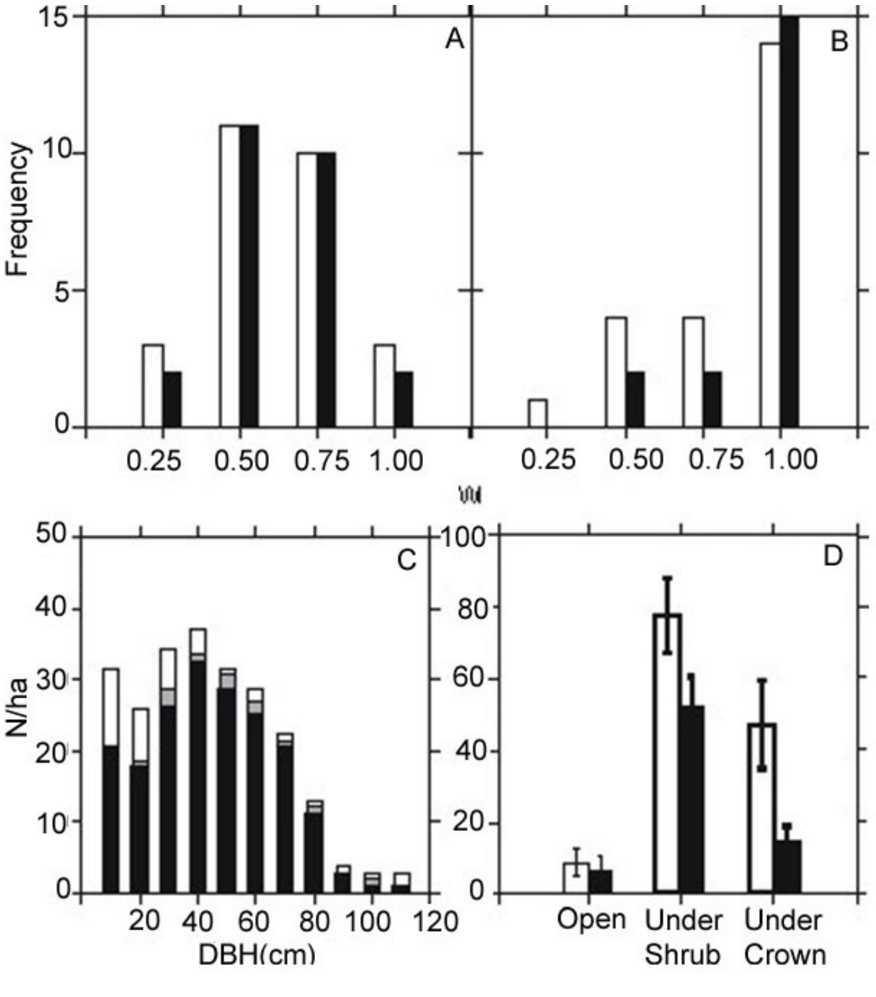
“Through simulations from regular, random, and clumped stands (Gadow and Hui 2002) Wi=0 indicates individuals are regularly distributed, Wi=0.5 indicates a random distribution whereas Wi=1 suggests individuals are clumped (see Schmidt et al. 2006 for more information on Wi).”
BackgroundSelf-citationCharacteristics and metrics of resilient forests in the Sierra de San Pedro Martír, Mexico
Murphy, J. S., York, R. A., Rivera‐Huerta, H., & Stephens, S. L. (2020) · Forest Ecology and Management · doi:10.1016/j.foreco.2020.118864 · Cited by 23
Self-citationTree Patterns in Central Oregon Ponderosa Pine Forests
West, N. E. (1969) · The American Midland Naturalist · doi:10.2307/2423994 · Cited by 22
Research works printed but not linked: 4
- [15]15. Gadow, K. V., and G. Y. Hui. 2002. Characterizing forest spatial structure and diversity. Proceedings of the SUFOR International workshop on Sustainable Forestry in Temperate Regions, Lund, Sweden. https://www.ecologyandsociety.org/vol13/iss2/art10/ Ecology and Society (): r http://www.ecologyandsociety.org/volXX/issYY/artZZ/
- [19]19. Krofta, D. M. 1995. Stand structure and composition of mixed conifer-hardwood forest in Cuyamaca Rancho State Park, San Diego County, California. Dissertation, San Diego State University, San Diego, California, USA.
- [24]24. Moore, M. M., W. W. Covington, and P. Z. Fulé. 1993. Spatial changes in southwestern ponderosa pine since settlement. Bulletin of the Ecological Society of America 74:365.
- [48]48. Stephens S.L, Fry D., and Franco-Vizcano, E. 2008. Wildfire and forests in Northwestern Mexico: the United States wishes it had similar fire 'problems'. Ecology and Society 13(2):10. http://dx.doi.org/10.5751/ES-02380-130210 https://www.ecologyandsociety.org/vol13/iss2/art10/
Cited by
Drought, Tree Mortality, and Wildfire in Forests Adapted to Frequent Fire
Stephens, S. L., Collins, B. M., Fettig, C. J., Finney, M. A., Hoffman, C. M., Knapp, E. E., North, M. P., Safford, H., & Wayman, R. B. (2018) · BioScience · doi:10.1093/biosci/bix146 · Cited by 407
Self-citationTemperate and boreal forest mega‐fires: characteristics and challenges
Stephens, S. L., Burrows, N., Buyantuyev, A., Gray, R. W., Keane, R. E., Kubian, R., Liu, S., Seijo, F., Shu, L., Tolhurst, K. G., et al. (2014) · Frontiers in Ecology and the Environment · doi:10.1890/120332 · Cited by 374
“…numbers of highseverity fires in many Sierra Nevada forests from 1984 to 2010 (Miller and Safford 2012), which suggests that freely burning fires in some forests can, over time, regulate fire-induced effects across the landscape (Stephens et al. 2008; Miller et al. 2012; Parks et al. 2013).”
BackgroundSelf-citationChurchill, D. J., Larson, A. J., Dahlgreen, M. C., Franklin, J. F., Hessburg, P. F., & Lutz, J. A. (2013) · Forest Ecology and Management · doi:10.1016/j.foreco.2012.11.007 · Cited by 347
“Irregular tree patterns, large openings, and resulting variation in surface fuels inhibit the spread of crown fire and perpetuate variable post-fire patterns (Beaty and Taylor, 2007; Pimont et al., 2011; Stephens et al., 2008), analogous to strategic placement of fuel treatments at larger spatial scales (Finney et al.”
BackgroundInfluentialLarson, A. J., & Churchill, D. (2012) · Forest Ecology and Management · doi:10.1016/j.foreco.2011.11.038 · Cited by 324
“Pre-settlement forests embodied structural and compositional conditions resistant and resilient to fire (Fulé, 2008; Stephens et al., 2008): these forests persisted through numerous past disturbance events and through multiple centuries of climatic fluctuation (Agee, 1993; Allen et al., 2002).”
BackgroundInfluentialThe ecology of mixed severity fire regimes in Washington, Oregon, and northern California
Perry, D. A., Hessburg, P. F., Skinner, C. N., Spies, T. A., Stephens, S. L., Taylor, A. H., Franklin, J. F., McComb, B., & Riegel, G. (2011) · Forest Ecology and Management · doi:10.1016/j.foreco.2011.05.004 · Cited by 306
“In concept, low severity fires principally reduce the volume and distribution of the most flammable fuels via surface fire activity, and mortality effects are typically minimal (Stephens et al., 2008).”
BackgroundResultSelf-citation
Metadata
- Authors
- Stephens, S. L., Fry, D. L., & Franco-Vizcaíno, E.
- Affiliations
- University of California, Berkeley (US)
- ORCID
- Stephens, Scott L.
- Venue
- Ecology and Society
- Publisher
- Resilience Alliance, Inc.
- Published
- 2008
- Volume
- 13
- Issue
- 2
- ISSN
- 1708-3087 (ISSN-L)
- OpenAlex
- W2553197836
- Cited by
- 91
- References
- 39
- Citations by year
- 2025: 3 · 2024: 3 · 2023: 4 · 2022: 2 · 2021: 4 · 2020: 4 · 2019: 7 · 2018: 7 · 2017: 4 · 2016: 6 · 2015: 4 · 2014: 8 · 2013: 8 · 2012: 8
- FWCI
- 5.71
- Type
- journal article
- Language
- en
- Open access
- gold
- doi.org
- Licence
- cc-by
- Locations
- Ecology and Society (publishedVersion, cc-by)
- DOAJ (DOAJ: Directory of Open Access Journals) (submittedVersion, cc-by-sa)
- Digital Library Of The Commons Repository (Indiana University) (submittedVersion)
- Funders
- U.S. Department of Agriculture
- Topics
- Physical Sciences › Environmental Science › Global and Planetary Change › Fire effects on ecosystems
- Life Sciences › Agricultural and Biological Sciences › Forestry › Forest Management and Policy
- Physical Sciences › Environmental Science › Ecology › Rangeland and Wildlife Management
- Keywords
- forest fires, forest spatial patterns, fire regimes, northwestern Mexico, United States comparison, fire ecology
About these checks
Registry, retraction, Cites and statistics results are computed, not judged, with one exception: a printed reference that no index lists is read once by a model before it counts as a citation error. Claims are extracted by a model and kept only when their quote appears verbatim in the text; each cited source is then checked, with a model’s help, for whether it says what the claim relies on. Those verdicts can be wrong — read the claim’s quote and the cited source before relying on one.
Statistics and arithmetic are recomputed, not judged.
Confidence bands are shown only for fields calibrated on our annotated test set. None is calibrated yet, so no band is shown.
What counts as a claim ›How we measure confidence ›How we check this ›
Are you an author, or do you see a problem with this page? Request a review
Data sources
Bibliographic data: Semantic Scholar, OpenAlex, Crossref.
Contains information from the Semantic Scholar Academic Graph Datasets, made available under the ODC Attribution License (ODC-BY 1.0).
Semantic Scholar’s data is described in: Kinney, R., et al. (2023). The Semantic Scholar Open Data Platform. arXiv:2301.10140.
