

Agreement of cardiac index measurements between ultrasonic cardiac output monitor and transthoracic echocardiography in neonates
Open accessThe DOI matches its Crossref record; 32 of the 32 references it cites were found in a registry or an index.
Abstract
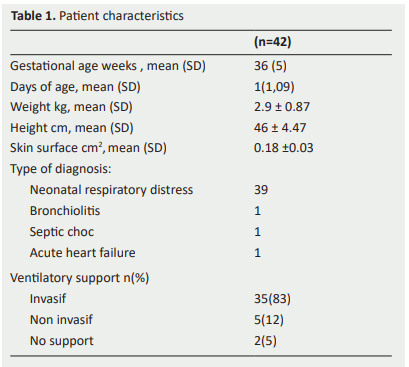
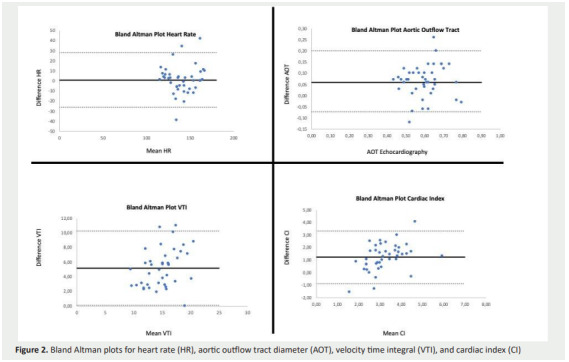
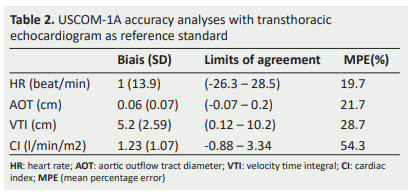
Objectives : To evaluate the agreement of cardiac index (CI) calculated by Ultrasonic sonic cardiac output monitor (USCOM) and transthoracic thoracic echocardiography (TTE) in order to know if we can recommend USCOM in our pediatric intensive care unit (PICU). Design : Prospective observational evaluative study carried out over a period of 3 months Setting: PICU at children's hospital in Tunis Participants: All newborns without tracheostomy or a known congenital heart disease, admitted to the PICU during the study period were enrolled. Interventions: Paired and consecutive measurements of CI were obtained in all patients with both technologies. All measurements by TTE and USCOM were performed by two distinct operators. It is the average of three successive measures of the CI, in the same patient, with each technology, which was considered. Agreement of CI between the 2 techniques was assessed by Bland-Altman analysis and percentage error. Measurements and Main Results : Forty-two infants were analyzed with the mean (standard deviation) gestation 36 weeks ( 5 days), age 1 days (1.09) , and weight 2.9 kg (0.87). Respiratory failure was the main cause of admission 75%. At the time of the study, 33 (75.%) patients were ventilated artificially. Bias (mean difference) of the CI between the two methods was 1.2 l/min/m2 and precision (± 2 SD of differences) was 1.08 l/min/m2. The MPE of CI measurement for USCOM vs TTE was 54.9%. Conclusions : The USCOM showed a poor agreement to TTE measures of CI. The two methods cannot be considered interchangeable.
Overview
The claims and statistics of this paper haven’t been checked yet.
Free: it reads the open-access text and checks the first 5 claims that cite a source we can check. Create a free account to check every claim.
Integrity signals
Registry
Cites
Statistics
Figures
Verification
Claims the paper makes
The claims and statistics of this paper haven’t been checked yet.
Free: it reads the open-access text and checks the first 5 claims that cite a source we can check. Create a free account to check every claim.
Claims other papers make about this one
Each is checked against this paper’s own text: does it say what the citing paper says it does?
The source backs part of the claim, not all of it — or backs it for a different population, condition or comparison.
In the citing paper
“Multiple investigations have concluded that USCOM is not suitable for routine use in pediatric cardiac populations [61].”
From Trends and Challenges in Noninvasive Hemodynamic Monitoring of Neonates Following Cardiac Surgery: A Narrative Review (2025) · cites this paper as [61]
Experimental — accuracy not yet measured
Self-check
Percentages, sums and reported differences re-computed from the paper’s own numbers.
The self-check needs the paper’s full text.
Citations
Cites
STATISTICAL METHODS FOR ASSESSING AGREEMENT BETWEEN TWO METHODS OF CLINICAL MEASUREMENT
Martin Bland, J., & Altman, D. (1986) · The Lancet · doi:10.1016/s0140-6736(86)90837-8 · Cited by 47,965
The Intraclass Correlation Coefficient as a Measure of Reliability
Bartko, J. J. (1966) · Psychological Reports · doi:10.2466/pr0.1966.19.1.3 · Cited by 2,299 · cited 1×
“The Intra Class Coefficient (ICC) was calculated for the set of three USCOM and TTE measurements to evaluate the intra-observer variability (27).”
MethodCritchley, L. A. H., & Critchley, J. A. J. H. (1999) · Journal of Clinical Monitoring and Computing · doi:10.1023/a:1009982611386 · Cited by 1,325 · cited 2×
“Bland-Altman analyses showed a wide range of bias and limits of agreement between the USCOM device and TTE, with a high MPE for USCOM measurements, higher than the accepted threshold of 30 % (26).”
MethodLai, W. W., Geva, T., Shirali, G. S., Frommelt, P. C., Humes, R. A., Brook, M. M., Pignatelli, R. H., & Rychik, J. (2006) · Journal of the American Society of Echocardiography · doi:10.1016/j.echo.2006.09.001 · Cited by 886
Clinicians’ abilities to estimate cardiac index in ventilated children and infants
Tibby, S. M., Hatherill, M., Marsh, M. J., & Murdoch, I. A. (1997) · Archives of Disease in Childhood · doi:10.1136/adc.77.6.516 · Cited by 224 · cited 1×
“The commonly used variables such as heart rate, non-invasive blood pressure, and diuresis are not well correlated with cardiac output (CO) (1).”
MethodTan, H., Pinder, M., Parsons, R. W., Roberts, B., & van Heerden, P. V. (2005) · British Journal of Anaesthesia · doi:10.1093/bja/aei054 · Cited by 149
Critchley, L. A. H., Peng, Z. Y., Fok, B. S. P., Lee, A. S. Y., & Phillips, R. A. (2005) · Anesthesia & Analgesia · doi:10.1213/01.ane.0000144774.42408.05 · Cited by 97 · cited 1×
“It has been validated in a canine model (9) and in adult patients where it has been compared to CO pulmonary artery thermodilution technique (2-6 , 10-16”
MethodDey, I., & Sprivulis, P. (2005) · Emergency Medicine Australasia · doi:10.1111/j.1742-6723.2005.00722.x · Cited by 91
Knobloch, K., Lichtenberg, A., Winterhalter, M., Rossner, D., Pichlmaier, M., & Phillips, R. A. (2005) · The Annals of Thoracic Surgery · doi:10.1016/j.athoracsur.2004.12.034 · Cited by 84
Cardiac Output Estimation With a New Doppler Device After Off-Pump Coronary Artery Bypass Surgery
Chand, R. K., Mehta, Y. B., & Trehan, N. K. (2006) · Journal of Cardiothoracic and Vascular Anesthesia · doi:10.1053/j.jvca.2005.05.024 · Cited by 78
Knirsch, W., Kretschmar, O., Tomaske, M., Stutz, K., Nagdyman, N., Balmer, C., Schmitz, A., Béttex, D., Berger, F. F., Bauersfeld, U., et al. (2008) · Intensive Care Medicine · doi:10.1007/s00134-008-1030-y · Cited by 77 · cited 1×
“Knirsh et al. (21) found in 22 patients with congenital heart disease undergoing interventional catheterization a bias of −0.13 l/min, limits of agreement of ±1.34 l/min and a MPE of 36.4%.”
BackgroundInfluentialComparison of a supra-sternal cardiac output monitor (USCOM) with the pulmonary artery catheter
Thom, O., Taylor, D. M., Wolfe, R. E., Cade, J. F., Myles, P. S., Krum, H., & Wolfe, R. S. (2009) · British Journal of Anaesthesia · doi:10.1093/bja/aep296 · Cited by 73
Mellander, M., Sabel, K., Caidahl, K., SOLYMAR, L., & Eriksson, B. O. (1987) · Pediatric Cardiology · doi:10.1007/bf02427536 · Cited by 71
Clinical validation of the non-invasive cardiac output monitor USCOM-1A in critically ill patients
van Lelyveld-Haas, L. E. M., van Zanten, A. R. H., Borm, G. F., & Tjan, D. H. T. (2008) · European Journal of Anaesthesiology · doi:10.1017/s0265021508004882 · Cited by 51
Patel, N., Dodsworth, M., & Mills, J. F. (2010) · Archives of Disease in Childhood Fetal & Neonatal · doi:10.1136/adc.2009.170704 · Cited by 44
van den Oever, H. L. A., Murphy, E. J., & Christie-Taylor, G. A. (2007) · Anaesthesia and Intensive Care · doi:10.1177/0310057x0703500608 · Cited by 42 · cited 1×
“USCOM measures the HR, VTI and calculate the CSA using the aortic outflow tract diameter (AOT) based on a validated nomogram derived from height and weight (13).”
MethodWong, L.-S. G., Yong, B.-H., Young, K. K., Lau, L.-S., Cheng, K.-L., Man, J. S.-F., & Irwin, M. G. (2008) · Liver Transplantation · doi:10.1002/lt.21483 · Cited by 42
Nguyen, H. B., Banta, D. P., STEWART, G. M., Kim, T., Bansal, R., Anholm, J. D., Wittlake, W. A., & Corbett, S. W. (2010) · Journal of Clinical Monitoring and Computing · doi:10.1007/s10877-010-9240-6 · Cited by 41 · cited 1×
“Furthermore, the measurement error inherent to the Doppler technique used in USCOM and TTE measures, may be involved through either, mal-positioning of the Doppler sample, or failure to minimize angles of insonation of the Doppler beam (18,19).”
MethodValidation of an Ultrasound Cardiac Output Monitor as a Bedside Tool for Pediatric Patients
Beltramo, F., Menteer, J., Razavi, A., Khemani, R. G., Szmuszkovicz, J. R., Newth, C. J. L., & Ross, P. A. (2015) · Pediatric Cardiology · doi:10.1007/s00246-015-1261-y · Cited by 40 · cited 1×
“Beltramo et al (22) found in 31 children with normal cardiac anatomy a bias of 0.2 l/min, limits of agreement between 1.2 and 1.6 l/min.”
BackgroundInfluentialMeyer, S., Todd, D. A., & Shadboldt, B. (2009) · Journal of Paediatrics and Child Health · doi:10.1111/j.1440-1754.2009.01535.x · Cited by 40 · cited 1×
“Finally, although previous pediatric studies (28-30) have shown a strong inter-observer reliability, we did not evaluate this aspect in our study.”
Su, B.-C., Yu, H., Yang, M., Lin, C., Kao, M., Chang, C.-H., & Lee, W. (2008) · Liver Transplantation · doi:10.1002/lt.21461 · Cited by 38
Dhanani, S., Barrowman, N. J., Ward, R., & Murto, K. (2010) · Pediatric Anesthesia · doi:10.1111/j.1460-9592.2010.03480.x · Cited by 36
Chan, J. S., Segara, D., & Nair, P. (2006) · Critical Care and Resuscitation · doi:10.1016/s1441-2772(23)02064-1 · Cited by 30
Corley, A., Barnett, A. G., Mullany, D. V., & Fraser, J. F. (2009) · International Journal of Nursing Studies · doi:10.1016/j.ijnurstu.2009.03.013 · Cited by 27
Echocardiography as a hemodynamic monitor in critically ill children
Klugman, D., & BERGER, J. T. (2011) · Pediatric Critical Care Medicine · doi:10.1097/pcc.0b013e3182211c17 · Cited by 27 · cited 1×
“…the invasive methods using the principle of thermodilution remain the gold standard of CO measurement (2-6) in adults, they are usually not applicable and not suitable for neonates even in developed countries where transthoracic echocardiography (TTE) represents the reference technique (7,8).”
MethodInter-Rater Reliability for Noninvasive Measurement of Cardiac Function in Children
STEWART, G. M., Nguyen, H. B., Kim, T. Y., Jauregui, J., Hayes, S. R., & Corbett, S. W. (2008) · Pediatric Emergency Care · doi:10.1097/pec.0b013e31817de143 · Cited by 26 · cited 1×
“Finally, although previous pediatric studies (28-30) have shown a strong inter-observer reliability, we did not evaluate this aspect in our study.”
Mehta, Y. B., Arora, D., Chand, R. K., & Trehan, N. K. (2007) · Annals of Cardiac Anaesthesia · doi:10.4103/0971-9784.37939 · Cited by 26
Non-invasive cardiac output assessment in critically ill paediatric patients
Wongsirimetheekul, T., Khositseth, A., & Lertbunrian, R. (2014) · Acta cardiologica. Supplementum · doi:10.1080/ac.69.2.3017298 · Cited by 20 · cited 1×
“Furthermore, the measurement error inherent to the Doppler technique used in USCOM and TTE measures, may be involved through either, mal-positioning of the Doppler sample, or failure to minimize angles of insonation of the Doppler beam (18,19).”
MethodHorster, S., Stemmler, H., Sparrer, J., Tischer, J., Hausmann, A., & Geiger, S. (2012) · Acta cardiologica. Supplementum · doi:10.1080/ac.67.2.2154208 · Cited by 16
Fraga, M. V., Dysart, K., Rintoul, N. E., Chaudhary, A. S., Ratcliffe, S. J., Fedec, A., Kren, S., Cohen, M. S., & Kirpalani, H. M. (2019) · Neonatology · doi:10.1159/000501005 · Cited by 15
Pliauckienė, A., Liubšys, A., Vankevičienė, R., & Usonis, V. (2021) · Journal of Clinical Monitoring and Computing · doi:10.1007/s10877-021-00711-2 · Cited by 5
Letter to Editor: Reliability of the Ultrasound Cardiac Output Monitor for Pediatric Patients
Beltramo, F., Menteer, J., Razavi, A., Khemani, R. G., Szmuszkovicz, J., Newth, C. J. L., & Ross, P. A. (2016) · Pediatric Cardiology · doi:10.1007/s00246-016-1431-6 · Cited by 3
Cited by
Nedelcu, C., Ionescu, N. S., Bizubac, A. M., Filip, C., & Cirstoveanu, C. (2025) · Life · doi:10.3390/life15101621 · Cited by 2
Kuzlu, V., Kuzlu, N. D., & Kararmaz, K. A. (2026) · Journal of Cardiothoracic and Vascular Anesthesia · doi:10.1053/j.jvca.2026.05.010 · Cited by 1
Li, Y., Chen, J., Bian, J., Chen, F., Wan, Q., & Yuan, F. (2025) · Reviews in Cardiovascular Medicine · doi:10.31083/rcm27100
Wang, N., Tang, B., Zhang, H., Wang, W., & Zhang, J. (2025) · Medical Ultrasonography · doi:10.11152/mu-4538
Metadata
- Authors
- Menif, K., Ayari, A., Louati, A., Ibn Haj Hassine, S., Bouziri, A., & Borgi, A.
- Affiliations
- Tunis University (TN)
- Venue
- La Tunisie Médicale
- Publisher
- Tunisian Society of Medical Sciences
- Published
- 2024-08-27
- Volume
- 102
- Issue
- 9
- Pages
- 565-570
- ISSN
- 0041-4131 (ISSN-L)
- 2724-7031
- PMC
- PMC11459236
- OpenAlex
- W4402620206
- Cited by
- 3
- References
- 32
- Citations by year
- 2026: 1 · 2025: 2
- FWCI
- 1.26
- Type
- journal article
- Language
- en
- Open access
- diamond
- doi.org
- Licence
- Locations
- La Tunisie Médicale (publishedVersion, cc-by-nc-nd)
- PubMed Central (publishedVersion, cc-by-nc-nd)
- PubMed (publishedVersion)
- Topics
- Health Sciences › Medicine › Surgery › Hemodynamic Monitoring and Therapy
- Health Sciences › Medicine › Cardiology and Cardiovascular Medicine › Cardiovascular Function and Risk Factors
- Health Sciences › Medicine › Critical Care and Intensive Care Medicine › Ultrasound in Clinical Applications
- Keywords
- cardiac index, ultrasonic cardiac output monitor, transthoracic echocardiography, neonates, measurement agreement, pediatric intensive care, respiratory failure, mechanical ventilation, hemodynamic monitoring
- MeSH terms
- Cardiac Output, Echocardiography, Female, Heart Defects, Congenital, Humans, Infant, Newborn, Male, Monitoring, Physiologic, Prospective Studies, Tunisia, Intensive Care Units, Pediatric
About these checks
Registry, retraction, Cites and statistics results are computed, not judged, with one exception: a printed reference that no index lists is read once by a model before it counts as a citation error. Claims are extracted by a model and kept only when their quote appears verbatim in the text; each cited source is then checked, with a model’s help, for whether it says what the claim relies on. Those verdicts can be wrong — read the claim’s quote and the cited source before relying on one.
Statistics and arithmetic are recomputed, not judged.
Confidence bands are shown only for fields calibrated on our annotated test set. None is calibrated yet, so no band is shown.
What counts as a claim ›How we measure confidence ›How we check this ›
Are you an author, or do you see a problem with this page? Request a review
Data sources
Bibliographic data: Semantic Scholar, OpenAlex, Crossref.
Contains information from the Semantic Scholar Academic Graph Datasets, made available under the ODC Attribution License (ODC-BY 1.0).
Semantic Scholar’s data is described in: Kinney, R., et al. (2023). The Semantic Scholar Open Data Platform. arXiv:2301.10140.
