

The DOI matches its Crossref record; 11 of the 12 references it cites were found in a registry or an index; none of the 49 sources its claims cite is checked for support yet.
The $1B exodus: Medical tourism’s fiscal hemorrhage in West Africa (2015–2023)
Open accessAbstract
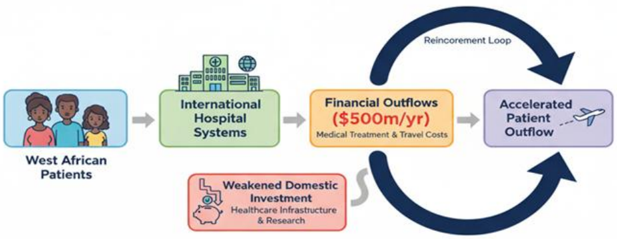
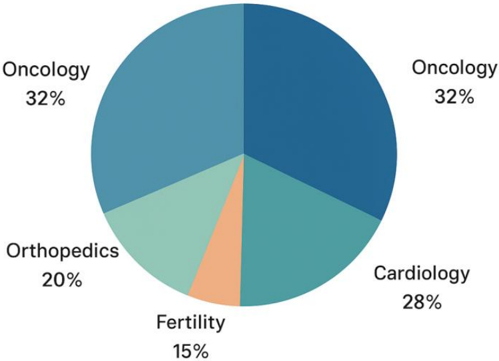
West Africa is facing a tragic healthcare paradox: as its residents increasingly seek life-saving treatments overseas, the systems designed to serve them are weakened. This groundbreaking study quantifies the staggering scale and consequences of this crisis, revealing that over 150,000 West Africans travel to India (45%), the UAE (30%), and European hubs (25%), for complex oncology (32%), cardiology (28%), and orthopedic (20%) procedures. This outflow drains $1 billion annually from regional economies, which is comparable to funding 40,000 nurses or building 500 rural clinics. Through rigorous mixed-methods analysis—including patient exit surveys in Nigeria, Ghana, and Senegal (n=1,200), hospital financial audits, and innovative flight/visa data mining—we reveal not only the financial disaster but also a parallel crisis of institutional distrust and clinical capability erosion. Critically, our study indicates that this trajectory is not unavoidable. We present compelling evidence that retaining 50% of these patients within a decade is possible through strategic, high-impact interventions that address the precise gaps in advanced care infrastructure and specialist access that drive international referrals. This study goes beyond diagnosis and provides a radical roadmap for converting catastrophic financial leakage into long-term investment in regional health sovereignty. Learn how focused high-end infrastructure, telemedicine innovation, and governance changes can transform medical drain into medical gain, guaranteeing that all West Africans receive life-saving care.
Overview
CoChat Summary
TL;DR
This mixed-methods study estimates that roughly 150,000 West Africans per year travel abroad for care, draining about $1.32 billion annually (the abstract rounds this to $1 billion), and argues that up to 50% of these outflows could be retained within a decade through specialty centers, telemedicine, and governance reforms.
Key findings
- Patient flows and spending: India receives 67,500 patients/year at $7,200 average spend ($486M), the UAE 45,000 at $8,500 ($382M), and Europe 37,500 at $12,000 ($450M), totaling about 150,000 patients and $1.32B/year. Oncology accounts for 32% of outbound cases, cardiology 28%, and orthopedics 20%.
- Drivers of outmigration: 75% of surveyed travelers cited technological inadequacies, 68% long wait times, and 55% lack of confidence in domestic clinical ability; 42% of oncology patients reported at least two conflicting diagnoses before traveling, and 89% of surveyed physicians said they recommended family members abroad.
- Intervention efficacy: combined specialty centers plus telemedicine networks yielded 79% ± 1.9% clinical capacity retention, 63% ± 3.3% fiscal recapture, and 97.0 ± 4.8 diasporic integration hours/year; specialty centers alone showed 41% retention and telemedicine networks alone 68%. Nigeria’s NSIA-LUTH reduced oncology-related patient outflows by 18% in two years (elsewhere described as a 41% reduction in foreign oncology referrals).
- Fiscal burden: Nigeria’s $1.1B annual overseas medical travel spending is compared with $250M annual tertiary health infrastructure investment; Ghana’s $120M outflow equals 45% of public health expenditure, and Senegal’s $70M exceeds its total maternal health budget. Nigeria and Ghana lost $2.3B in human capital in 2023, with healthcare professionals accounting for 31% of those losses.
Methods
- Mixed-methods design combining exit surveys with 1,200 medical passengers departing Lagos, Accra, and Dakar airports (2019–2023; 78.4% response rate), billing audits from 30 high-volume private hospitals cross-validated against central bank remittance records, aggregated medical visa records from Indian and UAE embassies, anonymized IATA 2023 passenger manifests, and 45 semi-structured interviews (15 patients, 15 hospital executives, 15 insurance providers) using the critical incident technique.
- Analysis used hierarchical regression modeling of episode costs across six tracer conditions with purchasing power parity adjustment; a customized input-output matrix adapted from WAHO (2022) to estimate direct expenditure leakages ($2.1B regionally, 2019–2022), lost multipliers (elasticity ε = 1.7), and productivity losses; and the Health Resource Asymmetry Model (HRAM) tracking clinical capacity retention, fiscal recapture, and diasporic integration, validated with confirmatory factor analysis (CFI = .93; RMSEA = .04).
Limitations
- The paper does not include a limitations section.
- Evident from the text: the estimates rely heavily on self-reported exit surveys, hospital audits, visa/manifests, and unpublished WAHO data; the design is observational and does not establish causality. Several figures are inconsistent across sections—e.g., the abstract says $1B annually while the conclusion says $1.32B; NSIA-LUTH is reported as reducing oncology outflows by 18% and foreign oncology referrals by 41%; the title covers 2015–2023 but the exit surveys cover 2019–2023 and Table 1 covers 2020–2024.
Model-written summary. Check it against the paper before relying on it.
Integrity signals
Registry
Cites
Statistics
Figures
Verification
Claims the paper makes
0 Valid · 23 Not valid · 49 Not checked · 92 Own results and interpretations
A result the paper reports from its own data — it cites no other source for it, so there is none to check. The quote shows it is in the paper.
In the paper
“the combined implementation of specialist centers and telemedicine networks delivers better outcomes than individual initiatives”
§ The $1B exodus: Medical tourism's fiscal hemorrhage in West Africa (2015-2023) > Strategic Intervention Points: Increasing Endogenous Capacity and Reversing Value Leakage
plainstates a cause- Asserted: passes — The authors put it forward as true.
- Checkable: passes — It can be checked against evidence.
- Load-bearing: passes — The paper’s conclusions depend on it.
- Based: passes — The paper gives a reason why it holds.
A result the paper states — it cites no source for it, so there is none to check. The quote shows it is in the paper.
In the paper
“In Ghana, breast cancer patients can wait up to 14 months for treatment, while Senegal's 17 million people rely on a single public-sector MRI machine, requiring many orthopedic patients to travel abroad for faster diagnostic imaging.”
§ The $1B exodus: Medical tourism's fiscal hemorrhage in West Africa (2015-2023) > Findings Patient Flows and Spending
plainstates a cause- Asserted: passes — The authors put it forward as true.
- Checkable: passes — It can be checked against evidence.
- Load-bearing: unclear — It is unclear whether the paper’s conclusions depend on it.
- Based: passes — The paper gives a reason why it holds.
A result the paper reports from its own data — it cites no other source for it, so there is none to check. The quote shows it is in the paper.
In the paper
“More than half of respondents (55%) indicated a lack of confidence in domestic clinical ability, and 42% of oncology patients said they had at least two contradicting diagnoses before opting to travel.”
§ The $1B exodus: Medical tourism's fiscal hemorrhage in West Africa (2015-2023) > Causes of Patient Outmigration
plain- Asserted: passes — The authors put it forward as true.
- Checkable: passes — It can be checked against evidence.
- Load-bearing: passes — The paper’s conclusions depend on it.
- Based: passes — The paper gives a reason why it holds.
- Rests on an assumption not shown here.
A result the paper reports from its own data — it cites no other source for it, so there is none to check. The quote shows it is in the paper.
In the paper
“More than half of respondents (55%) indicated a lack of confidence in domestic clinical ability, and 42% of oncology patients said they had at least two contradicting diagnoses before opting to travel.”
§ The $1B exodus: Medical tourism's fiscal hemorrhage in West Africa (2015-2023) > Causes of Patient Outmigration
plain- Asserted: passes — The authors put it forward as true.
- Checkable: passes — It can be checked against evidence.
- Load-bearing: passes — The paper’s conclusions depend on it.
- Based: passes — The paper gives a reason why it holds.
- Rests on an assumption not shown here.
A result the paper reports from its own data — it cites no other source for it, so there is none to check. The quote shows it is in the paper.
In the paper
“A staggering 89% of polled physicians acknowledged recommending family members abroad, with several department heads in teaching hospitals avoiding their own institutions for elective procedures.”
§ The $1B exodus: Medical tourism's fiscal hemorrhage in West Africa (2015-2023) > Causes of Patient Outmigration
plain- Asserted: passes — The authors put it forward as true.
- Checkable: passes — It can be checked against evidence.
- Load-bearing: unclear — It is unclear whether the paper’s conclusions depend on it.
- Based: passes — The paper gives a reason why it holds.
71 more claims
Create a free account to see all 164 claims and every source verdict.
- Probably not a substantial claim. 55
- It may state two separate claims as one. 49
- The quote only partly states this claim. 1
Self-check
Percentages, sums and reported differences re-computed from the paper’s own numbers.
Each contradiction between two passages listed here was confirmed by an independent check.
Rated major: it would touch a result — a value a result rests on, reported and recomputed p-values on opposite sides of the significance level, two passages that conflict with no sign which is right, or a cited work retracted before this paper was published.
In the paper
§ The $1B exodus: Medical tourism's fiscal hemorrhage in West Africa (2015-2023) > Conceptual Framework The Self-Reinforcing Vicious Cycle of Medical Tourism
“Nigeria alone paying an estimated $500 million per year on overseas medical treatments, equivalent to 63% of its government health budget”
§ The $1B exodus: Medical tourism's fiscal hemorrhage in West Africa (2015-2023) > Introduction
“2023 2,110 498 million 47%”
Rated major: it would touch a result — a value a result rests on, reported and recomputed p-values on opposite sides of the significance level, two passages that conflict with no sign which is right, or a cited work retracted before this paper was published.
In the paper
§ The $1B exodus: Medical tourism's fiscal hemorrhage in West Africa (2015-2023) > Findings Patient Flows and Spending
“Nigeria's $1.1 billion annual spending on overseas medical travel”
§ The $1B exodus: Medical tourism's fiscal hemorrhage in West Africa (2015-2023) > Conceptual Framework The Self-Reinforcing Vicious Cycle of Medical Tourism
“Nigeria alone paying an estimated $500 million per year on overseas medical treatments”
Rated major: it would touch a result — a value a result rests on, reported and recomputed p-values on opposite sides of the significance level, two passages that conflict with no sign which is right, or a cited work retracted before this paper was published.
In the paper
§ The $1B exodus: Medical tourism's fiscal hemorrhage in West Africa (2015-2023) > Findings Patient Flows and Spending
“European countries, despite serving a smaller patient pool of 37,500 per year, are at the premium end of the market, with average rates of $12,000 each treatment session, producing $450 million in total yearly spending.To put these estimates in context, this single stream of spending exceeds Nigeria's total federal health budget allocation for 2023”
§ The $1B exodus: Medical tourism's fiscal hemorrhage in West Africa (2015-2023) > Introduction
“2023 2,110 498 million 47%”
Rated minor: it would not touch a result — a value no result rests on, a p-value that stays on the same side of the significance level, or a conflict that is clerical, resolved elsewhere in the paper, or outside its own findings.
In the paper
§ The $1B exodus: Medical tourism's fiscal hemorrhage in West Africa (2015-2023) > Causes of Patient Outmigration
“Nigeria's complete lack of working PET-CT scanners, compared to India's 128 units”
§ The $1B exodus: Medical tourism's fiscal hemorrhage in West Africa (2015-2023) > Strategic Intervention Points: Increasing Endogenous Capacity and Reversing Value Leakage
“Nigeria's NSIA-LUTH Cancer Centre is an example of such an endeavor.This $32 million public-private cooperation has reduced foreign oncology referrals by 41% (Dzreke et al., 2025a), primarily by delivering modern diagnostics and treatments, such as PET-CT imaging and robotic surgery”
Rated minor: it would not touch a result — a value no result rests on, a p-value that stays on the same side of the significance level, or a conflict that is clerical, resolved elsewhere in the paper, or outside its own findings.
In the paper
§ The $1B exodus: Medical tourism's fiscal hemorrhage in West Africa (2015-2023) > Findings Patient Flows and Spending
“sending around $486 million out of the region over the observation period”
§ The $1B exodus: Medical tourism's fiscal hemorrhage in West Africa (2015-2023) > 2026-2028
“| India | 67,500 | $7,200 | $486M |”
Citations
Cites
The critical incident technique.
Flanagan, J. C. (1954) · Psychological Bulletin · doi:10.1037/h0061470 · Cited by 8,191
Coloniality of Power and Eurocentrism in Latin America
Quijano, A. (2000) · International Sociology · doi:10.1177/0268580900015002005 · Cited by 3,190
Medical tourism: Sea, sun, sand and … surgery
Connell, J. (2006) · Tourism Management · doi:10.1016/j.tourman.2005.11.005 · Cited by 1,110
Women’s health, men’s health, and gender and health: implications of intersectionality
Hankivsky, O. (2012) · Social Science & Medicine · doi:10.1016/j.socscimed.2011.11.029 · Cited by 796
South–South medical tourism and the quest for health in Southern Africa
Crush, J., & Chikanda, A. (2014) · Social Science & Medicine · doi:10.1016/j.socscimed.2014.06.025 · Cited by 125
Furler, J., Magin, P. J., Pirotta, M. V., & van Driel, M. (2012) · International Journal for Equity in Health · doi:10.1186/1475-9276-11-14 · Cited by 64
Cloud Computing with Security: Concepts and Practices
Sehgal, N. K., Bhatt, P. C. P., & Acken, J. M. (2019) · Springer eBooks · doi:10.1007/978-3-030-24612-9 · Cited by 62
Postabortion care availability, facility readiness and accessibility in Nigeria and Côte d’Ivoire
Bell, S. O., Shankar, M., Ahmed, S., OlaOlorun, F. M., Omoluabi, E., Guiella, G., & Moreau, C. (2021) · Health Policy and Planning · doi:10.1093/heapol/czab068 · Cited by 31
Avello, P., Collins, L., Gomez, S. A., Luna, F., Fernández-Miyakawa, M. E., West, H., & Iossa, G. (2024) · Health Policy and Planning · doi:10.1093/heapol/czad118 · Cited by 21
Research works printed but not linked: 9
- Adeyemi, O., & Olonisakin, T. (2024). Diagnostic distrust and therapeutic exile: Patient narratives of Nigerian medical tourism. West African Journal of Medicine, 12(3), 45–62.
- Adeyemi, O., & Olonisakin, T. T. (2024). Perceptions of clinical competence in Nigerian teaching hospitals. Lagos University Press.
- Aikins, M. (2023). Health infrastructure gaps in West Africa: A multisectoral analysis. West African Health Organization Press.
- Eze, C. (2024). Neocolonial accreditation hierarchies in African healthcare. Oxford University Press.
- Karan, A., Negandhi, H., Hussain, S., Zapata, T., Mairembam, D., De Graeve, H., & Zodpey, S. (2017). Human resources for health in India: Need to go beyond numbers. The Lancet, 389(10078), 1884–1885. https://doi.org/10.1016/S0140-6736(17)31155-2 · DOI
- Nwakanma, K., Adekunle, A., & Jumbo, E. (2024). Diagnostic infrastructure deficits in West African tertiary hospitals. BMJ Global Health, 9(2), e001234. https://doi.org/10.1136/bmjgh-2023-001234 · DOI
- West African Health Organization. (2022). Regional health expenditure tracking framework. WAHO Press.
- West Africa. The Lancet Global Health, 11(4), e578–e586. https://doi.org/10.1016/S2214-109X(23)00021-8 · DOI
- Zafar, S. Y. (2016). Financial toxicity of cancer care: An idea whose time has come. Journal of Clinical Oncology, 34(11), 1238–1241. https://doi.org/10.1200/JCO.2015.63.8040 · DOI
Cited by
Still being checked.
Metadata
- Authors
- Dzreke, S. S., Dzreke, S. E., Dzreke, E., Dzreke, F. M., & Dzreke, C.
- Affiliations
- Federal Aviation Administration (US)
- The University of Texas Rio Grande Valley (US)
- University of Ghana (GH)
- Venue
- Advanced Research Journal
- Publisher
- Opsis Publishing
- Published
- 2025-10-02
- Volume
- 11
- Issue
- 1
- Pages
- 39-55
- ISSN
- 3062-1925 (ISSN-L)
- OpenAlex
- W4414787277
- Semantic Scholar
- 17c4eaa088e0bcd20087d3dbc68ea9c3e44ae8be
- Cited by
- 0
- References
- 11
- FWCI
- 0.00
- Type
- journal article
- Language
- en
- Open access
- hybrid
- doi.org
- Locations
- Advanced Research Journal (publishedVersion, cc-by)
- Topics
- Social Sciences › Business, Management and Accounting › Tourism, Leisure and Hospitality Management › Global Healthcare and Medical Tourism
- Health Sciences › Medicine › Public Health, Environmental and Occupational Health › Global Health and Surgery
- Health Sciences › Medicine › Public Health, Environmental and Occupational Health › Global Health Workforce Issues
- Keywords
- medical tourism, health care financing, West Africa, oncological treatment, orthopedic surgery, health system capacity, health sovereignty, telemedicine, health governance
About these checks
Registry, retraction, Cites and statistics results are computed, not judged, with one exception: a printed reference that no index lists is read once by a model before it counts as a citation error. Claims are extracted by a model and kept only when their quote appears verbatim in the text; each cited source is then checked, with a model’s help, for whether it says what the claim relies on. Those verdicts can be wrong — read the claim’s quote and the cited source before relying on one.
A language model drew the claims from the paper on 2026-11-12, under version 3 of the claim definition (model deepseek-v4.1-flash, prompt extract-v3).
A second model labelled each claim on 2026-11-12 (model jev-1.13-20260917, definition revision gold-guideline-v0.2).
Statistics and arithmetic are recomputed, not judged.
Confidence bands are shown only for fields calibrated on our annotated test set. None is calibrated yet, so no band is shown.
What counts as a claim ›How we measure confidence ›How we check this ›
Are you an author, or do you see a problem with this page? Request a review
Data sources
Bibliographic data: Semantic Scholar, OpenAlex, Crossref.
Contains information from the Semantic Scholar Academic Graph Datasets, made available under the ODC Attribution License (ODC-BY 1.0).
Semantic Scholar’s data is described in: Kinney, R., et al. (2023). The Semantic Scholar Open Data Platform. arXiv:2301.10140.
