

The DOI matches its Crossref record; 85 of the 85 references it cites were found in a registry or an index.
Role and outcomes of community health workers in HIV care in sub-saharan Africa: a systematic review
Open accessAbstract
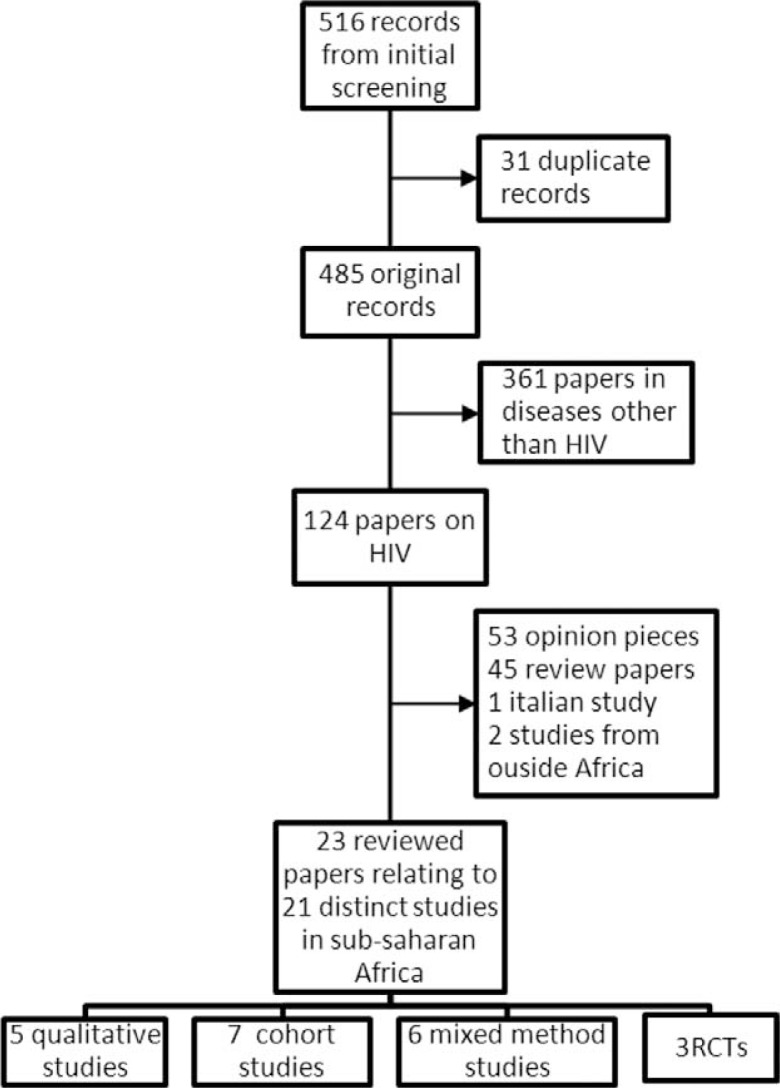
INTRODUCTION: The provision of HIV treatment and care in sub-Saharan Africa faces multiple challenges, including weak health systems and attrition of trained health workers. One potential response to overcome these challenges has been to engage community health workers (CHWs). METHODOLOGY: A systematic literature search for quantitative and qualitative studies describing the role and outcomes of CHWs in HIV care between inception and December 2012 in sub-Saharan Africa was performed in the following databases: PubMed, PsychINFO, Embase, Web of Science, JSTOR, WHOLIS, Google Scholar and SAGE journals online. Bibliographies of included articles were also searched. A narrative synthesis approach was used to analyze common emerging themes on the role and outcomes of CHWs in HIV care in sub-Saharan Africa. RESULTS: In total, 21 studies met the inclusion criteria, documenting a range of tasks performed by CHWs. These included patient support (counselling, home-based care, education, adherence support and livelihood support) and health service support (screening, referral and health service organization and surveillance). CHWs were reported to enhance the reach, uptake and quality of HIV services, as well as the dignity, quality of life and retention in care of people living with HIV. The presence of CHWs in clinics was reported to reduce waiting times, streamline patient flow and reduce the workload of health workers. Clinical outcomes appeared not to be compromised, with no differences in virologic failure and mortality comparing patients under community-based and those under facility-based care. Despite these benefits, CHWs faced challenges related to lack of recognition, remuneration and involvement in decision making. CONCLUSIONS: CHWs can clearly contribute to HIV services delivery and strengthen human resource capacity in sub-Saharan Africa. For their contribution to be sustained, CHWs need to be recognized, remunerated and integrated in wider health systems. Further research focusing on comparative costs of CHW interventions and successful models for mainstreaming CHWs into wider health systems is needed.
Overview
The claims and statistics of this paper haven’t been checked yet.
Run the check — free, no account needed. It reads the open-access text and checks the sources it cites.
Integrity signals
Registry
Cites
Statistics
Figures
Verification
Claims the paper makes
The claims and statistics of this paper haven’t been checked yet.
Run the check — free, no account needed. It reads the open-access text and checks the sources it cites.
Claims other papers make about this one
Each is checked against this paper’s own text: does it say what the citing paper says it does?
The cited source doesn’t support the claim as written.
In the citing paper
“However, unlike Mwai et al. (2013) (111), who reported a more even distribution of research efforts across SSA, our review indicates comparatively fewer SWD studies from West and Central Africa.”
From Applications and implementation considerations for stepped-wedge designs in sub-Saharan Africa: a systematic review (2026) · cites this paper as [111]
Checked by a reasoning model — may be wrong.
Experimental — accuracy not yet measured
Self-check
Percentages, sums and reported differences re-computed from the paper’s own numbers.
The self-check needs the paper’s full text.
Citations
Cites
Preferred Reporting Items for Systematic Reviews and Meta-Analyses: the PRISMA statement
Moher, D., Liberati, A., Tetzlaff, J., Altman, D. G., & for the PRISMA Group (2009) · BMJ · doi:10.1136/bmj.b2535 · Cited by 83,823
Preferred Reporting Items for Systematic Reviews and Meta-Analyses: The PRISMA Statement
Moher, D., Liberati, A., Tetzlaff, J., & Altman, D. G. (2009) · Journal of Clinical Epidemiology · doi:10.1016/j.jclinepi.2009.06.005 · Cited by 19,575
Assessing the quality of reports of randomized clinical trials: Is blinding necessary?
Jadad, A. R., Moore, R. A., Carroll, D., Jenkinson, C., Reynolds, D. J. M., Gavaghan, D. J., & McQuay, H. J. (1996) · Controlled Clinical Trials · doi:10.1016/0197-2456(95)00134-4 · Cited by 17,582
Preferred reporting items for systematic reviews and meta-analyses: The PRISMA statement
Moher, D., Liberati, A., Tetzlaff, J., & Altman, D. G. (2010) · International Journal of Surgery · doi:10.1016/j.ijsu.2010.02.007 · Cited by 12,156
Zhang, Q., Wang, C., Zheng, M., Li, Y., Li, J., Zhang, L., Shang, X., & Yan, C. (2014) · Cerebrovascular Diseases · doi:10.1159/000369778 · Cited by 11,609
Interpreting Qualitative Data Methods for Analysing Talk, Text and Interaction
Kleinsasser, R. C., & Silverman, D. J. (1997) · Modern Language Journal · doi:10.2307/329190 · Cited by 6,862
Dong, Y., Hao, L., Shi, Z., Wang, G., Zhang, Z., & Han, C. (2013) · Urologia Internationalis · doi:10.1159/000351405 · Cited by 4,557
Silverman, D. (2024) · SAGE Publications Ltd eBooks · doi:10.4135/9781036233358 · Cited by 3,562
Mays, N., Pope, C. J., & Popay, J. (2005) · Journal of Health Services Research & Policy · doi:10.1258/1355819054308576 · Cited by 1,384
Lewin, S. A., Munabi-Babigumira, S. K., Glenton, C., Daniels, K., Bosch‐Capblanch, X., van Wyk, B. E., Odgaard‐Jensen, J., Johansen, M., Aja, G. N., Zwarenstein, M., et al. (2010) · Cochrane Database of Systematic Reviews · doi:10.1002/14651858.cd004015.pub3 · Cited by 1,030
Research works printed but not linked: 4
- UNAIDS, 2012, Report on the global AIDS epidemic
- Silverman D, 2001, Methods for analyzing talk text and interaction
- World Health Organization, 1989, Strengthening the performance of community health workers in primary health care
- World Health Organization, 2010, Global experience of community health workers for delivery of health related millennium development goals: a systematic review, country case studies, and recommendations for integration into national health systems
Cited by
Sorted by citations
Scott, K., Beckham, S. W., Gross, M., Pariyo, G., Rao, K. D., Cometto, G., & Perry, H. B. (2018) · Human Resources for Health · doi:10.1186/s12960-018-0304-x · Cited by 732
Diabetes in sub-Saharan Africa: from clinical care to health policy
Atun, R. A., Davies, J. I., Gale, E. A., Bärnighausen, T., Beran, D., Kengne, A. P., Levitt, N. S., Mangugu, F. W., Nyirenda, M., Ogle, G. D., et al. (2017) · The Lancet Diabetes & Endocrinology · doi:10.1016/s2213-8587(17)30181-x · Cited by 574
Cometto, G., Ford, N. P., Zambruni, J. P., Akl, E. A., Lehmann, U., McPake, B., Ballard, M., Kok, M. C., Najafizada, M., Olaniran, A., et al. (2018) · The Lancet Global Health · doi:10.1016/s2214-109x(18)30482-0 · Cited by 288
Self-citationAkintola, O., & Chikoko, G. L. (2016) · Human Resources for Health · doi:10.1186/s12960-016-0151-6 · Cited by 253
Sayed, S., Cherniak, W., Lawler, M., Tan, S., El‐Sadr, W., Wolf, N. G., Silkensen, S. L., Brand, N. R., Looi, L., Pai, S. A., et al. (2018) · The Lancet · doi:10.1016/s0140-6736(18)30459-8 · Cited by 245
Metadata
- Authors
- Mwai, G. W., Mburu, G., Torpey, K., Frost, P., Ford, N., & Seeley, J.
- Affiliations
- Brighton and Sussex Medical School (GB)
- International HIV/AIDS Alliance (GB)
- University of Cape Town (ZA)
- University of East Anglia (GB)
- Corresponding author
- Mwai, Grace W
- Venue
- Journal of the International AIDS Society
- Publisher
- Wiley
- Published
- 2013-01
- Volume
- 16
- Issue
- 1
- Pages
- 18586-18586
- ISSN
- 1758-2652 (ISSN-L)
- PMC
- PMC3772323
- OpenAlex
- W2100664910
- Cited by
- 372
- References
- 85
- Citations by year
- 2026: 11 · 2025: 27 · 2024: 31 · 2023: 25 · 2022: 29 · 2021: 46 · 2020: 37 · 2019: 27 · 2018: 43 · 2017: 36 · 2016: 23 · 2015: 24 · 2014: 11
- FWCI
- 2.50
- Type
- journal article
- Language
- en
- Open access
- gold
- doi.org
- Locations
- Journal of the International AIDS Society (publishedVersion, cc-by)
- Europe PMC (PubMed Central) (publishedVersion, cc-by)
- PubMed Central (publishedVersion, cc-by)
- PubMed (publishedVersion)
- Lancaster EPrints (Lancaster University) (acceptedVersion)
- LSHTM Research Online (London School of Hygiene and Tropical Medicine) (acceptedVersion)
- UEA Digital Repository (University of East Anglia) (submittedVersion)
- Topics
- Health Sciences › Medicine › Infectious Diseases › HIV/AIDS Research and Interventions
- Social Sciences › Economics, Econometrics and Finance › Economics and Econometrics › HIV/AIDS Impact and Responses
- Health Sciences › Medicine › Public Health, Environmental and Occupational Health › Global Health Workforce Issues
- Keywords
- community health workers, HIV care, sub-Saharan Africa, patient support, home care, retention in care, health workforce capacity, community-based care
- MeSH terms
- Africa, Community Health Workers, Health Services Research, Humans, HIV Infections, Africa South of the Sahara
About these checks
Registry, retraction, Cites and statistics results are computed, not judged, with one exception: a printed reference that no index lists is read once by a model before it counts as a citation error. Claims are extracted by a model and kept only when their quote appears verbatim in the text; each cited source is then checked, with a model’s help, for whether it says what the claim relies on. Those verdicts can be wrong — read the claim’s quote and the cited source before relying on one.
Statistics and arithmetic are recomputed, not judged.
Confidence bands are shown only for fields calibrated on our annotated test set. None is calibrated yet, so no band is shown.
What counts as a claim ›How we measure confidence ›How we check this ›
Are you an author, or do you see a problem with this page? Request a review
