

The DOI matches its Crossref record; 56 of the 56 references it cites were found in a registry or an index.
A neural mechanism of speed-accuracy tradeoff in macaque area LIP
Open accessAbstract
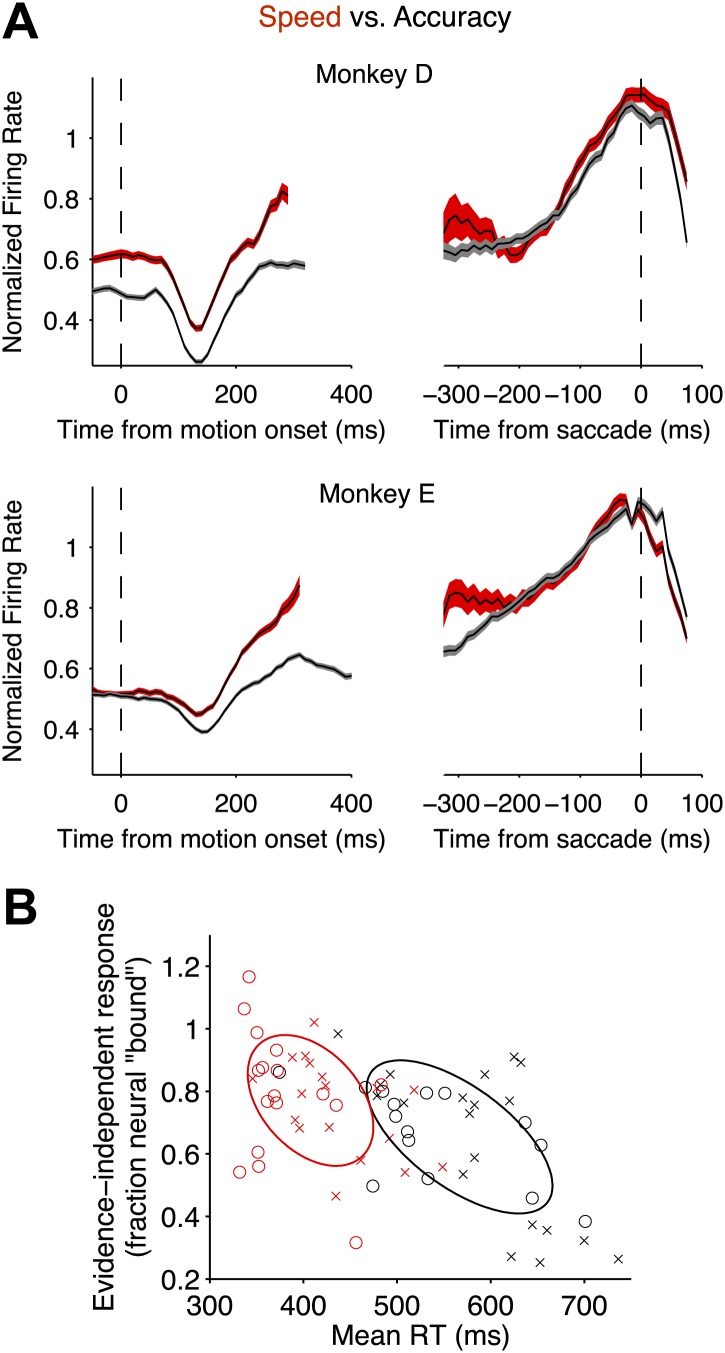
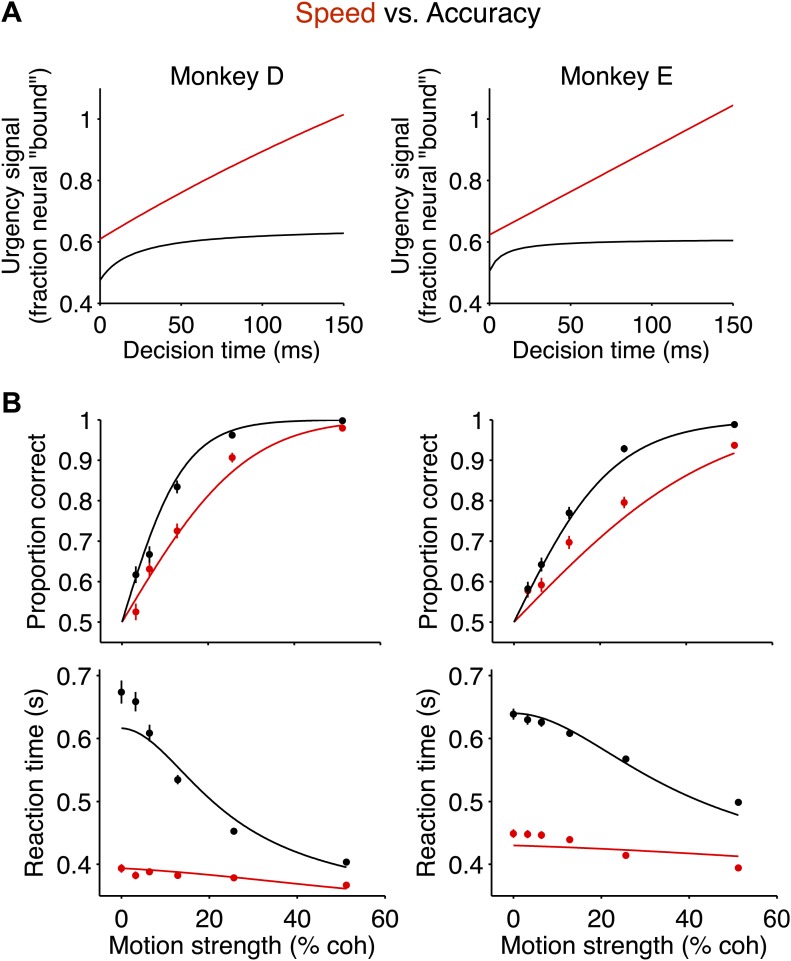
Decision making often involves a tradeoff between speed and accuracy. Previous studies indicate that neural activity in the lateral intraparietal area (LIP) represents the gradual accumulation of evidence toward a threshold level, or evidence bound, which terminates the decision process. The level of this bound is hypothesized to mediate the speed-accuracy tradeoff. To test this, we recorded from LIP while monkeys performed a motion discrimination task in two speed-accuracy regimes. Surprisingly, the terminating threshold levels of neural activity were similar in both regimes. However, neurons recorded in the faster regime exhibited stronger evidence-independent activation from the beginning of decision formation, effectively reducing the evidence-dependent neural modulation needed for choice commitment. Our results suggest that control of speed vs accuracy may be exerted through changes in decision-related neural activity itself rather than through changes in the threshold applied to such neural activity to terminate a decision.
Overview
The claims and statistics of this paper haven’t been checked yet.
Run the check — free, no account needed. It reads the open-access text and checks the sources it cites.
Integrity signals
Registry
Cites
Statistics
Figures
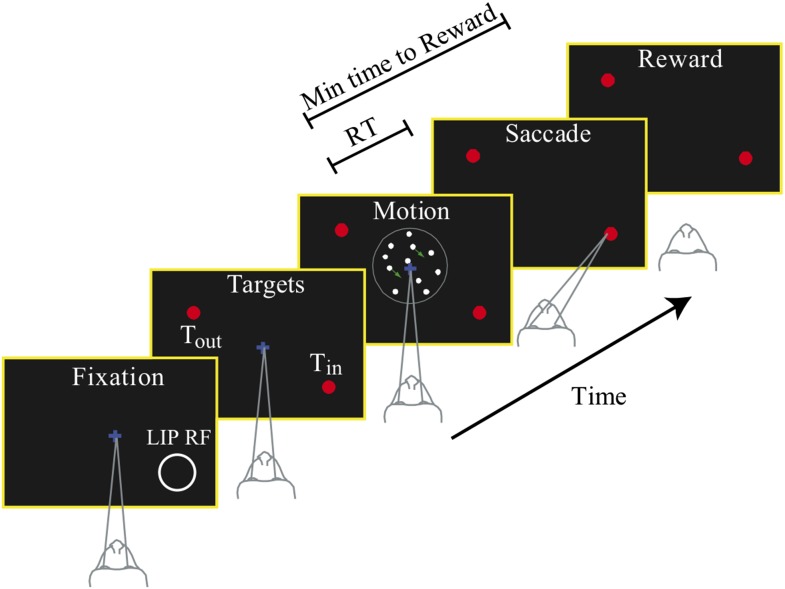
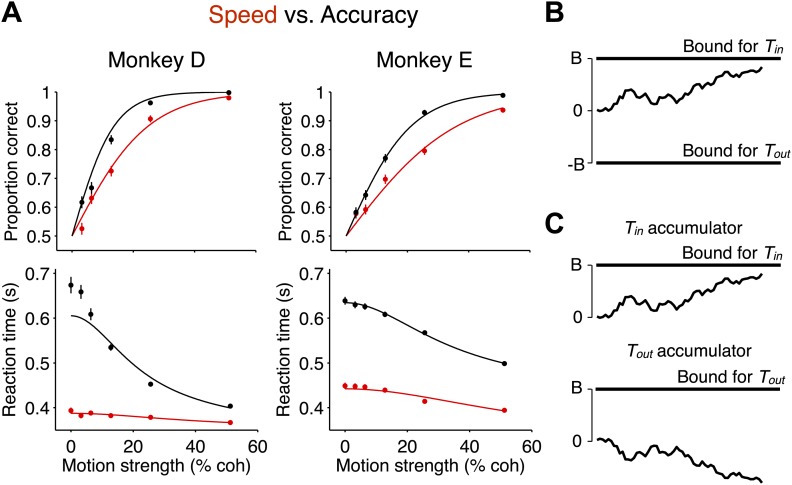
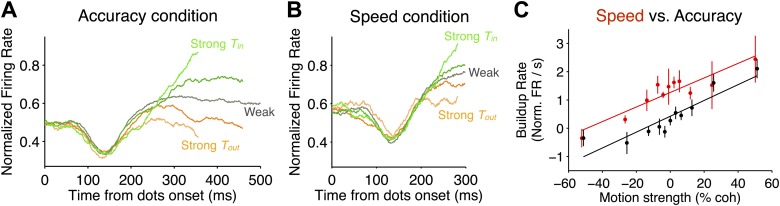
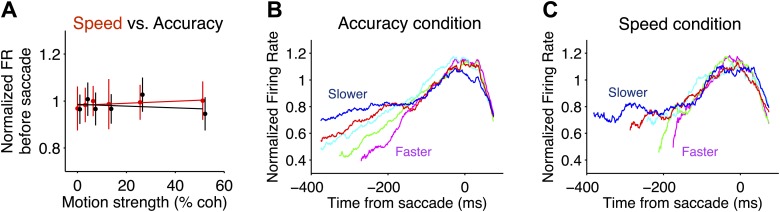
Verification
Claims the paper makes
The claims and statistics of this paper haven’t been checked yet.
Run the check — free, no account needed. It reads the open-access text and checks the sources it cites.
Claims other papers make about this one
Each is checked against this paper’s own text: does it say what the citing paper says it does?
The source backs part of the claim, not all of it — or backs it for a different population, condition or comparison.
In the citing paper
“the factors that determine when to stop gathering information and commit to a final decision, as well as which options to sample from, remain an active area of investigation1,4,9–11.”
From Interpretable abstractions of artificial neural networks predict behavior and neural activity during human information gathering (2026) · cites this paper as [9]
Experimental — accuracy not yet measured
Self-check
Percentages, sums and reported differences re-computed from the paper’s own numbers.
The self-check needs the paper’s full text.
Citations
Cites
Brainard, D. H. (1997) · Spatial Vision · doi:10.1163/156856897x00357 · Cited by 20,012
(1966) · Medical Entomology and Zoology · Cited by 10,293
Signal detection theory and psychophysics
Ingleby, D. (1967) · Journal of Sound and Vibration · doi:10.1016/0022-460x(67)90197-6 · Cited by 8,616
Ratcliff, R. (1978) · Psychological Review · doi:10.1037/0033-295x.85.2.59 · Cited by 4,513
The Neural Basis of Decision Making
Gold, J. I., & Shadlen, M. N. (2007) · Annual Review of Neuroscience · doi:10.1146/annurev.neuro.29.051605.113038 · Cited by 3,764
Self-citationThe time course of perceptual choice: The leaky, competing accumulator model.
Usher, M., & McClelland, J. L. (2001) · Psychological Review · doi:10.1037/0033-295x.108.3.550 · Cited by 2,152
(1986) · Cited by 2,022
Neural Basis of a Perceptual Decision in the Parietal Cortex (Area LIP) of the Rhesus Monkey
Shadlen, M. N., & Newsome, W. T. (2001) · Journal of Neurophysiology · doi:10.1152/jn.2001.86.4.1916 · Cited by 1,755
Self-citationNeural correlates of decision variables in parietal cortex
Platt, M. L., & Glimcher, P. W. (1999) · Nature · doi:10.1038/22268 · Cited by 1,721
Roitman, J. D., & Shadlen, M. N. (2002) · The Journal of Neuroscience · doi:10.1523/jneurosci.22-21-09475.2002 · Cited by 1,589 · cited 5×
“…of both evidence accumulation and a decision bound that leads to commitment for saccadic decisions (Shadlen and Newsome, 2001; Roitman and Shadlen, 2002; Hanks et al., 2006; Yang and Shadlen, 2007; Churchland et al., 2008; Kiani and Shadlen, 2009; Rorie et al., 2010; Churchland et al.,…”
BackgroundMethodResultInfluentialSelf-citation
Research works printed but not linked: 2
- Green, 1973, Speed-accuracy trade off in auditory detection
- Lewis, 2000, Mapping of architectonic subdivisions in the macaque monkey, with emphasis on parieto-occipital cortex, The Journal of Comparative Neurology, 428, 79, 10.1002/1096-9861(20001204)428:13.0.CO;2-Q · DOI
Cited by
Sorted by citations
Neuronal Reward and Decision Signals: From Theories to Data
Schultz, W. (2015) · Physiological Reviews · doi:10.1152/physrev.00023.2014 · Cited by 1,126
Sequential Sampling Models in Cognitive Neuroscience: Advantages, Applications, and Extensions
Forstmann, B. U., Ratcliff, R., & Wagenmakers, E. (2015) · Annual Review of Psychology · doi:10.1146/annurev-psych-122414-033645 · Cited by 665
Flexible timing by temporal scaling of cortical responses
Wang, J., Narain, D., Hosseini, E. A., & Jazayeri, M. (2017) · Nature Neuroscience · doi:10.1038/s41593-017-0028-6 · Cited by 425
Perceptual Decision Making in Rodents, Monkeys, and Humans
Hanks, T. D., & Summerfield, C. (2017) · Neuron · doi:10.1016/j.neuron.2016.12.003 · Cited by 409
Self-citationFrontosubthalamic Circuits for Control of Action and Cognition
Aron, A. R., Herz, D. M., Brown, P., Forstmann, B. U., & Zaghloul, K. A. (2016) · Journal of Neuroscience · doi:10.1523/jneurosci.2348-16.2016 · Cited by 299
Metadata
- Authors
- Hanks, T., Kiani, R., & Shadlen, M. N.
- Affiliations
- Princeton University (US)
- New York University (US)
- Howard Hughes Medical Institute (US)
- Corresponding author
- Hanks, Timothy
- Shadlen, Michael N
- Venue
- eLife
- Publisher
- eLife Sciences Publications, Ltd
- Published
- 2014-05-27
- Volume
- 3
- ISSN
- 2050-084X (ISSN-L)
- PMC
- PMC4054775
- OpenAlex
- W2170716773
- Cited by
- 222
- References
- 56
- Citations by year
- 2026: 13 · 2025: 19 · 2024: 13 · 2023: 22 · 2022: 14 · 2021: 20 · 2020: 21 · 2019: 19 · 2018: 26 · 2017: 14 · 2016: 23 · 2015: 15 · 2014: 3
- FWCI
- 10.23
- Type
- journal article
- Language
- en
- Open access
- gold
- doi.org
- Licence
- Locations
- eLife (publishedVersion, cc-by)
- Europe PMC (PubMed Central) (publishedVersion, cc-by)
- PubMed Central (publishedVersion, cc-by)
- PubMed (publishedVersion)
- DOAJ (DOAJ: Directory of Open Access Journals) (submittedVersion, cc-by-sa)
- eScholarship (California Digital Library) (submittedVersion, cc-by)
- Funders
- Howard Hughes Medical Institute
- National Eye Institute (EY11378)
- Human Frontier Science Program (RGP0067/2011)
- Topics
- Life Sciences › Neuroscience › Cognitive Neuroscience › Visual perception and processing mechanisms
- Life Sciences › Neuroscience › Cognitive Neuroscience › Neural and Behavioral Psychology Studies
- Life Sciences › Neuroscience › Cognitive Neuroscience › Neural dynamics and brain function
- Keywords
- speed-accuracy trade-off, lateral intraparietal area, decision-making, evidence accumulation, decision threshold, motion discrimination, macaque
- MeSH terms
- Animals, Bayes Theorem, Behavior, Animal, Choice Behavior, Decision Making, Macaca, Models, Neurological, Motion Perception, Neurons, Neurophysiology, Photic Stimulation, Reaction Time, Time Factors, Reproducibility of Results
About these checks
Registry, retraction, Cites and statistics results are computed, not judged, with one exception: a printed reference that no index lists is read once by a model before it counts as a citation error. Claims are extracted by a model and kept only when their quote appears verbatim in the text; each cited source is then checked, with a model’s help, for whether it says what the claim relies on. Those verdicts can be wrong — read the claim’s quote and the cited source before relying on one.
Statistics and arithmetic are recomputed, not judged.
Confidence bands are shown only for fields calibrated on our annotated test set. None is calibrated yet, so no band is shown.
What counts as a claim ›How we measure confidence ›How we check this ›
Are you an author, or do you see a problem with this page? Request a review
