

The DOI matches its Crossref record; 137 of the 149 references it cites were found in a registry or an index.
Protein language model identifies disordered, conserved motifs implicated in phase separation
Open accessPublished version of a preprint
Abstract
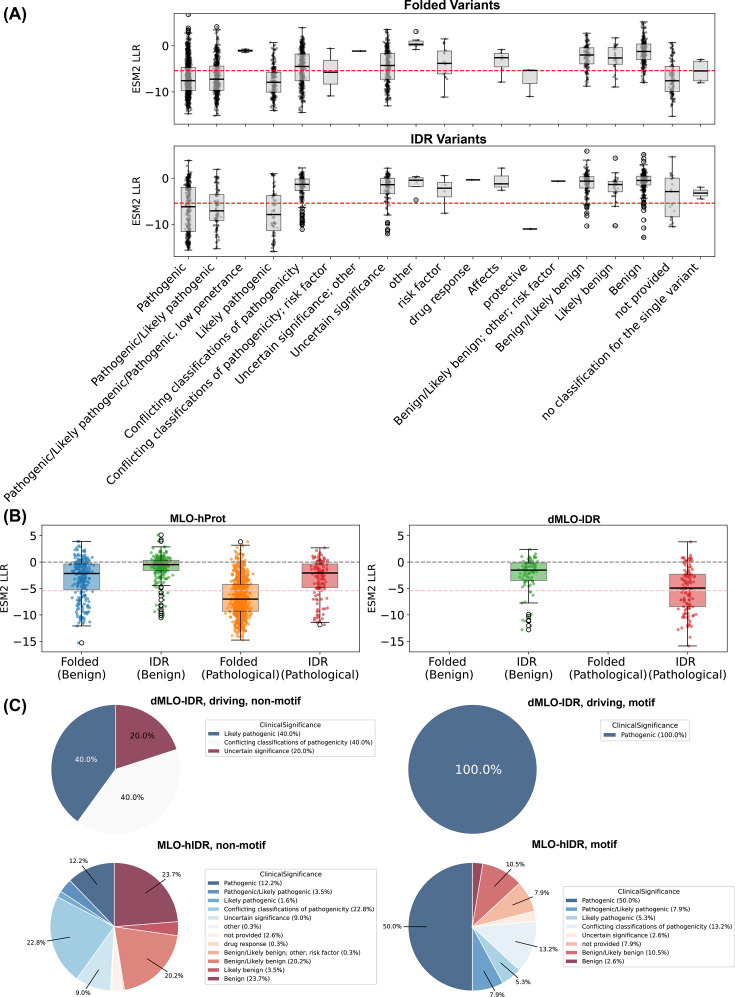
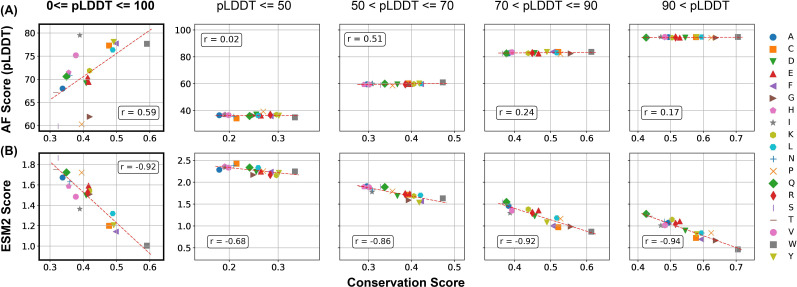
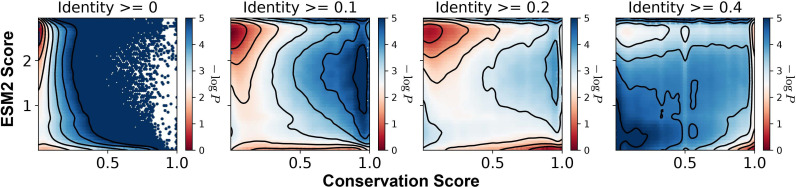
Intrinsically disordered regions (IDRs) play a critical role in phase separation and are essential for the formation of membraneless organelles (MLOs). Mutations within IDRs can disrupt their multivalent interaction networks, altering phase behavior and contributing to various diseases. Therefore, examining the evolutionary constraints of IDRs provides valuable insights into the relationship between protein sequences and phase separation. In this study, we utilized the ESM2 protein language model to map the residue-level mutational tolerance landscapes of IDRs. Our findings reveal that IDRs, particularly those actively participating in phase separation, contain conserved amino acids. This conservation is evident through mutational constraints predicted by ESM2 and supported by direct analyses of multiple sequence alignments. These conserved, disordered amino acids include residues traditionally identified as ‘stickers’ as well as ‘spacers’ and frequently form continuous sequence motifs. The strong conservation, combined with their potential role in phase separation, suggests that these motifs may act as functional units under evolutionary selection to support stable MLO formation. Our findings underscore the insights into phase separation’s molecular grammar made possible through evolutionary analysis enabled by protein language models.
Overview
The claims and statistics of this paper haven’t been checked yet.
Run the check — free, no account needed. It reads the open-access text and checks the sources it cites.
Integrity signals
Registry
Cites
Statistics
Figures
Verification
Claims the paper makes
The claims and statistics of this paper haven’t been checked yet.
Run the check — free, no account needed. It reads the open-access text and checks the sources it cites.
Self-check
Percentages, sums and reported differences re-computed from the paper’s own numbers.
The self-check needs the paper’s full text.
Citations
Cites
Vaswani, A., Shazeer, N., Parmar, N., Uszkoreit, J., Jones, L., Gomez, A. N., Kaiser, L., & Polosukhin, I. (2017) · arXiv · doi:10.48550/arxiv.1706.03762 · Cited by 120,404 · cited 1×
“Trained on large protein datasets, such as UniProt ( Boutet et al., 2016 ), these models leverage neural network architectures like the Trans-former ( Vaswani et al., 2017 ) to capture correlations among amino acids within a sequence.”
Highly accurate protein structure prediction with AlphaFold
Jumper, J., Evans, R., Pritzel, A., Green, T., Figurnov, M., Ronneberger, O., Tunyasuvunakool, K., Bates, R., Žídek, A., Potapenko, A., et al. (2021) · Nature · doi:10.1038/s41586-021-03819-2 · Cited by 43,764 · cited 1×
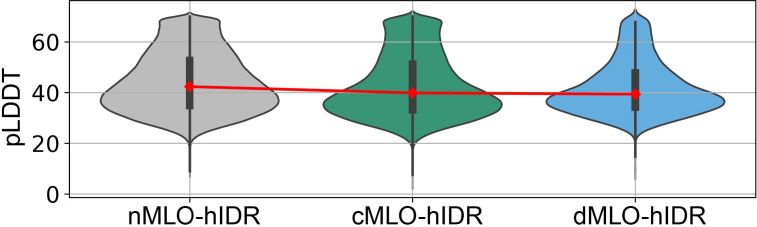
“The pLDDT scores have been shown to correlate well with protein flexibility and disorder ( Jumper et al., 2021 ), making them a reliable tool for distinguishing structured from unstructured regions.”
Biomolecular condensates: organizers of cellular biochemistry
Banani, S. F., Lee, H. O., Hyman, A. A., & Rosen, M. K. (2017) · Nature Reviews Molecular Cell Biology · doi:10.1038/nrm.2017.7 · Cited by 6,058 · cited 1×
“…environments and play a vital role in forming specialized biochemical compartments that drive essential cellular functions ( Hirose et al., 2023 ; Banani et al., 2017 ; Choi et al., 2020 ; Pappu et al., 2023 ; Ginell and Holehouse, 2023 ; Latham and Zhang, 2020 ; Latham and Zhang, 2022a ; Latham…”
Evolutionary-scale prediction of atomic level protein structure with a language model
Lin, Z., Akin, H., Rao, R., Hie, B., Zhu, Z., Lu, W., Smetanin, N., Verkuil, R., Kabeli, O., Shmueli, Y., et al. (2022) · doi:10.1101/2022.07.20.500902 · Cited by 5,990 · cited 2×
“ESM2 enables the quantification of the probability, or likelihood, of observing any of the 20 amino acids at site i .”
ClinVar: improving access to variant interpretations and supporting evidence
Landrum, M. J., Lee, J. M., Benson, M., Brown, G. R., Chao, C., Chitipiralla, S., Gu, B., Hart, J., Hoffman, D., Jang, W., et al. (2018) · Nucleic Acids Research · doi:10.1093/nar/gkx1153 · Cited by 4,196 · cited 1×
“To explore potential clinical implications, we analyzed pathogenicity data from ClinVar ( Landrum et al., 2014 ; Landrum et al., 2018 ; Cagiada et al., 2024 ; Luppino et al., 2025 ; Fawzy and Marsh, 2025 ).”
Thermodynamics of High Polymer Solutions
Flory, P., & Krigbaum, W. R. (1941) · The Journal of Chemical Physics · doi:10.1063/1.1723621 · Cited by 4,126 · cited 1×
“…( Brangwynne et al., 2015 ; Pappu et al., 2023 ; Zeng and Pappu, 2023 ; Schmit et al., 2020 ; Mittag and Pappu, 2022 ; Dzuricky et al., 2018 ; Flory, 1942 ; Huggins, 1942 ; Dignon et al., 2018 ; Dignon et al., 2019 ; Latham and Zhang, 2020 ; Joseph et al., 2021 ; Regy et al., 2021 ; Latham…”
ClinVar: public archive of relationships among sequence variation and human phenotype
Landrum, M. J., Lee, J. M., Riley, G. R., Jang, W., Rubinstein, W. S., Church, D. M., & Maglott, D. R. (2014) · Nucleic Acids Research · doi:10.1093/nar/gkt1113 · Cited by 3,516 · cited 1×
“To explore potential clinical implications, we analyzed pathogenicity data from ClinVar ( Landrum et al., 2014 ; Landrum et al., 2018 ; Cagiada et al., 2024 ; Luppino et al., 2025 ; Fawzy and Marsh, 2025 ).”
Rives, A., Meier, J., Sercu, T., Goyal, S., Lin, Z., Liu, J., Guo, D., Ott, M., Zitnick, C. L., Ma, J., et al. (2019) · doi:10.1101/622803 · Cited by 3,280 · cited 1×
“Recent advances in protein language models ( Ofer et al., 2021 ; Rives et al., 2021 ; Elnaggar et al., 2021 ; Strodthoff et al., 2020 ; Alley et al., 2019 ; Brandes et al., 2022 ) provide alternative approaches for sequence analysis and information decoding.”
Liquid-Liquid Phase Separation in Biology
Hyman, A. A., Weber, C. A., & Jülicher, F. (2014) · Annual Review of Cell and Developmental Biology · doi:10.1146/annurev-cellbio-100913-013325 · Cited by 3,155 · cited 1×
“…et al., 2023 ; Banani et al., 2017 ; Choi et al., 2020 ; Pappu et al., 2023 ; Ginell and Holehouse, 2023 ; Latham and Zhang, 2020 ; Latham and Zhang, 2022a ; Latham and Zhang, 2022c ; Latham and Zhang, 2022b ; Latham et al., 2024 ; Liu et al., 2025 ; Lao and Zhang, 2024 ; Jiang et al., 2015 ).”
HHblits: lightning-fast iterative protein sequence searching by HMM-HMM alignment
Remmert, M., Biegert, A., Hauser, A., & Söding, J. (2012) · Nature Methods · doi:10.1038/nmeth.1818 · Cited by 2,288 · cited 1×
“We performed MSA analysis using HHblits from the HH-suite3 software suite ( Suzek et al., 2007 ; Suzek et al., 2015 ; Remmert et al., 2012 ; Steinegger et al., 2019 ), a widely used open-source toolkit known for its sensitivity in detecting sequence similarities and identifying protein folds.”
Research works printed but not linked: 1
- Zhang Y. 2025. ESM2_IDR_LLPS. GitHub. swh:1:rev:318a81268901ea4e1349122f1ddb12ee8f5e15d0. https://archive.softwareheritage.org/swh:1:dir:f98ccbe03ad38d248f9d12d0b452c3fe2f054a54;origin=https://github.com/ZhangGroup-MITChemistry/ESM2_IDR_LLPS;visit=swh:1:snp:35bf3137f559f3a75ca839779dc10c553125d97b;anchor=swh:1:rev:318a81268901ea4e1349122f1ddb12ee8f5e15d0.
Cited by
Sorted by citations
MOFF2: A Transferable Coarse-Grained Protein Force Field for Predictive Condensate Simulations
Liu, S.-M., Zhang, Y.-M., Riveros, I., Wang, C.-Z., & Zhang, B. (2026) · bioRxiv · doi:10.64898/2026.06.10.731384 · Cited by 2
Self-citationZeng, X.-Y., Wang, T., Kulkarni, A., Lu, A., Ni, A., Xing, P., Zhao, J., Chen, S.-W., & Zhou, D. (2025) · doi:10.48550/arxiv.2507.02883 · Cited by 1
“This limitation is particularly consequential for applications that depend on dynamic and context-dependent interactions, including protein-protein interaction (PPI) prediction and phase separation [35].”
On the limits of marginal protein folding stability: methodological goals and drawbacks
Ferreiro, D., Zoni, V., & Arenas, M. (2026) · Journal of Molecular Modeling · doi:10.1007/s00894-026-07034-6
“Because PLMs are trained on millions of unannotated protein sequences using a masked-language-modeling objective, they inter-nalize statistical patterns of protein architecture, including residue-residue contacts and functional motifs [62].”
Zhang, Y.-M., Sood, A., Athreya, A., & Zhang, B. (2026) · Journal of Physical Chemistry B · doi:10.1021/acs.jpcb.6c05200
Self-citationMOFF2: A Transferable Coarse-Grained Protein Force Field for Predictive Condensate Simulations
Liu, S., Zhang, Y., Riveros, I., Wang, C., & Zhang, B. (2026) · Journal of Chemical Theory and Computation · doi:10.1021/acs.jctc.6c01336 · Cited by 4
Self-citation
Metadata
- Authors
- Zhang, Y., Zheng, J., & Zhang, B.
- Affiliations
- Massachusetts Institute of Technology (US)
- Corresponding author
- Zhang, Bin
- Venue
- eLife
- Publisher
- eLife Sciences Publications, Ltd
- Published
- 2025-10-20
- Volume
- 14
- ISSN
- 2050-084X (ISSN-L)
- PMC
- PMC12537011
- OpenAlex
- W4410139515
- Cited by
- 4
- References
- 149
- Citations by year
- 2026: 3 · 2025: 1
- Type
- posted content
- Language
- en
- Open access
- gold
- doi.org
- Licence
- Locations
- eLife (publishedVersion, cc-by)
- Europe PMC (PubMed Central) (publishedVersion, cc-by)
- PubMed (publishedVersion)
- DOAJ (DOAJ: Directory of Open Access Journals) (submittedVersion, cc-by-sa)
- Funders
- National Institute of General Medical Sciences (R35GM133580)
- Topics
- Life Sciences › Biochemistry, Genetics and Molecular Biology › Molecular Biology › Protein Structure and Dynamics
- Life Sciences › Biochemistry, Genetics and Molecular Biology › Molecular Biology › RNA Research and Splicing
- Life Sciences › Biochemistry, Genetics and Molecular Biology › Molecular Biology › RNA and protein synthesis mechanisms
- Keywords
- intrinsically disordered regions, phase separation, biomolecular condensates, protein language models, ESM-2, mutational tolerance, evolutionary conservation, conserved motifs, multivalent interactions, protein sequence evolution
- MeSH terms
- Phase Separation, Amino Acid Sequence, Organelles, Conserved Sequence, Evolution, Molecular, Amino Acid Motifs, Intrinsically Disordered Proteins
About these checks
Registry, retraction, Cites and statistics results are computed, not judged, with one exception: a printed reference that no index lists is read once by a model before it counts as a citation error. Claims are extracted by a model and kept only when their quote appears verbatim in the text; each cited source is then checked, with a model’s help, for whether it says what the claim relies on. Those verdicts can be wrong — read the claim’s quote and the cited source before relying on one.
Statistics and arithmetic are recomputed, not judged.
Confidence bands are shown only for fields calibrated on our annotated test set. None is calibrated yet, so no band is shown.
What counts as a claim ›How we measure confidence ›How we check this ›
Are you an author, or do you see a problem with this page? Request a review
How to cite
Cite CoChat for the checks on this page, and the paper for its own findings.
- This page
- CoChat. (2026). Citation check: Protein language model identifies disordered, conserved motifs implicated in phase separation. https://app.cochat.ai/papers/10.7554/elife.105309
- The paper
- Zhang, Y., Zheng, J., & Zhang, B. (2025). Protein language model identifies disordered, conserved motifs implicated in phase separation. eLife. https://doi.org/10.7554/elife.105309
