

The DOI matches its Crossref record; 66 of the 66 references it cites were found in a registry or an index.
Publication bias and the canonization of false facts
Open accessAbstract
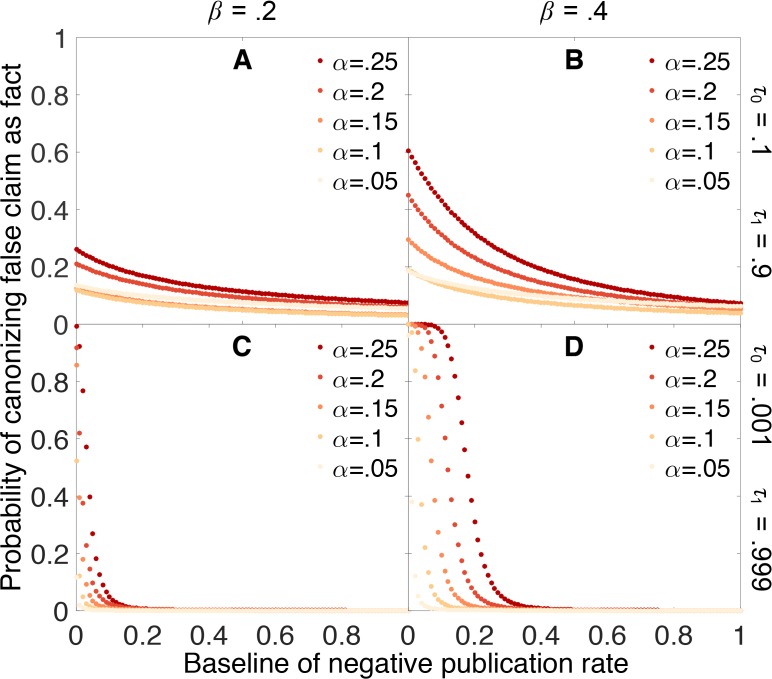
Science is facing a “replication crisis” in which many experimental findings cannot be replicated and are likely to be false. Does this imply that many scientific facts are false as well? To find out, we explore the process by which a claim becomes fact. We model the community’s confidence in a claim as a Markov process with successive published results shifting the degree of belief. Publication bias in favor of positive findings influences the distribution of published results. We find that unless a sufficient fraction of negative results are published, false claims frequently can become canonized as fact. Data-dredging, p-hacking, and similar behaviors exacerbate the problem. Should negative results become easier to publish as a claim approaches acceptance as a fact, however, true and false claims would be more readily distinguished. To the degree that the model reflects the real world, there may be serious concerns about the validity of purported facts in some disciplines.
Overview
The claims and statistics of this paper haven’t been checked yet.
Run the check — free, no account needed. It reads the open-access text and checks the sources it cites.
Integrity signals
Registry
Cites
Statistics
Figures
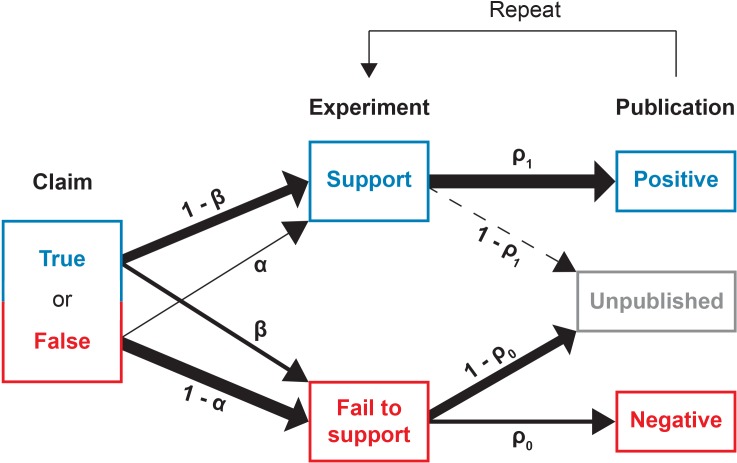
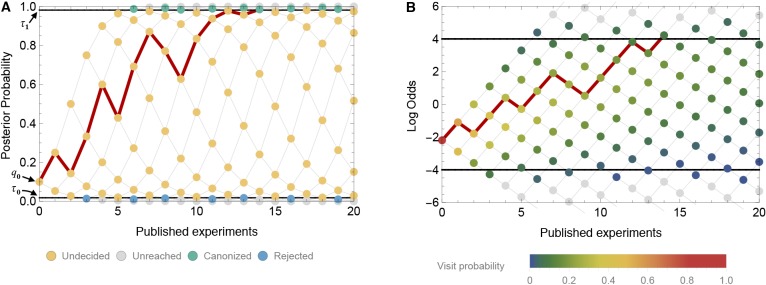
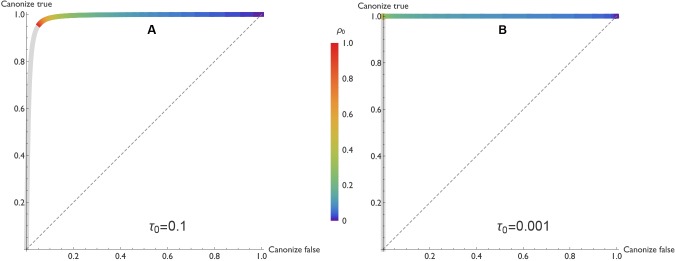
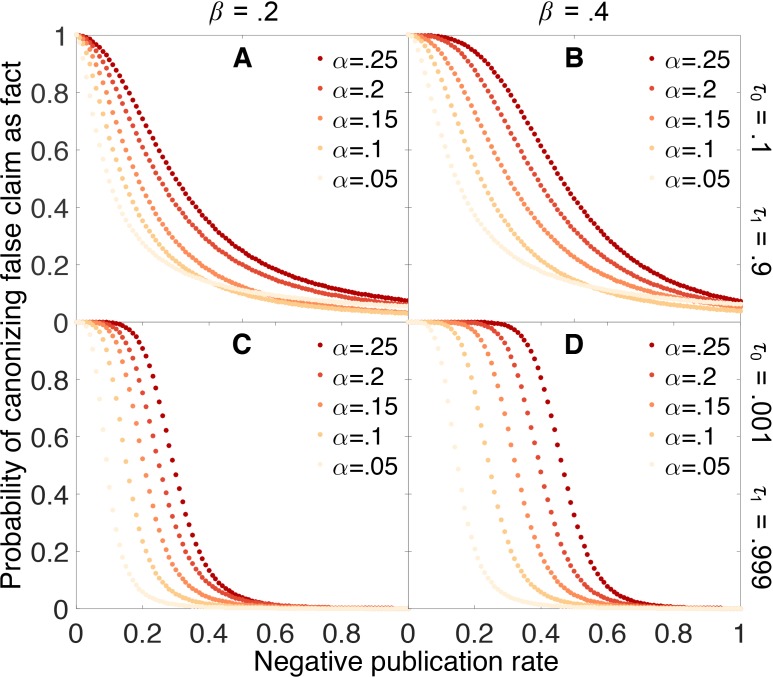
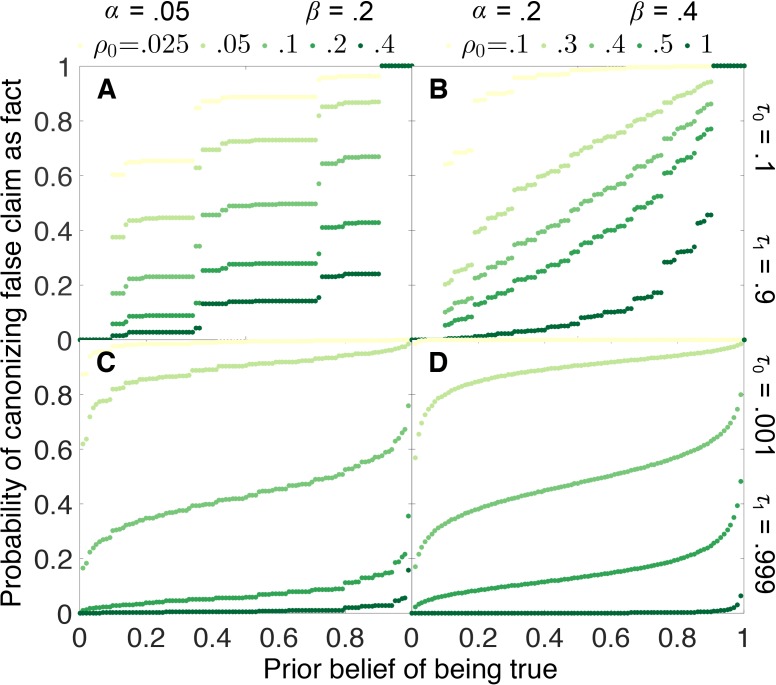
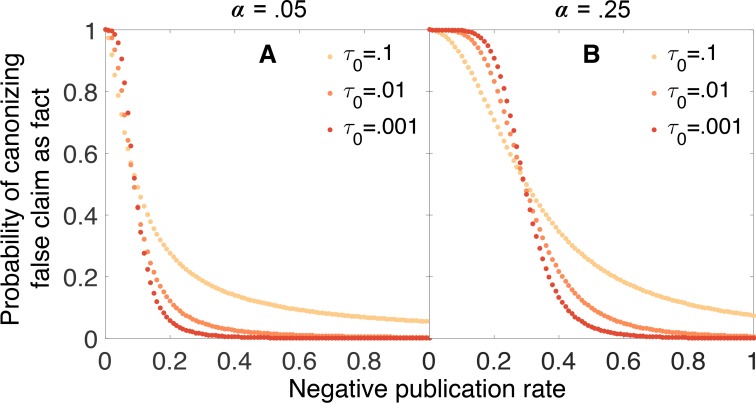
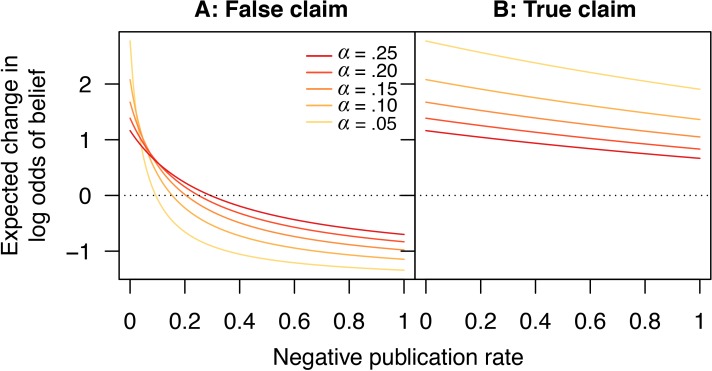
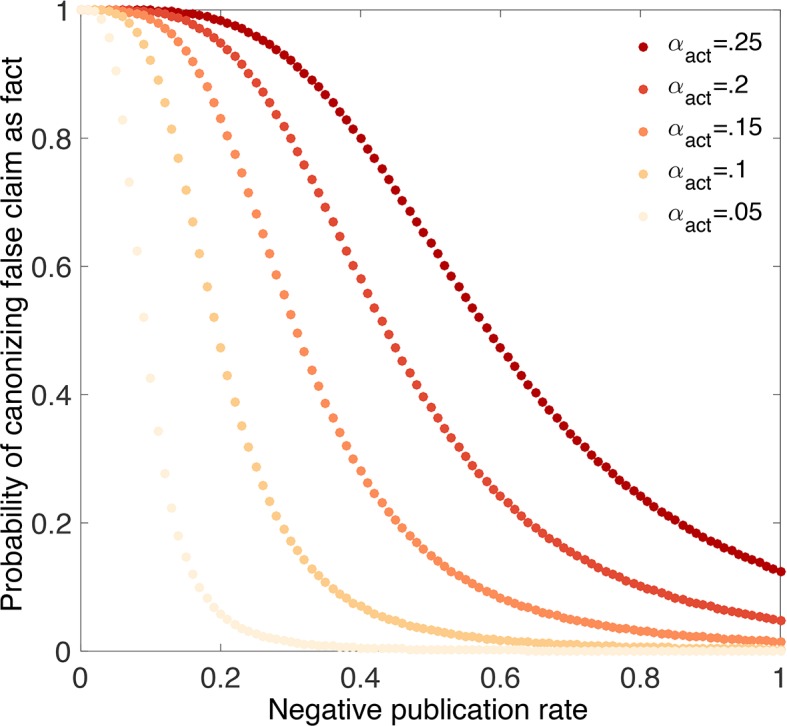
Verification
Claims the paper makes
The claims and statistics of this paper haven’t been checked yet.
Run the check — free, no account needed. It reads the open-access text and checks the sources it cites.
Claims other papers make about this one
Each is checked against this paper’s own text: does it say what the citing paper says it does?
The source backs part of the claim, not all of it — or backs it for a different population, condition or comparison.
In the citing paper
“It can be shown that the”
From Fraudulent studies are undermining the reliability of systematic reviews: on the prevalence of problematic images in preclinical depression studies (2025) · cites this paper as [57]
Experimental — accuracy not yet measuredIn the citing paper
“With negative results buried in file drawers (55), conclusions drawn from the published record can be misleading, and 'false facts' can become canonized in the literature (56).”
From Misinformation in and about science (2021) · cites this paper as [56]
Self-check
Percentages, sums and reported differences re-computed from the paper’s own numbers.
The self-check needs the paper’s full text.
Citations
Cites
(2014) · Climate Change 2013 – The Physical Science Basis · doi:10.1017/cbo9781107415324.004 · Cited by 23,880
Science in Action: How to Follow Scientists and Engineers through Society
Bijker, W. E., & Latour, B. (1988) · Technology and Culture · doi:10.2307/3105094 · Cited by 10,770
Why Most Published Research Findings Are False
Ioannidis, J. P. A. (2005) · PLoS Medicine · doi:10.1371/journal.pmed.0020124 · Cited by 10,505
The file drawer problem and tolerance for null results.
Rosenthal, R. (1979) · Psychological Bulletin · doi:10.1037/0033-2909.86.3.638 · Cited by 9,068
(1987) · Cited by 8,955
Estimating the reproducibility of psychological science
Open Science Collaboration (2015) · Science · doi:10.1126/science.aac4716 · Cited by 8,515
Anderson, N. H. (2001) · Psychology Press eBooks · doi:10.4324/9781410600004-24 · Cited by 6,939
Role for a bidentate ribonuclease in the initiation step of RNA interference
Bernstein, E., Caudy, A. A., Hammond, S. M., & Hannon, G. J. (2001) · Nature · doi:10.1038/35053110 · Cited by 5,018
The Foundations of Statistics.
Good, I. J., & Savage, L. J. (1955) · Journal of the Royal Statistical Society Series A (General) · doi:10.2307/2343133 · Cited by 4,764
Why Most Published Research Findings Are False
Ioannidis, J. P. A. (2005) · CHANCE · doi:10.1080/09332480.2005.10722754 · Cited by 4,702 · cited 3×
“The limited benefits of strengthening evidentiary standards can be understood through the mathematical theory of random walks [30].”
Background
Research works printed but not linked: 1
- Norris, 1998, Markov Chains
Cited by
Sorted by citations
Fortunato, S., Bergstrom, C. T., Börner, K., Evans, J. A., Helbing, D., Milojević, S., Petersen, A. M., Radicchi, F., Sinatra, R., Uzzi, B., et al. (2018) · Science · doi:10.1126/science.aao0185 · Cited by 1,497
Self-citationShi, L., & Lin, L. (2019) · Medicine · doi:10.1097/md.0000000000015987 · Cited by 818
Walter, J., Armet, A. M., Finlay, B. B., & Shanahan, F. (2020) · Cell · doi:10.1016/j.cell.2019.12.025 · Cited by 596
PREPARE: guidelines for planning animal research and testing
Smith, A. J., Clutton, R. E., Lilley, E. J., Hansen, K. E. A., & Brattelid, T. (2017) · Laboratory Animals · doi:10.1177/0023677217724823 · Cited by 620
Dewa, C. S., Loong, D., Bonato, S., & Trojanowski, L. (2017) · BMJ Open · doi:10.1136/bmjopen-2016-015141 · Cited by 546
Metadata
- Authors
- Nissen, S. B., Magidson, T., Gross, K., & Bergstrom, C. T.
- Affiliations
- University of Copenhagen (DK)
- Corresponding author
- Gross, Kevin
- Bergstrom, Carl T
- Venue
- eLife
- Publisher
- eLife Sciences Publications, Ltd
- Published
- 2016-12-20
- Volume
- 5
- ISSN
- 2050-084X (ISSN-L)
- PMC
- PMC5173326
- OpenAlex
- W2515380863
- Cited by
- 266
- References
- 64
- Citations by year
- 2026: 12 · 2025: 42 · 2024: 26 · 2023: 30 · 2022: 32 · 2021: 28 · 2020: 27 · 2019: 21 · 2018: 25 · 2017: 14 · 2016: 8
- FWCI
- 42.86
- Type
- journal article
- Language
- en
- Open access
- gold
- doi.org
- Licence
- Locations
- eLife (publishedVersion, cc-by)
- PubMed Central (publishedVersion, cc-by)
- PubMed (publishedVersion)
- Research at the University of Copenhagen (University of Copenhagen) (publishedVersion, cc-by)
- arXiv (Cornell University) (submittedVersion)
- DOAJ (DOAJ: Directory of Open Access Journals) (submittedVersion, cc-by-sa)
- arXiv (Cornell University)
- Funders
- John Templeton Foundation
- Danish National Research Foundation
- Topics
- Social Sciences › Library and Information Sciences › Academic Publishing and Open Access
- Social Sciences › Library and Information Sciences › scientometrics and bibliometrics research
- Social Sciences › Decision Sciences › Statistics, Probability and Uncertainty › Meta-analysis and systematic reviews
- Keywords
- publication bias, replication crisis, false claims, scientific credibility, Markov model, belief updating, negative results, p-hacking, false positives
- MeSH terms
- Humans, Publication Bias, Biomedical Research
About these checks
Registry, retraction, Cites and statistics results are computed, not judged, with one exception: a printed reference that no index lists is read once by a model before it counts as a citation error. Claims are extracted by a model and kept only when their quote appears verbatim in the text; each cited source is then checked, with a model’s help, for whether it says what the claim relies on. Those verdicts can be wrong — read the claim’s quote and the cited source before relying on one.
Statistics and arithmetic are recomputed, not judged.
Confidence bands are shown only for fields calibrated on our annotated test set. None is calibrated yet, so no band is shown.
What counts as a claim ›How we measure confidence ›How we check this ›
Are you an author, or do you see a problem with this page? Request a review
