

The DOI matches its Crossref record; 66 of the 66 references it cites were found in a registry or an index.
Publication bias and the canonization of false facts
Open accessAbstract
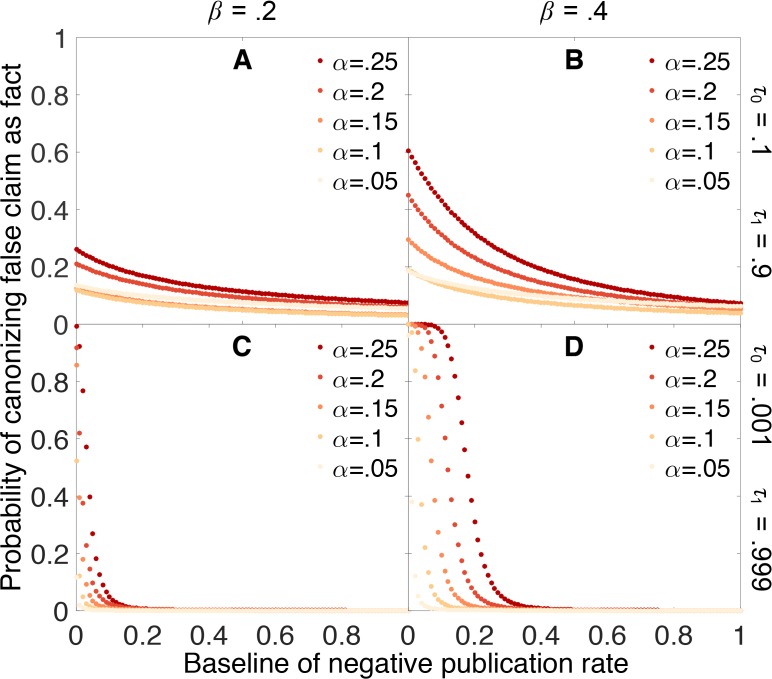
Science is facing a “replication crisis” in which many experimental findings cannot be replicated and are likely to be false. Does this imply that many scientific facts are false as well? To find out, we explore the process by which a claim becomes fact. We model the community’s confidence in a claim as a Markov process with successive published results shifting the degree of belief. Publication bias in favor of positive findings influences the distribution of published results. We find that unless a sufficient fraction of negative results are published, false claims frequently can become canonized as fact. Data-dredging, p-hacking, and similar behaviors exacerbate the problem. Should negative results become easier to publish as a claim approaches acceptance as a fact, however, true and false claims would be more readily distinguished. To the degree that the model reflects the real world, there may be serious concerns about the validity of purported facts in some disciplines.
Overview
The claims and statistics of this paper haven’t been checked yet.
Run the check — free, no account needed. It reads the open-access text and checks the sources it cites.
Integrity signals
Registry
Cites
Statistics
Figures
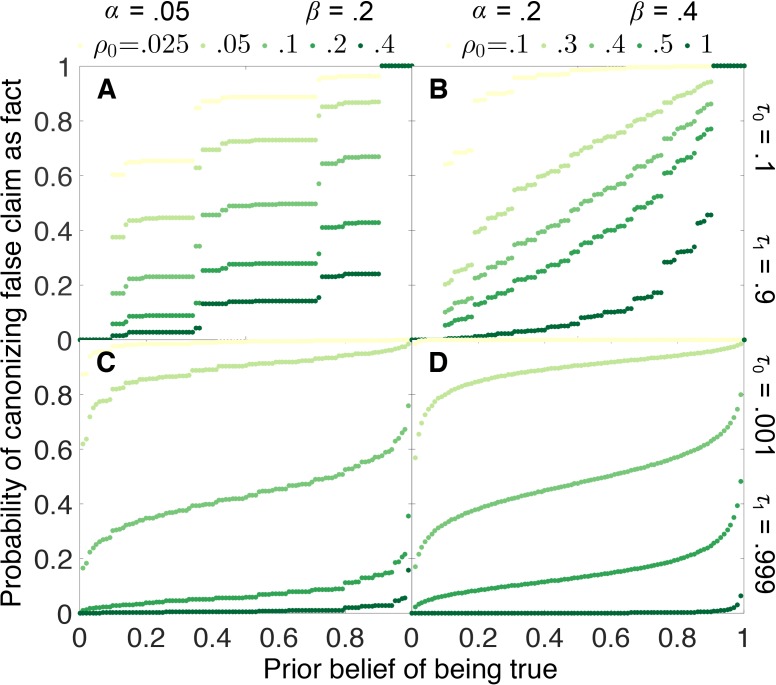
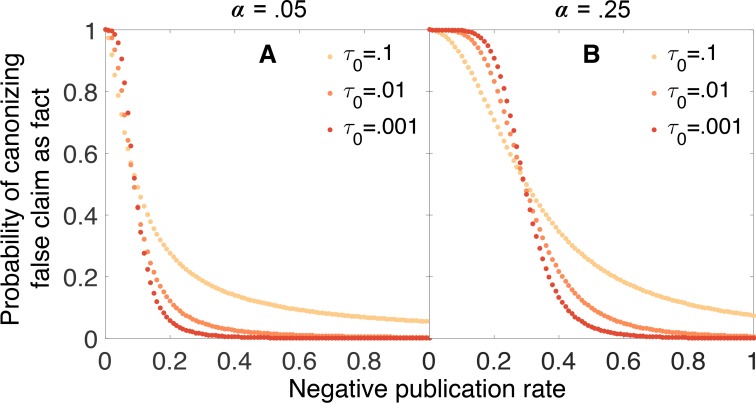
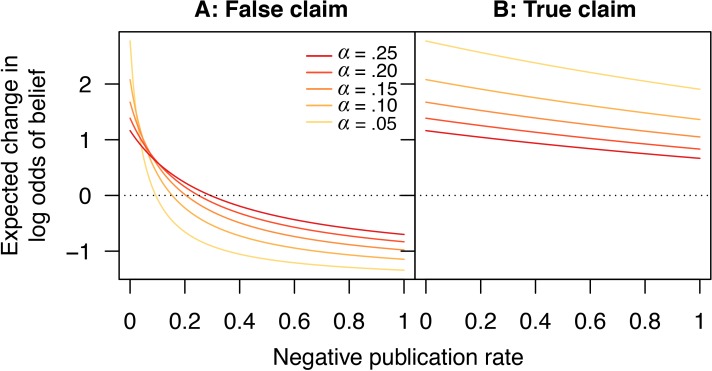
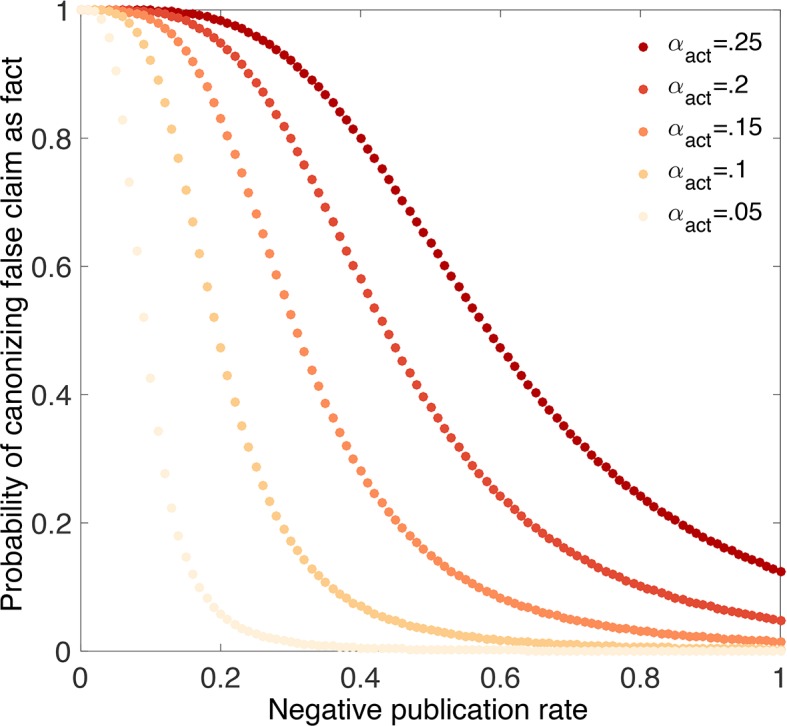
Verification
Claims the paper makes
The claims and statistics of this paper haven’t been checked yet.
Run the check — free, no account needed. It reads the open-access text and checks the sources it cites.
Claims other papers make about this one
Each is checked against this paper’s own text: does it say what the citing paper says it does?
The source backs part of the claim, not all of it — or backs it for a different population, condition or comparison.
In the citing paper
“It can be shown that the”
From Fraudulent studies are undermining the reliability of systematic reviews: on the prevalence of problematic images in preclinical depression studies (2025) · cites this paper as [57]
Experimental — accuracy not yet measuredIn the citing paper
“With negative results buried in file drawers (55), conclusions drawn from the published record can be misleading, and 'false facts' can become canonized in the literature (56).”
From Misinformation in and about science (2021) · cites this paper as [56]
Self-check
Percentages, sums and reported differences re-computed from the paper’s own numbers.
The self-check needs the paper’s full text.
Citations
Cites
(2014) · Climate Change 2013 – The Physical Science Basis · doi:10.1017/cbo9781107415324.004 · Cited by 23,880
Science in Action: How to Follow Scientists and Engineers through Society
Bijker, W. E., & Latour, B. (1988) · Technology and Culture · doi:10.2307/3105094 · Cited by 10,770
Why Most Published Research Findings Are False
Ioannidis, J. P. A. (2005) · PLoS Medicine · doi:10.1371/journal.pmed.0020124 · Cited by 10,505
The file drawer problem and tolerance for null results.
Rosenthal, R. (1979) · Psychological Bulletin · doi:10.1037/0033-2909.86.3.638 · Cited by 9,068
(1987) · Cited by 8,955
Estimating the reproducibility of psychological science
Open Science Collaboration (2015) · Science · doi:10.1126/science.aac4716 · Cited by 8,515
Anderson, N. H. (2001) · Psychology Press eBooks · doi:10.4324/9781410600004-24 · Cited by 6,939
Role for a bidentate ribonuclease in the initiation step of RNA interference
Bernstein, E., Caudy, A. A., Hammond, S. M., & Hannon, G. J. (2001) · Nature · doi:10.1038/35053110 · Cited by 5,018
The Foundations of Statistics.
Good, I. J., & Savage, L. J. (1955) · Journal of the Royal Statistical Society Series A (General) · doi:10.2307/2343133 · Cited by 4,764
Why Most Published Research Findings Are False
Ioannidis, J. P. A. (2005) · CHANCE · doi:10.1080/09332480.2005.10722754 · Cited by 4,702 · cited 3×
“The limited benefits of strengthening evidentiary standards can be understood through the mathematical theory of random walks [30].”
Background1,500 scientists lift the lid on reproducibility
Baker, M. (2016) · Nature · doi:10.1038/533452a · Cited by 4,209
Cluster failure: why fMRI inferences for spatial extent have inflated false-positive rates
Eklund, A., Nichols, T. E., & Knutsson, H. (2016) · Proceedings of the National Academy of Sciences · doi:10.1073/pnas.1602413113 · Cited by 3,487
Publication bias in clinical research
Easterbrook, P. J., Gopalan, R., Berlin, J. A., & Matthews, D. R. (1991) · The Lancet · doi:10.1016/0140-6736(91)90201-y · Cited by 3,109 · cited 1×
“[21] Philippa J Easterbrook, Jesse A Berlin, Ramana”
BackgroundRaise standards for preclinical cancer research
Begley, C. G., & Ellis, L. M. (2012) · Nature · doi:10.1038/483531a · Cited by 2,979
Selective publication of antidepressant trials and its influence on apparent efficacy
Turner, E. H., Matthews, A. M., Linardatos, E., Tell, R. A., & Rosenthal, R. (2008) · New England Journal of Medicine · doi:10.1056/nejmsa065779 · Cited by 2,435
HARKing: Hypothesizing after the results are known
Kerr, N. L. (1998) · Personality and Social Psychology Review · doi:10.1207/s15327957pspr0203_4 · Cited by 1,989
Publication bias in the social sciences: Unlocking the file drawer
Franco, A., Malhotra, N., & Simonovits, G. (2014) · Science · doi:10.1126/science.1255484 · Cited by 1,542
The Existence of Publication Bias and Risk Factors for Its Occurrence
Dickersin, K. (1990) · JAMA: The Journal of the American Medical Association · doi:10.1001/jama.1990.03440100097014 · Cited by 1,417
The Extent and Consequences of P-Hacking in Science
Head, M. L., Holman, L., Lanfear, R., Kahn, A. T., & Jennions, M. D. (2015) · PLOS Biology · doi:10.1371/journal.pbio.1002106 · Cited by 1,388
Evaluating replicability of laboratory experiments in economics
Camerer, C. F., Dreber, A., Forsell, E., Ho, T.-H., Huber, J., Johannesson, M., Kirchler, M., Almenberg, J., Altmejd, A., Chan, T., et al. (2016) · Science · doi:10.1126/science.aaf0918 · Cited by 1,314 · cited 1×
“In the development of a scientific field, certain claims stand out as both significant and stable in the face of further experimentation [1].”
BackgroundNegative results are disappearing from most disciplines and countries
Fanelli, D. (2012) · Scientometrics · doi:10.1007/s11192-011-0494-7 · Cited by 1,248
Sterling, T. D. (1959) · Journal of the American Statistical Association · doi:10.1080/01621459.1959.10501497 · Cited by 964 · cited 1×
“Publication bias arises when the probability that a scientific study is published is not independent of its results [16].”
The Statistical Crisis in Science
Gelman, A., & Loken, E. (2014) · American Scientist · doi:10.1511/2014.111.460 · Cited by 963
Factors Influencing Publication of Research Results
Dickersin, K. (1992) · JAMA · doi:10.1001/jama.1992.03480030052036 · Cited by 931
Scientific Knowledge and its Social Problems.
Lyon, A., & Ravetz, J. R. (1973) · The Philosophical Quarterly · doi:10.2307/2218013 · Cited by 842
Publication bias—a problem in interpreting medical data
Begg, C. B., & Berlin, J. A. (1988) · Journal of the Royal Statistical Society. Series A (Statistics in Society) · doi:10.2307/2982993 · Cited by 814
Statistical Problems in the Reporting of Clinical Trials
Pocock, S., Hughes, M. D., & Lee, R. J. (1987) · New England Journal of Medicine · doi:10.1056/nejm198708133170706 · Cited by 663
Chan, A.-W., & Altman, D. G. (2005) · BMJ · doi:10.1136/bmj.38356.424606.8f · Cited by 613 · cited 1×
“The same processes that allow publication of a single incorrect result can also lead to the accumulation of sufficiently many incorrect findings to establish a false claim as fact [15].”
BackgroundSterling, T. D. (1959) · Journal of the American Statistical Association · doi:10.2307/2282137 · Cited by 524
The effectiveness and cost-effectiveness of prophylactic removal of wisdom teeth.
Song, O'Meara, Wilson, P. M., Golder, S., & Kleijnen, J. (2000) · Health Technology Assessment · doi:10.3310/hta4150 · Cited by 478
Publication and Related Biases
Song, F., Eastwood, A. J., Gilbody, S. M., Duley, L., & Sutton, A. J. (2001) · SAGE Publications Ltd eBooks · doi:10.4135/9781848608344.n21 · Cited by 469
Data dredging, bias, or confounding: They can all get you into the BMJ and the Friday papers
Smith, G. D., & Ebrahim, S. (2002) · BMJ · doi:10.1136/bmj.325.7378.1437 · Cited by 434
Publication and related biases.
Song, Eastwood, Gilbody, Duley, & Sutton (2000) · Health Technology Assessment · doi:10.3310/hta4100 · Cited by 427
Publication Bias in Editorial Decision Making
Olson, C. M. (2002) · JAMA · doi:10.1001/jama.287.21.2825 · Cited by 395
Palmer, A. R. (2000) · Annual Review of Ecology and Systematics · doi:10.1146/annurev.ecolsys.31.1.441 · Cited by 385
Ioannidis, J., & Trikalinos, T. (2005) · Journal of Clinical Epidemiology · doi:10.1016/j.jclinepi.2004.10.019 · Cited by 352
On the Principle of Total Evidence
Good, I. J. (1967) · The British Journal for the Philosophy of Science · doi:10.1093/bjps/17.4.319 · Cited by 332
Noury, J. C. L., Nardo, J. M., Healy, D., Jureidini, J. N., Raven, M. K., Tufănaru, C., & Abi‐Jaoude, E. (2015) · BMJ · doi:10.1136/bmj.h4320 · Cited by 329
An open investigation of the reproducibility of cancer biology research
Errington, T. M., Iorns, E., Gunn, W., Tan, F. E., Lomax, J., & Nosek, B. A. (2014) · eLife · doi:10.7554/elife.04333 · Cited by 312
Jennions, M. D., & Møller, A. P. (2002) · Proceedings of the Royal Society B Biological Sciences · doi:10.1098/rspb.2001.1832 · Cited by 251
Is Economics Research Replicable? Sixty Published Papers from Thirteen Journals Say 'Usually Not'
Chang, A. C., & Li, P. (2015) · doi:10.2139/ssrn.2669564 · Cited by 217
Is Economics Research Replicable? Sixty Published Papers from Thirteen Journals Say "Usually Not"
Chang, A. C., & Li, P. (2015) · Finance and Economics Discussion Series · doi:10.17016/feds.2015.083 · Cited by 216
Role of Dicer in Posttranscriptional RNA Silencing
Jaśkiewicz, Ł., & Filipowicz, W. (2007) · Current topics in microbiology and immunology · doi:10.1007/978-3-540-75157-1_4 · Cited by 210
Matosin, N., Frank, E., Engel, M., Lum, J., & Newell, K. (2014) · Disease Models & Mechanisms · doi:10.1242/dmm.015123 · Cited by 209
The existence of publication bias and risk factors for its occurrence
Dickersin, K. (1990) · JAMA · doi:10.1001/jama.263.10.1385 · Cited by 209
The "File Drawer Problem" of Non-Significant Results: Does It Apply to Biological Research?
Csada, R. D., James, P. C., & Espie, R. H. M. (1996) · Oikos · doi:10.2307/3546355 · Cited by 204
Dickersin, K. (1992) · JAMA · doi:10.1001/jama.267.3.374 · Cited by 193
Current Incentives for Scientists Lead to Underpowered Studies with Erroneous Conclusions
Higginson, A. D., & Munafò, M. R. (2016) · PLOS Biology · doi:10.1371/journal.pbio.2000995 · Cited by 192
Reanalyses of Randomized Clinical Trial Data
Ebrahim, S., Sohani, Z. N., Montoya, L., Agarwal, A., Thorlund, K., Mills, E. J., & Ioannidis, J. P. A. (2014) · JAMA · doi:10.1001/jama.2014.9646 · Cited by 191
Manipulation of host behaviour by parasites: a weakening paradigm?
Poulin, R. (2000) · Proceedings of the Royal Society B Biological Sciences · doi:10.1098/rspb.2000.1072 · Cited by 185
Replication, Communication, and the Population Dynamics of Scientific Discovery
McElreath, R., & Smaldino, P. E. (2015) · PLOS ONE · doi:10.1371/journal.pone.0136088 · Cited by 117
van Assen, M. A. L. M., van Aert, R. C. M., Nuijten, M. B., & Wicherts, J. M. (2014) · PLoS ONE · doi:10.1371/journal.pone.0084896 · Cited by 113
Towards a reduction in publication bias.
Newcombe, R. G. (1987) · BMJ · doi:10.1136/bmj.295.6599.656 · Cited by 113
Simmons, L. W., Tomkins, J. L., Kotiaho, J. S., & Hunt, J. (1999) · Proceedings of the Royal Society B Biological Sciences · doi:10.1098/rspb.1999.0677 · Cited by 105
The half-life of facts: why everything we know has an expiration date
(2013) · Choice Reviews Online · doi:10.5860/choice.50-5556 · Cited by 101
Tannock, I. F. (1996) · JNCI Journal of the National Cancer Institute · doi:10.1093/jnci/88.3-4.206 · Cited by 92
Knight, J. (2003) · Nature · doi:10.1038/422554a · Cited by 83
Nelson, L. D., Simmons, J. P., & Simonsohn, U. (2012) · Psychological Inquiry · doi:10.1080/1047840x.2012.705245 · Cited by 78
Sipper, M., & Reggia, J. A. (2001) · Scientific American · doi:10.1038/scientificamerican0801-34 · Cited by 71
Why Selective Publication of Statistically Significant Results Can Be Effective
de Winter, J., & Happee, R. (2013) · PLoS ONE · doi:10.1371/journal.pone.0066463 · Cited by 69
Weight or the Value of Knowledge
RAMSEY, F. P. (1990) · The British Journal for the Philosophy of Science · doi:10.1093/bjps/41.1.1 · Cited by 68
Microparadigms: Chains of collective reasoning in publications about molecular interactions
Rzhetsky, A., Iossifov, I. H., Loh, J. M., & White, K. P. (2006) · Proceedings of the National Academy of Sciences · doi:10.1073/pnas.0600591103 · Cited by 52
Scientific Knowledge and its Social Problems
Gowing, M. M. (1974) · The British Journal for the History of Science · doi:10.1017/s0007087400012875 · Cited by 39
Kasenda, B., von Elm, E., You, J. J., Blümle, A., Tomonaga, Y., Saccilotto, R., Amstutz, A., Bengough, T., Meerpohl, J. J., Stegert, M., et al. (2016) · PLOS Medicine · doi:10.1371/journal.pmed.1002046 · Cited by 33
(2016) · Nature · doi:10.1038/536373a · Cited by 20
Does "Publication Bias" Lead to Biased Science?
SILVERTOWN, J. W., & McConway, K. (1997) · Oikos · doi:10.2307/3546101 · Cited by 14
Research works printed but not linked: 1
- Norris, 1998, Markov Chains
Cited by
Sorted by citations
Fortunato, S., Bergstrom, C. T., Börner, K., Evans, J. A., Helbing, D., Milojević, S., Petersen, A. M., Radicchi, F., Sinatra, R., Uzzi, B., et al. (2018) · Science · doi:10.1126/science.aao0185 · Cited by 1,497
Self-citationShi, L., & Lin, L. (2019) · Medicine · doi:10.1097/md.0000000000015987 · Cited by 818
Walter, J., Armet, A. M., Finlay, B. B., & Shanahan, F. (2020) · Cell · doi:10.1016/j.cell.2019.12.025 · Cited by 596
PREPARE: guidelines for planning animal research and testing
Smith, A. J., Clutton, R. E., Lilley, E. J., Hansen, K. E. A., & Brattelid, T. (2017) · Laboratory Animals · doi:10.1177/0023677217724823 · Cited by 620
Dewa, C. S., Loong, D., Bonato, S., & Trojanowski, L. (2017) · BMJ Open · doi:10.1136/bmjopen-2016-015141 · Cited by 546
Metadata
- Authors
- Nissen, S. B., Magidson, T., Gross, K., & Bergstrom, C. T.
- Affiliations
- University of Copenhagen (DK)
- Corresponding author
- Gross, Kevin
- Bergstrom, Carl T
- Venue
- eLife
- Publisher
- eLife Sciences Publications, Ltd
- Published
- 2016-12-20
- Volume
- 5
- ISSN
- 2050-084X (ISSN-L)
- PMC
- PMC5173326
- OpenAlex
- W2515380863
- Cited by
- 266
- References
- 64
- Citations by year
- 2026: 12 · 2025: 42 · 2024: 26 · 2023: 30 · 2022: 32 · 2021: 28 · 2020: 27 · 2019: 21 · 2018: 25 · 2017: 14 · 2016: 8
- FWCI
- 42.86
- Type
- journal article
- Language
- en
- Open access
- gold
- doi.org
- Licence
- Locations
- eLife (publishedVersion, cc-by)
- PubMed Central (publishedVersion, cc-by)
- PubMed (publishedVersion)
- Research at the University of Copenhagen (University of Copenhagen) (publishedVersion, cc-by)
- arXiv (Cornell University) (submittedVersion)
- DOAJ (DOAJ: Directory of Open Access Journals) (submittedVersion, cc-by-sa)
- arXiv (Cornell University)
- Funders
- John Templeton Foundation
- Danish National Research Foundation
- Topics
- Social Sciences › Library and Information Sciences › Academic Publishing and Open Access
- Social Sciences › Library and Information Sciences › scientometrics and bibliometrics research
- Social Sciences › Decision Sciences › Statistics, Probability and Uncertainty › Meta-analysis and systematic reviews
- Keywords
- publication bias, replication crisis, false claims, scientific credibility, Markov model, belief updating, negative results, p-hacking, false positives
- MeSH terms
- Humans, Publication Bias, Biomedical Research
About these checks
Registry, retraction, Cites and statistics results are computed, not judged, with one exception: a printed reference that no index lists is read once by a model before it counts as a citation error. Claims are extracted by a model and kept only when their quote appears verbatim in the text; each cited source is then checked, with a model’s help, for whether it says what the claim relies on. Those verdicts can be wrong — read the claim’s quote and the cited source before relying on one.
Statistics and arithmetic are recomputed, not judged.
Confidence bands are shown only for fields calibrated on our annotated test set. None is calibrated yet, so no band is shown.
What counts as a claim ›How we measure confidence ›How we check this ›
Are you an author, or do you see a problem with this page? Request a review
